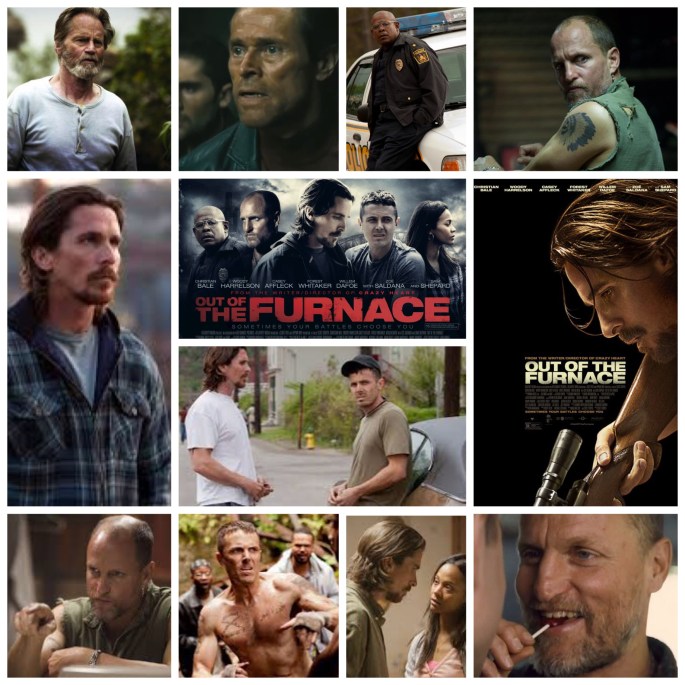
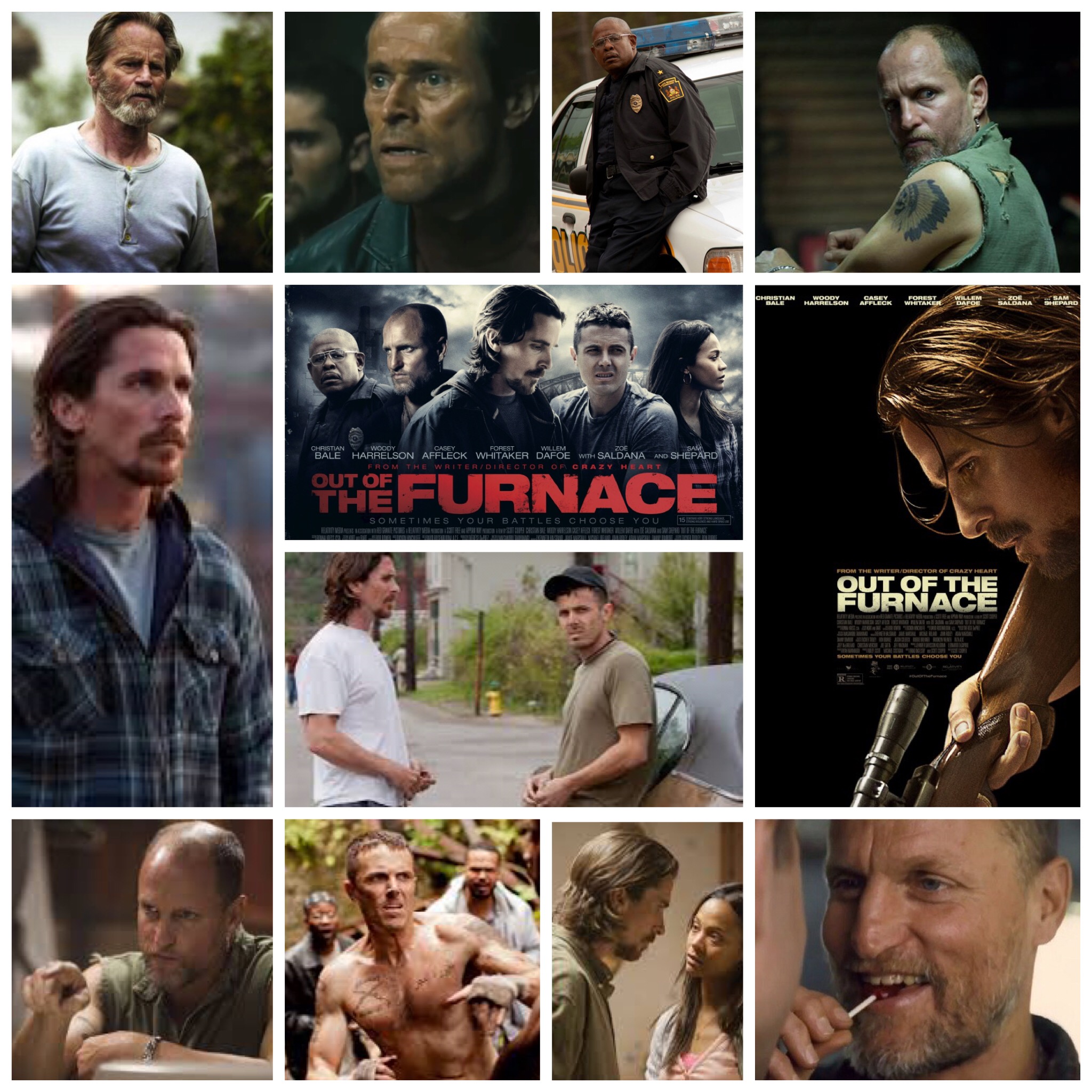
Scott Cooper’s Out Of The Furnace 


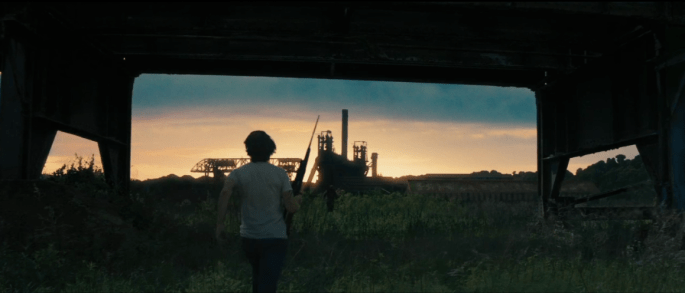
While not quite in the pantheon of powerhouse that the filmmakers intended it to be, Scott Cooper’s Out Of The Furnace is still a bleak, devastating picture. This is a film about endings, and not resolute, satisfactory ones either. Set in a borderline derelict mining town somewhere in the rust belt, industry has come to a grinding halt, giving way to the inevitable rise of rural crime, spreading like a cancer across land that once flourished and prospered. Every character in the film meets their bitter end somehow, and what’s fascinating is that earlier in life they all could have been more whole, and come from some other, brighter genre film, but the lives they’ve led set them on the same course as their county, and one by one we see them reach the last bend in the road, and the light in their life unceremoniously flicker out, leaving a cold shell. If I’m making this sound depressing, I’m doing my job well. This is a soul crushing film, with no light at either end of the tunnel and all glimmers of hope already extinguished before the opening titles even show up, so just make sure you have Finding Nemo or Wallace & Gromit queued up next in line if you give it a go. Opening with a prologue that leaves a bad taste in your mouth, you know right off the bat what you’re in for, as we’re introduced to Woody Harrelson’s Harlan Groat, an absolute monster who runs everything from underground fight clubs to an intricate web of meth trade in the region. Groat is at odds with steelworker Russell Baze (An implosive Christian Bale), a hard man with anger issues just looking for an excuse to get fired up. Russell’s brother Rodney (Casey Affleck in the film’s best work) is a broken Iraqi war vet who got on the wrong side of Groat’s gang, and has since disappeared. Since the law won’t venture into the near mythic backwood hills where Groat skulks, Baze goes vigilante, waging personal war and raging against a light that has long since gone dead. This is a big cast we’re looking at here, and some of the subplots either distract from the main show or just seem like overkill, like Zoe Zaldana as Russell’s ex who has since shacked up with the local Sheriff (Forest Whitaker), or an underused Sam Shepherd as his uncle Red. Willem Dafoe has a nice bit as a seedy but sympathetic local gangster though, it’s always nice to see him, as well as Tom Bower as the salt of the earth bartender. It’s all about Woody and the danger he brings, he’s terrifying in the most mundane of exchanges, and lethal when he gets worked up. The feeling of economic decay follows him like a noxious cloud, his brittle ruthlessness a mascot for the hard times that many a town in the US has fallen on in recent years. One need only look at the poster to see the obvious and intentional shades of Michael Cimino’s The Deer Hunter, and though the film wears its influences on its heavy flannel sleeve, it finds its own dark, despairing poetry, and leaves you gutted in the final, anticlimactic frame. 

-Nate Hill
“You got a problem with me?” – A review of Out Of The Furnace by Josh Hains

Scott Cooper’s sophomore film Out Of The Furnace follows Russell Baze (Christian Bale) through the empty, broken down streets of Braddock Pennsylvania like a lonesome ghost. He works in the local steel mill where his slowly dying father once worked, using what little money he makes to pay off his brother Rodney Jr.’s (Casey Affleck) gambling debts to sleazy local bookie John Petty (Willem Dafoe), all the while trying to maintain a relationship with his girlfriend Lena Taylor (Zoe Saldana). That all comes crashing down when Russell gets into trouble with the law and spends the next four years in prison, getting periodic visits from Rodney with updates on the state of their father’s health, Lena, and Rodney’s own exploits overseas in Iraq. Both men are broken and trying to keep it together for the sake of each other.

In due time Russell is released back into Braddock, the once thriving city on the verge of death with the mill soon to be closed. Things are different now for Russell, the times have changed, people have changed, and he has no other choice but to suck it up and trudge forward into the unforeseeable future. Rodney has picked up a deadly new habit, bare knuckle boxing, his way of violently paying off his debts to Petty before the stack gets too high. Russell tries talking him into a “normal” job to no avail; after multiple horrific tours of duty in Iraq, Rodney has been left shaken, twitchy, and is a mere shell of the man he once was. All that seems to be left is violence, anger, and undying love for Russell. Rodney begs John Petty to get him into bigger fights in backwoods New Jersey, dirtier, bloodier fights held under the watchful eye of local sociopathic hillbilly Harlan DeGroat (Woody Harrelson).

By this point in a standard issue revenge thriller, Rodney would have been long dead, but Cooper wisely makes the decision to give us time to settle into this world, and come to understand characters who feel like people, and not just cardboard cut outs. That the latter half of the movie devolves somewhat predictably into the same kind of movie it was previously avoiding replication of, is a disappointment. However, what does occur is given room to breathe. Cooper might be following the tropes of the genre, but he at least has the sense to let it unfold slowly and organically. Very little feels forced.

Things quickly turn ugly for Rodney and Petty, and when both go missing, the local law led by sheriff Wesley Barnes, exhausts all possible means in an attempt to find the pair, but can only go far because law enforcement lives in fear of DeGroat’s brutal reign of the area, and the fact that it’s outside of Braddock police’s jurisdiction doesn’t help matters either. So Russell and his uncle Red (Sam Shepard) cautiously take matters into their own hands the only way they know how.

Christian Bale delivers his most believable performance to date, fully embodying the heart and soul of Russell Baze, right down to the slightest nuances and subtleties of the man. He’s a truly masterful actor, strutting his stuff in such low-key fashion that because of the deep naturalism, rawness, and intense realism he imbues, within the first few minutes it stops feeling like a performance. It becomes, real, as Russell battles his inner demons and carries the weight of the world on his lean shoulders right up until the final frames fade to black.

Woody Harrelson knocks it out of the ball park as Jersey backwoods hillbilly sociopath Harlan DeGroat, topping his wildly over-the-top performance as Mickey in Oliver Stone’s Natural Born Killers. If you thought Mickey was a bad dude, wait until you watch DeGroat force a hot dog down the throat of a woman at a drive-in movie theatre in the films unnerving opening sequence. Harrelson has an uncanny ability of inhabiting even the most repulsive of villains with some semblance of humanity, and toward the end of the film does so with nothing more than an all-knowing expression upon his face and burning in his eyes as he delivers a couple heartfelt lines.

With this performance, Casey Affleck shed the boyish light his previous performances have always been garnished with, trading it in for a toned body and volatile outbursts of pent-up rage. He gives the more energetic performance of the two brothers, effortlessly capturing Rodney’s broken down mannerisms. Forest Whitaker, Willem Dafoe, Zoe Saldana, and Sam Shepard each provide the right amount of nuance and naturalism to their perfomances that blend evenly with their bleak surroundings and the trio of astounding lead performances.

In a scene near the midsection of the film, Russell and Lena have a conversation on a bridge about their future after Russell has been released from prison. Despite Russell’s plea to make things right between them, Lena cannot commit to him anymore because she’s carrying Barnes’ child. In a moment that ought to shatter even the hardest of hearts into a million pieces, Russell congratulates Lena, assuring her she’ll be a good mom amidst tears from both of them. This scene assuredly carries the finest moments of acting we’ve seen from Bale and Saldana to date. 

The cinematography by Masanobu Takayanagi (The Grey) is impeccable, capturing beautifully and quite often starkly, the dreary and dirty grit of Braddock, the crispness of the violence, the cold bitterness of the dialogue dripping from the tongue of the people inhabiting the film. Scott Cooper directs this film with ease, honestly and authentically capturing the bleak essence of the dying town, the harsh realities of the effects the economy is having on the people, and the brutality that is the violence that twists their worlds upside down in the blink of an eye.


The Big White: A Review by Nate Hill 

Snowbound location. Pitch black comedy. A corpse that’s central to the plot. The Big White was obviously influenced by Fargo, the Pulp Fiction of wintry crime comedies, but holds its own fairly well thanks to solid acting and writing. It’s nothing new or incredible, but it’ll get you your perversely humerous noir fix, and who can say no to Robin Williams, playing a pitiable travel agent who spies a risky way to end his financial problems. Discovering a frozen corpse, he has the brilliant idea to pass it off as his deceased brother and collect the insurance money. A few problems lie ahead: a dogged insurance investigator (Giovanni Ribisi), two moronic hitmen (Tim Blake Nelson & W. Earl Brown) and the small detail that his brother isn’t actually dead, and comes waltzing back into his life in the form of a rampaging, unstable Woody Harrelson. William’s spitfire wife (Holly Hunter) looks on in exasperation as her husband turns their lives into disaster, while everyone is somewhat clueless and misinformed, leading to great amounts of hilarity. Sound chaotic? It is, sort of. It’s also kinda laid back and deadpan enough to make the Coen brothers proud. Harrelson and Williams both bring their very different brands of manic, Williams I’m a forlorn desperate sense, and Harrelson  just the unhinged wildcard. Alison Lohman is also running about, but it’s been so long since I saw it I can’t remember exactly who she plays. Fans of Fargo will be tickled, those with a weird sense of humour as well. Fun stuff. 

THE WALKER – A REVIEW BY J.D. LAFRANCE

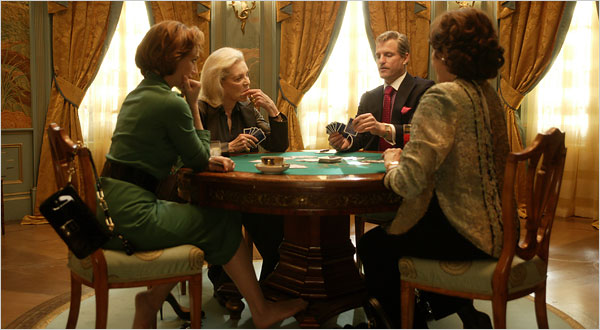
07walker-600

After dabbling briefly with a major studio with Dominion: Prequel to the Exorcist (2005), writer/director Paul Schrader returned to the relatively safe confines of the independent film scene with The Walker (2007). This film continued his fascination with loner protagonists ostracized by their profession as examined in American Gigolo (1980) and Light Sleeper (1992), or by their worldview as in Taxi Driver (1976).

Carter Page III (Woody Harrelson) is a popular socialite who works as a confidant, companion, and card player to the wives of politicians in Washington, D.C. – a professional “walker,” a term coined for Nancy Reagan’s companion when she was First Lady. Carter is the epitome of the Southern gentleman. He plays a weekly card game with three women as they gossip and tell stories complete with salacious details about the denizens of Capitol Hill. Carter is finely groomed and impeccably dressed with only the finest suits, living in a beautifully furnished place.

With the stories Carter tells his dates, he hints at a rich backstory but he is careful not to reveal too much about himself. While waiting for Lynn Lockner (Kristin Scott Thomas), one of his dates, to meet up with her lover, she comes back in shock. Her lover is dead and she asks Carter to keep the incident quiet. Of course, he decides to get involved (he knew the victim). Carter used to trade in juicy gossip and now he has become the subject of it. It doesn’t help that he lost considerable money on an investment that the victim advised and this gives the socialite a motive. As a result, he decides to investigate the murder using his own insider contacts and uncover a few dirty secrets that people in positions of power don’t want revealed. His efforts to clear his name become more urgent once the Feds apply pressure thanks to a particular nasty agent (William Hope). Pretty soon, events conspire against him and Carter becomes the prime suspect.

Woody Harrelson disappears into the role affecting a flawless accent and does an excellent job with Schrader’s witty dialogue and distinctive cadence. Every few years between amiable comedies Harrelson gets a juicy dramatic role to sink his teeth into and showcase his acting chops: Natural Born Killers (1994), The People vs. Larry Flynt (1996), and now this film. Schrader’s screenplay, as you would expect, snaps and pops, especially the scenes where Carter and his companions banter and gossip. It doesn’t hurt that he has the likes of Lauren Bacall, Lily Tomlin, and Kristin Scott Thomas delivering it. The Walker is a fascinating inside look at a subculture that exists in Washington, D.C. under the auspices of a murder mystery. It shows to what lengths politicians will go in order to protect themselves and their dirty secrets. Schrader has crafted a smart thriller with interesting characters that is driven by a well-plotted story and not a bunch of noisy, hastily edited action sequences.

SEMI-PRO – A REVIEW BY J.D. LAFRANCE

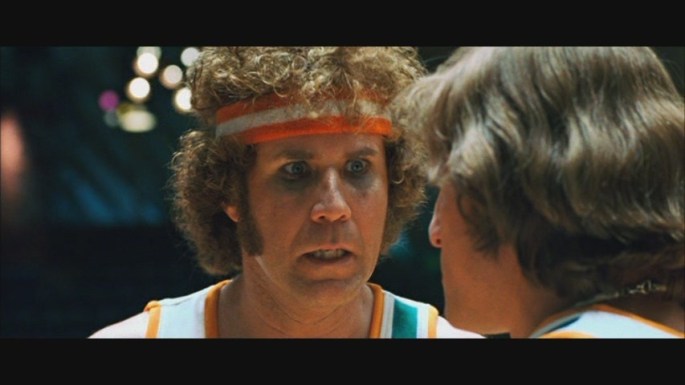
Will-Ferrell-in-Semi-Pro-will-ferrell-11769585-853-480

Semi-Pro (2008) proved that Will Ferrell is no longer bulletproof at the box office. The film was not well-received by the critics (nothing new for Ferrell) but failed to connect with his fans like Anchorman: The Legend of Ron Burgundy (2004) and Talladega Nights: The Ballad or Ricky Bobby (2006) did. On paper, Semi-Pro must’ve seemed like a sure-fire hit: mix the dumb guy humor from Anchorman with the underdog sports team of misfits from Slap Shot (1977) and sprinkle all sorts of popular culture references from the 1970s. So what went wrong?

Jackie Moon (Ferrell) is the ever-confident, terminally clueless owner, head coach, and star player (if you can call him that) of the Flint Tropics, an ABA basketball team that might be dissolved when the league merges with the NBA. Only the four best teams will make the cut, which is not good news for Jackie’s team. They are awful, averaging an attendance record of 91 people a game. The lone exception on the team is Clarence “Downtown” Malone (Andre Benjamin) who actually has a shot at making it to the NBA. The Tropics are so bad that one of the local commentators reads the Classifieds section of the newspaper during one game.

In order to improve the team’s chances, Jackie trades their washing machine for Ed Monix (Woody Harrelson), a physical player not above punching out his opponents. The Tropics certainly have their work cut out for them. Not only do they have to start winning on a regular basis but they also have to average 2,000 people every home game. So, Jackie thinks up all kinds of hair-brained schemes to fill seats, including jumping the team’s cheerleaders on roller-skates and wrestling a grizzly bear.

For the first half of Semi-Pro, the comedic beats, or rhythm, is just not there. At the very least, it is inconsistent. Many jokes fall flat and are just not funny. The two color commentators Lou Redwood (Will Arnett) and Dick Pepperfield (Andrew Daly) steal every scene that they are in with their raunchy repartee (much like Jason Bateman and Gary Cole did in Dodgeball: A True Underdog Story). Then, a funny thing happens in the second half. The film actually gets better. There are a few serious moments, mostly dealing with Monix and his ex-girlfriend (Maura Tierney), and once the Tropics get their act together, the film picks up momentum.

Will Ferrell plays the same type of character we’ve seen in countless films – the clueless confident guy with a touch of arrogance. To be fair, he’s got it down to a science now, but it is getting a tad predictable. One gets the feeling that Ferrell is trying to recapture the magic of Anchorman, complete with the 1970s setting. Unfortunately, Semi-Pro is nowhere near as funny despite an excellent premise. Aside from Will Arnett as his usual snarky self, Woody Harrelson is quite good as a washed-up former NBA player looking for redemption and hoping to rekindle his relationship with an ex-flame.

Semi-Pro isn’t a total train-wreck by any stretch and it does have its genuine moments of hilarity but doesn’t quite deliver as well and as often as it should. If you can make it through the first half of the film, where the filmmakers struggle to find the right mix of humor and drama, you’ll be rewarded for a much more satisfying second half that pays off your patience for sticking it out.

The Hunger Games: A Review by Nate Hill

image

I have never read the Hunger Games books, and didn’t rush out to see this first installment when it was released. I have this thing where I sometimes resist a largely popular project simply because it’s buxzingwith so much hype. There’s a word for that that I resist even more, which starts with H, but good luck getting me to admit to that. Anywho, I did watch it one day on netflix, loved the hell out of it, and have seen every subsequent entry, up til last year’s final one. It’s damn great storytelling that soars on a brilliant extended performance by Jennifer Lawrence, who is the actress of her generation and a genius of the craft no matter what anyone says. People called this a slick version of Battle Royale, and while that may be true, it’s certainly not a bad thing, and not the sole extent of what the franchise achieves. There’s stinging social commentary which both condemns and makes satirical light of modern North American culture. It examines the power of propoganda for both good and bad ends. It looks at the abuse of power, and the potent rise of fascism and fear tactics, and how quickly they can become commonplace. And this is all in a young adult orientated film that stars a strong, unhindered female protagonist. Gives you hope for the world. Lawrence is powerful as Katniss Everdeen, a young woman chosen from her district to compete in the much celebrated and very violent Hunger Games, a death tournament which serves as a purge and reminder to the citizens what it cost them to rebel against their oppressors years before. This is all at the behest of mega villain President Snow (Donald Sutherland oozes quiet malice with every articulate and icy syllable), who lives in the wealthy and decadent capitol city of Panem, a dystopian version of North America. Along with Katniss there’s also Peeta  (but no hummus) a local baker’s boy played by Josh Hutcherson, who really struggles to match the skill level of almost everyone around him, especially Lawrence. They are thrust into the posh and stylized razzle dazzle of Capitol life as they train for the ruthless games, watched over by previous Victor and proud alcoholic Haymitch Abernathy (Woody Harrelson), as well as preening diva Effie Trinket (Elizabeth Banks channellig Marie Antoinette crossed with a poodle). The film takes some time to ramp up to the games, but as soon as it does the events unfold in breathless fashion set against a lush wilderness background, each and every member fighting tooth and nail to stay alive against both each other and the obstacles which gamesmasters have placed in their way. Anyone with an intense fear of wasps will want to be warned. A clever riff on the talk shows of our climate is shown, as the competitors are quizzed by Ceasar Flickerman (Stanley Tucci) a manically hopped up pop personality with a hairstyle that would make a samurai jealous and teeth so white they get accused of stealing oscar nominations. Tucci is truly a well of energy and the proceedings go electric whenever he’s around. Watch for Paula Malcolmson, Liam Hemsworth, Wes Bentley, Toby Jones and Lenny Kravitz as Cinna, a kindly fashion guru who takes a shine to Katniss and designs her a dress to end all dresses. Lawrence carries the entire thing on her mockingjay wings, making Katniss a spirit of unrest, a true symbol of hope and above all, a scared girl tossed into events she can’t possibly imagine navigating. Her performance is most of what makes these films so solid, and they couldn’t have made a better casting choice. Be sure to stay fpr the credits to hear ‘Abraham’s Daughter’, a fittingly grandiose original song by Arcade Fire.

John Hillcoat’s Triple 9: A review by Nate Hill

John Hillcoat’s Triple 9. Bloody. Nasty. Blistering. Nihilistic. And surprisingly deft in its presentation of character. The only clear cut, out and out protagonist is Casey Affleck’s Marcus Allen, a young detective with a wife and kid, brutally unaware that he’s been targeted by a group of stunningly dirty cops and a few ex special forces hardcases to bite the dust in a planned homicide, sparking an ‘officer down’ over the airwaves to distract the force from what’s really going down. With the exception of his straight arrow heroics, the entire rest of the cast is a snake pit of depraved, slimy, reprehensible degenerates, populating a decayed, gang infested Atlanta where the cops are just as likely to empty a clip into your skull as the cholos. Chiwetel Efjor plays Atwood, leader of a most unfortunate crew of misfits who are forced to perform near suicidal heists for tyrannical Israeli-Russian mafia bitch Irena (a bleach blond, terrifying Kate Winslet). Their newest venture is so impossible that they’re attempting to use a slain officer as a ditch effort to get their stake. Of course it all goes to high hell, as we’ve come to expect and love in these type of films, with bullets, profanity, self destructive behaviour and wanton violence languishing all over the screen in glorious excess. Efjor is crackling good, showing brief glimpses of humanity in a dude who has lost his soul down a deep dark well, a caged animal fighting tooth and nail to no avail. The rest of his crew spend the film savagely trying to out – sleaze each other, and I mean that in the best way possible. They are really a bunch of snot rags, and this is a group of outstanding actors having bushels of fun being irredeemable bad boys. Anthony Mackie is walking C-4 as Efjor’s right hand, a guy rotten to the marrow with moral conflict. Norman Reedus leaks grease as an ex special ops prick and their getaway driver. I didn’t think Aaron Paul could be anymore despicable than in breaking bad, but somehow manages it here, playing a dude so grungy you’ll squirm. It’s Clifton Collins Jr. who scores the points though. He hasn’t had a great role in years and he comes out blazing as the icy sociopath of the group. Then there’s Woody Harrelson. Oh, Woody. He’s clearly having a ball as Affleck’s stoner uncle and high ranking cop. He spends the entire film ripped off his gourd on joint after joint, and take it from me, he knows how to play stoned impeccably. Despite the laconic bumbling, he shows that fire and ferocity we’ve come to know from him in brief unmistakable flashes, especially where it matters. Throw in Teresa Palmer as Affleck’s loving wife and Gal Gadot in full slut mode and you’ve got a cast for the time capsule. Hillcoat wastes not a second in propelling his narrative forward with the force of a bulldozer, giving us minute moments of respite amongst the surging monsoon of bloodshed and dirty deeds. Composer Atticus Ross whips up a foreboding, hair raising war cry of a score that kicks in from the first frame and doesn’t quit till the last shell casing has hit the ground. The only misstep the film makes is killing off its best actor way too early on, vut its not enough to be an actual concern or hurt it overall. If sickeningly satisfying ballets of blood, broken limbs and morally bankrupt people engaging in all kinds of giddily fun criminal activities are your thing, this is a great way to kick off the year, cinematically speaking. Hell even if it’s not your thing go check it out. It’ll shake your shit up and then some.

STEPHEN FREARS’ THE HI-LO COUNTRY — A REVIEW BY NICK CLEMENT

2The Hi-Lo Country is a very unique film, totally under the radar (where’s the Blu-ray?!), made with supreme skill and confidence by an eclectic group of collaborators, and anchored by two fantastic performances by Woody Harrelson and the eternally undervalued Billy Crudup. Set in post-WWII New Mexico, it’s a cowboy film, it’s a Western, it’s a family drama, it’s a romance, and there are more than a few grace notes contained in Walon Green’s poetic screenplay (based on the novel by Max Evans) which provides a lyrical sense of love and sweep for the time period and dusty locations. Directed with a classical sense of proportion and clear-eyed dramatics by the gifted British director Stephen Frears, the film also boasts Martin Scorsese as a “Presenter,” further adding to the name-brand quality of the filmmaking team. The stellar supporting cast includes Patricia Arquette as the woman who falls in love with both of the leads, a crusty Sam Elliot as the chief antagonist who feels right at home in this material, a baby-faced Penelope Cruz in one of her first English-language feature films, and the distinctive actor Cole Hauser in an early (and possibly best) performance as a sketchy acquaintance of both Harrelson and Crudup. Carter Burwell’s familiar orchestral notes lend an interesting aural texture to the film, with Oliver Stapleton’s honeyed and golden widescreen cinematography made excellent use of the vistas and endless desert and open-plain landscape. The film was barely released back in late 1998 (it grossed $166,000!), and curiously, critical reception was more mixed than might have been expected. But over the years, it’s been a film that’s always enticed me back for revisits; there’s just something so different and offbeat about this movie, which while trading off of expected conventions (both visually and narratively), feels like few other modern genre pieces that I can think of. This film is the very definition of a small gem, a work that’s begging to be re-discovered by a more appreciative audience.

11