Man Down 


I’ll say this right off the bat: do not watch Man Down if you’re already in a mood, because it will emotionally lay you the fuck out. I learned that the hard way the other night. Billed as a war film, marketed as such and discreetly snuck onto iTunes without so much as a hint of theatrical release, its easy to see why they’ve tried to bury this one, it’s the bleakest film I’ve seen so far this year, and possibly the previous one. If there’s any doubt still surrounding Shia Labeouf’s acting talent (there shouldn’t be at this point), his work here should solidify greatness. All publicity antics and oddball muckery aside, he’s proven time and again that he’s one hell of a performer, and this is the best work he’s ever done, by a long shot. As Afghan war vet Gabriel Drummer, he’s put through an emotional wringer, sent back to an America ravaged by some vague pandemic, on a hopeless mission to locate his wife (Kate Mara) and young son (Charlie Shotwell). Joined by his best friend and fellow soldier Devin (Jai Courtney), Gabriel’s mission seems hazy and desperate, his family always just out of reach, tormented by the psychological wounds of combat but determined not to give up. This is interspersed with an extended dialogue scene between him and General Peyton (Gary Oldman, restrained, patient and careful), in which he heartbreakingly opens up about the horrors he has seen. This is where Labeouf shines, his tears uncannily genuine, his work visibly shaking up Oldman and tearing at the edges of the screen in it’s implosive intensity. Trust me, this is not the film you are expecting, not even close. By the time the third act rolls around and you see what’s really going on, you’re emotionally sucker punched when least expecting it, and the film’s quiet, devastating anti-war message is hit home with the force of a sledgehammer. I can’t say too much more without ruining it, but it’s one of the most thoughtful, understanding war films I’ve seen, one that gets the reality of what it’s like to have seen such atrocities, and come out of it a different person. Strong, stinging stuff that takes a while to shake off. 

-Nate Hill

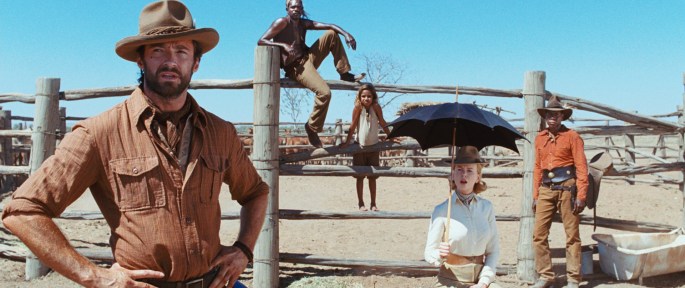
Jackman Unleashed Week: Baz Luhrmann’s Australia

2008_australia_hugh_jackman

By J.D. Lafrance

After his debut film Strictly Ballroom (1992), writer/director Baz Luhrmann never looked back, creating lavish, ultra-stylish musicals William Shakespeare’s Romeo + Juliet (1996) and Moulin Rouge! (2001), and let’s not forget that $5 million Chanel commercial starring his cinematic muse, Nicole Kidman. With, Australia (2008), he decided to take national pride to a whole new level by creating a sweeping romantic epic about his home country that takes place between the World Wars and was made by and starring Australians. With a budget in the neighborhood of $130 million, the pressure was on Luhrmann now more than ever before to deliver at the box office and, while underperforming in North America, it went on to gross $200 million worldwide despite a lukewarm critical response.

Lady Sarah Ashley (Kidman) is a headstrong English aristocrat who travels to Northern Australia in 1939 to meet her husband at their ranch Faraway Downs. Within a few minutes of arriving, she meets her guide to this strange new land, a man known as the Drover (Hugh Jackman), a hard-drinking, two-fisted Australian version of a cowboy. They take an instant dislike to each other: she thinks that he’s crude and uncultured and he thinks that she’s too prim and proper.

They arrive at Faraway Downs to find her husband dead (apparently at the hands of an Aboriginal) and the ranch in disarray and in danger of being foreclosed. Mr. Carney (Bryan Brown), the local tycoon with a monopoly on the local economy, has his right-hand man, Mr. Fletcher (David Wenham) try to sabotage Lady Ashley. In order to save Faraway Downs, she has to drive 1,500 head of cattle to Darwin and so she enlists the help of the Drover. Along the way, they befriend a young Aboriginal boy named Nullah (Brandon Walters) whom she protects from being taken away and forced to assimilate with white folks.

As with his previous films, Luhrmann populates Australia with broad, stereotypical characters and tells a classic story. The film revels in archetypes: Ashley is a pure, upstanding woman, the Drover is the rugged western hero, Fletcher is the dastardly villain, and Nullah is the adorable child who narrates the story. As he proved with is previous films, Luhrmann has an uncanny knack for casting. Who can forget the undeniable chemistry between Leonardo DiCaprio and Claire Danes in Romeo + Juliet and the sparks that flew between Ewan McGregor and Nicole Kidman in Moulin Rouge!? He’s at it again with this film with the casting of Hugh Jackman and Kidman as the romantic leads.

Jackman finally fulfills those early comparisons to Clint Eastwood, playing the Drover as a tough, dependable hero who’s not afraid to show his vulnerable side. He’s never been more charismatic as he proves to be equally adept at the physical demands and the emotional range that the role requires. No one knows how to photograph Kidman quite like Luhrmann. She looks stunning, even covered in a layer of dirt and dust from a cattle drive. At first, her stuffy English aristocrat comes off as a cartoonish stereotype but as her character becomes acclimatized to the country and she develops a bond with Nullah, she becomes warmer and more empathetic.

Beginning in 1939 and climaxing with the Japanese bombing of Darwin in 1942, Luhrmann’s Australia mixes the larger-than-life melodrama of Gone with the Wind (1939) with the exciting cattle drive in Red River (1948) and with a dash of The Wizard of Oz (1939). His film clearly harkens back to the kind of cinema that they just don’t make any more with very little CGI used and everything built from scratch and on location. Australia is the kind of ambitious Technicolor epic that might have been made by John Ford or George Stevens. It is a marvel of absolutely stunning cinematography – only Luhrmann could make the desolate outback look vibrant and alive. He alternates between sun-drenched day scenes and night scenes that appear to be impossibly illuminated by the stars.

One should not go into Australia expecting realism. Luhrmann presents a mythologized take on his country. Love him or hate him, you have to respect Luhrmann for not being afraid to wear his heart on his sleeve. He’s arguably the most romantic filmmaker working today with the possible exception of Wong Kar-Wai. And with Australia, he has made an unabashed love letter to his homeland on a grand scale.

Kong: Skull Island

Kong-Skull-island-700x300

Remakes and monster movies continue to be reviled in many corners of the filmgoing public, which is surprising considering both are practically as old as the form itself.  King Kong debuted on the silver screen not long after silver screens themselves took their initial bow, so the royal title remains apt to this day.  The creature’s climb up the Empire State Building remains iconic, not only for the audacity of the image but the promise of the fantastic that cinema itself offered newly minted movie fans—the very idea that walking into a theater would take you away from reality and show you things you’d never see anywhere else.  Clearly the great ape was built to last, as he’s turned up in one form or another over the years, most recently in Peter Jackson’s 2005 laborious love letter to the original.  Fast forward 12 years and Time Warner, fresh off the relatively successful Godzilla reboot, is looking to craft its own interconnected series of blockbuster films just like all the other remaining major studios, hence Kong: Skull Island is set to be released (somewhat tentatively in March instead of tent pole-y in May).  Is it a successful undertaking?  The short answer is yes and no, and a somewhat longer answer follows.

First of all, you’re not going to get the coy buildup towards monster mayhem that Gareth Edwards’ Godzilla offered, although you do get a credit sequence similar enough to that films’ that you’ll pick up on the universe building intentions right off the bat.  Once Kong arrives, he’s in full view and he’s rampaging just the way you want him to, smacking down uninvited guests on the titular island and throwing down with its fellow oversized inhabitants on the regular.  This all commences after fifteen minutes of highly perfunctory character introduction and motivation establishment.  At times the dialogue and reasoning feels like it’s being generated by a scripting software app, but at least Kong: Skull Island assembles a relentlessly charming cast, from handsome Tom Hiddlesworth to Oscar winner Brie Larson to affable John Goodman and badass Samuel L. Jackson.  A lesser group would have probably sunk the proceedings, as several of them—especially the purported leads, Hiddlesworth and Larson—are so underwritten it’s safe to say the film could have marched through its explosions without their presence.  Fortunately Goodman and Jackson are given a bit more to do, the former harboring a belief in the fantastic that’s not explained right off the bat and the latter adopting the warmongering swagger of Duvall’s Colonel Kilgore by way of Melville’s Captain Ahab.  They each have what the film comes closest to offering as far as character arcs go, and Jackson especially stands out.  The best story and performance hiding in between the flying bullets and crashing helicopters belongs to John C. Reilly, a punchy World War 2 veteran looking to return to civilization with our band of heroes.  He gets the strongest lines from a script that struggles to find any rhythm outside of the genre tropes we all expect.

On the plus side, Kong and his monstrous neighbors are lovingly (and of course digitally) rendered, and Larry Fong’s camera guides us around location sets ranging from Hawaii to northern Vietnam with grace and awe.  Once director Jordan Vogt-Roberts (an interesting choice given the indie film and television comedy background he brings to the table) stumbles through the early expositional scenes, he does a fine job staging the carnage, chases and explosions, of which there are many.  And Kong himself, in keeping with the typical incarnations of the character, really is just a hero in screaming ape’s clothing, there to provide deus ex machina services when the other creatures get too problematic.  There are enough tributes, visual and otherwise, to make fans of the previous films feel right at home on Skull Island as well.  In short, this is a fine action setpiece delivery system if that’s what you’re in the mood for.  A perfectly fine if not transcendent slice of fantastic escapism, with the inevitable promise of more to come if enough tickets are sold.

kong-skull-island-legendary-530x298

Top Five Hugh Jackman Performances

With LOGAN being a gigantic hit at the box office, after seventeen years and seven turns as the Wolverine, Hugh Jackman is done with his most seminal character.  I imagine we’ll see him again, at some point down the road, but time will tell.  Jackman is so much more than the rough and tough Canadian mutant, he’s a wonderfully rounded actor that can mix brute blood lust with musical performances and soul bearing dramatic performances.  While Jackman is just hitting the sweet spot of his career, I wanted to take a look back at his finest performances.


THE FOUNTAIN 2006 Dir. Darron Aronofsky

jackman fountain

This is a film that has accrued such a following over its lackluster release, that one day, this will be looked at as not only one of Aronofsky’s finest films but also one of Jackman’s best performances.  Here, he plays the same soul over a course of three different centuries.  It’s apparent he’s a different man with each new becoming, yet he still is able to remain the same person.  It’s an incredibly heartfelt and touching performance in a film that needs more acclaim.

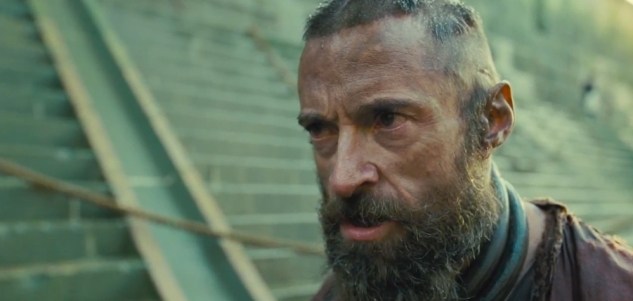
LES MISERABLES 2012 Dir. Tom Hooper

Les-mis-hugh-jackman-2

Hugh Jackman has gone through a bounty of physical transformations playing Wolverine on screen, but nothing like his turn as Jean Valjean in LES MISERABLES.  Here, he embodies a fugitive, for decades, on the brink of the French Revolution – well, I’m pretty sure everyone knows the story.  But here, Jackman is able to pivot back to an area of performing that he loves: musicals.  While the contemporary Hollywood musical comes back in fads, I think this film stands out due in part to the actors are all singing live while being filmed.  This not only enhances their performances but makes them feel honest and organic, particularly Jackman.

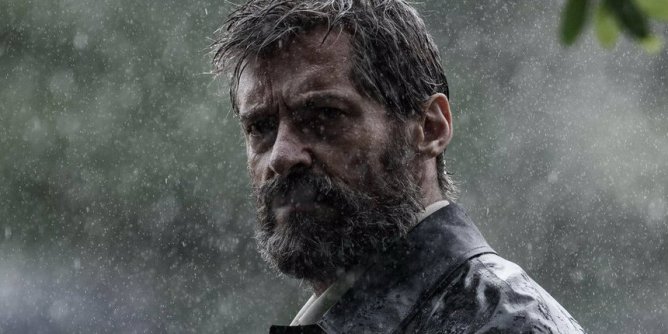
LOGAN 2016 Dir. James Mangold

jackman logan

This is it (maybe).  Jackman in his last turn as Wolverine.  He brings his all to this film, not once coasting in a character he’s played seven times in seventeen years.  Here, Logan is broken, surrendered, and wanting his life to finally be over.  Bravo to Jackman for going all out for this role.  He didn’t have to, and it is incredibly admirable of him to treat this character with such fondness and respect.  While the overwhelming echo chamber of hype is loud, I imagine this is the film that everyone is going to remember Jackman for.

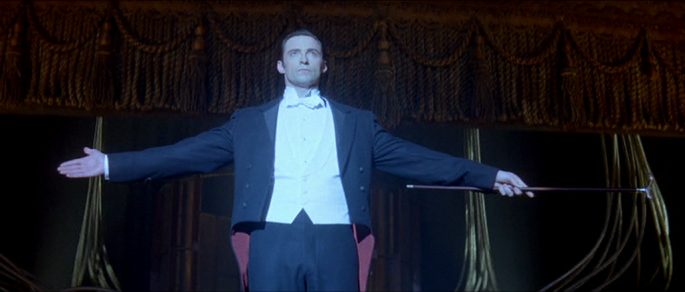
THE PRESTIGE 2006 Dir. Christopher Nolan

jackman prestige

Jackman has an incredible knack for taking all of his affability and rolling into ambiguous characters that are cast in the greyscale of morality.  Here, Jackman’s obsession takes him down a rabbit hole of darkness where he ends up doing things so unforgivable, there is not really much of a shot at redemption, but I suppose that’s the point of this dark and twisted tale of magicians bent on obsession.

PRISONERS 2013 Dir. Denis Villeneuve

jackman prisoners

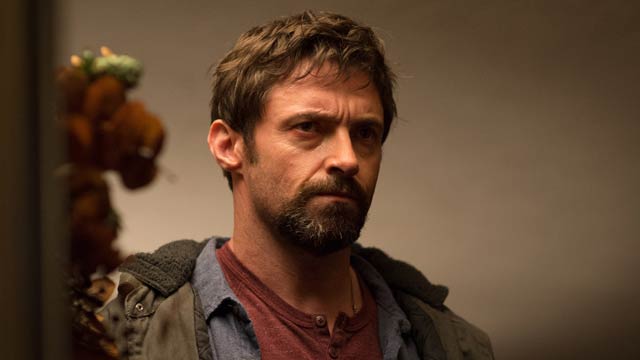
In the role of a grieving father, blinded by revenge and rage, Jackman plays his most complex character.  The brilliance of the film, but in particular, the development of Jackman’s character, is that we’re given clues to who this man in before the events of the film unravels at a rather rapid pace.  While some of the clues are aesthetic choices or shot composition, a majority of them are cued in by subtle actions Jackman takes.  While his character becomes more and more vested in revenge and violence, the path to atonement becomes more and more opaque, and Jackman eventually gets the ambiguous end that he deserves.  Or does he?


JAMES MANGOLD’S LOGAN — A REVIEW BY NICK CLEMENT

3

Depending on your sensibilities, you may agree with how I feel about Logan – this is the most satisfying comic-book/superhero movie since The Dark Knight Rises and EASILY the best movie to have that flashing-image Marvel logo attached to it. It took 17 years, but they finally made an R-rated Wolverine movie, and because of this decidedly different tone and approach, no other cinematic endeavor featuring any of the X-Men can remotely come close to touching it. This film feels as if it was created for adults rather than for children; look elsewhere for spandex outfits and reassuring, jokey humor. I’ve always felt that there’s nothing PG-13 about a mutant with razor blades that pop out of his knuckles when he’s pissed, so considering that director James Mangold got a chance to go balls-out with the character, it would be sort of hard to screw up the potential that this particular premise has to offer. Mangold has long been a solid craftsman with more than a few very strong pictures on his resume (Cop Land is my favorite work that he’s released and I’ve viewed Walk the Line countless times), and after he delivered two-thirds of a good entry back in 2013 with The Wolverine (the final act is really dumb with that mechanical samurai thing), it’s clear he learned from that film’s shortcomings, dialing it back a notch, and making a genre film that is refreshingly free of distracting and needless CGI.

2

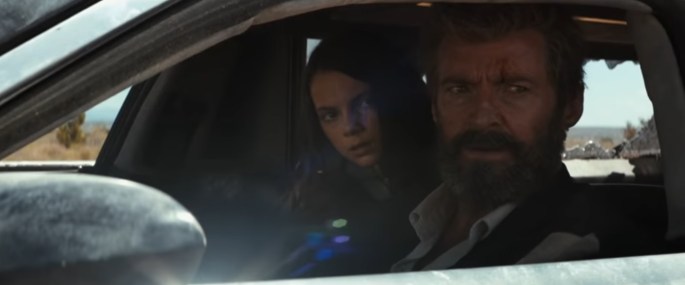
It’s pointless to reiterate the fact that Hugh Jackman is perfectly cast in the lead role; this will be the big-screen character that he’ll always be remembered for. He’s absolutely on fire in Logan, all animalistic fury but with a broken heart as well as a crushed soul; he needs one final shot at redemption. I loved that the film felt like a desolate Western, both visually and thematically, and Dafne Keen was a total scene-stealer as the mutated child, all feral rage and explosive anger to match Jackman’s patented brand of ferocity that he’s always brought to his dual character of Logan/Wolverine. Patrick Stewart is, as usual, terrific as Professor X, and gets some key emotional moments because of the surprisingly thoughtful screenplay. Richard E. Grant smartly underplays the chief baddie role, while Boyd Holbrook is very menacing as one of the main henchmen, with a flawlessly integrated mechanical hand that’s definitely creepy. And under albino make-up, Stephen Merchant is affecting as the link between the two parties, as this is essentially an extended chase scenario, with an ailing Logan and Professor X trying to protect a special girl with a dark history.

2

The screenplay by Mangold, Scott Frank, and Michael Green is literate, witty, and packed with brutal action, with cinematographer James Mathieson doing some beautiful yet low-key work behind the camera. The set=pieces sting with a level of brutality that feels bracing for the gore-free previous outings, which seem downright jokey and lame in comparison. I don’t really care, on the whole, about the comic-book movie genre; to me, these types of movies are fast-food-cinema. They get the job done, and then you’re hungry for something more substantial. But Logan is a different beast in that it DOES feel substantial, like there’s some emotional heft and weight behind it. And the way it subverts your expectations is a crucial reason for its success. The filmmakers present a narrative with true stakes, never spinning out of control and unleashing the dreaded CGI vortex in the sky, keeping the themes intimate so that you actually care about the outcome, while the action is bloody, unrelenting, and consistently savage. As it should be. Free of creative constraints, it’s abundantly clear everyone had a blast with this seemingly final chapter of this particular saga.

1

Marvel has boxed themselves in with Logan; how can one be asked to take their product seriously when they’ve offered a definitive portrait of one of their most iconic characters, doing it the gritty justice that it deserves? The best thing that one might be able to say is that someone has come along and made a superhero film that doesn’t really feel like a superhero movie for nearly the entire runtime. I’m no easy-lay with Marvel product; I’ve skipped or not enjoyed as many as I’ve been able to hang with. My favorite stuff has included the two Captain America films, Iron Man 3, and Ang Lee’s underrated Hulk. But Logan is something all-together different. It doesn’t give a fuck about anything that’s come before it and doesn’t give a fuck if you don’t like it or think that it’s too nihilistic or aggressive. In short, it’s the Wolverine movie we all deserve and I can’t imagine myself feeling inclined to see too many more movies of this type in the future.

1

“I am very sure that’s the man who shot me.”: Zodiac 10 years later – by Josh Hains

The idea of offering up a defence for David Fincher’s Zodiac seems rather silly given that ten years later it’s widely regarded as perhaps Fincher’s greatest film, often revered as one of the finer films released over the past decade. We all know it’s great, though admittedly, I didn’t know that for several years.

I avoided Zodiac like it was coated in radioactive slime until 2014. I had heard a great deal of positive things about the movie, and had been greatly intrigued by the marketing behind it, but the knowledge that not only was it was a long, slow paced movie, but also a rather unsettling one too kept me away for so long. When I did finally give it a chance late September 2014, my mind immediately gravitated toward Google, scouring through page after page of information about the investigation in an attempt to better understand the finer details of the case, and come to my own conclusions about who the Zodiac killer may have been. My gut however, felt like I’d eaten a bad take out meal, disturbed, shaken, and stupidly hungry for more. I felt like how I imagined Robert Graysmith felt all those years ago, minus the fear, paranoia, and impending danger of course.

That David Fincher populated Zodiac with such a great cast is a marking of a great director who knows how to compile actors who will treat the characters as individuals and not just caricatures. I find it intriguing and perhaps even ironic, or merely coincidental, that Jake Gyllenhaal starred in last year’s underrated thriller Nocturnal Animals, given that in Zodiac he is essentially one. His Robert Graysmith is a nocturnal animal, an increasingly gaunt, wide eyed mouse sniffing around for a piece of cheese, in this case the next tangible clue or lead worth obsessively investigating. And it’s all thanks to his unshakeable love for puzzles, a factor that helps decode the first Zodiac letter. As he digs deeper into the case, we come to fear for his safety, in particular during a genuinely white knuckling scene in which the unarmed and unimposing Graysmith ventures into the basement of someone we begin to assume might put an abrupt end to Graysmith’s life.

Before the blockbuster splash that was Iron Man in 2008 thundered into the film scene, one could have argued that Robert Downey Jr.’s performance as the San Francisco Chronicle reporter Paul Avery was the best he’d ever given. An argument can be made that while he was seemingly born to play the billionaire tycoon and saviour of the planet Tony Stark, his best work still resides in the fractured Avery. The deeper the investigation gets the further Avery seems to slip from cool as a cucumber journalist to a paranoid, spineless slob.

Prior to his self induced exile on a houseboat, I got a kick out of the scene where he joins Graysmith (Jake Gyllenhaal) for drinks at a populated watering hole, chugging back those luminous bright blue Aqua Velvas while rambling about the case and their personal lives. There’s a great sense of both humour and humanity in that scene, as Avery lets his guard down and actually engages with someone beyond a superficial relationship, while Graysmith sheds his mouse-like internalized mannerisms in favour of energetic, loud behaviour, though briefly. From this point forward however, Graysmith has a spine, albeit a rather loosely fitting one, and Avery has seemingly lost his, donning “I am not Paul Avery” buttons in the hopes of fending off potential threats. He’d have made a wonderful Doc Sportello.

And of course, there’s San Francisco detective Dave Toschi played with a real sense of respectable authority by Mark Ruffalo. Toschi, an Animal Cracker snacking family man, and the inspiration behind both Steve McQueen’s preferred method of wearing his service revolver in Bullitt, and Dirty Harry’s iconic law breaking detective Harry Callahan, can’t seem to figure out how to put the pieces together in the Zodiac case, understandable in light of the overwhelming amount of contradictory information at hand. Under Fincher’s direction, Ruffalo portrays Toschi as a driven yet logically minded detective. He remains dedicated for years to catching the Zodiac, but lacks the desperation and paranoia Graysmith possesses. Instead, Toschi approaches every aspect of the case with the kind of logical thinking and reasoning every detective should be in possession of, following procedure by the book, and generally doing everything he can to crack the case until the psychological burden becomes far to heavy to bear. You can see how heavy sits in his mind by Ruffalo’s subtle body language in later parts of the movie, and you soon feel sorry for the guy.

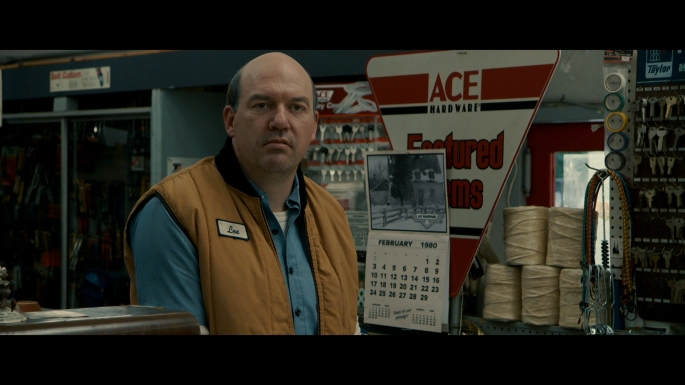
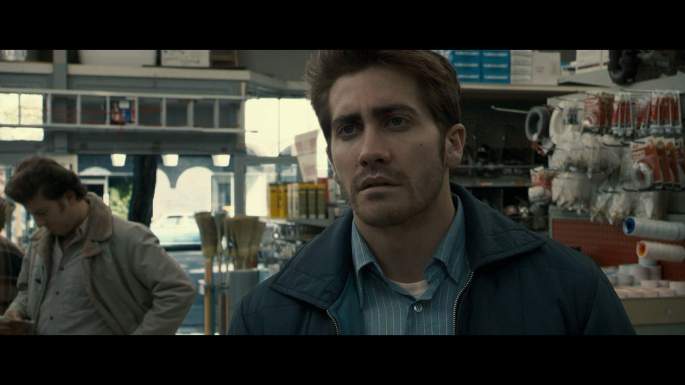
Near the end of the film, Graysmith declares “I need to stand there, I need to look him in the eye and I need to know that it’s him.”, desperate to prove that Arthur Leigh Allen (John Carroll Lynch; perfectly unnerving and subtle) is indeed the cold blooded killer. He gets his wish a short time later when he encounters Allen at an Ace Hardware store in Vallejo where Allen works as a clerk. Allen offers his assistance to Graysmith with a polite “Can I help you?”, Graysmith responds with a “No.”, the two men simply staring at one another until Graysmith leaves, Allen thrown off by Graysmith, and Graysmith appearing much more certain that Allens is the man they’re after. The movie moves forward eight years to when Mike Mageau, survivor of the Zodiac killer at the start of the film, meets with authorities to potentially identify the Zodiac killer, positively identifying Arthur Leigh Allen as the man who shot him and killed Darlene Ferrin. While many had their suspicions and some evidence pointed in his direction, Allen died in 1992 before he could be questioned. Not that he would have confessed anyway.

Admittedly, I have intentionally left out many details and characters, with no disrespect intended, and it should be said that every actor involved in this film, from the leading performances to the smallest of cameos (for exmaple, Ione Skye of Say Anything as Kathleen Johns, a woman who was threatened in her car by the Zodiac killer), give world class performances, some even the best of their careers to date. And the script by James Vanderbilt, based on books by Robert Graysmith, is an achievement of impeccable research and respect for the case. And the cinematography  by the late Harris Savides is bar none the greatest work the man had ever crafted, richly capturing everything with immaculate detail, from the lush valleys of California and its busy, inviting cities and streets, to the Aqua Vera drinks, to beams of red light emanating from police cars. He painted a gorgeous picture for us to gawk at for years to come.

Ten years later, I find it astonishing that Zodiac never truly ends like other movies do. Most movies tie up every loose thread with a ribbon to go with it, others leave room for potential sequels. You can’t end a movie when their is no resolution in reality, forcing a tacked on Hollywood ending wouldn’t sit right with anyone in possession of a brain. You can only leave the audience with the next best thing, the assurance of a living Zodiac victim that the man in the picture they’re pointing to is indeed the man who shot him. That Fincher was bold enough to choose this manner of ending his film shows us he’s a director capable of unsettling viewers long after the film ends, without needing to manipulate his audience or present alternative facts. Zodiac is a bona fide masterpiece, the crime film equivalent to All The President’s Men, and just as good too.
11415612_862880327137375_6688093266983067936_o

Sam Peckinpah’s The Osterman Weekend 


-Nate Hill-
Sam Peckinpah’s The Osterman Weekend is so strangely plotted, so illogical and hard to understand, that not even John Hurt providing a play by play from an ever present tv monitor can seem to make sense of it. It’s not that it’s a bad film, parts are very well done and there’s that nostalgic Cold War vibe that 80’s espionage thrillers always have, it’s just that somewhere along the way, whether in the editing room, the shot list or scheduling, someone quite literally lost the plot. It’s enjoyable, well acted and supplies some of that classic Peckinpah grit he’s known for, but it’s just one massive loose thread that no one bothered to pull taut, which is a shame when you look at the talent involved. The film opens with the murder of a beautiful woman, the wife of a CIA spook (Hurt). Now, this inciting incident is what spurs on the rest of the plot, but the how and the why seem to be missing, and the matter of his wife doesn’t come into play again until all is almost said and done, and seems to have not a lot to do with the entire rest of the film. The bulk of it focuses on controversial talk show host John Tanner (Rutger Hauer), a man who lives to rub people the wrong way and put men of power on the spot with provocative, candid questions, all from the safety of his brightly lit studio. He’s forced to get his hands dirty though when Hurt contacts him, informing him that his three friends he’s planned to spend the weekend with (Craig T. Nelson, Dennis Hopper and a sleazy Chris Sarandon) are in fact soviet spies in hiding. Forced to bug his weekend home and play host to Hurt as he watches them all via hidden cameras, tensions arise as they try to smoke the three out and figure out… something. But what? It’s anyone’s guess what three potential traitors have to do with a murdered agent’s wife, and I’m sure the novel by Robert Ludlum on which this is based covers that a little more pointedly, but this film is just all over the place. It drags where it should glide, and skips hurriedly over scenes with potential to be great. Nevertheless, they achieved some level of class at least, with a crackling on-air conclusion that cathartically weeds out some corruption and provides almost a glimmer of an answer to what’s going on. There’s a fight scene between Nelson and Hauer that’s excellently choreographed, the performances are committed and engaging, and I’m always a sucker for cloak and dagger theatrics. But the thing just can’t seem to cohesively pull itself together and present a story that makes sense. It’s not even that it doesn’t make sense in a Tinker, Tailor, Soldier Spy sense, because I’m sure that if I sat down and watched that film like five times in a row, id get it, it has a plot buried under all of it. This one though, it’s like there’s pieces missing, and the ones that are left are either out of order, or from a different puzzle entirely. Close, but no cigar. 

Predator 2


-Nate Hill-
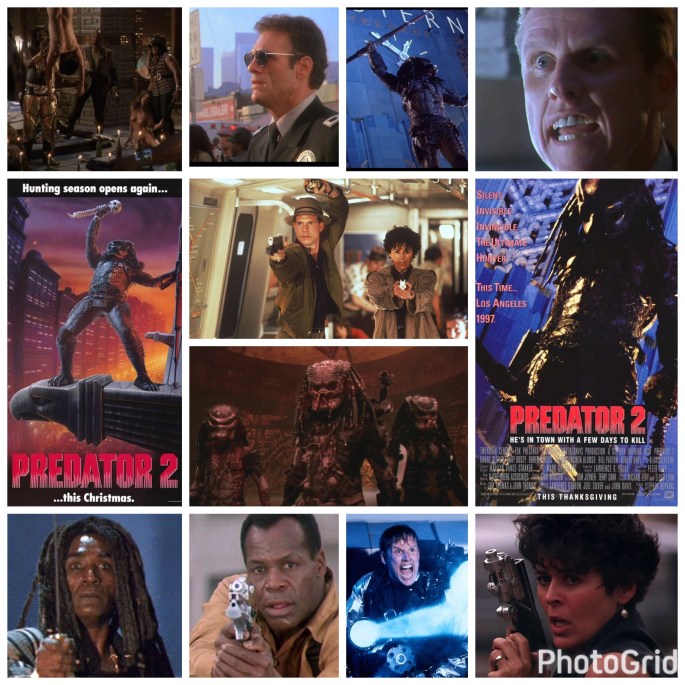
Predator 2 is a gem of a film, and don’t let anyone ever try and convince you otherwise. It’s just so different and so much crazier than the first that I think people had a knee jerk ‘wtf’ reaction and panned it. It’s tough to top the sheer bombastic overdrive of the first one, which is considered a classic, but if anything the sequel switched the nitrous dial past maximum and blasts off into the stratosphere of excessive R rated chaos, an impressive feat. It also switches settings, from the sweaty jungles of South America to the equally sweaty and opulent grime of the urban jungle, namely Los Angeles of the future, bursting at the seams with so many over the top criminals and hectic, delirious violence that by the time the Predators show up they not only fit in, but seem relatively sane compared to everyone else. Seriously, every human character in this film is a coked up tornado of cartoonish energy and brashness it’s hard to keep up unless you’ve hoovered up a few rails yourself prior to sitting down and popping in the blu ray (the blu ray of this is wicked by the way, gorgeous transfer). So get this: Danny Glover, before he got too old for this shit, basically serves as a renegade SuperCop in this hellhole of a metropolis, waging all out war on loads of feral gang members and degenerates, constantly leaned on by the obligatory pain in the ass of a police commissioner (Robert Davi, god bless his republican ass) and backed up by a team of state of the art badasses, including Aliens’s Bill Paxton, who gets all the best lines and delivers them with the gusto the material deserves. He’s also backed by Ruben Blades and tough girl Maria Conchita Alonso, whose appearance and scenes with Paxton call to mind him and Jannette Goldstein side by side in Aliens, or is that just the fanboy in me having an aneurysm? Together they achieve 80’s action movie squad goals by messily wiping out as much of the criminal faction in the city as they can, including weird Rastafarian crime lord King Willie (Calvin Lockhart, spooky as all hell), until something else comes along. Something they can’t see, hear, or easily empty clips at whilst cheerfully spewing profanity. The predators have branched out, and this time there’s more than one, giving their inherent tactical nature a whole new twist. So who better to take on these extraterrestrial game wardens? Glover of course, who positively froths at the mouth. You know you’re overacting when Gary Busey has to keep up with you, and he does his loony best as some hush hush Fed who has been keeping tabs on the Preds for sometime, and has big notions of taking them down. It’s all in good fun, with jaw dropping, spectacularly brutal set pieces, violence that would not go over well these days (the 80’s didn’t give a fuck, man) and a seriously chaotic vibe humming through the whole breathless ordeal. I’d even be so bold as to say that this is the better of the two Predator films, upon getting all misty eyed and craving a rewatch after writing this. Go ahead, shame, me. It’s just too great of a flick to be as under appreciated as it is. Oh, and watch for a sly cameo from another otherworldly baddie late in the third act. 

THE FITS (2016) – A REVIEW BY RYAN MARSHALL

vlcsnap-2017-03-05-12h44m38s177.png

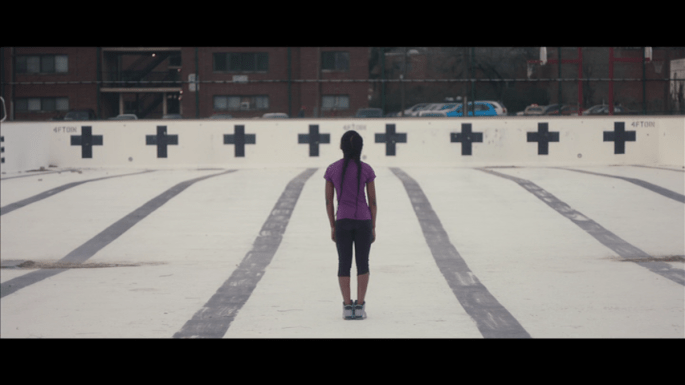
If Anna Rose Holmer is simply testing the waters with her marvelously brooding first feature, then let it be said that she isn’t content to merely leave it at that and swims around a little; and even if the New York native isn’t quite as fearless as her outstanding work would suggest, and it’s likely that she is, she’s quick to conceal it for the entire duration, which is just a few minutes short of seventy.

THE FITS is a bold and totally committed portrait of isolation, maturation, and an inexplicable outbreak of hysterics – all filtered through the curious, abstracted gaze of an eleven year old girl. Tony (Royalty Hightower) exists in what is unmistakably a “man’s world” and yet the temptation of normality is never too far. Day after day, she trains with her brother Jermaine (Da’Sean Minor), a boxer, in their local community center, but a trip down the hall to retrieve a water jug could inevitably lead to a voyeuristic view of the dance team which also functions there.

vlcsnap-2017-03-05-12h42m44s473

What is initially a grim reminder of the character’s introversion is soon turned into an outlet for pent-up frustration and desires alike, until the titular epidemic begins to spread throughout the building’s female population. As one can probably infer, this is certainly a weird one, and one can also imagine it might have been a bit of a tough sell; as much a coming-of-age narrative of remarkable posture and patience as a disturbing psychological horror film that never steps over into discernible genre territory.

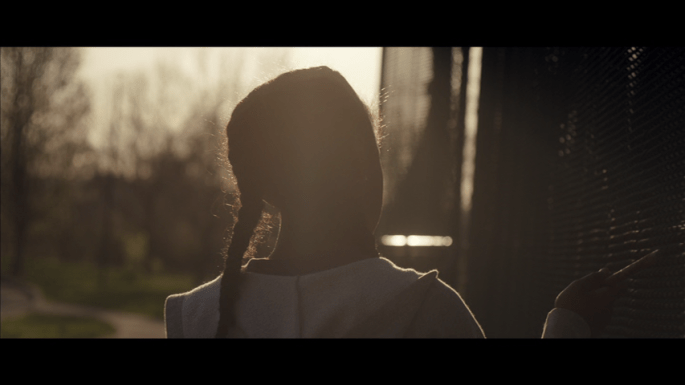
And yet, these prove to be rather attractive qualities in the end. There isn’t a single moment that goes by when we aren’t seeing the events through the eyes of our charming protagonist, never a time when her loneliness and pursuit of social acceptance isn’t felt deep in the gut. Cinematographer Paul Yee’s work here should not go unmentioned, as virtually every frame is packed with pulsating tension, and every hypnotic movement registers as the purest expression of a singular soul. It threatens to alienate through suppression, but so do most films that commit this thoroughly to it.

vlcsnap-2017-03-05-12h45m06s050.png

The film’s potent sense of dread is thankfully complemented by something comparatively sweeter but not so much that the atmosphere loses density as a result. THE FITS has a great deal of merit as a testament to the relationships that young women forge during their formative years, as evidenced when Toni takes a shine to Beezy (Alexis Neblett), a younger dancer. Their friendship is simultaneously a complicated and beautiful one; in other words, it’s entirely believable, no small thanks on the part of the efforts of the cast.

Hightower is an exceptional find, her presence positively demanding your attention with the kind of naturalistic swagger that would suggest a successful career in the cards, further enhanced by the actress’s intrepid gamble with the unfathomable void which surrounds her.  If there’s any price at all that Holmer must pay for such gratifying results, it’s that sometimes her interest in crafting exquisite tonal stagnation occasional gives way to sequences which border on relatively mild tedium. Luckily, this doesn’t speak for the experience on a whole, but in a film that is otherwise so intoxicating, it has the tendency to induce a distinct sinking sensation.

vlcsnap-2017-03-05-12h44m10s918.png

Nevertheless, this is an exhilarating and audacious first-timer, even more poignant afterwards than it is in motion. So much of it – especially that oddly enticing ending, which is certainly more cathartic than downright odd in retrospect  – can seem cold and uninviting, when really it embraces a spectacularly unorthodox existence. Holmer’s decidedly different beast isn’t always the easiest to pin down, unless the rather blunt central metaphor is taken into consideration, but getting anywhere close to doing so works just fine. Simply put, it’s a peculiar pleasure, getting lost in the film’s depressed depths. If Holmer doesn’t have all the right answers, she at least does well to ask all the right questions.

“You got a problem with me?” – A review of Out Of The Furnace by Josh Hains

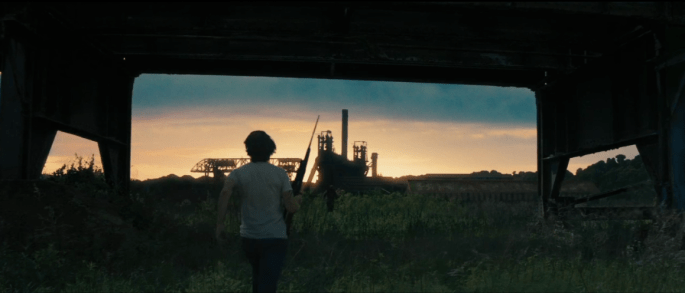
Scott Cooper’s sophomore film Out Of The Furnace follows Russell Baze (Christian Bale) through the empty, broken down streets of Braddock Pennsylvania like a lonesome ghost. He works in the local steel mill where his slowly dying father once worked, using what little money he makes to pay off his brother Rodney Jr.’s (Casey Affleck) gambling debts to sleazy local bookie John Petty (Willem Dafoe), all the while trying to maintain a relationship with his girlfriend Lena Taylor (Zoe Saldana). That all comes crashing down when Russell gets into trouble with the law and spends the next four years in prison, getting periodic visits from Rodney with updates on the state of their father’s health, Lena, and Rodney’s own exploits overseas in Iraq. Both men are broken and trying to keep it together for the sake of each other.

In due time Russell is released back into Braddock, the once thriving city on the verge of death with the mill soon to be closed. Things are different now for Russell, the times have changed, people have changed, and he has no other choice but to suck it up and trudge forward into the unforeseeable future. Rodney has picked up a deadly new habit, bare knuckle boxing, his way of violently paying off his debts to Petty before the stack gets too high. Russell tries talking him into a “normal” job to no avail; after multiple horrific tours of duty in Iraq, Rodney has been left shaken, twitchy, and is a mere shell of the man he once was. All that seems to be left is violence, anger, and undying love for Russell. Rodney begs John Petty to get him into bigger fights in backwoods New Jersey, dirtier, bloodier fights held under the watchful eye of local sociopathic hillbilly Harlan DeGroat (Woody Harrelson).

By this point in a standard issue revenge thriller, Rodney would have been long dead, but Cooper wisely makes the decision to give us time to settle into this world, and come to understand characters who feel like people, and not just cardboard cut outs. That the latter half of the movie devolves somewhat predictably into the same kind of movie it was previously avoiding replication of, is a disappointment. However, what does occur is given room to breathe. Cooper might be following the tropes of the genre, but he at least has the sense to let it unfold slowly and organically. Very little feels forced.

Things quickly turn ugly for Rodney and Petty, and when both go missing, the local law led by sheriff Wesley Barnes, exhausts all possible means in an attempt to find the pair, but can only go far because law enforcement lives in fear of DeGroat’s brutal reign of the area, and the fact that it’s outside of Braddock police’s jurisdiction doesn’t help matters either. So Russell and his uncle Red (Sam Shepard) cautiously take matters into their own hands the only way they know how.

Christian Bale delivers his most believable performance to date, fully embodying the heart and soul of Russell Baze, right down to the slightest nuances and subtleties of the man. He’s a truly masterful actor, strutting his stuff in such low-key fashion that because of the deep naturalism, rawness, and intense realism he imbues, within the first few minutes it stops feeling like a performance. It becomes, real, as Russell battles his inner demons and carries the weight of the world on his lean shoulders right up until the final frames fade to black.

Woody Harrelson knocks it out of the ball park as Jersey backwoods hillbilly sociopath Harlan DeGroat, topping his wildly over-the-top performance as Mickey in Oliver Stone’s Natural Born Killers. If you thought Mickey was a bad dude, wait until you watch DeGroat force a hot dog down the throat of a woman at a drive-in movie theatre in the films unnerving opening sequence. Harrelson has an uncanny ability of inhabiting even the most repulsive of villains with some semblance of humanity, and toward the end of the film does so with nothing more than an all-knowing expression upon his face and burning in his eyes as he delivers a couple heartfelt lines.

With this performance, Casey Affleck shed the boyish light his previous performances have always been garnished with, trading it in for a toned body and volatile outbursts of pent-up rage. He gives the more energetic performance of the two brothers, effortlessly capturing Rodney’s broken down mannerisms. Forest Whitaker, Willem Dafoe, Zoe Saldana, and Sam Shepard each provide the right amount of nuance and naturalism to their perfomances that blend evenly with their bleak surroundings and the trio of astounding lead performances.

In a scene near the midsection of the film, Russell and Lena have a conversation on a bridge about their future after Russell has been released from prison. Despite Russell’s plea to make things right between them, Lena cannot commit to him anymore because she’s carrying Barnes’ child. In a moment that ought to shatter even the hardest of hearts into a million pieces, Russell congratulates Lena, assuring her she’ll be a good mom amidst tears from both of them. This scene assuredly carries the finest moments of acting we’ve seen from Bale and Saldana to date. 

The cinematography by Masanobu Takayanagi (The Grey) is impeccable, capturing beautifully and quite often starkly, the dreary and dirty grit of Braddock, the crispness of the violence, the cold bitterness of the dialogue dripping from the tongue of the people inhabiting the film. Scott Cooper directs this film with ease, honestly and authentically capturing the bleak essence of the dying town, the harsh realities of the effects the economy is having on the people, and the brutality that is the violence that twists their worlds upside down in the blink of an eye.