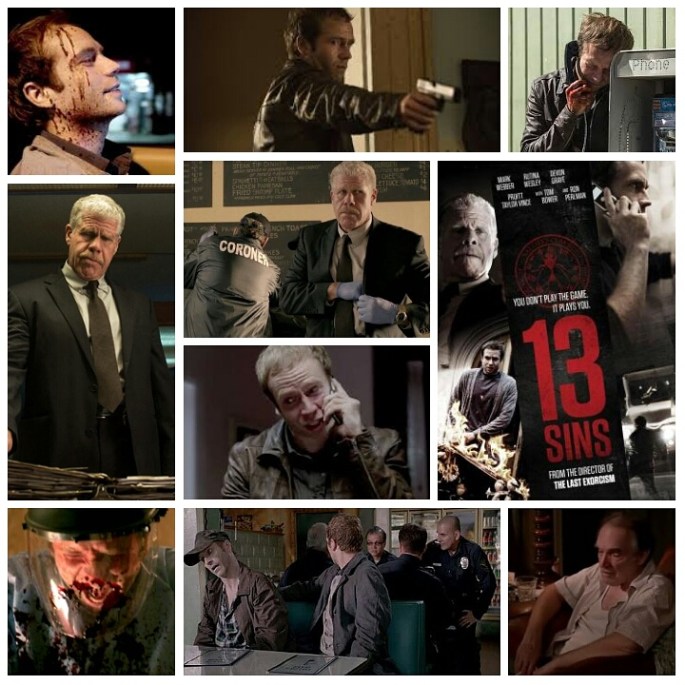
13 Sins is a mean, mean movie, one that pushes it’s audience as far as the central premise does it’s characters. By push I mean it gleefully tries to figure out just how many acts of nasty human depravity it can parade before you before the laughs turn to “oh damn, that’s actually horrible.” Me being the sicko that I am, I laughed pretty much straight through til the bombastic finale, but I recognized the rotten nature in the story and felt the weight all the same. The idea is simple: One day a financially troubled man (Mark Webber, who just has one of those faces you want to punch) gets a mysterious phone call from a game show host sounding dude, telling him to swat a fly, after which one thousand dollars will be deposited into bis account. Easy enough, right? Yeah, sure. Now he’s had a taste of money, wants in on the game and has no clue what soul crushing horrors await. Each new task gets more violent, disgusting, risky, disturbing and (if you’ve got the right mind for it) increasingly hilarious. Make a child cry. Push an old woman down a flight of stairs. Set a church nativity scene on fire. Cheery stuff. Then shit gets real and he’s asked to do things right out of a horror movie, all in the name of green money. The aim, besides of course amusement, is to prove that anyone can be turned into a monster if the price is right. As funny as it is, it leaves a sickening feeling in the pit of your stomach, like you’ve been kicked in the nuts by every horrible news report of late, a gnawing reminder of what levels humans are capable of sinking too when they have too much time and money on their hands. Ron Perlman plays the obligatory baffled police detective, always one step behind the action, and watch for veteran Tom Bower too. The film kind of falls apart near the end, as what little believability it had evaporates alongside the forced plot twists, but had it remained lean and simple I think it would’ve fared better. All its forgiven when considering the impact it makes though, both as action social horror story, extremely black comedy and alluring thriller.
Author: natewatchescoolmovies
Michael Cimino’s Desperate Hours: A Review by Nate Hill
Michael Cimino’s Desperate Hours, despite only really being a servicable home invasion/hostage thriller, still has a lot of fun with it’s two leads, brash sociopath Mickey Rourke and even brasher estranged family man Anthony Hopkins. Based on a creaky old Humphrey Bogart film, Cimino obviously vamps up the violence and eroticism that simmers beneath it quite a bit, and when you have Rourke as your antagonist you know it’s not going to be anywhere near a relaxed affair. He plays Michael Bosworth, a dangerous felon on the run with two other goons, his volatile brother (Elias Koteas) and another creepy lowlife (David Morse). He crashes into the home life of Tim Cornell (Anthony Hopkins) a boorish father visiting his wife (Mimi Rogers) and children. The film mainly takes place inside the house, as the creep factor rises along with the threat of blaring violence which we know will come, made all the more likely by the growing police presence outdoors, and the tensions of everyone involved, threatening to snap at any moment. Rourke walks a tightrope between amiable and unstable, a man sure of himself, who always gets his way, and is capable of bad, bad things if he feels he won’t. Hopkins plays Cornell as a man used to being in control, but his inability to hold his family together is made worse by the gang’s arrival, rubbing salt in an already festering wound. Cimino has a brawny style to his violence, a trademark that’s seemingly born of both De Palma and Peckinpah, rich bloody gun battles and accentuated slow motion death scenes. Most of the film is held back, but the flood gates do eventually open and action hounds will get what they came for. Watch for Lindsay Crouse, Kelly Lynch, Shawnee Smith, James Rebhorn and Dean Norris as well. Not groundbreaking in the least as far as thrillers are concerned, but still an entertaining little piece made memorable by Rourke and Cimino’s ever interesting pairing.
B Movie Glory with Nate: Point Blank
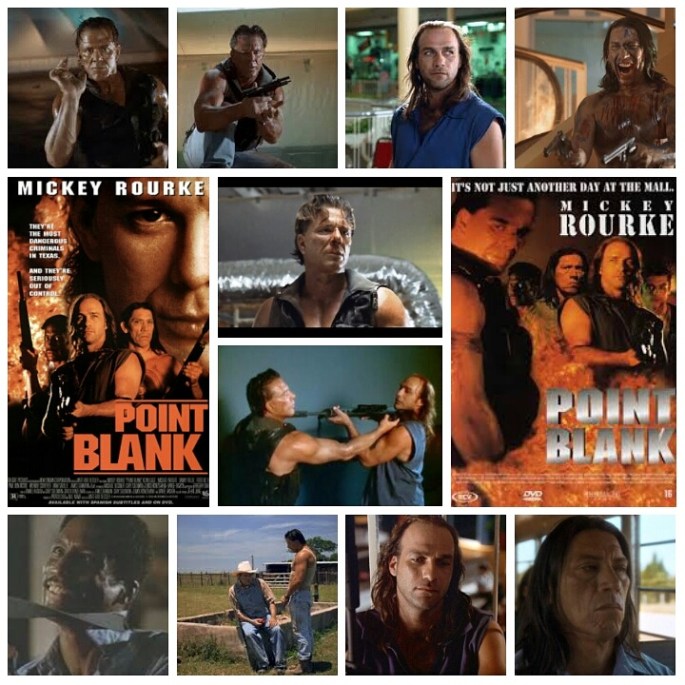
Point Blank takes a big, silly macho whack at the trashy action genre, and gives fans of such lowbrow, cheese saturated stuff a huge sloppy kiss. It’s so ridiculous you have to laugh, but you’re laughing with it because it sheepishly knows what an outlandish hoot it is, which is somewhat reassuring in this territory, because a lot of them play it dead straight and are oblivious to their own vapid density. Not this baby. It wears it’s stupidity loud and proud, and there’s many a moment that will have you howling. Mickey Rourke was in the height of his juicing heyday here, and he looks like Buffalo Bill covered the incredible Hulk in the tanned leather of some poor broad (should have put the lotion in the basket like he told you). He plays Rudy Ray, an ex special ops turned farmhand of few words and lots of action. Rudy’s brother (Wainegro himself, Kevin Gage) is mixed up with a nasty bunch of escaped convicts who have hidden out in a rural strip mall and taken multiple hostages. Rudy is summoned by the local Sheriff (Fredric Forrest), and with the resolute blessing of his crusty father (the immortal James Gammon) proceeds to go redneck John McClane on these whackos and basically tear the place apart. Gage is the leader of the pack, but the most dangerous one by far is a coked up, homicidal Danny Trejo, who terrorizes a poor female captive and basically empties clips at anything that moves. Throw in Michael Wright as a seriously intense war vet with a rocky past (he has a monologue that dips between scary and campy quite a bit) and Paul Ben Victor displaying acting so far over the top it’ll make your eyes and ears bleed, and you’ve got one inane B movie crew ready to fulfill your every schlocky need. It’s funny because there’s an ’emotional’ scene near the end where Rourke and Gage go brother to brother and it’s supposed to be touching. The writing is so godawful, and the music so beyond ludicrous, but the two of them are such good actors that they end up completely selling it without even trying, like they couldn’t turn in bad work if they wanted to. It’s basically Die Hard in the sticks, with Rourke instead of Willis, a mall instead of a skyscraper, and you know… the fact that it’s obviously not a good movie. It’s a hell of a lot of fun though, if you’re in the mood to get silly with it.
Danny Boyle’s Trance: A Review by Nate Hill
Danny Boyle’s Trance is that rare head spinner that follows through with it’s audacious vision, uses dazzling sleight of hand to win us over and make us believe we’ve discerned the outcome, then whips the technicolor rug out from under our feet, hurls a psychedelic curve ball at us and makes a beeline for a conclusion that is both unpredictable and shocking, to say the least. Not to mention the fact that the journey leading up to said conclusion is a reality shattering cerebral laser show that will have you questioning not only your own sanity, but that of every character as well. I watched it with a friend who was nonplussed, dazedly uttering the sentiment “Who can ever tell what of that was real or not?”. A fair enough concern, but not really the kind of hangup you should trip over if you expect to have fun in a film like this. Boyle has a knack for bucking the trends, both in the versatility of his career and in the uniqueness found in each project as an individual. I guarantee that you haven’t seen anything like this before, and that any brief plot description you see on netflix or the like won’t even begin to prepare you for it. Read any further online and you’ll deliberatly spoil what will be a divine treat. James Mcavoy is the meek art curator who finds himself on the wrong end of a heist. Vincent Cassel is the volatile thief determind to find a piece that’s been hidden by Mcavoy, and subsequently forgotten after severe head trauma. Rosario Dawson is the enigmatic hypnotherapist hired by Cassel’s crew to help unlock the secrets of his mind and locate the painting. That’s all you really need to know. The rest is a spiraling cyclone of mind tricks, betrayals, candy colored cinematography that blasts you along with fiercely hopped editing, a whizz-banger of an electronic soundtrack that leaves your pulse playing hopscotch double time and some surprising emotional depth, taking you just as off-guard as the frequent and unforseeable plot twists. Mcavoy just continues to put forth commendable work in sublime films (if you haven’t seen Filth or The Disappearance Of Eleanor Rigby, please queue them up immediately), his turn here being one of the best in recent years. I’ve never been super hot on Cassel, but he holds his ground here nicely. Dawson is just groundbreaking in what is so far the performance of her career. This kind of arc is just so tricky to land, let alone carry believably the whole way, especially when there’s so much cognitive commotion to distract the audience from her work. She’s an emotional lighthouse in a sea of pixelated madness, and serves as the heart of the whole piece. Boyle is a director who is hopelessly in love with film. What it can do. How it can make you feel. The many and varied ways which it can entertain us and make us fall for the medium over and over again anew. He’s crafted a corker of a psychological slam dunk here, with an essential human core that gives all the trippy heady stuff some discernable weight. I’d say it’s a tad overlooked, to be sure. It has its audience but I wish it’d been the smash hit it so deserved to be. Imaginitive, confusing, unconventional, visually alive and crackling with an auditory soundboard in both score and soundtrack. Masterpiece for me.
Elmore Leonard’s Killshot: A Review by Nate Hill
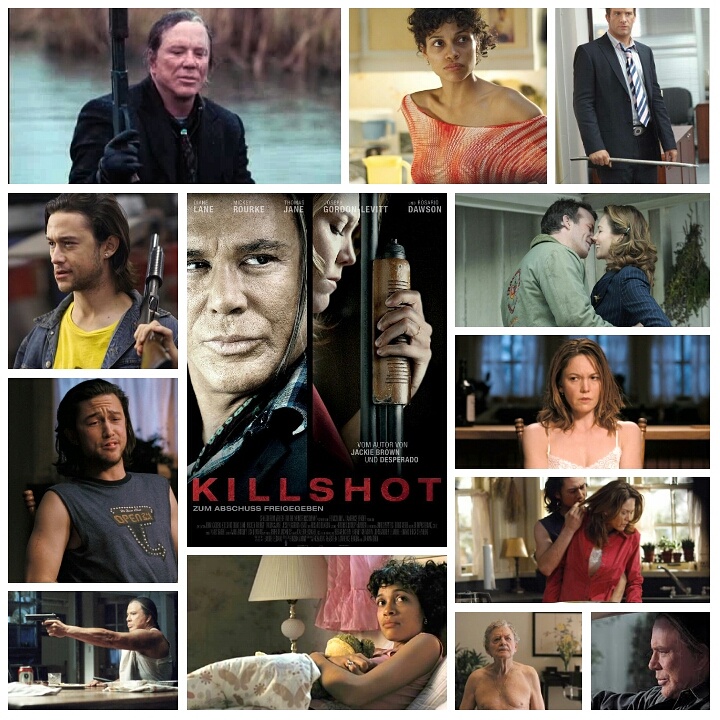
John Madden’s Killshot went through the ninth ring of production hell before it was finally released in 07 or so, after like three years of gathering dust on the shelf. The resulting film didn’t win anyone over who waited all that time with baited breath, because you can see the cuts, chops and gaps in story where it’s been muddled around with, no doubt by the fuckwit studio. I still love it, flaws and all. Based on an Elmore Leonard tale (you can never go wrong with his work, it’s a sombre tale of psychopaths, assassins and one hapless estranged couple (Thomas Jane & Diane Lane) caught in between. When legendary native american hitman Arman ‘The Blackbird’ Degas (Mickey Rourke) botches a job for the Toronto mafia, he’s forced on the run, and hides out with aimless young lunatic
criminal Ritchie Nix (Joseph Gordon Levitt), who somewhat reminds him of a litte brother he lost years before. Rourke pulls off the native angle quite well, and shows vague glimpses of a humanity that was once there and has long since been buried in violence. When Jane and Lane accidentally witness him murder someone, he won’t let it go, pursuing them beyond rationality or reason, even to his own end. Levitt never gets to play the wild card, and he rocks his redneck sociopath brat role with scary aplomb. Rosario Dawson has an odd appearance as Ritchie’s girlfriend, an elvis fan who is seemingly a little bit challenged upstairs. Watch for a cameo from Hal Holbrook as a crusty old mobster too. You’ll just have to imagine the federal agent character played by Johnny Knoxville though, because he never made it into the film and can now only be seen in ages old trailers that were a false start. Despite it’s issues, I find it to be an atmospheric little pulp outing that does have the classic Leonard feel, a hard bitten, cold-hearted turn from Rourke that’s one of his best characters in recent years, and a mean, unforgiving narrative set in picturesque northern Canada. Give it a shot, it deserves way more love than its received so far.
Jason Bourne: A Review by Nate Hill
He’s back, baby. God it’s so good to see Jason Bourne doing his thing on the big screen again, especially in a flick that’s every bit as excellent as the original trilogy in all the old, good ways, while adding a few twists of its own that suit the digital age we have progressed into, and the concerns which go hand in hand with it. It’s been sometime since Jason swam away out of frame as an unsure news report claimed that his body was never recovered, and a slow smirk spread over Nicky Parson’s (Julia Stiles) face as she observed on TV. With ex CIA director Kramer (Scott Glenn) no doubt incarcerated, the agency is headed up by the worst apple of the bunch so far, Robert Dewey (Tommy Lee Jones), a surveillance hound dog who has ties to Bourne’s past and wants to use a record breaking social media app to illegally spy on users for ‘national security’ purposes (heard that one before). Scary stuff, but simply a backdrop for Bourne to come speeding back onto their radar and make hell for them, after Nicky hacks the database and spurs him on. Damon is beefed up, weathered and has never been more furious as Bourne, and if you thought his revenge rampage in Supremacy was something to behold, just wait til you see these fireworks. It feels a bit more intimate than the last three, with a lot of time spent on Bourne, and less agency types howling in control rooms and backstabbing each other, save for Dewey and his eager beaver protégé Heather Lee, played by Alicia Vikander in a slightly perplexing character arc that I’m still trying to think through. She has her own agenda, clashing with that of a ruthless rogue asset (Vincent Cassel is going grey, but damn he can still run around like nobody’s business) that Dewey foolishly sends after Jason. Paul Greengrass is back in the director’s chair again, and after this chapter I can honestly say I think he’s the best captain to ever sit at the helm of a Bourne flick. He just has this way with action that never feels too stylized or obviously cinematic, while still delivering a pure rush of thrills that exist in a realistic space. There’s an early scene taking place in Greece during a dangerous riot that feels like they just dropped the cast and crew in the midst of a real life police skirmish and started shooting, in more ways than one. My favourite has to be a thundering car chase down the Vegas Strip in which a SWAT tank causes a jaw dropping bout of vehicular Armageddon. Sounds too over the top for a Bourne flick, right? You’d think, but somehow they just make the thing work and stay within the parameters of this world. I had this fear that they wouldn’t be able sneak another Bourne movie onto the back end of an already perfect trilogy without it feeling out of place. While it certainly is different than it’s predecessors (we live in a radically different time), it still has that magic, feverish rush that I love so much and that has carried the franchise along on wings of adrenaline. A blast. Cue Moby’s Extreme Ways to play out my review.
Sin City: A Review by Nate Hill
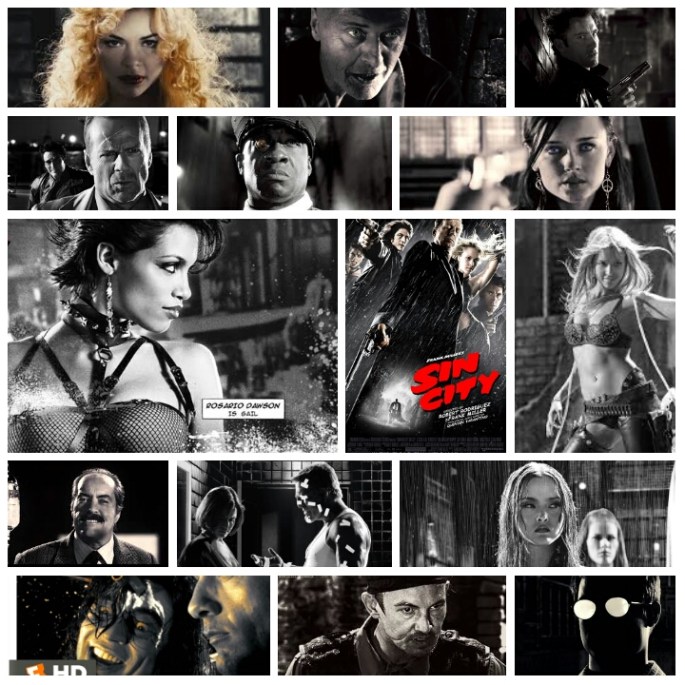
I remember seeing the edgy character posters for Robert Rodriguez’s Sin City hanging on the movie theatre wall when I was younger, having no idea what Sin City was or any knowledge of the books, but thinking they looked incredibly cool and enticing. Then the trailer came out, and it was all I could think, talk or breathe about for months leading up to its release. I was obsessed. When opening weekend arrived I got my dad to take me, and spent two unforgettable hours of cinematic nirvana in a dark auditorium that was packed to the gills with fans old and young alike, each basking in the delectable black, white and colour speckled glow of the piece unfolding in front of us. I had never seen anything like it, and it blew my system into sensory orbit like nothing had before. Around this time I was just discovering a lot of Rodriguez’s and Tarantino’s career, poring over pulp and crime thrillers from all across the decades as my love for cinema expanded, and this was something I just knew would be special as soon as I saw that first provocative teaser poster. The innovation and artistic ambition used by the ever resourceful Rodriguez and his team led to gleaming critical reception, a massive box office hit and one of the most gorgeous pieces of art in the motion picture realm. His decision to simply lift the still frames out of Frank Miller’s graphic novels was something that not every director would be able to go along with, let alone wrap their minds around (director’s are a finicky lot who always have thir own bright ideas, even when the source material is already gold). Rodriguez was so in love with the books that he envisioned them onscreen just the way they were drawn, and that’s pretty much what you get in the film. The pre-credit sequence sets the dark, vibrant, moody and impossibly lurid setting of Basin City, a rotting heap of corruption where almost everyone is either corrupt, sleazy or just outright evil, and even the ones that aren’t deal out some pretty heinous bouts of violence themselves. The prologue involves girl in in a red dress (Marley Shelton) conversing with a mysterious, well dressed man (Josh Hartnett). The scene takes a turn for the dark and tragic, we zoom out as Rodriguez’s self composed gutter lullaby of a score grinds into motion, and the glowering opening credits trundle by, a moment of a pure joy for anyone watching. The film is separated into three central vignettes, each from a different volume of the comics. The first, and strongest, features a sensational Mickey Rourke as Marv, a hulking bruiser built like six linebackers and basically impervious to anything that could kill a human being. After a heavenly night with hooker Goldie (Jaime King), he wakes up to find her lying dead next to him, not a mark on her. This gives his set of talents a purpouse beyond bar fights and roughing up abusive frat boys, and he wages a war of ultraviolence in her name, to his grave if he must. There are some villains in these stories that seem to be dredged up from the very bottom of the last pit of hell, just the worst of humanity’s many deplorable qualities. Marv eventually runs into evil arch bishop Cardinal Roark (a devious Rutger Hauer) and insane cannibal ninja sicko Kevin (Elijah Wood will haunt your nightmares)., on his bloody quest. Rourke’s genius even shines out through 12 pounds of prosthetic makeup slapped all over his mug, and he captures the wayward warrior soul in Marv, a restless anger and old school, Charles Bronson esque charm by way of Frankenstein’s monster. His work is a great way to kick off the first third of the film, and the gravelly narration hits you right in the film noir nostalgia. The second segment is a lot more lively, with far more people running around, sans the melancholy of Rourke’s bit, and instead emblazoned with a war cry of a story starring Clive Owen as Dwight, a hotshot tough guy who gets on the wrong side of seriously scummy dirty cop Jackie Boy (a growling Benicio Del Toro having a ball) who likes to beat up on waitress Shelley (Brittany Murphy). Dwight pursues him to Old Town, a district run by lethal militant prostitutes lead by no nonsense Gail (Rosario Dawson can use that whip and chain on me anytime). Then everything goes haywire (I won’t say why), and Michael Clarke Duncan gets involved as a weirdly articulate, golden eye sporting otherworldly mercenary named Manute. This middle section is the one that feels most like a comic book, where as the other too have more of a noir flavor, like their old Hollywood roots. The third and most depraved chapter (which is no light statement in this town), sees aging Detective John Hartigan (Bruce Willis) lay his life down in order to protect young Nancy Callahan from a terrifying pedophile child killer (Nick Stahl) who is the spawn of despicable US Senator Roark (Powers Boothe sets up a cameo of the pure evil he would go on to exude with his much larger role in the sequel). Jessica Alba plays the adult version of Nancy, now an exotic dancer and once again in danger from Stahl, who now has some… interesting changes to bis appearance, courtesy of genital mutilation from Hartigan years before. It’s one demented set of stories that would be almost too much to take in the real world, but this is Sin City, a realm that exists in the darkest dreams of Raymond Chandler and his ilk, a seething netherworld of stunningly beautiful women, ghastly corruption and terror, and good deeds that go unheralded in the night, bloody retribution perpetrated by antiheros and tragic scapegoats who know damn well what a pit of hell their town is, and that nobility is but a drop in the bucket of injustice they wade through on their way to violent exodus. The cast list goes on for miles longer than I’ve mentioned so far, but look out for Alexis Bledel, Carla Gugino, Michael Madsen, Jude Ciccollela, Nicky Katt, Nick Offerman, Tommy Flanagan and Devon Aoki as Miho, a deadly little hooker assassin who can turn you into a pez dispenser with her razor sharp katana. The level of violence on display throughout the film is so far over the top that after a while it seems almost Looney Toons in nature. Throats are slashed, heads are removed, testicles are ripped off, skulls are crushed and all manner of maiming and murder inflicted. What made it acceptable with the ever gay MPAA though is the fact that mic of it exists in the black and white mode of visual storytelling, and only a few instances of actual red blood seen. That goes for more than just the violence though in terms of color. Amid the sea of stark black and white there are beautiful hidden gems of colour that you have to train your eye to find. A pair of green eyes, a crimson convertible cadillac, the sickly yellow pallor of Stahl’s mutated skin. That’s but a taste of the patchwork quilt of visual artistry you are treated to here, and has constantly been emulated in either work since, but never quite effectively as here. That’s the idea of it though, a heavily stylized piece of hard boiled neo noir that exists simply to plumb the very depths of darkest genre territory, do justice to Miller’s books with a laundry list of wicked actors, a bonus scene directed by Quentin Tarantino and a story that’s pure noir to its bloodstained bones.
Tony Scott’s Unstoppable: A Review by Nate Hill
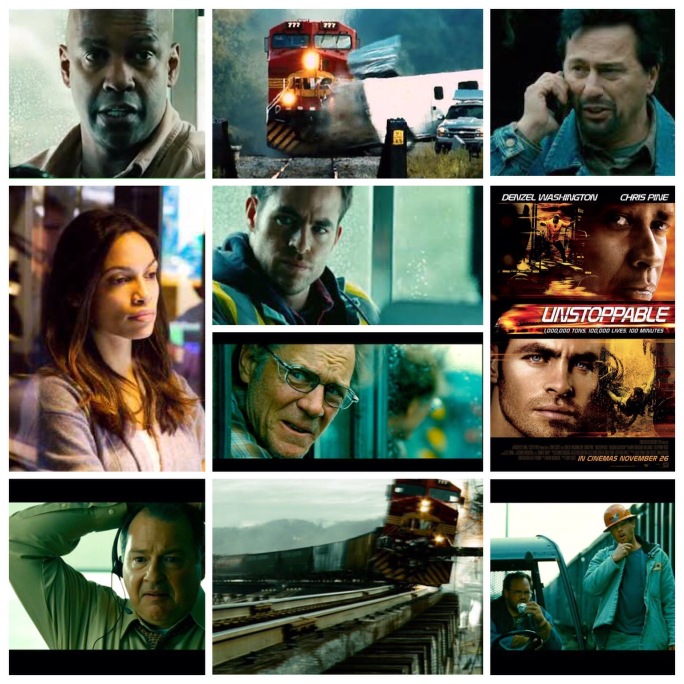
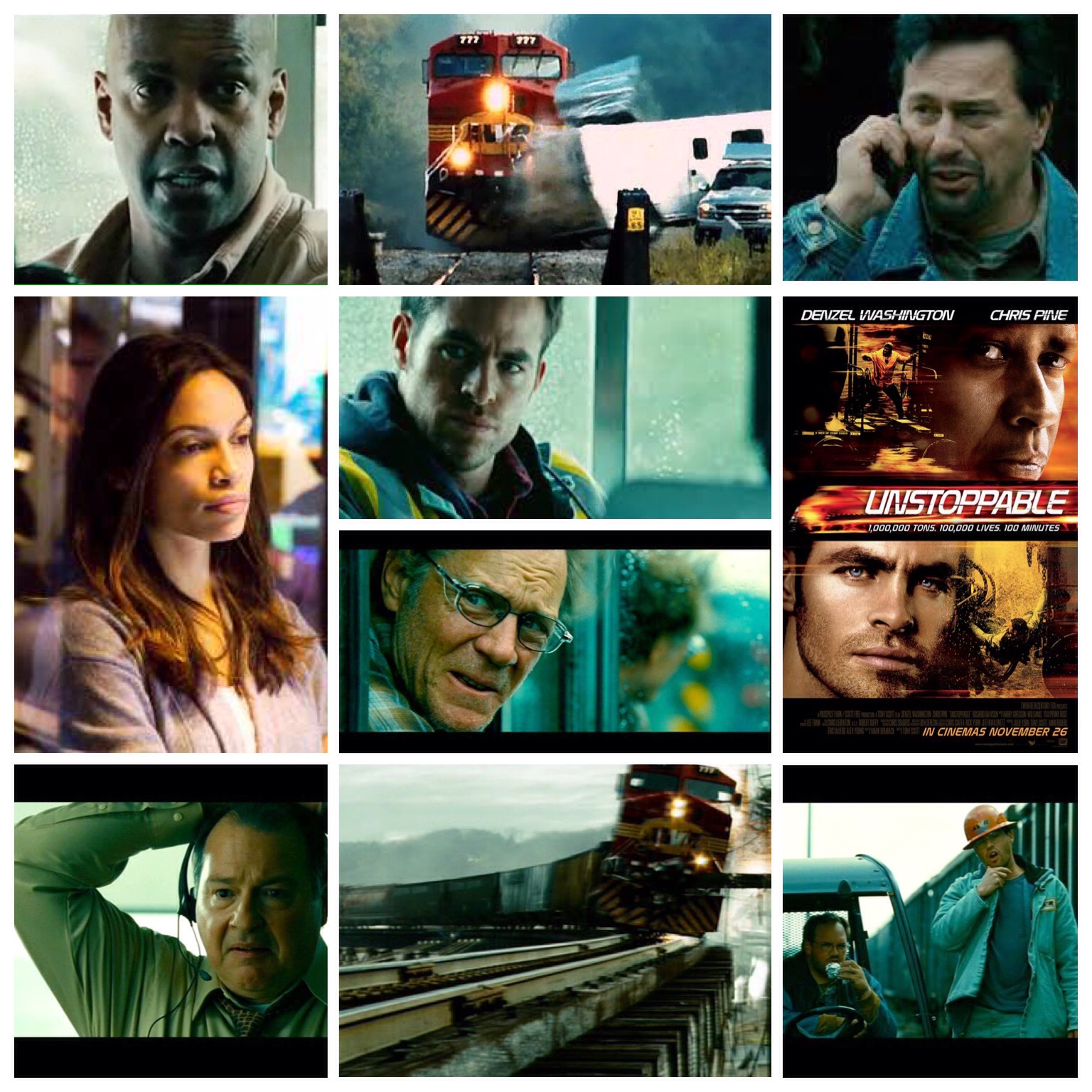
Tony Scott’s Unstoppable was the maverick’s last directorial outing before his heartbreaking and untimely death. It’s ironic because the film’s title is a descriptive term I would have applied to the man’s career, life and approach to filmmaking. But it was not to be. This is some swan song of a film to go out on though, a pleasing juggernaut of an action drama that greases the tracks and goes full steam ahead. Any film about trains run amok will inevitably be compared to the 1984 masterpiece Runaway Train, and although this one is vastly different in both story and tone, they just seem to be sister films. The mournful, resolute nature of Jon Voight’s character in it just seems to echo the sadness surrounding this film, and the fact that it was Tony’s last. But that’s just my strange intuition talking. The film itself isn’t really melancholy or downbeat, in fact it focuses largely on human triumph in the face of gross error. There is in fact a runaway train on the loose here, but the stakes are upped when we find out that it’s packed to the brim with highly toxic and flammable chemicals, and hurtling unchecked towards a densely populated metropolitan area. Denzel Washington is the Everyman veteran railroad worker, in danger of having his job devoured by greedy corporate development and ready to have a meltdown. Chris Pine is the hothead rookie swaggering through his first month on throb, and together they have to deal with the disaster, and prevent any further outcome. Rosario Dawson is the frantic control station operator, trying to coach two other workers (Lew Temple & Ethan Suplee) and help as best she can. Kevin Dunn is the abrasive company CEO, unwilling to get his hands dirty and callously looking for the first readily available solution, even if it results in mild casualties that he doesn’t have to witness. It’s all been done before, no doubt, but not by Scott, and you can never write off a formula, trope or act n cliche as dead until the maverick has had a good crack at it. The scenes involving the train are breathless and edited with a glass shard explosiveness, never to shaky or chaotic, always in control and bursting from the frames like the speeding locomotive they encompass. Look out for Jeff Wincott as Pine’s older brother, as well as Kevin Corrigan, T.J. Miller and David Warshofsky as well. It’s not a bad little flick for a director to put the final seal on his career with, and stands as a wrecking ball of an action flick. I just wish we got to see more from the guy. RIP Tony.
B Movie Glory with Nate: Fire With Fire
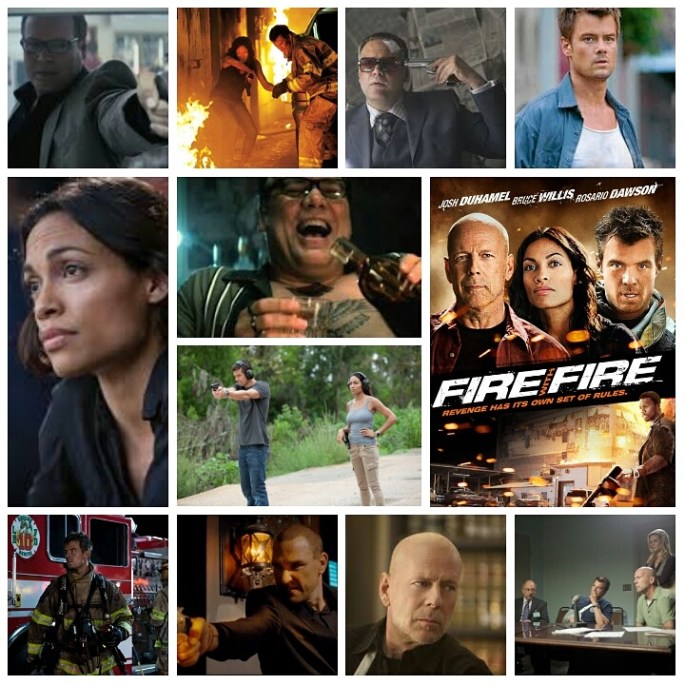
Fire With Fire is one in a long string of recent direct to video flicks that Bruce Wilis seems oddly intent on appearing in. Some are cool (Catch 44), some are halfassed (The Prince) and some are just plain poo (Set Up). This one falls in the first category. It’s an overblown and unbelievable little thriller but it has a great cast on it’s side, and when you score Vincent Donofrio for your villain role, you’ll always at least have some merit. The story is pure B movie: a studly firefighter (Josh Dumahel) ends up seeing something he shouldn’t and gets on the wrong side of a vicious neo nazi psychopath (Donofrio) and his crew. Just his luck though, as his foxy girlfriend (Rosario Dawson) happens to be an FBI agent working on a task force headed up by a gruff senior operative (Bruce Willis). Willis has been trying to nail Donofrio and his gang for years, and he finally has a handy little firefighter witness to testify. Donofrio won’t stop though, making their lives hell as he shakes their shit up right left and center. He’s a hell of an actor, especially when playing the baddie (his turns in The Cell, Daredevil, The Salton Sea and Men In Black are legendary), and this loose cannon weirdo white supremacist nut job is one more to add to the canon. Duhamel does his classic laid back pretty boy thing, Dawson is tough and oh so attractive as always, and Willis dials up the grumpy metre for a nice little jaded turn that i actually really enjoyed. Vinnie Jones lends his mug to the role of second in command, 50 Cent shows up (wherever Willis and Deniro go in B movie land, he unnervingly seems to tag along), and watch for more work from Quinton ‘Rampage’ Jackson, Julian McMahon, Richard Schiff, Arie Verveen and Kevin Dunn. I like the chaotic formula employed here: a bunch of characters running around, large cast, flashy violent spectacle, flamboyant villain. It almost seems like a 70’s genre piece, and I’d love to have seen a hand drawn, retro style poster with a bunch of stuff sprawled together in a mural like those old school flicks used to do. It sure would beat the generic, vanilla design they went with and I feel like the film deserves more. Great stuff.
Quentin Tarantino’s Death Proof: A Review by Nate Hill
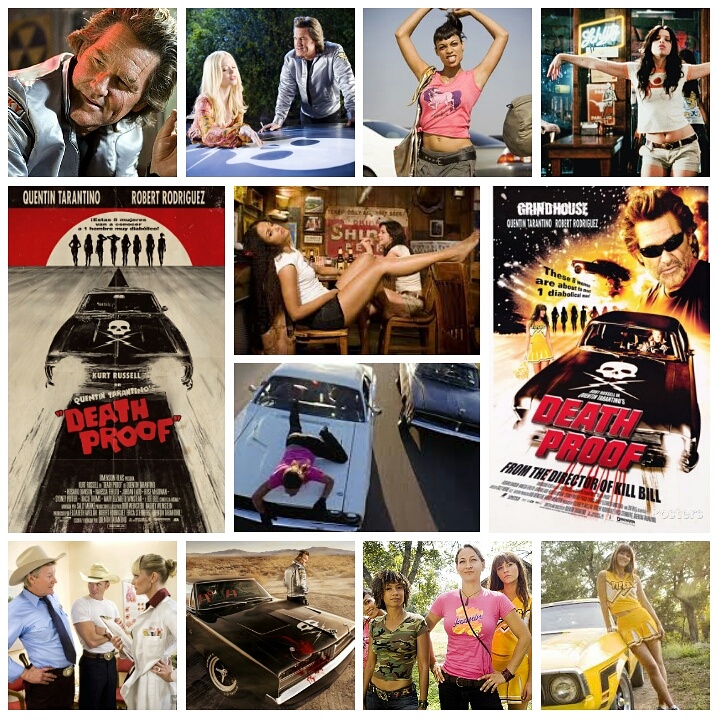
Death Proof is… not the best flick in Quentin Tarantino’s career so far, but an entertaining little ride through the B movie corn nonetheless. It’s Quentin playing in the sandbox, and although he tends to fling it about too energetically in spots, and dawdle around listlessly in others, one can forgive such pacing issues when you consider how much fun it is for the most part. It also helps that his Grindhouse effort is heaps better than his pal Robert Rodriguez’s painfully lame Planet Terror, but that’s a whole other chestnut. Death Proof works mostly thanks to the bubbly, endlessly sexy performances from an extensive roster of irrisistable cbicks, and one gleefully evil bit of work from genre legend Kurt Russell, having a devilish blast as Stuntman Mike, a psychopath who batters helpless chicks to death as he rattles them around in his specially rigged vintage muscle car, primed for murder and ready to burn rubber straight to the ER. A fair chunk of the film is spent simply observing these girls talking, bickering, socializing and indulging in idiosyncratic pop culture banter that’s a facet of the Q Man himself. He loves to project his own affinities onto the written page and use them as backbones for his characters, and although that may be one of the core elements of screenwriting in itself, it’s always a little more pronounced with QT. Writers are books, but he is a popup book, always a tad more garish than the rest of the kids on the playground. I don’t wanna say that such lenghthy swaths of running time spent on girls chilling out isn’t fun (it’s captivating, especially with this bunch), but it is essential to the Grindhouse vibe they set out to emulate? A minor quibble, but a quibble all the same. To their credit, the girls are simply terrific. The first bunch include Rose McGowan’s angelic and short lived Pam, Sydney Poitier’s spunky radio DJ Jungle Julia, and Vanessa Ferlito’s wiseass Latina. The first act sees them run into Stuntman Mike in a roadhouse bar owned by Tarantino himself, who just can’t resist casting himself in his own shit lol. Oh well, at least he didn’t try an Australian accent this time around. The second time act we meet Rosario Dawson, stuntwoman Zoe Bell and cutesy pie Mary Elizabeth Winstead, all in the crosshairs of Mike’s radar, but this time he may be in way over his greaser hairdoed head. The vehicular mayhem is traditionalist and non CGI, and quite honestly a spectucalr firework show of blood, glass, metal and scorched asphalt. I just wish there was more of it, man. Sure, the character building with the gals is awesome, but it eclipses the action in gross proportion. A little balance between talky talky and vroom vroom would have been appreciated. Russell is a hoot in a role that was originally going to be played by Mickey Rourke. He just has that knowing gleam in his eye and good ol’ boy charm that makes it work so well, especially in a naughty little fourth wall break that shows you just how much Mike enjoys his sick little game of bumper cars. There’s characters that bleed in from Rodriguez’s side of the fence, including Michael Parks as the seemingly immortal Texas Ranger Earl Mcgraw, and Marley Shelton as his daughter. It’s a valiant effort, with plenty of Mad Max style merit and a seriously smoking lineup of luscious ladies. I just feel like he over fed certain ingredients to the pot when cooking this one up, and neglected others in areas. Still though, even average Tarantino is brilliant, and this one glows, if for a few dull spots.