B Movie Glory: Walled In

Walled In isn’t scary enough to be memorable or original enough to leave a lasting impression, it’s just one of those drab, grey, middle of the road horror flicks that comes and goes as quickly and unceremoniously as a sudden breeze through the room. The only notable reason for it existing beyond background noise is the presence of a few cool actors. Mischa Barton headlines, and despite her teen star shtick I’ve always thought that she’s a really good, engaging actress. Supporting her are Vancouver’s own Deborah Kara Unger and Cameron Bright, who always add class to any venture. Their trio of involvement made it worthwhile for me, but the story and production overall is just a hazy blur. Barton plays an agent for a demolition company who is overseeing the removal of a particularly old building, with some freaky secrets laid into the foundation. Unger is the building’s super creepy caretaker who knows what’s up but ain’t snitching to anyone, while Bright is even less helpful as her weird son. It turns out there’s hidden tombs in the walls where the long dead victims of a mysterious killer were shut in, and even years later the murderer may still be lurking about the place, which should have put Barton in the hot seat for some potentially suspenseful scenes, but alas, it’s a sleepy slog the whole way through. The thing would have been more lively as a video game or something, anything more stimulating than the cable level lack of thrills and chills doled out here. Barton was good, as she always is, but other than her, Unger and Bright, this is just mud.

-Nate Hill

B Movie Glory: Tough Luck

Tough Luck is one of long forgotten low budget crime drama mystery flicks that always contain the same key elements: a seductive femme fatale, a young drifter caught up in sensual intrigue, the jealous older husband/lover, all gilded by lies and the vague threat of violence, which is always inevitable. The loner here is Norman Reedus as a young grifter who comes across a travelling circus run by gypsy Armand Assante and his darkly angelic wife (the stunning Dagmara Dominczyck). He gets close to the two of them, too close to her and eventually the kind of sparks fly that often result in danger and deceit. Reedus made this same movie years prior, except it was called Dark Harbour, was set in the Pacific Northwest instead of the Oklahoma dust bowl and he starred alongside Polly Walker and Alan Rickman instead. That goes to show that the traditions and tropes of this sub-genre are as old and intrinsic as the routines in the circus Assante owns here. There’s a shifty quality to all three leads here, all seemingly unlikeable until the mournful third act plays out and we see which one really deserves our sympathy. Reedus always looks like a scrappy lost dog that’s seen a few back alley fights, he has the kind of natural magnetic charisma that you can’t fake. Assante is sometimes a long of ham in his work, but seems a bit more relaxed here and let’s the circus monkey on his shoulder do some of the talking. Dagmara is a true beauty, captivating the screen and making us really believe we’d fall under her dark spell while we’re hypnotized. Not a bad flick at all, and has some really good moments in the final act which gets quite grounded, sad and has a neat little twist.

-Nate Hill

“I can’t do that.” A review of Sicario: Day of the Soldado – by Josh Hains

In my review for Sicario, I noted that I had some difficulty shaking the movie so to speak, because seeing it in theatres had been such an impactful, resonant experience for me. I ended that review by saying, “It is assuredly an openly nihilistic (in the best way possible), unflinching examination of the thin grey line that separates wolves from sheep, and hunters from the hunted, with one hell of a bloodthirsty, tortured man in Alejandro dragging us blindly into a realm where darkness reaches out to darkness with battered hands and consumes its soul. And ours.”, and I think that ruling also applies to its sequel, Sicario: Day of the Soldado, which plays a lot less like your average movie sequel, and much more like the intended standalone spin-off that was being advertised.

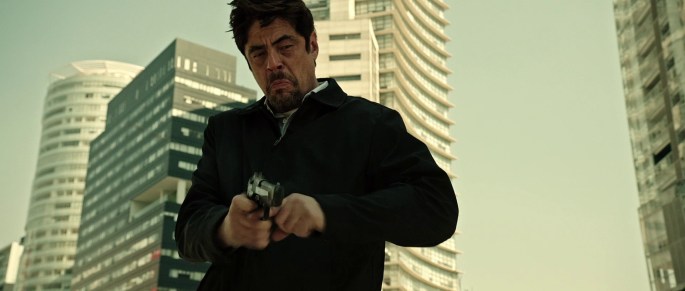
A group of suicide bombers walk into a crowded Kansas City grocery store and murder 15 innocent people, including a mother and her young child, during the most disturbing and frightening sequence in either Sicario movie that lets you know immediately, this will be a significantly darker venture than what came before. The American government suspects that Mexican cartels are now illegally transporting Islamic territory across the border (sound like anyone we know?) and in reaction to this suspicion Secretary of Defense James Riley (Matthew Modine) gives CIA operative Matt Graver (Josh Brolin) carte blanche to combat the increasing threat of these ruthless cartels. So of course Matt calls up his “big dog”, Alejandro Gillick (Benicio Del Toro), to help him wage a war between the major cartels, which includes killing a high level lawyer for one of the cartels, and the kidnapping of Isabela Reyes (Isabela Moner), the daughter of one of the cartel kingpins. In time, things go south fast when the President issues an order to the CIA to abandon the mission and erase all proof of American involvement in the false flag operation including Isabela, pushing Alejandro into brutal protector mode having bonded with her, pitting him against Graver and his team.

By now you have likely heard that for some, the absence of Sicario director Denis Villeneuve, the late composer Johann Johannsson, cinematographer Roger Deakins, and the Kate Macer character portrayed by Emily Blunt, is deeply felt throughout the entire running time of the movie. While Roger Deakins may not be the name behind the camera, Dariusz Wolksi does a remarkable job emulating the style and palette of Deakins’s work on the first movie, while also projecting a grittier, grimier image that adds to the low-key realism of the film, and the score by Hildur Guðnadóttir does a fine job of emulating Johannsson’s magnificent, dread inducing score of Sicario. Filling in for Villeneuve, Stefano Sollima successfully replicates the same style, atmosphere, and tone of the first movie, in a way that allows us to feel like we are back in that same world, but experiencing it through a different set of eyes.

There is no doubt in my mind that both Kate Macer, and Reggie Wayne (Daniel Kaluuya), could have been incorporated into Soldado in a multitude of ways if the script had gone in a partially different direction, much to the appeasement of those who were unable to see past their absence (more specifically, Kate’s absence), citing it as a major downfall of the movie. The question I have for those same naysayers is, how? How do you make her return feel natural and organically constructed, and not forced and unnatural?

Having seen the direction Soldado (which means “soldier” when loosely translated from Spanish) travels in without Kate (and Reggie), there is no denying that Soldado would have been a vastly different movie altogether had the character been brought back. Perhaps in the script for the impending third Sicario movie there is an opportunity to bring her back. Perhaps she experiences a personal loss or attempt on her life by the hands of the cartel, compelling her to become a Sicario like Alejandro. Maybe she joins Matt Graver’s task force because Alejandro was right, and nothing made sense to her American ears, she doubted everything they did, but in the end understood why it happened. Maybe she has no place in that movie either. Who knows? What I do know is, in my eyes her affiliation with Alejandro and Matt came to a close before Sicario ended, just as Alejandro told her the last lines of the movie: “You should move to a small town, somewhere the rule of law still exists. You will not survive here. You are not a wolf, and this is a land of wolves now.” Sure, I would have enjoyed her presence in this standalone spin-off, I do not doubt that Blunt would have knocked out yet another terrific performance, and Soldado would have been better for it, but I’m perfectly okay without her being there.

I disagree with the notion that the violence of Soldado is in any way, exploitive, or over the top, or unnecessarily ugly, which differing opinions suggesting that the movie only contains this violence because the filmmakers weren’t smart enough to convoy anything else, and not because it needed to be there. Obviously the violence is in service of the plot, and it occurs naturally so. In Sicario, the task force operated within a particular set of rules of engagement, including not firing unless fired upon, which we saw come into effect during the notorious border scene. Here in Soldado, carte blanche allows them to kill freely, so when they swiftly execute a truckload of gang members as efficiently as they did those border crossing cartel members, without having to be fired upon, it inherently creates an ugly aura to the violence, perfectly befitting of the new rule free, carte blanche perspective of this horrific crime infested world established in Sicario.

As one would expect from the next Sicario movie, the performances across the board are once again top notch. While actors like Jeffrey Donovan (reprising his role from the first movie), Matthew Modine, and Catherine Keener add gravitas and depth to their supporting roles with subtle nuances in their physicality, and grounded, authentic delivery of dialogue, it’s the principal trio who will take the most credit for truly knocking it out of the park. Anyone underwhelmed by Isabela Moner in Transformers: The Last Knight (which I haven’t seen, yet) will be pleased as punch to see her impress with a performance that elevates what could have been another in a long line of shallow kidnapping victim performances. Josh Brolin still so effortlessly manages to tow the thin line of playing someone with an intimidating record and a hefty amount of authority, who can be coldly serious, calculated, and unflinchingly, efficiently brutal if need be, while also projecting a relaxed “Chill out bro, let’s go catch some waves,” kind of attitude that allows Matt Graver apt exist within the Sicario world as a multi-dimensional character, and not merely a one-sided archetype.

I hold particular fondness for the way in which Taylor Sheridan writes Alejandro, and the subtle way Del Toro has portrayed him across both films, and has stolen every scene he’s been in. He cuts through any given scene (and both movies in their entirety) like a hot knife through butter, a true scene stealer but in a quiet and controlled manner. One might be inclined to incorrectly categorize the performances as minimalist, with so few lines because he convinced both Villeneuve and Sollima to allow him to remove lines so he may play in silence more often, adding to the allure and mystery of the Sicario while his powerful performance, quite often nothing more than the look in his eyes and/or the expression upon his face, helps us see the living layers within the man. The softness we first saw from him in Sicario, that showed care in how Kate was feeling after the attack on her, comes through all the more in tender scenes between him and Isabela, and during a delightful scene with a deaf man.

Make no mistake, the cold ferocity is still boiling like molten lava within him, it’s just that we are privileged to see more of the man who used to wear that skin long before the land of wolves tuned him into one.


B Movie Glory: Breaking Point

There’s some debate on whether rappers are decent actors. Some think they have no place in a business that requires training and practice. Other are more accepting. I’m somewhere in the middle, but Breaking Point (aka Order Of Redemption) makes a pretty good case for them, particularly Busta Rhymes and Kirk ‘Sticky Fingaz’ Jones, who star in this urban crime/courtroom drama alongside genre veterans Tom Berenger and Armand Assante. This is a very solid flick by direct to DVD standards, one that actually says something about the state of the streets, poverty, evil, corruption and second chances. Berenger plays a once mighty defense attorney who has fallen a long way following family tragedy and drug addiction. He’s brought back onto the scene when an ex athlete turned gang member (Fingaz) is embroiled in a complex murder case involving an infant and the vicious, psychopathic crime boss played by Busta Rhymes. Igniting matters further is a hothead rival attorney (Armand Assante in full sleaze mode) who has it in for Berenger. He and Fingaz make a strong alliance and both try to find some light at the end of a very dark tunnel by saving the baby from Rhymes, smoking out corruption in both the police force and the DA’s office with the help of a friend on the inside (the always lovely and vastly underrated Musetta Vander) and get their lives back on track in the process. Berenger is brilliant as the fallen avenger trying to burn bright again, while Rhymes does a chilling variation on the cold hearted killer archetype with his own angry twist. This may be low budget and not very prolific, but they say that all you need for a good film is a good script, and this has an excellent one that’s brought to life vividly by everyone involved for a bristling, provocative, emotional crime drama.

-Nate Hill

B Movie Glory: American Strays

There’s a turn of phrase that I like to avoid in where a writer compares any eclectic crime film they can find to the work of Quentin Tarantino by labelling it a ‘Tarantino knockoff’, or any variation in vocabulary. I renounce this lazy, unimaginative jab as it’s based in the worst form of criticism, that of negative comparison and ignorance of a film’s original qualities. However, in the case of American Strays, even I have to concede that it’s a blatant, unapologetic ripoff of QT’s style that makes no efforts to mask the plagiarism or do it’s own thing. He should sue. Not to mention the fact that on it’s own terms it’s just a horrible, boring, awkward fuckin piece of shit movie. It’s set up in the same anthology sequence except none of them are even connected, let alone make sense. Two nimrod hit men (James Russo and Joe Viterelli) drive through the desert engaging in strained extended dialogue that’s neither funny nor stimulating. A psychotic vacuum salesman (the great John Savage) goes door to door harassing people until he meets his match in a femme fatale housewife (Jennifer Tilly). A stressed out family man (Eric Roberts, looking like he’d rather be anywhere else) drives his dysfunctional brood through the desert. Elsewhere, Luke Perry plays a depressed, suicidal weirdo who sits around in a shack with a guy he’s paid to literally beat the shit out of him. The worst is a cutesy pie, insufferable Bonnie and Clyde style couple that are so obviously emulating Clarence and Alabama from Tarantino’s True Romance that you begin to wonder if they gave up and just set the script on autopilot like one of those knowingly ridiculous knockoffs you see on Netflix that are simply there to decoy you out into clicking a title that looks *almost* like what you want to watch (TransMorphers, anyone?). None of these vignettes are remotely engaging, it’s like a parade of shitty, awkward, misguided SNL skits from a dimension where humour and wit don’t exist. Every actor just looks tired, every line lands with a hollow thud. Just. Don’t. Bother.

B Movie Glory: D-War aka Dragon Wars

D-War, aka Dragon Wars if the obnoxious CGI cover art wasn’t obvious enough, is a slovenly, sorry ass piece of pseudo sci-fi wannabe Godzilla garbage that manages to take a concept ripe with silly Corman-esque potential and turn it into something so boring it will melt your frontal lobe before the ‘dragons’ even show up. Apparently based on a Korean legend, I’d be fascinated to snoop around and see just what liberties were taken with the lore, because this plays out more like a Transformers movie but if the Autobots were giant Pokémon. An investigative reporter (Jason Behr) spends most of the time staring vacuously into the horizon as he and a hot chick (Amanda Brooks) race towards LA to try and stop a race of giant monsters from destroying everything. Where did they come from? Couldn’t say, and neither could the film from what I remember. What do they want? To smash and break things. Poor Robert Forster slums it up as an old mentor to Behr who has some vague sagely knowledge about the dragons, while Twin Peaks’s Chris Mulkey plays a corrupt FBI agent with his own agenda who hunts them down. The whole thing reeks of rushed, scattered production values and the shared knowledge among cast and crew that this wasn’t ever going anywhere but straight to DVD, no matter how prolific a legend it’s based on. Blech.

-Nate Hill

B Movie Glory: Asylum

Asylum is first rate trash, a nasty, cheap exercise in shocker horror that gives sanitariums everywhere a bad name and perpetuates the ludicrous stigma that all such institutions are the scariest, most unorganized places on earth. God bless the cheap underside of Hollywood and it’s deliberately skewed perception of things. This one sees Robert ‘T-1000’ Patrick as a private investigator who goes undercover inside a mental hospital as a patient when it becomes clear that people are going missing inside and something is up. The set, design and mood of the place is schlock to the core, without the faintest hint of realism to be found. The facility’s head doctor (the late great Henry Gibson) is a benign fool who has no idea the kind of havoc being perpetrated under his watch. The place has a special kind of crazy in a character played by Malcolm McDowell called Sullivan Rane, a lucidly maniacal serial killer who has red herring written all over him and moonlights under an obvious wig and mask as a patient known simply as ‘Doc’. It’s a hammy throwaway role, but ever intense McDowell seems to have a ball playing whatever oddball garage sale B role they give him, and ends up stealing his few scenes, as usual. Patrick plays it straight and his trademark steely reserve is an odd contrast to the knowingly silly demeanour of almost everyone else involved. The film does it’s best with a twist one can sense coming a good country mile off, but it gives one aforementioned actor some last minute juicy scenes to make his involvement worthwhile. Low rent horror and then some.

-Nate Hill

B Movie Glory: Past Midnight

Past Midnight describes the cable time slot that disposable psycho thrillers like this are relegated to for all time, soaked in by weary, often inebriated viewers in the haunted wee hours and oft remembered as a hazy dream or recollection. This one stars the late great Natasha Richardson and Rutger Hauer, who is one of the reigning sultans of B Movies among actors out there. He plays a man who is recently released from prison for allegedly stabbing his wife to death a decade before. Natasha is the social worker who falls in love with him and gradually begins to believe that not only is he innocent, but the real killer is still lurking out there somewhere. It’s taut psycho-suspense done pretty well, and there’s certainly enough menacing atmosphere and evocative rural locations to spare. Hauer, even when playing the most saintly heroes, just always puts off a dangerous, disquieted vibe so it’s only fitting for him to play this guy we’re kind of not sure about until the third act revelations come along, he really nails it the whole way. Richardson, who tragically passed away a few years back, was always magnetic no matter what (I’ll always fondly remember her as Lindsay Logan’s mom in The Parent Trap), and the burgeoning love, compassion and curiosity to get to the truth is nicely cultivated by the actress. The legendary Clancy Brown shows up as well as a potential suspect, filmmakers tend to throw in his presence to ratchet intensity but he’s fairly relaxed here. Watch for an early career glimpse of Paul Giamatti too. This one doesn’t break new ground or go down in history as anything new, but as far as chiller thrillers go it ain’t half bad at all, and definitely benefits a bunch from having Hauer and Richardson on the frontline.

-Nate Hill

B Movie Glory: Quick

Quick doesn’t quite live up to it’s title, and probably should have been called something contrary to that like “Slow” or “Take Your Time”. It’s technically an action thriller but it ambles along at a leisurely pace, one pearl in a strand of interchangeable 90’s B Movies that you’d never dream of actually watching unless you’re a serial cinephile like myself. Actually, there is one reason this one stands out and may be worth one’s time: Teri Polo. Mrs. Gaylord Focker from Meet The Fockers to most, she’s on an early career rush here as the titular assassin, a deadly femme fatale playing the cops and the mob against each other whilst simultaneously romancing a meek accountant (Martin Donovan) who knows too much about a powerful crime boss (the legendary Robert Davi in relaxation mode). Polo is probably one of the sexiest female protagonists I’ve seen in an action flick, exuding natural sex appeal, especially in a scene with Donovan that would get anyone hot and bothered. It’s too bad the film itself can’t keep up with her and arrives pretty limp. Not even the usually magnetic Davi can seem to rile up a pulse. The only other spark of life is Jeff Fahey as a psychotic corrupt cop who’s into violent kinky sex and probably should never have been given a badge. Tia Carrere isn’t bad either as his foxy partner. Not a terrible flick when you consider the cast and what they get to do, but at the end of the day it’s still essentially just polished up time filler junk.

-Nate Hill

B Movie Glory: Heaven’s Fire

There’s an expression around the campfire of film criticism called ‘Die Hard clone’, a residual effect of how influential that movie was on the action genre. Although that term certainly applies to the terminally goofy Heaven’s Fire (that title tho), I resist the impulse to always trace films back to their inspiration as a negative connotation, and view every story as it’s own encapsulated adventure. Now that aside, this one is pretty shitty on it’s own terms, as you can probably tell by the almost deliberately shabby DVD art. It’s worth it for two reasons only, if you’re a fan of either: Eric Roberts and Jurgen Prochnow, two charismatic genre players who are always so much fun to see, even in Fisher Price knockoff crap like this. Prochnow, for like the tenth time in his career so far, plays a terrorist who seizes a high rise building, planning to hold the city ransom or blow it up. Roberts, that charming bastard, plays an off duty treasury agent who happens to be on a tour through the facility with his family and gets caught in the middle. You can guess where it goes. Gunfire, cringy one liners, standoff’s, inept hostage negotiations, all the tropes are present and accounted for. The script is so bad it almost seems like an SNL parody concocted by fifth grade guest writers, you almost can’t even hate the film because it reaches levels of absurdity that are, dare I say, *adorably* terrible. Eric and Jurgen ham it up in their own special way and if you enjoy their work (I’m something of a fanatic) it’s worth tracking down just to see the two legends side by side. Oh and like so many two bit flicks of this nature, Vancouver is the home-base for filming, which is always a plus no matter how shitty your movie is, because I get to take in the scenery and spot landmarks I pass by every day. Silly, silly stuff, and I’m pretty sure it’s rated PG13 too as there’s no swearing and all the violence is Grade school play level.

-Nate Hill