What the world needs now: Remembering The Return of Captain Invincible with Philippe Mora by Kent Hill

This slideshow requires JavaScript.

It was the eighties here in Australia. Video stores were huge and their selection was impeccable. Aisle upon aisle they ranged; the good, the bad and the extraordinary. During this fine time the local industry was bold and daring. Our filmmakers were still doing genre pictures, and among these great men was a director I have always admired, one Philippe Mora.

I remember watching Mad Dog Morgan (Mora’s feature debut) for the first time with some neighbourhood friends. Unlike me, their parents were very controlling over the films they were allowed to watch, thus they would come round to my place regularly to sample the weird and wonderful.

So there we were watching Mad Dog, and I swear I have not seen since, such perplexed expressions on children’s face whilst watching a movie. They were stunned and poorly and not enjoying the flick at all. It was following this screening that my house became off-limits and I had to go to their houses to watch stuff where we could be monitored, and I could no longer expose these young, fragile minds to quality cinema.

Philippe has an eclectic resume that’s got everything from alien abduction to ballerina werewolves. But there is a film of his that I have watched more than all the others. It is movie that was ahead of its time. It has it all; comedy, action and Christopher Lee singing. It is the ultimate tale of a superhero that has hits the skids; it is The Return of Captain Invincible.

I recently had the opportunity to interview Philippe on this, my favourite of his movies:


KH: You had come off of Mad Dog Morgan, and then The Beast Within – how did Captain Invincible fall into your lap?

PM: My agent Robert Littman gave me the script and an offer to direct. I liked the basic idea of the fallen super hero, the opening newsreel montage, and the American history reminded me a bit of my film Brother Can You Spare a Dime. I wanted to stylize it and I also wanted to make a musical. I said I would direct it if I could turn it into a musical which reflected different styles of popular music and the producer agreed.

KH: The writer of the film (one of the three credited writers) was Steven E. De Souza who would go on to write Die Hard – what was your experience working together?

PM: We never worked together on the film for reasons that I have honestly forgotten. We are now friends and want to work together on something if we can agree. I have found that producers sometimes like to keep directors and writers apart as a misguided control tactic. I worked on one re-write with Peter Smalley where my aim was, quite crudely put, to have a gag on every page, that is, every minute. Any kind of gag – visual or verbal.

KH: It was I think a great plot. A superhero, helps end WWII, is accused of siding with communists, retires Down Under, the US has a secret weapon go missing, the world needs the Cap back, but he’s hit the booze and gone over the edge?

PM: The plot was unique and ground-breaking. Until we made this film superheroes never had problems. But with alcoholic Captain Invincible recovering, now every superhero has problems! Recently The Guardian called it “pioneering.” At the time many people did not understand the film because it radically broke with formulas and was cross cultural in genre and national cultures. The Australian angle was due to financing necessities and I embraced it to make it work.

KH: You re-teamed with your Mad Dog cameraman Mike Molloy for the film?

PM: Molloy in my opinion is brilliant and one of Australia’s best. He was a newsreel cameraman in Vietnam and I met him when I was a kid at my parent’s restaurant the Balzac in Melbourne.

KH: You directed Alan Arkin in the title role; Christopher Lee is the villain – also accomplished Australian actors like Bill Hunter and Chris Haywood – a very eclectic mix?

PM: James Coburn was my first choice for the Captain, but it seems strange to me even now, he didn’t get the humour. I worked with him later on Death of a Soldier. Superb actor. Arkin I believe accepted the role for personal and political history reasons: his father I understand had been a blacklisted teacher. He is brilliant in the film in my opinion and hysterically funny to my taste. Regarding the Aussie actors Bill Hunter was part of my OZ “repertory” company since Mad Dog and Haywood was very funny as the French valet. Serious actors love doing comedians’ work and vice versa.

KH: I still can’t get Christopher Lee’s musical number out of my head after all these years, “If you won’t chose your poison, I’ll have to bring the boys in…”

PM: As WW2 buffs, Lee and I became fast friends. He was dying to sing in the film and when he found I wanted to make a musical he was in. He hated Nazis his whole life and so liked the idea of caricaturing a Nazi racist. Richard O’Brien wrote the incredibly clever lyrics so we had a perfect storm of talents. Unique in the history of musical films. Lee himself thought that number was one the best or favourite things he had ever put on film. It was killer!

KH: Can you tell us any anecdotes from the productions that have not surfaced:

PM: We had a crew doctor who gave the crew legal stay awake pills that also increased appetite! The producer Andrew Gaty came to me about a third way through the gruelling shoot and said the food and catering budget was way over budget, skyrocketing. I expressed bafflement. Which was true. Anyway I ended the shoot rather heavy like everyone else. I think the pill was called Catovit.

KH: Superhero films are the order of the day. Your film was, some might say, a superhero parody, something that could really be said to be ahead of its time – an anti-superhero film on the level with what would emerge with The Watchmen and Kick Ass. Time has been called the ultimate critic. Looking back, in your opinion, how has time treated the Captain?

PM: As mentioned The Guardian recently called it pioneering and I agree. At the time there was more creative freedom in Australia under 10BA financing than anywhere else in the world and that is the only way it ever could have been made. I think cross genre films are anathema to corporations and financing entities because the brain type cannot comprehend innovation or non-formulaic narrative. The frontal lobe starts melting. Anyway Invincible has now spawned many films with variations on superheroes as anti-heroes or damaged individuals. Yesterday’s innovation becomes today’s cliché. Many films have been derivative of my film: for example, look at Hancock.

KH: What are your finally thoughts on Captain Invincible?

PM: I love the film and was originally really confused by the reaction. I am very proud of it and I think it stands alone. As I recall we paid Irving Berlin ten thousand dollars for using Kate Smith singing God Bless America, which he donated to the Boy Scouts of America. So when I see Captain Invincible inadvertently crushing the Boy Scouts shoulder at the beginning of the film I always get a chuckle.


Well that was Philippe Mora ladies and Gentlemen. For those interested in the Guardian article which is referenced, please find the link below. For those of you not familiar with Captain Invincible, I urge you to seek it out; for adventure, for laughs, for the unknown. In the days before it was Marvel, Marvel everywhere and not a spot to think – Mora’s movie is more than ever, what the world needs now!

Into the blue!

http://www.theguardian.com/film/2015/sep/20/the-return-of-captain-invincible-rewatched-pioneering-superhero-film

COMING SOON: Elvis has left the building: Remembering 3000 miles to Graceland with Demian Lichtenstein.
 

Neill Marshall’s The Descent: A Review by Nate Hill 

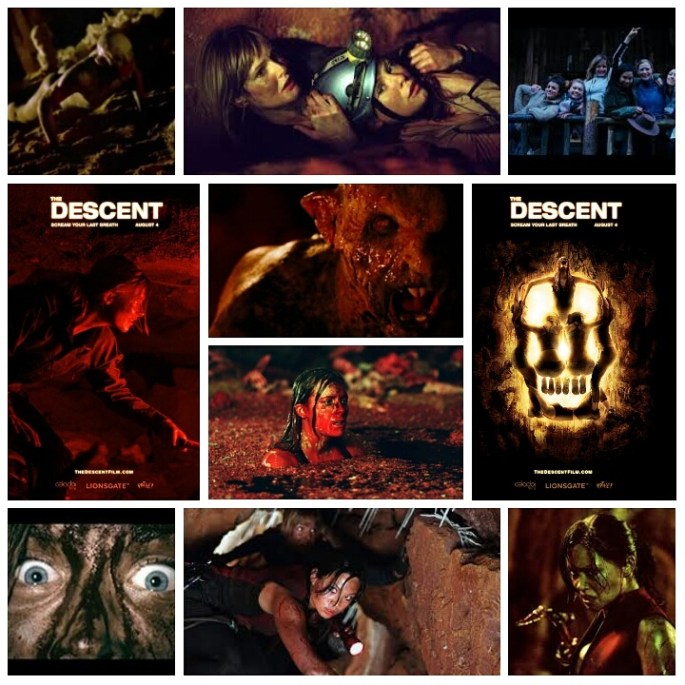
Don’t watch Neil Marshall’s The Descent if you suffer from claustrophobia. Just… don’t. This film does for caves what Alien did for derelict space stations and what The Ring did for videotapes. Cleverly combining close quarters panic, the gnawing fear of losing your way in a near infinite set of tunnels and some visceral, throat ripping terror, it’s one horror package that will leave you reeling. I believe this is the one that put Marshall on the map, and since then he’s been doing mostly medieval style action adventure (he helmed the pilot for Game Of Thrones). This is his first, and most effective outing in a really solid career. The premise is simple: a group of girls decide to go on an excursion deep within a cave system in Eastern Europe. They run into a string of bad luck though, as they first find themselves hopelessly, sickeningly lost. Then the real fun begins as they realize they’re not alone down there, and that something is hunting them. Terrifying subterranean creatures emerge like Gollum on bathsalts, fast, wiry, agile terrors from the deep that know the system inside out and prey on these poor girls one by one. Once they show up its a chaotic bloody free for all that will shred your nerves, but I almost found everything leading up to that even more scary. The slow buildup where they realize they are just so lost and may be stuck down there forever just puts a knot in your stomach and instills a hopeless dread that can’t really be equalled by any monster or gory scene. Still, those things are pretty gnarly and provide more than a few wicked scares, especially when the girls first catch fleeting glimpses of them around corners and between cracks, dismissing them as tricks of the light. Marshall also employs cunning narrative tricks to perpetuate the lack of any kind of way out, one in particular that just curdles the blood in its ruthless, resolute sense of doom. The scariest film you will ever see set in a cave, and one of the premier fright fests ever made.  

Episode 31: BENJAMIN COX’S BETTER OFF SINGLE with SPECIAL GUEST BENJAMIN COX

ep-31

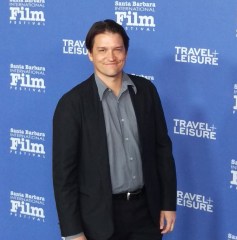
imag0543-2Joining us is filmmaker Benjamin Cox to talk about his film opening today, BETTER OFF SINGLE.  Ben wrote, directed, produced, and edited the film.  The film opened at this year’s Santa Barbara International Film Festival last February where Frank saw it’s first screening.  The film stars Aaron Tveit, Abby Elliot, Lewis Black, Abby Elliot, Kal Penn, and a bounty of other great actors that create a wonderful ensemble.  Ben also was apart of our red carpet interviews for our 31st Santa Barbara International Film Festival podcast where you can listen to here.
JOE DANTE’S EXPLORERS — A REVIEW BY NICK CLEMENT

1-3

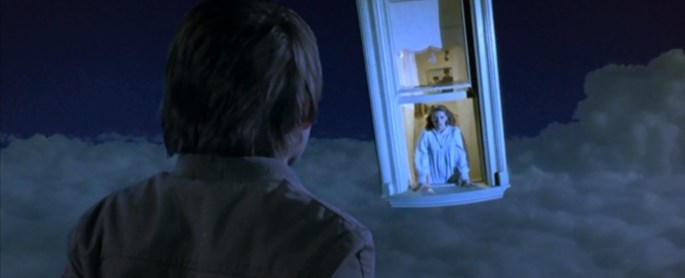
There’s a key moment in Joe Dante’s heartfelt children’s adventure film Explorers when an extraterrestrial utters the iconic cinematic phrase: “The stuff that dreams are made of.” That sentiment essentially applies to Explorers as a whole; the film feels as if it were born from my childhood dreams, and I’ll bet that many others share this same emotion. This is an all-time favorite from my formative years, and a film that has held up so well through the decades because of the honest sense of love it conveys in all departments. I have heard and read the stories that Dante wasn’t happy with the final cut due to a rushed schedule and studio interference. And I respect his comments. I’m not a filmmaker, so I can’t imagine what it must be like to see a film you’ve worked so hard on to be sent out in a compromised state. But his sentiments have done nothing to diminish how much this movie means to me on a personal level.

3-3

There were a core group of films for me as a child that truly spoke to me, films like D.A.R.Y.L., Flight of the Navigator, The Last Starfighter, The Monster Squad, My Science Project, The Goonies, Cloak & Dagger, Dragonslayer, Legend, The Dark Crystal, Harry and the Hendersons, and so many others. But there was something so unique, so truly special about Explorers that it’s rather hard to sum it up into words. There’s a graceful sense of uncynical, gee-whiz-wonder in Eric Luke’s perceptive and wise screenplay, and because Dante has always known how to blend amazing special effects with stories that have a lot of heart, this is the sort of film that qualifies as total movie magic. If you’re addicted to something like Stranger Things, or really enjoyed this year’s absurdly underrated Midnight Special, do yourself a favor and check out Explorers.

5

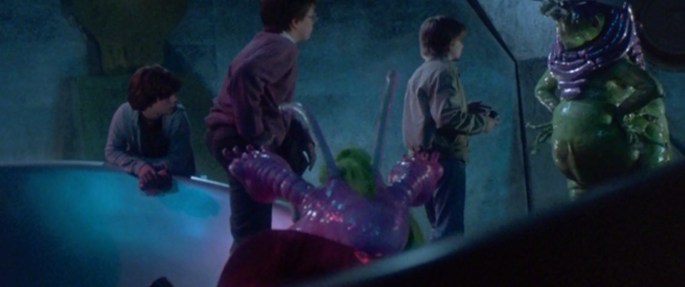
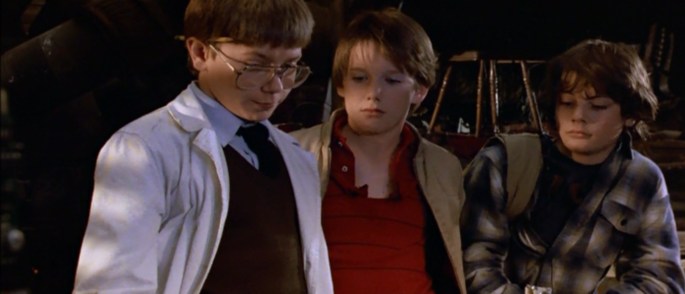
The plot centers on a trio of extremely adventurous young boys, played by Ethan Hawke, River Phoenix, and Jason Presson, all of whom are obsessed with computers and inventions and sci-fi movies and video games. They all start to have the same interconnected-dreams, which inspires them to build a homemade spaceship, which they then use to blast off into outer space, where they’re greeted by some pop-culture loving aliens who have some interesting ideas about what’s going down on planet Earth. John Hora’s phenomenal, Amblin-esque cinematography busted out the lens flares and made everything look casually stylish if never ostentatious. Look out for James Cromwell, Dick Miller, Robert Picardo, and Mary Kay Place in supporting roles.

7

Nothing is forced, the film has an innate understanding of what it’s like to be a 12 year old boy, the sense of discovery is palpable all throughout the narrative, and it absolutely nails those feelings of your first crush (lovely Amanda Peterson was the object of affection for Hawke on-screen, and whose attention was apparently competed for by Hawke and Phoenix off-camera, or so the rumor goes). Released in 1985 and featuring imagination-stirring special effects work by ILM and extremely fun make-up effects for the aliens, which were designed by cinematic legend Rob Bottin, Explorers didn’t catch on at the box office, slipping in and out of theaters before becoming a massive cult favorite due to the explosion of VHS in the 80’s. The masterful score was composed by Jerry Goldsmith.

2-4

Mark Pellington’s The Mothman Prophecies: A Review by Nate Hill 

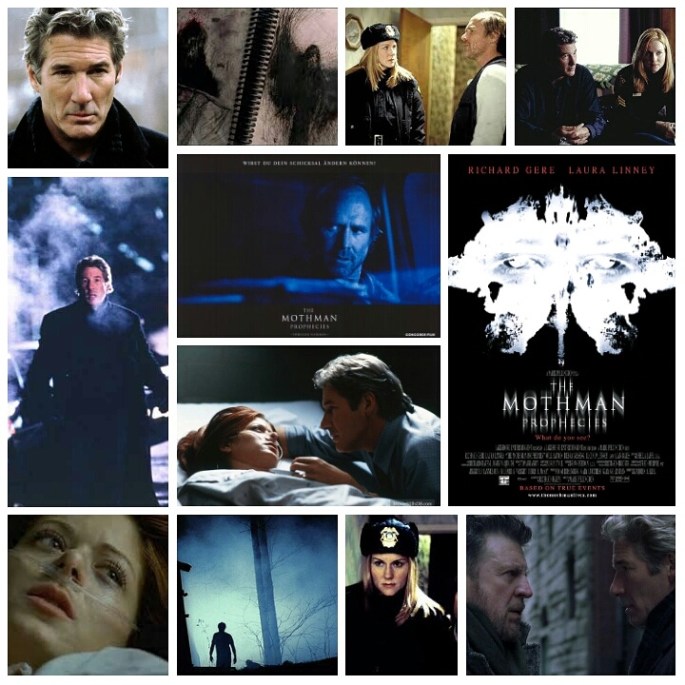
Mark Pellington’s The Mothman Prophecies takes a harrowing look at a curious set of events that did indeed occur for real in the rural West Virginia area. Now, just how much of what we see in the film actually happened is eternally unclear, but I’ve read up on a lot of it and there’s enough testimonials, independent of each other, to both justify the film and shiver your spine. A myriad of unexplainable phenomenon plagued those poor people for some time back then, including visions, eerie phone calls and a mysterious red eyed creature in the shape of a giant moth. Businessman Richard Gere and wife Debra Messing come face to face with what appears to be this entity one night on a lonely stretch of highway, causing a grisly car crash and leaving Messing in a dire psychological state. With the help of a local policewoman (Laura Linney), Gere unwisely tries to figure out this terrifying mystery by putting himself way closer to the occurances than I would ever go, experiencing the stuff of nightmares along the way. Pellington comes from a music video background and as such he is incredibly adept at creating style and atmosphere (his opening credits for Arlington Road are almost as foreboding as anything in this film), two key elements in successfully telling a tale such as this. Gere wanders around in a daze most of the time, distraught over his wife’s condition and obviously influenced by forces unknown. Whatever is out there remains blessedly unseen save for a few hurried glimpses, say, behind a tree or at a kitchen window momentarily, spurring heart attacks from both audience and the poor sods stuck in this brooding bad dream. Rounding out the cast is Alan Bates as the obligatory historian who has seen this all unfold previously in some far corner of the world, and an excellent Will Patton in a frightening turn as a rural farmer who comes who becomes tragically influenced these dark forces. No one plays disturbed quite like him, a jittery, resolute calm always playing around in his eyes, the perfect presence to set anyone on edge. The finale sort of emerges from the chrysalis of dark atmospherics into large scale disaster mode, a choice which didn’t really work for me. I would have preferred to have it kept intimate and creepy right up until some kind of moody end, but they went with fireworks instead. Not enough to hurt the film of negate what came before though, it’s just too good of a time in the haunted house to be dragged down by anything, really. Chilling stuff. 

ROBERT ALTMAN’S CALIFORNIA SPLIT — A REVIEW BY NICK CLEMENT

3

Breezy, funny, and feeling almost cinematically stoned, Robert Altman’s genial yet somehow distressing gambling comedy California Split is a film that has a deceptive undercurrent of sadness to match its potent study of male bonding while exploring the importance of true camaraderie. Centering on two life-long casino-junkies, one a bit more slightly involved than the other initially, the playful and observant narrative pivots on Charlie Waters (Elliot Gould in one of his loosest performances) and his buddy Bill Denny (George Segal, amazing as always), as we watch them search for the biggest jackpot of their lives in Reno. Ann Prentiss and Gwen Welles were both extremely funny in supporting roles as Charlie’s prostitute roommates, and the film features an early screen appearance from Jeff Goldblum. I loved the naturalistic cinematography by Paul Lohmann, who had just previously shot the iconic Blaxploitation movie Coffy and would become a frequent Altman collaborator, while the editing kept a very quick pace without sacrificing any sense of heft or dramatic importance. The script was written by Joseph Walsh (who also appeared as Bill’s bookie, Sparkie), who reportedly worked on the script with Steven Spielberg for close to a year during the earliest stages of the script’s life.

1

Steve McQueen, Peter Falk, and Robert De Niro were all attached at various points during the film’s lengthy development process (it changed studios from MGM to Universal), and at one point while the film was at MGM, the studio wanted to position it as a Dean Martin-led project with a mafia flavor. Reviews were extremely positive and the film did solid box office despite not having a long theatrical life; various rights issues, mostly stemming from musical inclusions, have prevented Altman’s original cut to hit the physical media market. Former world champion poker player Amarillo Slim appeared as himself during the climactic match. The film is also famous for its pioneering sound techniques, as it’s the first movie ever to use the eight-track sound system, which allowed for eight separate audio channels to be recorded, which of course fed directly into Altman’s personal obsession with overlapping dialogue and ambient sounds. Last year’s fantastic and vastly underseen Mississippi Grind, with Ben Mendelsohn and Ryan Reynolds, was essentially a very smart updating of this timeless material. Available on DVD from Mill Creek, sans extras/special features, but showcased in 2.35:1 widescreen.

2

MALCOLM X: A Review by Joel Copling

**** (out of ****)
Denzel Washington, Angela Bassett, Albert Hall, Al Freeman Jr., Delroy Lindo.
Directed by Spike Lee. Written by Lee and Arnold Perl, based on the book by Alex Haley and Malcolm X.
Rated R. 203 minutes. 1992.

Like Amadeus and Raging Bull a decade before it, and Ali and The Aviator a decade after, Spike Lee’s galvanizing Malcolm X is one of the great screen biographies (joining Nixon in that categories for a pair from the 1990s), never taking for granted the hero status of its polarizing figure, but examining his psychology and what made the man into the martyr. Superficially, the structure is not uncommon. We see his upbringing, born Malcolm Little in Omaha, Nebraska, to a father later probably killed by the Ku Klux Klan in a “streetcar accident” and a mother who loses her nerve as swiftly as she loses the ability to support Malcolm and his brothers. He later leads a life of drugs, pimping, gambling, and racketeering, before being imprisoned, partially for cavorting with white women while doing so. In prison and after, he becomes smitten with the teachings of Islam, in particular through the mentoring of Elijah Muhammad, the leader of the Nation Islam. Black supremacy, in the guise of black self-reliance, is the subject of the teachings, as Malcolm, who sheds his “slave” surname and replaces it with the letter “x,” learns that all white men are devil spawn. After a pilgrimage to Mecca, he becomes considerably less radically anti-white, though returning the African diaspora from the Americas, Europe, or anywhere else to their mother continent remains his message until his violent assassination, probably by Elijah Muhammad’s henchmen within the Nation of Islam,  with which he becomes increasingly disenfranchised over the course of his life. Here is that life, entirely and sprawling, portrayed in just less than three-and-a-half hours by Lee and co-screenwriter Arnold Perl (adapting Malcolm X’s own autobiography, co-written by Alex Haley, presumably after the man’s murder), who earn the gargantuan film’s every minute. We see this man live, breathe, fear, love, hate, doubt, firmly believe, and orate, and in an astonishing performance that ranks among the best in the movies, Denzel Washington captures the spirit, the controversy, and the humanity of this great man. Surrounding him is a superb supporting cast, each of whom I could name, but at the center is Washington’s disappearance into the role of any actor’s lifetime. It’s a performance of great courage in a film of great candor.

Cherry Falls: A Review by Nate Hill 

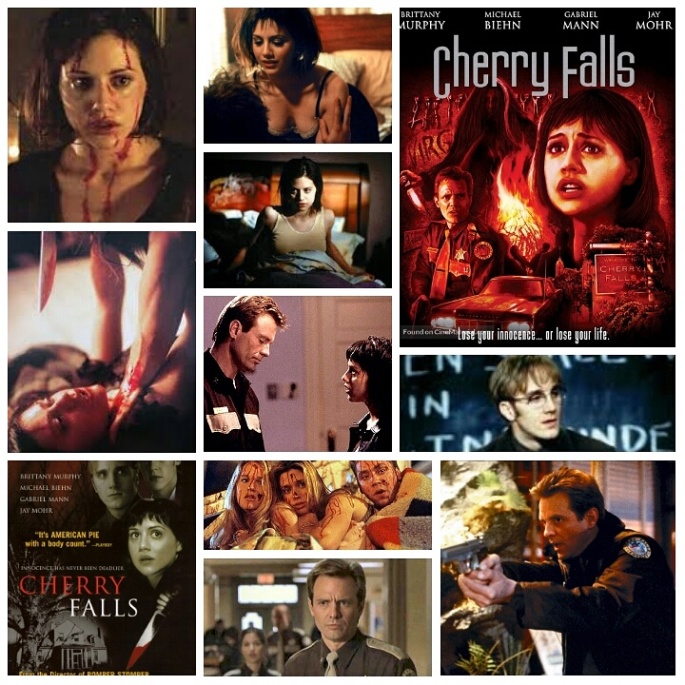
The slasher genre never got a tune up quite like it did with Cherry Falls, a tongue in cheek satire that while hilariously high concept and silly, can actually be pretty frightening, especially during it’s intense climax. Here’s the premise: Cherry Falls is a small town in Virginia that has fallen prey to a masked serial killer. The twist? Said killer is only targeting virgins, which causes quite the uproar. As the high school kids all scramble to get laid before they get laid six feet under, the prudish townsfolk become unhinged and disgusted by the whole affair, and a decades old secret involving some of the town’s best and brightest comes to light, a scandal to rival tr sleazy parade of flesh this murderer has set into motion. Young Jody Markum (Brittany Murphy) has yet to have her cherry popped, and fears for life in between bouts of teenage angst. Her father (Michael Biehn), who also happens to be the town sheriff, wrestles with demons in his past, as well as his own. A schoolteacher (Jay Mohr) scours the town archives for clues before it’s too late. And every horny adolescent tries to desperately get their freak on, providing some of the funniest moments you’ll see in a fright flick. Gymnasium orgies, rampant fornication and all kinds of naughty antics ensue. Nothing beats the faculty meeting where parents violently argue as to who has the sluttiest offspring. Full of in jokes, innuendo and sly sexy humour, this is one of the great overlooked horror comedies out there. 

PAUL GREENGRASS’ CAPTAIN PHILLIPS — A REVIEW BY NICK CLEMENT

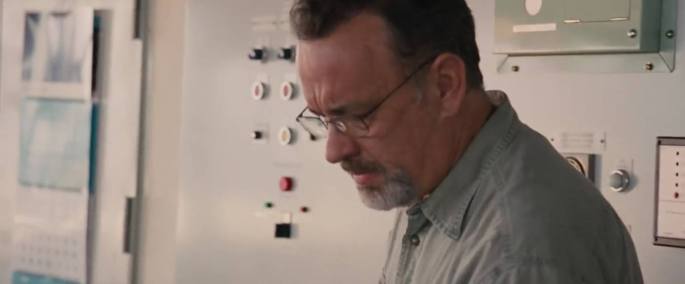
3To say that I’m a fan of the visceral filmmaking aesthetic of director Paul Greengrass would be a massive understatement. I think he’s a genius, and he’s one of my absolute favorite directors. From the stunningly realized recreations of real-world tragedies as depicted in masterpieces like Bloody Sunday and United 93 to his fantastic studio-based work on the Bourne franchise and the supremely underrated Iraq war thriller Green Zone, he employs a certain degree of cinematic verisimilitude that I find thrilling and immediate to experience. 2013’s Captain Phillips found him working with a nearly-career-best Tom Hanks on the true story of a freight ship captain who is taken hostage by Somali pirates on the open seas. Newcomer Barkhad Abdi was terrific as Hanks’s main nemesis, projecting both desperation and anger in an extremely vivid, unpredictable performance. \

2

Billy Ray’s compressed and tight screenplay fed very well into Greengrass’ inherently stripped down storytelling instincts. Ace cinematographer Barry Ackroyd (The Hurt Locker, United 93) kept the camera swerving and ducking, and in tandem with the staccato editing patterns of Chris Rouse, the film maintained a break-neck momentum for two, extremely tight hours, demonstrating nearly unrelentingly intensity. And then, when those final five minutes arrive, with Hanks pulling out all the stops and shattering the screen in an emotional juggernaut of acting – it’s not only his character’s catharsis but that of the audience, too. One of the best “ripped-from-the-headlines” thrillers of all-time, this is a crisp and clean actioner with important topical overtones, and produced with a phenomenal sense of the here and now.

1

JFK: A Mini-Review by Joel Copling

**** (out of ****)
Kevin Costner, Kevin Bacon, Tommy Lee Jones, Joe Pesci, Sissy Spacek.
Directed by Oliver Stone. Written by Stone and Zachary Sklar, based on the book by Jim Garrison and Jim Marrs.
Rated R. 201 minutes. 1991.

Note: This mini-review is based on a viewing of the director’s cut of JFK.

The late, great Roger Ebert once said, “I don’t have the slightest idea whether Oliver Stone knows who killed President John F. Kennedy,” and that pretty much sums up my own thoughts on the matter. Oliver Stone’s JFK is, purely, simply, and truly, an examination of so-called “facts,” a conclusion that those facts are likely made of whole cloth, and a hypothesis that fills in the gaps with what Stone believes are probably the events. He is imparting truth here, not procedural facts about the killing of the 35th President of the United States of America. He tackles, through his protagonist Jim Garrison, the man on whose book (co-written by Jim Marrs) Stone’s screenplay (co-written by Zachary Sklar) is based and who is played by Kevin Costner, the facts of the assassination as provided to the American public by the government who investigated it. Garrison finds damning evidence in every nook and cranny, as witnesses and accomplices are killed with impunity and under curious circumstances or otherwise bought to keep silent, a series of connections are uncovered between the American government, the Dallas Police Department, and the branch of the Dallas mob that resided in the metroplex, and supposed assassin Lee Harvey Oswald’s guilt begins to appear increasingly coincidental. The footage of the actual shooting, captured by onlooker Abraham Zapruder, establishes, rather unexpectedly, evidence of more than one rifle used in the crime. A mysterious former military man lays the groundwork for Kennedy’s assassination at the feet of a U.S. government that desires war for financial viability. Stone’s most monumental achievement lay in Joe Hutshing and Pietro Scalia’s editing, which makes sense of the labyrinthine investigation laid out before Garrison, and in the astounding cast: Costner, sympathetic as Garrison; Tommy Lee Jones, superbly indifferent as primary defendant Clay Shaw; Gary Oldman, adopting Oswald’s unique vocal inflection and affording great humanity to a man seen around the world as a villain; Joe Pesci, a bundle of nerves as getaway pilot David Ferrie; Sissy Spacek as Liz Garrison, increasingly tired of her husband’s seeming obsession with the assassination; Jay O. Sanders, Michael Rooker, Wayne Knight, Gary Grubbs, and Laurie Metcalf as Garrison’s army of investigators; Donald Sutherland, fascinating in his single-sequence appearance as “X,” the mysterious whistle-blower later identified as Fletcher Prouty, who offers crucial points in Garrison’s investigation; Ed Asner, Jack Lemmon, Walter Matthau, Kevin Bacon, and John Candy, all solid as various figures within the investigation itself. The film weaves in, around, and through the varied ways that Oswald could not have acted alone. This, Garrison and the film reckon, was a conspiracy, and the result was a murder of great mystique, political expediency, and, worst, arrogance that led a consortium to believe a story with this many holes would survive scrutiny.