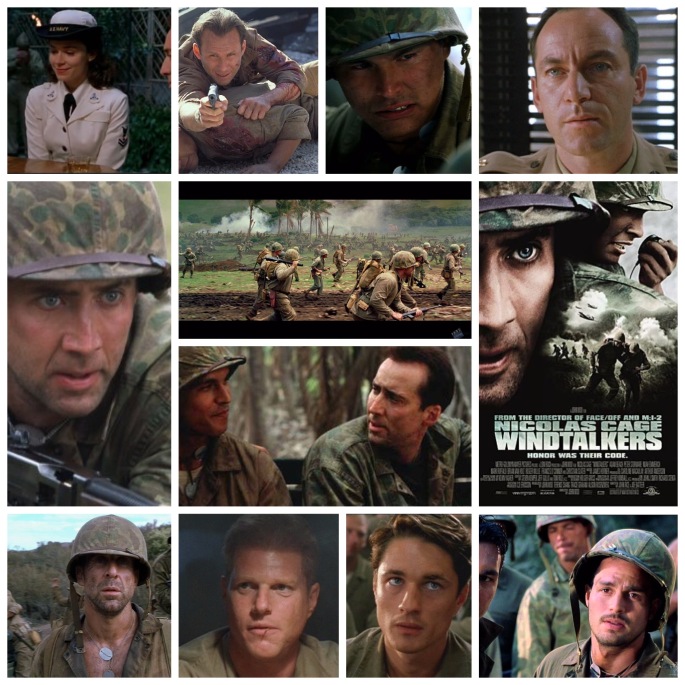
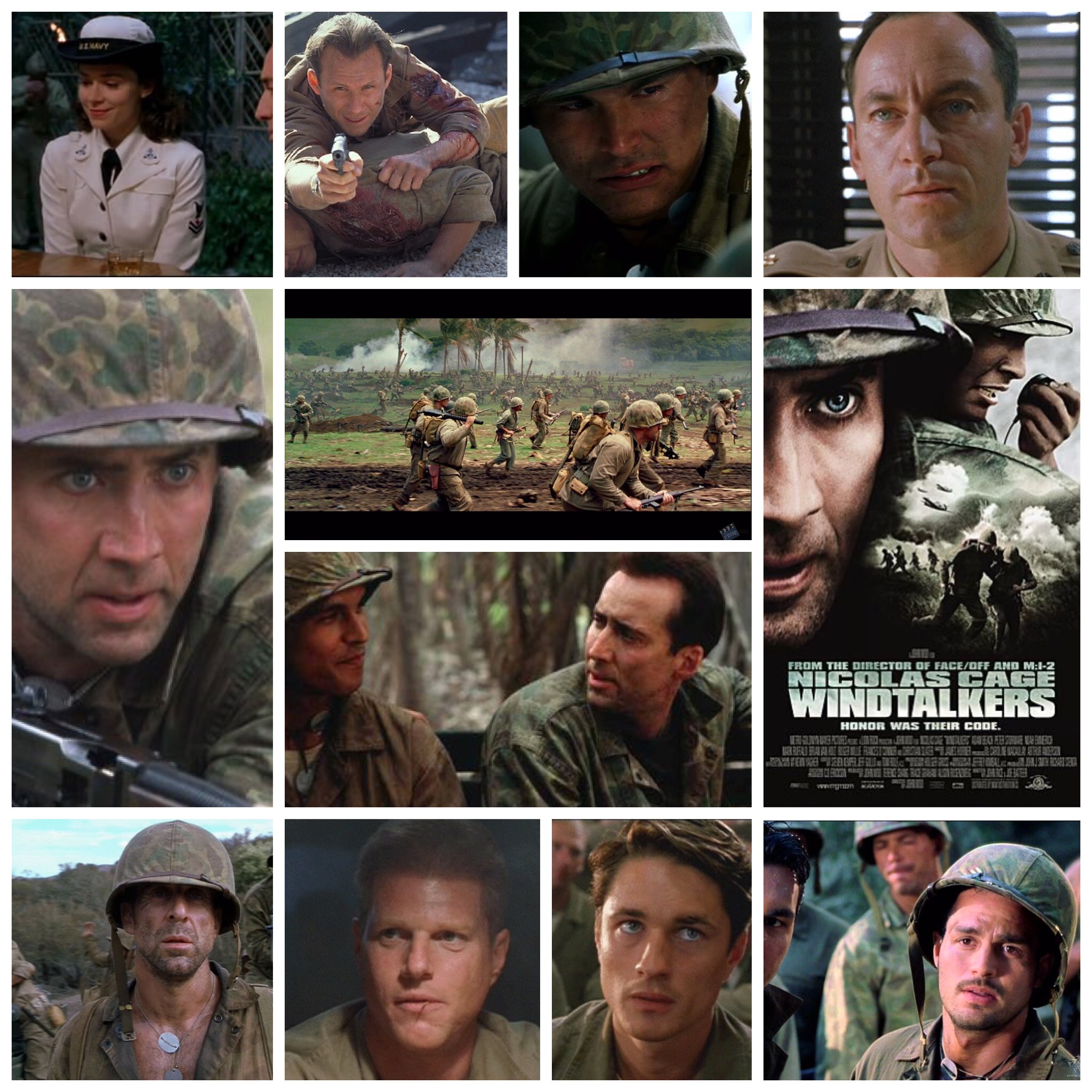
John Woo’s Windtalkers


John Woo’s Windtalkers is a brutal, somber, joyless affair, a muddy and hopeless war picture that contains little of the ethereal poise of stuff like The Thin Red Line or heroic muscle such as Saving Private Ryan. As long as you can adjust and tune into it’s frequency it’s a well made, sorrowful look at the American effort against Japan, particularly a mission involving a regiment whose task is to protect Native Navajo code breakers that can detect messages fired off by the enemy. A mopey Nicolas Cage is their shell shocked leader, pressing his men onward into territory that no doubt contains the same horrors he witnessed before the film begins. We find him in a trauma ward initially, cared for by a kindly nurse (Frances O’Connor), until Jason Isaacs cameos as the recruitment officer who spurs him back into action. His troupe is composed solely of excellent, distinct acting talent and they help the film considerably. The Navajo are played by Adam Beach and Roger Willie, giving grace and nobility to two men who are out of their depth and terrified. Peter Stormare, Christian Slater, Noah Emmerich, Mark Ruffalo, Brian Van Holt and a standout Martin Henderson are the rest of the troops, each getting their moment to shine within the unit’s cohesive arc. Woo is an odd choice for a war picture, and his stylized flair for bullet ridden action is nowhere to be found in these bleak, bloodied trenches, trading in suits and duel wielded glocks for faded camo and muted rifle fire. The action is neither cathartic nor poetic, simply a concussive cacophony of combat that offers little aesthetic pleasure, forcing you to find the value in empathy towards these men, and as long as you can do that, you’ll get something out of it. 

-Nate Hill

Episode 49: Patty Jenkins’ WONDER WOMAN

Image result for wonder woman photo

Join Tim and Frank as they discuss WONDER WOMAN. They discuss the influences, the current state of the DCEU, where the WW franchise will go from here, and what this film means for the DCEU and the genre in general.

LUC BESSON’S THE FIFTH ELEMENT — A REVIEW BY NICK CLEMENT

1

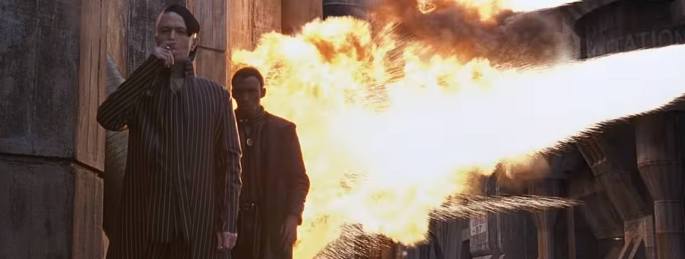
Luc Besson’s wild and wacky sci-fi action film The Fifth Element is one of the most insane pieces of eye-candy ever devised, with a cartwheeling sense of manic energy, absolutely stunning production values, an overstuffed screenplay, and performances that range all over the map in terms of tone. I can vividly remember seeing this film with my parents on opening day during the summer of 1997, and being a massive fan of Leon, I was totally jacked to see it. And while I was fully entertained and most definitely overwhelmed by the film upon first viewing, over the years I’ve revisited this distinctive piece of work numerous times, and the film simply gets better and better. There’s also an extended male-on-female oral sex joke sequence that goes on for an extended period of time, and I truly don’t get how the MPAA let that one slide, but I love it regardless! This film has a brazen sense of its own self, and I love how Besson seemingly didn’t care about anything except for his exploding imagination and letting everything rip and fly. And the blending of CGI with practical and in-camera effects is rather stunning to observe all throughout.

2

Everyone was off their ass in this film, most especially Chris Tucker, who took a role that was originally conceived for Prince, and blasted his way off the screen as one of the most obnoxiously over the top characters ever to enter a film at more than the half-way point. Thierry Arbogast’s ridiculously stylish cinematography was in perfect synch with the gaudy costumes designed by Jean-Paul Gauthier and the eye-filling production handled by the brilliant Dan Weil. Besson and co-writer Robert Mark Kamen’s script is a hodgepodge of ideas and tropes that is both silly and serious in equal measure. The flying cars and futuristic cityscapes still dazzle, and positively pop in the Blu-ray format. Gary Oldman went to the moon and back in this film, and Bruce Willis did a reliably great job as the hunkered down bad-ass who has to spring into action and handle business. I’ve enjoyed most of Besson’s directorial offerings, and this one is near the top of the list for me. But I don’t think anything will ever unseat Leon as his crowning cinematic achievement, as that film really means something special, especially the international director’s cut.

3

TSUI HARK’S TIME AND TIDE — A REVIEW BY FILMMAKER & GUEST CRITIC DAMIAN K. LAHEY

TimeandTidePoster

‘Time and Tide’ (2000) dir. Tsui Hark

Hands down, this is one of my favorite action movies. Wicked stunts, wonderful characters, well placed humor – this is a film that comes together in a perfect blend of movie madness!

But what I LOVE about it more than anything is that there is NOTHING to compare it to. When I recommend this film to people I am not comparing it to other iconic actioners. I am not saying stuff like: ‘Dude, it’s like ‘Die Hard’ meets ‘Speed”’. No way, ‘Time and Tide’ is its own thing. Such a singular achievement in a genre bogged down in derivative mediocrity.

Check out this plot. Our directionless hero has a drunken one night stand with a lesbian cop, gets her pregnant and then becomes part of a security detail for a shady businessman in order to take care of their child. He winds up entangled in a convoluted web of shifting alliances, stolen money, violent mercenaries and along the way learns the value of friendship and true love. Sound confusing? It is. But it works. Amazingly so.

And here’s something else that this film has to be commended for. In many instances the non action sequences in films of this type are merely filler. You know it to be true. We’re just biding our time during uninspired plot points in order to get to the next action sequence. In ‘Time and Tide’ everything is watchable. Every beat is electric. Everything naturally propels itself to the next scene. The narrative hits a magic sweet spot where even when it falters – we are swept up in the emotionalism, performances, and aesthetics so that it all seems JUST RIGHT.

Serious credit needs to go not just to Hark’s direction but to the vibrant cinematography of Chiu-Lam Ko and Herman Yau as well as the natural chemistry between actors Nicholas Tse and Wu Bai with fantastic support from Anthony Wong and Candy Lo. It is said that the legendary Hark found a different film than what he originally shot and intended to make while in post-production. And this is certainly reflected in the film’s eccentric rhythm. For those that thrive on action flicks that have their own voice – this one’s for you!

TimeandTideStill

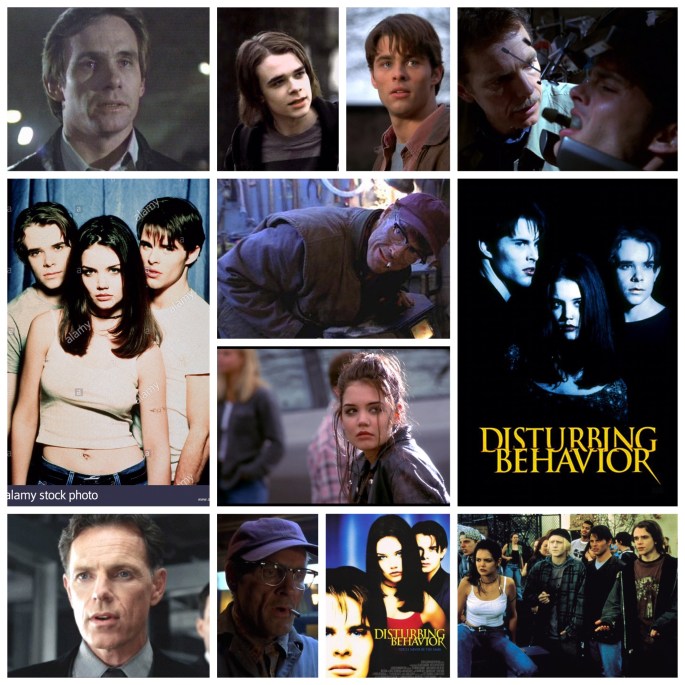
Disturbing Behaviour 


Everyone knows that high school teenagers are the most lawless, degenerate, ill adjusted scoundrels out there, but what to do about it? Radically unethical, mandatory brain modification of course, or at least that’s what mad scientist school principal Bruce Greenwood has in mind in Disturbing Behaviour, a Scream/Faculty esque 90’s shocker that didn’t get half the attention it deserved upon release. Shame because it’s a sleek, well oiled little horror outing. James Marsden and Katie Holmes are the new kids in town, siblings thrust into the savage Serengeti of high school and forced to jump through that fiery hoop of social interaction. Nick Stahl channels his inner awkwardness as the brooding outcast who befriends them, and the trio soon notice some weird activity from their peers. Behavioural patterns are erratic, robotic and vicious, their classmates seemingly not themselves anymore. A creepy local cop (always nice to see Steve Railsback) seems to know what’s up but eerily keeps it hush hush, and calmly maniacal Greenwood definitely has a few skeletons in a few closets. It’s up to them to figure out what’s going on, escape the cerebral rescanning net before they end up dead or worse. Assisting them is a scene stealing, nearly unrecognizable William Sadler as the school’s eccentric, hard-nosed janitor. Working from a script by word wizard Scott Rosenberg and beautifully spooky cinematography from John Bartley that captures the unsettling North Vancouver and Bowen Island coastlines, this flick has a lot going for it and should have gotten way more kudos. 

-Nate Hill

DAVID MICHOD’S WAR MACHINE — A REVIEW BY NICK CLEMENT

1

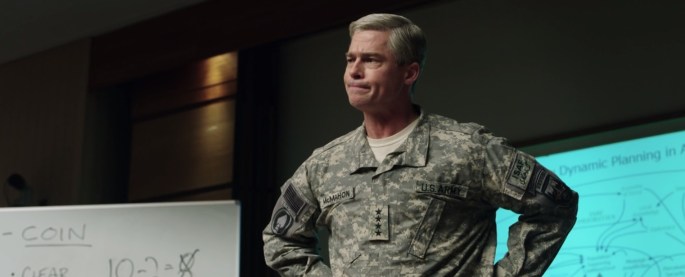
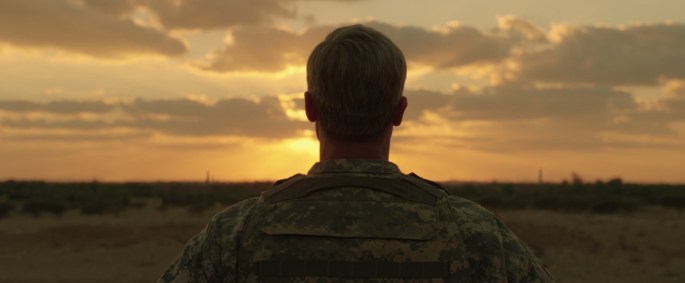
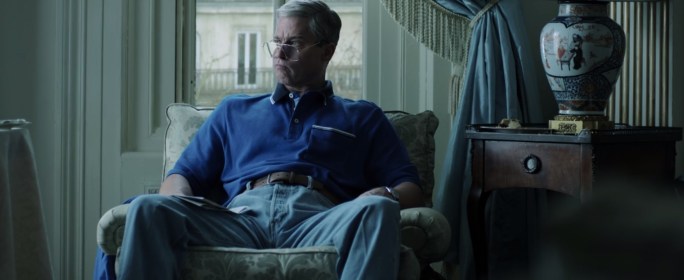
I’m not exactly sure what all the bitching and moaning was about (56% at Rottentomaotes – are you kidding me?!), but from where I sit and view cinema, the new Netflix original movie War Machine, from hot-shot director David Michod (Animal Kingdom, The Rover) is a pointed, extremely funny, and often times sad commentary on the war in Afghanistan and how the American military simply could never fully understand the ramifications of doing what they’ve done in the middle east. Brad Pitt is absolutely terrific as General Glen McMahon, a fictionalized version of General Stanley McChrystal, a take no nonsense commander who was given the unenviable task of “fixing” the situation in Afghanistan, something that he could never possibly have done, as he very quickly learned. One thing leads to another in this wild and woolly tale, and one of the things that I admired most about the film is that it carries a persistent “This is Fucked” vibe that’s both startling and humorous.

war_machine_xlg

Pitt and the excellent ensemble cast, including Alan Ruck, Scoot McNairy, Anthony Michael Hall, Emory Cohen, Ben Kingsley, Topher Grace, Meg Tilly, Will Poulter, and Tilda Swinton, who gets one of the best and most ferocious scenes of the film with her reporter character going straight for the jugular, were clearly in match-step with one another, as Michod’s script, which was based on the book The Operators by Michael Hastings, is filled with sly yet upfront humor that rolls off the tongue, with an especially lacerating quality in various key spots. The outright hubris that was demonstrated on the parts of various government officials during these stages of the “War on Terror” is ridiculous to note, and the backwards and reductive approach to troop involvement is very much shown on screen. Cinematographer Dariusz Wolski (The Martian, Dark City) shoots in a straight forward fashion, never calling attention to the images, but still giving the film a very polished and stylish look.

2

I absolutely love topical filmmaking and seeing stories about our current geopolitical conflicts. I’m not a “too soon” cry-baby (United 93 is and always will be a masterpiece) or someone who is easily rattled by Hollywood taking poetic license with the facts. Movies are movies, documentaries are documentaries, and when I watch something that’s ripped from the headlines, I can accept the fact that filmmakers have to change certain things around, condense characters and situations, and approach the material with a strong viewpoint in order to get their message across. War Machine is the sort of film that would have been funded by a major studio in past years, but because it doesn’t fit the current franchise-driven corporate mold and isn’t a safe “Oscar bet”, Netflix took action and made a relevant and smart piece of entertainment that sadly not enough people will check out. This is definitely not an empty-headed action picture, but rather, a film that has something on its mind that’s worth saying.

3

What Michod does so well in War Machine is present the absurdity of the situation, while piling on incident and conflict, with characters who shuffle in and out of the narrative who don’t ever have a full idea as to what’s truly going on around them. I don’t want spoil anything as there’s any number of scenes that are outrageous in their content and deeply funny because of the absurdity on display. The varied musical score by Nick Cave and Warren Ellis plays up the comic uncertainty of the entire operation while still getting tense when required, while Peter Sciberras keeps a fast pace via tight editing; look out for a hilarious cameo during the final scene for one last kicker. And hey, if this isn’t your cup of tea and you stories cut from the world around you aren’t of interest, the latest and greatest in CGI-idiocy is playing down the hall or available to stream on various platforms. Me? I’ll take a bitter, ruthless, smarty-pants satire like this any day of the week, as War Machine further cements Michod’s arrival as a new and distinctive cinematic voice to take note of.

55


Review: Michael Mann’s subversive ‘Blackhat’ is uniquely familiar.

In the past, if you wanted to steal money, you would hire a professional safe cracker or you might grab a few ski masks and AK-47’s to rob a bank in broad daylight.  In those instances, people didn’t get hurt as a result of the stolen money, only institutions.

Today, sophisticated criminals use the digital world to do their dirty work – hackers and network specialists hide their trails among the 1’s and 0’s; the bits and bytes of data.  If you’re good enough, you might even be able to affect the course of every day goods and services, thus affecting everyday people.

If both of these scenarios sound like the basis of any number of Michael Mann’s films, you’d be absolutely correct.  And, while we pay homage to Thief and Heat, we must acknowledge his foray into the digital underworld with Blackhat.

Inspired by the Stuxnet computer worm, Mann worked with former editor turned screenwriter Morgan Davis Foehl to deliver a taut, if somewhat glacially-paced thriller.  Chris Hemsworth plays Hathaway, an imprisoned hacker who is furloughed when a nuclear reactor overheats and a stock exchange is hacked, causing soy futures to rise.  Hathaway’s former college roommate, Chinese captain Chen Dawai played by Leehom Wang discovers that Hathaway’s code was used to infiltrate the various affected systems.  Viola Davis plays FBI Agent Carol Barrett.

Foehl’s script is steeped in rich characters and locations that span the globe while Mann, true to his form, is authentic to his subject matter maintaining his tried and true style of filmmaking.  The result is a thriller that modern audiences can relate to.

Hemsworth’s casting was criticized at the time of the film’s release, suggesting that he looked too good to be a hacker.  However, he carries the narrative and his magnetic attraction to Chen Lien (Tang Wei), Chen Dwai’s sister, is as strong as Eady’s relationship with McCauley in Heat, Isabella and Crockett’s relationship in Miami Vice or Jessie’s relationship with Frank in Thief – each of these relationships are just as dynamic and as important to the overall story.  Mann chose to use Lien here as much as he used Isabella in Vice; each a fundamental reason why our main protagonists continued on to their logical conclusions.

If there were any criticisms here, they would be leveled at the antagonist, Sadak played by Yorick van Wageningen.  Although he was vindictive enough to have cooked up the plan, his motives were not well-laid out, though they are understood.  Sadak is not the anti-hero we are used to seeing and there is not the same dynamic between he and Hathaway, giving us only glimpses of threats under the murkiness of the Internet.  Perhaps, this is the film’s genius in that today’s society can very easily hide behind a firewall, never meeting another real person, releasing threats with just the stroke of a couple of keys.

For dramatic purposes, that theory holds water.  But we need meat and potatoes, people.

Where McCauley had a dynamic relationship with Vincent Hannah or Vincent had with Max, the virtual dynamic here is nowhere near as strong as the aforementioned visual dynamics.  For Blackhat, the visual dynamic is laid between Hathaway and Kassar (Ritchie Coster), Sadak’s henchman who also operates in the shadows, but is more representative of the worldly threat.  And, this is the film’s major downfall.  The story could not balance all three relationships.

Stuart Dryburgh carried on the photo-realistic look that permeates Mann’s films, similar to Dion Beebee’s work in Miami Vice and even more reminiscent of Beebee’s and Paul Cameron’s work in Collateral where the colors are oversaturated and the image is frenetically on the move, almost as if they smeared Vaseline on the edges of the lens and paned the camera rapidly.  The use of 2.35:1 really lent a global perspective to the film, becoming a character of its own.

Harry Gregson-Williams and Atticus Rose each contributed to the film’s score.  Reportedly, Mann abandoned Gregson-Williams’ score almost completely favoring Rose’s despite both getting screen credit.

I saw the film when it hit theaters in 2015 and I was not initially a fan. Like any good Mann film, I gave it the benefit of the doubt.  FX recently debuted a director’s cut of the film which makes one major change in the film’s timeline, but doesn’t take or add any additional scenes.  The change does improve the flow of the film.

Blackhat is a unique entry in Mann’s collection of film, authentic to its core while carrying his familiar themes.  Despite my earlier misgivings, it is better than I remember and is a worthy addition to his body of work.

John McTiernan’s Predator – 30th Anniversary

This week was the 30th anniversary of John McTiernan’s iconic science-fiction action film Predator.  For their next discussion, Ben and Kyle talk about their love for the film why it remains an important part of American action cinema.

predator-featured-e1485055357488 (1)

KYLE: Ben, can you give us the background?

BEN:  In the fall of 1985, there was a joke running around Hollywood that Rocky Balboa had defeated all of his earthly opponents in Rocky IV and he would have to fight an alien if a fifth Rocky film were to be made.  Based on that idea, the unknown brother-writer team of Jim and John Thomas would morph the joke into what became John McTiernan’s second directorial turn, Predator.

20th Century Fox optioned the Thomas’ script, then entitled Hunter and gave it to producer Joel Silver, who was also developing Lethal Weapon for Warners.  Silver brought on Lawrence Gordon and John Davis as his producing partners and they brought on Arnold Schwarzenegger, whom Silver had worked with on Commando, also for Fox.

200_s

KYLE:  I had no idea that the idea sprung from a Rocky joke!  Let’s dig into it.

BEN: Part Aliens, part The Thing, part Commando and full of machismo, McTiernan delivers a pulse-pounding action thriller that understands its purpose as both a sci-fi actioner and a military thriller.  It successfully blended both aspects together, dwelling on neither for too long.  From a story that reeks of the global socio-political situations in the mid-1980’s to an alien creature that is as well-hidden as its Xenomorph brethren from Alien and Aliens, they delivered something very unique.

KYLE: I love that it’s a merging three separate genres that unfolds over three unique acts.  It begins as a military thriller (love your term!) and then transitions into an And Then There Were None scenario during the second act.  Finally, it ends with a man vs. monster showdown that removes not only the established rules, but reveals the creature’s monstrous nature.   What about the amazing cast?

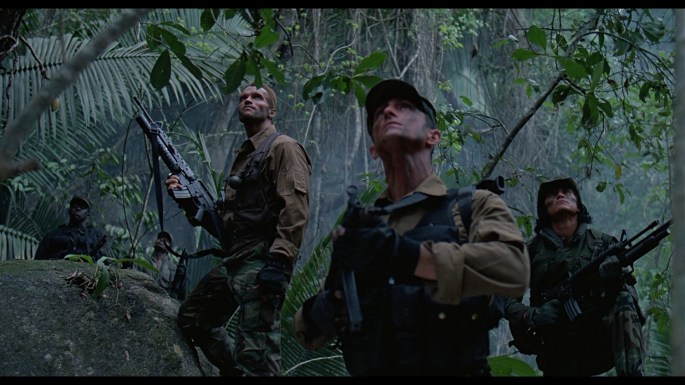
BEN: Schwarzenegger plays “Dutch” the leader of an elite group of soldiers who are tasked with retrieving a missing U.S. diplomat in the South American jungles.  Opposite him, in an ironic twist is Carl Weathers, who plays Dillion, an old friend of Dutch’s. The irony was that he played Apollo Creed in the-then four Rocky films.

While we all cheer for Schwarzenegger, the supporting cast really is the foundation of this film.  Bill Duke, who also starred in Commando with Schwarzenegger is beyond awesome, especially when he gets pissed off.  Sonny Landham, who starred in 48 Hrs. plays Billy, a ‘tracker’. Billy really resonated with Shane Black’s “Hawkins” raunchiness, which Billy only partially gets.  The gunner, Blaine is played by Jesse Ventura.  He looked like he had a lot of fun with this role, especially when he interacted with “Poncho” played by Richard Chaves: “I ain’t got time to bleed.”  “You got time to duck?”

arnold-schwarzenegger-as-dutch-in-predator

KYLE:  Yes!  I think it’s a testament to the script in how well each of the characters are distinctly developed.  It could have been easy to overdo the action and violence, but instead the story takes its time deliberately fleshing out each victim so their eventual death has more impact.  You mentioned machismo, and while I agree, there’s also a bit of deconstruction, such as Mac’s monologue to Blaine before the pig attack and Billy’s supernatural fear of the creature.  Speaking of, it was Stan Winston’s design right?

BEN: Interestingly, Richard Edlund developed the original creature, which proved unworkable in the jungle.  It was scrapped and redeveloped by Winston with the help of an unlikely source:  James Cameron.  R/Greenberg Associates, who received critical acclaim for their opening credits work on 1978’s Superman, were on board to help supervise the practical effects, giving us the now familiar infrared imagery from the Predator’s perspective.  The 1.85:1 aspect ratio that McTiernan and Donald McAlpine shot the movie in gave the film a visual intimacy, allowing the Predator to blend into the jungles, only revealing him late in the second act.

KYLE: I think that is one of the entire franchise’s best elements, how they weave together the POV’s of both the human characters and the alien.  McAlpine’s eye really captures some amazing shots, the intro of the team as they arrive in a helicopter in low light is fantastic, as is the wide shot of Poncho and Blaine underneath the hill as it explodes.  Every time the creature is revealed with that mask is both stunning and chilling.

BEN: Jean Claude Van Damme was originally signed to play the Predator, but it was thought that he was not menacing enough.  Kevin Peter Hall, who also played Harry in Harry and the Hendersons and would reprise his role in Predator 2 in 1990 filled the costume with his 7 ft 2 in frame.  He was the perfect size to play the behemoth.  Sadly, he died in 1991 at age 35.

Underscoring the onscreen action and the drama, was maestro Alan Silvestri.  His bombastic military themes, with deep brass expanded the stage while the brooding sci-fi themes underpinned the otherworldly nature of not only the Predator, but the jungle itself.
predator-dutches-team-2.jpg

KYLE: That is a great point!  From the second they repel down into the jungle, the viewer knows they’ve left the safety of the civilized world and entered a place of extreme danger.  The brotherhood building fantastic, because the characters (for the most part) work together against the threat, rather than it becoming a three-way dance between oppositions and I really respect that choice.  I think it’s one of the reasons the film remains a personal favorite for so many film lovers.

BEN: Watching the film on a big screen the other night was a treat.  The film’s looks hold up and its story is relevant today.  However, its pacing always felt just a bit off for me.  We go from longer sequences and typical sci-fi style edits to rapid-fire editing indicative of military films.  Oh, don’t mistake me.  The movie works because of its cast, the story, and for exactly the same reasons Alien, The Thing, and Aliens worked:  they all gave us relatable characters and a series of events building up to the big reveal.  They maximized the humanity while crafting the finite details and environment; and they weren’t worried about creating a world or a franchise.

KYLE: I can respect that.  I think I’d go 4 or 4.5/5 if I were pressed, but as a favorite, pure entertainment affair, this is one of the all-time greats for me.  I enjoy the pacing and the tonal shifts because I think it’s really Predator’s key to success.  The endless copies tried to emulate the formula and continually failed because they went to heavy on one of the themes rather than finding harmony, which McTiernan does with a great sense of style.  This was the beginning of his legacy.

BEN:  Jesse Ventura would go on to be governor of Minnesota and Schwarzenegger would go on to be governor of California (and he married Maria Shriver during this film’s production).  McTiernan went wide with this film and he would go even further with 1988’s Die Hard, setting up a solid track record of films with solid stories.  Joel Silver would go on to work on other big projects, giving us Lethal Weapon, of which Shane Black wrote the screenplay for, and would work with the Thomas brothers on 1996’s Executive Decision. Black, who caught a lucky break when Silver owed him a favor with his role as Hawkins, shadowed McTiernan and is writing and directing next year’s The Predator.

KYLE: The Thomas brothers would also write the script and Silvestri would score the second film as well.  You know I had to include a shameless plug for Predator 2!  What a fantastic franchise!  Highly recommended?

BEN: I respect the inclusion of Predator 2.  We are in agreement!
predator-title-card


Edward Zwick’s Courage Under Fire


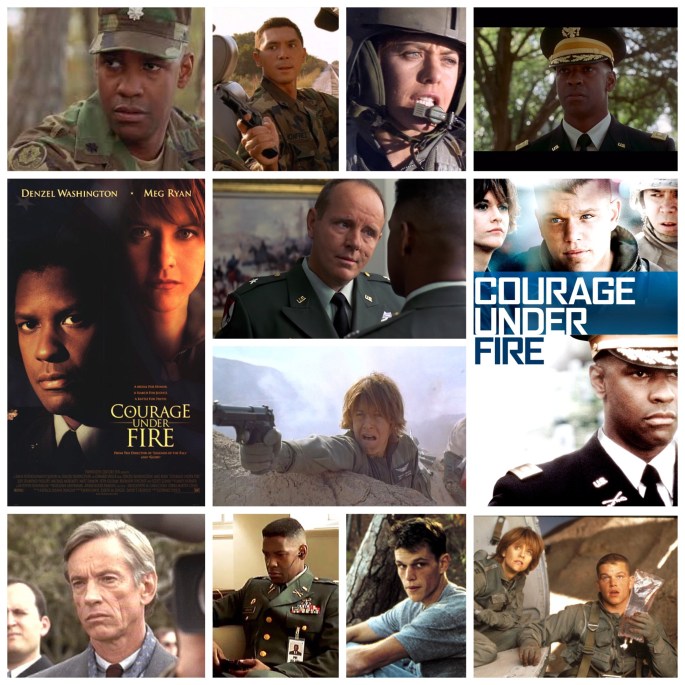
The darker side of the military is a touchy subject for Hollywood, as it’s supposed to be an outfit that sets a glowing standard of honour and nobility for everyone. But, like any other business or organization, it has a flip side too, and in Edward Zwick’s Courage Under Fire we see just what can go wrong in the ranks when no one is looking. Denzel Washington plays a traumatized gulf war vet who is tasked with assessing whether a heroic, deceased helicopter pilot (Meg Ryan) is worthy of the medal of honour, which would be awarded to the first female officer in history. Only problem is, testimonies from her fellow comrades in arms simply don’t add up. Two in particular, played by a gaunt Matt Damon and an excellent Lou Diamond Phillips, certainly know more than they let on and appear to harbour some deep guilt riddled scandal. With some help from a stern superior general (Michael Moriarty) and a journalist source (Scott Glenn) Washington must navigate this minefield of misdeeds and deception, and the story takes him to some fairly visceral, intense places. It’s just shy of melodrama when the secrets do come out, the third act a horrifying exposé, everyone’s expectations and image of the platoon unravelling. The rest of the soldiers are played by a hectic bunch including Bronson Pinchot, Zelijko Ivanek, Sean Astin, Sean Patrick Thomas and Bruce McGill. Ryan fares well in a role that’s essentially just a plot device, as we already know the eventual outcome of her arc, but she adds mystery and resilience to the scenes she does get. It’s like a political horror story, this one, showing the absolute worst outcome of a situation like this, and the lengths some scared individuals will go to smother any mention of it. Zwick handles the broad strokes well, and we end up with quite a stalwart, fiercely made war piece. 

-Nate Hill

K Pax


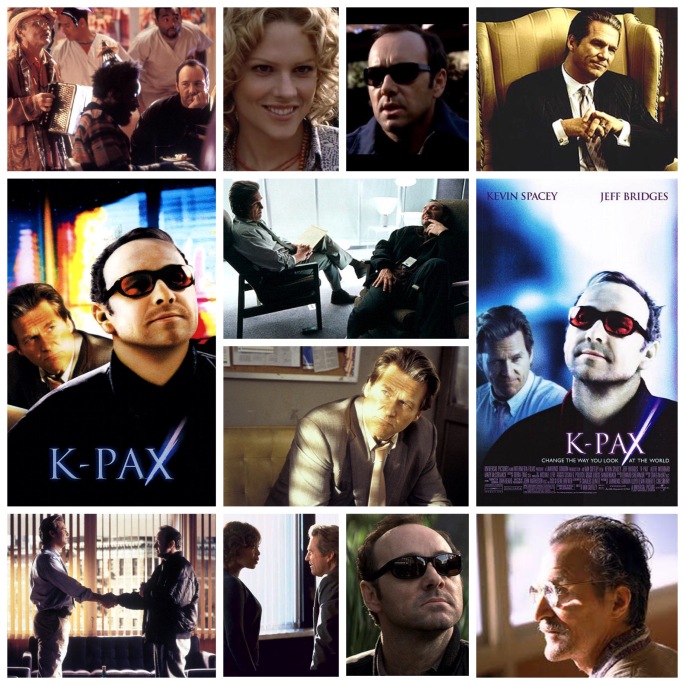
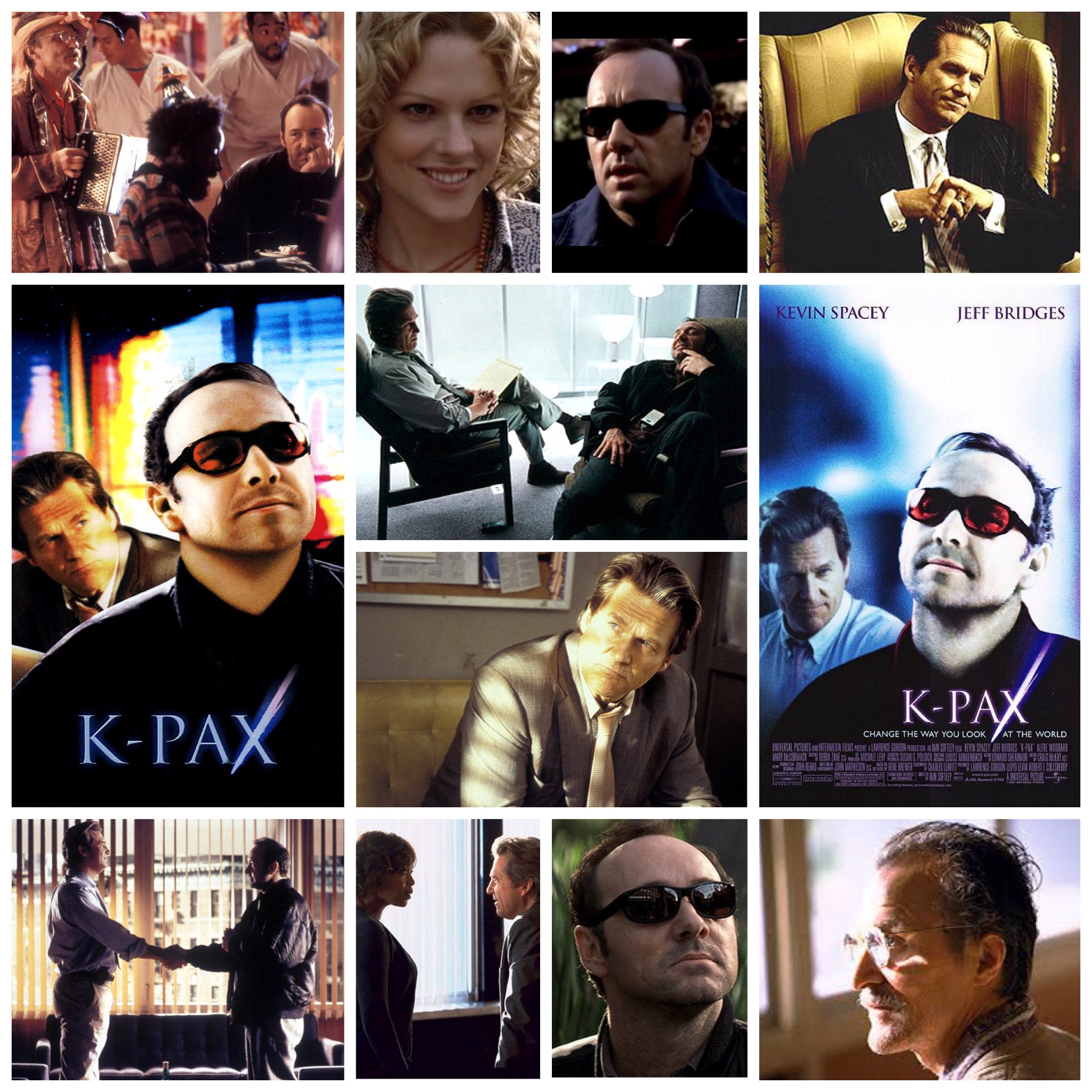
K-Pax is a beautifully told, warmhearted film that despite being mildly frustrating in it’s persistent ambiguity, is no doubt a better film for never really drawing a line and stepping to one side of it. Kevin Spacey is charming and sad as a mysterious man called Prot. Prot lives in a psychiatric ward and claims to be from a distant planet (named K Pax, naturally) in a faraway galaxy. Jeff Bridges plays the kindly therapist assigned to take care of him and eventually coach him out of his delusions. But are they delusions? Prot boasts uncanny, impossible knowledge of the solar systems and beyond, and won’t budge on a single detail of his story, which is not characteristic of someone suffering mental illness. Is Prot really who he says he is, or simply a man with a past so deeply traumatic that he’s spun this web of science fiction around his pain and nestled into it like a cosmic comfort blanket? This is where the film refuses to delineate or choose, which is either it’s one fallacy or it’s strongest, bravest creative quality, I haven’t decided yet. It’s interesting that they’ve casted Bridges because there’s a noticeable vibe akin to John Carpenter’s Starman here, which he starred in. Spacey and him are pure magic, navigating their scenes of dialogue like a dance of light, showing kindness and compassion in a situation that breeds confusion and fear. The supporting cast is peppered with talent including David Patrick Kelly, Mary McCormack, Aaron Paul, Alfre Woodward and Bill Lucking, but it’s Bridges and Spacey’s show all the way, and they turn the script they’re given into spun gold. Not to mention the crisp, brilliantly lit cinematography courtesy of John Mathieson as well. It’s one thing to come across intelligent science fiction, but when a film has the emotional heft to back up the tech and brains, you get the whole package, and this one delivers. 

-Nate Hill