I forgot how much goddamn fun Shanghai Noon is. It’s pretty much the quintessential east meets west buddy flick (sorry Rush Hour, love you too bbz), and upon rewatching it I realized that it’s every bit as awesome, and more so, than I remember as a kid. You take Jackie Chan, a stoic, robotic Chinese fighting machine with the sense of humour god gave a sock, and pair him with Owen Wilson, a wishy washy surfer dude of a cowboy who can’t take one second out of the day to stop talking or cracking jokes, and you’ve got gold. Of course, they need a film to run about in that’s just as solid as they’re team up, and that’s just what we get. This is a bawdy, unapologetic roll in the hay, a genre bender that tosses the American western, the buddy cop flick and the Kung Fu picture into a big cauldron, fires a few bullets in and gives it a big old stir. It’s ridiculously fun for its entire duration, an achievement which the sequel just couldn’t keep up with. Chan is Chon Wang (say it fast), a Chinese imperial guard on the trail of runaway Princess Pei Pei (Lucy Liu), who has runoff to America. No sooner does he set foot on Yankee soil, he’s bumped into peace pipe smoking Natives, and clashed with a band of train robbers led by Roy O Bannon (Owen Wilson), a fast talking soldier of fortune who doesn’t seem to have much skill besides yapping his way out of a situation. The two are thrown into a mad dash across then west, Chon looking for the princess, and Roy after the missing gold from the train. It’s what movies were made to be, a pure rush of gunfighting and chop socky, kick ass action sequences, all given the boost of Chan’s insane talents. He’s like a rabid squirrel monkey, and Wilson a drunk sloth, constantly mismatched yet always coming out on top, like the best comic duos always do. They’re faced with taking dpwn a few baddies, including Walton Goggins as the dumbest outlaw this side of the Rockies, and a terrifying Xander Berkeley as a corrupt, homicidal marshal. The core of it rests on Chan and Wilson to entertain us though, and even in the down time between action, their energy is infectious, especially in a manic drinking game that just can’t be described in writing. Like I said, the sequel, Shanghai Knights, just doesn’t capture he magic quite like this one does, and seems to fall flat. You can’t go wrong with this original outing though, and it just gets better with age.
Category: Film Review
Bullet: A Review by Nate Hill
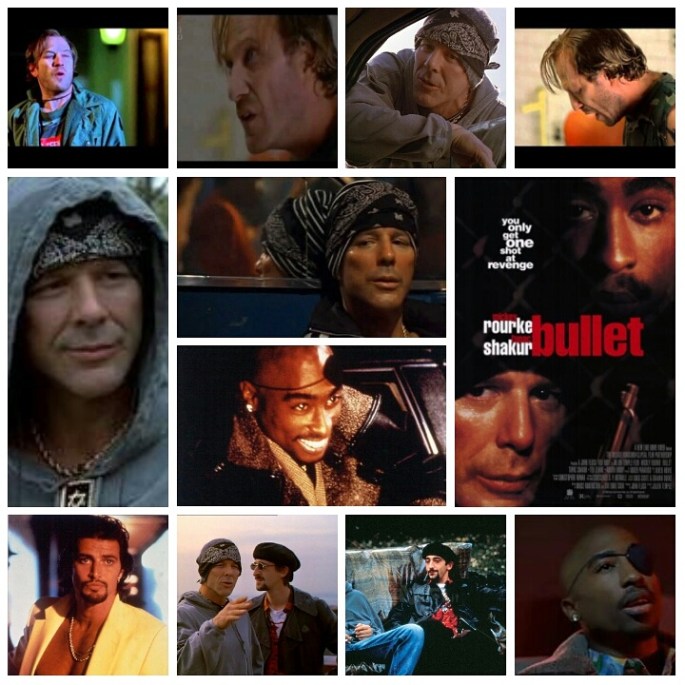
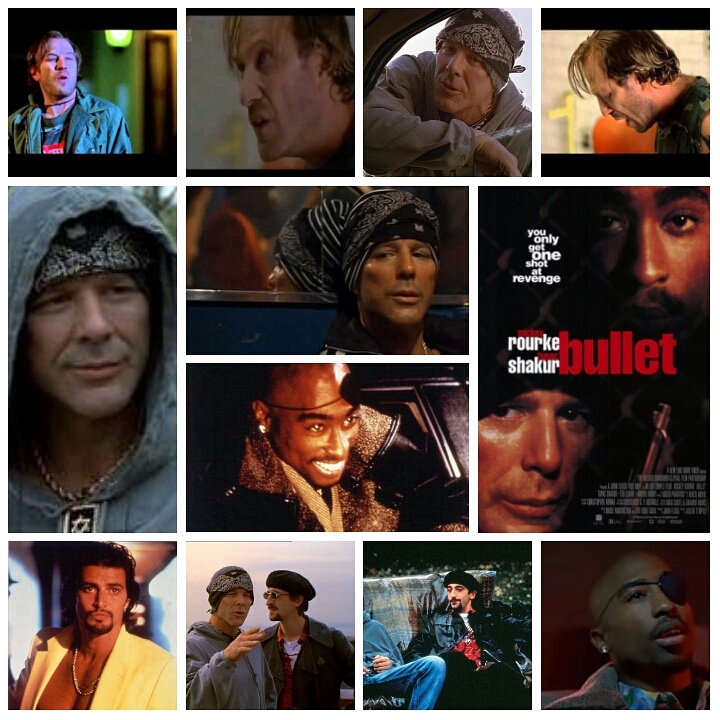
Bullet is a violent cautionary tale about what it means to live a life of crime in New York City’s brutal Hell’s Kitchen, to live (and die) with all the baggage and tragedy that comes along with it. Mickey Rourke is excellent as Butch Stein, a pathetic yet somehow endearing Jewish American hoodlum locked in a personal war with local drug dealer and gangster Tank (Tupac Shakur). Butch still lives with his family, and spends his nights slumming about with slick wannabe wiseguy Lester (John Enos III) and his gangly brother Ruby (Adrien Brody). One gets the feeling that all of them are essentially still little kids who never learned to grow up or use their words, but the sandbox they’re squabbling in now is a dangerous area of town, and their toys are heavy artillery. Butch has another brother, a reclusive weirdo played phenomenally by Ted Levine. He’s distant and strange, but there’s breaks of clarity that shine through, and in those moments he’s pretty much the voice of reason amongst all the tomfoolery that adds to the mortality rate in their district. Levine is unique and shelters the gold in his work until right at the end, letting off an emotional stinger of a cap to his performance that is yet another testament to his skill. Rourke broods through his work with sombre self loathing and a grim resolve, dead set in his ways, perhaps unable to live his life differently, and feeling helpless at the road he’s taken, a dark one that has strayed far from what might have been. Tupac’s role is somewhat underwritten, which isn’t quite fair to the guy, because he has more acting talent than pretty much any other rapper I’ve seen in film. Reduced to a mostly a jive talk sterotype gangsta antagonist, I would have liked to see them allow him to level with Rourke in a way that made their locking horns seem a little bit more than just a petty turf war. Director Julien Temple comes from a music video background, and transitions nicely into the world of the urban crime drama, shooting the seedy NYC locales with glittery precision that suggests festering rot below. It’s an anti-crime film, and I’m always curious to see if such a sentiment is undone by the glorification of such a lifestyle, intentional or otherwise (it’s easy to get caught up in sensation and cinematics, losing sight of what you set out to say in the first place). This one stays true to its word, showing us characters who have irreparably lost their way, and assuring bullet by bullet, death by death, that this isn’t any kind of life for anyone. Searing stuff.
GUS VAN SANT’S TO DIE FOR — A REVIEW BY NICK CLEMENT

Gus Van Sant has made some terrific movies during his eclectic career, but one of his absolute best (and easily my personal favorite), is the scalpel-sharp 1995 satire To Die For. Ultra-vicious, scandalous, and gleefully nasty, this film is still as incisive now as it was at the time of its release over 20 years ago. Van Sant employed a mockumentary approach to a portion of the highly-stylized narrative, which was in perfect tandem with the truly hysterical and dark humor in Buck Henry’s absolutely brilliant screenplay. Henry, an old-pro-master of caustic, sexually charged cinema (The Graduate), biting social commentary (Catch-22), and playful comedy (What’s Up Doc?), wrote a poison-pen letter to the entire country with To Die For, and delivered some of the smartest, saddest laughs that I can possibly think of. This is a scathing indictment of our constant need to be celebrated, and it’s downright crazy how many similarities it shares with the recent and equally disturbing Nightcrawler; both films revel in outright contempt for our hyperactive media and the ever celebrated notion of “15 minutes of fame.” Loosely based on the real-life Pamela Smart murder case based out of Derry, New Hampshire, Nicole Kidman delivered the trickiest, iciest performance of her career, totally investing herself in a sociopathic character who sits at the same table as Lou Bloom in Nightcrawler.

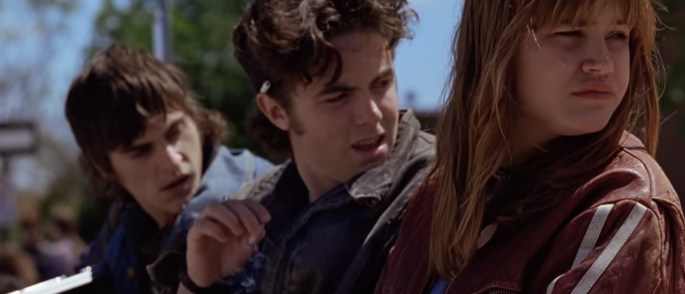
The comparisons are striking between the two films, as both feature self-possessed lead characters who are consumed with the need to be important and famous, both drive flashy red sports cars, both have coldly detached, murderous instincts, and both will stop at nothing to accomplish their “goals.” I’m assuming that Dan Gilroy is a big fan. Kidman has only matched her overall work in To Die For a couple of other times (Birth, Eyes Wide Shut), and has always been an actress of stunning, porcelain-doll beauty, but in the role of Suzanne Stone-Maretto, she tapped into something scary deep within herself, subverting her intense physical appearance, resulting in a performance for the ages. The stellar supporting cast includes the perfectly selected Matt Dillon as the poor, unfortunate husband, the impossibly unique Illeana Douglas, an absurdly young Casey Affleck and Joaquin Phoenix as two ultimate high school stoners, a dry Kurtwood Smith, Wayne Knight, Dan Hedaya, Michael Rispoli, and Buck Henry in a deliciously evil cameo as the high school teacher from Hell. Tragic, absurd, and mean-spiritedly honest about the delusions of a certain type of person, To Die For holds up remarkably well as a damning portrait of cinematic narcissistic self-involvement that extends its grasp to the fringes of our demented society.

Animal Factory: A Review by Nate Hill
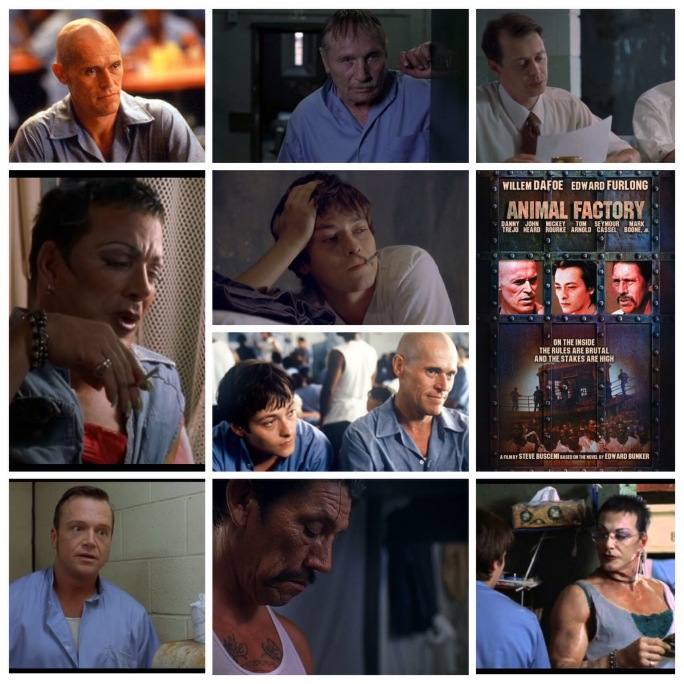
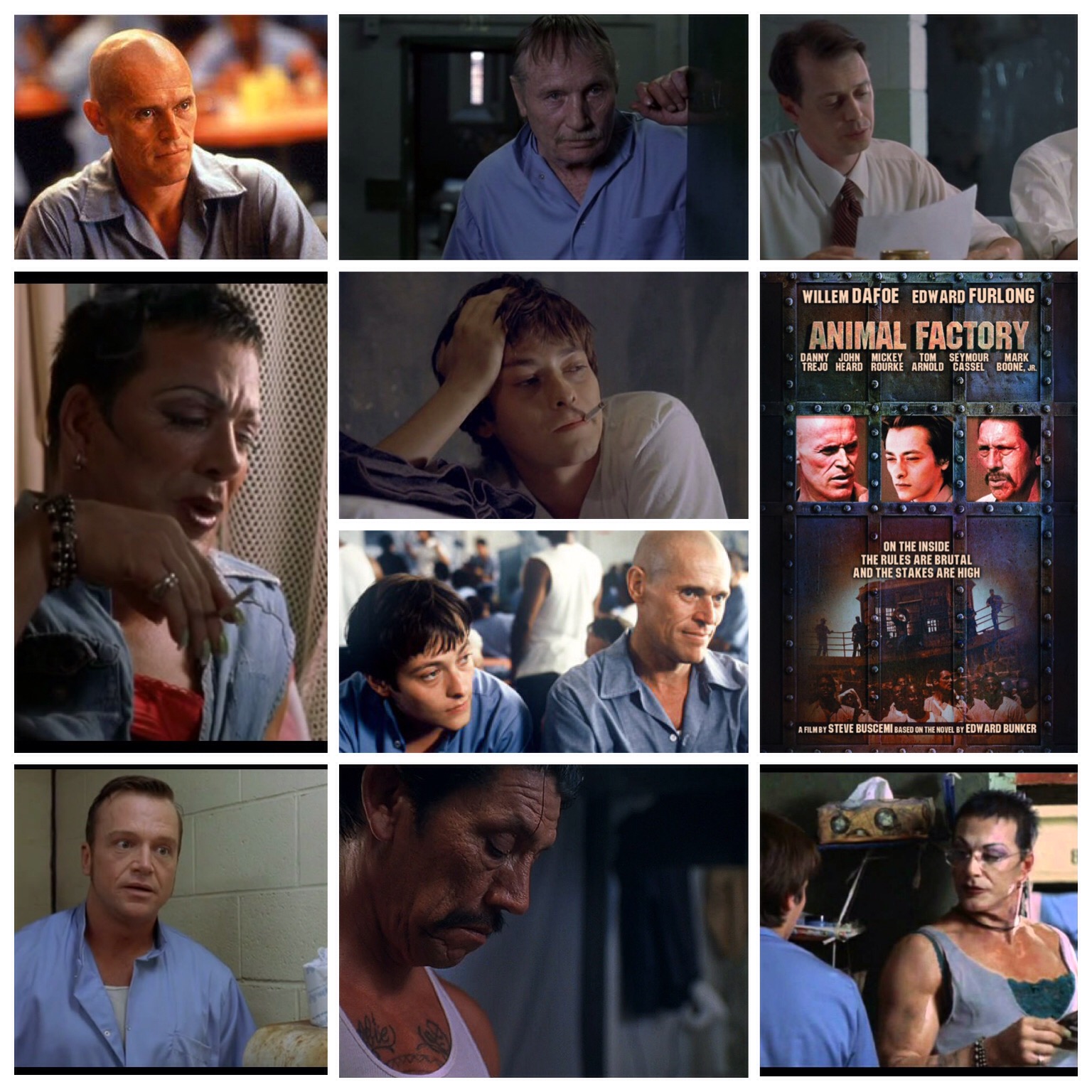
Animal Factory is a prison set film directed by actor Steve Buscemi and based on a novel and subsequent screenplay by Edward Bunker, a real life ex convict, who played Mr. Brown in Reservoir Dogs. If that sounds like an irresistible team up to make this type of thing work, you’re thinking right. And I haven’t even mentioned the epic cast yet. It’s a scrappy little film that almost takes stage play form, as we watch a plethora of raggedy and very diverse inmates navigate the difficult, tragic and often touching life of incarceration. Edward Furlong (before he ballooned out) plays a young man barely out of his teens, locked away for marijuana possession, essentially a victim of the extremely harsh system they got down there in ‘Murica. He’s a sitting duck on the inside, but receives kindness and mentorship from veteran con Earl Copen (Willem Dafoe, excellent). It’s all done in an almost Robert Altman style way; characters jump in and out, events trundle by in centrifugal motion with little regard for one solid narrative, instead choosing to arbitrarily shift focus from prisoner to prisoner, whilst periodically checking back in on Furlong, who is the closest thing to a main protagonist. The cast is wonderful: Danny Trejo shows up (another guy who has done time in real life), Tom Arnold plays a pervert sicko who preys on Furlong, and Mickey Rourke is an absolute standout as Jan The Actress, a transvestite cell mate with a peppy life lesson or two for young Furlong. Watch for Bunker himself, Seymour Cassel, Mark Boone Jr., Chris Bauer, Buscemi as a parole board member and John Heard as Furlong’s father. Bunker no doubt based much of the story on his actual prison experience, and the dedicated authenticity shines through in every aspect of the film. Buscemi is no doubt an actor’s director (being one himself), and he lets every player have their moment to shine, while always contributing to the story as a whole as well. Prison films don’t get much better than this. Not to be missed.
PHILIP KAUFMAN’S THE RIGHT STUFF — A REVIEW BY NICK CLEMENT

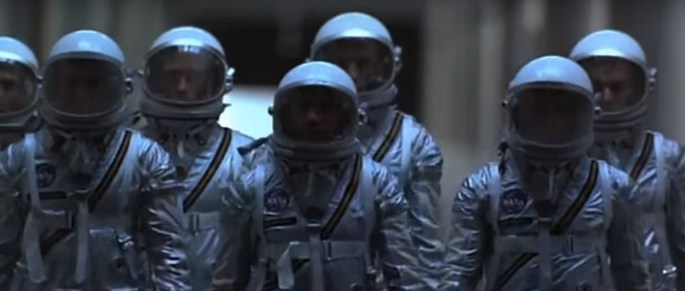
Epic yet somehow light on its feet, incredibly heroic and patriotic without ever slipping into phony jingoism, and massively entertaining above all else, Philip Kaufman’s iconic 1983 American masterpiece The Right Stuff is a shining example of dramatic, true life cinema done absolutely correct. The story of the great space race between the U.S. and Russia has been explored many times throughout pop culture but it’s never been given this sort of grand, sweeping treatment. The cast assembled for this film was extraordinary: Sam Shepard, Scott Glenn, Ed Harris, Fred Ward, Jeff Goldblum, Barbara Hershey, Veronica Cartwright, Lance Henriksen and Harry Shearer, with everyone getting their chance to shine and nobody ever forgetting the value of a great ensemble. Caleb Deschanel’s soaring, gorgeous cinematography fills the screen with one unforgettable image after another, all crafted in camera before the onslaught of CGI, in various aspect ratios, mixing archival footage and re-enactments into the proceedings flawlessly thanks to the remarkably fluid cutting from a five editor team.

Bill Conti’s massive musical score envelopes the entire film but never overpowers it, with stirring passages that rock the heart and soul. The three hour and 15 minute director’s cut Blu-ray has a fantastic image quality and the Oscar winning sound design roars from speaker to speaker with all levels perfectly calibrated. It’s hysterical how much Michael Bay stole from this movie for Armageddon, and I never realize how much Christopher Nolan cribbed from The Right Stuff during the first hour of Interstellar; it was also lovely to see the influence that Kubrick’s 2001 had on Kaufman during numerous scenes in The Right Stuff. Filmmakers have inspired their peers throughout the years with their boundary pushing work, and with a movie like The Right Stuff, it’s easy to see why so many people hold it close to their heart. It’s an impossibly mythic film, stretching from 1947 to 1965, tracing the birth of the test-pilot era all the way to the first men sent up into space, told in classic linear fashion, at an unhurried but smooth pace, with no boring spots or wasted moments. What a magnificent accomplishment.

SUICIDE SQUAD – A Review by Frank Mengarelli

“Will you live for me?”
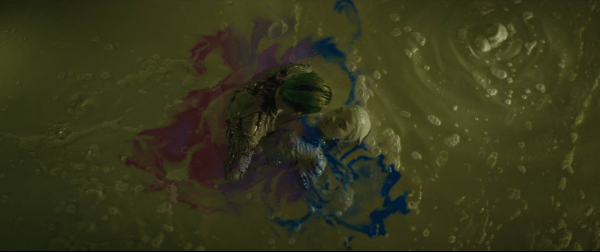
SUICIDE SQUAD is a complete mess, yet it is a total glory. I know, relax. Hear me out. Since the resurrection of Christopher Nolan’s Batman, there has been a forceful push to ground a superhero film in reality. Sometimes it works, other times is does not. SUICIDE SQUAD removes itself from that universe and takes place within movie world.

There’s a lot that is blatantly strange and oddly incoherent about the film. Whether it was from studio tinkering (panic) or that everyone was on acid while making the film. None of that matters. The film has a great soundtrack and devilishly fun performances from the entire cast.
The film isn’t bright and glossy with a drumbeat joke every five minutes, it’s sloppy and dirty with perverse humor that will curl even the most uptight hipster’s mustache, while he’s passive aggressively using the Oxford comma to demean this film.

Will Smith’s overly stereotypical ghetto jive, the over objectifying of Margot Robbie’s butt, the uppity bitch mode of Viola Davis, and Jared Leto’s insane transformation into a Joker that’s feverishly in love, are a step away from the safe mediocrity we’ve seen in recent tent-pole films.

Director David Ayer has received so much critical flack for this film, it isn’t even funny. This wasn’t a film made for critics, nor was it seeking the approval of top ten lists. It’s loud, it’s obnoxious, it’s gratuitous, and it’s everything that the new DC Universe should aim for going forward. Let other studios play it safe with their glossy sheen, DC; keep forming a lewd and egregious world for the rest of us.
A Prayer For The Dying: A Review by Nate Hill
A Prayer For The Dying is a melodramatic romantic action thriller following IRA assassin Martin Fallon (Mickey Rourke), a man with a brutal path in life whose long buried conscience surfaces after an explosives mission goes awry, resulting in the death of schoolchildren aboard a bus. It’s a bold scene to start a film with, and in every instance after it Fallon has a haunted frenzy about him, clearly damaged by what he did and saw. As if that weren’t enough, he now finds himself compelled to murder a priest (Bob Hoskins) who witnessed one of his militant crimes. Fallon spends a lot of time hesitating, and in that hesitation he strikes up a romance with the Hoskins’s blind daughter (Sammi Davis), finding sanctuary and a modicum of redemption with the two of them. A lot of nasty people from his past are looking for him though, including his amoral former partner (Liam Neeson), an evil British crime kingpin (the great Alan Bates) and the kingpin’s murderous brat of a son (Christopher Fulford). Obligatory shootouts, personal and religious angst, sappy sentiment and dodgy accents, particularly from Rourke, ensue. He can blend into a lot of roles and pull off a lot of different characters, but it seems an Irish accent is a stretch, and it shows. As the character of Fallon himself, ethnicity aside, he does a bang up job though. Bates is razor focused in playing anyone, and his villain here is a spidery creepo. Neeson is young and doesn’t get much to do except hassle Rourke, but their confrontations are nicely done by both parties. Director Mike Hodges, whose other work I’ve never really seen, seems to like slow and deliberate action scenes, very old world and sometimes repetitive, but entertaining nonetheless. Not the best IRA thriller out there (most of the events here have little to do with the movement anyway, and focus more on Fallon), but a decent way to spend a couple hours.
A Suicide Squad review by Josh Hains
Don’t worry, the following review is a spoiler free zone.
Appalling. Bad. Very, very bad. Trash. Garbage. Stupid. Incoherent. Incomprehensible. Dumb. Boring. Awful. Mediocre. Disaster. Rotten. I don’t agree with words such as these being used in reviews for Suicide Squad to describe the movie as whole. I’m not being blindly dismissive like some social media users out there who are mad that this highly anticipated movie isn’t getting a great critical reception. I just don’t agree, I had a different experience, and this review will reflect that experience.
Suicide Squad has a pretty straightforward plot: government spook Amanda Waller (Viola Davis) assembles Task Force X, a motley crue of super-villains plucked from prison, and let loose in a city under attack by a malevolent meta-human. Kill the bad guy, save the city, and get some time off your prison sentences, that’s honestly as deep as it goes. But that’s not a detrimental aspect of the movie. In many comic book movies, the plot takes a back-seat to the action, humour, and character development, and Suicide Squad embraces that trope with wide open arms. With these team oriented comic book movies, it’s kind of expected that the story takes a back-seat to the character interactions and action, and if you need proof of that look no further than The Avengers movies. You don’t need an over complicated plot with far too many sub-plots for this kind of movie (I’m looking at you Batman V Superman). Simplicity is key, so by the time the plot gets thrown out of the window late in the second act you really won’t mind because director David Ayer makes up for it with great character moments, irreverent Deadpool style humour, and a wallop of fun action. Think of this movie as the DC equivalent of The Expendables, with way more humour but no gore, and you’ll be fine.
Speaking of character moments, many of the best belong to Deadshot (Will Smith), Harley Quinn (Margot Robbie), Rick Flag (Joel Kinnaman), and El Diablo (Jay Hernandez), all of whom are given just enough screen time (or more than enough) to make us care about the characters as they contend with their dire mission. I was initially worrisome about the casting of Smith as Deadshot, I thought he might end up becoming overbearing and even over the top, but he proved me wrong with a subtle and believable performance, his best since the Pursuit Of Happyness. Joel Kinnaman matches Smith’s performance, bringing a naturalistic touch to what could have been a stereotypical stubborn leader role. Margot Robbie’s Harley Quinn is exactly like the Harley I grew up watching in the animated series that her creator Paul Dini wrote (minus the jester costume), and a total scene stealer. More on her later. El Diablo, the “fire guy” as Captain Boomerang (Jai Courtney) tauntingly dubs him, has the biggest emotional journey of any of the Squad members, though not as much screen time as the trio of aforementioned characters.
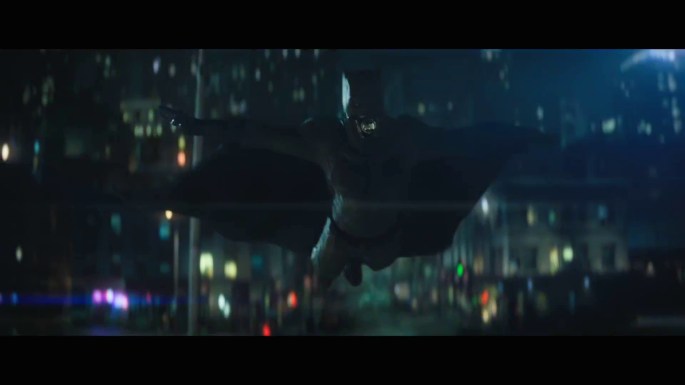
Captain Boomerang gets a solid amount of time to do his thing, which is make plenty of jokes and jabs, and kick a few asses along the way, but he isn’t given quite enough to do, which is a shame because he’s quite a lot of fun. Adewale Akinnuoye-Agbaje as Killer Croc, Karen Fukuhara as Katana, Cara Delevigne as June Moon & Enchantress, and Viola Davis as Amanda Waller, don’t get much to do, and neither does the sacrificial lamb Slipknot (Adam Beach), who follows in the footsteps of other villains in Suicide Squad comic and cartoons whose sole purpose is to prove that the bad guys aren’t playing around. Davis, a blank slate lacking charisma and passion behind her delivery of lines, doesn’t do much more than manipulate a few minds and give orders, and Delevigne’s characters aren’t fleshed out enough for us to care all that much about her. Killer Croc and Katana have minor moments of asskicking, and Croc gets a couple of funny lines, but neither of them are all that relevant to the plot, and easily could have been removed from the movie altogether without hurting the final product. However brief they may be, the two much hyped cameos, which includes Batman himself (Ben Affleck), fit naturally into the movie, and lack the feeling of being shoehorned into the movie for the sake of having them there.
Now back to Harley. Margot Robbie, equipped with a believable Bronx accent, and a fresh take on the New 52 Suicide Squad comic iteration of Harley, brings life and a lot of love for the character to a performance many were worried would fall flat. She looks, sounds, and behaves exactly like the Harley Quinn fans know and fondly love, and it’s a joy to see her steal scene after scene. She’s also fortunate enough to have some of the funniest lines in the movie, which Robbie delivers with a glint of pure enjoyment in her eyes.
In my eyes, the performance I was most drawn to belongs to Jared Leto as the Clown Prince of Crime himself, The Joker. Seemingly drawing from previous Jokers such as Caesar Romero, Jack Nicholson, and Heath Ledger, as well as the vast number of animated incarnations, Leto gives us a fresh take on the iconic villain that doesn’t feel like any Joker that came before it. I’d equate the performance to that of taking all the best elements of the aforementioned Jokers, and building from the ground up a composite of what that may look like. He’s not better, or worse than Heath Ledger’s Oscar winning turn as The Joker, he’s just different in his own unique fashion. I do think he’s better than the Jokers pre-Ledger though. Leto is gleefully over the top, cackling and growling like a tiger waiting to tear the face off his next unsuspecting victim, but not too over the top. This Joker’s as unpredictable, crafty, and brutal as ever before, but not overbearingly so. Sadly, Joker’s vastly underused, with much of his screen time left on the cutting room floor. I’d love to see more of this new Joker. The relationship between he and Harley, while volatile and unhealthy, is perfectly reflective of the one seen in the pages and frames of various DC comics and cartoons, and seeing it come to life was also a rather joyous experience.
Throughout the second and third acts of the movie, the editing seems to be a bit on the choppy side, more predominantly in the third act than the second act by a mile. It became pretty clear to me that the push for a two hour crowd pleasing comic book movie got in the way of giving the sidelined characters more depth and more impactful screen presences. Somehow, despite the clunky nature of the editing (which isn’t very distracting, thankfully), these scenes that are affected by it still work fairly well until the editing seems to get back on track and working just fine.
Beyond the quibbles I have with the editing, the story, the character development, and the casting of Amanda Waller, I still enjoyed this movie a lot, in some ways more than I thought I would, and in a couple of ways, less. I do not feel that this is a bad movie by any means, I think it’s actually damn good, but it’s not quite as great as it could have been, though I wasn’t always wanting or expecting it to be great anyways. If anything, all I ever wanted was yet another fun comic book movie I could lose myself in while watching these badass villains kick all kinds of ass six ways to Sunday. David Ayer gave me that in spades.
Now where’s the sequel?
PTS Presents EDITOR’S SUITE with MARK GOLDBLATT

Podcasting Them Softly is beyond thrilled to present a discussion with veteran film editor Mark Goldblatt! Mark‘s credits are beyond amazing, and feature some of the greatest action adventure films of our lifetimes — The Terminator, Terminator 2, True Lies, Bad Boys 2, Pearl Harbor, Armageddon, Commando, Rambo: First Blood Part 2, Starship Troopers, Predator 2 and Tony Scott’s immortal action masterpiece The Last Boy Scout. He’s worked with absolute titans of industry, including James Cameron, Michael Bay, Paul Verhoeven, and Joe Dante, all of whom Mark has worked with multiple times. Other amazing credits include Rise of the Planet of the Apes, Hollow Man, Showgirls, The Ambassador, Halloween II, and Piranha. He also had multiple collaborations with Cannon Films head honcho Menahem Golan, which is always a subject that fascinates us at PTS! Mark‘s directorial debut was the wild and crazy Dead Heat with Treat Williams and Joe Piscopo, which he then followed up with the absolutely awesome The Punisher with Dolph Lundgren. We were overwhelmed by his resume and are so excited to share this exciting chat!
PETE DOCTER’S UP — A REVIEW BY NICK CLEMENT

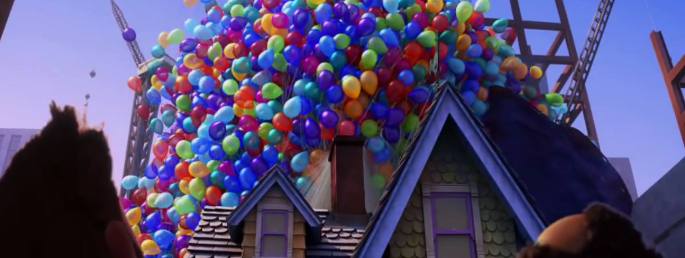
I’m not a huuuuge fan of animated fare, but I have to say, Up is ALL of the things that great films are – sad, funny, timeless, heart-warming, exciting, and by the end, genuinely moving. It’s a film that’s about never letting go of your dreams, no matter how out of reach they may seem. There’s a thrilling sense of adventure and a constant sense of wonder in Up that’s positively infectious, and along with the magical and masterful Wall*E, I consider it to be at the very top of the Pixar heap. The story is simple: Karl Fredricksen, an old man still in love with his deceased wife, doesn’t want to lose his beloved house to urban development, so he tethers about 100,000 balloons to it in order to fly off to the exotic (and possibly dangerous) island where he and his wife always wanted to visit and explore. The catch – the old man has a surprise companion, in the form of a tubby Eagle Scout named Russell, who just so happened to be on his doorstep before the house took flight. Up becomes a buddy picture of sorts, with the old man learning from the little kid, and vice versa.

Visual and verbal humor is on display in almost every scene, and director Pete Docter’s elegant gift with movement, eye-popping color, and visual and narrative sweep is in clear view. Bob Petersen’s amazing voice work as Doug the Dog is the stuff of instant comedy legend, and the bright, explosive color palette of Kevin the Bird is gorgeous and eye-filling. The mostly silent wedding/marriage/life montage that opens the film is a tour de force of non-verbal storytelling and easily one of the most captivating sequences I’ve ever seen in any film, animated or live-action. I was a bleary-eyed mess while watching this touching five minute prologue during my first viewing, and every time I give the film a revisit, I’m nervously apprehensive about watching the opening in full – it hits me very, very hard. If you’ve ever loved someone, there are elements of Up that will remind you of why we do in fact love other people, and why it’s important to never forget those who are the most important in our lives.


Podcasting Them Softly is beyond thrilled to present a discussion with veteran film editor