Judge Dredd: A Review by Nate Hill

image

Ah yes, the 90’s version of Judge Dredd, featuring a hopped up Sylvester Stallone as the titular comic book lawman. There is so much hate floating around for this flick that I feel like radios have picked up some of it right out of the air. There used to be a lot more loathing, but then the 2013 version graced our presence, and it was so good, so true to the source material and such a kick ass flick that the collective bad taste left the fan’s mouths, leaving this version somewhat forgotten and to many people, for good reason. But.. but… bear with me for just a moment, readers, and I’ll tell you why it’s not as bad as it’s utterly poopy reputation. Yes it’s silly, overblown, altogether ridiculous and Stallone takes off his helmet to yell about the law a lot. Basically pretty far from the source material and weird enough to raise eyebrows in many others, and prompt the torch and pitchfork routine from fans of the comic series. But it’s also a huge absurdist sci fi spectacle that will blow up your screen with its massive cast, opulent and decadent special effects and thundering, often incomprehensible plot. It’s in most ways the exact opposite of the 2013 version, all the fat that was trimmed off of that sleek, streamlined vehicle is left to dangle here, resulting in a chaotic mess that looks like a highway pileup between Blade Runner, Aliens and some Roger Corman abomination. But.. is it terribly unwatchable?  Not in the least, or at least not to me. Like the highway pileup, it’s so off the rails that we can’t help but gawk in awe, and if we’re not some comic book fan who is already spiritually offended to the core by it, even enjoy that madness and lack of any rhyme or reason in it. Stallone uses his bulk to inhabit the character, and infuses a level of stagnant processed cheese to his dialogue that would be distracting if it weren’t for the electric blue contact lenses he sports the whole time, which look like traffic lights designed by Aqua Man. He’s embroiled in one convoluted mess of a plotline involving a former sibling (a hammy Armand Assante with the same weird eyes). Joan Chen and Diane Lane fill out the chick department, the former being some kind of cohort to Assante, and the latter a fellow judge alongside Dredd. Dredd has two superiors, the noble and righteous “” (Max Von Sydow in the closest thing he’ll ever make to a B-movie), and the treacherous Griffin (a seething, unbridled Jurgen Prochnow). The cast is stacked from top to bottom, including a rowdy turn from James Remar who sets the tone early on as a rebellious warlord who is set straight by Dredd. Rob Schneider has an odd habit of following Stallone around in films where his presence is wholly not needed (see Demolition Man as well), playing a weaselly little criminal who pops up whenever we’re off marveling at some other silly character, plot turn or risible costume choice. Scott Wilson also has an unbilled bit as Pa Angel, a desert dwelling cannibal patriarch, and when one views his scenery chomping cameo, although no doubt awesome, it’s easy to see why he had his name removed from the credits. The whole thing is a delightful disaster that shouldn’t prompt reactions of hate, at least from the more rational minded crowd. Yeah its not the best, or even all that good, but it’s worth a look just for the sake of morbid curiosity, and to see an entire filmmaking, acting and special effects team strive way too hard and throw everything into the mix, forgetting that less is more as they pull the ripcord of excess. Sure I’m generous, but I’d rather be puzzled and amused rather than bitter and cynical when a lot of work still went into this and me as an average joe has no right to bring down artists when my greatest life accomplishments so far are riding a bike with no hands while I have a beer in one and check my phone in the other. Such silliness is what we find in this movie, and I gotta say I was tickled by it.

PUBLIC ENEMIES – A REVIEW BY J.D. LAFRANCE

Public-Enemies-4-790022

Public Enemies (2009) marked Michael Mann’s fourth foray into American history with The Last of the Mohicans (1992), The Insider (1999), and Ali (2001) being his previous efforts. The director got his start making documentaries and always been interested in achieving absolute authenticity in the depiction of the professions that his protagonists practice, be it safecracking in Thief (1981) or serial killer profiling in Manhunter (1986). Born and raised in Chicago, it is easy to see what drew Mann to the story of John Dillinger, a famous bank robber during the 1930s. He and his crew were the best of the best at the time and so, he certainly fits the kind of protagonist Mann is drawn to.

Public Enemies begins in 1933 during the golden age of bank robbery and Mann wastes no time getting into it as he opens the film with an exciting escape from an Ohio prison orchestrated by Dillinger (Johnny Depp) and his crew. Soon after, we meet FBI agent Melvin Purvis (Christian Bale) in action as he takes down Pretty Boy Floyd (Channing Tatum) with a hunting rifle from an impressive distance. In no time at all, Mann has established the film’s protagonist and antagonist. They are smart, super efficient men of action that are single-minded in their respective goals.

Unable to get funding and criticized by his superiors, FBI Director J. Edgar Hoover (Billy Crudup) needs high-profile busts and enlists Purvis to find and stop the country’s Public Enemy No. 1 – John Dillinger. The more notorious he becomes the more this angers not just the FBI but also the Chicago mob because his actions put extra heat on them. There is a nice scene where he meets with a mob representative who basically tells him that he is a dying breed. The money he makes knocking over one bank, they make in one day through illegal gambling.

Mann demonstrates that he is a master at orchestrating action sequences. They are cleanly photographed and edited so that there is no confusion. You can always tell what is going on and who everyone is instead of the kamikaze, headache-inducing editing and slapdash camerawork in films by the likes of Michael Bay and McG. The shoot-out at Dillinger’s hide-out in Little Bohemia is the film’s show-stopping action sequence much like the bank heist in Heat (1995) and the nightclub shoot-out in Collateral (2004). It is powerfully executed and full of tension and excitement as well as an impressive display of firepower with the deafening blasts of tommy guns and shotguns.

Public Enemies reunited Mann with key collaborators, chief among them cinematographer Dante Spinotti who has shot his most memorable films (including Manhunter, The Last of the Mohicans, Heat, and The Insider). Mann has come under considerable criticism for making the move to digital cameras and even more so with Public Enemies because it is a period film and audiences are used to seeing them done on traditional film stock. However, it looks great with crisp, clear images, especially at night where there is an impressive depth of field. Certain scenes have a graininess to them inherent with digital cameras but, in this case, it gives a tangible, gritty texture that works. There are some truly beautiful shots in this film, like one in which a car carrying Dillinger and his crew hurtle down a road surrounded by a vast forest of trees that tower over them.

Mann is also reunited with composer Elliot Goldenthal who worked on Heat. Since The Last of the Mohicans (1992), Mann has relied on soundtracks comprised mostly of disparate tracks from various sources. Being a period piece, obviously Public Enemies really doesn’t lend itself to that kind of a soundtrack and Goldenthal expertly augments the drama that unfolds in various scenes, creating one of the best scores in a Mann film to date.

The attention to period detail is fantastic with classic trains, cars, and classic gangster iconography like tommy guns, fedoras and trenchcoats permeating the film. Mann really immerses us in the time period but not in a way that calls undo attention to itself. It’s just there in the background of every scene with vintage period architecture. Ever the perfectionist, Mann shot on location, often at the actual locations that Dillinger and his gang frequented. Whether you are consciously aware of this or not, the film just oozes authenticity.

Dillinger certainly enjoys the fruits of his labor but is always planning his next job. He follows his own personal code: he doesn’t kill unless absolutely necessary and doesn’t think about the future, living only in the present because he could easily end up in jail or dead. He is also very conscious of how he’s perceived by the public, enjoying the notoriety his exploits create. Johnny Depp portrays him as a very confident guy who is always in control. There is often this mischievous glint in his eye like he’s in on a private joke. Depp plays Dillinger with a lot of charm, like when he addresses the media while being booked in an Indiana jail. He knows how to work the crowd and the charismatic actor is excellent in this scene. However, Public Enemies is not afraid to point out that Dillinger is no hero. The man has no problem with killing someone if they got in his way but the film goes to great lengths to point out that he did so only when there was no other option. Dillinger was clearly a man who didn’t believe in wasting time, much like Frank, the safecracker in Thief. Depp inhabits the role with his customary dedication, adopting a specific voice, accent and effortless delivery of period lingo that sounds natural and genuine.

Christian Bale is quite good as the very determined Purvis. While Mann doesn’t create the balance of cop vs. robber as he did in Heat, Bale has a significant amount of screen-time in the film. Like other law enforcement figures in Mann’s films, Purvis uses state-of-the-art technology, for the time, to track Dillinger and his crew. As determined as Purvis is, Mann allows some humanity to seep in, like when he stops the brutal interrogation of Dillinger’s girlfriend Billie Frechette (Marion Cotillard) and personally helps her get cleaned up. It is this small moment that adds a welcome layer to his character.

There are all kinds of parallels between Public Enemies and Heat. In both films we are meant to sympathize with the bank robber. Also, the two leads only meet face-to-face in one scene. There is a climactic gun-battle where both sides take on significant casualties that alter the conclusion of the story. And, like McCauley in Heat, there is an inevitability to Dillinger’s life; that he will run out of time and luck; that Purvis and the FBI will close the net around him. That being said, Public Enemies is not a carbon copy of Heat. Personality-wise, Dillinger and McCauley are very different people with the former being a risk-taker and the latter being overly cautious. The same goes for the lawmen. Purvis is not the larger-than-life extrovert that Hanna is, but rather a no-nonsense man who gets the job done and that’s it. There’s even a loose cannon in the form of Baby Face Nelson (Stephen Graham) who is to Public Enemies what Waingro was to Heat. A psychopath that the bank robbers initially ally themselves with but end up cutting loose when he proves to be too unstable. Structurally, both films couldn’t be different as Mann continues to experiment with narrative structure in a fascinating way. This isn’t your typical, cookie-cutter A to B to C plotting, which may frustrate some (see Ali or Miami Vice) but if you the patience and can get into it, watching Public Enemies is a very rewarding experience.

Lemonade–A Review By Tim Fuglei


beyonce-lemonade-film-fire

When Beyonce took the stage during the halftime show of Superbowl 50 this past February and played her surprise single, Formation, pundits and fans made vague noise about politicizing the event (how dare black women show up to this, the most first world of parties, and act powerful!); few realized the song and accompanying video were merely a warning, barely an inkling of what was coming.  It was both a prequel to and ultimately the next chapter in a project the world now knows as Lemonade.  The artist was laying the groundwork for a stunning piece of art with this performance, a “Visual Album” that takes the conceit of infidelity and stretches it between strikingly personal and hugely sociopolitical extremes throughout its thoughtful, hypnotic 58 minutes.  The story is simple, but the charges are damning:  Just like her man did her, America done women of color wrong, and it’s time for a reckoning.

beyonce-lemonade-thatgrapejuice

I don’t think Beyonce intended to drop this film/music hybrid (we used to call them “videos,” and one of the many levels this project delights at is the nostalgic one for when 4 minute music/art film mashups were a lovely, ubiquitous standard in the industry) in its entirety mere hours after the world lost Prince, but it simply underscores the awesome power of Lemonade that it serves as a de facto handing of the torch from one towering black icon to another.  Not only that, it flips The Purple One’s ultra-stylized, sex-crazed male fantasy world on its head to expose the downtrodden but resilient backbone of the African American community.  The backbone that gets taken for granted and loses too many men, boys, children to violence, poverty, hopelessness.  This story isn’t about partying all night and winning all day; no, this is the story about worrying all night and working all day, every day.  The way this film gracefully unfolds its visual tone poem about the challenges of being a black woman in America and rounds into a rallying cry for them to embrace their strength, their hope, and their unexpected power is a marvel to behold.

beyonce-lemonade-film-chairs

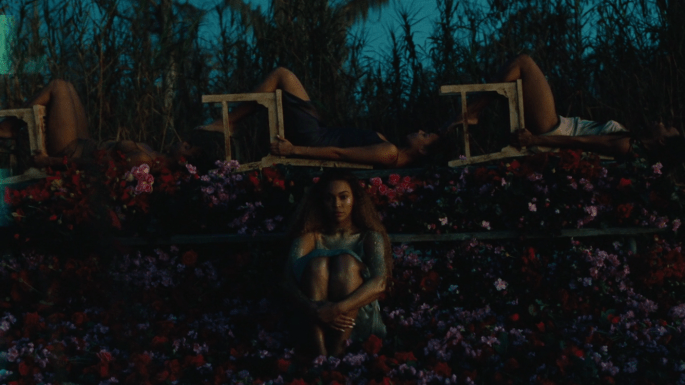
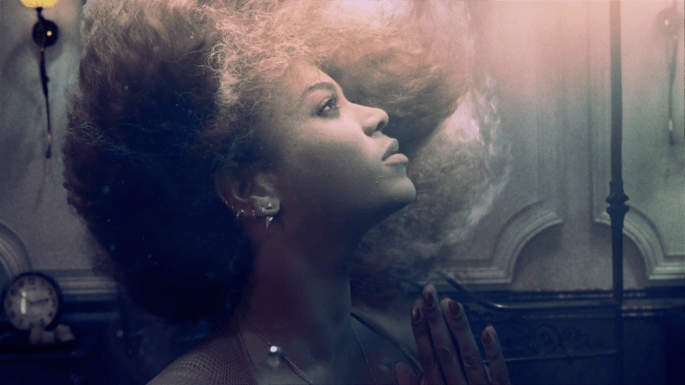
Make no mistake, this is indeed a Film, capital F.  Despite the many modern pop culture touchstones on display in these interlocking images paired with music, I was most struck by its fealty to the likes of Russian legend Andrei Tarkovsky and his masterpiece Zerkalo (aka The Mirror), or Terrance Malick with his career topping Tree Of Life.  Hushed poetry, an often somber journey through personal and political history, all told with languidly presented and immaculately framed visions flush with elemental power (all four on frequent display), delivered via clever juxtapositions of color stock with black and white.  An expansive group of directors joined up with Beyonce to realize Lemonade, and while there are plenty of unique individual moments, the cohesiveness of the project is fluid and stunning.  Like any great pop star, Beyonce is the hero of a thousand masks, inhabiting characters of both an idealized and familiar nature, so the viewer feels as if they’re walking beside her while gazing upon the shining star at the same time.  She’s diving deep within herself to find the story she wants to tell, then she’s playfully striking out against those who’ve wronged her; next she’s even appropriating the gangster mantle to angrily threaten her enemies.  Escalating into (and always never far from) a celebration of the goddess-like power women of color have and should celebrate, Lemonade almost threatens to become a fairly simplistic sermon.  Then, like all things in life, it gets more complicated than revenge clichés, than anger, than even self respect.  The world is a tough place—we are solemnly reminded by none other than Malcom X how tough it is for black women, and we are brought to tears by a late sequence paying tribute to the young black lives our nation has lost—and in order to survive, there has to be room for introspection, for understanding, and forgiveness.  The great arc of this story bends towards this lovely redemption, but it also ends with a repeated call to arms, hinted at in Mobius strip form by the opening notes of Formation playing as the credits roll.

beyonce-lemonade-women

Did I mention the music?  Oh, there is wonderful music.  Sassy, sexy, forlorn, funky, menacing, magnificent, rootsy, rocking, Lemonade covers the spectrum and does it all with graceful aplomb.  Again, Beyonce has collected a wide variety of talent in order to bring a depth and variety of sound to the project the likes of which we haven’t heard at these heights of popular music in many years.  Discovering what aural delight is around the corner to swim around and beside the imagery is a surprisingly bewitching exercise; I finished the film and immediately started it over again, and enjoyed it twice as much the second time around.  Unfortunately some film lovers appear to be put off by the singer’s notoriety and aren’t giving the experience its due because the musical corollary to artistic cinema can’t be hit singles; I hope those who feel that way put their prejudices aside and give the songs a fair shot too—that’s all they’re asking for, and they’ll give so much in return.  To sum up, Lemonade strikes one as a blast of pure art from a parallel universe where Toni Morrison had pipes on loan from Heaven and went to USC Film School with Lucas and Coppola.  Accomplished pop art like this doesn’t come along all that often, and in fact despite the familiar trappings mentioned above and the seemingly shopworn life lesson the title refers to, Lemonade carries the striking jolt of something truly sweet and new.

beyonce-lemonade-film-water

DAVID MICKEY EVANS’ THE SANDLOT — A REVIEW BY NICK CLEMENT

3

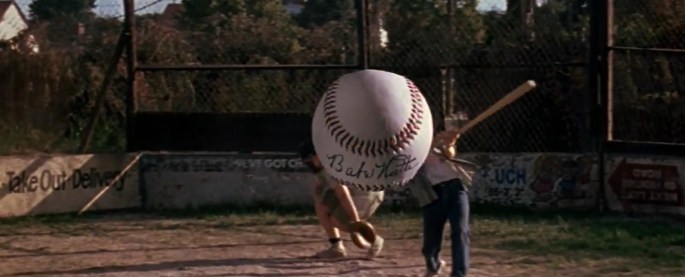
The Sandlot is an effortlessly charming family film. I can’t wait to show this film to my son, Owen, when he’s old enough to grasp it. It’s so wonderful on so many levels, and what’s so pleasurable about it, is that it’s one of those nostalgic items that you don’t feel guilty about still loving, because it holds up as solid, completely unpretentious cinema that has a heart and soul and passion. Written and directed and narrated by family movie specialist David Mickey Evans, the film is a loving period piece and a gentle friendship story, with just the right touch of mystery and childlike suspense to keep it always interesting. It’s also a beautiful coming of age story, told without forced nonsense on a narrative level, and never looking down on the child protagonists, all of whom are treated with respect and like adults. Which is why I think this film is so resonant and successful; it feels like a kid’s movie made by a person who completely understands the mindset of his characters, with zero pretense or judgement. Evans’ legendary original screenplay for Radio Flyer, along with his recent book The King of Pacoima, clearly present a man who is in touch with what it means to be young, and how various life experiences shape who we grow up to become. And when it comes to showing love for America’s greatest pastime, The Sandlot hits a grand slam, with some terrific baseball footage that was clearly pulled off by the versatile cast, and a clear sense of what makes the sport so fascinating and important for so many people.
2

The story concerns young Scottie Smalls (Thomas Guiry), an insecure kid who moves to a new neighborhood. He’s able to make some friends within a clearly bonded group of kids who practice   baseball at the local sandlot field. Baseball – it’s all these kids do – morning, noon, and night, eat it, drink it, and sleep it. Evans’s script charts one particular summer as Smalls ingratiates himself into the group, with mixed results, while all of the kids end up going on a series of adventures, both big and small, on and off the field. The big drama of the piece rests on the sketchy neighbor who lives on the other side of the fence near the field, and the reportedly monstrous beast that lives there, waiting to devour any baseball that lands in its yard. Evans got so much from his amazingly talented cast, and when revisiting the film just recently after a few years of not having seen it, I appreciated all of the performances that much more. Along with lead actor Guiry, Mike Vitar, Patrick Renna, Chauncey Leopardi, Marty York, Brandon Adams, Shane Obedzinski, Victor DiMattia, and Grant Gelt all provided memorable and in some instances incredible touching pieces of acting. Denis Leary and Karen Allen were smartly cast as Smalls’ parents, while James Earl Jones figures into the plot late in the game. Look out for an extremely young and cute Marley Shelton as an object of affection for the boys, and for Arliss Howard in an uncredited cameo during the final moments.

1

This is a film that I’ve seen countless times, and it’s one that will surely make the rounds for years to come on family movie night. The Sandlot feels like the type of movie that would be nearly impossible to get made in today’s moviemaking climate, as it’s a story that feels honest and real and never manufactured in order to hit focus-tested moments of expected action or plot developments. There’s a quaint feeling to the entire thing, with its leisurely yet never slack pacing, and a terrific emphasis on family dynamics and the importance of conversation and friendship. I love the unforced nature of Evans’ direction, and how he used snappy scene transitions with fun sound effects; this movie feels like it belongs playing on a double bill for all eternity with Joe Dante’s similarly underrated and heartfelt Matinee. A great baseball movie and a great family film all together, The Sandlot continues to be an audience pleaser after all of these years, and my guess is that it will continue to do so for years to come.

7

Top Ten Quentin Tarantino Characters: A Write Up by Nate Hill

Quentin Tarantino’s career has been vividly defined by all the beloved qualities which we hold dear in film: visuality, music, dialogue, emotion, conflict and especially character. His films contain some of the most captivating, idiosyncratic and unique people to ever grace the screen, played by an incredible lineup of actors, some of which he would go on to use time and time again. Below you will find my personal top ten picks from the rogues gallery of individuals who have appeared in his stories. Please keep in mind these are characters from films he has both written and directed only, not just ones he has written. Enjoy, and if you do, please share!

10. Zed, played by Peter Greene in Pulp Fiction. 


      Greene refused this part multiple times, causing Tarantino to hunt him down like a dog and basically beg him to play the role. When the director has a face in mind for a role and won’t quit like that, you’d better believe he’s gonna make magic with it if he ever manages to sway the actor. He does, and so does Greene, an actor with a distinct, sinister look who plays the absolute hell out of the character, spinning a small supporting turn into one of the most terrifying movie villains ever, and certainly the scariest character in Tarantino’s career. Everyone’s favourite redneck rapist sheriff, Greene leaves quite the unsettling impression with his work. 

9. Texas Ranger Earl McGraw, played by. Michael Parks in Kill Bill, Grindhouse and From Dusk Till Dawn


Tarantino casted underrated acting chameleon Parks as this character several times, each appearance resulting in pure gold. My personal favourite has to his bit in Kill Bill Volume 1, where he’s called to the El Paso wedding chapel massacre. Parks can literally play any part thrown his way, be it melodramatic French Canadian drug runner, neo-nazi hit man or the laconic southwestern lawman archetype, which he nails down to the detailed mannerisms here. McGraw is a lynchpin of Tarantino lore and an absolute pleasure to see every time he pops up. 

8. Captain Koons, played by Christopher Walken in Pulp Fiction


Walken balances weirdness and gravity like no other, often blurring the lines between the two to amusing and touching effect. When given what is perhaps the juiciest monologue ever written by Tarantino, Walken gives us a mesmerizing account of his time in the war, and his efforts to protect a coveted family heirloom which he then presents, with much ceremony, to a young Butch Coolidge. The film halts the momentum dead in its tracks to allow Walken to do his thing, completely off the leash and inhabiting his own special corner of the beloved film. He’s unforgettable, and makes a two minute appearance speak the volumes of eons.   

7. Bill, played by David Carradine in Kill Bill


There’s a scene in Kill Bill Volume 2 where Uma Thurman discovers Bill waiting for her outside the wedding chapel, playing his pan flute. There’s an epic passage of Morricone music, and he looks her dead in the eye. Upon reviewing a rough cut, Tarantino turned to Carradine and said “I think this is your best moment of the film.” Carradine’s response was, “Hell, I think it’s the best moment of my whole career!.” Bill is a mythic, titular antagonist who is built up no end for the duration of the films, the ultimate badass villain, and when the climax arrives in the eleventh hour, Tarantino writes an exodus for the character that is far more personal, emotional and grounded than I imagine anyone saw coming. It’s a gift to Carradine and fans alike, a villain with depth and purpose who exists in a surreal comic book world where the people couldn’t be more human or real. Carradine purrs his way through the role of his career and on into legend. 

6. Budd, played by Michael Madsen in Kill Bill


Tarantino brings out the best in Madsen, a purely charismatic dude who unfortunately makes a lot on unwatchable junky poo movies these days, squandering his obvious talent. This is is shining hour, playing Budd as a bitter backwater kid and younger sibling, nearing the end of his road and fermenting in bitter loneliness way out in the California desert. Madsen channels tough guys of the golden age as Budd, a rotten son of a bitch with a glint of humanity showing through his booze-dimmed eyes. 

5. Hans Landa, played by Christoph Waltz in Inglorious Basterds


Quite possibly the most entertaining villain in Tarantino’s work, due the the exuberant and absolutely committed performance of Waltz, in a trailblazing turn that would put him on the map in a big way. Beaming from ear to ear in almost every scene with a charming grin that dissipates occasionally, showing traces of the spider beneath, he’s a wonder in the role, a nazi A-hole rotten straight to the core. He doesn’t even possess any constitution or debt of faith in the cause which his smartly emblazoned SS uniform advertises; he’s in it for himself only, which is one more despicable quality to add to the list of traits one might use to define him. Perhaps the biggest Basterd of them all, and a joy to watch. 

4. Vincent Vega, played by John Travolta in Pulp Fiction


Pulp Fiction kickstarted Travolta’s career back into gear in a huge way, and it’s easy to see why as we watch his Elvis-esque slickster prance about the screen with effortless, heroin addled coolness and one hell of a dance sequence. His hair deserves its own spinoff film, he steals scenes by simply laying low and playing the dude with flair that never makes itself overly known. 

3. Mr. Blonde, payed by Michael Madsen in Reservoir Dogs


A stone cold psycho to the bone, Madsen relishes in brining this cop killing sadist to life, and dancing his way through one of the most iconic Tarantino scenes to date. Madsen has a rumbling threat to his work, a paced, portentous vibe that suggests the onset of a dangerous storm, but always seems to veer on the edge. With Mr. Blonde he crosses that line and shows us what a true madman looks like, without even raising his voice above a willowy growl. A class act in violent behaviour that laced with the blackest humour that we feel bad for laughing at. Mr. Blonde all the way. 

2. Jules Winnfield, played by Samuel L. Jackson in Pulp Fiction


A rain of hellfire awaits any viewer who has the privilege of seeing Jackson bellow forth biblical fury in his first collaboration with Tarantino. He’s the life of the party in Pulp Fiction, an articulate, relentless loudmouth with a character arc that amusingly negates his belligerent nature and makes Jules all the more fascinating for it. Jack sonics at his most magnetic when he’s in Tarantino films, and this is mile zero, baby. Not for a second does the spark leave his eye, or the threat of violence evaporate from his wake. Criminals who ruminate on life, love and cunnilingus have become a goldmine for writers post Tarantino, and one which he only mined the first nuggets of. Jackson is ground zero for the character type, and fires it up in a way which none of us will ever forget. 

1. The Bride a.k.a. Beatrix Kiddo, played by Uma Thurman in Kill Bill


Tarantino’s muse has been Uma Thurman since the days of Pulp Fiction, and here he writes a titanic revenge epic in which the actress gets to bare her claws and sink her teeth into the single most affecting and arrest in female role that he has ever written, also forging the best, or at least my favourite performance from any actor or actress in his films. The Bride is the revenge archetype, an angry blonde angel forsaken by her lover and dead set on a bloody warpath. Tarantino isn’t above writing in moments of stirring emotion, including the final twenty minutes of Volume two which is Thurman’s showcase piece as an actress and an achingly appropriate send-off for The Bride, as well as the one which she deserves. 
Thanks for reading, more to come!

Top Ten Tommy Lee Jones Performances

Tommy Lee Jones has had a uniquely interesting career.  He’s made a career out of playing the authoritative Gary Cooper-esque strong silent types; yet Jones has embraced his stoic calling to cinema, freely admitting that some of his turns are because people pay him a lot of money.  Even when he’s walking through a role that he’s done before, like in CAPTAIN AMERICA, he’s always a joy to watch.  Jones is incredibly sharp; his IQ is astronomic.  He’s best friends with Cormac McCarthy, and spends his free time on his ranch in Texas.  Jones is also a PR nightmare.  He only does interviews because he is contracted to, and he makes it very apparent during them, and you can’t help but feel bad for the person who is interviewing him.   His career is has been split into three different factions: staple Tommy Lee Jones, wildly hammy and outrageous Tommy Lee Jones, and the quiet auteur behind the camera who has become one of cinema’s most quietly treasured filmmakers.

BATMAN FOREVER 1995 Dir. Joel Schumacher

TLJ BATMAN

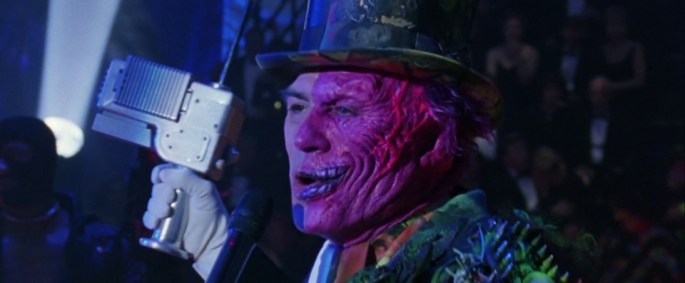
Cashing in on his recent Oscar win for THE FUGITIVE, Jones embarked on a crash course of over-the-top shtick.  In an interview, Jim Carrey recalled meeting Jones for the first time prior to filming.  Carrey was sitting at a bar excited to meet Jones.  Jones walked in, went up to Jim Carrey and looked at him dead in the eyes and said, “I hate you.  I really don’t like you.  I cannot sanction your buffoonery.”  As cold and outright awful a thing that is to say to someone, I can’t help but picture that situation in my mind and laugh.  Jones spent the entire production in ridiculous costumes and makeup, doing his absolute best to out Jim Carrey, Jim Carrey.  Whilst the film is a far cry from the Burton films, it is still a lot of fun.  The fun is attributed to the ironically great chemistry between Jones and Carrey.

COBB 1994 Dir. Ron Shelton

Cobb.jpg

COBB is a unique film.  It’s a very unorthodox sports biopic by Ron Shelton, yet it almost feels incomplete.  For any flaws this film has, it has nothing to do with Jones’ performance.  He is remarkable in this film.  Shelton did some of the best writing of his career with the overly colorful dialogue that he provides for Jones.   He blends his stoicism with a very hammy performance.  It is easily Jones’ most understated performance.  He plays two Ty Cobbs, the young and ruthless baseball player in flashbacks and then for a majority of the film, a mad old genius that is very reminiscent of Howard Hughes.  He’s brilliant, he’s crazy, he’s outrageous, and yet Jones shades this unlikable character with an amount of vulnerability that you cannot help but identify and sympathize with.

HEAVEN AND EARTH 1993 Dir. Oliver Stone

Heaven and Earth.jpg

In Jones’ second collaboration with Olive Stone, he portrays the most frightening character in his career, the affable Steve Butler who falls in love with a woman while serving in Vietnam.  Throughout the course of the film once he enters, Jones takes a back seat in more of a supporting role, but while watching the film unfold, you feel the pressure of his performance whenever he’s not on screen.  His character is brutal, a psychological villain that has nothing to give the world but overt brutality.

JFK 1991 Dir. Oliver Stone

JFK.jpg

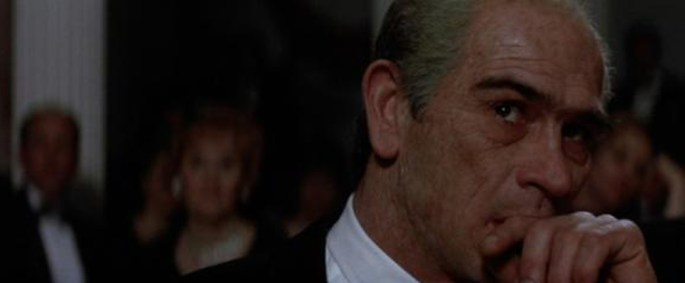
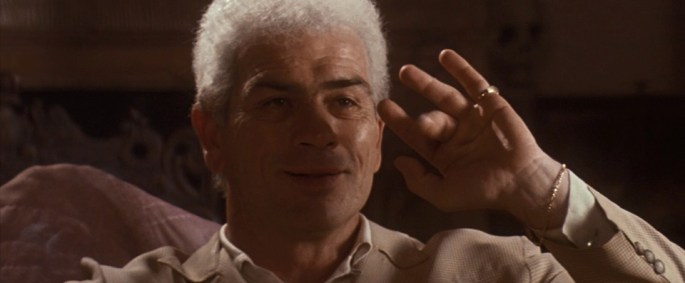
There is not enough that can be said about Oliver Stone’s masterpiece about obsession.  It is one of the most engrossing films ever made; it has the most unique ensemble ever.    The casting of Jones as a flamboyantly gay, ex CIA man who lives in the public of New Orleans as well as the dark shadow world of conspiracy, and underground sex parties is one of the most brilliant casting strokes ever.  Jones plays two characters in this film.  Clay Shaw, the upstanding citizen, business man, and community leader of New Orleans.  He’s the epitome of a straight man; he’s regarded and respected, he’s a class act.  And then.  And then we see him as Clay Bertrand, in all gold body paint, with a cap on making himself look like the Greek God Apollo, snapping poppers and inhaling excessive amounts of cocaine and acting in a way that is so repulsive, you are completely mesmerized by his performance.

LINCOLN 2012 Dir. Steven Spielberg

Lincoln.jpg

Daniel Day-Lewis playing the most admired President in US history wrapped with Tommy Lee Jones’ turn as the civil rights champion Thaddeus Stevens is an absolute Godsend to cinema.  While Day-Lewis’ performance flat-out dwarfs everyone else in this film, Tommy Lee Jones goes toe to toe with him.  His screen time is smaller than it probably should have been, but Jones gives a standout performance not only in the film, but also of his career.  His apathy for anything other than what is right, is brutally honest in this film.  His sunken and worn down physicality only adds mileage to a performance, which if anyone else played could have most certainly been a one note role.

NATURAL BORN KILLERS 1994 Dir. Oliver Stone

Natural Born Killers.jpg

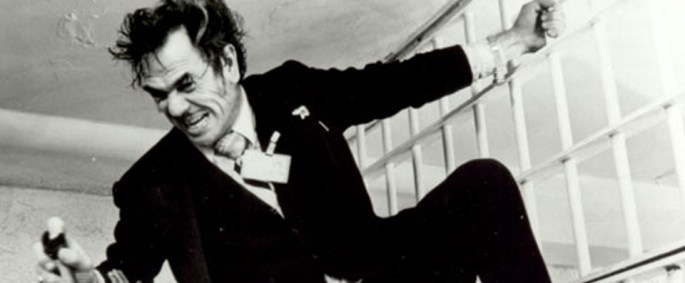
In their third and final collaboration Oliver Stone and Tommy Lee Jones brought to life one of the most excessively outrageous characters in a film that was already chalked full of excess.  In the third act of the film, we are introduced to the vile Warden Dwight McCluskey, and my God is the Warden a vile human being.  His greasy hair is perfectly slicked to the side, his crusty pencil thing moustache is all you can look at, and his zany attire is obnoxious.  Jones plays this part perfectly.  He outdoes anything he has ever done.  His performance is out so out of control it makes Mickey and Mallory look tame.

NO COUNTRY FOR OLD MEN 2007 Dir. Joel and Ethan Coen

No Country.jpg

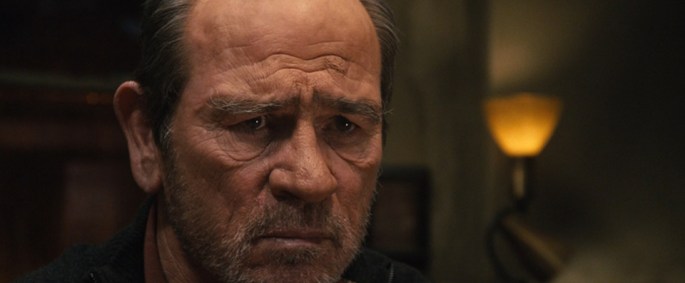
No one could have played Sheriff Ed Tom Bell like Tommy Lee Jones.  The horror and cruelness of Cormac McCarthy’s world is in every crack and crevasse of this man’s face.  The brutality of it all has worn this man down, more so than almost any other character we have seen on the screen.  He’s a man who as seen it all, until the events of the film unfold, and his apathy is swiftly shaped into caution and disbelief.  His low key performance is criminally overshadowed by the flamboyance of Javier Bardem.  This performance remains on the highest tier of his filmography and is one of his most underrated.

THE SUNSET LIMITED 2011 Dir. Tommy Lee Jones

SL.jpg

HBO deserves all the credit in the world for allowing Tommy Lee Jones to adapt Cormac McCarthy’s brutally heavy two man play for a Saturday night premier.   It is one of the most emotionally draining experiences anyone can endure.  The dark philosophy of life is on full display in a two hour conversation between a suicidal intellectual played by Jones and a killer turned born again savior played brilliantly by Samuel L. Jackson.  McCarthy’s razor sharp dialogue is made even more protruding by Jones’ linguistic abilities as well as his physical acting.

THE THREE BURIALS OF MELQUIADES ESTRADA 2005 Dir. Tommy Lee Jones

THREE BURIALS.jpg

The honestly of Jones’ performance in this film is absolutely haunting.  The hardened vulnerability of his performance is what won him Best Actor at Cannes, and it is a performance that will always stick with you after seeing it.  Out of his entire filmography, his performance in this film is the one that is criminally underseen, underrated, and understated.  I implore anyone and everyone to seek this unique film out and watch it.  This is the film that put Jones on the map as a not only a brilliant filmmaker, but in that unique class of actor/filmmaker that rarely works to the degree that it does with this gut-wrenching film.

UNDER SIEGE 1992 Dir. Andrew Davis

US.jpg

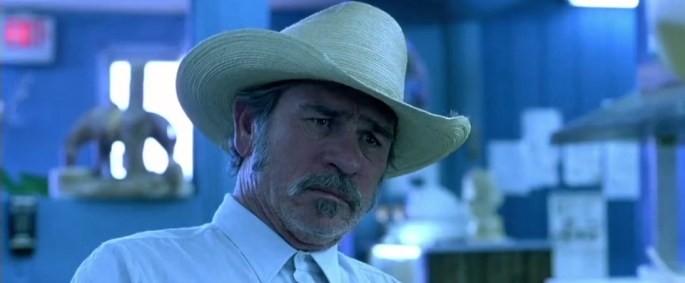
Whoever was behind casting Tommy Lee Jones against Steven Seagal is a genius.  Jones capitalizes on his quick wit and intellect and amazingly holds his own against Seagal in their blistering knife fight during the climax of the film.  Jones is at his absolute finest in this film, delivering darkly humorous dialogue that is strangely understandable.  Not only is Jones on fire in this film, he also gives us one cinema’s best villains.  What makes his performance so great in this film, is how much fun he’s having.

Honorable mentions: THE FUGITIVE/US MARSHALS, IN THE VALLEY OF ELAH, THE HUNTED, BLOWN AWAY, SPACE COWBOYS, LONESOME DOVE, BLUE SKY, THE CLIENT, ROLLING THUNDER.

JEREMY SAULNIER’S GREEN ROOM — A REVIEW BY NICK CLEMENT

1

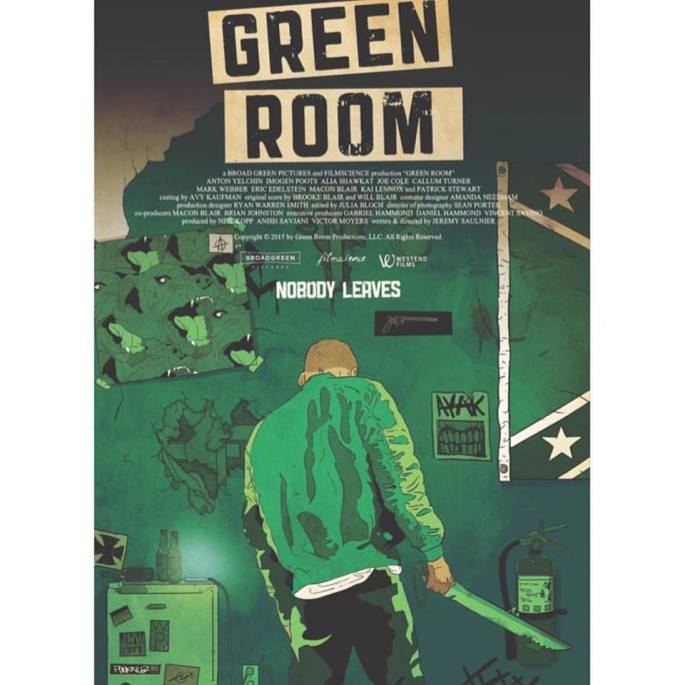
Jeremy Saulnier is a cinematic madman. His 2007 debut Murder Party announced a new, distinctive voice on the indie movie scene, while his follow up, 2013’s blistering revenge thriller Blue Ruin demonstrated that a tremendous new talent had taken a huge leap forward. And now, with his latest film, the pulverizing horror-thriller Green Room, he’s firmly staked his claim as one of the most exciting cinematic voices to hit the movie landscape in years. He’s not making films that are going to appeal to the old farts in the Academy, but rather, he’s embraced the idea of the unpretentious thriller, stripping his genre based elements to their bare essentials, and cruising through nihilistic narratives that only potentially offer catharsis or safe haven by the end. But, like the best filmmakers, be ready to have your expectations constantly subverted, as Saulnier clearly revels in the art of the surprise.

2

I don’t know anything about the punk rock scene in Seattle, but this movie feels like it knows this world intrinsically, so I believed every single moment in this compact bit of storytelling. Saulnier makes some subtle generational jabs by writing the band members the way he does, and one of the things that made this movie as effective as it is was that at no point did I feel that this couldn’t happen. As in Blue Ruin, there’s an escalating sense of tension and violence that permeates the entire film, and if I wasn’t as emotionally invested in the narrative in Green Room as I was in his previous picture, it takes nothing away from the continued formal precision and careful, air-tight plotting that almost begs to be scrutinized. There’s a nice twist that makes sense towards the start of the third act, and rather than the moment feeling contrived in order to advance the plot, it felt organic and logical.

3

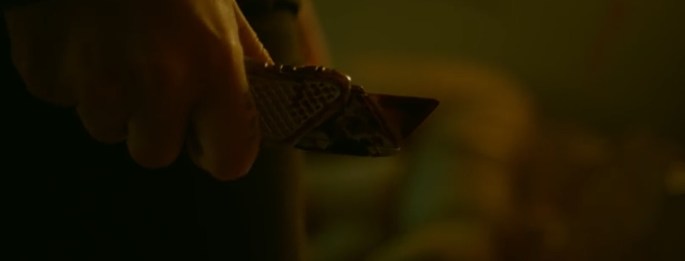
This is a grubby, grimy movie, with terrific production design by Ryan Warren Smith, and overall, it’s the sort of effort that Quentin Tarantino or Wayne Kramer would go nuts for (QT apparently has!), involving a punk rock band playing at the A-1 wrong venue, a hell-house run by skinheads. The band members inadvertently witness the aftermath to a murder, and before you know it, they’ve all been marked for death, with the head neo-Nazi played by Patrick Stewart in a bone-chilling performance that’s unlike anything I’ve ever seen from this most excellent actor. Casting Stewart in this role was a stroke of genius in and of itself, but the way that Saulnier continually builds dread all around his hapless characters helps to raise the stakes all throughout, with Stewart taking on an almost mythic quality. And then there’s the attack dogs – just you wait! Anton Yelchin continues on his terrific streak of quality projects with unique filmmakers, and for once, it was a pleasure to see a character in one of these movies that gets stabbed, and then actually feels the pain. How novel!

GR

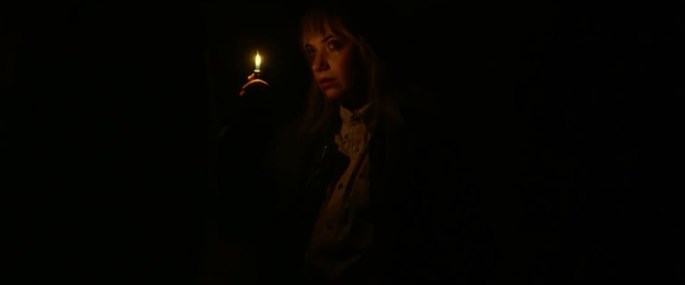
The lovely Imogen Poots strips away her cutie-pie looks and shreds her image with a gross hair style and an eerie sense of near-joy during some of the more nasty moments of bloodshed, with Saulnier delivering a sly feminist undercurrent to a portion of the film.  Macon Blair reteams with the filmmaker after their startling collaboration on Blue Ruin, here delivering a totally different and equally impressive performance. The always awesome Mark Webber also gets some choice scenes; there’s something about this actor’s face that suggests inherent engagement. Cinematographer Sean Porter bathes the film in dark greens and inky blacks, sometimes looking for that shade of brown that Fincher has been searching for of late, stressing strict camera placement and expert attention to visual space, so that each action scene stings with the necessary blunt force that the story demands. Gory, unrelenting, and totally nasty in every sense of the word, Green Room is yet another aesthetically exciting and formally bracing piece of work from Saulnier, who along with Ben Wheatley, has cemented himself as one of my new favorite cinematic voices.

2

The Excorcist III: A Review by Nate Hill

image

William Peter Blatty’s The Excorcist III is my favourite in the series, and if that leaves some people aghast with disbelief, I’ll still hold my stance. Don’t get me wrong, the first film is a classic of atmospheric dread, the sequel is a psychedelic oddity that’s also very underrated, but there’s something about this one that just sat better with me than any of the others, including the two prequels with Stellen Skarsgard. This one deviates from the pattern as well as lifts the focus from Linda Blair’s character, paving a cool new story for itself and breaking new ground. It’s also got one of the single most terrifying moments I’ve ever seen on film, orchestrated perfectly enough to give a good dose of goosebumps to the strongest of spines. The immortal and always excellent George C. Scott plays Kinderman, a police lieutenant who is on the trail of a bloodthirsty serial murderer nicknamed The Gemini Killer. The killer himself has actually been long deceased, but uncanny similarities in the current crimes have freaked the police right out, and so he follows the clues to a foreboding psychiatric facility. It soon becomes clear that there’s something very mysterious going on, and something very wrong with the patients. Skittish Dr. Temple (Scott Wilson) seems to know what’s going on, but also seems not to, or to be too scared to divulge anything. A terrifying patient named James Venuman (Brad Dourif is so scary you’ll want to hide behind the couch) seems to contain something malevolent inside him, his ravings making eerie sense to the detective. There’s a few surprise cameos from veterans of the franchise, as well as work from Ed Flanders, Nicol Williamson and, believe it or not, an appearance from Fabio, of all people. The atmosphere is so thick you could choke on it, the dread hanging in the air like clammy mist, helped in part by the disturbing choice of location, Dourif’s sheer ghoul act and cinematographer Gerry Fisher’s camera, which lurks along walls and corridors and turns the facility into a haunted house, and our nerves into a jittering mess. Underrated as both a standalone fright flick and as an entry in the Excorcist series. Top notch creepfest. 

MAGGIE CAREY’S THE TO DO LIST — A REVIEW BY NICK CLEMENT

to_do_list_ver3_xlg

How this little comedic diamond in the rough isn’t more well-known and widely loved I’ll never understand. Oh wait, I do understand – it’s yet another instance of a studio having zero faith in its product, and relegating it to unfortunate and undeserved also-ran status. Which is a crime, as The To Do List is easily one of the funniest, shrewdest teen sex comedies that I’ve ever seen, raunchy and heartfelt in equal measure, and possessing an extremely high joke per minute ratio. Operating as both a crass and sweet genre topper and a painfully observant 90’s period piece (shoot me…!), this is one of those movies that never got a fair shake from critics (52% at RT, what the hell…?) and is miles better than most of its competition. In all honesty, it destroys the likes of American Pie, which I’ll always have a soft spot for, and it really makes most other recent laughers look tame and mild in comparison, both in terms of graphic sexual content and honest-to-goodness guffaws. Written with extreme vulgarity but also extreme smarts and capably directed by Maggie Carey in her filmmaking debut, the film is the naughty story of Brandy Clark, the amazing Aubrey Plaza, and how she charts an epic sexual journey during the summer before she enters college. Plaza is such a gifted comedienne, and in scene after scene, her impeccable comedic timing is on display, while she clearly has no qualms with getting down and dirty.

She’s a virgin, but more than just that – she’s done NOTHING of any carnal consequence whatsoever. So, with the help of her more advanced friends (Alia Shawkat and Sarah Steele, both excellent), her always-having-fun sister (the adorable Rachel Bilson), and her boss at the town pool (an outstanding Bill Hader), she creates the ultimate sexual To Do List, in an effort to not become embarrassed as a college freshmen. She’s obsessed with a hunky lifeguard played by Friday Night Light’s Scott Porter, while she’s mostly oblivious to the charms of fellow employee Cameron (a perfectly cast Johnny Simmons). Also featured in the stellar supporting cast are Connie Britton and Clark Gregg as Brandy’s hysterical parents, who steal the film with a subplot that’s normally taken out of most movies. And speaking of scene stealing, Hader, as usual, absolutely owns the movie when he appears. Andy Samberg, Christopher Mintz-Plasse, Jack McBrayer, Donald Glover, and Adam Pally round out the deep cast of comedic performers. On a visual level, the film is nothing to write home about, but this isn’t a flashy exercise in style. This is a near constant stream of hilarity, with mostly fixed camera positions and simple set-ups, as Carey knew that her script just needed to be filmed as-is with a minimum of fuss. Sadly, The To Do List never played on more than 600 screens nationwide when it was released in July of 2013, and it grossed less than $5 million domestic. I can only hope and pray that this totally deserving little gem in hiding has started to find the audience that it truly deserves.

DAVID O. RUSSELL’S THREE KINGS — A REVIEW BY NICK CLEMENT

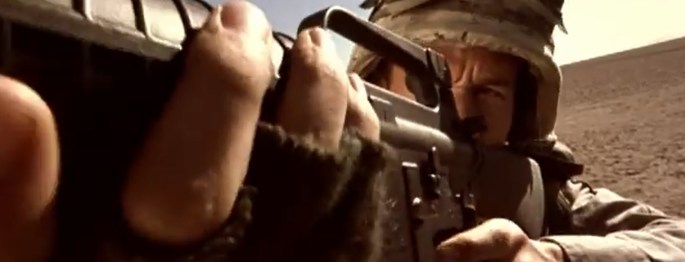
1I can still remember the first time I viewed David O. Russell’s blitzkrieg masterwork Three Kings, which for me, is my favorite of all of his terrific cinematic works (I Heart Huckabees is a VERY close #2). I was in college, working on my 16mm, black & white student film, and the entire crew went out to see it after a long day of working on our own little action romp. And I can still remember how the film ripped the tops of our heads off, and how it sent us out into the lobby with a serious cinematic buzz that would take weeks to get rid of. This was a theatrical three timer, and over the years, I’ve probably seen it 20 times, either in full or in bits and pieces. On an aesthetic level, Three Kings was a game changer and a mind-blower, with Newton Thomas Sigel’s eye-scorching images producing one phenomenally visceral moment after another, while the hilarious black comedy and pointed satirical elements of the script landed direct blows in every instance.

3

The chemistry between George Clooney, Mark Wahlberg, Ice Cube, and Spike Jonze was intense and palpable, their characters fully fleshed out as human beings and as a result capable of mistakes and lapses in judgement, each with their own strict sense of morality, with Russell’s usual brand of idiosyncratic humor sprinkled along the edges. The action scenes are violent and explosive, and still register strongly to this day, even in the face of countless blow ‘em ups that have come and gone throughout the overly CGI’d years. The amazing supporting cast included a very young and adorable Judy Greer, Cliff Curtis, Nora Dunn, Jamie Kennedy, Saïd Taghmaoui, Mykelti Williamson, and Holt McCallany. Noted for its turbulent shoot and controversy over scripting credits, this is one of those films that feels alive and essential, and is overdue for special edition treatment from a group like The Criterion Collection. The film’s trailer is also an all-timer, as well as Russell’s making-of video diary. I’ll never get tired of revisiting this film, because on so many levels and then as an entirely unique whole, I think it’s one of the best contemporary war films ever made.

2