I like when comedic actors do serious roles, especially when they’re such a tonal and characteristic departure from what we’re used to seeing that you get to view the artist in a completely new light. Dan Rush’s Everything Must Go is a sensational indie drama that focuses on a mostly dead serious, unbelievably restrained Will Ferrell as Nick, an upper middle class fellow who is also a relapsing alcoholic and whose life is starting to spin dangerously out of control. After several pretty bad alcohol related incidents at work he arrives at his home in the Arizona suburbs to find his wife has left him, changed all the locks and dumped his belongings all over the lawn. Feeling pretty much at rock bottom, he stocks up on booze, posts up on his lawn and cracks open a tall can of Pabst Blue Ribbon, his drink of choice and the first of many. This is where much of the film finds him, just sitting in his yard amidst a maze of personal stuff that he attempts to sell in an impromptu ongoing yard sale with the entrepreneurial assistance of a local kid (Christopher Jordan Wallace). Various folks in his life try to do their best to help him including his cop buddy and former AA sponsor (Michael Pena) and the sympathetic pregnant homemaker (Rebecca Hall) across the road, while he makes his best effort to connect with them and with a former high school sweetheart played by Laura Dern who blesses the film with a brief but luminously earnest cameo. This is a pretty bleak film that focuses on someone who has nearly lost everything in life, it’s not an area of human experience the we or cinema overall likes to dwell on but think of the thousands of everyday people going through this sort of thing whose voices remain unheard, and the countless others who have made it through such a life altering addiction and it’s subsequent personal ramifications and how viewing a film like this may give them further hope and inspiration. Ferrell is a revelation as Nick; gone is his wacky, wild eyed persona and any moments of comedy to be found here are of the subtlest, driest variety, the kind of laughs that hurt on the way out. Everything that’s happened to him is essentially his own fault, but that didn’t stop me from caring about him deeply and wanting him to make it through his rough time intact, or noticing that underneath the mess his life has become, he’s a bright, sweet guy with a slightly dimmed but nevertheless good outlook on life and a kind, open heart. Just observe how he cares for the kid he’s hired to sell his stuff, or does his best to treat Rebecca Hall’s character with respect and kindness, even when his drinking and jaded mental perspective make it difficult to do so. There’s a scene near the end of the film which I don’t want to spoilt too much except to say that she gives him a gift, a small token that is profoundly resonant and reflective of the brief, unorthodox but very important piece of time they have shared together by pure happenstance, and it’s the emotional core of the whole thing: one human being doing their best to comfort and lift up another who has fallen on perhaps the hardest times they’ll ever see. This is an uncommonly emotionally intelligent film with a career best performance from Ferrell who is about as committed, grounded and heartbreaking as he’ll ever be in his career and a fleeting glimpse into the life of someone you might hurry past on your way, divert your gaze when they meet yours or speed up in indirect shame as you drive past and see him on that lawn, can of PBR in hand, surrounded by broken materialistic dreams. But his story, countless others just like it and the human beings in them are just as important as any others, and it’s life affirming to see a filmmaker tackle one with such compassion, honesty and empathy. Great film.
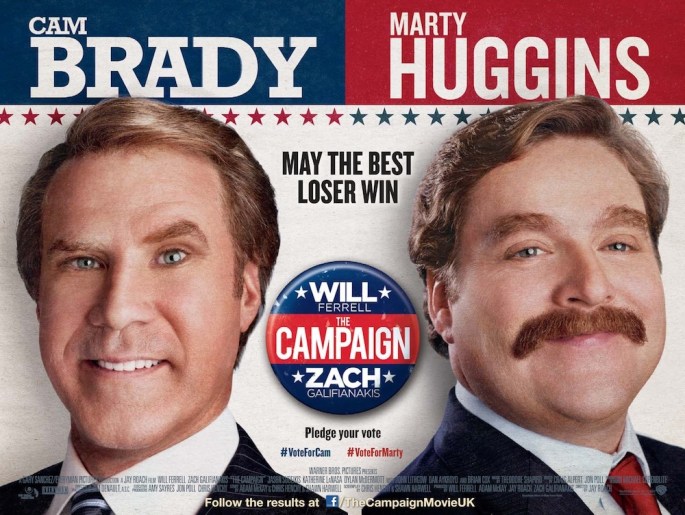
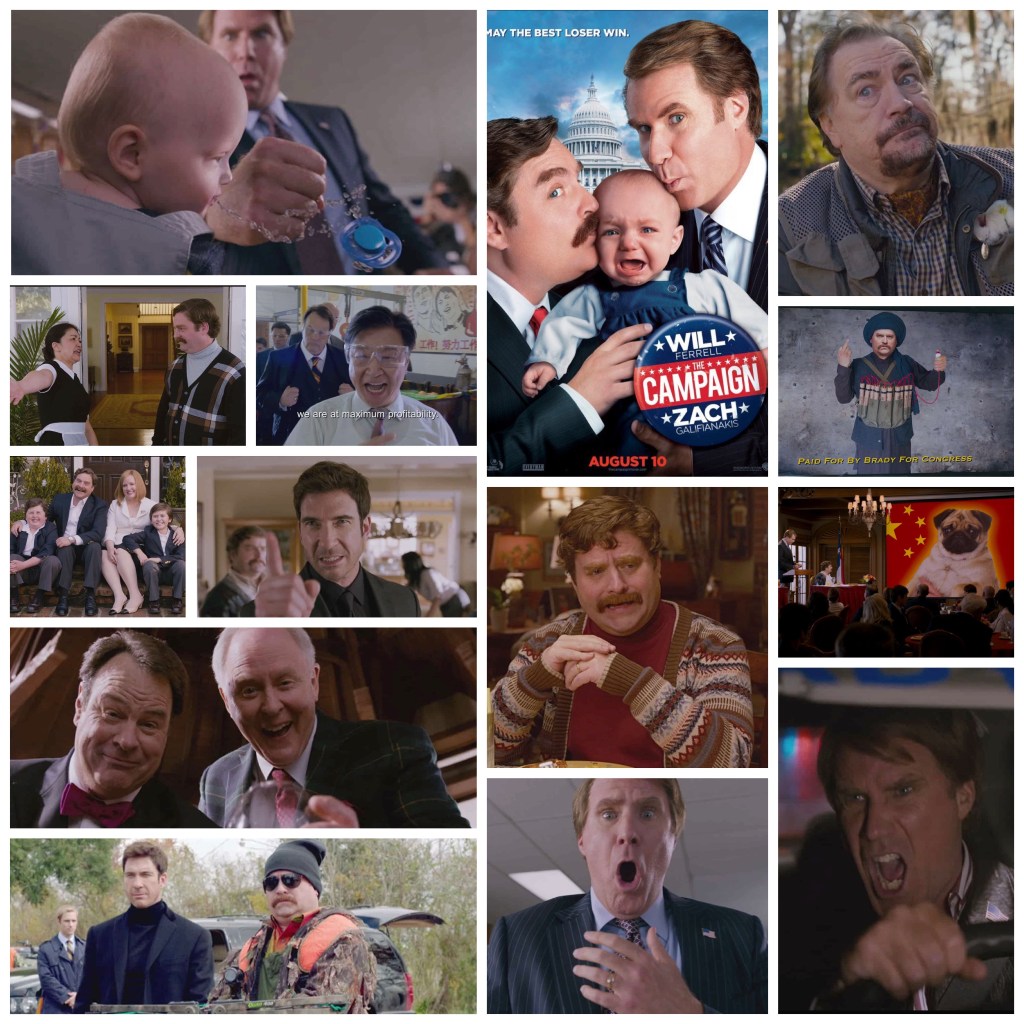
I didn’t expect much from The Campaign given how saturated the comedy genre is with collective Will Ferrell/Zach Galifinakis content that can be profoundly hit or miss but this is one seriously funny film, starting with the freedom to play thanks to its R rating which is always an asset. Political satires should always elicit nervous laughter here and there and this does a good job of having fun but also kind of subtly showing us exactly how elections work and the inherent, ever present corruption behind each and every one of them. Ferrell is Cam Brady, a dipshit Louisiana congressman with the IQ of a riverbed who is up for re-election and since he’s so far unchallenged, is in relax mode. However, two scheming, cigar chewing billionaire industrialists (John Lithgow and Dan Ackroyd channeling their inner Looney Toons) are trying to sell out their state’s resources to those pesky Chinese that seem to keep buying everything up so they can develop a bunch of land into sweatshops and turn dirty profits loose. They need a rival candidate that they basically own though, which brings us to Galifinakis’s Marty Huggins, a hopeless but sweet dim-bulb from old money whose rich prick kingpin father (a perpetually tipsy Brian Cox) doesn’t think much of him. A Slick Dick campaign fixer (Dylan McDermott) is hired and suddenly Brady has a challenger in this sweet tea swillin’, double pug owning, piss-ant little character who at first is in way over his head but soon gets a clue and then it’s clash of the brain-dead republican candidates. On paper this sounds like it skewers republicans only but all these people really don’t give a shit about the party ideals they’re representing and it’s clear that this kind of behaviour, cash backed policies, rampant scandals, passive aggressive smear attempts and clandestine maneuvers happen on both sides regardless of red or blue, and no one is off the hook. These two go to great and terrible lengths to one up each other that start with trying to bang each other’s wives, escalates to one tricking the other into driving while spectacularly hammered (and getting subsequently disgraced) and by the time this battle of wits (or lack thereof) reaches its fever pitch Ferrell has accidentally one-punched both a baby and a dog! I’m not gonna lie this film had me fuckin laughing almost the entire way through at these blissfully tasteless antics and appreciating the diabolically satirical script that is the most on point send up of politics this side of Barry Levinson’s Wag The Dog. Also I’ll add that there’s more cameos in this film than an episode of Entourage so keep your eyes peeled for a lot of famous people being super ridiculous. Hilarious film.
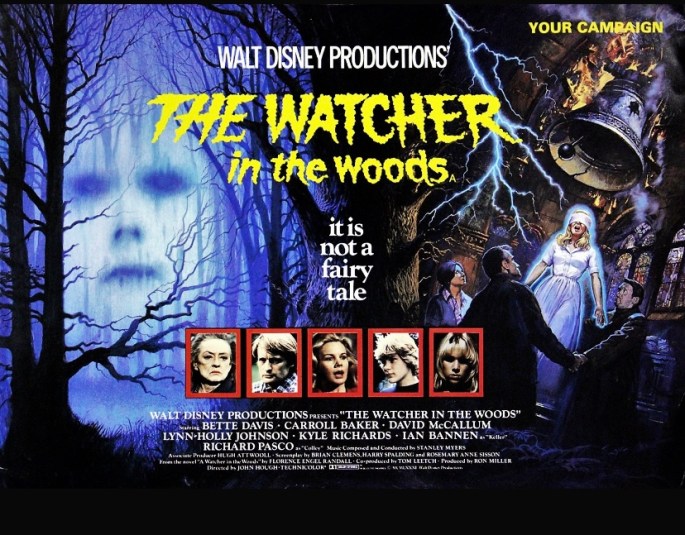
Disney used to do a lot of cool, creaky old live action films back in the day, awesomely retro SciFi/horror/adventure type stuff, and while not as timeless or important to me as others of its type, The Watcher In The Woods is still an atmospheric enough piece with beautiful UK locations, eerie sound design and a solemn, spooky performance from Bette Davis. She plays the widowed owner of a massive Victorian mansion in the English countryside who rents part of her home out to an American family for reasons that I still can’t quite figure out, but it has something to do with her daughter who died on the grounds under mysterious circumstances decades before. It isn’t long before the eldest daughter (Lynn-Holly Johnson) starts t have strange visions, hears things on the edge of the woods outside the property and dreams of a ghostly blindfolded girl who cries out for help. This all escalates into an impressively supernatural yet still down to earth series of plot revelations anchored by Davis and her intense eyes and well acted by everyone. The youngest daughter is played by Kyle Richards who we remember as Lindsay Wallace in John Carpenter’s Halloween which packs in some further horror pedigree. I’ll admit I wasn’t as won over by this film as I thought I would be, but I think I built it up too much. I have been searching for this one for years, it’s far too expensive to buy on Amazon and Disney plus neglected to add it to their stable for some reason (they’re notorious for that vault-hoarding bullshit) so my only hope was thrifting. I did eventually score a DVD and was beyond excited but it just didn’t grab me like some films of its kind do. Terrifically eerie sound design and atmosphere for days, but the story felt like it could have been tighter, more focused and amped up.
Underworld: Awakening picks up the relative slack of Revolution and rejoins Selene’s story once again after the rousing medieval diversion of Rise Of The Lycans and is one of the strongest, most action packed and exciting entries so far. This one is cool because it goes for a shocking and ambitious premise: the human population on earth have somehow found out about the vampire and Lycan races and it’s caused all kinds of chaos. A human CDC kingpin (Stephen Rea) concocts a shady plan full of tainted vaccines, inter species psuedo genetic modification and various hidden agendas that poses a real threat to both sides while Kate Beckinsale’s Selene, who never seems to get a moments rest, wakes up from some kind of cryo-sleep in Rea’s spooky lab and must fight her way out, figure out his sinister plan and protect the daughter (India Eisley) she never knew she had from all these nefarious forces. There is a fucking tremendous amount of action in this one, nearly wall to wall and it just might have some of the most impressive set pieces, or at least the most satisfying for me as a fan. Rea is no stranger to the vampire/werewolf genres, he’s done vicious turns for Neil Jordan in both Interview With The Vampire and The Company Of Wolves. He makes a formidable enemy for Selene here and gets to chew scenes in that kind of super low key, almost laidback but still menacing way he’s perfected as an actor. Also in his employ is a strange Lycan super-breed who becomes the size of a literal tank when he transforms, so there are numerous incredibly badass sequences of her fighting this gigantic tank-sized werewolf that are so much brutal fun. She also finds herself at the bottom of an elevator shaft at one point with the speeding elevator in free fall headed right for her. Being the franchise that this is, she simply empties countless rounds from her guns into its incoming floor until it’s perforated with bullet holes and she can literally punch right through it. So. Fucken. Cool. Once again this franchise is not gonna be everyone’s thing and even for those who liked the first, these might get a bit repetitive but this world, action, effects, atmosphere and overall aesthetic is just so up my dark alley I could literally never get tired of them, and this was one of my favourites so far.
Few films or shows are able to impart just how complex and capable of contradictory behaviour, light and darkness and moral ambiguity human beings are, but Harriet Warner’s Tell Me Your Secrets gets it and is a sensational showstopper, deep psychological imbroglio of disturbing deeds, poetically serendipitous plot turns, emotionally devastating character work, evocative southern gothic atmosphere and petrifying suspense. Originally shot in 2018 for TNT and subsequently abandoned by the network, Amazon has made an intuitively excellent choice in rescuing it from the scrap heap because based on the first season alone, it’s already looking like one for the books. The story, although deeply complex and labyrinthine, is actually fairly easy to get a handle on: Karen Miller (Lily Rabe) was once the girlfriend of vicious serial killer Kit (Xavier Samuel) who murdered nine women with a claw hammer, and kept his crimes secret from her. When it all came out, as it always does, he ends up on death row, she ends up in Witness Protection in Louisiana far from him and things smooth over, save for those loose ends which always seem to find their way back. One of those is grieving mother Mary (Amy Brenneman) whose missing daughter was once spotted in the vicinity of Kit, so she naturally assumes he must have been the one who took her. She is relentless to the point of recklessness and self destruction in this belief, going as far as to hire recently ‘reformed’ serial rapist John Tyler (Hamish Linklater) to dredge up his long dormant predator’s instincts and track Karen down, wherever the program has relocated her in hopes of any usable intel. Got that? Doesn’t matter, the show uses a crisp, well versed and fluid vernacular to tell this tale that has a lot of moving parts, tricky bends in the road and thunderclap revelations, it’s gripping, succinct, uncommonly intelligent work. Lily Rabe is an actress that I immediately connect/mesh with in the sacred viewer/performer symbiosis, I love her work in American Horror Story and since then have been hoping for her to get a truly showcase part.. this is it. She always seems to be one thousand percent actively engaged in the scene, always has the intensity turned up past eleven on the dial but always *owns* that choice and makes it feel earned. Karen is a girl in an impossibly rough life situation, handed cards no one should have to play. Her character arc is a thing of beauty as we slowly see what type of person she is, the choices she’s made and what she’s trying to do to shape her future, and the committed, finely tuned yet organic performance behind that from Lily radiates forth and reflects it all. Brenneman works wonders with a tricky character that you’ll want to hate but she’s been through a ton of trauma too and while it doesn’t excuse her overall course of actions within the moral quagmire of a narrative, I understood why she was the way she was, without judgment or endorsement. Liklater is just about as scary as one can get in a role like this and I’d imagine about as close to the mark in portraying a sicko perv rapist sociopath lunatic as one might get. He’s amiable, soft spoken, charismatic, strikingly remorseful and pleasantly chatty… until the true nature comes out. It’s a diabolical acting creation and I’m not familiar with his work before this but he’s squarely on my sonar now. This is deep, dark, distressing storytelling and at times the story is so disturbing, suspenseful and asks so much mental engagement and empathy from the viewer it can be quite an endeavour to take on, but the rewards to an avid participant and those who hunger for challenging content that lingers in your thoughts and dreams long after are superabundant. The principal leads anchor a three point triangle of psychologically, emotionally harrowing but somehow cathartic and almost Shakespearean level karmic epiphanies, backed up by a brilliant supporting cast, a tangled bayou of secondary narratives and chilling sideshow mysteries embroiled into the gumbo of our main tangent, an impressively eerie score that hovers along almost sub-audibly on the fringes of awareness and overall every aspect of this wonderful, fearsome, engrossing story shines bright out of the dark. Please, please let’s have many more seasons.
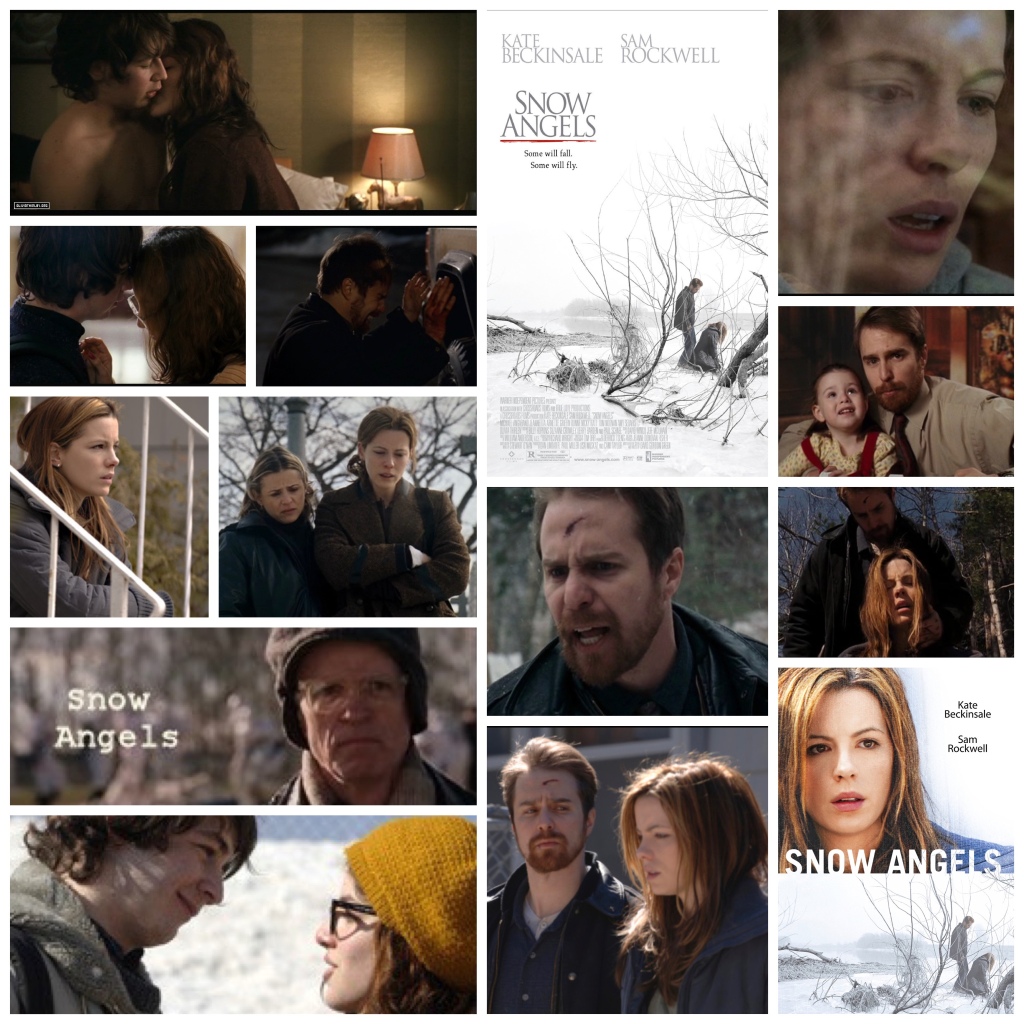
David Gordon Green’s Snow Angels is a film that asks the viewer to accept hard truths: that any given human being is capable of maliciousness, compassion, mistakes, volatility, naïveté and the desire to do better within the same lifetime. It presents to us an ensemble of small town characters at penultimate crossroads of their lives where decisions will be made that cannot be unmade, and may shape both their futures and our perceptions of character but we must remember… they’re only human. Resisting the urge to use any sort of filmmaking gimmickry, Green forges a blunt, unforgiving yet unusually honest portrait of these people: Sam Rockwell and Kate Beckinsale give heartbreaking, career best performances as hopelessly dysfunctional divorced parents who lose their way both as a unit and as individuals following the tragic death of their infant daughter. This event spirals out around them into the community as we see murder, adultery, budding teen romance and all manner of human interaction transpire. Rockwell is a careening time bomb of emotional immaturity, a man who loves his ex wife and loved his daughter dearly but cannot reconcile his own mental health issues and his performance implodes upon itself like a dying star in a work of art that has never seen this actor more vulnerable and raw. Beckinsale ditches her glossy, restrained pretty girl image for a character that it’s easy to dismiss as unlikeable and irresponsible until you see the depth and dimension she pours into the performance, and it’s not so easy to pass judgment or condemn. Others provide vivid impressions including Griffin Dunne, Amy Sedaris, Nicky Katt, Jeannetta Arnette and Tom Noonan who bookends the film in haunting profundity as a no nonsense high school band teacher who seems almost like a godlike force or deity watching over the souls of this small northwestern town. The single uplifting plot thread is a teen romance between Olivia Thirlby and Michael Angarano, who flirt adorably, fall for each other awkwardly and discover sex, conversation and each other’s company in a realistic, down to earth and warm-hearted way, it’s a cathartic oasis of love and light amidst the dark onslaught of this overall bleak snowstorm of a narrative. What makes all of this tragedy, pain and sorrow so palatable then, you may ask? Green is a terrifically intuitive director who gets genuinely believable performances from his actors, full of naturalistic dialogue, believable idiosyncrasies and a sense that nobody in this story is simply good, simply bad or there to serve one archetype, they are all flawed human beings capable of the deepest acts of love, caring and compassion or the most callous, nightmarish violence, neglect and abuse. There’s a scene where a mother comforts her teen son who has made a traumatizing discovery and she tells him how important it is not to keep that pain bottled up, but to feel through it and it’s one of many strikingly intimate, uncommonly intelligent scenes in a film that is a meticulously edited and shot carousel of human experience. The tag line read: “Some will fly, some will fall,” and it’s applicable to our our experience as human beings overall: life is not easy for everyone, mistakes are made, love is found and lost and the cycle continues. A lot can be learned, felt, internalized and reflected upon after watching this miracle of a film.
Kate Beckinsale roars back into action with Underworld: Evolution, a sequel that, like many follow ups, isn’t as structured or fresh as the first but still manages to be every inch as stylish, baroque and gorgeous looking as the other few in the series I’ve seen (I am making my way through a Blu Ray box set of all five films in their extended cut glory). The action takes up right where it left off; outcast warrior Selene (Beckinsale) has killed vamp elder Viktor (Bill Nighy) and ran off into the night with her halfbreed lover Michael (Scott Speedman) with monstrous final boss Marcus in hot pursuit. This provides one of the entire franchise’s most jaw dropping, visually dynamic action sequences as they careen down Vancouver’s Sea To Sky highway against a muted overcast sky in a big rig semi truck. Now Marcus (Tony Curran under a metric ton of makeup) is one of those snazzy Spawn-esque vamps who can fly and has extra razor sharp limbs and cool bodily accessories to help him fight, so basically he’s flying alongside them at a crazy speed attacking the truck while Selene empties clip after clip into his face from her semiautomatics before ploughing right into the Britannia Mine tunnels, it’s just an exhilarating, incredibly well shot action sequence and the highlight of the film. Also I’m a bit tired of American studios filming here and then trying to pass off my beautiful home province as some place in the states or wherever so from now on I’m just going to refer to any film shot in Vancouver as being set here as well. Anyways, this is a solid entry that benefits from Marcus as a formidable, physically ruthless villain and continues the ongoing trend of seasoned British stage actors cast as vampire elders, Derek Jacobi stepping in here for a mostly absent Bill Nighy. Not my favourite of the series that I’ve seen so far, but a solid entry with memorable set pieces including a snowy medieval prologue that sets the tone for Rise Of The Lycans, an impressive climax set atop a ruined mountain castle complete with hovering helicopters and that Sea To Sky truck chase is just one for the ages.
Many werewolf films take place in the woods, mountains or various other rugged and elemental vistas that are inherently threatening and suit the mythos. But what about the urban jungle? How many werewolf films can you think of that place their action in a big city? Wolfen is one that does this and as such stands out in the genre for being a moody, eerie inner city horror about a gruff, unfriendly NYC police detective (Albert Finney) chasing down mysterious murderous hoodlums who he soon realizes are some kind of lycanthropic shapeshifters straight out of a Native legend. This leads him on a hushed yet bloody and quite atmospheric hunt through some of New York’s shadiest areas, made all the more spooky by the presence of these ferocious and quite stealthy cryptid hybrids. He’s helped and hindered by many in one eclectic cast that includes Diane Venora, James Tolkan, Rino Thunder, Edward James Olmos, Gregory Hines as a slick streetwise colleague, a very drunk and very brief Tom Waits and Tom Noonan as an ill fated ‘expert.’ This isn’t a very loud, snazzy or schlocky horror flick and in fact if memory serves it’s more of a mood piece type thing than any sort of thriller or shocker. Finney is sombre, muted, hard to read and even vaguely menacing, while the cast around him are sly, eccentric and always seem like they know more than they’re letting on. The werewolf attacks are hazy, dreamlike and terrifying in an otherworldly sort of way while still retaining enough gore and gristle, the special effects for the creatures themselves wonderful and the use of real wolves (or dogs, perhaps) adds to the earthen, folky aura that collides fascinatingly with this urban aesthetic. It’s been a long time since I’ve seen this (a rewatch is no doubt imminent) and I can’t recall everything except that it’s one strikingly distinctive, unique and very immersive big city horror cop flick amalgamation that is well worth checking out.
I think that seeing Daniel Baldwin yank vampires out of a boarded up hideout into the sunlight with a steel cable pulley winch mounted to his truck to get torched to death is one of the most satisfying scenarios in John Carpenter’s Vampires, and maybe the vampire genre overall. This is an amazingly fun, super imaginative, down n’ dirty vampire western in the tradition of stuff like From Dusk Till Dawn where the vamps are fearsome beasts, those who hunt and kill them are profane, volatile outsiders and the overall tone is the opposite of what you’d call subtle, an aesthetic I love. James Woods is Jack Crow, a vampire slaying guru who works as freelance mercenary for the Vatican along with his second in command Montoya (Baldwin) and a host of other badasses who all hilariously get killed off in the opening scenes of the film as nasty vamp kingpin Valek (Thomas Ian Griffith) raids their motel party and leaves everyone dead save for Jack, Montoya and ill fated hooker Katrina (Sheryl Lee) who has been bit and shares a handy psychic link with Valek but is also a time bomb now that she’ll turn soon. It’s basically the big opening shootout and then a series of dusty, bloody extended chase sequences across the southwest with Jack and Montoya shouting at each other, Katrina looking progressively more sinister and Valek flying around like a literal bat out of hell trying to bite them, and I loved spending time with these characters. The Vatican’s cantankerous top dog (Maximillian Schell) dispatches a twitchy rookie priest (Tim Guinee) to assist Jack but he mostly gets in the way and serves as cannon fodder for his offbeat sense of humour and strikingly unchecked rage issues. Carpenter’s score is a departure from his synthy super sonic work and has this twangy, grinding western vibe that I really liked as well. The film is loud, gory and pretty hectic but it somehow also manages to feel laid back and easygoing, with Lee stealing the show, Woods doing his blustery asshole shtick to a tee and Baldwin being pretty badass for a Baldwin that isn’t, ya know, Alec. Good times.
The screen is black and the opening credits begin. The first thing we hear is a dirge called Clementine’s Loop, composed by Jon Brion. The mood it pitches is stark and foreboding. The audience is immediately keyed in to the notion that the next 102 minutes will probably not be a reflection of the life-affirming highlights of the characters’ lives.
When the image comes up, we’re outside a Denny’s. Well, a reconverted Denny’s. The world of Hard Eight is one of unshakable reputations; it can say Jack’s Coffee Shop on the sign but it’s still a Denny’s that has been broken down, sold off, and is quietly functioning in its new skin. Walking towards this cafe is Sydney, a shadowy, yet direct man who, seemingly at random, offers to buy a poor stranded soul named John a cup of coffee.
It seems appropriate to note that, once upon a time, Peter Yates directed Robert Mitchum in a film called the Friends of Eddie Coyle which was not too dissimilar from Hard Eight. Set in the less-cinematic parts of Boston, that film chronicled the lives of the lowest-level functionaries in the organized crime business; bottom feeders who would feed on each other if need be. And in that film, everyone spoke with a clarity that ensured that whoever was listening understood what was said and what was not being said.
Hard Eight is very much like this world. In the earlier film, Robert Mitchum got to put the fear of God into a hot shot gunrunner by explaining why you never ask a man why he’s in a hurry. In Hard Eight, Sydney helpfully reminds John never to ignore a man’s courtesy. In both scenes, the veteran looks dog-tired and slow but you never once doubt his wisdom and respect the commanding way he delivers it.
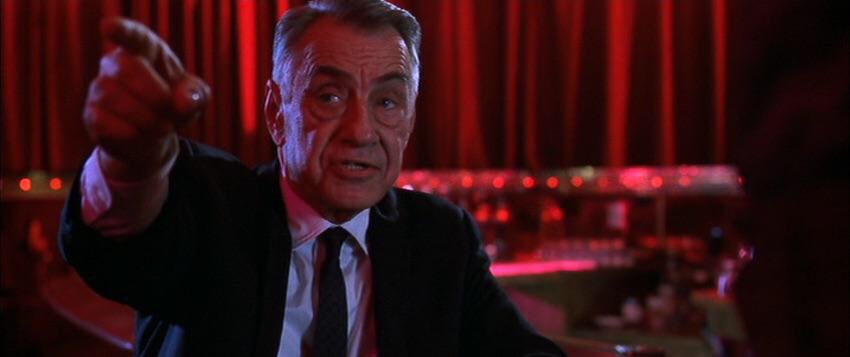
In Hard Eight, Sydney is played by Philip Baker Hall and John is played by John C. Reilly. During the course of the opening scene, we will learn just enough about each character to want to tag along with them; Sydney is a well-dressed, professional gambler and John is a sweetly dim loser who only wants to win enough money in Vegas to pay for his mom’s funeral. Fifteen minutes into the film, we’re hanging on Sydney’s every word and John’s receptiveness to them. By the time sad-eyed cocktail waitress-cum-prostitute Clementine (Gwenyth Paltrow) and reptilian casino security manager Jimmy (Samuel L. Jackson) are added to the mix, we slowly begin to see the ingredients of disaster come together and, like John, we look to Sydney for his guidance and trust his every movement. For there’s no doubt he’s seen disaster before.
What’s most astonishing about the debut film of Paul Thomas Anderson is how subdued it is, Made by a young man of 26, Anderson refuses to fall into the trap that 99% of nascent filmmakers do which dictates that one must be as flashy as possible by jamming in as many cinematic references and tricks that they can. In his first time out as a filmmaker, Anderson shows a real maturity in his restraint and his ability to approach material correctly and there is an amazing wisdom in the dialogue.
The film’s setting is interesting, too. Like Robert Altman’s California Split, Hard Eight takes place in the unglamorous world of daytime nightlife. Garish hotel rooms, eerily desolate roads, and the sparse, Wednesday afternoon crowd in dumpy Reno casinos are all writ large on cinematographer Robert Elswit’s wide canvas. And John Brion’s Hammond B3-laced score injects the right amount of lounge-lizard sleaze into the atmosphere. The characters and plot, a potent blend of a Jean Pierre Melville’s Bob Le Flambeur, Louis Malle’s Atlantic City, and an Elmore Leonard novel, mix with its harsh, cinematic world in such a way that you can smell the stale cigarette smoke on every frame of film.
To achieve this, a film has to be extraordinarily observant and meticulous in its details. Take, for instance, a scene in which Clementine, who has to leave town with John in a hurry, gives Sydney instructions for feeding her cats and how to unlock her apartment door with a key ring that is ridiculously overloaded with keys and trinkets. It’s not played for laughs and it doesn’t even call attention to itself. It’s simply a detail that serves as a reminder that Anderson knows characters like Clementine; someone who sadly, and in the name of basic survival, gives so much of herself away that overloading her keychain with goofy charms and ephemera seems like one of the few remaining frontiers of self-expression and individuality.
As well-realized its world and well-written its dialogue, Hard Eight is, above all, an actor’s film. Philip Baker Hall, an actor who before Hard Eight was mostly known as Richard Nixon in Robert Altman’s film adaptation of Secret Honor, got one of the biggest gifts from the gods with a role for the ages. Stoic and precise, Hall gets the immense actor’s pleasure of both being able to express himself with his stoney face and the right to spit hot-fire lines of dialogue like “You know the first thing they should have taught you you in hooker school? You get the money up front.” It’s a performance of masterful skill, immense control, and sheer perfection. I’ll fight the man, woman, or child that disagrees.
John C. Reilly can never get enough credit and is one of the finest character actors working today. In Hard Eight, he turns in one of his greatest performances as a truly pitiful lug who needs a hug and an emotional anchor. While Hall is tasked with the heavy lifting during the scenes of severe gravity, Reilly gets a few astonishing moments of emotional counterbalance, most especially during a telephone conversation in a key scene in the film’s third act. Also bringing the lumber is Gwenyth Paltrow who summons up the depressing cheapness that runs through her character while also making her vulnerable and human. It helps that her character is the hooker with a heart of despair and loneliness, not gold and half of the time her smeared lipstick makes her look like a clown that escaped a black velvet painting.
Fourth-billed Samuel L. Jackson brings fire to the film as the charismatic yet crudely loathsome security manager who knows everything that goes on in, and out, of the casino. With his wide grin, his maroon leather jacket, and his driving gloves, Jimmy is a study in someone who wouldn’t know class if he fell into it, yet is supremely lethal and projects a menace that, once he’s introduced, hangs like a pall over every remaining second of the film.
Hard Eight was marketed to capitalize on the then-red hot Samuel L. Jackson and Quentin Tarantino vibe; an explosive, rapid-fire of witty banter, cool Vegas shenanigans, and gritty gangster action. To give the film more of that post-Rat Pack fetish vibe that washed all over indie cinema in the mid to late 90’s, the trailer assigned face-card titles to the characters (Gwenyth Paltrow is the Queen!). That the film had none of the aforementioned elements probably surprised the few that were able to overcome the distributor’s shameful mismanagement and were able to see it. For some, the surprise was likely a let down. Regardless of quality, there was, once upon a time, an audience that ate up every single post-Pulp Fiction-ish film indiscriminately. But, like a bunch of overstimulated, hyperactive toddlers, this crowd would write a film off as boring if it didn’t have that level of cinematic masturbation as a Tarantino picture (hence the lopsided, legacy love for absolute worthless garbage like The Boondock Saints). And while Boogie Nights and, especially, Magnolia are awash in dazzling visual arabesques Hard Eight, doesn’t traffic in them. Despite the use of a quick pan here or there and one tremendous tracking shot of Sydney moving like a shark across the casino floor, the film’s dynamism comes solely and bravely in its silences and what it doesn’t say. The electricity it emits is a slow burning charge that feels confident.
But, finally, Tarantino fashioned the mood of Pulp Fiction after those deliciously chosen pop tunes with which he festoons his soundtracks. Anderson fashioned Hard Eight after a Tom Waits song; it’s a true broken boulevard of heartache and misery where, after an evening of carnage, one can merely adjust their coat sleeve to cover up the bloodstains and move about their day unmolested.





 Podcasting Them Softly