In Defense of the STAR WARS Prequels

Dear Simon Pegg, The Hollywood Reporter and everyone else who goes out of their way to degrade and dismiss the STAR WARS prequels.

You’re not a real STAR WARS fan.

If you can’t accept the STAR WARS prequels for what they are, flaws and all, STAR WARS does not mean nearly as much to you as you pretend it does.

If you love the original trilogy, that’s great. But don’t act like STAR WARS is important to you. And if that’s you, please do us all a favor and own it. The constant shaming of George Lucas, and the STAR WARS prequels has become this relentless and bandwagon circle jerk that those of us who love, embrace, and accept all of the STAR WARS cinematic universe have to endure and hits us in a very deep and personal place.

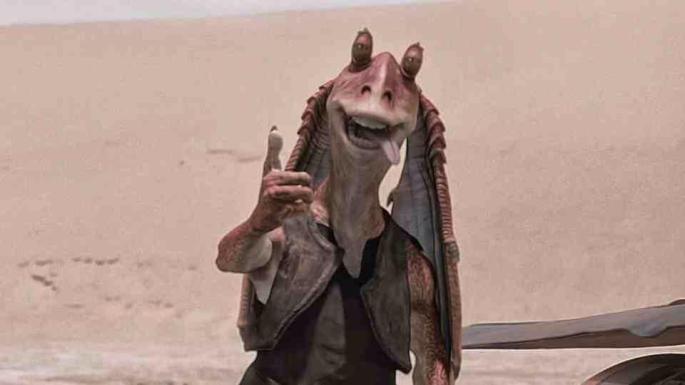
I, as anyone who loves the prequels can fully admit, they have flaws, some of the films have deeper flaws than others, and they are not as good as the original trilogy, but the bottom line is, they are STAR WARS films and they are fantastic. There are a couple of fallback arguments any prequel shamer will telegraphically always pivot to. Jar Jar Binks, the “overuse” of CGI, Hayden Christensen, Jake Lloyd, and poor dialogue.

All of those pivot points have their merits, I can fully admit it. Look, I used to be somewhat dismissive of the prequels too, and I’d be lying if I didn’t say that my appreciation and love of the prequels grew from the Cartoon Network/Netflix show STAR WARS THE CLONE WARS, and from different video games, novels, comic books and merchandising that flushed out more of the rich story that lies within the prequels.

The “overuse” of CGI in the prequels is the one pivot point that drives me absolutely crazy.

First of all, the CGI in the prequels is absolutely pristine and looks better, to this day, than most CGI induced films that have come out since. The use of CGI and moving to the digital format completely changed the film industry, for better or worse. The “overuse” of CGI is a poor pivot point for prequel bashers, due to the fact of not nearly as much CGI was used as they think. George Lucas used a lot of practical effects and built a lot of sets for the prequels. You know how I know that? Because I educated myself by watching the supplements on the STAR WARS blu ray suite, read articles with Lucas, Rick McCallum (the producer of the prequels), and others from Industrial Light and Magic.

Look, the prequels needed CGI. General Grievous, Yoda, the Senate Chamber, all the Clones needed Temuera Morrison’s face, the MagnaGuards, the epic space battle above Coruscant in EPISODE III, an 80 year old Christopher Lee fighting, and the plethora of exotic planets HAD to use CGI.

What, are all of those going to be miniatures? Or puppets? Puppet Yoda in the original trilogy is amazing. Love it. I don’t even think he’s a puppet. Remember puppet Yoda in EPISODE 1? It was AWFUL. Because in the prequels, Yoda servers a far different and bigger purpose, he’s a warrior, a general in the Clone army. He has to actually fight, and we get to see why Yoda is the most powerful Jedi.

General Grievous, the general of the Separatist army, the cyborg Jedi killer who fights with four lightsabers. Would it have been better if there was a man in a ridiculous suit with arms controlled by puppeteers?

Should there have been a massive scouting effort for people who looked identical and have the same physique of Temuera Morrison? Or prosthetic face molds?

If you’re so hung up on the “overuse” of CGI, you surely must RAGE when you watch a Zack Snyder, Christopher Nolan, Michael Bay, or a Steven Spielberg film, and surely you must HATE any and all of the Marvel/DC films, right?  Oh, and those LORD OF THE RINGS films, Peter Jackson is an idiot, he should have made those films without CGI.  Same goes for GAME OF THRONES.  Man, WATCHMEN should have used nothing but practical effects. INTERSTELLAR?  Don’t even get me started.

Yeah, do ANY of that without an abundance of CGI.

Hayden Christensen. Yes he’s miscast, but stop acting like he’s the first actor to miscast in a film ever.

Poor dialogue? Valid point. Lawrence Kasdan must have been busy.

Jake Lloyd? Anakin Skywalker wasn’t born as Darth Vader. He wasn’t born evil. He’s a kid playing a kid.

Jar Jar Binks? Jesus Christ. Get over it. The best part about Jar Jar is that Lucas owns the hatred of that character, and uses Jar Jar to make the move in the Republic Senate to give Supreme Chancellor Palpatine complete and total control at the height of the Galactic Civil War.

There are so many shining moments in the prequels.

We get to see the beautiful and vibrant universe pre Empire, before the dilapidation and worn universe we’re used to seeing in the original trilogy.

Liam Neeson.

Liam Neeson.

Liam Neeson.

Ian McDiarmid as Palpatine/Sidious. Easily one of the best acted roles in the entire saga.

Ewan McGregor is absolutely terrific as the younger Obi-Wan.

The Duel of the Fates battle between Qui Gon, Obi and Maul is one of the best lightsaber battles in the entire saga, if not the best. And it is accompanied by a magnificent John Williams track.

The Republic Senate scenes are masterfully created and designed, and perfectly sets up a principle understanding of how and why Palpatine becomes the Emperor of the Empire.

Christopher Lee is incredible. One of my favorite characters in the entire universe.  The dissention of Yoda training Dooku, Dooku training Qui Gon, Qui Gon training Obi and Obi training Anakin makes so much sense, how and why Anakin is who he is.

The full-out Jedi and Clones vs Geonosians and Battle Droids in the climax of EPISODE 2 is terrific. That’s a moment a lot of us have been waiting for, a full out Jedi battle.

We get to see the Jedi Council in action, see the plethora of Jedi, as opposed to the three we see in the original trilogy.

EPIC saber battles, as I mentioned before with the Duel of the Fates, but we also watch Yoda battle his former student, Dooku – watch him go toe to toe with Palpatine himself, watch Palpatine take down four Jedi, and see the brutal and heartbreaking final battle between Anakin and Obi-Wan.

I could continue, but I won’t. I’m sure a lot of the points I’ve made will go over a lot of the prequel basher’s heads because they don’t catch the references. Because they’re not STAR WARS fans. Bottom line, get off your high horse and shut the fuck up about “George Lucas ruined my childhood” or that the “prequels don’t matter”. The worst part about all of this, is that George Lucas has admittedly been shamed for making any more films. This guy is bigger than STAR WARS, he’s responsible for AMERICAN GRAFFITI and THX 1138 which is one of the best science fiction films ever made.

To quote William Friedken, “STAR WARS is a religious experience.” STAR WARS means so much, to millions and millions of people globally. There are very few things that can match that kind of passion. Without George Lucas, you’d have absolutely nothing to bitch about in the first place.

ROB BOWMAN’S THE X-FILES: FIGHT THE FUTURE — A REVIEW BY NICK CLEMENT

1

One of the best transitions ever for a TV show to feature film. Directed with style and smarts by series veteran Rob Bowman. Fantastic widescreen cinematography from underrated shooter Ward Russell (Days of Thunder, The Last Boy Scout), who utilized a rich color palette and took full advantage of the excellent locations chosen for the story. Absolutely loved the Neanderthal Man opening sequence with the first alien encounter – raw, nasty, primal, and scary. Series mastermind Chris Carter took full advantage of the inherently cinematic possibilities with his iconic material, and along with Frank Spotnitz and undoubtedly many others, crafted a fabulous continuation of the central alien mythology plot-line, while beefing everything up visually and thematically. I’ve gone back to this movie for years, not just out of my love for The X-Files in general, but because, on its own, it’s a damn good movie. Fine, some of it is a bit impenetrable to the casual viewer or non-fan, but even in those instances, the gripping set pieces, tremendous production design, and excellent performances should alleviate any concerns.

Bowman throws in nods to various political thrillers from the 70’s, most notably Alan Pakula’s masterpiece The Parallax View, and all throughout, there’s an unnerving vibe present, from the ominous back-room deals with the Syndicate, to the sub-Antarctic government base that forms the absolutely smashing action-oriented finale. All of the regular faces from the TV show are present in the film, while the filmmakers brought in some excellent supporting players like Martin Landau, Armin Mueller Stahl, Blythe Danner, and Terry O’Quin. The opening domestic terrorism bombing sequence is rivetingly staged, while the mid-film action sequence inside the dual domes out in those corn stalks is expertly shot, cut, and directed. And when those bees are released, the scene kicks it up a further notch. David Duchovny and Gillian Anderson were at their best here as Mulder and Scully, and their “almost-kiss” moment was one of the absolute best moments in the series. Everything about this movie clicked (which you can’t say for the decade later follow up, The X-Files: I Want to Believe), and I am eagerly anticipating the return of the TV series when it drops at the beginning of 2016. I just really hope that the central narrative beats pivot off of the extraterrestrial angle that the show is famous for.

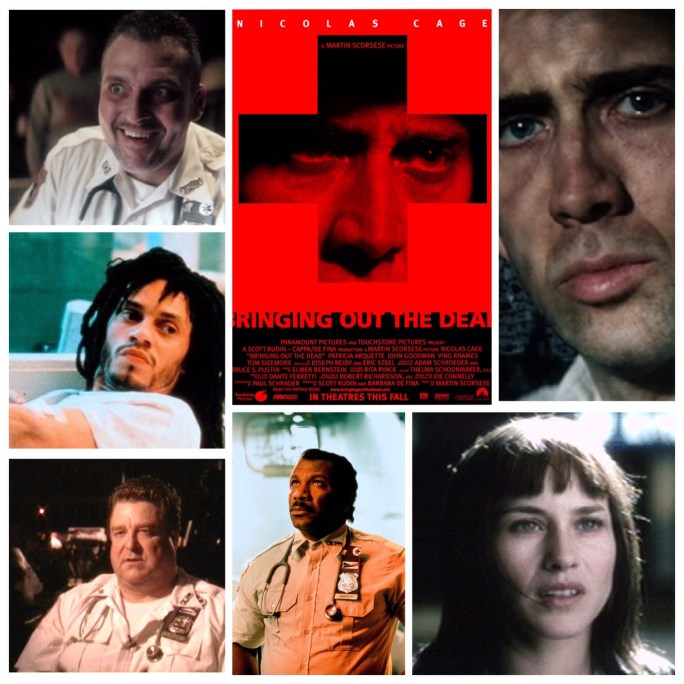
Psychology Of Film Episode 2~Paramedic Fever Dreams: Martin Scorsese’s Bringing Out The Dead

Recently myself and a good friend of mine, Mo Barrett, have begun to craft special ‘interactive’ video summaries of some of our favourite darker, more challenging films. This installmeant sees us look at Martin Scorsese’s Bringing Out The Dead, a terrific. Option picture which we both have a mutual love for. Please click the link below and enjoy!

Bringing Out The Dead
Created By Mo Barrett and Nate Hill, with thanks to the support of Frank Mengarelli and Nick Clement of Podcasting Them Softly.

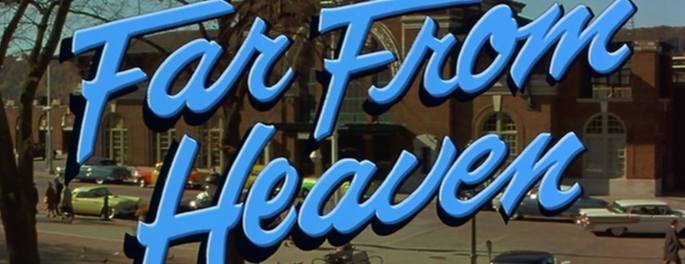
TODD HAYNES’ FAR FROM HEAVEN – A MINI REVIEW BY NICK CLEMENT

1

An aesthetic and thematic masterpiece for director Todd Haynes, who brilliantly recalls the work of Douglas Sirk with this passionate, exquisitely mounted melodrama. Sterling performances from Dennis Quaid, Julianne Moore, and Dennis Haysbert, with sharp supporting turns from Patricia Clarkson and Viola Davis and James Rebhorn. Ed Lachman’s primary-color-rich cinematography frequently pops the eye, from the bravura opening crane shot, all the way through to the studied camera placement and deliberate pacing, this is an extraordinary evocation of a lost genre, while simultaneously operating as a stirring piece of emotional storytelling. Features a gorgeous and soul-stirring score by Elmer Bernstein. I can’t wait to see the upcoming film Carol, which seems to be some sort of companion piece to Far From Heaven.

CHRISTOPHER NOLAN’S THE DARK KNIGHT – A REVIEW BY NICK CLEMENT

1

At this point, there isn’t much left to be said about The Dark Knight. The film grossed almost a billion dollars worldwide and its critical acclaim vaulted its director, Christopher Nolan, into the upper stratosphere of big-budget filmmakers. It’s a masterwork of comic book moviemaking, talking iconic imagery and filtering them through the prism of a Michael Mann crime epic, and featuring a tour de force performance by Heath Ledger as the most sinful of all superhero antagonists, The Joker. While I will always prefer the epic nature of The Dark Knight Rises (flaws and all, it’s my favorite in the Nolan series), there’s something so lean and tough-guy-poetic about The Dark Knight; it really does feel like Heat featuring men in masks. Picking up right where he left off after his excellent franchise re-boot Batman Begins, Nolan essentially made his first effort look like a student film by comparison, and that’s not to knock Begins, because it’s a wonderful piece of entertainment, a movie that reimagined Batman for a modern, more visceral style of storytelling within this particular genre. And what’s particularly awesome, and where the film is better than The Dark Knight Rises, is that The Dark Knight is both epic and intimate; this is a massive crime saga, taking cues from the aforementioned Heat and Brian De Palma’s The Untouchables, but never forgetting to stay true to the intense character dynamics that have made this universe of costumed freaks so especially memorable. By placing Batman and all of his cronies and adversaries in a real world setting, no matter how stylized his Gotham City is, Nolan was able to fashion a trilogy of films that felt all the more tangible and immediate, something that not one, single Marvel effort has ever done, with the possible exception of Captain America: The Winter Soldier.

Batman, again played with gritty determination by Christian Bale, who brought stoic seriousness to his dual performance as Bruce Wayne/Batman, is caught between his own sense of vigilante justice, crossed with deeper psychological issues. In The Dark Knight, the Nolans and David S. Goyer, stacked the deck with his arch nemesis, the Joker, played with such menacing glee by Ledger that you have to just assume that the preparation and performance might have affected his psyche; his posthumous Oscar trophy was indeed fully warranted, and not some nonsense done for sentimentality or good-faced-publicity as some dunderheads have suggested in the past. The plot is multi-layered, convoluted yet not impenetrable, and steeped in crime movie mythology that speaks both to classic film noir and the graphic novel roots that Nolan favored. The Joker is out to bring down Batman, while also trying to put a stranglehold on Gotham’s City’s overall criminal element. From the steely, Mann-esque precision of the film’s opening bank robbery sequence; you get the sense that Ledger’s Joker isn’t a playful clown, but rather, a certifiable psychopath. The way he licks his scarred lips and the way his sinister cackle fills a room with eerie rage are just two of the ways that Ledger left an indelible mark on this classic comic book icon; I wonder if any other actor will be up to the challenge in future installments. Harvey Dent, an excellent Aaron Eckhart, is trying to clean the streets up from city hall, and Jim Gordon, played with low-key integrity by Gary Oldman, is working his way up the police chain of command. Various gangsters figure into the plot and there is a morally complex chain of events that figures into the film’s gripping climax. But the real show is the duel between Batman and the Joker, and it’s here, with two of the comic-world’s most beloved characters, that The Dark Knight really excels.

Nolan, reteaming with his phenomenal cinematographer Wally Pfister, bathed the film in shadows and blacks; this is a dark movie, both in theme and in appearance, but in the end, serving a stylistic and narrative purpose. The tragic nature of Harvey Dent is highlighted in a powerful character arc that exposes the many faces (literal and metaphorical) to the character; Eckhart’s performance was one of his absolute best. And then there’s the film’s major action scene, occurring at the half-way mark, which is a towering triumph of choreography, seamless CGI integration, and old-fashioned movie magic. By the end of this haunting and beautifully crafted piece of explosive entertainment, the viewer can’t help but breathe a sigh of relief. The Dark Knight was one of the first superhero films to never feel like a traditional superhero film, and the topical, real-world grounding that Nolan infused into his trilogy has been felt on other, future projects from a variety of other filmmakers. And yet, at the end of 2008, the old farts in the Academy felt like dissing one of the most successful films of all time, which was truly a shame, because the film stands as a genre centerpiece, and a reminder that art within this particular canvass is still attainable even when toys and lunchboxes are being considered; rarely does big-budget, summertime filmmaking become this successful at fusing all of the creative elements together.

MICHAEL BAY’S PAIN & GAIN – A REVIEW BY NICK CLEMENT

1

What if a “real movie” looked like a Michael Bay movie? Pain and Gain is that project. This is Bay’s best work as a storyteller and filmmaker. In fact, it’s his only “film,” as he’s made a career out of making “movies.” And that’s fine. Sometimes, we need silly fun to clean the palette or to just admire in the way of aesthetic beauty, and in terms of Bay’s visual abilities, it’s inarguable that he’s a master of composition, camera, color, texture, atmosphere, and pyrotechnics. He’s at the top of the class when it comes to “blowing shit up and making it look fabulous in anamorphic 2.35:1 widescreen,” as The Rock, Bad Boys, and most especially, Bad Boys II, are genre touchstones, and I’ll always go to bat for The Island and the first Transformers. But make no mistake – Bay’s special brand of visual insanity is absolutely head-spinning when it wants to be, as almost always, he’s capable of astonishing visual sights. His use of saturated primary colors, all vibrant and slick yet still with some grit packed in there (hello, Tony Scott…), has influenced commercial filmmaking over the last 20 years. I’ve had a long, off-and-on obsession with this man’s robust filmmaking technique, as I think there’s a level of cinematic dynamism that is impossible to ignore.

But, with his long-time passion project Pain & Gain, Bay proved that he actually DOES have the ability to tell a multi-tiered story, complete with flawed and unlikable characters with smart pacing and witty dialogue. I also loved the upending of the idea of the classic Bay Hero, which is one of the most unique aspects of this fresh little black-comedy crime caper. The script was credited to Christopher Markus and Stephen McFeely (Captain America: The First Avenger, Captain America: The Winter Soldier), and it’s clear from the start that this won’t be another easy-to-digest popcorn movie or a $250 million toy commercial posing as a summer blockbuster. All three lead performances (an unnervingly stone-faced Mark Wahlberg, an extra-agitated and creeped-out The Rock, and Anthony Mackie providing some great moments of dim-witted comedic levity) are fantastically gross, while the movie revels in nastiness and a foul, wrongly-idealized version of the American dream. Tony Shaloub is viciously nasty, Ed Harris dominated the final act with a gruff performance of coiled masculinity, and there’s a great cameo from Michael Rispoli, who I always love seeing on screen. This was the movie that Bay forced Paramount to make in between Transformers entries, and it’s the movie he had been keeping in his back pocket for years and years. And it’s not hard to see why; the project is based on a true story, the Florida locale plays to Bay’s sexy visual strengths, and the characters leap of the screen. Whether or not you like them at all is your business. The script isn’t afraid to get down and dirty, as it‘s very clear that Bay felt energized about the notion of making an honest-to-goodness story without having long-lead conversations about marketing tie ins and lunch boxes.

9

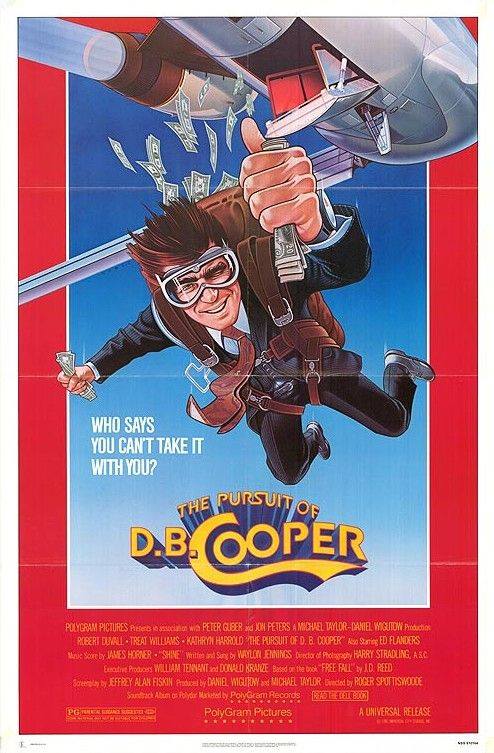
ROGER SPOTTISWOODE’S THE PURSUIT OF D.B. COOPER — A REVIEW BY NICK CLEMENT

1

Being a product of the 1980’s, there are more than a few under the radar gems that always made me smile (for one reason or another) or that kept me entertained. Based on the novel Free Fall by J.D. Reed, The Pursuit of D.B. Cooper was one of those titles that I found myself watching on cable (or was it HBO?) repeatedly, never truly understanding it, but enjoying it nonetheless. It’s always been on the back on my mind to revisit, so I sought it out, and low and behold, it’s nearly impossible to find. So I recently purchased a Hungarian Region B DVD for the film (no American disc release has ever occurred, to my knowledge), and despite the fact that the movie was lensed 1.85:1 and then presented in the 1.33:1 aspect ratio (thus losing visual information), I had to check it out again. The disc transfer looks to have been processed in bowls of urine, which is a shame, because the image looked overly yellow in numerous spots and the cinematography, in general, is consistently eye-catching. As for the movie, it’s exactly as I remembered it being – a raucous, wild, totally crazy little action adventure that took a real man and real situation and turned the entire thing into the equivalent of story you’d tell at a campfire, or an urban legend that takes on a mind of its own.

Released in 1981, the film centers on wild-man aircraft hijacker D. B. Cooper (Treat Williams in a unique role), who made off with $200,000 in 1971 after leaping from the back of a plane over the Pacific Northwest. The script imagines what it would have been like for Cooper to hide out and attempt to evade capture by law enforcement. Jeffrey Alan Fiskin’s incident packed screenplay fictionalized most of what happened during Cooper’s escape, but that doesn’t prevent this offbeat item from being undervalued if a tad obscure; Fiskin’s other scripting credits include Cutter’s Way and Tony Scott’s pulpy thriller Revenge. John Frankenheimer was the film’s original director, and would later denounce the entire production. He was replaced by TV journeyman Buzz Kulik just before shooting began. Then, after the movie was well into production, Kulik was fired, and replaced by final collaborator Roger Spottiswoode, who would be the only director to receive an onscreen credit. The film has an interesting, sort of ramshackle visual aesthetic, heightened by a jaunty, honky-tonk-ish score by James Horner. A sort of lark that would never get made today, the performances by Robert Duvall (as an insurance investigator) and Williams anchor the film with a level of class and conviction, Kathryn Harrold was a total knock-out, and while the overall lightheartedness of the entire endeavor is apparent from frame one, the various action scenes are briskly shot, cut, and executed, especially the opening sequence complete with a real sky-dive done before the era of CGI laziness kicked in.

Kirk Cameron’s Saving Christmas–A Review by Tim Fuglei


SavingXmas

As anyone named Kirk Cameron can tell you, Kirk Cameron’s got it all figured out.  A faded sitcom star from the 80s, he’s remade himself into something of a one man cinematic cottage industry; thanks to an aggressive religiosity he’s pumped out a variety of ‘films’ that are light on things like acting and production value but heavy on evangelical finger-wagging.  His smug mug is actually the perfect front for a denomination known for a general tenor of “I’m right and you’re wrong” moralizing and agonizing mental gymnastics applied in the service of proving the Bible to be an inerrant history of civilization.  I’m cautiously optimistic that his wins—previous film Fireproof brays that it’s “the most successful independent movie in history!” on the DVD case—will result in some right wing sugar daddy bestowing a few million on him that results in cavemen riding dinosaurs across the silver screen, but until then we are left with the no budget likes of Kirk Cameron’s Saving Christmas, a holiday classic in only the loosest sense of the term.

Kirk Cameron’s Saving Christmas is actually a narrative film in only the broadest definition of the form.  Our hero starts the proceedings by directly addressing the audience in his best Bing Crosby mode, fireside and pontificating about the complexities of rectifying the Christ in Christmas with the supposed pagan trappings that the holiday has picked up over the years.  We’re then introduced to Cameron’s brother in law, toting the leaden name Christian, of course, and told he hates the crass commercialization of this most serious of holidays (most theologians worth a crap would tell you that Christ’s resurrection, celebrated on the equally heathen-stained Easter, is actually the one you should keep your eye on).  He marches out of a Christmas party set in a bland suburban McMansion and populated with an ethnically diverse group that doesn’t appear to actually know each other to pout about all of this in his car.  Kirk follows him out to set him straight with 40 minutes of bizarre speechifying.  The good news is that viewers who find themselves flummoxed by complicated plots can ease right into this low mileage beauty and hit the road; there’s actually no story, so to speak, aside from what I’ve described.  We are treated to about two scenes of what might be considered a subplot with a jive-talkin’ co-worker of Christian’s who is about two steps up from a full blown minstrel show, but otherwise it’s just Kurt explaining away Christmas trees and Saint Nick as righteous biblical figures, wholly appropriate to the message.  It’s a bizarre exercise, delivered with relentless sincerity, weak stabs at humor and no attempt to actually entertain the audience.

Before you know it, 55 minutes have passed and Kirk’s run out of sermon, and out of movie.  The pair pull themselves back inside for an extended dance sequence and a bit more speechifying to drag the exercise towards something approaching feature film run time, but nobody’s fooled.  While I don’t begrudge anyone their faith or their right to make a living, Cameron and his cohorts have left a rather large stain on the venerable holiday film genre, much as his Left Behind series did on the disaster flick and Fireproof on the romance movie.  It’s not an understatement to call Kirk Cameron’s Saving Christmas a war on film itself, and I can only recommend its viewing if alcohol and sarcastic company are both in plentiful supply.


A chat with actor Peter Onorati

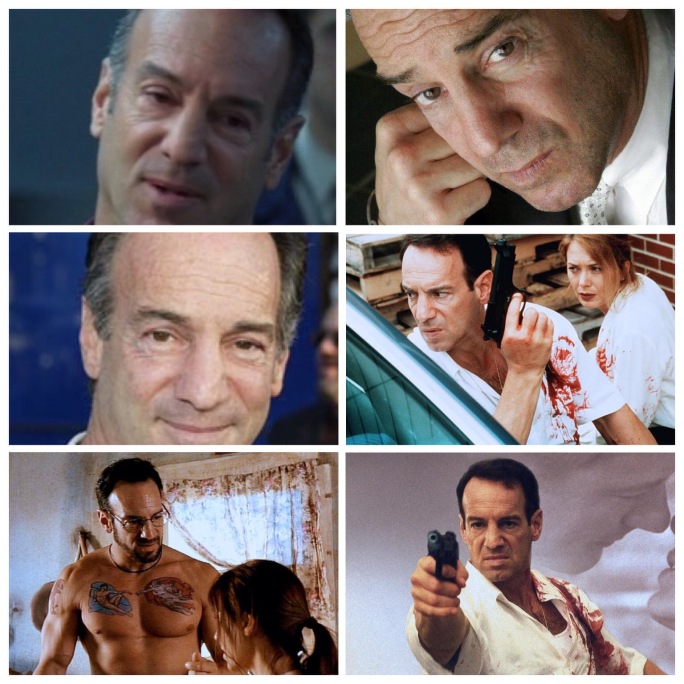
Pleased to bring you my latest interview, with veteran actor Peter Onorati. Peter has appeared in many films including Martin Scorsese’s Goodfellas, Rocketman, Shelter, The Last Ride, Postcards From The Edge, Blood Deep, The Last Ride and more. He’s also acted in Television shows including Sex And The City, Tales From The Crypt, CSI, NCIS, Monk, Crossing Jordan, ER, Batman Beyond, The Wild Thornberries, The Outer Limits, 24, Blue Bloods, Sons Of Anarchy, Castle and many more. Enjoy!
Nate: You have done quite a bit in life, before and besides acting, including playing football. When did you know you wanted to be an actor, and knew it would be something you would enjoy doing indefinitely?
Peter: I really never thought about acting until I was challenged to take a 1-night stand class in comedy in NYC, which turned out to be a class in Improvisation. At the time, I had my MBA and I was the Director of Marketing and Research for 3 of McCall’s magazines and dating a childhood crush who was the Art Director of one of the magazines. After the 1-night class I was asked to join an Improv group in NYC that ended up being called Port Authority Theatre Ensemble or Pate (pronounced Pattay like the French word). The Group was named so because NONE of us were in the acting business and we came together from as far as Boonton N.J. (me) and Queens and the boroughs. We were indeed very much like a Pate. We played all he shit-holes in NYC for a few years and competed in the Improvisation Olympics in Chicago at Second City. I met a starving actress in the group named Jeanette Collins who was classically trained in Improv and who had moved to NYC from California. When my childhood crush broke up with me Jeanette took pity on me and dated me. Soon after I had some of my research published in Advertising Age and was being sought after by some big package good firms like P&G. I let my boss at McCall’s know and she decided that I wasn’t worth keeping so she made my life miserable for a few months. During that time Jeanette said “I think you could be an actor” to which I replied “Yeah, so I can have 4 jobs and starve like you?” When I subsequently removed the ice-pack from my eye, I decided to try acting. I walked into McCall’s and quit and within 2 weeks was on hold for a national beer commercial. Within about 2 years I had made more money as a commercial actor than I did as a Marketing Exec and I got my first break in TV on the last season of Kate and Allie. From there you can check my resume cause there’s too much to type.
 Nate: Who are some actors/filmmakers whose work you enjoy and maybe have inspired you in your own work? 
Peter: Actors who inspire me: DeNiro (whom I worked with in my first big movie Goodfellas) Robert Duvall, John Casales, Christian Bale, John Garfield, James Gagney, Spencer Tracey (too many to type) – Filmakers/Actors – Redford, Stallone, Clooney. Barry Levinson, Scorsese (again too numerous to type)
Nate:  You have a very rambunctious, energetic nature to your work; many of your characters have a vitality that lights up the screen and commands attention. Is this something you consciously have done with practice and training, or do you think it comes out of your own personality?
Peter: Most of what I do comes from me. I have no real formal training as an actor so I have nothing to draw upon except my own life experience. For better or worse, there is always a huge piece of me or somebody I loved or hated in what I do. Let’s face it, I have no other resources.
Nate: 24: how was you experience working on this show? 
Peter: My experience on 24 was GREAT and would have lasted longer except for the way this stupid business works. I am an acquaintance of Jon Cassar the Exec Prod (he has subsequently climbed on board with a script I co-wrote to be the Exec Prod.) They offered me that role and that doesn’t happen too much to actors at my level. However they did not make it a “Regular Role” and lock me in. (probably because they didn’t want to pay me). So in the middle I was offered a 4 episode arc on Desperate Housewives and took the guarantee over the possibility of more episodes of ‘24’. So as most of the stories of this business go, ‘24’ called me for more eps but I committed to Desperate Housewives so I did no more.
Nate: You have done a fair amount of voice work in your career. How did that come about, do you enjoy it, and how does it compare to acting in front of a camera in live action? 
Peter: As one who got kicked out of Catholic School in 5th grade for mimicking the Nuns and Priests, I never thought I’d make money doing exactly what I did wrong so long ago.
Nate: I remember a little film you did called Shelter, with Kurtwood Smith and Costas Mandylor, who played your brother. You stole the show as the hyperactive Greek mafia boss. Any memories from that one, and how was the experience? 
Peter: One of the best experiences of my career. Not only did I get to sit across from the great Charles Durning but I got to do something actors at my level NEVER get to do. Unless you’re Dustin Hoffman or Christian Bale, you never get to do maladies or accents. The writer/producer and the director let me speak in Greek and do the Greek/American accent at my suggestion for the character. This is unheard of for us guys at the lower levels.
Nate: Any upcoming projects you are excited for and would like to mention? 


Peter: Nothing in acting right now. I have had some success writing and have put together some strong and interesting packages for my work. Actually I am writing something right now with my wife ( in 30 years together we haven’t done this) She is part of a writing team Collins an Friedman and has been everything from Exec to Co-Exec producer on shows since we moved to California.
Nate: Some of your favorite roles you have played over the course of your career so far?
Peter: I love ALL of my own series. They gave me a sense of security and a long term approach to finding my characters. I specifically loved doing a show that my agents and managers kept me from doing for a while as it was not “the thing to do”. The show was Walker Texas Ranger and I had a BLAST and Chuck was incredibly congenial and respectful of my ideas for my character. I can’t mention all the special jobs that stretched my chops like “Harry’s Law” and the joy and fatigue that accompanied the work. I guess that when I’m not working like most actors I feel unaccomplished. When you come to this town it’s all about the trophies and the P.R. but when you’ve been here as long as I have, you realized it’s a major accomplishment just to raise a family, put your sons through college and stay in your house. So I guess I made out ok.