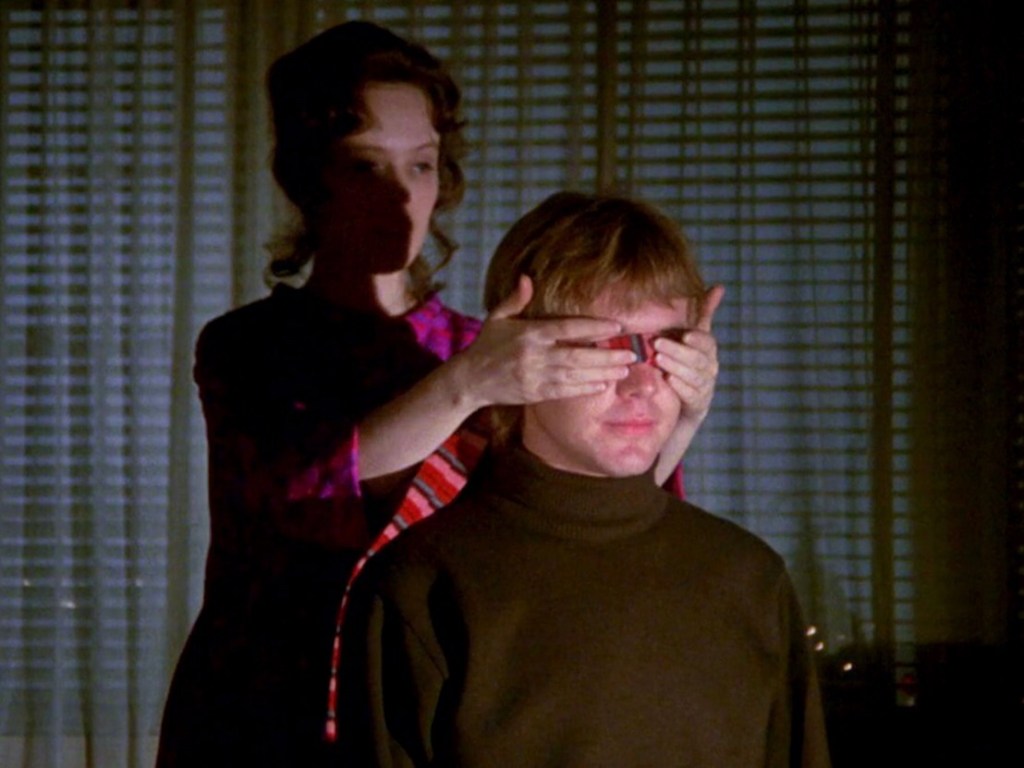
WOODSTOCK (1970) D. Michael Wadleigh

By Patrick Crain

The first person we see is Sidney Westerfield, a grinning, amiable tavern owner in “Mongaup Valley, New York State.” He is a man who has seen no small amount of years, so much so that he’s still calling movie theaters “the moving pictures.” The look on his face is both awed and grateful. His tone sets the table. “The kids were wonderful,” he says, almost wistfully. “Nobody can complain about the kids.” He also promises that whoever does see the film that has documented this phenomenon “will really see something.”

  It’s a little hard to fathom Woodstock in this day and age. In a time where everything from casual meetups to nationwide protests can be organized over a social media app on a phone, the thought of half a million kids caravanning from all over the lower 48 just to descend on the otherwise unremarkable town of Bethel, New York for a music and arts festival is kind of mind-blowing. Almost more astonishing than that was that so many of them just went on blind faith that they would somehow be able to get into the festival without tickets. And there were so many of these that, within hours, the fences were torn down and anyone who wanted in, got in.

  But I suppose the only thing in any of that that’s unfathomable is that it occurred in a time of AM radio, three network channels, and, usually, two editions of the daily newspaper. If my WiFi is down for an hour, I feel like I’m Henry David Throreau. But somehow these folks came from all over for a festival that was more or less pitched to residents of New York only.

Woodstock, the documentary film that was released in theaters in 1970, is the grand spectacle from the ground floor; a sunkissed narrative of a small nation-state of fired up young people who were doing their best to change the system for the good with peace, love, and music. And, indeed, director Michael Wadleigh (Wolfen) and editor Thelma Schoonmaker (and, to some degree, co-director and co-editor Martin Scorsese) assemble the film as a beautiful ode to the power of communal spirit which netted an Oscar for Best Documentary and earned Schoonmaker her first Oscar nomination (a competitive technical Oscar nomination for a documentary is a RARE bird). From the opening montage of the unspoiled farm of Max Yasgur as the advance team arrives and begins to assemble to stage to the final moments of a very much changed landscape that has been worn down to its muddy foundation, Woodstock is an ode to lightning in a bottle; a monumental bacchanal that, despite the anniversaries and spin-off/knock-off festivals that actually eclipsed it in terms of attendance (the Watkins Glen Festival with the Grateful Dead, the Band, and the Allman Brothers drew a bigger crowd), remains its very own special chapter in American history.

The film more or less follows the three days of the festival, doing a masterful job of mixing the musical performances with the captured moments with festival goers and the citizens of Bethel. The practical concerns of the people who actually live there and are then forced to live through what turned into a disaster area butt up against the encroaching hippies who seem to wander in and out of the frame like the living dead in Romero’s rural Pennsylvania. But this is in the service of being even-handed. Woodstock, the film (and, by extension, its soundtrack), needed to be a hit to help offset the losses from the actual show and these folks weren’t going to make a bucket of money bumming people out by showing a three hour movie about a bunch of pissed off townies and farmers and their economic hardships during the Woodstock festival. No, Woodstock had to be first and foremost a concert film because, after all, that’s what was at the backbone of the festival in the first place.

And as for the performances in Woodstock, they’re mostly all pretty terrific. Standout moments belong to Richie Havens having the unenviable task of opening the whole affair and setting the tone with the electrifying “Handsome Johnny” and “Freedom;” a pregnant Joan Baez bringing the vocal lumber to “Joe Hill” and “Swing Low, Sweet Chariot” in the middle of a very cold night; Crosby, Stills and Nash pulling off a flawless “Suite: Judy Blue Eyes;” Joe Cocker overcoming his backing singers who seem to be lost in the sauce of a different key during a powerful, career making cover of “With a Little Help From My Friends;” Sly and the Family Stone mostly setting the stage on metaphoric fire with a version of “I Wanna Take You Higher” that will get you pregnant; and Santana’s rendition of “Soul Sacrifice” which contains a jaw-dropping and borderline ridiculously sublime drum solo by Michael Shrieve, then just barely 20 years old and the second youngest performer at the whole festival that will get you even pregnant-er.

And not completely undersold is the darker side of Woodstock. As mentioned before, it touches on the community unrest and the conflicts between the conservative mentality with the more progressive and lax townsfolk. And the film famously includes the inconvenient rainstorm which created a disgusting swamp of mud which, occurring on day three, was probably the last straw for some. There are folks on bad trips, people emotionally overwhelmed by the situation on the ground, and then Sha Na Na shows up for some fucking reason.

And a film as sprawling as Woodstock is going to be bound to be as famous for what DIDN’T make it as it is for what did. The end of Abbe Hoffman’s street cred was famously delivered by Pete Townshend when the former climbed up on stage to go on a typical rant about John Sinclair and the latter knocked him off of the stage. That’s not included. Credence Clearwater Revival, the first band contracted to play, drew such a lousy play time (12:30 a.m on Sunday following a set by the Grateful Dead that was capped with a fifty minute rendition of the Pigpen-fronted “Turn on Your Lovelight”) that John Fogerty disallowed the band’s appearance in the film or on the subsequent soundtrack citing a substandard performance. And touched upon but not really explored is just what a financial disaster all of it was. If organizers Artie Kornfeld and Michael Lang’s “Far Outs” and “Outta Sights” were currency, then they might have broken even. But as they stand around with dopey grins on their face as their capitalistic venture gives way to socialism when the fences come down with a quickness and the paid festival becomes a free one, Lang and Kornfeld’s eyes look glazed over and in a certain kind of shock that belie their supposed antiestablishmentarianism.

Even more perfumed in nostalgia is the longer director’s cut which was released in 1994 to coincide with the festival’s 25th anniversary as it incorporates sets from Canned Heat, Jefferson Airplane, and Janis Joplin. In a lot of ways, these are mostly backwards glancing as the presence of Janis, who would die within two years of her performance, seems necessary if only to remember that, yes, Woodstock had an edge of loss that was felt a year after the film came out in the theaters. As joyous as the Canned Heat set is (most especially when a fan bounds onto the stage and bums a cigarette from singer Bob Hite), it lacks the dazzle of Schoonmaker’s split-screens and multi-angled coverage feeling more like raw footage thrown into the pool for a bigger party. And the longer cut also adds back to Jimi Hendrix’s performance, elongating the electrifying but incredibly sad end of the festival, forcing the viewer to perhaps reconsider the film’s denouement in the shadow of Altamont which, in 1970, didn’t mean the same thing to the Boomers as it did in 1994.

But, honestly, it’s probably best to remember Woodstock as a golden memory and not as the realistic, muddy sump hole that left starving hippies gnawing out the last bit of watermelon as if they had been banished to a weird kind of hell on earth. No. The kind of grim reckoning that was upon America was but weeks away on the other side of the country when The Rolling Stones would get over their skis. On the contrary, Woodstock drives most scenes to an upbeat ending and presses the point by focusing on the goodness of everyone (the Port-O-San Man is a national treasure). And it’s in this spirit that, before snapping back to the pristine Yasgur farm to begin a recap montage over which the closing credits will roll, the last moment we see in Woodstock is an aerial view of the festival at its most swollen; a massive and unthinkable dream come true. It actually happened and you’ll always have the memories. It’s a beautiful snapshot of the determination and boundless energy of the young.

Regardless of the sociological ramifications of the Woodstock generation and the kind of cynical thought process that naturally occur when one luxuriates into middle age, my mind still likes to think about Woodstock in terms of the open-faced, plaid-clad girl who pops up to talk about being asked to tell a stranger about his wild eyes. Her revelation that she has to get her sister back home in time for court seems like quite a task but her follow-up that reveals that her sister got lost somewhere in the crowd during Richie Havens makes one’s eyes widen. After all, this is now a sea of people and Richie Havens was the first performer. How in the world will this even realistically happen? Will the communal spirit that drove all of these people to Woodstock in the first place be the thing that will draw these two siblings back together through the thick of the throng? Perhaps that’s the most fitting thing that can be said about the prevailing spirit of Woodstock. Regardless of its inherent naïveté, somehow, someway you kind of figure that she’s going to find her sister and, as John Sebastian said, “everything is gonna be all right.”


The Boy

I think it’s safe to say there’s an over saturation of killer/haunted doll movies these days, I mean just ask Chucky, who has a lot of competition in this era as the top dog. It’s refreshing then to find an entry like The Boy, which on the surface appears to be another chomp at the evil doll bit but, without revealing too much, has more going on than one might think and although it doesn’t quite keep the viewer genuinely guessing or break the mould of predictability, certainly has more than a few moments of genuine suspense and chills. Lauren Cohan plays an American nanny hired by a plummy old British couple to watch their young son Brahms while they go on holidays. These two are apparently senile old goats though because Brahms turns out to be an especially creepy little porcelain doll who they literally treat like a human child, and expect their recently hired nanny to as well. Her amusement quickly sours into terror and paranoia when she’s left alone with Brahms and… weird shit starts to happen. Her only human contact is with the house handyman (Rupert Evans) and eventually her abusive maniac ex boyfriend (Ben Robson) who has followed her across the pond. I really can’t say much but you may end up guessing pretty quick what’s really happening in the house, and then again you may not because the answer, although evidently logical, isn’t exactly presented super obviously. The film has enough scares, atmosphere and suspense to be worth a solid viewing, but it’s not too original or noteworthy. The big reveal in the third act is done really well though and is the most effectively skin crawling moment in the film. Also, I gotta say that Cohan is a strikingly terrific actress with natural charisma, beauty and presence, I love seeing her in lead roles and I honestly hope she gets to give that tiresome Walking Dead crap the slip soon so she can focus on some more film roles.

-Nate Hill

Eric Red’s Bad Moon

A 90’s werewolf flick starring Tom Cody from Streets Of Fire, written by the guy who penned The Hitcher and set in the Pacific Northwest.. gotta be a winner, right? Well.. kinda. There are aspects I did enjoy about Eric Red’s Bad Moon and some things I thought were a little weaker. Michael Paré plays a dude who gets bitten by a werewolf in the South American jungle and winds up back home in Vancouver where his affliction puts his sister (Mariel Hemingway) her son (Dennis The Menace) and their German shepherd Thor in great danger. In this version of the werewolf lore it doesn’t have to be a full moon for him to transform, it just happens every night, which causes maximum destruction and carnage in the neighbourhood. So what I liked about this film: obviously I’m a push for that Vancouver scenery and the film is gorgeous, the two main settings being a beautiful character home that Hemingway’s lawyer salary has snagged and a breathtaking lakeside locale where Paré parks his airstream. The film is actually mostly from the perspective of the dog, who is the only one to really figure out that there’s a monster around, POV shots and pacing are used to present him as the protagonist and I really enjoyed that choice. What didn’t work for me: the wolf itself looks cheap a scraggly, not aesthetically pleasing or impressive enough for me. The human characters/acting are not so great either.. Paré is a great presence in anything and does ok but his character goes through a bizarre an unexplained personality change (beyond just being a werewolf lol) midway through the film while Hemingway and the kid are just awkward, stilted and I just didn’t buy that these people were siblings/uncle etc. The dog is great though! He should have his own spinoff film where he goes into business as a werewolf hunter. I wanted to love this based on all the elements involved but it kinda just was an okayish one bordering on a meh.

-Nate Hill

Underworld: Rise Of The Lycans

I feel like the Underworld films don’t get proper credit for just how visually magnificent and stylistically sumptuous they are. I mean sure the stories are often a muddle of faux Shakespearean shifting alliances and paranormal melodrama that are impossible to decipher but if you just approach them overall as the story of an ongoing war between vampires and werewolves with lots of preening politics, an abundance of beautifully gory, darkly balletic action sequences and the occasional splash of forbidden romance then you’re good, and don’t need to engage the brain much further. Take Underworld: Rise Of The Lycans, for example, which best I could figure is some kind of prequel to the first film where we see what went down between the two species hundreds of years before. Bill Nighy gives the word overacting new meaning here but is a lot of fun as Viktor, king of the vampire nation who has effectively enslaved all the werewolves for his own work/war effort and forces them to hunt down their own kind who rebel. His daughter Sonja (Rhona Mitra) does some rebelling of her own by constantly defying daddy’s orders and carrying out a secret romance with Lycan leader Lucian (Michael Sheen). This overall unrest leads to the werewolf uprising and eventual incursion that will start a centuries long war. That’s all you need for story, trust me. What works best about this film is the resplendently beautiful production design and what makes it stand out in the initial trilogy is that it’s set far in the past so the uproarious gunfights become ruthless swordplay, the nocturnal urban atmosphere becomes a moonlit medieval castle aesthetic and never before has the franchise felt this gothic. Mitra is a beauty and then some, and while she’s not quite as lithe or physically distinctive as Beckinsale and her leather trench coat, she suits the ancient warrior aesthetic and does the Underworld name proud. Nighy is so far over the top I wanted him to calm down a bit before he had a stroke or something, he’s about as arch and theatrical as it gets but it suits the role and tone of the film nicely. Much of the film is sound, fury, blood and metal under inky black moonlight and some may have trouble deciphering the specifics of choreography under such a dim cloak of a visual palette but trust me it’s all there and it’s all *very* well done. This franchise has some of the most gorgeous, anatomically and aesthetically satisfying werewolves I’ve personally seen in horror, just great big bastards that look like they could rip a cow in half and are deadly in their speed, physicality and agility despite their hefty size. The Vamps have this eerie aristocracy to them and always seem calmly observant and deviously in charge, with help from the iridescent, creepy contact lenses the actors get to wear. The fight scenes are brutal and relentless, packed with gore and stylish weaponry and staged against spatially striking castle, river, forest and mountain vistas. There’s a shamelessly lurid sex scene between Sonja and Lucian where they’re literally writhing in slow motion on the edge of an impossibly baroque cliffside that is quite possibly one of the most arousing, breathtaking sex scenes I’ve ever seen on film. Say what you want about these movies man, and maybe I’m just a whore for visually stimulating horror films and am too generous on the ones that rely on the style over substance play, which is quite possibly the case, and I own that. However, I’m sitting there watching all of this play out and I’m in raptures about it, totally and completely entertained and pleased in my experience, and if that be the case, well I’m more than okay with all style and little substance, provided the style is as bounteous and well crafted as is the case here. *Great* looking film, if not a great one overall.

-Nate Hill

THE ROBERT ALTMAN FILES: M*A*S*H (1970)

By Patrick Crain

And then there was M*A*S*H.

Once upon a time, fifty one years ago to be exact, long before the block programming of post-Carson syndication would lull my generation to sleep with the overly familiar, brassy theme song “Suicide is Painless” before drifting into the recorder-driven opening for Taxi, M*A*S*H was a third-priority Korean War film about which the suits at 20th Century Fox barely cared. For their eyes were collectively on both Tora! Tora! Tora!, a multi-helmed, transcontinental production and Patton, a star vehicle for George C. Scott. Over the hill in Calabasas, California and amongst the knotty hills of brown and olive was Robert Altman and a ragtag bunch of nobody actors making a picture about a war that was already mostly forgotten. He brought it in on time and under-budget so the suits were happy.

Well, they were happy until they saw what Robert Altman had done to Ring Lardner Jr’s adaptation of Richard Hooker’s novel about Army surgeons. A structureless mess of anarchy one would have to have been a detective to recognize as “not Vietnam,” M*A*S*H was everything the aging brass at Fox would have rather avoided. In fact, to drive home the point that it was set in Korea, the suits demanded Altman include a post-credit crawl making explicit that THIS was a film about a PREVIOUS war, implying that this was not at all to be misconstrued as to be sending up the current administration and our involvement in the conflict in Vietnam.

I mean… ok. But it’s Vietnam. And that’s probably a good thing because the core audience that lifted M*A*S*H to its dizzying heights of financial and critical success was the cynical Boomer generation who was more than ready to pick up what Altman and company was putting down. The late and lamented father of a buddy of mine used to speak about seeing M*A*S*H in the theater in tones so reverent, they were probably better suited to stories about the birth of his son. “We had to go back and watch it again immediately to pick up the stuff we missed,” he said.

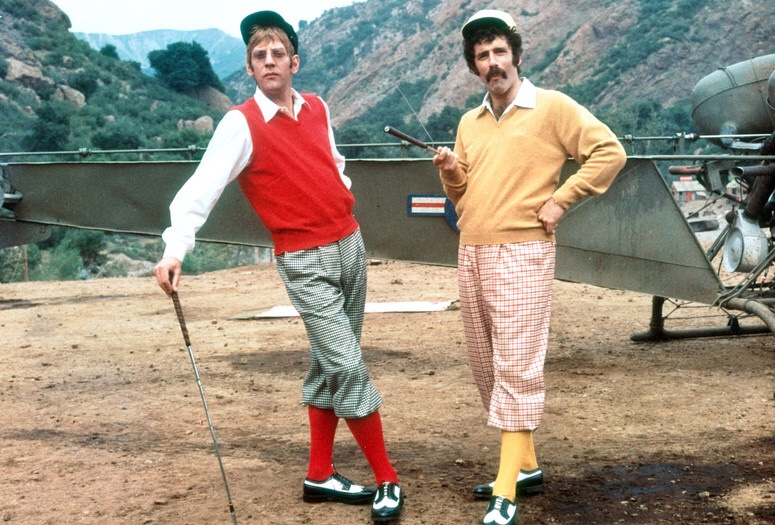
And, of course, M*A*S*H is really where Altman’s style blossomed which caused one to want to go back and watch it again. And maybe that’s not by choice but accident. After all, his previous three films all seemed much more tightly bound by story and plot. Regardless of whatever the screenplay was or the source material from which it sprung, Altman decided M*A*S*H was a mood and not a story and all but chucked the script; something that made Lardner none too pleased until, ironically, he picked up an Oscar for his troubles. Bracketed by the arrival and departure of Col. Hawkeye Pierce (Donald Sutherland) and Duke Forrest (Tom Skerritt) to and from the 4077 Mobile Army Surgical Hospital unit which is mere miles from the front, M*A*S*H zips through its running time dividing itself between the zany antics of the irreverent surgeons and the horrendous detail of their gruesome work. When the film settles down into the operating rooms, the film turns shockingly gory and, additionally, gets awash in so much overlapping dialogue regarding surgical procedural and other ephemera that the audience never once thinks that Sutherland and Skerritt (and Elliott Gould who shows up as ace chest surgeon “Trapper John” McIntyre), aren’t actual doctors.

It is in this busy canvass of toil and work that Altman can let his focus run free and drift in and out of clusters of people, all engaged in their own private worlds. The multi-tracked soundtrack he’d perfect in Nashville gets its first workout here as stacked conversations force the viewer to choose one and stick with it only to realize you’ve drifted into another conversation that somehow seemed adjoined to the other. That Altman could do this at will and almost any film was pure magic and the biggest reason his films have such long legs in terms of their conduciveness for revisiting. And M*A*S*H is Altman’s first film to have the wide and warm tapestry of supporting players who fade in and out of the scenery in half-measures but all of whom we feel as if we know by the time the closing credits run. It is around this time that Altman begins to toy with building communities within his films. A practice that would run to the release of Popeye (and non-release of HealtH) in 1980, Altman’s productions became something of a communal experience with actors being chosen as types and then asked to flesh them out on the screen while using the script only as a loose framework (most notably in the following year’s McCabe & Mrs. Miller). In M*A*S*H, we come to adore secondary characters such as Major Frank Burns (the extra dry Roger Bowen), Father Mulcahy (Rene Auberjonois, having a ball), Painless Pole Waldowski (John Shuck, making history by dropping the very first instance of the word “fuck” in a scripted motion picture by a major studio), and Corporal Radar O’ Reilly (Gary Burghoff, the only cast member to make the transition to the television adaptation).

The film might have a cruel misogynistic streak by today’s standards and there are plenty of people who will impose all the current social values and norms to a fifty year old movie without applying much context to the discussion. But while it would be silly and irresponsible to cancel it outright, M*A*S*H shouldn’t be let off the hook completely. For it is true that the kind of cruelty heaped upon Major Margaret “Hot Lips” O’Houlihan (Sally Kellerman, bringing a fire to the role that nabbed her an Oscar nomination for Best Supporting Actress) is of an aggressively sexual and misogynistic nature but Altman wants to make sure that it’s not entirely at the hands of the hands of men. In what is seen as the most overtly crude humiliation (namely the shower scene), it’s clear that the other women in the camp have as much disdain for her as the men and are likewise in on the prank. In M*A*S*H, the camp isn’t simply a “boy’s club,” but a “club for open hedonists.” Nobody cares that the aggressively hypocritical Frank Burns (a terrific Robert Duvall) and O’Houlihan are having sex, what they care about is Burns and O’ Houlihan’s attitudes about everyone else who are having sex. But, all of that said, that women are in on the prank in the movie cannot erase the fact that none of the filmmakers were women. In this world, O’Houlihan is tasked with the binary choice of dumbing down and shutting up or resigning her commission which everyone knows means everything to her. This is where the film’s aim to drag all authority down to a very low level, strong career women like O’Houlihan become collateral damage and its hard not see the the undermining of similar women characters of the era as a feature and not a bug. Luckily, Altman would get much better at this in a very big hurry.

So, for certain, M*A*S*H is a product of its time but it’s hard to overstate what a dynamite product it was. Nothing seemed scared after M*A*S*H. Hell, even the holy game of football, as American as war, gets pulled through the ringer in the film’s final act (with some footage courtesy of future trash auteur and Wide World of Sports pioneer, Andy Sidaris). At a time in which norms were crumbling by the second, M*A*S*H took dead center aim and laughed all the way to the bank as it stomped through all that we took seriously as a nation. The combination of our cathartic exhale and the film’s black humor proved quite therapeutic. And while the film launched a whole cottage industry of similar comedies in which anti-authoritarianism is taken to a sophomoric and perverse level, (it’s difficult to watch something like National Lampoon’s Animal House without seeing much of M*A*S*H’s DNA), Altman, now a superstar director with a monster hit under his belt, would be displaying his brand of fully-committed anarchy by the year’s end as the next trick up his sleeve would both equally dazzle and confuse and put on full display the fearless maverick that he truly was.

León & Cocina’s The Wolf House

There are many ways to symbolically impart real world events in film, and sometimes when the events are particularly grim it helps to bathe your message in a healthy dose of artistic abstraction, as not to overwhelm your audience in grisly details or bring the mood down with a stifling sense of literacy. Joaquín Cociña/Cristóbal León’s The Wolf House is based upon (in spirit) the true life tale of a horrible former Nazi who started a nightmarish, controlling doomsday cult who abused hundreds of children in the Chilean mountains sometime after WWII. After one young girl is punished for allowing pigs to escape, she runs away from the commune herself and it’s this basic framework that allows a terminally surreal stop-motion Dreamscape to play across the screen. There is no actual story to the events onscreen and one would have to either read up on the film or come across a review like this to even fully grasp the theme and backstory. There’s a quick and deliberately ominous infomercial for the commune right at the start of the film but even that is untethered of context and quickly segues into a consistently unearthly theatre of the bizarre. This isn’t succinct, structured stop motion animation in the way someone like Tim Burton would create, this is something so wild, so artistically expressive I can almost not even put it into words, but my review is accompanied by a PhotoGrid mood-board as always, so feast your eyes. The tactility and sculpted bazaar of mâché, clay and many other materials creates a swirling, never placid, always metamorphosing subconscious ballet of scintillating, melting, dissolving image and sound that is truly, singularly unlike any other medium I’ve ever seen. The film reportedly took five years to make, and honestly I would have guessed double that with how complex and elemental the design is. One has to watch it at least that many times to fully absorb everything on display as we see figurines constantly disintegrating mid-scene, transforming into inanimate objects, suddenly becoming ectoplasmic vapour that creeps across the walls of the detailed dioramas they inhabit in forms of movement that are anything but of this world. Because of how non-traditional the experience is, the viewer must use mood sensors and subconscious intuition to intake the film’s essence, and abandon all hope of a clearly discernible plot. A scene where the animated figurine of three German children sing a haunting lullaby together was the emotional core and the closest the filmmakers get to outright exposition, it’s a heartbreaking image when contrasted against the Wikipedia knowledge about the cult in real life, which was a horrible and senseless event that could have been avoided. This is an art installation come to life, not a narrative story, and inside the circus of paint, colour and dynamism we can sense the undertones of menace and tragedy if we’re tuned into the film’s far out frequency. Highly recommended for creative types who enjoy films that not only function outside the box of what’s considered normal and palatable, but barely seem like they’re from this dimension at all. A wonderful experience, streaming on Shudder for anyone interested.

-Nate Hill

Indie Gems: Paolo Barzman’s Emotional Arithmetic

Paolo Barzman’s Emotional Arithmetic is a stunning independent drama that, despite a ridiculously prolific cast, ultimately slipped through the cracks into obscurity. It’s well worth hunting down to see four seasoned professionals as the top of their game in telling the story of various characters dealing with the lingering horrors of the Holocaust, both directly and indirectly. Susan Sarandon plays a Canadian woman sometime in the 80’s who survived a concentration camp at a very young age, and has invited two fellow survivors (Max Von Sydow & Gabriel Byrne) to a reunion at her house in the Quebec countryside where they will reconnect after decades of separation following a tragically abrupt parting from each other and will have the chance to meet her much older husband (Christopher Plummer) and their son (Roy Dupuis). It’s a pleasant, cathartic enough reunion but the collective scars they share from enduring such a horrific phase of their lives are apparent in each of them, in different ways. Byrne’s quiet, introspective character has buried his trauma under a cloak of calm, Von Sydow deliberately tried to forget using electroshock therapy, while Sarandon herself has obsessively documented, scrapbooked and reflected on their past very openly over the years to employ her own process. Plummer’s character is the outsider, having never gone through what they did and starts the film off in a sort of cavalier, borderline insensitive way until the grave reality of what his wife and her friends have suffered through hits home and he becomes more compassionate. All of the performances are absolutely magnificent and I really wish more people were able to see this moving film because each of these actors provide showcase work and should be very proud. If you are lucky enough to find a DVD, please ignore the misleading, stupid Hallmark style artwork and silly alternate title (Autumn Hearts, are you kidding me? Lol) because it’s as if the distribution company didn’t even watch the film and just did whatever the hell they wanted. This is not a sappy, syrupy film at all, it’s a deep, thoughtful, challenging interpersonal drama that stirs the soul in a realistic fashion without cheap manipulation. Highly recommended, wonderful hidden gem of a film.

-Nate Hill

Daryl Duke’s The Silent Partner

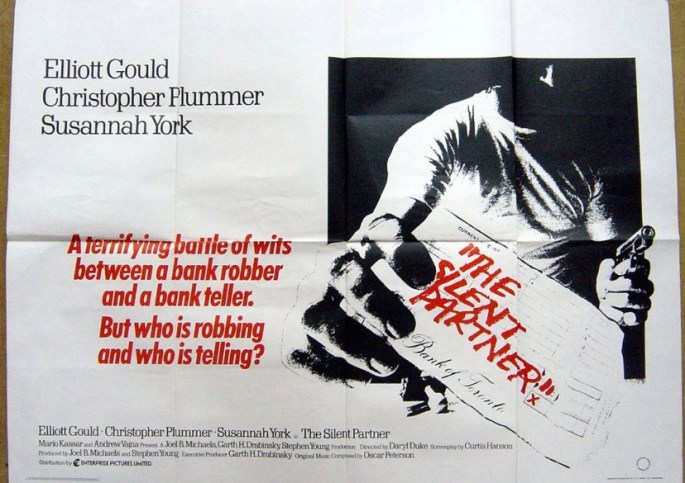
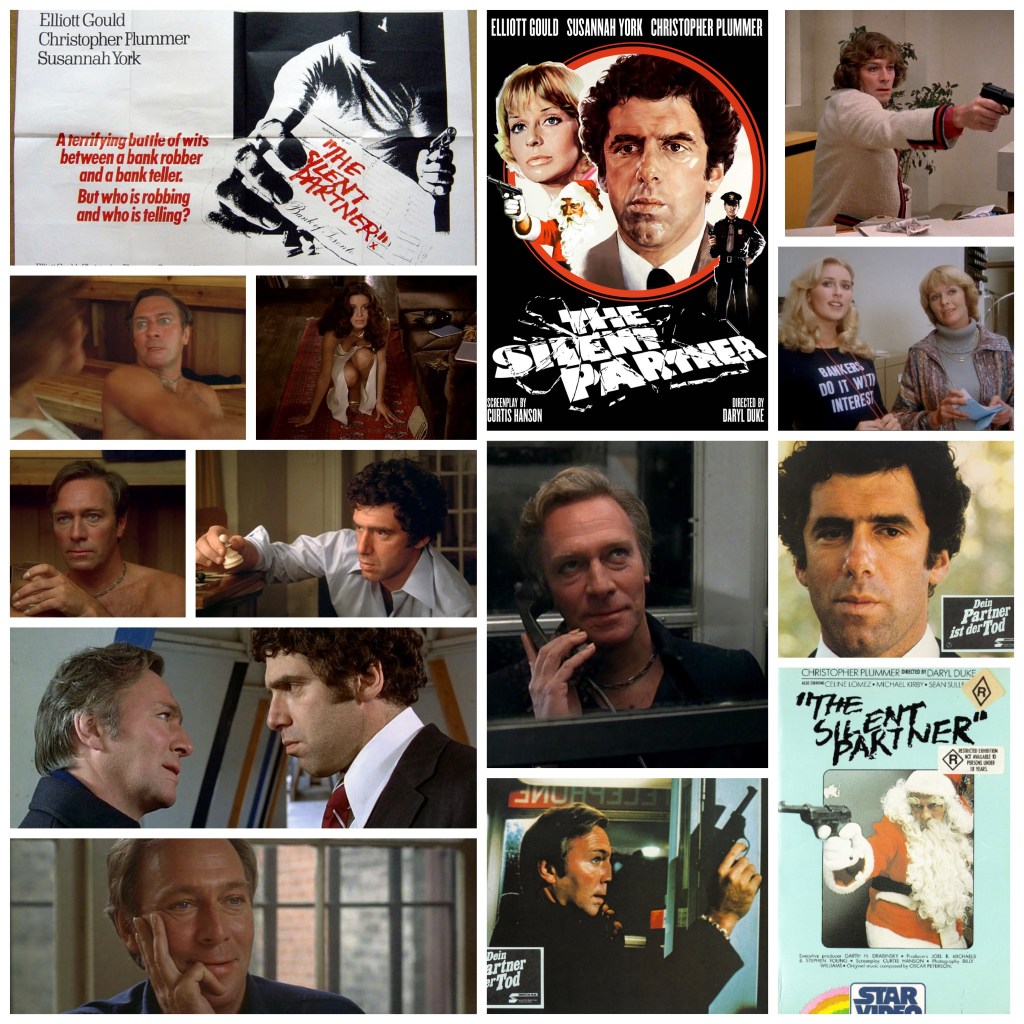
If you think Billy Bob Thornton was a Bad Santa wait until you see Christopher Plummer in The Silent Partner, he gives him a run for his money and then some as a psychopathic, profoundly evil criminal who hits a Toronto bank for all its worth disguised as the local mall Santa. Only problem is, shrewd bank teller Elliot Gould realizes he’s going to do it while he’s still casing the joint, steals all the cash for himself minutes before the hit, and thinks he’s got away with it. Plummer is also a smart dude here and not the kind of fellow you want to pull a stunt like that on, soon he comes around looking for the money he believes to rightfully be his and so ensues a vicious game of cat, mouse and morally bankrupt working professional as these two individuals, one not particularly likeable and the other downright abhorrent, battle each other for the prize. Two girls are involved with both of them, confused fellow bank teller Susannah York and French Canadian femme fatale Céline Lolez but they end up being more collateral damage in the narrative than anything else. So… this film has a huge cult following, glowing reputation and overall hype surrounding it and I wish I could fully get onboard with that, but I just wasn’t as taken by it as many seem to have been. I liked it, I didn’t love it. Let’s start with the film’s strongest asset: Christopher goddamn Plummer. The man goes fully into bizarro world here to play this character, and the guy is a villain for the ages. Heinously violent, gruesomely misogynistic, volcanically volatile, decked out in super femme eyeshadow and heaps of mascara and decorated with bangles of silver bling on every limb, he’s a flamboyantly nasty piece of work and steals the film, whether he’s being an evil Santa or showing up in drag which he gets to do later on. Gould plays his bank teller as very intelligent but also very awkward and somehow stilted in expression and line delivery, I couldn’t really get a sense of his character beyond stoic idiosyncrasy and I feel like he’s an actor who perhaps didn’t find his groove until later in his career when he appeared in stuff like Ocean’s 11, where he’s far more engaging and charismatic than this younger incarnation. Roger Ebert raved about this one being a taut, clockwork tight narrative and I kind of feel different.. the first and third acts are terrifically suspenseful, exciting and ruthless but the film’s midsection wastes a lot of runtime on languid romantic subplots featuring the two girls that don’t add much overall, don’t feel believable with a guy as odd as Gould’s character having that much game with the ladies and bog the narrative momentum down quite a bit. Still, when the film is in its highest gear it’s quite a mean machine, especially when Plummer has anything to say or do about it, which he does. Careful with this one if you’re sensitive about violence towards women, there’s a couple sequences that push the envelope on that just about are far as you can go (even by 1978 standards) and are tough to watch. I found this to be a good if not great suspense thriller with some very well done set pieces and plot turns, and one truly despicable turn from Plummer, who is also playing very against type and loving it. Not as much of a gem for me as it was for a lot of others, but definitely worth a watch.

-Nate Hill

3 for 3: Sean Connery

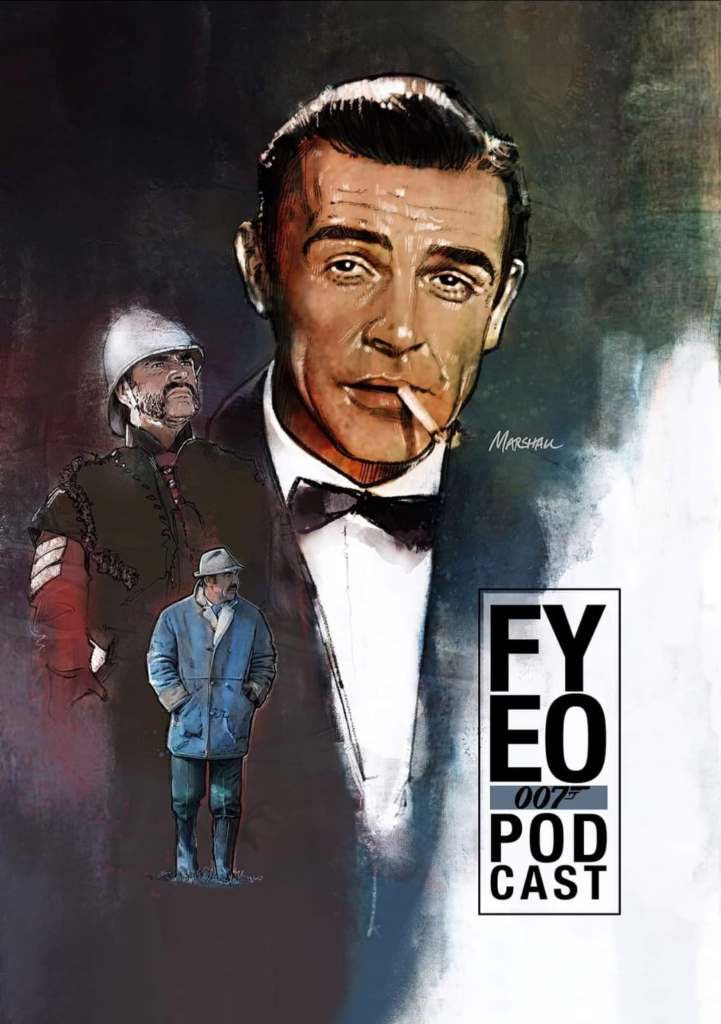
Join Frank, Tom, and the esteemed Mac McSharry as we bring Podcasting Them Softly’s For Your Ears Only and 3 for 3 full circle! We discuss three “undercard” films of Sean Connery’s at length, discuss his contribution to film, along with some of our other non-Bond films that didn’t make our respective selections! Upcoming podcasts from the three of us include Pierce Brosnan’s final outing as James Bond in DIE ANOTHER DAY and then a brand new 3 for 3 where we discuss our three favorite character actors.

THE ROBERT ALTMAN FILES: That Cold Day in the Park (1969)

By Patrick Crain

On a random chilly day in Vancouver, a wealthy woman of undetermined age named Frances Austen spots a boy, teetering somewhere between his late teens and early twentes, sitting on a park bench adjacent to her home. The day grows colder and is then is finally saturated by rain, yet he doesn’t budge from the bench. Frances observes this from her window and for reasons either of benevolence or simple, piqued interest, the woman invites the boy, who first appears to be mute, into her home. From here, an unorthodox and obsessive relationship begins.

Robert Altman’s That Cold Day in the Park is a movie about sex though not necessarily in the way you’d expect from the description above. More specifically, it’s a tragic and mysterious film about a woman whose unmoored sexual blossoming combusts with her rigid repression. Sandy Dennis’s Frances Austen is almost a zombie of ritual who lives in a sarcophagus of high-class privilege occupied by the waxy specters of her late parents’ peers. We know little about her other than what we get by way of light expository dialogue and her direct yet taciturn demeanor. Her daily activities don’t seem to include any kind of employment but, instead, are spent entertaining, shopping, listening to selections from her utterly square record collection, and playing bocce ball with people twice her age. It’s as if her entire reason for being were awarded to her through a probate judgement along with her house and its servants.

This is juxtaposed with the life of The Boy, credited as such and played with a certain bright and impish charm by Michael Burns. Detangled from his large, overwhelming family we glimpse in one masterful exterior shot of his cramped, multi-level home that reveals multitudes while saying very little, he seems to float on a wave of pure life, his only real connection being that of his free-spirited sister who squats in a docked, derelict boat with her hippie boyfriend. It is with her that we learn that he is not, indeed, mute but is instead a curious observer with some rather eccentric tendencies.

In Altman’s first film to really put a real examining glass to human nature, That Cold Day in the Park lives in a very uncomfortable space where sex is never something joyous, exciting, a good time, or expressive but where it is a commodity, a disgusting biological necessity with frightening and painful ramifications, or an unreachable and twisted curiosity. There is always a heavy dichotomous swing between the awkwardness of not knowing anything or, in the case of The Boy, possibly knowing far too much. And while it doesn’t decry healthy sexual freedom, it looks on in sadness at unhealthy sexual identities which leaves the emotionally crippled without any alternatives or outlets.

With her downward-turned smile, librarian hair, and muted earth tones, Sandy Dennis’s Frances is as sharp and as emotionless as a clock and it is next to impossible to imagine that Dennis was but 32 years old when the film was made. Only when she eats some pot-laced cookies gifted to her as a gag by The Boy do we see her melt into a soft-focused thing of beauty, lifted into the ether by the tremendously gorgeous camerawork of Vilmos Zsigmond. Like Sissy Spacek’s Pinky in Altman’s 1977 masterpiece 3 Women, Sandy Dennis’s Frances literally transforms into another character in front of the audience’s face and it a thing of true wonder. As the scene slowly relaxes forward, we begin to vibe with her and pick up on the fully sexual being that she clearly would love to be if situations and forces unknown wouldn’t have stifled her. And like many an Altman woman that would pop up in his filmography, we get that her life has been robbed somewhere of a natural joy. Little wonder that when disappointment strikes, Frances snaps back into her discomforting comfort zone. And boy, does she snap back hard.

Also dividing the film in a rather bold way is the way it splits its time between the controlled environment of Frances’s apartment and the exterior world. As in Roman Polanski’s Apartment Trilogy, Frances’s apartment becomes a controlling space just as Susannah York’s two homes do in Altman’s Images, a film which would come three years later. In both films, the women are mostly trapped in cloistered environments are either inescapable or out of which it’s impossible to exist as the characters are constantly met with chaos and confusion and an inability to navigate through reality. And as That Cold Day in the Park marches toward its conclusion and moves more and more away from the confines of Frances’s apartment, Altman really cuts loose with his observations utilizing his signature style of messy sound design meant to give the audience the sensation of being a casual observer. For all the ink spilled about the following year’s M*A*S*H being the birth of the specific thing we’d eventually define as “Altmanesque,” I’d ask that the clock be turned back a bit and present this as an alternative Exhibit A. Here, it’s used not only as an engaging participatory device for the audience but also as an overwhelming sensory overload to Frances as a character as moments in the very chatty waiting room of a gynecologist and a pitiful attempt in a bar by Frances to procure a prostitute attest. In both scenes, she is entirely out of her element and rudderless and her anxiety is palpable.

Aided by Gillian Freeman’s beautifully delicate screenplay (based on a novel by Peter Miles), Altman’s third time at bat is an astonishing and effective film that gets lost in the conversation regarding his greatest works. While it lacks the jolts of Images and it can’t conjure the deliriously impenetrable and mysterious gossamer of 3 Women, That Cold Day in the Park reflects an artist interested in the marginalized and the outcast; people who aren’t given much serious study but who are indeed out there, doing their damndest, and putting their whole heart into it, regardless of consequence.