As the child from a working class family in South Bend, Indiana, Larry was introduced to the movies by his father. He was not restricted as to what he could watch, so he watched it all. After high school he debated between pursuing either a career in comedy or a life in pictures.
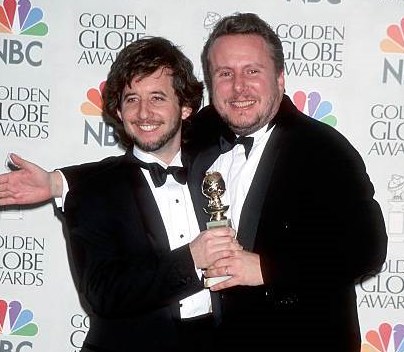
Larry opted for the movies, and soon found himself at USC. It was there that he would meet Scott Alexander, and together they would form not only a friendship, but also the foundation of a prolific career as a successful screenwriting duo.
After (and though it launched a trilogy of films and even an animated series) Problem Child, the screenwriters struggled to find work. It seemed as though they had been typecast buy their work and so looked to independently produce a biopic they were working on about the notoriously bad filmmaker Ed Wood.
As fate would have it, word of the project reached director Tim Burton. After expressing interest, the boys would have to hammer out a screenplay in double-quick fashion. They succeeded, and this, the first in a string of biographical efforts, would re-establish them in Hollywood and from it they would carve out their place in the genre and become, in many ways, its ‘go-to guys.’
Biopics of Larry Flynt and Andy Kaufman would follow, seeing the boys team up with Academy Award winner Milos Forman. They would go on to re-team with Tim Burton as well as dabble in a variety on different genres including everything from a kid-friendly version of James Bond to horrific hotel rooms were you’ll spend a night or perhaps even an eternity.
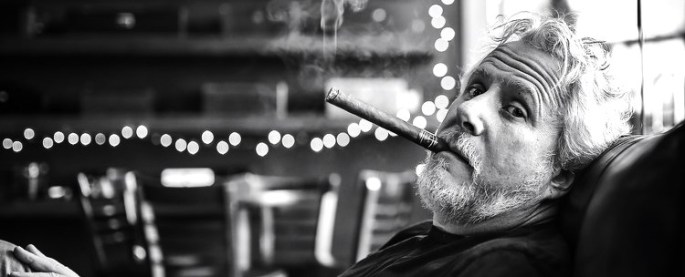
Larry and Scott have garnered the highest accolades the industry has to offer and continue to deliver. While trying to get a hold of Larry for this interview I caught him riding high on his recent wave of success, so I would just have to wait for the tide to turn. I am however, glad that I did. It was, as it is ever, a privilege to chat with a man whose work I heartily admire. I love the films he has written and I look forward to the projects that he and Scott have in the pipeline.
Without further ado I present, the award-winning screenwriter and all-round nice guy . . . the one, the only, Larry Karaszewski.
“…There’s nothing here for me now. I want to learn the ways of the Force and become a Jedi like my father.” ~ Luke Skywalker
With two films under his belt, a young and relatively inexperienced director made a journey that would take him from the deep Saharan Desert, to the rain forests of Guatemala and the comfortable studios just outside London.
This young director would not only go on to revolutionize the way films were produced, but he would also develop sound techniques and visual effects systems that would allow him to tell his story, creating several cottage industries along the way.
Oh, and he would revolutionize the term ‘summer blockbuster.’
As with anyone finding their way in the world, roadblocks would ensue and a patient studio executive with an impatient board would push our young hero to his limits, and back again.
I am, of course referring to George Lucas and his small-ish Sci-fi-opera, Star Wars which opened in a limited release forty years ago, today.
By the time shooting started in March, 1976, the story wasn’t completed with Lucas making adjustments along the way. He also had a young, inexperienced trio of actors in the lead roles with two legendary actors who might have all questioned Mr. Lucas’ sanity more than once.
In the lead role of young Luke Skywalker was Mark Hamill who got his start in television on “General Hospital” in 1963. He was recommended by Robert Englund for his first theatrical role. Joining Hamill was the daughter of Debbie Reynolds and Eddie Fisher, Carrie Fisher. Fisher was 19 when she filmed Star Wars, young enough and rebellious enough to portray Princess Leia Organa. She was stunning in her performance and held her own against the roguish, charming Harrison Ford who would play Han Solo, a fighter pilot with a few tricks up his sleeves.
Rounding out the cast were Peter Cushing as the cunning, evil Grand Moff Tarkin and Sir Alec Guinness as Obi-wan “Ben” Kenobi, a wizard of sorts with a mysticism about him that Luke very much wants to learn about, and Han tries to completely avoid. British actors Sir Antony Daniels and Kenny Baker would play our lovable ‘droids, See-Threepio (C-3P0) and Artoo Deetoo (R2-D2), respectively. David Prowse plays the role of Darth Vader, while an initially uncredited James Earl Jones would voice Darth Vader, a menacing hulk of blackness, threatening to anyone who would get in his way. Peter Mayhew would play a 7’ furry, yet friendly creature named Chewbacca, the first mate on the Millennium Falcon, Han Solo’s ship.
Lucas had clout from his success with Universal’s American Graffiti but, he did not have the money to produce the film. So he convinced Alan Ladd, Jr. at 20th Century Fox to bankroll the $8.4 million budget on the condition that Lucas would retain the rights to future sequels and the merchandising rights.
Technical and labor problems in both Tunisia and England put Lucas behind schedule several times throughout the production causing the release to be delayed from Christmas, 1976 to summer, 1977.
The first cut of the film was a disaster forcing Lucas to bring on two editors, Paul Hirsch and Richard Chew, who would tighten up the film’s pacing. Lucas found that he didn’t have enough footage and convinced Ladd to release additional funds to cover the budget shortfall so that they could get the necessary Second Unit shots completed.
On the recommendation of Steven Spielberg, John Williams was brought on to compose a score that would be as whimsical as the images it was set to. Scoring over 12 days in March, 1977, Williams would deliver a stunning, memorable score evoking thoughts of the Flash Gordon serials that Lucas based his Star Wars on. Yes, he had influences from other sources, but the allusion towards Gordon is one of the most apparent.
“This will be a day long remembered….”
Fox did not initially believe in the success of the film, instead hedging its bet on Charles Jarrott’s The Other Side of Midnight. They booked Mann’s Chinese Theater and 32 other theaters across the nation on Star Wars’ initial release, May 25, 1977. Mann’s held the film for two weeks before William Friedkin’s Sorcerer took its place.
In an unprecedented move, Fox convinced Mann’s to bring Star Wars back on August 3, 1977, this time with all the trimmings of a gala premiere. At that time, 1,096 theaters had the film and approximately 50 theaters ran the film non-stop for an entire year.
Star Wars would go on to set or break numerous box office records during its initial theatrical run that it was re-released in 1978, 1979, 1980, 1981, and 1982.
The box office take was not enough, receiving six Oscar statuettes at the 50th Academy Awards, including Best Art Direction, Best Costume Design, Best Film Editing, Best Original Score, Best Sound, and Best Visual Effects. Alec Guinness was nominated for Best Supporting Actor and Lucas would get nods for Best Original Screenplay, Best Director and Best Picture, losing out to Woody Allen’s Annie Hall. Not too bad for a film that no one believed in.
Lucas would revisit the film after Spielberg was able to successfully use computer generated special effects in 1993’s Jurassic Park and in 1997, Star Wars and its sequels, 1980’s The Empire Strikes Back and 1983’s Return of the Jedi received a digital overhaul with enhanced effects, sound and new sequences. They were all three released theatrically during the late winter and early spring of 1997.
I was 13 months old when Star Wars was first released. My older brother got me in to mania with the toys and the action figures. Many days were spent with my imagination flowing. I remember watching a badly copied VHS copy of The Empire Strikes Back and finally seeing Return of the Jedi on it’s theatrical release in 1983. I was in college when the Special Editions were released and made it a point to see them all as many times as I could.
Fundamentally, Star Wars works because it is a story of hope and yet it’s greatest strength is in its characters and the actors Lucas found to play them.
Now, forty years later, Disney is continuing Mr. Lucas’s efforts with a sequel trilogy. Our favorite characters have returned to us and we will continue to see the ‘Adventures of Luke Skywalker’ this Christmas with The Last Jedi.
As we celebrate forty years of the Force, of Wookies, of Rebellions and dreams, we remember those who have passed before us. The Force is strong with them.
There isn’t a day that goes by where I say “thank you” to Mr. Lucas for inspiring me. He gave me hope. He still gives me hope.
James Gunn doesn’t quite surpass the first Guardians film with his followup, but there is more than enough to love from a sequel that stands monumentally taller than any other Marvel film (save for the first).
Gunn is such a remarkable auteur; his use of seminal popular music, blended with his not only perfect casting of genre actors but knowing how to use them, is what keeps this Guardians film from being a rehash of the first.
The story, while at times has too many plot points running at once, stands on its own, and is not reliant upon any other arc within the Marvel Cinematic Universe. That is incredibly refreshing. The film is about Star-Lord and his father Ego, played by Kurt Russell who turns in yet another fantastic performance.
Guardians 2 does use a few conventional gimmicks: the token Stan Lee cameo that has worn out its effectiveness sixteen movies ago, and an opening scene with a CGI de-age character which actually works well. Aside from that, and a second act that drags its feet slightly, the film is a lot of fun and you’ll be smiling and laughing through the entire film. Heck, you may even tear up during a few moments.
What’s very disappointing about this film, is the incredible missed opportunity of reuniting onscreen Kurt Russell and Sylvester Stallone. Call me shallow, but that’s a moment a lot of us were hoping for going into this film, knowing the kind of genre respect and sensibilities that Gunn has as a filmmaker, it is kind of a shock that this didn’t happen.
Speaking of Stallone, seeing him in a film like this is an absolute joy. He doesn’t have a whole lot to do in the film, he’s mainly being setup for an expanded role in future Marvel films, but you can tell he’s having a lot of fun. Towards the beginning of the film, he shares a scene with Michael Rooker, and anyone who loves CLIFFHANGER will stand up and fist pump in the theatre.
Perhaps the best, and most effective part of the film isn’t the special effects (which are brilliant), or the genre actor cameos (which is even more brilliant), but a scene between Star-Lord and his Ego, as they discuss The Looking Glass’ hit song, BRANDY. It’s a very sweet and emotional moment between a father and son and showcases the star power that Russell brings to the role.
There are a plethora of scene stealing moments. The opening scene, the opening credits, the musical numbers, Baby Groot, Awesome Mix Tape Vol. 2, Michael Rooker – like I said, this film may not be as good as the first, but it’s an awesome experience and do yourself a favor and run the theatre to go see it.
What’s almost hard to understand is how Marvel allows Gunn to make non-templated films that are a part of the MCU, yet really have nothing to do with any of these silly “phases”. The two Guardians films are different, they don’t fit inside of Marvel’s box of conventionality. They take place within a world where Gunn has the absolute freedom to do whatever he wants, and that in itself is a feat that is a cause for celebration, and very much leaves you looking forward to the next Guardians film.
Escape from Tomorrow is a work of cinematic madness. This willfully deranged little freak-out was written and directed by Randy Moore, and because this was his debut feature, the film feels even more radical than if a more seasoned filmmaker had attempted something similar. The narrative pivots on a recently unemployed father (Roy Abramsohn, totally out of control) who takes his family to Disney World for the ultimate vacation, only to have the entire experience spin out of control due to his increasingly sketchy hallucinations and perverted sexual visions. The vast majority of this film was shot guerrilla style on the grounds of Disney World and Disneyland, without permission or permits, which obviously is a no-no and only amps up the anxiety of the entire picture; Moore also fled to South Korea to complete the visual effects and editing process so as to remain undetected by Disney and their lawyers.
There’s a bizarre streak a mile wide in this film, with lots of bad-trip imagery which will certainly startle the most jaded of viewers, while overall the film clearly would speak to someone like David Lynch, as the surreal nature of the entire piece really needs to be seen to be believed. I can’t truly describe this one. But trust me, you’ve not seen anything like it. Escape from Tomorrow premiered at the 2013 Sundance Film Festival, and was personally chosen by the late Roger Ebert for inclusion in his film festival, Ebertfest. This is pure outlaw cinema that will delight those looking for something that could possibly leave some scars. Available on Blu-ray/DVD and various streaming providers, but beware, this film will most certainly not be for everyone, but for adventurous cinematic souls who have a thirst for the wild side, Escape from Tomorrow could become an instant obsession.
That was the news that greeted me on my way into work.
I wasn’t dour or sad at the news of his passing. In fact, I was inspired and glad.
Yes, we lost our beloved James Bond. Yet his alter ego, one of many, will remain with us to cherish forever.
I was inspired by his humanity as an ambassador to the people. Not just in his home country of Great Britain, but around the entire world. Moore gave of himself selflessly, and took much pleasure in doing so. The entire world benefited from his generous spirit, his courage, his grace, the many talents on the screen with a twinkle in his eye, and his self-effacing nature.
He genuinely helped real people. And he wanted to. As a UNICEF Goodwill Ambassador, he advocated for children’s rights in Brazil, Mexico, and Ethiopia.
The Crown recognized his services both on and off the screen with the Knight Commander of the British Empire in 2003. At the time it “meant far more than if [he’d] gotten an award for acting.” Hollywood answered that call, awarding him a star on the Hollywood Walk of Fame three days before his 81st birthday.
Ever the ladies’ man, he was married four times and had three children. They were by his side as he passed after a short, but brave battle with prostate cancer.
Although I did not have the pleasure of meeting him, the first time I saw him on the big screen was in 1985’s A View to a Kill. I had seen Octopussy and For Your Eyes Only on home video, but View really inspired me to explore the Bond-world. I can thank my dad for getting me into Connery, but for me, there would always be Roger. My mom introduced me to Moonraker and its largess, which I fell in love with.
Then, there was The Spy Who Loved Me. It truly did define an era and made Moore an even bigger global presence.
Of course, Moore had other roles, most notably as Simon Templar in ‘The Saint’, The Wild Geese’s Lt. Shawn Fynn, Seymour Goldfarb, Jr in Cannonball Run, and a cameo as Inspector Jacques Clouseau in Curse of the Pink Panther among others.
Throughout the day, I heard several people talk about his leading role as Ffolkes in ffolkes. As I say when I am introduced to a movie I haven’t seen, “It’s going on the list” to watch.
I mentioned that I was glad. I was glad that he did not suffer over a prolonged period. I’m also glad that he made a difference in people’s lives, real people.
Roger Moore, KBE is someone to look up to and admire. He once said “You can either grow old gracefully or begrudgingly. I chose both.” I could only be so lucky.
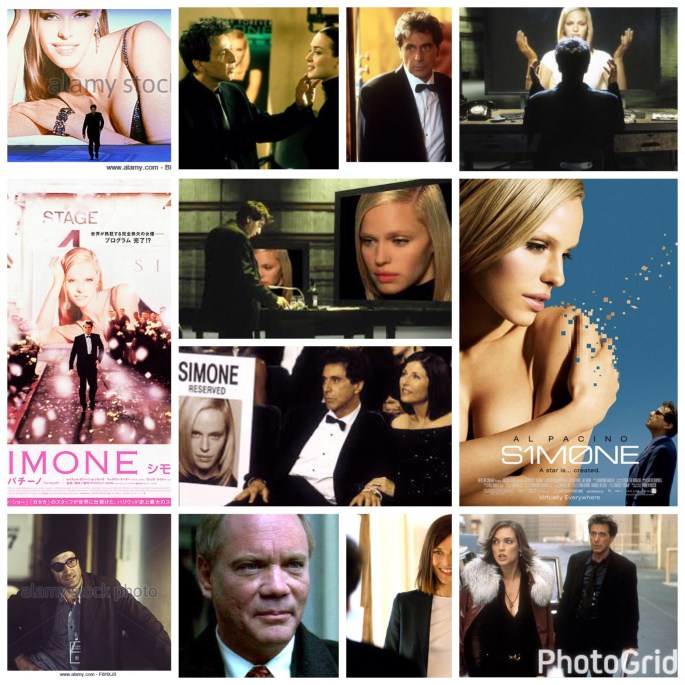
Andrew Niccol’s S1mone is social satire at its cheeriest, a pleasant, endearing dissection of Hollywood mania and celebrity obsession that only hints at the level of menace one might achieve with the concept. It’s less of a cautionary tale and more of a comedic fable, and better for it too. In a glamorous yet used up Hollywood, mega producer Viktor Taransky (Al Pacino with some serious pep in his step) needs to give his enterprise a makeover. His go-to star (Winona Ryder) is a preening diva who drives him up the wall, and there seems to be a glaring absence of creative juice in his side of the court. Something cutting edge, something brand new and organic, something no one else has. But what? Simone, that’s what. After finding clandestine software left behind by a deceased Geppeto-esque computer genius (Elias Koteas, excellent), he downloads what lies within, and all manner of mayhem breaks loose. The program was designed to create the perfect virtual reality woman, flawless and capable in every way, including that of the cinematic thespian. Viktor sees this as gold and treats it as such, carefully introducing Simone (played by silky voiced model Rachel Roberts) to an unsuspecting film industry who are taken by storm and smitten. Simone can tirelessly churn out five oscar worthy performances in a month, never creates on set drama, whips up scandals or demands pay raises. She’s the answer to everyone’s problem, except for the one issue surrounding her very presence on the screen: she isn’t actually real. This creates a wildly hysterical dilemma for Pacino, a fiery Catherine Keener as a fellow executive, and everyone out there who’s had the wool pulled over their starry eyes. It’s the kind of tale we’d expect from Barry Levinson or the like, a raucously funny, warmhearted, pithily clever send up of the madness that thrives in the movie industry every day. There’s all manner of cameos and supporting turns including Evan Rachel Wood, Jay Mohr, Pruitt Taylor Vince, Jason Schwartzman, Rebecca Romjin and the late Daniel Von Bargen as a detective who cheekily grills Pacino when things get real and the masses want answers. This is fairy tale land in terms of plausibility, but it’s so darn pleasant and entertaining that it just comes off in a relatable, believable manner. Pacino is having fun too, a frenzied goofball who tries his damnedest to safeguard his secret while harried on all sides by colleagues and fans alike. Roberts is sensual and symmetrical as the computer vixen, carefully walking a tightrope between robotic vocation and emoting, essentially playing an actress pretending to be an actress who isn’t even human, no easy task. It’s a breezy package that’s never too dark or sobering, yet still manages to show the twisted side of a famously strange industry. Great stuff.
George Lazenby’s story of taking over Sean Connery’s duties as James Bond in MGM’s ‘On Her Majesty’s Secret Service’ is one of the most infamous and fascinating stories in film history. Upon the release of OHMSS, Lazenby was offered a six picture deal and a one million dollar signing bonus yet he turned it down.
‘Becoming Bond’ is a rather intimate and candid look at who Lazenby is, and who he was before he conned his way into a film role of a lifetime. He recounts his childhood, adulthood, and life in England as a male model. Lazenby isn’t an actor, he is for lack of a better description an individual. He does exactly what he wants, and whether or not his decision turns into a catastrophic mistake, he doesn’t regret the life he has lived.
George Lazenby [Credit: Hulu]
The documentary was written and directed by Josh Greenbaum is set up with flashbacks recreated with actors. Notably, Josh Lawson plays the younger version of Lazenby, Jane Seymour is in the film as an inadvertent mentor of a young Lazenby, and Dana Carvey shows up briefly playing Johnny Carson.
While the doc has a fun and refreshing approach to a story that he been told second hand for decades, what makes the film remarkable is how candid brutally refreshing Lazenby is as he recounts his love life, his time as Bond, and his anti-establishment persona upon the release and promotion of the film.
George Lazenby and Michael Caine [Credit: Hulu]‘Becoming Bond’ is a must-watch for anyone who loves James Bond, and it comes highly recommended for anyone else. The film is currently streaming on Hulu.
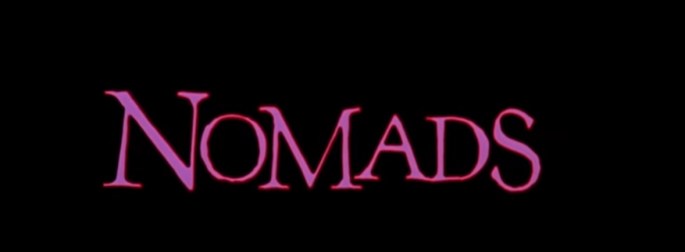
Action-adventure auteur John McTiernan (Die Hard, Predator, The Hunt for the Red October, Die Hard with A Vengeance) made a unique and striking debut with the fun and freaky supernatural horror film Nomads in March of 1986, announcing himself as a major action director in the making, and showcasing the formation of his often imitated muscular visual aesthetic. Starring Pierce Brosnan as a French scientist with a background in nomadic history, the zesty script cooked up by McTiernan mixed biker culture, Inuit mysticism, and the expectations of the vampire genre, and threw all of the ingredients into the cinematic blender, resulting in a strangely compelling slice of B-movie fun. The film features an awesome musical score by Bill Conti, while Lesley-Anne Down matched solidly with Brosnan, who found himself on leading-man turf for the first time in a big motion picture after years of work on the hit TV series Remington Steele. Despite not making a dent at the box-office, the film got McTiernan noticed by the industry, and critics spotted his signature style beginning to emerge; rumor has it he got the Predator job after Arnold Schwarzenegger saw a screening of Nomads and thought the atmospheric touches be brought to the film would perfectly suit the sci-fi in the jungle tale which would become iconic.
Netflix’s newest arrival, GET ME ROGER STONE, is the best and most important political documentary since THE WAR ROOM. The film showcases the flamboyant and unapologetic architect of not only the Trump presidency but also the transformation of the Republican Party post Richard Nixon’s resignation.
Stone is proudly candid as he recounts and fully embraces his insane political power. He cut his teeth at nineteen when he got caught up in the Watergate scandal, from that point forward he became a champion in the dark shadow world of lobbying. It was during the 1980 presidential campaign that Stone met his future mentor, Roy Cohn.
What you see is what you get with Stone. He doesn’t really care about policy, the truth, or America. He wants to yield unmatched power and accrue as much money as he possibly can. He was behind the 2000 Florida recount debacle, the plethora of sexual misconduct allegations of Bill Clinton in the 90’s. He brought down former New York Governor Elliot Spitzer, and he is the man responsible for not only Trump’s brand but building his political base and capital.
While most of the things Stone has said and done are pretty much awful, you can’t help but be amazed by his awesome power. He doesn’t care what anyone thinks of him. He wants power and money and more power and more money. And he’ll be the first to tell you that.
Much like Trump, Stone is a showman and absolutely revels in the attention he gets. Good or bad, he doesn’t care. As Stone proudly proclaims, “it’s better to be infamous than not to be talked about at all.” Regardless of your political affiliation, or your personal feelings regarding Stone, you cannot deny that the guy is an absolute genius.
GET ME ROGER STONE is currently streaming on Netflix.
Few thrillers from the mid-80’s are as underrated as At Close Range, which features two blistering performances from Christopher Walken and Sean Penn as a father/son unit repeatedly tested via a life of crime, and a final act of nearly unbearable tension and intensity. Written with emotional heft by Nicholas Kazan (Fallen, Reversal of Fortune) and directed with gritty integrity by James Foley (After Dark My Sweet, The Corruptor), Orion Pictures distributed this severely low profile gem in April of ’86, and while critics embraced it, the film failed to find a theatrical audience. But over the years, and as the two main stars continued to gain in popularity, Foley’s red-hot drama has become a major cult classic, with the supporting cast, including Mary Stuart Masterson, Chris Penn, David Strathairn, Candy Clark, Crispin Glover, Eileen Ryan (the real life mother of the Penn brothers), and Kiefer Sutherland, adding lots of colorful background to this already volatile mix of crime, violence and family dynamics. Juan Ruiz Anchia’s star cinematography painted a bleak portrait of lived-in hostility, while Howard E. Smith’s exacting editing left no fat to pick off of the bones of the grim narrative. At Close Range was nominated for the Golden Bear at the Berlin Film Festival, and is currently available on DVD as a two-fer with the superb cop film Colors, and also on Blu-ray.


 With two films under his belt, a young and relatively inexperienced director made a journey that would take him from the deep Saharan Desert, to the rain forests of Guatemala and the comfortable studios just outside London.
 March, 1976, the story wasn’t completed with Lucas making adjustments along the way. He also had a young, inexperienced trio of actors in the lead roles with two legendary actors who might have all questioned Mr. Lucas’ sanity more than once.
 with enhanced effects, sound and new sequences. They were all three released theatrically during the late winter and early spring of 1997.



 Not just in his home country of Great Britain, but around the entire world. Moore gave of himself selflessly, and took much pleasure in doing so. The entire world benefited from his generous spirit, his courage, his grace, the many talents on the screen with a twinkle in his eye, and his self-effacing nature.
 Ever the ladies’ man, he was married four times and had three children. They were by his side as he passed after a short, but brave battle with prostate cancer.
 .
.




 Podcasting Them Softly