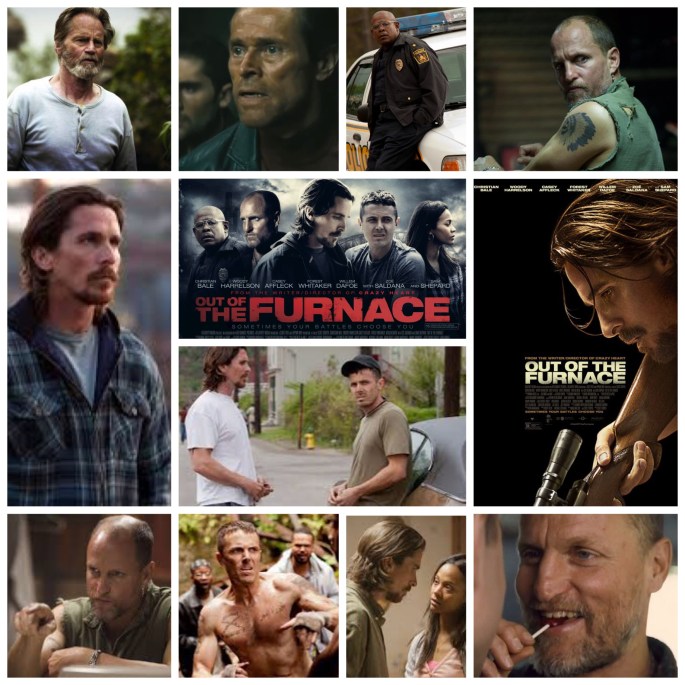
Scott Cooper’s Out Of The Furnace 


While not quite in the pantheon of powerhouse that the filmmakers intended it to be, Scott Cooper’s Out Of The Furnace is still a bleak, devastating picture. This is a film about endings, and not resolute, satisfactory ones either. Set in a borderline derelict mining town somewhere in the rust belt, industry has come to a grinding halt, giving way to the inevitable rise of rural crime, spreading like a cancer across land that once flourished and prospered. Every character in the film meets their bitter end somehow, and what’s fascinating is that earlier in life they all could have been more whole, and come from some other, brighter genre film, but the lives they’ve led set them on the same course as their county, and one by one we see them reach the last bend in the road, and the light in their life unceremoniously flicker out, leaving a cold shell. If I’m making this sound depressing, I’m doing my job well. This is a soul crushing film, with no light at either end of the tunnel and all glimmers of hope already extinguished before the opening titles even show up, so just make sure you have Finding Nemo or Wallace & Gromit queued up next in line if you give it a go. Opening with a prologue that leaves a bad taste in your mouth, you know right off the bat what you’re in for, as we’re introduced to Woody Harrelson’s Harlan Groat, an absolute monster who runs everything from underground fight clubs to an intricate web of meth trade in the region. Groat is at odds with steelworker Russell Baze (An implosive Christian Bale), a hard man with anger issues just looking for an excuse to get fired up. Russell’s brother Rodney (Casey Affleck in the film’s best work) is a broken Iraqi war vet who got on the wrong side of Groat’s gang, and has since disappeared. Since the law won’t venture into the near mythic backwood hills where Groat skulks, Baze goes vigilante, waging personal war and raging against a light that has long since gone dead. This is a big cast we’re looking at here, and some of the subplots either distract from the main show or just seem like overkill, like Zoe Zaldana as Russell’s ex who has since shacked up with the local Sheriff (Forest Whitaker), or an underused Sam Shepherd as his uncle Red. Willem Dafoe has a nice bit as a seedy but sympathetic local gangster though, it’s always nice to see him, as well as Tom Bower as the salt of the earth bartender. It’s all about Woody and the danger he brings, he’s terrifying in the most mundane of exchanges, and lethal when he gets worked up. The feeling of economic decay follows him like a noxious cloud, his brittle ruthlessness a mascot for the hard times that many a town in the US has fallen on in recent years. One need only look at the poster to see the obvious and intentional shades of Michael Cimino’s The Deer Hunter, and though the film wears its influences on its heavy flannel sleeve, it finds its own dark, despairing poetry, and leaves you gutted in the final, anticlimactic frame. 

-Nate Hill

EPISODE 40: DEATH PROOF and KILL BILL Vol. 2

episode 40

Join Tim and Frank as they discuss their respective favorite Quentin Tarantino films!  It’ll be a, spirited, discussion to say the least!

Review of T2 TRAINSPOTTING

Ewan McGregor, Johnny Lee Miller, Ewen Bremner, Robert Carlyle, Anjela Nedyalkova. Directed by Danny Boyle. Rated R. 117 minutes. 2017.

Stewing in nostalgia is no way to go through life, but it’s the only way the characters in T2 Trainspotting know how to live. The film, catching us up on the lives of characters to whom we were introduced in 1996’s rambunctiously enjoyable Trainspotting, also stews in that sense of nostalgia, much of it empty, because while the ending of the first film certainly hinted at an enormous amount of interpersonal conflict between its characters through the self-preservative actions of one of them, this film only deals with that conflict when the machinations of John Hodge’s screenplay allow it to do so. Instead of dealing honestly with its wounded characters, director Danny Boyle inserts each of them into separate plots, then shifts randomly between them. The sense of focus and rhythm has been replaced by routine.

One of the plots dedicated to these characters works surprisingly well, and that would be our reunion with Spud (Ewen Bremner), whose position as the comic-relief of the central foursome hasn’t really changed. There’s a sense of melancholy to the character this time around, as we learn that his wife Gail (Shirley Henderson) has left him, with their son in tow, after he relapsed and spiraled into the drug world once more. There’s also a lot of potential in what we learn about what Renton (Ewan McGregor), the de facto leader of the group, has done in the interim since making off with almost all of the money owed to the others. The only one to whom he gave any money was Spud, who of course abused his chance at an escape. Spud is in the middle of attempting suicide when Renton is reunited with him and saves his life.

If these two are the ones who are treated as genuine characters, the others in the group are treated as narrative devices. Sick Boy (Jonny Lee Miller) has been leading a life of con artistry with Veronica (Anjela Nedyalkova), blackmailing upper-class society people with forged sex tapes to take a considerable portion of their income. Begbie (Robert Carlyle) has been in prison, although he breaks out by staging a shivving with a fellow prisoner and being sent to hospital. When he gets out, he can’t wait to get back into his life of crime, even going so far as to employ his son in a scheme that nearly goes terribly awry. Much of these threads is played as comedy, although Sick Boy’s schemes quickly evaporate as the film sees less and less use for them and Begbie’s animosity toward Renton (once the film, in its last act, finally reunites the two) leads to a massive shift in tone as it all becomes a caper with a horror-movie killer as the predator.

Interwoven through this surprisingly thin material is a movie that consistently looks backward with an oddly misplaced sense of fondness that misses the point of the earlier film. There was at least a bit of optimism in that film, particularly when Renton twisted an anti-drug advertisement to look forward; here, he gets a similar moment that has itself been twisted into something as cynical as how he once viewed Scotland. He eventually turns to his old ways, which feels like an obligation in a screenplay that also contrives for Diane (Kelly Macdonald) to return for one scene to pass judgment on Renton. With T2 Trainspotting, Hodge and Boyle commit an act of revisionist history that feels dishonest, both toward its audience and toward characters who, for all of their flaws, deserve better.

Review of POWER RANGERS

Dacre Montgomery, Naomi Scott, RJ Cyler, Ludi Lin, Becky G. Directed by Dean Israelite. Rated PG-13. 124 minutes. 2017.

There is a solid start, as well as a firm foundation in its characters, to Power Rangers. That is a surprise for this adaptation of the goofy television series that has just recently entered its 24th season and is primarily known for the over-the-top brand of karate-infused acrobatics employed by the titular superheroes to defeat various, fantastical villains and monsters. In fact, director Dean Israelite and screenwriter John Gatins barely seem interested in introducing the Rangers of the title until the point at which its climax begins, and that ends up being a good decision. I’m getting ahead of myself, though, because for a long time, it’s easy to rally behind these misfits-turned-heroes, thanks to genuine chemistry between the actors and a screenplay that considers how they must end up being Rangers.

The effect is a nice deviation from the beats of the plot that we expect, but it only lasts so long. Until that point, we are introduced to those eventual heroes. The first three meet in detention. Jason (Dacre Montgomery), the Red Ranger, is a disgraced football champion who got into trouble with the law after an incident involving a male bull that was confused for a female cow (Think about it) and an ensuing chase with police. Kimberly (Naomi Scott), the Pink Ranger, was involved with an unfortunate candid-photo incident that drove her to knock a tooth from her boyfriend’s mouth. Billy (RJ Cyler), the Blue Ranger, accidentally blew up his lunchbox. There is an amusing energy to the scenes between the heroes, who also ultimately include Zack (Ludi Lin), the Black Ranger, and Trini (Becky G.), the Yellow Ranger.

This is especially true after the driving narrative is established. The fivesome merge after an incident at a closed-off work site leads them to some glowing rocks and a collision with a train that unintentionally binds each of them to the color signified above. They meet Zordon (Bryan Cranston), a former Ranger who died burying the rocks in order to secure the destiny of five future warriors, and Alpha 5 (voice of Bill Hader), the remarkably annoying robot who has been waiting 65 million years for these warriors. It becomes clear that the warriors could technically have been any five people who stumbled across the glowing rocks, but whatever: They must save the universe from the clutches of Rita Repulsa (Elizabeth Banks), a villainous villainess of villainy who is searching for some sort of other glowing rock thing that’s been hidden away in a Krispy Kreme location (seriously) and who has a leviathan made of gold as her main lackey.

The best scenes of the teenagers accepting their destinies as Rangers include the initial discoveries of their increased strength and speed, a training montage that might be a montage but seems more focused on the physical comedy of teenagers whose hormones are raging as much as their new powers, and a fireside chat in which we learn about some of the issues plaguing the kids (Zack’s mom is ill, Trini is currently questioning her sexuality, Billy is autistic, and Jason and Kimberly are suffering from the ennui of their dull existence in the town). The particulars of the plot held by Rita are hogwash whose conclusion has apparently been left to the inevitable sequel, and the build-up to the climactic action set piece, in which the characters don their suits for the first time, is so long that, when it comes, the visually ugly chaos that ensues is all but entirely anticlimactic. Power Rangers is intriguing enough to make one wonder where a series spent in the company of these characters might lead, but then it becomes a Power Rangers movie.

JAN DE BONT’S SPEED — A REVIEW BY NICK CLEMENT

2

This is a totally smashing, R-rated action-adventure film, made back in the good-old-days-90’s before the obnoxious and lazy practice of smothering your film in needless, endless CGI became the new norm; no swirling vortexes in the sky to be found here! Joss Whedon and Graham Yost’s zippy and propulsive screenplay presents fully fleshed out characters that are sympathetic and still resemble actual human beings, while the villain that dominates the narrative is especially well-considered and performed by Dennis Hopper. Cinematographer turned director Jan de Bont never crafted a better film while sitting in the helmer’s chair, bringing his innate widescreen visual sense to each robust set-piece, with ace lenser Andrzej Bartkowiak doing some seriously muscular work behind the camera. The pulse-pounding musical score by Mark Mancina amps up the thrills to the max, with leading man Keanu Reeves dropping one of his signature performances, with Jeff Daniels, Sandra Bullock, Alan Ruck, Joe Morton, and many more all doing invaluable back-up work. I can vividly remember seeing this on the big screen on opening night, and how it sent shivers of excitement down my spine. And the best part – this is a movie that proudly holds up over 20 years later, casually brushing off the watered-down, PG-13 competition that has been plaguing the genre for years.

3

A Week of Monsters – The Invisible Man

The Invisible Man

1933.  Directed by James Whale.

theinvisibleman1933

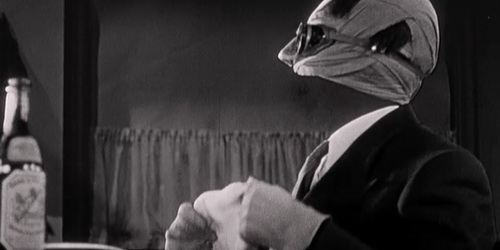
The Universal Monsters pantheon has a central theme of loss, with all of the stories focusing on a creature’s bereavement, be it from an errant loved one or surrendering to the murderous side of their nature.  James Whale’s The Invisible Man breaks this trend by focusing on the narcissistic aftermath of the protagonist’s transition from mild mannered scientist to preternatural madman.  A groundbreaking display of special effects enhances a sordid tale of discover gone awry, departing from traditional romantic Gothic themes and delving into the realm of criminal mayhem.

Claude Rains stars as the titular villain, a promising scientist whose experimentation with pharmaceuticals renders him invisible and unhinged.  R. C. Sheriff’s script weaves a farcical tale of madness and murder, with Rains’ interpretation of the material hearkening back to Lang’s Dr. Mabuse films, foreshadowing the eventualities of a certain Clown Prince.  The Invisible Man works best when the serious and slapstick combine, keeping the horror and pitch black comedy in harmony while never taking itself too seriously, but also never submitting completely to the satire.

invisible-man-1933-claude-rains-shot

John Fulton’s special effects are vintage wizardry of the highest form.  The Invisible Man’s presentation and the use of wires to simulate obfuscated hijinks are jaw dropping considering the time.  While other films had the luxury of a visible monster, Fulton capitalized on the lack of a physical being, allowing the viewer’s mind to conjure the wickedness, making the film’s first act an unforgettable sequence of smoke and mirrors not often replicated to this day.  Una O’Conner’s squeamish innkeeper contrasts the underscored menace of Rains’ mysterious patron, leading to one of the film’s best, and absolutely hilarious scenes.  Despite the laughs, the film maintains an edge, staying loyal to the blackness that pulses through the heart of the story.

Murder is a complex undertaking.  Pre-code Hollywood was unrestricted, allowing Whale to take H. G. Wells’ novel into a realm of anarchy that continues to inspire cinematic villainy to this day.  This is reflected in several monologues that highlight Rains’ sinister transition by way of his relationship with an unwilling colleague, expounding upon the nebulous morality at the heart of Wells’ classic novel.  While it is the experiment that fractures the Invisible Man’s mind, it is the absence of identity, the unfettered freedom of true anonymity which calls to the dark heart of indulgence.

The-Invisible-Man-1933-3

Available now for digital rental, The Invisible Man is one of the strongest entries among the Universal Monster films. A maniacal central performance, a layered script, and cutting edge special effects work in tandem to allow Whale’s directorial prowess to deviate from narrative conventions to produce a chilling film that explores greed and mental duress, both of which are bathed in the shadow of gallows humor that infuses every scene of this essential film.

Highly Recommend.

invisible-man-movie-title

B Movie Glory: Frogs For Snakes


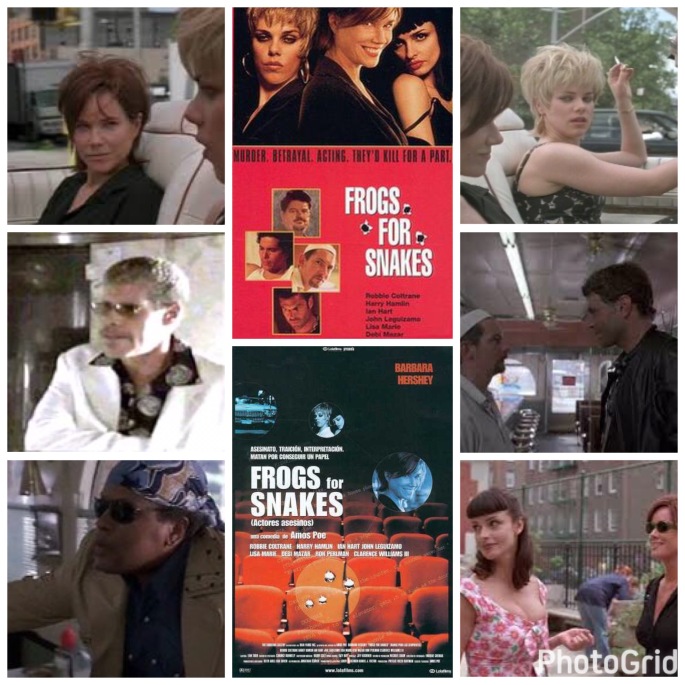
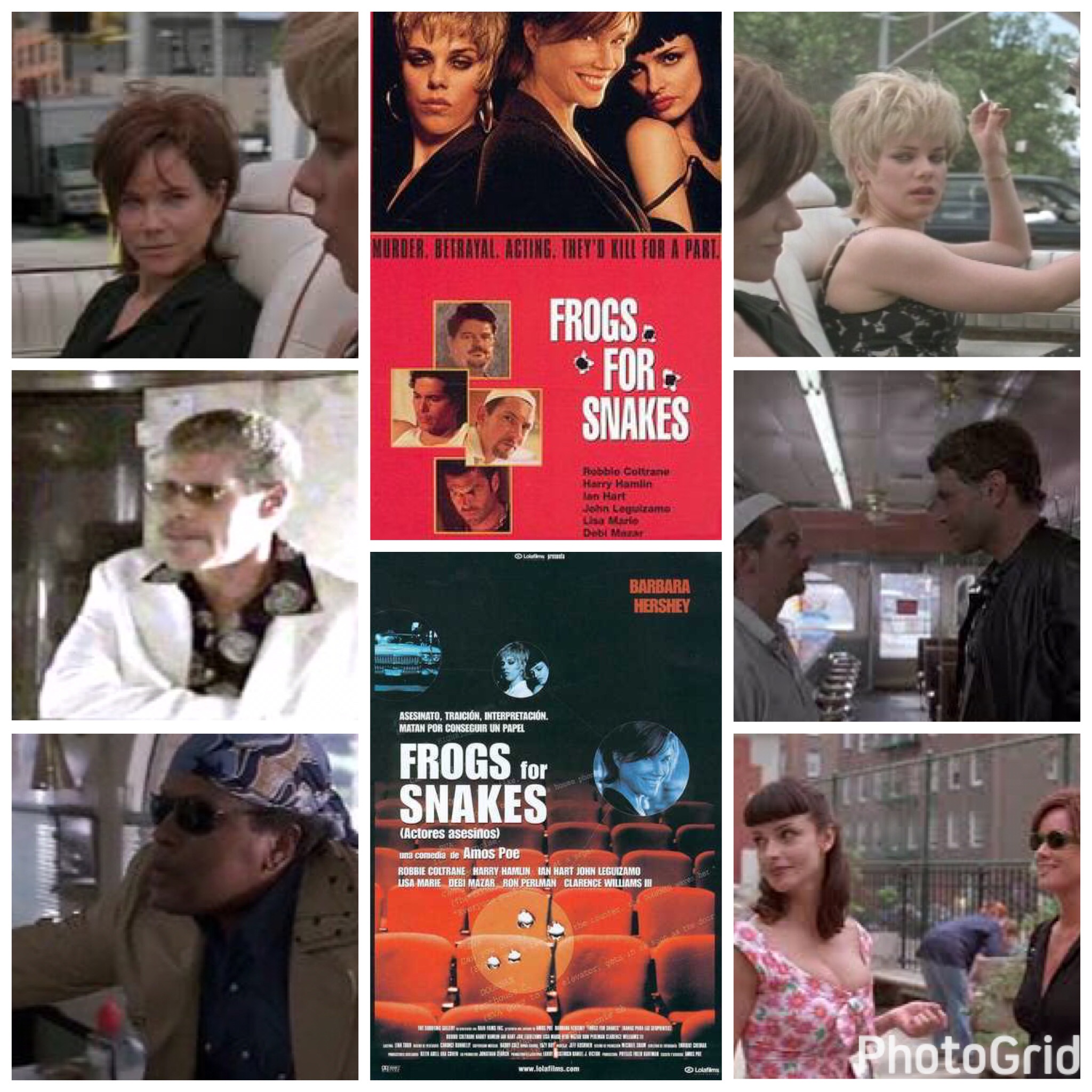
They say actors will literally ‘kill for a role’, and in the long forgotten, bizarre NYC set indie flick Frogs For Snakes, that’s the very concept. A handful of Bronx lowlifes all directly involved with criminal kingpin Al Santana (Robbie Coltrane, before he went all Hagrid on us), discover he is putting on a play, and promptly begin to literally murder each other for parts. Now, such a premise should provide a downright brilliant film, but sadly that’s not the case with this dreary gutterball. The possibilities are just endless, and all these miscreants do is just languish in alleyways, decrepit apartments and dive bars, monologuing about.. nothing much at all. It hurts when you have a cast this good in such fuckery as well. Al’s ex wife (Barbara Hershey) works as a debt collector for him, while she pines for her thespian boyfriend (John Leguizamo) who spends the majority of his scenes reciting overblown monologues that have nothing to do with the story, or lack thereof. There’s all manner of creeps and hoodlums running about like New York sewer rats, played by an impressive lineup including Harry Hamlin, Lisa Marie, Ian Hart, Clarence Williams III, Nick Chinlund and briefly Ron Perlman, but none of them have much to do and seem to aimlessly shamble through their scenes as if they were never given much of a script. Being the weirdo that I am though, I did get a sick thrill out of hearing potty mouthed Debi Mazar explicitly describe giving a blowjob to Coltrane’s character, a mental image I won’t soon erase from my head. It’s a whole lot of nothing for the most part though, and kinda makes you wonder how the thing ever got green-lit, let alone attracted such talent. If the film itself were a play, it would be run out of town on opening night. 

-Nate Hill

FRANCIS FORD COPPOLA’S TETRO — A REVIEW BY NICK CLEMENT

2

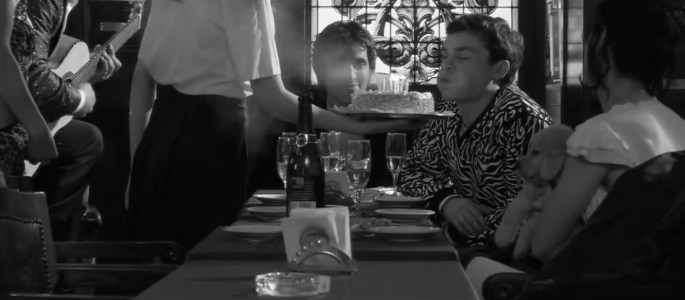
Tetro is a beguiling film, definitely underrated and rarely discussed; I think it’s one of Francis Ford Coppola’s most interesting and personal films that he’s ever crafted, and I love how the narrative and visual style work to cast this spell of heightened familial discord with a nearly dreamy aftertaste that sometimes makes you question everything you’re being presented with. Set in Argentina, Tetro dives into the lives of two Italian brothers who are natural born rivals, and how the artistic passions that are found in their family have come to define them as men and as artists. Shot in smoky, gorgeous black and white by the eclectic and painterly cinematographer Mihai Malaimare Jr. (his work here apparently caught the eye of Paul Thomas Anderson who drafted him for The Master), Tetro unfolds with a graceful sense of classical storytelling, with shades of noir thrown in to jazz up the background. Vincent Gallo and current flavor of the month Alden Ehrenreich were both superb as the quarreling brothers prone to verbal combat, while everyone in the mostly unfamiliar supporting cast all provided passionate performances. Coppola apparently wrote the script for Tetro while he was editing his divisive Youth Without Youth, and looked to independent European financiers to produce this esoteric yet still accessible piece of cinema.

3

What began with Weng Weng: An Interview with Andrew Leavold by Kent Hill

When Shakespeare wrote about all the world being a stage, and all the people in it being merely players with their entrances and exits, he was on to something. But it is the line: and one man in his time plays many parts that brings to mind the life and now the burgeoning cinema of Andrew Leavold.

Here is a man for whom movies are a great passion, a grand obsession, and they have been the catalyst for the direction in which he has moved through his life. Beginning with his own video store, Andrew filled the shelves with everything from the opulent and the uniquely obscure. For the better part of two decades he brought awareness and ultimately his love for film to the renting public – but the times, as they are bound to do, started a changin’. The landscape of delivering entertainment to the masses forced the then proprietor of Trash Video to reassess.

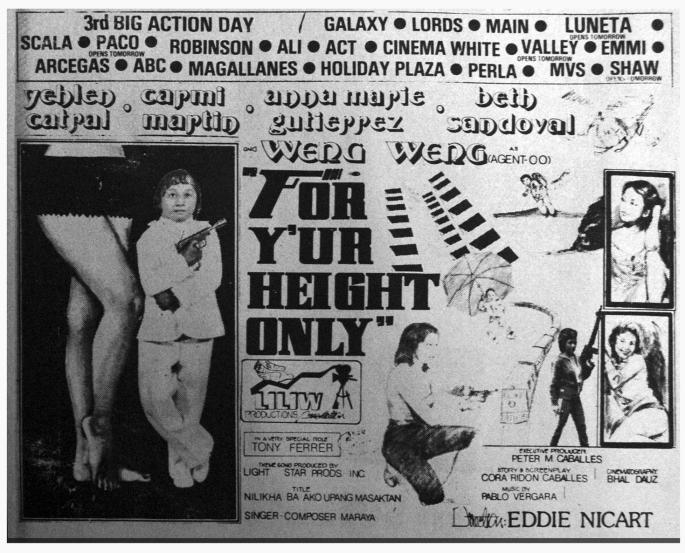
Fortunately by the time the demise of the video store descended, Andrew had already encountered the thing that would prove to be the gateway to the next phase in the evolution of him realizing his dream. That ‘thing’ would appear in the form of a little man the world, up until that point, knew simply as Weng Weng; a pint-sized Filipino actor that had been propelled into recognition as Agent 00 in a film called For Y’ur Height Only.

for_your_height_only_1

Andrew’s fascination with the tiny action man would see him embark on a seven year odyssey, returning multiple times to the Philippines in search of Weng Weng and the story surrounding his life and cinematic career. All of this became the basis of the incredible documentary which still continues to evolve; its release bringing to light more and more stories about this petite performer seemingly enshrouded by magic and myth. But The Search for Weng Weng (the film) is only a piece of the adventure. There is now a book, the print companion to the documentary in which Leavold extends and expands upon all he has and continues to unearth.

What I took away from our conversation is that the spark that fuels the fire which burns within us, inspires us, drives us toward that which we seek to achieve can come, at the best of times, from the most unlikely of places. For Andrew, a mysterious video tape catapulted him from one dream to the next, now, he is the filmmaker he thought he would never become. It was a privilege to talk with him and I sincerely hope you will check out The Search for Weng Weng, the book and the film and help Andy continue his work, keeping the dream alive.

Ladies and Gentlemen . . . Andrew Leavold.

Me


To get your hands of the book and the film please visit:

https://www.facebook.com/TheSearchForWengWeng

https://www.facebook.com/andrew.leavold

WRONG: DULL ISLAND

kong-skull-island1

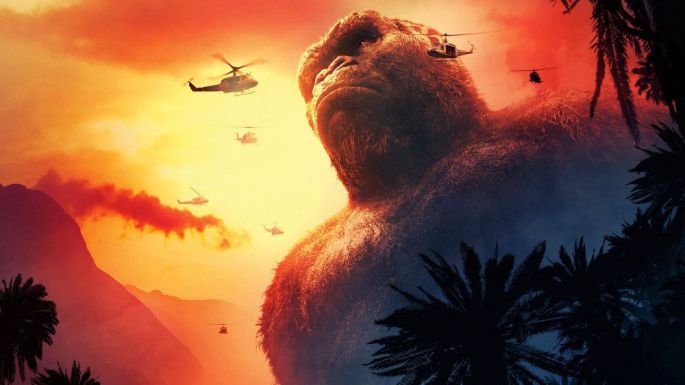
He’s bigger, he’s better and he’s back. He’s King Kong, and this time he is not going to be dragged off Skull Island and taken back to civilization to be paraded around till he takes exception to being someone’s meal ticket, breaks loose his chains and starts a city smashing rampage which ends with a barrage of bullets and a long fall to the asphalt below.

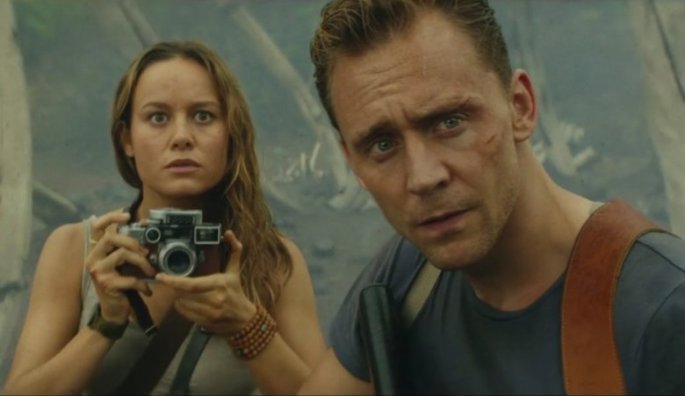
No folks, this time round Kong, now the size of a mountain, is hanging out and keeping the peace on his island. That is until and group of curious humans, led by an alleged Bear Grylls, Tom Hiddleston, Oscar winner Brie Larson who shifts between looking wide-eyed at things and taking photos, John Goodman who knows the truth is out there and Samuel L. Jackson. When you absolutely, positively have to kill every monkey in the room – accept no substitute. This group headlines a cast of who-gives-a-shit characters on a trip to Skull Island where everything is big. Even the ants apparently, but that’s a set piece too far.
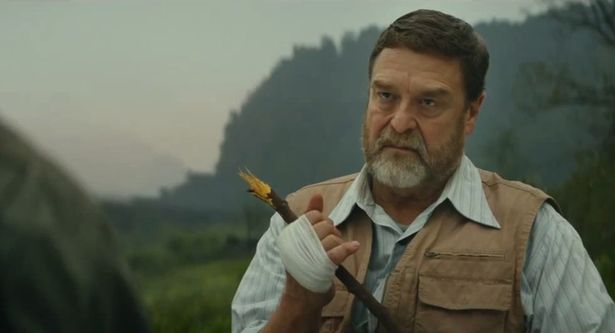
Kong-Skull-Island-Trailer

The journey to the island is mandatory – montage and music stuff. Then we break through the perpetual storm clouds and have ourselves a bit of an Avatar moment as the crew marvel at the grandeur and beauty of this lost wilderness. Then Kong shows up and goes apeshit. He smashes up the Apocalypse Now homage and then walks off to enjoy a little calamari, ’cause they just don’t make bananas that big. So,  with the cast all over the place, Tom and snap-happy Brie and their group are headed from the rendezvous point, Sam and John and that guy who played Private Wilson in Tigerland, plus the other soldiers are off to get some more guns to aid in Sam’s desire to turn the King into fried funky monkey meat.

There’s a giant spider that should make Jon Peters happy. There’s the Watcher in the Water moment. The Soldier who writes to his son bites it, or gets bitten by something unusual, but we don’t get the exposition till we meet up with John C. Reilly looking like his character Gershon Gruen from The Extra Man, minus the collection of souvenirs and the no-testicle high voice. This guy though gives the film a pulse. Oh, and he was the pilot from the beginning, SPOILER! He’s been hanging out on the island with the tribe that speech forgot, waiting to come in and add some much needed comic relief. Turns out there are huge nasties that you can call whatever you want under the ground that Kong has kept from emerging to prominence and getting there own spin-off movie.
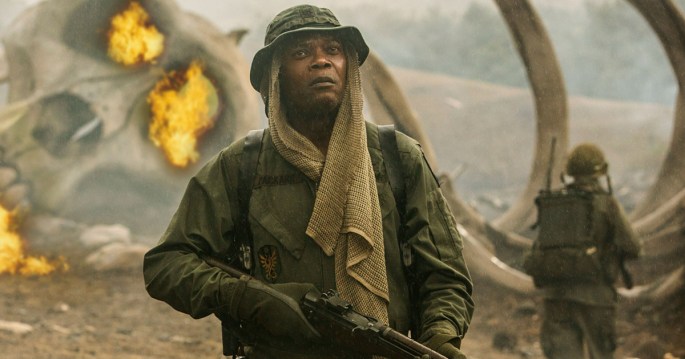
10-apocalypse-now-kong-skull-island_w1200_h630

This task used to be in the hands of more Kongs, but there is a ‘big one’ of these things that lay waste to them. Now Kong is the only one left who can keep cool, sit tight and keep the creatures in there holes. Of course this film falls into the cash-cow category. They brought back Godzilla, now they make a Kong that’s to scale, in order for the pair to have a decent scrap. But sadly it is a joyless ride. Predictable, laughable, with (and I’m quoting a prior review I’ve read) cardboard cut-out characters that are simply there to fill in the time between Kong and his monster-bashing bits. Heck my son started talking at least 45 minutes out from the end. This tells me that he is board out of his mind and I was with him. But I tried to hang on. I did not fall asleep like I did after the first fifteen minutes of the Conan remake. I have since completely avoided the try-again versions of Clash of the Titans, RoboCop, Ben Hur, Point Break, Total Recall as so on and so forth.

There is a line from James Ivory’s Surviving Picasso in which Anthony Hopkins, as the title character, refers to the methods of artists who have found fame and fortune. He says they make themselves little cake-molds and bake cakes, one after the other, all the same. He then  stresses to Natascha McElhone’s Francoise, not to become your own connoisseur. This is extremely relevant and typical of the modern Hollywood. There is little to no attempt at originality, and if there is, it takes place within a film that fits into the friendly confines of a pre-branded property.
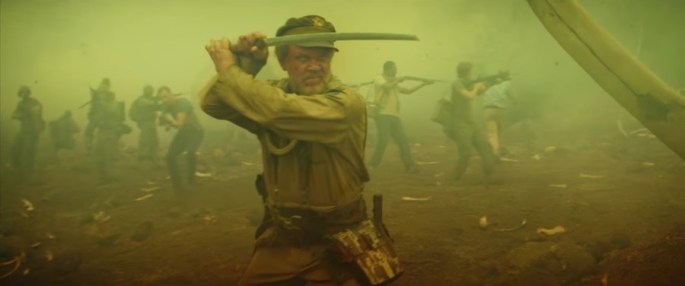
kong-skull-1

But the big ape lives and walks off into the center of his jungle home. He survives his encounter with dim-witted humanity, only to go off and fortify himself for the coming sequels and, quick note on cinematography, Larry Fong gets to send a love letter to his buddy Zack Snyder with a little samurai sword in green smoke action. We have reached that point in the history of the movies dear readers, in which the dead horse has been flogged so often that they have been whipping the bones. Soon all that will be left is the dust of said bones under foot. What are we to expect then? I’m reminded of one of Kevin Costner’s lines from his summation speech in JFK, “perhaps it will become a generational thing.” Ten years goes by  and it’ll be, “Well, time to drag a King Kong movie out again.”

Sam Jackson buys the farm much like he does in Deep Blue Sea, swiftly and unexpected, at least for him. I’m starting to believe Hollywood is looking at us the same way. Here we stand, full of confidence, about to witness triumph in whatever form it may appear. Then it becomes like the lead up to the first ever screening of the Phantom Menace. The audience was cheering, poised, ready for the planets to align in complete and utter harmony. The Fox logo. The Lucasfilm logo. A long time ago, in a galaxy far far away. Star Wars. If you watch the documentary The People Vs. George Lucas, one interviewees describes this as perhaps one the greatest moments in cinema history, then, then the film started.

I think it is a frequent occurrence today. There is so much pomp and pageantry surrounding these tent-pole movies that more often than not bad, because to achieve the same level as the hype generated is near impossible. Mind you, there are a few that defy this convention but they are few and far between.

So my favorite Kong is still the one I grew up with, the John Guillermin 1976 version.

People tell me they hate that one too. But to each his own. Kong will most likely be back in a decade after this lot. He’ll be half the size of the planet, ripped and ready to rumble against the Independence Day giant aliens when they decide to return to the best place in the universe, Planet Earth: home and the re-imagination of the adaptation of the sequel of the remake.

He’ll take a huge crap in his mighty hand and fling it at them. Oh if only…

The Dude in the Audience

flat,550x550,075,f.u1