I’ve never really been a trekkie my whole life. Didn’t grow up with the television series and haven’t actively explored it later in life. When the announcement came that wonder-kid JJ Abrams would be taking on the lofty overhaul of a remake, I didn’t freak out or anything. In fact I waited quite a while before seeing it in theatres, dragged along by a buddy who talked it up quite a bit. Well, it was amazing, and still is. Nothing gets you pumped and makes your heart ache quite as much as that epic ten prologue, starring an intrepid Chris Hemsworth who selflessly saves the lives of everyone onboard his ship, including his newborn son, James T. Kirk. When your eyes flood with tears in the first few minutes of a film, it’s always a good sign. Abrams ushered in Star Trek for the new generation, and I imagine strived to keep core elements like friendship, cameraderie and wonder alive as well. Chris Pine makes one hell of a Kirk, but then he’s one of the best in his age group these days. Cocky, belligerent, dysfunctional, impulsive and recklessly brave, he’s the perfect opposing force to Zachary Quinto’s calculated, logical, no nonsense Spock, who goes through quite a wringer when his entire world is decimated by rogue Romulan extremist Nero, played by a sensational Eric Bana. Both Kirk and Spock are no stranger to loss, being affected and reacting to it in different ways. Their initial rivalry tangles into the beginning of a friendship, hinted at by Leonard Nimoy’s Spock Prime, visiting Quinto from far in the future (time travel, baby). The plot and character motivations are in fact mostly about loss and anger; Nero himself is driven by grief which has morphed into poisonous hatred, willing to inflict hurt a thousand fold in return for what happened to his people. Bana finds the wounded areas of Nero, and uses the trademark Romulun leer to cover them up in violent fury. There must always be comic relief too, and when the banter between the two heroes gets too dark, the spotlight shifts to chipper Scotty (Simon Pegg) and a brilliant Karl Urban as Leonard ‘Bones’ Mccoy, the ship’s neurotic doctor. Urban is cast heavily against type in the liveliest role he’s ever been thrown, and clearly loves every antsy second of it. John Cho makes a formidable Sulu, and the sadly departed Anton Yelchin charms the pants off of everyone with his priceless russian accent. Clifton Collins Jr. and Jennifer Morrison are great as well. Abrams loves to cast beloved actors from bygone eras in these things (I peed a little when Peter Weller showed up in the sequel), so keep a look out for terrific work from Ben Cross and Winona Ryder as Spock’s parents. Bruce Greenwood is nobility incarnate as Commander Pike, the kindly captain who sees the potential in Kirk and paternally attempts to clear the wreckage of his personality, dust it off and make something out of him. The special effects and set pieces are a dizzying dream of nonstop adrenaline. The opener I mentioned before, a show stopping fight scene atop a giant chain miles above the surface of a planet, the hair raising arrival of Nero’s ship (it looks like some horrific giant space beetle) and a chase across a snowy tundra pursued by an evil Yeti Muppet thing are highlights that demonstrate how effective and useful CGI can be when implemented properly. For all its razzle dazzle though, Star Trek is ultimately about relationships between different beings (human or other), the ways in which they deal with tragedy, love one another, learn to coexist, help those in need and most importantly, explore the wonders of the universe around them. I admire the fact that in a huge Sci Fi blockbuster such as this, those kind of themes and qualities come first. We are all made of stars, and inward exploration of the ones that reside in us and how they make us what we are is just as essential as the world’s that lie millions of light years away, awaiting our arrival. JJ understands this, and I offer him a well earned Starfleet salute for it.
THE BOURNE ULTIMATUM – A REVIEW BY J.D. LAFRANCE

After two films with Jason Bourne (Matt Damon) on the defensive and on the run, The Bourne Ultimatum (2007) sees our hero going on the offensive and taking the fight to his handlers. Coming full circle not only thematically, but also on a production level – the film was born out of chaos as principal photography began without a completed screenplay – it managed to come out the other side with a coherent final product that endeared itself to both audiences and critics. Ultimatum not only avoids the dreaded third installment of a trilogy jinx (they are notoriously the weakest), but ends up being the strongest one of the series as Bourne gets some definitive answers to who he is and his past.
Ultimatum picks up right where The Bourne Supremacy (2004) left off with Bourne on the run in Moscow after being seriously injured in an exciting car chase with a fellow Treadstone assassin. Meanwhile, Simon Ross (Paddy Considine), an investigative reporter with The Guardian, a British newspaper, is working on a story about Bourne and a top-secret CIA operation known as Blackbriar. Naturally, the agency finds out and puts Ross under surveillance in the hopes that Bourne will contact him, which he does, at a busy London train station.
Bourne’s rendezvous with Ross amidst the hustle and bustle of the train station is a nice homage to the opening of Francis Ford Coppola’s The Conversation (1974) as the two men are heavily scrutinized by all kinds of CIA surveillance. There is a lot of fun to be had watching Bourne masterfully evade all their manpower and hi-tech equipment in a wonderfully intense and insanely choreographed sequence that successfully ratchets up the tension as the CIA closes in. However, before Bourne can get Ross to reveal his source, an extremely efficient Blackbriar assassin (Edgar Ramirez) kills the journalist and disappears like a ghost.
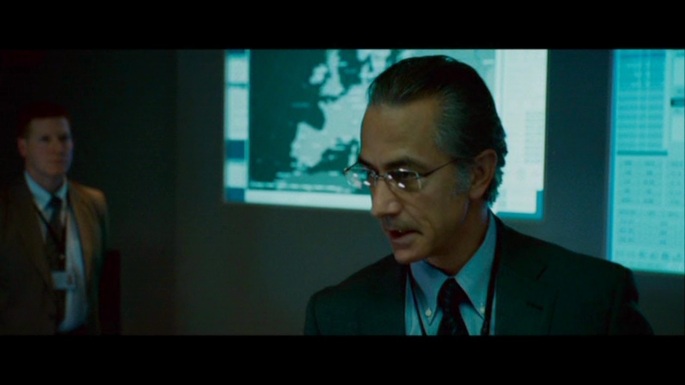
Fortunately, Bourne takes Ross’ notes and figures out that the source is located in Madrid. During the course of his investigation, Bourne is reunited with Nicky Parsons (Julia Stiles), a CIA operative sympathetic to his plight. Within the agency, the man in charge of Blackbriar, CIA Deputy Director Noah Vosen (David Strathairn) wants Bourne dead because he sees him as a dangerous liability while another agent, Pamela Landy (Joan Allen), wants to take him alive because she doesn’t agree with Vosen’s methods. This results in some wonderfully testy bickering between the two actors as they argue over what to do about Bourne. The rest of Ultimatum plays out as a brilliantly staged cat and mouse game with Bourne turning the tables on his handlers.
This time around, David Strathairn is the veteran character actor enlisted to play the CIA honcho tasked to find and eliminate Bourne. Like Chris Cooper (The Bourne Identity) and Brian Cox (The Bourne Supremacy) before him, he has the gravitas to play a take-charge authority figure and part of the enjoyment of this film is watching Bourne constantly thwart Vosen’s plans. In Ultimatum, Landy is a more sympathetic figure as she wants to capture Bourne alive (unlike Vosen). As the film progresses and she learns more about what the United States government did to Bourne and others in Treadstone, she realizes that she can no longer be complicit in the CIA’s illegal activities. Nicky Parsons also undergoes significant development as she ends up helping Bourne and turns out to be a key figure in his past.
Paul Greengrass, who also directed Supremacy, is back behind the camera bringing his trademark, no-nonsense pacing and visceral, hand-held camerawork to Ultimatum. The film’s action sequences are the epitome of edgy intensity as the fight scenes are quick and as brutal as a PG-13 rating will allow. They are realistically depicted – after all, guys as well trained as Bourne don’t waste any time and know exactly how to bring someone down as quickly and as efficiently as possible.
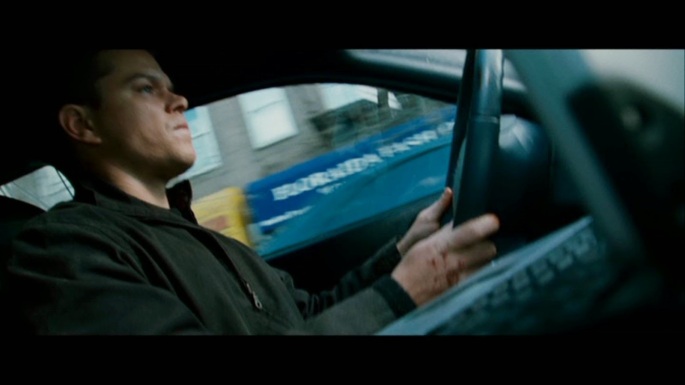
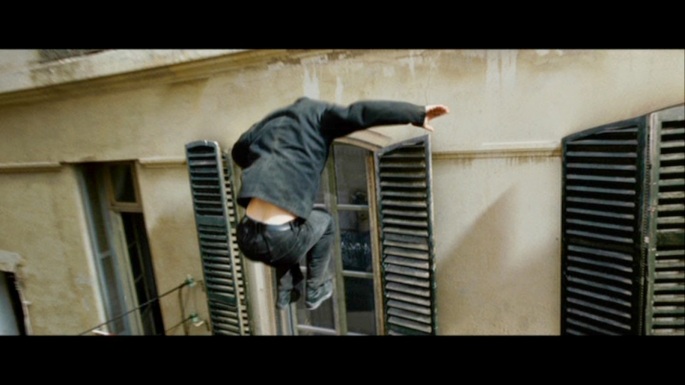
Like with the other Bourne films, Ultimatum also has exciting chases, including the police pursuing Bourne over rooftops in Tangiers while he’s chasing an assassin going after Nicky, and a crazy car chase through the busy streets of New York City. Greengrass and his stunt people upped the ante on the chases, most notably the sequence in Tangiers, which starts off with scooters in the busy streets and then after a car bomb goes off, along rooftops on foot. Greengrass’ kinetic camerawork is taken to the next level as we literally follow Bourne leaping through the air from one building to another.
The lo-tech versus hi-tech dichotomy is beautifully realized in all three Bourne films as symbolized in the way he kills the highly trained assassins sent to kill him. In The Bourne Identity (2002), it’s with a pen, in Supremacy it’s with a rolled up magazine and in Ultimatum it’s with a book. The films never make a big deal about it and even show how well Bourne can manipulate technology, but his best chance at survival is to MacGyver it and stay off the grid.
With the phenomenal success of The Bourne Supremacy, Universal Pictures persuaded screenwriter Tony Gilroy to write the first draft of The Bourne Ultimatum for a significant amount of money, but only under the conditions that he could leave after its completion and that he wouldn’t have to speak with director Paul Greengrass, who was also returning, and did not get along with the writer. According to Damon, “It’s really the studio’s fault for putting themselves in that position. I don’t blame Tony for taking a boatload of money and handing in what he handed in. It’s just that it was unreadable. This is a career-ender.”
After Gilroy left the project and a release date looming, Greengrass brought in four other writers including George Nolfi, Scott Z. Burns, and Tom Stoppard, the latter who said of his input: “Some of the themes are still mine—but I don’t think there’s a single word of mine in the film.” Amazingly, before the film’s release date, Gilroy arbitrated and lost to get sole credit. As a result, the filmmakers were writing the script as they were making the film over three continents in 140 shooting days. According to Damon, “There wasn’t a single day where we didn’t have new pages! The main issue was that a question was never answered: Why was Bourne here? … What Paul settled on was that it has to be a story about meeting his maker.”
The exciting chase through the streets of Tangiers was an homage to Gillo Pontecorvo’s Battle of Algiers (1966). It took 14 days to shoot with Bourne’s rooftop leap done by a stuntman jumping right behind Bourne while carrying a small, lightweight camera. According to second unit director and stunt coordinator Dan Bradley, he often allowed the stunt people to hold the cameras because “they’re not too freaked out about getting hit or sliding under something while holding a camera. Some of the best shots in Supremacy and Ultimatum are because the stunt guys were operating.” Once again, Greengrass applied an independent film aesthetic to a big studio movie budget or, as he put it, “one of the ways you do it is to try your luck and set the action in places where you can’t behave like a big movie … You’re forced to sort of be a bit like a student film and make it up as you go along, live on the land and shoot when people are around.”
If Identity was about our hero escaping from his CIA handlers and Supremacy was about him figuring out why they are still after him, then Ultimatum is all about getting revenge on those responsible for messing up his life in the first place and figuring out, once and for all, his identity. What elevates Ultimatum (and the rest of the series) above, say, the Mission: Impossible movies, is that it is more than just an exciting thriller (although, it does work on that level). It is also has a sharp, political component in the form of a scathing critique of the CIA’s dirty little secrets. The series ultimately asks, what happens when a highly-trained and conditioned government operative questions what he does and why? How does he undo the programming that made him what he is and come to grips with what he’s done? This film answers these questions to a satisfying degree while also being very entertaining conclusion to the series.
ANGELINA JOLIE-PITT’S BY THE SEA — A REVIEW BY NICK CLEMENT

By the Sea was always going to present itself as a challenge to pretty much anyone who encountered it. How could it not? A very personal and artful piece made by the most glamorous Hollywood couple imaginable, with the wife directing and the two magnetic personalities producing and starring, it’s clear that both Angelina Jolie-Pitt and Brad Pitt wanted to do something serious as artists with this Euro-flavored and retro-tinged relationship drama. And even if it didn’t really say anything new for this well-traversed milieu, the exquisite production values, strong performances, and erudite sense of direction by Jolie-Pitt, who definitely proves that she’s a film scholar and admirer of contemplative and provocative items from yesteryear, make this well worth watching. Set off the stunning coast of France and feeling as if it were set in the early 70’s, By the Sea explores a damaged marriage between a mentally fractured wife (Jolie-Pitt), racked with jealousy and suspicion as her drunkard, failed-writer husband (Pitt, with sleazy mustache) has seemingly had some sort of affair of the flesh if not the heart.

They attempt to reconcile at a glorious hotel right along the ocean, and become almost immediately distracted by the alluring couple sharing the room next door, a vivacious pair on their honeymoon (the beyond sexy Melanie Laurent and super-handsome Melvil Poupaud), who are prone to frequent sexual adventure that can be spied upon via a secret hole in the wall. This is a film where sex and intimacy are essentially at the crux of its themes, and in this department, Jolie-Pitt pulled a 70’s and said, hey, they’re just breasts, let’s get some skin on screen, and show some passionate onscreen lovemaking. All of this is captured by the estimable cinematographer Christian Berger (The White Ribbon), who mainly utilized natural light during filming, and was able to capture one radiant and luscious image after another. Ellen Mirojnick’s stylish yet smartly subdued costumes suggested great wealth and taste, rather than empty tackiness. Jon Hutman’s elegant and extra-classy production design seals the entire aesthetic package with a golden bow.

As with any film about infidelity, there comes a point in the narrative where the two emotionally challenged leads must explode, and while this happens to a certain degree in By the Sea, I was surprised by how calm and measured everything was, and how it didn’t resort to easy histrionics in order to make its point. The film explores grief from both sides, and because Pitt’s husband character is so quiet and introverted (and half in the bag or totally wasted), you do wonder at times what he’s thinking, which is a nice thing for the viewer to not have it all spelled out. Pitt has easily become one of the most underrated actors of his generation, continuing to etch one distinctive performance after another. Jolie-Pitt gets to show why she’s one of the most exotic women ever to be filmed by a camera, as she smartly used her real-life persona to create an image in everyone’s head of exactly the sort of tortured soul she was presenting on screen.

And when it comes to their big love scene, while I think it could have been even more bold in terms of the on-screen action, they projected a carnal sense of passion that needed to be explored within the terms of the story. I think what surprised me the most about By the Sea was how sedate it was when compared to the film’s rather morose theatrical trailer which seemed to promise a much more overwrought viewing experience. The ending is also rather surprising given all that’s come before it, and feels almost out of place considering the heavy lifting that had preceded the final beat. Critics had their knives sharpened because that’s what paid movie critics get to do, be snarky and flippant and bitchy, and I think it’s a joke how this movie was treated by its distributing studio, and by the apparent taste-makers who should be discussing a provocative adult drama that actually has something on its mind rather than relegating it to also-ran status.

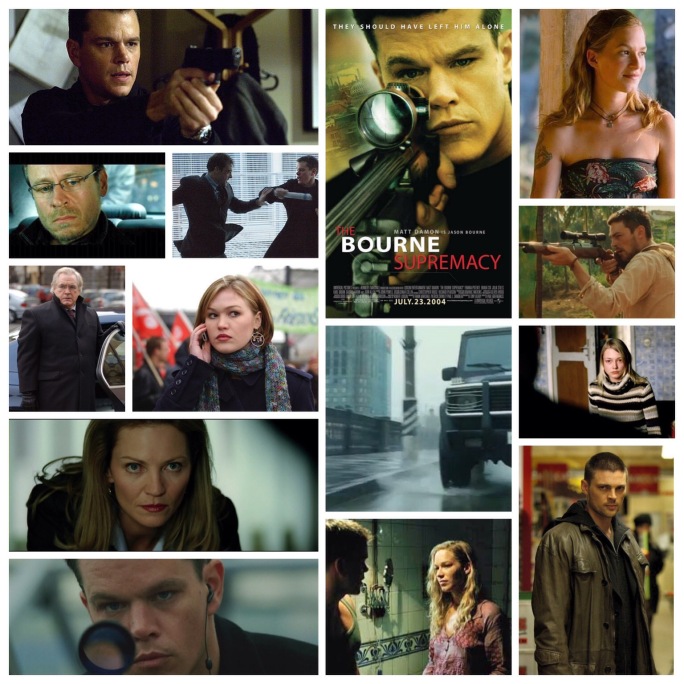
The Bourne Supremacy: A Review by Nate Hill
It’s nearly impossible for me to pick a favourite from the original Bourne trilogy, but I suppose if you held a gun to my head I would have to go for the breathless, breakneck Bourne Supremacy. It’s the first one I ever saw and one of the very first big summer movie experiences of my youth, so I have a burning nostalgia. I wouldn’t base my decision solely on that, though. No, I’ve thought a lot about it, and Supremacy just has every element in pitch perfect place, every second of pacing hurtling by on full throttle and Matt Damon taking names like he never did before. I love the fact that Bourne has something driving him other than a need to know who and what he is this time around. He has revenge for the death of someone he loved, which is never something you want to provoke when you have someone like him gunning for you. Life is quiet for Jason and Marie (Franka Potente 😍) for about five seconds at the beginning of the film, until a highly skilled assassin (a capable, relentless Karl Urban) explodes into their lives, sends their jeep careening off a bridge, resulting in Marie’s death. This pisses Jason off and then some, prompting a global excursion to find out who Urban works for and take them down. Also on his trail is CIA bigwig Pamela Landy (Joan Allen, excellent) and the severely morally misguided Ward Abbott (Brian Cox takes slimy to a whole new level in this outing). There’s also scheming Russian oil magnate Gretkov (a relaxed Karel Roden) with his own reasons for wanting Bourne. As is always the case, Jason is the smartest guy in the room, more so even than those that trained him, and he out thinks, out shoots and outruns them all every step of the way that takes him nearer to his goal. He isn’t simply running scared and confused with no outlet or idea how to use his talents anymore. He’s a lethal asset with emotion and forethought on his side, and he takes no prisoners. Damon is just ridiculously badass, especially in the several furious hand to hand combat scenes he dances through, doling out the smackdown faster than anyone’s reflexes can react. There’s also a humanity to him, burgeoning regret when he learns what Treadstone made him do, and the yearning to set it right, or at least make himself known to the daughter (Oksana Akinshina) of a Russian couple he once murdered. People complain about all the shaky cam, but whatever man, it sure fires up an action sequence and places you right there amid the mayhem of a rattling jeep chase through a Berlin tunnel, a bone splintering man to man with an ex Treadstone operative (Marton Csokas) and more. Julia Stiles is terrifically intense as a girl who used to do the psych evaluations for agents, Chris Cooper briefly returns as Conklin, the devious founder of the program, and watch for Tomas Arana, Corey Johnson, Gabriel Mann and Michelle Monaghan too. Like I said it’s a tricky task to pick a favourite, and on any given day I’d just say I love all three equally. This one just has a bit of an edge on the others in certain spots, and never feels like it bears the curse of the middle chapter. It’s a tightly wound coil of a film that springs into kinetic motion with the force of a piston. I’m curious to see how the new Bourne flick does, but I doubt it’ll come close to the first three, let alone this platinum classic. Cue Moby’s Extreme Ways to play out my review.
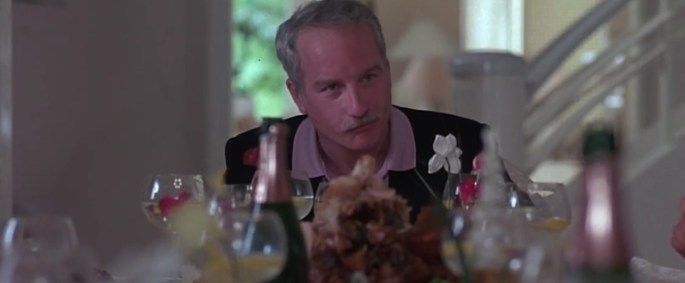
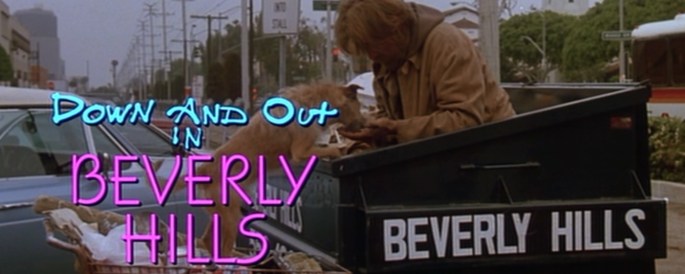
PAUL MAZURSKY’S DOWN & OUT IN BEVERLY HILLS — A REVIEW BY NICK CLEMENT

Almost 30 years later and Paul Mazursky’s incisive and always amusing social-class comedy Down and Out in Beverly Hills still holds up. Mazursky was a filmmaker who was always interested in people and their flaws and what it means to be human in a world that often overlooks people and their problems. I love how the opening credits closely resembled those from Harry & Tonto; Mazursky was a filmmaker in love with people’s faces and the untold stories that they tell. Everyone in the cast was perfect; Nolte as the grizzled homeless man looking for a second chance, Dreyfuss as the angry Richie-Rich who needs something to justify his existence, and Bette Midler as the spoiled wife who just absolutely needs to have a dog psychotherapist visit their family pet. Donald McAlpine’s crisp and clean cinematography kept an appropriately upscale vibe. What people found funny in one generation can sometimes feel stale and incredibly unfunny a few generations later – this is definitely not the case with this timeless gem. Released in late January of 1986, I wonder if the studio thought it would become as big of a hit as it did (it grossed nearly $70 million domestic).

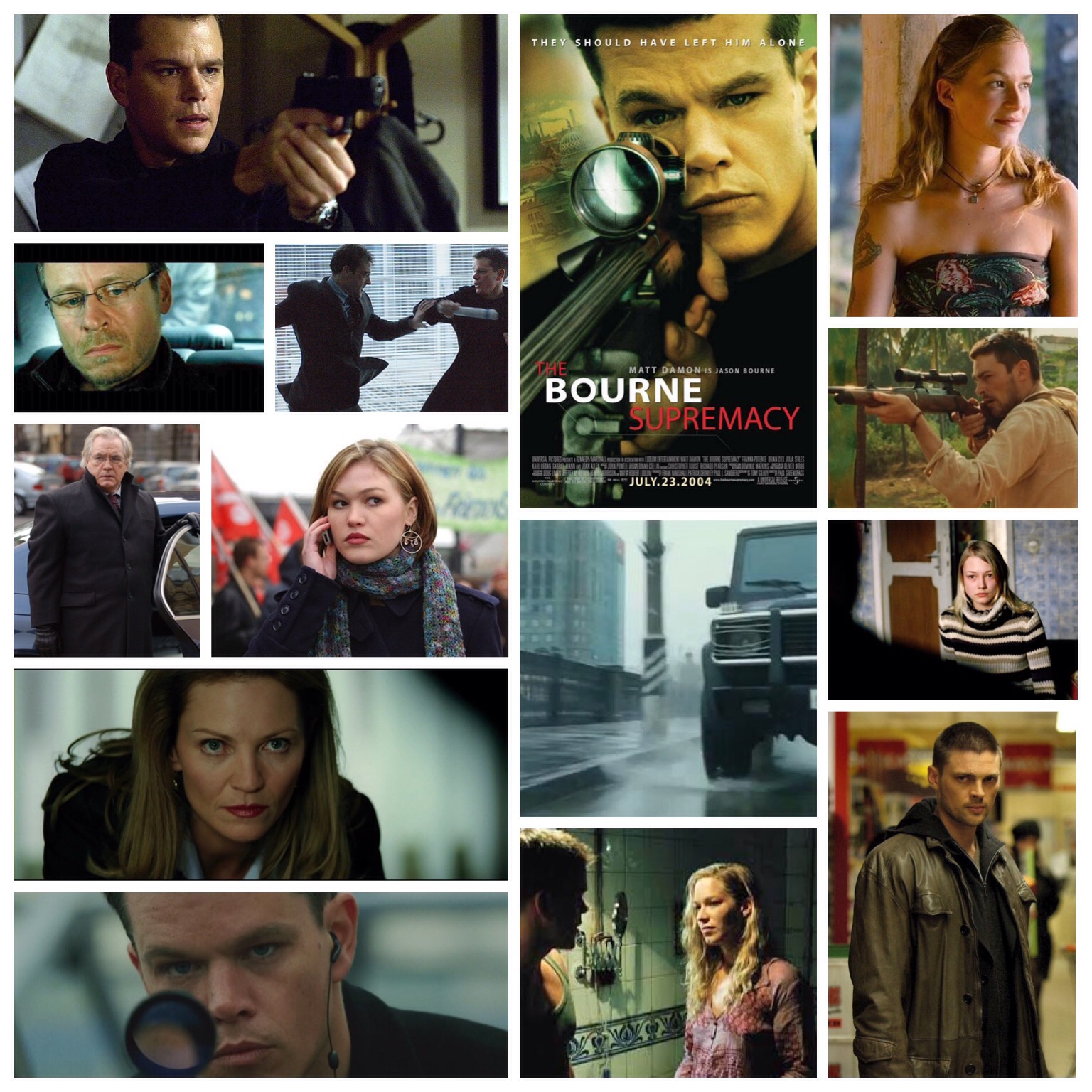
THE BOURNE SUPREMACY – A REVIEW BY J.D. LAFRANCE

After the grueling experience that was making The Bourne Identity (2002), Matt Damon was understandably wary about reprising the role of Jason Bourne. However, the film’s substantial box office success meant that the studio was eager to crank out a sequel and brought their leading man back into the fold with the promise of a new director after Doug Liman managed to alienate almost everyone on the first film. Paul Greengrass, director of the critically-acclaimed Bloody Sunday (2002) came on board, taking up where Liman left off by adopting the same loose, hand-held camerawork and cranking up the intensity, especially with the action sequences, to the detriment of some that felt the herky-jerky movements resulted in motion sickness. Regardless, The Bourne Supremacy (2004) was a hit both critically and commercially, outperforming Identity.
Bourne (Damon) and Marie (Franka Potente) have gone off the grid by taking refuge in India and this gives him time to sort through his fragmented memories and feverish nightmares. But, as is always the case with these kinds of films, our hero can’t stay hidden for long and trouble finds him. Meanwhile, a top-secret government deal in Berlin goes bad. Two agents are assassinated by Russian bad guys who steal $3 million and files that pertain to the whereabouts of Bourne. Greengrass ups the stakes right from the get-go as he has Bourne framed for the agents’ deaths and the stolen money and has an assassin (Karl Urban) track him and Marie down. An exciting car chase ensues that leaves Bourne alone and putting on him on the run again. This makes him dangerous as he has nothing holding him back so he can focus entirely on finding out who wants him dead and sift through the remnants of Operation Treadstone from the first film.
One of the first things that becomes obvious while watching this film is how its look harkens back to 1970s American cinema. Director Paul Greengrass utilizes the gritty, realistic look of his previous film, the powerful Bloody Sunday, with a lot of hand-held camerawork and snap zooms to give a you-are-there rush of adrenaline and urgency to the action sequences. In the car chases, Greengrass often places the camera right in the vehicle so that it is almost like we are riding along with Bourne, trying to piece together his fragmented past. In particular, the first chase in India is like The French Connection (1971) by way of Calcutta. Tony Gilroy’s screenplay wastes no time getting into it. We’re not 15 minutes into the film and Bourne is being chased by a mysterious and ruthless Russian assassin. It is this intense, no-nonsense pacing that propels this film so that one barely notices the two-hour running time.
Matt Damon plays Bourne with a quiet determination and intensity. It’s a surprisingly minimalist performance devoid of self-conscious tics and proves that his performance in the first Bourne film was no fluke. Bourne is not some invincible, super-soldier, but a tortured man trying to rebuild his past and his identity. He doesn’t kill unless absolutely forced to. And yet, he is certainly a man of action, capable of going from an inert, passive figure to one full of explosive action in a heartbeat. Supremacy sheds more light on his past as he’s haunted by a job where he killed a Russian politician and his wife. Damon does a nice job of portraying a man coming to terms with the fact that he is a killer. Bourne also comes to terms with the notion that what was just another mission for him forever changed the life of a young woman who was made an orphan because he killed her parents. It is an important part of the humanizing of Bourne as he sheds his past of being a detached assassin to someone trying to redeem himself. He tracks down people like Nicky Parsons (Julia Stiles), introduced in Identity as a handler to the Treadstone assassins, that can provide him with pieces of his past so that he confronts it and understand what he was in order to change who he is in the present.
The primary bone of contention that critics had with The Bourne Supremacy was how Greengrass films the action sequences. There is an impressively staged fight scene between Bourne and another Operation Treadstone survivor in Munich that is dizzyingly claustrophobic thanks to extensive hand-held camerawork that dives right into the chaos. It is memorable not only for its jarring brutality but also for Bourne’s skill with a rolled-up magazine that he uses to defend himself against a rather large knife. Greengrass’ camera flies around the tight confines of this room, dragging us along for this visceral, almost primal sequence. He treads a fine line between being edgy and incoherent, but knows just how far to push it – something that the countless imitators didn’t always achieve. This approach drew criticism for being too fragmented and disorienting, making it difficult to see what was happening but I think it was Greengrass’ attempt to put the audience right in the middle of the action and to experience the sudden and brutal nature of how quickly these guys fight.
Joan Allen’s Pamela Landy is an interesting character in that initially it appears as if she will be an antagonist like Conklin in The Bourne Identity, but when she’s assigned to investigate the Berlin job she uncovers the existence of Treadstone and this brings her up against Ward Abbott (Brian Cox), the operation’s caretaker and the man who also mothballed it. She’s no dummy and quickly figures out its nature, what Conklin was up to and Bourne’s role, which, in a nicely executed scene, quickly recaps the events of Identity for those who haven’t seen it. Over the course of Supremacy, she shows indications of sympathy towards Bourne’s plight that are developed further in The Bourne Ultimatum (2007). Allen’s scenes with Cox are interesting as they are often fused with tension as Landy uncovers the secrets of Treadstone while Abbott, clearly uncomfortable with his dirty laundry being aired, tries to cover his ass, which makes for some heated exchanges between the two as they butt heads.
The Bourne Supremacy gives more screen-time to the character of Nicky Parsons. Landy brings her along because of what she knows, but Nicky ends up playing a crucial role when Bourne confronts her, asking questions about the operation. Stiles was an up and coming movie star in the late 1990s with films like 10 Things I Hate About You (1999), but had dropped off the mainstream radar by the mid-2000s. It is nice to see her pop up in the Bourne films even if she isn’t give much to do initially.
The Bourne Supremacy was based loosely on the 1986 best-selling novel of the same name by Robert Ludlum. Universal Pictures offered screenwriter Tony Gilroy $3 million to write the screenplay and he agreed, but only if it wasn’t a repeat of The Bourne Identity. Gilroy used a plot point from the novel – Marie is kidnapped and held ransom, forcing Bourne out of hiding – as the impetus for the sequel. The screenwriter came up with the idea of taking Bourne on “what amounts to the samurai’s journey, this journey of atonement,” said producer Frank Marshall. Gilroy didn’t want to make a revenge movie because “Bourne killed people and he doesn’t start the movie with a clean slate. There’s a lot of blood on his hands.” He decided to make Bourne a reluctant murderer and that he should suffer for his crimes. To this end, Gilroy envisioned Supremacy as “The Searchers of action films,” but was upset that Greengrass came in and placed an emphasis on action and not Bourne’s atonement.
Next, the producers had to find a new director that would have an affinity for the subject matter. Gilroy recommended that Marshall watch Bloody Sunday, directed by Paul Greengrass. It was a gritty recreation of the 1972 peaceful civil rights march in Derry, Northern Ireland that ended in violence. The producers were impressed with the film’s immediacy and sense of realism. Greengrass liked The Bourne Identity and how it “married an independent sort of feel with a mainstream Hollywood sensibility.” He flew to Prague and met with actor Matt Damon and they talked about the character of Bourne. Greengrass said of the character: “I think this film is not so much about a man who’s lost his memory, although that is part of it – but it’s more about what happens when you’ve recovered your memory and realized that you’re actually a bad man.”
Damon spent months doing personal and combat training including special firearm instruction in order to portray a trained assassin. The actor worked with a SWAT expert in Los Angeles so that when Bourne first picks up a gun in the film “it needs to look like an extension of his arm,” Damon said. He and Greengrass got along right away with the actor happy to have a director “who was putting you first and saying, ‘Be as natural and real and honest as you can and it’s our job to capture it rather than yours to adjust for the sake of my shot.’ That’s the thing an actor wants to hear.” The actor had no problem doing most of his own stunts, but was apprehensive doing an underwater scene where Bourne’s car goes crashing into a river. “I didn’t want to do that at all,” Damon said and so he worked with a diving instructor a couple times a week for a month in order learn how to relax underwater without an oxygen mask and eventually be able to do simple tasks like tying a shoe. Still, after one day of shooting under water, he “woke up probably four times gasping for breath, thinking I was drowning. It was terrible.”
Principal photography began on the streets of Moscow then moved to Berlin with the city’s former eastern sector doubling for the streets of the Russian capital and finally ending in Goa, India. Producer Patrick Crowley wanted the transition from locations to mirror Bourne’s arc “from lush, tropical and warm to more progressively cool, steely, blue, then finally to grays.” To depict the visceral car chases, the production utilized a high-speed, low center of gravity, chassis replacement stunt driving camera platform that was piloted by a stunt driver from a moveable cockpit, which allowed all kinds of camera placement around the vehicle.
The people behind the Bourne franchise are smart and willing to take chances. They cast an atypical action hero with Matt Damon, surrounded him with an eclectic cast that mixed Hollywood and internationally known stars (with the likes of Julia Stiles, Brian Cox and Karl Urban) and hired independent filmmakers like Doug Liman and Paul Greengrass against type to direct, letting them put their own unique stamp on their respective films. Ultimately, The Bourne Supremacy is all about the title character making amends for his past. There is a scene where he confronts the woman, whose parents he killed, that is rich in understated emotion as Bourne takes responsibility for his actions and tells her what really happened. It’s a great way to end the film as Greengrass eschews the cliché of a climactic action sequence (which happens before this scene) in favor of a more poignant one as Bourne atones for one of his many sins while also setting things up for the next installment.
OLIVER STONE’S NATURAL BORN KILLERS — A REVIEW BY NICK CLEMENT

In August of 1994, Oliver Stone released his defining masterpiece, Natural Born Killers, all across theaters nationwide, to a chorus of controversy. I can remember my father taking me to see it on the big screen at the impressionable age of 14, with my love for film just starting to bud; the impact it made on me would be forever lasting. I had never seen anything remotely like it, and to this day, few films have come close to matching the raw, primal, explosive intensity that it offers. I can remember my mind literally expanding as the images seared themselves into my cerebral cortex, providing me with a glimpse of madness that I couldn’t fully comprehend. It was at that point when I truly realized what a filmmaker could be capable of, and despite the fact that many layers of the story went over my head during that initial screening, over the years through countless viewings, I’ve come to understand what Stone was saying with this anarchic vision of a society gone berserk. The impact it made on modern filmmaking and up-and-coming-filmmakers is as bold and as hugely important as the impact made by Pulp Fiction, with both films being co-authored by Quentin Tarantino, which should tell you something. And to think that Pulp Fiction would be released roughly 6 weeks later – truly mind-boggling!

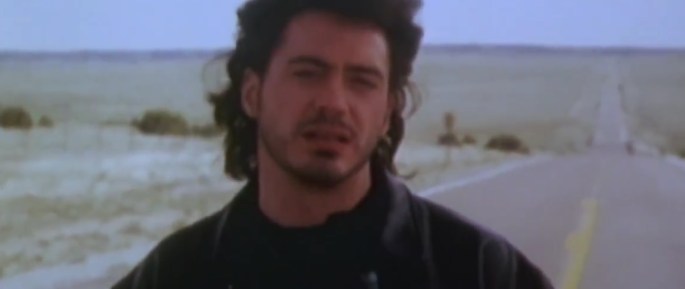
Birthed by the indelible pen of Tarantino and masterfully shaped by Stone and his writing partners David Veloz and Richard Rutowski, Natural Born Killers is a crushing, beyond-angry satire of the media, our culture, television in general, and our collective desire for bloodlust. Taking aim at the then-just-emerging trend of reality TV and 24/7 tabloid crime reporting, Stone and his team utterly destroyed our country’s obsession with criminals and mass-murders, painting a damning portrait of things to come. Woody Harrelson and Juliette Lewis, in career topping performances, are Mickey and Mallory Knox, two mass-murdering lunatics (not without their own set of ideals, naturally) who cut a bloody swath across the country on a Bonnie and Clyde-styled crime spree, while a psychopathic cop, played with demonic glee by Tom Sizemore, gives pursuit. Once captured, Mickey and Mallory incite a prison riot inside of warden-from-hell Tommy Lee Jones’s maximum security facility, and kidnap a morally bankrupt Geraldo Rivera-esque crime-TV reporter named Wayne Gayle (the utterly amazing Robert Downey Jr. at his slimy, faux-Aussie best) as they videotape their insanely violent escape. That’s a general story description, but like the best of gonzo-outlaw cinema, the plot is just a clothesline for the unique artistic expression on the part of the filmmakers, and it’s in this film that Stone went truly nuts as a signature storyteller.

Working with the legendary cinematographer Robert Richardson, the film has a hyperventilating and excessively stylized visual aesthetic, implementing 35mm, 16mm, 8mm, black and white, animation, various lens distortions, off-key filters, and expressive lighting patterns that give the entire film a purposefully ragged vibe in an effort to create maximum visceral impact. The audience is kept off balance all throughout the movie, the pace hurtling forward like a freight train, with flashbacks, flash-forwards, flights of fancy, and moments of extreme bloody violence that all add up to what might be considered hallucinatory, fever-dream cinema. Hank Corwin and Brian Berdan’s in-your-face editing went for the jugular at all times, yet everything remained coherent amidst the narrative insanity. The soundtrack is also an all-timer, filled with offbeat and inspired musical cuts to go along with the aggressive rock and roll underpinnings. It’s easy to state that a film like Natural Born Killers will never, ever get made again; it was the textbook definition of “lightning in a bottle,” ahead of its time in so many ways, the perfect combination of a filmmaker armed with perfect subject matter and a society at the exact place in its history ready to be skewered into oblivion. As Roger Ebert said in one of his numerous articles on this most important motion picture, “Seeing this movie once is not enough.”

A Batman V Superman review by Josh Hains
I haven’t received a single payment from Disney for my criticisms of Batman V Superman over the last four months. Cough up a buck already Disney, I’m waiting! But wait a minute, Warner Bros hasn’t paid me for my criticisms of Avengers: Age Of Ultron either! Where’s my damn money? I’m mad as hell, and I’m not going to take this anymore!
Before I go any further, I am a HUGE lifelong fan of comic books, both DC and Marvel alike, and I don’t prefer one over the other. Marvel has more movies, comics, and characters in their respective universes, so I’ve been exposed to more of their content and therefore have a tendency to lean toward Marvel. That being said, Batman and Superman are my first two favourite comic book characters in a top ten roster, and the first comic book I ever read was Batman (I still have the comic), so it’s not like Marvel completely dominates my love for comics, even if my favourite comic book movie is Guardians Of The Galaxy. No preferential treatment here, and besides, I like this movie.
Somewhere in my mind is a long, long review of this movie that eclipses four or even five thousand words and feels as long as the Director’s Cut of BVS (for my own sake I’ll refer to it as BVS from this point forward). I could go on for far too long about all the various plot issues I have found in this movie, but I don’t want to do that. That would bore me writing it as much as it would bore you reading it. Over the last few months, I’ve been able to watch and read all kinds of arguments for and against this movie, and had plenty of conversations myself with like minded individuals who share similar and opposing opinions. The more I watch, read, or talk BVS, the more flaws come to light, most of which are script level. This Director’s Cut seemed to rectify a lot of editing issues, so I won’t traverse that territory. I do however want to want paint a clear picture of my two main issues with the movie.
Nothing that has been said in the last four months can sway me to believe that Jesse Eisenberg was the right choice for Lex Luthor, and I do mean nothing. When you take into consideration that Bryan Cranston wanted to play Luthor, and even BVS’s director Zack Snyder admits that Cranston would have been an awesome choice, it’s nearly impossible to not watch this movie and picture the better actor delivering those lines. The Lex Luthor I grew up with in the pages of my Superman comics collection, or in cartoons or the classic Superman movie, was always a formidable opponent for Superman. He was built like Superman or Bruce Wayne, and had that entrepreneurial sensibility and the luxuries of a billionaire. He was what one could imagine an evil Bruce Wayne to be. That is not the Lex Luthor we see in BVS. The Lex Luthor in BVS lacks the immediate intimidating presence of the Luthor I grew up with. Instead we’re treated to a a socially neutered, twitchy geek who likes stuffing Jolly Ranchers into the mouths of government officials. Weird. Not once did I ever think he could fight Superman, or that he could outwit or outsmart Bruce Wayne. Not once did I find his behaviour unpredictable and ferocious, intimidating, powerful, and fearsome. He was just a whiny, thinly constructed way to bring the real heavy, Doomsday, to life. Yes, he does look like a steroid enhanced troll from Lord Of The Rings, but that dude was more than a match for three heroes. This Luthor never could be.
My other major critique is that the movie as a whole is bloated, and unnecessarily long in order to intentionally overstuff the narrative of the movie to allow for various subplots, most of which are also unnecessary. In the theatrical cut of the movie, many plot threads were left hanging because of continuous smash cuts that abruptly ended, and some footage that actually enhances the movie was brought back in for this Director’s Cut.
The new footage surrounding Bruce Wayne/Batman, actually contributes to the emotional impact of his storyline, as well as enhances the action sequences. The warehouse fight is even more brutal and cool to watch than ever before. Actually, nearly everything that has Batman or Bruce Wayne in this movie is pretty awesome stuff. I know some people were turned off by his murderous side, but clearly they’ve never read The Dark Knight Returns from which entire scenes were lifted and implanted into this movie. This is unmistakably the best live action representation of Bruce Wayne and Batman to date.
That being said, while the new footage ties up some of the loose ends, it not only leaves plenty left, but also creates more at the same time, and all of it is still incredibly unnecessary, and actually does very little to propel the story forward. You can argue against that and tell me I’m wrong all you like, but let me provide a strong example of what I’m alluding to first. Diana Prince casually pops up a few times over the course of two and half hours or longer, shoved in the background because Warner Bros needed to shoehorn this character into this movie to set-up Justice League. However, the extended game of cat and mouse she and Bruce play does absolutely nothing to propel the story of this movie forward. Their interactions easily could have been removed in favour of something that would actually contribute to the movie, like five extra minutes of the titular fight, rather than serving the Warner Bros agenda of Justice League setup. You can keep the actual Wonder Woman fight scene footage which was pretty badass stuff. Given that Warner Bros is setting up Justice League in this movie, it makes sense that they work in reference to other metahumans who we all know will later become League members. The addition of a scene where Bruce sends vital information showing off captured footage of these metahumans to Diana via email is embarrassingly stupid. I still can’t believe someone was paid millions to write that, but for a better writer it’s easily fixable.
Don’t even get me started on the Martha connection.
Aside from these issues that I can’t overlook, I still love this movie. It looks and sounds amazing, the cast is all fantastic with the exception of Eisenberg, the action is as slick and involving as ever, especially in 3D, and we’ve been given the best film Batman and Bruce Wayne to date, which is something to be proud of.
Somewhere in this bloated runtime and narrative indulgence is a two hour long movie that contains all of the incredible Bruce Wayne/Batman footage we saw in BVS, and smarter, refined, and involving material featuring Superman. A movie that has the same thought provoking idealism of controlling the uncontrollable as in Captain America Civil War, because the fear and worry of the destructive power of Superman keeps men like Bruce Wayne awake at night. A movie that chooses to build on the relationship between Superman and the public, and Clark and Lois. A movie that doesn’t need Lex Luthor’s boring evil plan to pit our heroes against each other. A movie that makes us believe that Batman and Superman are at odds, that bring them together for reasons that feel authentic to their dislike for each other. A movie with a titanic fight scene between Batman and Superman that lasts longer than eight minutes, that isn’t apocalypse porn and all CGI, and is so cool, so stylish, so powerful and resonant, it would make the battle that ends The Avengers weak in the knees. A movie that is about the triumph of good over evil, of light over darkness. The movie we all paid for and still haven’t gotten. It’s no masterpiece what we were given, but it’s not granny’s peach tea either.
It’ll do until Justice League gets here, and hopefully exceeds expectations.
Doom: A Review by Nate Hill
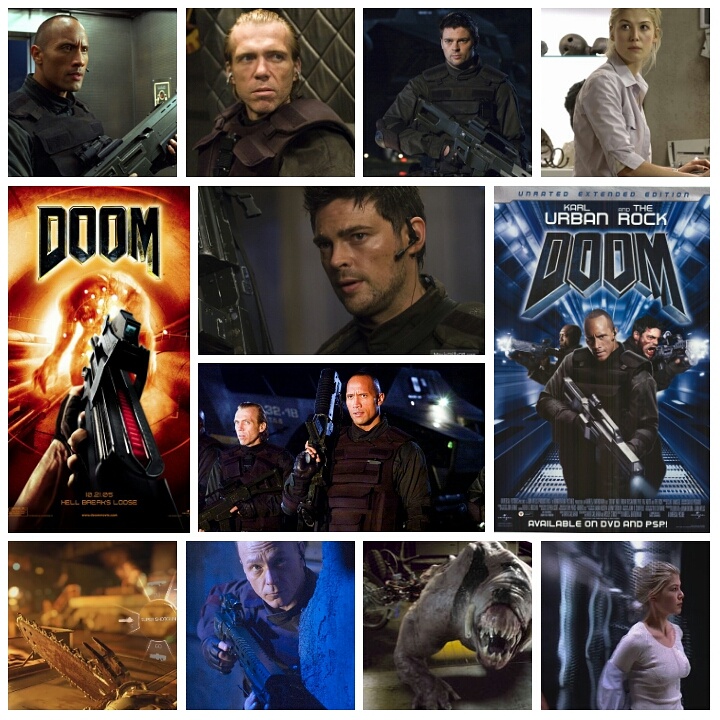
Despite not having a whole lot to do with the video games, Doom is still a rush of schlock and awe silliness, getting more fun and ridiculous in equal amounts near it’s nonsensical ending. Karl Urban and The Rock are the tough guys for the job when it comes to scoping out a Martian research base that’s accidentally opened up a portal to hell, unleashing all kinds of lovely things. Rock is Sarge, stoic commander of this unit, and Urban is John Grimm (he lives up to his last name) a battle scarred badass who has personal stake in fighting these monsters. His sister (Rosamund Pike) is a scientist on the base, and is now in a great deal of danger. After a neat Google Earth type zoom in on the Martian surface (ironically the only shot in the film that suggests they’re even on the red planet), it’s off to dank corridors, vast bunkers and beeping control panels, an Aliens-esgue siege on horrors of the dark that quickly goes sideways on them. It’s run of the mill stuff save for one stroke of brilliance: a pulse racing first person shooter sequence that showcases a POV of Urban shooting, slashing and chain-sawing his way through alien flesh. It’s a bold move that pays off immensely and is quite fun. The rest of their team is forgettable except for Richard Brake as Portman, the loudmouth A Hole of the bunch, a refreshingly animated performance in a roomful of muted, grim characters. The monster from the game shows up, a hulking hell pig nicknamed Pinky that tirades it’s way through everything until Urban gives it what for. This ain’t no great flick, but as far as video game movies go, you could do way worse. There’s definitely enough gore for the hounds, and it’s adequately stylish in presentation.
THE BOURNE IDENTITY – A REVIEW BY J.D. LAFRANCE

When The Bourne Identity (2002) debuted in theaters, audiences were hungry for a new kind of spy film. The James Bond movies adhered to a tried and true formula and it had gotten old. Mission: Impossible II (2000) collapsed under John Woo’s stylistic excesses and a boring love story with no chemistry between Tom Cruise and his love interest played by Thandie Newton. The world had changed dramatically since the events of 9/11 and a new international espionage action thriller would have to acknowledge this new reality. Along came The Bourne Identity, a very loose adaptation of Robert Ludlum’s novel of the same name and it connected with audiences even if most critics hated it.
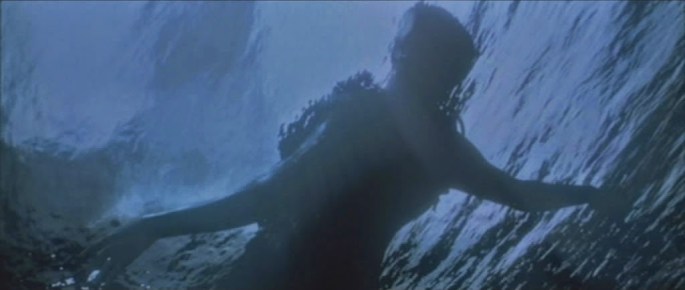
A mysterious, unconscious body is found floating out at sea by a boatload of fishermen. Two bullets in his back and a device that stores a Swiss bank account are found embedded in his hip. He wakes up with amnesia and one of the men onboard fixes him up. It isn’t until almost five minutes in that the first bit of understandable dialogue is uttered. Up to that point director Doug Liman drops us into this strange world without any set up so that we are disoriented, much like the film’s protagonist and therefore we identify and empathize with him almost instantly. These first few scenes establish the film’s style – constantly moving camerawork often with jarring, jerky movements that mimic our hero’s disorientation.
After two weeks at sea, he makes his way to land and begins a quest to uncover his identity. Over time, he discovers skills he didn’t know he had but that come out instinctively, like the ability to disable two armed police officers with his bare hands in Switzerland. He checks out his Swiss bank account and discovers that his name is Jason Bourne (Matt Damon). The safety deposit box contains money, passports for several different countries, and a gun. It becomes obvious that Bourne assembled this stash of supplies in case of a situation like the one he’s currently experiencing.
After a daring escape from the United States embassy, Bourne pays a young German woman named Marie (Franka Potente) to drive him to Paris where he apparently lives. It turns out that he’s some kind of lethal, CIA-trained assassin who has something to do with a top-secret operation known as Treadstone and he should be dead. It seems that the United States government is trying to silence an exiled Nigerian dictator by the name of Nykwana Wombosi (Adewale Akinnuoye-Aghaje) now living in Paris. He wants the CIA to put him back in power in six months or he’ll blow the whistle on their attempt to assassinate him. The man in charge of Treadstone – Alexander Conklin (Chris Cooper) – wants to make sure Bourne is dead because he was supposed to kill Wombosi when something went wrong. He sends three other assassins after Bourne and Marie.
Because Bourne suffers from amnesia and is being hunted by a secret branch of the CIA, we sympathize with his plight. It doesn’t hurt that he’s portrayed by Matt Damon who comes across as instantly likable and empathetic. Before The Bourne Identity, he was not regarded as an action star and so his capacity for sudden bursts of ruthlessly efficient violence and the ability to escape from several dangerous situations was a revelation. Damon pulls it off and more importantly is convincing as a deadly assassin with no memory. He is nothing short of a revelation as Bourne and the actor does an excellent job of not only gaining our sympathy early on, but also maintaining it throughout as we root for Bourne to figure out who he is.
When Bourne breaks out his martial arts for the first time in the film we are as surprised as he is and not just because it’s the first time we’ve seen him do so, but at the time Damon had never done a film like this before and it was his debut as a man of action. To his credit, he looks very adept and comfortable in the fight scenes and doing the stunts. The first substantial fight sequence where Bourne is attacked by a fellow Treadstone assassin is a visceral set piece as he uses everyday objects like a pen to defend himself. This is not the clean, polished style of Bond movies, but down and dirty fighting that looks bloody and painful. It has a personal vibe to it as the fight takes place up close and personal in an apartment. I like that the film shows Marie’s reaction to what has just happened. She is genuinely shocked and upset at the sudden outburst of violence she witnessed. As she and Bourne flee the scene she even throws up as a reaction to being in real danger.
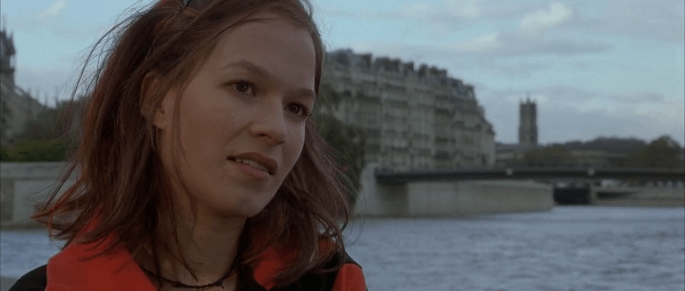
The casting of Franka Potente as Bourne’s love interest is an intriguing choice. She doesn’t have the supermodel looks associated with the Bond girls. She’s beautiful with a nice smile and an easy-going charm. She’s relatable and grounded – part of the film’s realistic aesthetic. Marie is an everyday person thrust into extraordinary circumstances once she encounters Bourne. Potente also brings a certain amount of international cinema cache thanks to her breakout performance in Run Lola Run (1998). As a result, she doesn’t come across as some damsel in distress, but a proactive foil for Bourne. They quickly develop an easy rapport as he finds her constant, nervous talking comforting. Damon and Potente play well off each other in these early scenes as her character humanizes Bourne so that he’s not just some inhuman killing machine.
Chris Cooper is ideally cast as the no-nonsense bureaucrat Conklin who knows more than Bourne and yet is always one step behind in finding and catching the elusive assassin. He isn’t given much to do, but makes the most of his limited screen-time as he orchestrates the search for Bourne with considerable technological resources at his disposal. Cooper exudes just the right amount of uptight malevolence that we’ve come to expect from a Republican-controlled government. A young Clive Owen shows up as a Treadstone assassin who methodically tracks and then kills his targets. His showdown with Bourne in a field of tall grass is a tension-filled sequence as our hero uses misdirection to get the drop on the assassin, neutralizing him, but not before he imparts crucial information about Bourne’s past.
One of the reasons that The Bourne Identity was such a game changer for the spy movie genre came as a result of taking the hi-tech surveillance used in movies like Enemy of the State (1998) and updated it on a global scale as Conklin and his room full of I.T. specialists (including character actor extraordinaire Walton Goggins in a small role) track Bourne’s movements in Europe. Everyone leaves electronic footprints be it through credit card use or being picked up on security cameras and this was even more prevalent after 9/11. This heightened sense of surveillance has become a part of our daily lives. There is a certain delicious irony at work as Liman crosscuts between Conklin and his staff using sophisticated technology to find two people who are doing their best to stay off the grid, which results in them taking refuge in a house in the French countryside.
I like that Liman shows Bourne and Marie actually trying figure out his identity by doing the legwork involved as they call potential leads on the phone, visit key locations and talk to people as they try to put together the jigsaw puzzle that is his past. There’s a nice sequence where Bourne walks Marie through a task that he needs her to do for him. As she makes her way through a hotel lobby his words play through her head and we hear them over the soundtrack in voiceover narration.
At the time of its release, much was made of the chaotic production that pitted indie director Doug Liman and against Universal Pictures. Their dirty laundry was aired in the mainstream press and there was speculation that The Bourne Identity was going to be a box office failure. After the critical and commercial success of Go (1999), Liman decided to pursue his passion project – an adaptation of Robert Ludlum’s The Bourne Identity, a book he loved while growing up. It had been published in 1980 and featured an ex-foreign-service officer on the CIA’s hit list. Liman read it again while making Swingers (1996) and found that the characters still engaged him. He inquired about the film rights and found that Warner Bros. controlled them. Over time, the rights expired and Liman met Ludlum at his home in Montana, securing the rights. In 2000, Liman asked screenwriter Tony Gilroy if he would rewrite the screenplay he had for The Bourne Identity. After the success of The Devil’s Advocate (1997), Gilroy had gotten a reputation for saving damaged scripts.
Gilroy was not thrilled with the source material: “Those works were never meant to be filmed. They weren’t about human behavior. They were about running to airports.” Liman persuaded Gilroy to read the script, which he realized was “awful,” but they met and the latter asked the former why he wanted to make this film. Gilroy declined Liman’s offer, but when pressed gave him a suggestion: toss the novel and keep the idea of an assassin with amnesia. “You only have one way to find out … What do I know how to do? I guess your movie should be about a guy who finds the only thing he knows how to do is kill people.”
Liman eventually wore Gilroy down and he agreed to work on the script. While the first five minutes of the film comes from Ludlum’s book everything after Bourne gets off the boat was created by Gilroy. At the time, Matt Damon wanted to “try an action movie … exactly the way I’d love to do it, with someone who was thinking outside the box. Doug being Doug, this would be an interesting movie.” He agreed to do the film after meeting Liman and reading Gilroy’s script.
Liman took the project to Universal Pictures in the first place because “it was just as important to them as it was to me to make this a character-driven movie and not just a generic action movie.” By his own admission, the director was mistrustful of studio decisions like their suggestion that he shoot in Montreal instead of Paris to keep costs down. He argued that the Canadian city didn’t look like the City of Lights and the studio relented. Liman applied his often chaotic, unpredictable style of filmmaking to a big budget studio film with mixed results, often angering the producers. For example, once in Paris, he hired a crew that didn’t speak English (so he could practice his French).
When Damon arrived he didn’t like the changes made to the script after the one that made him sign on in the first place. Liman had brought in David Self (Thirteen Days) to fix what he felt was a problematic third act when Gilroy left to write Proof of Life (2000). Some of the character-driven material had been removed in favor of bigger action sequences. According to Damon, Self “went to the book and did a page-one rewrite. Every few pages, something blew up … It was not the movie I agreed to do.” Editor Saar Klein remembers, “We went into production with a script that was just a mess.” Liman agreed and Gilroy came back after finishing Proof of Life to write new scenes and fax them from New York City to Paris.
Producer Richard Gladstein left the production because his wife was going through a difficult pregnancy. Universal did not want Liman filming unsupervised in Europe and brought in veteran producer Frank Marshall who had known the director since he was a child. The studio felt that Liman’s approach was unorganized and unnecessarily costly. He responded by saying, “I like to keep my options open. I’m known for changing my mind.” The studio also felt that he lacked maturity. For example, one night Liman paid the crew overtime to light a forest for him to play paintball. Liman claimed that the studio hated him and they tried to shut him down: “The producers were the bad guys.”
It got so bad between Liman and the studio that they rejected anything he said. The director ended up using Damon as his surrogate, but this only worked for a short time. One day, Liman realized he’d missed a shot and asked the producers if he could redo the scene. They said no and so he loaded four minutes of film in a camera and reshot the scene himself, which infuriated the producers. This resulted in a giant screaming match on the set. At one point, Liman even toyed with auctioning off his director’s credit on eBay. Despite all the friction between Liman and the studio the end result speaks for itself. The Bourne Identity was a commercial hit, but the studio had not surprisingly soured on Liman and banned him from directing the sequels. “I lost my baby,” he said.
The Bourne Identity was shown to a test audience who liked it, but wanted more action at the end. After much debate with the studio, Liman and Gilroy devised a new action sequence. The screenwriter did not enjoy the experience of working with Liman finding that the director “didn’t have any sense of story, or cause and effect.” Liman found Gilroy “arrogant” and at one point attempted to hire a new screenwriter until Damon threatened to quit if his script wasn’t used. Gilroy saw a rough cut during post-production and was worried that the film wasn’t going to be good. It had come out a year late and went through four rounds of reshoots. He tried to take his credit off the film and arbitrated against himself. He wanted to share credit (and blame) with someone else. After all the dust had settled the film went over budget by $8 million and two weeks over schedule. This forced Universal to move the original release date of September 2001 to February 2002 only to push it back again to May 31 and finally settling on June 14.
What separates The Bourne Identity from the Bond films at the time is that it took the international espionage thriller and personalized it. For the most part, the adventures that Bond had in his movies never affected him personally (the notable exception being License to Kill and now the Daniel Craig films) while in The Bourne Identity it is very personal, but without sacrificing all the things we’ve come to expect from a spy movie: exotic locales, exciting car chases, lethal bad guys, and intense fight scenes. What made the film such a breath of fresh air was how it tweaked these tried and true conventions.
At its heart, The Bourne Identity is a mystery as Bourne tries to figure out who he is and why there are people trying to kill him. This gives Liman the opportunity to ratchet up the tension as Bourne is constantly looking over his shoulder, never able to rest for too long and unable to trust anyone except for Marie. Known previously for character-driven independent films Swingers and Go, Liman showed his adeptness at working in multiple genres by bringing his trademark loose, almost improvisational approach that breathed new life into the spy genre. It had become safe and predictable and it took an outsider like Liman and casting against type with Damon to shake things up. Without The Bourne Identity, Casino Royale (2006) would have been a very different film and the subsequent Daniel Craig Bond films wouldn’t be as gritty and substantial as they are.