
I’ve been ragging a lot on Cuba Gooding Jr. The past few reviews, so I’ll go easy and speak about a good one instead. Wrong Turn At Tahoe has a script that should have been given the royal treatment; it’s wise, brutal, thought provoking and very violent, with many sets of morals clashing against each other in true crime genre style. It didn’t get a huge budget or a lot of marketing, but what it did get was a renakably good cast of actors who really give the written word it’s justice, telling a age old story dangerous people who inhabit the crime ridden frays of both society and cinema. Cuba plays Joshua, a low level mafia enforcer who works for Vincent (Miguel Ferrer), a ruthless mid level mobster who runs his operations with an OCD iron fist. He also rescued Joshua from a crack house when he was a young’in, forging a father son bond that runs deeper than terms of employment. When a weaselly informant tells them that local drug runner Frankie Tahoe (Noel Gugliemi, reliably scary) has it in for them, Vincent brashly retaliates first by viciously killing him. That’s where the shit starts to get deep. Frankie was an employee of Nino (Harvey Keitel) that most powerful crime boss on the west coast and not a man to cross. Nino Wants hefty payment for the loss of Frankie, who was a good operative. Vincent, being the proud and belligerent son of a bitch that he is, bluntly refuses. So begins a bloody, near Shakespearean gang war in which both sides rack up heavy losses and the phrase ‘crime doesn’t pay’ collects it’s due. All parties were inevitably headed to a bitter end whether or not the Tahoe incident occurred, and I think the writer simply used that inciting incident as an example of many ways in which a life like that will always end up at a dead end. The writing is superb, especially for Gooding, Keitel and Ferrer, a vicious triangle indeed, all at the top of their game and then some. Johnny Messner is great as Gooding’s cohort who can’t keep his mouth shit, and watch for Mike Starr, Leonor Varela, Paul Sampson and Louis Mandylor too. Dark deeds, unexpected betrayal, self destructive ego, combustible machismo and ironic twists of fate are explored here in a script the remains as one of my favourite of that year. Really excellent stuff.
The Last Rites Of Joe May: A Review by Nate Hill

The Last Rites of Joe May is Dennis Farina’s bittersweet swan song, his final exodus from a long, epic and beloved career, showcasing the actor in the role he was always meant to play, and a lead role no less. He did a few other films after this one and a priceless cameo on Family Guy, but this is the spiritual final entry, and when you look at the story of the film, it’s both eerie and fateful that the man would go on to pass away just a few years later. He plays Joe May here, a Chicago wiseguy and short money hustler who has been in the hospital with pneumonia for almost a year. Upon returning to his borough, he finds his apartment rented out to a woman (Jamie Anne Allman) and her daughter (Meredith Droeger), all his belongings sold, and his presence pretty much forgotten, with some even under the belief that he has died. The woman takes pity on him and let’s him stay in his apartment with them if he helps her out, and he goes back to the same hustling, or at least tries too. All his ventures have gone dry, his former boss (a splendid Gary Cole) giving the cold shoulder. Joe starts to realize that one must face the eventual consequences of a life lived in selfishness and foolhardy actions, as he finds himself alone in the world and shunned even by his own son. He gets a shot at redemption upon having the little girl in his life, and being there to help out her mother who has one lowlife monster of a boyfriend that just happens to be a cop. Farina is sensational in every scene, and it’s a shame the guy didn’t ever get more lead roles. He makes Joe a grim yet sympathetic being who serves as a sorrowful reminder of how we all will arrive at the end of our road someday, and how important it is to line said road with good deeds, kindness, respect and worthwhile ventures, even if they only show up in the last few miles of it. This is a Tribeca festival film so it’s tough to find, but anyone with a love for Farina or simple, well told and emotional stories should definitely check it out. The beautiful piano score adds to the loneliness of Joe and his state of mind, as does Farina’s performance which a a gift to filmgoers and contains see of the hardest work and piercing truth I’ve ever seen from the guy. RIP.
MICHAEL BAY’S 13 HOURS — A REVIEW BY NICK CLEMENT

Michael Bay is back. Potentially forever lost to giant toy movies (which certainly have all had their moments of gee-whiz visual insanity), he’s stepped up and made an uncompromising modern combat film with 13 Hours. Smartly avoiding any overt political specifying or sketchy speculation, Chuck Hogan’s battle-ready screenplay, based on Mitchell Zuckoff’s book, is all forward momentum, focusing on the harrowing and desperate efforts of six American private military contractors who leapt into action when a United States diplomatic compound in Benghazi was attacked by terrorist insurgents on September 11, 2012. Captured with Bay’s always spectacular sense of bravado, heroics and adventure, this is a grab you by the throat action picture, violent and sad and upsetting, never diluted by extraneous side plots or unnecessary digressions, all made more robust by the surprisingly thoughtful contextualization of the enemy and the local people of the area. The extra-macho cast includes the movie stealing James Badge Dale who completely dominates with a tough as nails performance, a surprisingly effective John Krasinski, the terrific Pablo Schreiber, Max Martini, Toby Stephens, David Denman, Dominic Fumusa, Freddie Stroma, and Alexia Barlier. The opening act and closing moments might’ve been a bit tighter, and some of the spoken dialogue is a tad corny in spots, but these are very minor quibbles, as this was a movie designed for maximum sensory force and extreme visceral impact, made by a filmmaker who seemed liberated to be working in a more decidedly adult arena.

Dion Beebe’s powerhouse cinematography is nearly hallucinatory at times, conjuring up images that are absolutely tremendous, while emphasizing spatial geography in nearly every instance, putting you smack-dab in the middle of one ferocious fire-fight after another with striking clarity. You’ve seen plenty of war films but not one done by Bay in this particular fashion, and it’s clear that he took notes from Black Hawk Down and Lone Survivor and other recent genre entries that have demonstrated a single-minded obsession of detailing bloody, terrifying sequences of wartime violence. The lucid and precise editing by master cutter Pietro Scalia (Black Hawk Down) only further ratcheted up the suspense, dread, and excitement. Lorne Balfe’s on-edge musical score highlights triumph where needed but mostly uses somber, almost mournful ambient sounds to give the film an added sonic pulse. One set-piece in particular, featuring a group of mercenaries taking refuge in a heavily armored Mercedes SUV that comes under fire from every direction, ranks as some of the best on-screen firepower that Bay has ever delivered, to say nothing of the overwhelming final blasts of rooftop fighting, with one particular on-screen injury ranking as one of the gnarliest I’ve seen. And that’s saying something. I’ve always been a fan of Bay’s distinct brand of visual mania, and this is the hardcore action picture I’ve been waiting to see from him for a very, very long time.

X-MEN: APOCALYPSE – A Review by Frank Mengarelli
X-MEN APOCALYPSE completely forgoes and abandons the immense promise we were given with DAYS OF FUTURE PAST. The entire film is a bloated and dull calamity. It is misguided at every turn. The direction, poor writing, and uninspired performances lead us to yet another third X-Men film that unintentionally tries it’s hardest at undoing the smart entertainment from its former two films.

The setup, is yet another rehash of the idealist Professor X uniting with his former best friend and now arch nemesis, Magneto, to save humanity from yet another unstoppable force. There is little to like about this film. Evan Peters as Quicksilver is the best part, but even his slow-motion scenes become a mundane walk-through. Hugh Jackman shows up in a forced and out of place cameo that leaves you wishing he wasn’t even in the film.
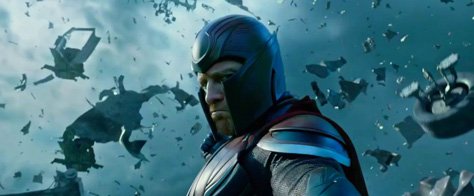
Unlike the previous two X-Men prequel films where each story capitalized on it’s time period, APOCALYPSE does absolutely nothing to remind us that this film takes place in the 80’s aside from Jean Grey having shoulder pads and a trio of them seeing RETURN OF THE JEDI. There is not any character progression for an of the existing characters, or any of the new ones. They just exist.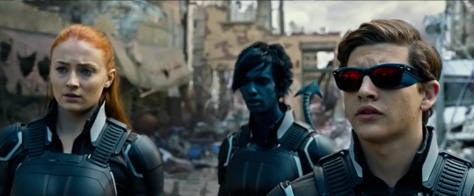
FIRST CLASS wasn’t a great film, but it built a solid foundation for the epic and remarkable DAYS OF FUTURE PAST that brilliantly and organically rebooted the entire X-Men franchise. This new film completely squanders the fresh start we were promised. I loved DAYS OF FUTURE PAST, but pertaining to X-MEN APOCALYPSE, there ain’t nothing good about this shit at all.
Chattahoochee: A Review by Nate Hill

Chattahoochee tells the sad and disturbing tale of Emmett Foley (Gary Oldman) a Korean War veteran who has returned home with severe PTSD. In a tragic and scary sequence, he shoots up his neighborhood in confusion and fear, injuring himself in the process. He is then sent to a ‘maximum security’ mental facility, and anyone who has heard what places like that were like in the 1950’s cam imagine what he’s in for next. The place is an unkempt, filthy sinkhole where the inmates are abused, neglected and subjected to inhuman maltreatment. So now, in addition to dealing with his mental illness, Emmet must witness this miscarriage of medical treatment on a daily basis, and suffer through it himself. He is befriended by deceptively cavalier Walker Benson (a funny and touching Dennis Hopper), and the two of them try to seek out better treatment and conditions for their fellow inmates. Only problem is, the beauricratic faction doesn’t want to hear any of this, stone walling and throwing it in their faces with callous indifference. It becomes the struggle of Emmet’s lifetime to win the day against this rotten system, and he’s aided by his sister (Frances Mcdormand) in his efforts. Oldman is as intense as you’d imagine with subject matter like this, an implosive tsunami of dread and outrage as he both bears witness and cries out in protest. Ned Beatty plays a nasty doctor, and there’s also work from Matt Craven, Gary Bullock, M. Emmett Walsh, Richard Portnow and Pamela Reed. This one is tough to find, and a tad forgotten, but it’s worth the hunt. It’s also based on a true story about a real veteran named Christopher Calhoun, who later wrote a book detailing his experiences. Harrowing, but important stuff.
B Movie Glory with Nate: Hardwired

The first IMDB review to pop up when you look up Hardwired has the log line “wtf?”, which just about sums up the movie. It’s straight up cow dung, a stunningly bad attempt to emulate everything from Blade Runner to Minority Report, failing in all imaginable ways. It does, however, possess a few deranged qualities which are worth a look purely for your own mirth and amusement. Let’s start with Val Kilmer’s hairdo. He sports a getup that looks as if someone threw the head of a mop into a wheat thresher, put it on his head and tried to style it like an emo anime character. It’s baffling, shocking and the hairpiece gives a better performance than the former Bruce Wayne sitting beneath it. Now,here’s the curious thing: on the dvd cover, Kilmer has a garden variety haircut, with no trace of the horror to come once you hit play. This makes not a bit of sense to me; if I were the filmmaker and it was my movie and I’d chosen that epic Goku hairdo for Kilmer, let alone get him to agree to it, I’d advertise it loud and proud, and put his image like nine different times all over the cover art. It’s ironic that a film about excessive commercialism is guilty of false advertising, but there you have it. Anywho, Kilmer and the hair play Virgil Killiger, a whacky PR manager of a mega corporation whose main revenue comes from serial advertising, in a half assed future where society has reached the oft imagined 1984 dystopia. He’s tasked with harassing Luke Gibson (Cuba Gooding Jr.), a man who owes a heavy debt to the company due to their products saving his life following an accident. Only problem is, it doesn’t end there. The corporation gets greedy and tries to insinuate itself into every aspect of people’s lives. Gooding bands together with a group of cyberpunk hackers led by Michael Ironside, and together attempt to bring down the company once and for all. It’s al big dumb dumb of a flick that doesn’t even put a modicum of effort in most of the time. Lance Henriksen fans beware: despite a credit, he’s not even in the thing, except for a single recycled photograph which sets the film up for sequels that I will bet my left testicle will never get made.
Murder In The First: A Review by Nate Hill
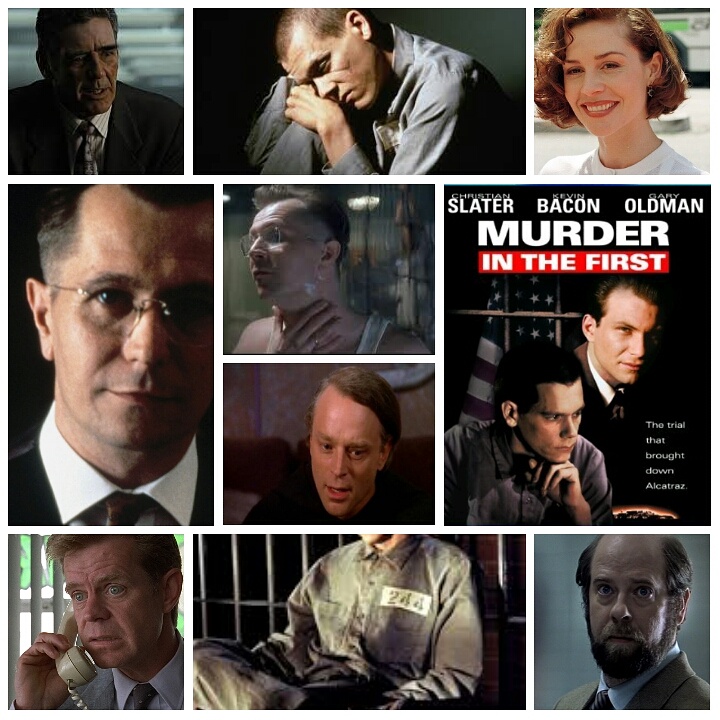
Murder In The First examines courtroom intrigue in San Francisco, concerning an Alcatraz inmate (Kevin Bacon) who has been accused of killing a fellow prisoner upon being let out of a cruelly long stint in solitary. In fact, the word cruel seems to be the running theme of his incarceration, at the hands of sinister and sadistic Warden Milton Glen (Gary Oldman). A decade prior, Bacon almost succeeded in escaping the island, which seems to have given the correctional officers the idea that they can do whatever they want to him. His plight creates ripples in the D.A.’s office, and soon a young, inexperienced attorney (Christian Slater) is assigned to his case. His boss (Stephen Tobolowsky) seems to think, and I quote, that a monkey would be more suited for the job. The D.A. (William H. Macy) has hope. And so it happens, with Bacon arriving in an obvious shellshocked state, Slater trying to exploit his maltreatment at the Warden’s hands and win not only his innocence, but his freedom. Bacon can swing his internal compass from victim to villain at the drop of a hat, taking up the bruised martyr mantle here and proving to be quite affecting. Slater is… Slater, the guy doesn’t have endless range but can carry a scene decently enough. Oldman is sly and scary, covering up the true nature of Glen’s monstrosity underneath a beauricratic sheen. The cast is wonderful, with further standouts from Brad Dourif as Slater’s veteran lawman brother, Embeth Davidz as a key witness, R. Lee Ermey as the stern judge overseeing the trial and brief appearances from Mia Kirshner, Charles Cyphers and Kyra Sedgwick. The expert cast carries it along with innate talent and applied teamwork, with Bacon and Oldman taking front and center. Now I’m not entirely sure if this is based on a true story, but it’s very fascinating nonetheless and serves to show the rotten places in the penal system which definitely do exist in real life. Solid stuff.
Dead Fish: A Review by Nate Hill
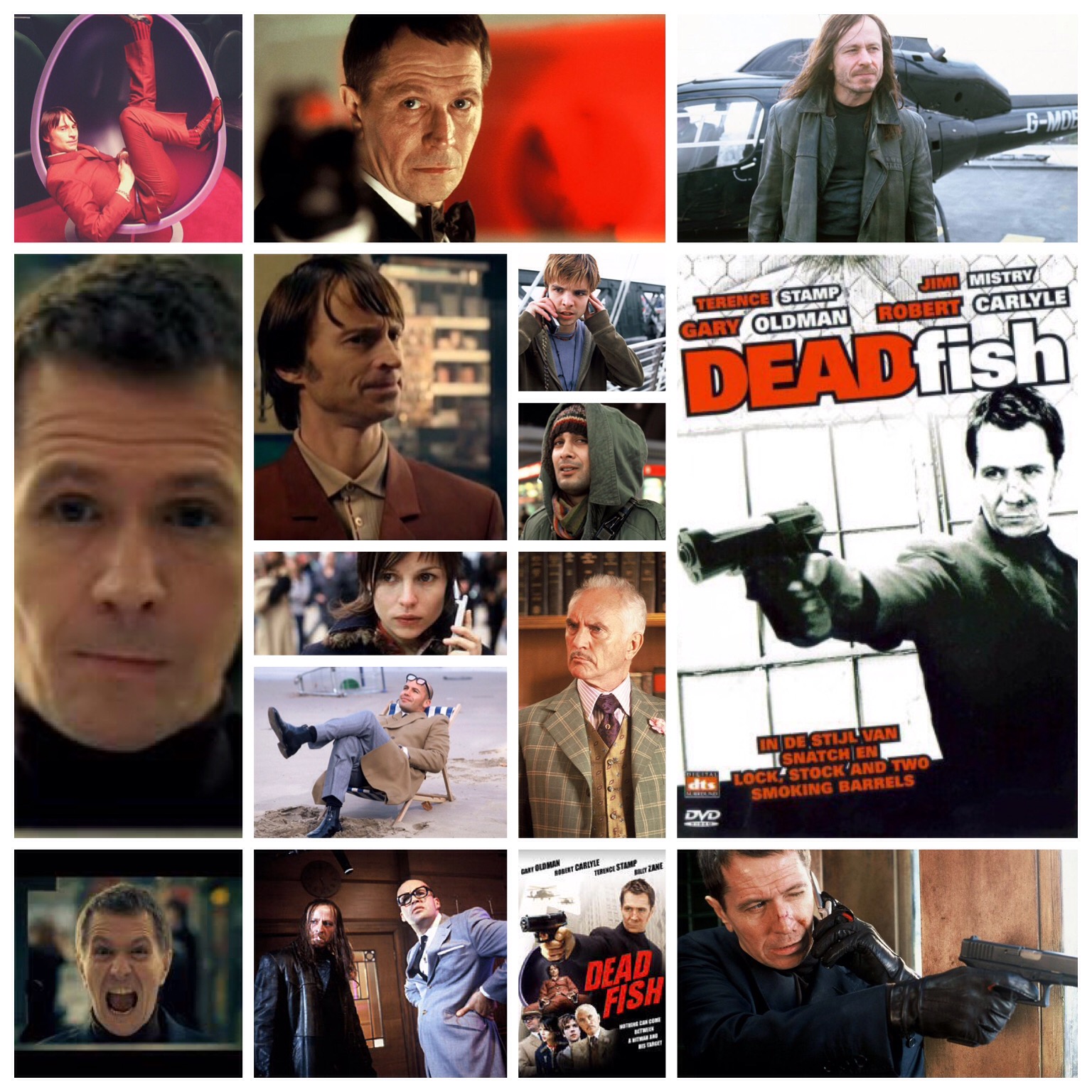
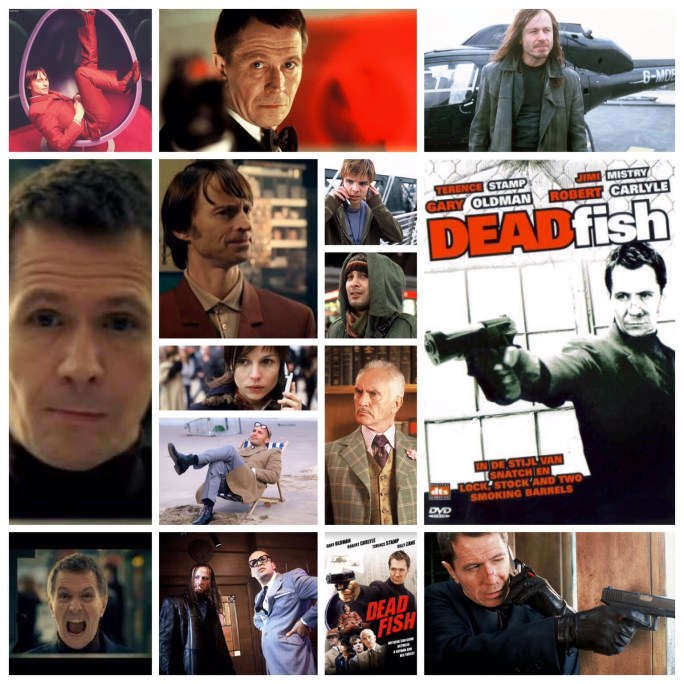
There’s a minefield of British gangster flicks out there, riding the colourful wake of Guy Ritchie’s output, and similar fare. Some are solid, and some blow up in your face with mediocrity when you come across them. Dead Fish falls somewhat in between those two reactions. On the one hand, it’s slick, visually adept, well casted and for the most part acted and knows how to set up a stylized scene. On the other hand, parts of it are silly, incongruent to the piece as a whole and kind of.. Shitty. It’s both a good bad movie and a bad good movie, and I know that doesn’t give much of a concise picture or really tell you whether to watch it or not, but too bad, that was my conflicted reaction. Gary Oldman, in one of his last loopy performances before he reigned it in, plays Lynch, a lively assassin with an unstable personality. He jumps from contract to contract, until a beautiful girl (Elena Anaya) catches his eye, and he’s struck with alarming and slightly creepy lovesickness for her. She’s got an American boyfriend (Andrew Lee Potts, who almost brings the film toppling down with his shoddy acting) who is on the run from violent loan shark Danny Devine (Robert Carlyle, frothing at the mouth like a pissy little windup toy). Lynch collides with them all including Pott’s stoner buddy (Jimi Mistry always looks like he needs to pee really bad and he’s waiting for them to say “cut”). It’s not super clear what Oldman’s character objective is besides going off on a freaky bi-polar tangent as he pursues his perceived dream girl and seems ready to forsake the high paying hitman job he seems so comfortable in. Nevertheless it’s fun to see him run around shooting people and being a mental head, and no one can do that like our Gary. The plot thickens, or rather becomes unintelligible, when two secret spy operatives are brought in by some agency to.. do…man I don’t even know. Billy Zane is a weird loony toons caricature as Virgil, a stuffy old spook with a plummy upper crust accent and some… wardrobe issues. He’s paired with Eastern European psycho Dragan (the always excellent Karel Roden) and the two literally spend their portion of the film bickering, cat fighting and squabbling, having actually no real interaction or function with the plot. Oh well, they’re amusing if nothing else. There’s also a brief appearance from Terence Stamp, who classes up the affair as Samuel Fish, a shady businessman with a vaguely coherent part to play in the madness. It’s all very strange and seems assured that it knows what it’s doing and where it’s going, even if at times the audience has not a clue. On the plus side, this is the only film I can think of where you can behold Gary Oldman break out into a musical number whilst tied down by a 250 pound S&M hooker. Yikes. Keep your ears peeled for a sonic little score from Groove Armada as well.
ULU GROSBARD’S STRAIGHT TIME — A REVIEW BY NICK CLEMENT

Helmed by stage and screen director Ulu Grosbard and written by screenwriters Alvin Sargent (Ordinary People), Edward Bunker (whose life the film is based on), and Jeffrey Boam (Lethal Weapon 2, Indiana Jones and the Last Crusade, Innerspace), the 1978 film Straight Time feels more like a Michael Mann production than anything else (he was an uncredited writer on the project, along with Slap Shot’s Nancy Dowd), with certain aspects feeling like early warm-ups for the events that would comprise the narratives of Thief and Heat. Starring Dustin Hoffman as a career criminal in what ultimately amounts to more than likely the best performance of his legendary career, this is a film of simple, direct power, never straying over the top, preferring sensible, if sudden and surprising, plot developments that propel the story forward at a brisk pace.

The fantastic M. Emmet Walsh co-stars as Hoffman’s overbearing parole officer, a man all too eager to throw Hoffman back into the joint after he’s been released in the first scene after six years in the pen, and there’s one scene between him and Hoffman at the film’s midpoint that’s got to be one of the funniest, most unexpected things I’ve seen in any movie. An innocent looking Theresa Russell, 21 at the time(!), is Hoffman’s love interest, a job-finder working with ex-cons who develops an unlikely crush on Hoffman. She knows he’s bad, just not HOW bad, and her character struck me as an almost exact match to Amy Brenneman’s role in Mann’s Heat. She’s the normally sensible woman who just gravitates towards the wrong man, even if her head is telling her no, because her heart is telling her yes.

The Heat-isms don’t stop there either; in one scene, Hoffman gives a moralistic speech that sounds like a junior version of De Niro’s cold-hearted “walk out on ’em in 30 seconds flat if you spot the heat around the corner” spiel that’s now become so popular. Hoffman’s increasingly desperate string of robberies mimics the late in the game plotting of Heat, and one lead character’s decision to kill another character feels incredibly reminiscent of Mann having De Niro take care of business during the final 30 minutes of Heat. Harry Dean Stanton, Gary Busey(!), and an almost unrecognizable Kathy Bates also have memorable bit parts. Hoffman is just electric here, quiet and reserved one moment, then all explosive rage the next, and while it feels a bit movie-movie that a sweet girl like the one Russell portrays would fall for a guy like Hoffman, I went along with it at all times because of the conviction of Grosbard’s unfussy direction, the uniformity of the performances, and the surprising beats that the story took at more than one juncture.
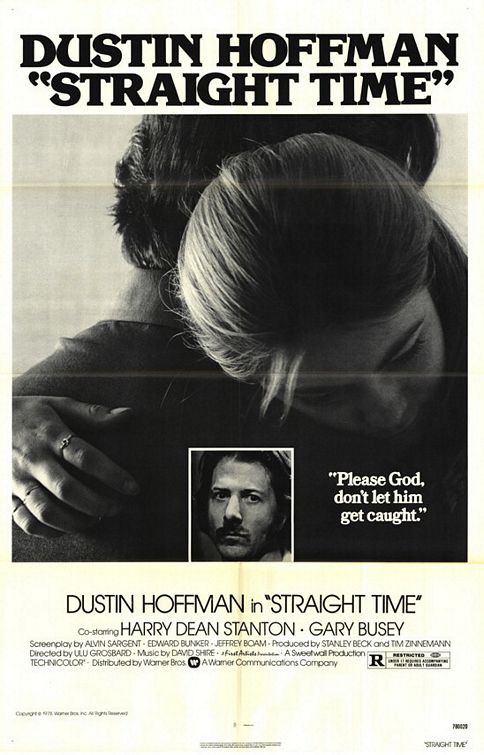
Grosbard, a talented storyteller who moved back and forth between movies and theater, never got in the way of his performers or added any unnecessary stylistic flourishes that would have otherwise distracted from his highly disciplined aesthetic. Owen Roizman’s crisp and clean cinematography eschewed any sense of artifice, bringing the same stripped down quality he brought to such seminal 70’s films such as The French Connection, Network, and The Exorcist. Hopefully, Warner Brothers will put out a special edition Blu-ray or license the rights to The Criterion Collection, because this is a film that’s worthy of long-term preservation.


Bang: A review By Nate Hill

Bang, a film by Ash. It’s a tough one to find, but it’s a scrappy little treasure trove of a flick. It’s a guerrilla film in the sense that the filmmakers had no permits, schedule, a puny budget and a barebones script which is mostly hijacked by wicked improv thanks to the cast. This seat of the pants storytelling technique doesn’t exactly ensure a wide distribution of any efforts in marketing, but they managed to pull of one of the most galvanizing, unpredictable and emotional films of the 1990’s, as far as I’m concerned. On a bright sunny morning in Beverly Hills, a young Asian American actress (Darling Narita in an arresting, pulverizing debut performance) heads to a make it or break audition with a hotshot Hollywood producer (David Alan Graf), who turns out to be an outright scumbag rapist, leaving her distraught and afraid. Her only friend seems to be Adam (Peter Greene), a ra,bun riots and slightly unstable homeless man who valiantly defends her by trashing every garbage can on the block, handling the arrival of a motorcycle cop (Michael Newland) who chases our heroine down, and attempts to persuade her into sucking him off as an exit to vandalism charges. Her fuse reaches its end and all of a sudden she overpowers him, take his gun and clothes and assumes much feared mantle of the LAPD. From there on in its a surreal odyssey of crime, mistaken identity, personal awakening and a riveting exploration of what makes a person powerful, what it takes for a woman to gain respect in a cutthroat city where misogyny runs rampant and unchecked, and ultimately how a downtrodden individual can regain their footing through the most traumatizing of encounters. It’s like baptism by fire, only the fire comes from the end of the police issue handgun she never wanted, and the baptism from the death it’s deals out in the extreme circumstances she finds herself in because of what the uniform, the symbol, represents. Narita is a startling wonder, attacking each scene with renewed intuition and never missing a beat. Greene is a rare revelation; he almost always plays nasty psychos, and here is given a shot at the eccentric loony toons style character that would usually be given to to Jim Carrey or Robin Williams. He shows what a talent he is as everyone’s favourite livable bum, displaying a gift for improv and off the cuff performing. Narita and him have an unforced friendship that blossoms early, ebbing and flowing as both find a modicum of solace within each other’s company that is periodically broken and reunited. Watch for Lucy Liu as a reprehensible young hooker as well. Ebert sung this ones praises when it came out.. No one heard. I imagine because of its extremely indie nature. It’s worth seeking out for the important message it brands upon the viewer, it’s frank and very candid approach, and it’s rabbit hole glance at one woman in trouble, navigating a zone out of her depth in an unchosen guise. One of the best films of the 90’s.
 Podcasting Them Softly