Rain Fall, like the meteorological event of its namesake, came and went with little fanfare when it was released. Based one novel in a series by Barry Eisler, it follows John Rain (Kippei Shina), a Japanese assassin for hire who becomes deeply embroiled in a hunt for a mysterious flash drive, the contents of which could have nasty consequences if released. Between the Yakuza, Japanese government and the CIA, Rain has his plate full, especially when he has to take a young girl under his wing who is in danger from all factions involved. Gary Oldman makes twitchy work playing William Holtzer, the unsavory and corrupt Token CIA station chief. He barks orders like he’s in a Bourne film, bends rules and is a morally blank, ruthless A-hole. Oldman plays him without his usual villainous and eccentric flair, opting for a stressed out, nervy turn which suits the gloomy tone of the film. It is a drab yet exciting affair, the intrigue dimmed down to dull greys and muted gunfights that ebb and flow with a minimal pulse. Shina is awesome as Rain, and seems born to play the spy thriller protagonist. Under the radar is how this one plays it, an atmospheric cloak and dagger outing well worth a watch.
The Chronicles Of Riddick: A Review by Nate Hill
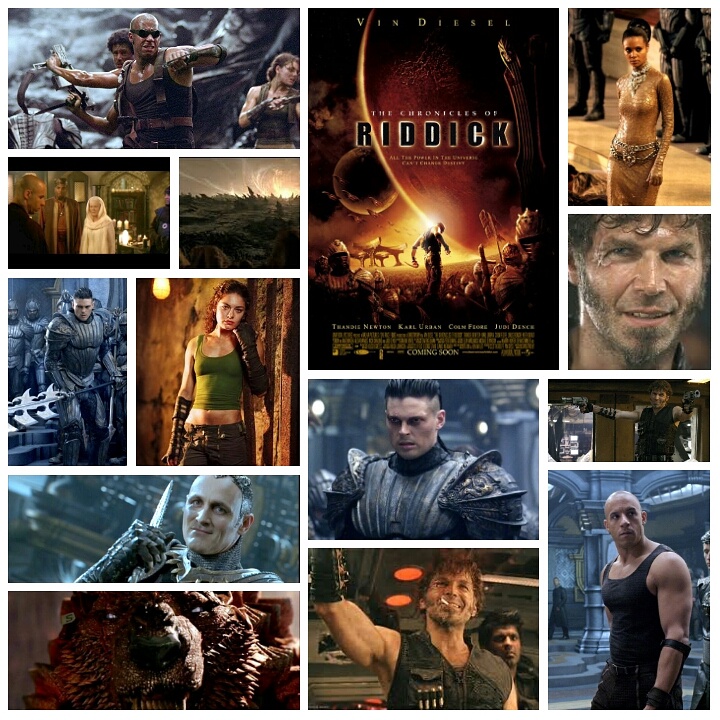
David Twohy’s Pitch Black was a dank, murky horror sci fi that took place inside a claustrophobic killing jar, all the action unfolding on one planet, and over a short amount of time. With The Chronicles Of Riddick, he lifts the lid off that jar, unveiling more planets, characters, creatures and broadening both the scope of what is seen visually and what takes place in the story. What began as a simple human vs. monster survival tale crystallizes into a full blown operatic space saga, and I loved every minute of it. Now there are a lot of people who hate it, and fine for them if they want to live inside such negativity. I was sold after the intro, in which a snarky, canine – like bounty hunter (Nick Chinlund) chases a haggard looking Riddick a across the bizarre, jagged face of a planet that would make the asteroid from Armageddon sweat. This film takes place sometime after Pitch Black, the few survivors scattered across the galaxy. There’s a price on Riddick’s head, which Toombs (Chinlund) intends to collect. Riddick unwittingly wanders into the path of something far more dangerous in his evasive efforts: a powerful, fascist master race known as the Necromongers are cutting a swath through the known universe, converting or killing anyone they find. They are led by the “” (Colm Feore), and commanded by Lord Vaako (another badass character for Karl Urban to another do to his rogue’s gallery), a nasty piece of work who is futher soured by his insidious wife (Thandie Newton). Riddick has encounter with them, as well as an old friend from former times (an all too brief Keith David) and is taken far and away, to a dangerous prison on a planet called Crematoria, where the wrecking ball of a sun fries everything on the surface every half hour or so. It all happens fast (and furious hehe), in a somewhat rushed frenzy of sci fi action, cool effects and surprisingly vicious antics for a PG-13 flick. Diesel was born to play Riddick, a growling night wolf of an antihero and endlessly watchable. There’s all sorts of half Cooke ideas running around, some fun and others left unexplored. There’s a prophecy involving the Purifier (Linus Roache) who has ties to Riddick’s tragic past and the fate of his race, a strange elemental (Judi Dench looking confused), another person from his past (Alexa Davalos) and other intrigue involving Urban. Best to sit back and let it wash over you like the fun it is. Chinlund is hilarious as Toombs, the only character who seems to have wandered in from inner city L.A., a wide ass prick with a hate streak for Riddick and that old school charisma that carries scenes. The set pieces are exhilarating and make up for the plot which is at times spread too thinly, but never hurts the film. I love it, watch it all the time, let the haters sulk… more for us.
LOVE & FRIENDSHIP: A Review by Joel Copling
Rating in Stars: ***½ (out of ****)
Cast: Kate Beckinsale, Xavier Samuel, Morfydd Clark, Stephen Fry, Chloe Sevigny
Director: Whit Stillman
MPAA Rating: PG (for some thematic elements)
Running Time: 1:32
Release Date: 05/20/16 (limited)
Love & Friendship gambles with our good will from the get-go with a protagonist who would be, in any other movie, the antagonist by trying to control everything with her manipulative hands. By positioning her as the head of a small ensemble and, thus, the person with whom we are supposed to empathize, writer/director Whit Stillman (adapted a novella by Jane Austen) tests our ability by then attempting to force us to buy into the woman’s motivation. It is an experiment that works, because Lady Susan Vernon, the recently widowed woman who deals with her grief by vainly clutching everything and everyone dearest to her close to her chest, is a once-in-a-blue-moon creation.
She is also played by Kate Beckinsale in a performance that receives the majority of the quick-witted dialogue (Imagine if Aaron Sorkin had written a period piece, and this character is that creation in microcosm), transforms itself into an art piece of its own, and then transcends all expectations we have for this character–even the ones higher on the list. This is a truly magnificent turn from the actress, who doesn’t merely chew but eats and digests the scenery, all the while remaining empathetic. It might be a rather cliché sentiment, but one is unable to take one’s eyes off of her.
Her husband, who was entitled with great wealth that has now passed onto her and their daughter Frederica (Morfydd Clark), has indeed died, and Susan has arrived to stay with his family–her in-laws–including his brother Charles (Justin Edwards) and Charles’ much younger wife Catherine DeCourcy (Emma Greenwell). Susan must also contend with the husband (Stephen Fry) of one of her best friends, an American named Alicia Johnson (Chloe Sevigny), who believes she will be sent back to the States if her husband has his way. Meanwhile, the dashing Lord Manwaring (Lochlann O’Mearáin) has left his wife (Jenn Murray) in a tizzy about potential infidelity.
That latter subplot doesn’t have much significance until a development at the end, but until then, the film is concerned with affairs of the heart, as two potential suitors enter the picture. The first is Reginald DeCourcy (Xavier Samuel), Catherine’s brother, who is younger by far than Susan but falls head over heels for her nevertheless. Sir James Martin (an uproariously funny Tom Bennett) courts Frederica, much to the young woman’s dismay, for the gentleman is, not to put too fine a point on it, foolish in the extreme. He means well, though, and is well off when it comes to money.
It takes about 15 minutes for Stillman to catch his stride and for us to engage with the film’s breakneck pacing, but once Love & Friendship hits, it’s impossible to dislike. It even provides a bait-and-switch for an audience expecting the narrative to go in one direction while the film’s two love stories take sharp left turns in a final few minutes. The cast are all on-target, the tendency for the film to introduce us to characters by way of close-ups and profiles with his or her name and a non sequitur description underneath never fails to garner a chuckle, and generally speaking, everything that could have come off precious and quirky gains a richness through the film’s capturing an era wherein a woman has no place to be manipulative. Even more surprising: We get a sense of why she is and how she got there. Here is a delightful surprise.
PTS Presents Editor’s Suite with DAVID KITTREDGE

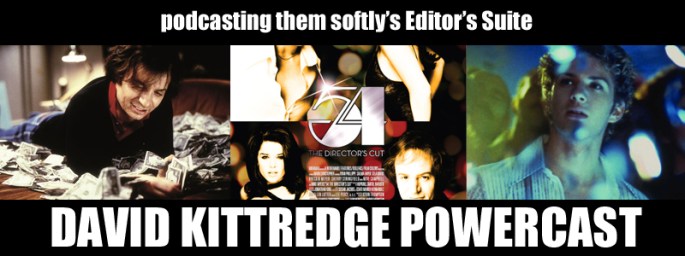
Podcasting Them Softly is extremely excited to present a discussion with special guest David Kittredge, the editor of 54: The Director’s Cut, which can be streamed via Amazon and iTunes and is now available to own on Blu-ray. Back in 1997, Mark Christopher’s disco club odyssey was released in theaters in a compromised state, featuring edits and reshoots not ever planned by the filmmakers, and which changed the general shape and scope of the picture. Now, nearly 20 years later, the creative team was able to go back to the original footage which test screening audiences balked at, and have reformed the movie as the ultimate director’s cut. There are so few films that experience a life like this one, as it’s a movie that got hit hard by critics and ignored by theatrical audiences at the time of its release. But because of our constantly shifting social attitudes and the advent of the DVD cult classic, it’s now time for this vibrant, sexy, and totally entertaining film to see the light of day as fully intended. A graduate of NYU’s Tisch School of the Arts and creative director of LA-based Triple Fire Productions, David is also the writer/director of film festival favorite Pornography: A Thriller, and has worked on various short films in multiple capacities. We also riff for a bit on one of our mutually favorite filmmakers, the late, great Tony Scott, which is always an exciting way to spend an evening. We hope you enjoy this fascinating, truly inside-Hollywood discussion about a film that deserves to find a new following!
John Boorman’s The Emerald Forest: A Review by Nate Hill
John Boorman’s The Emerald Forest is the kind of exotic, intoxicating, wildly adventurous, unbelievable and unforgettable film that comes along once in a decade, if that. These days this sort of film would be gilded to the hilt with unnecessary Cgi, a burden which filmmakers just can’t seem to free themselves from in this age. Back in 1985, they had to use what they had, filling every frame with on-location authenticity, genuine realism which prompts a feeling of wonder and sense of mysticism from the viewer, which any computer generated effort just cannot compete with (I will concede that this year’s The Jungle Book came up aces, so there are a few cutting edge exceptions). This film is quite the undertaking for both cast and crew, and one can see from scene to scene the monumental effort and passion that went into bringing this story alive. It’s also partly based on true events, adding to the resonance. Powers Boothe plays technical engineer Bill Markham, who is living with wife (Meg Foster) and two small children in Brazil, while he designs plans for a great river dam which will allow further development. One day, on a picnic at the edge of the rainforest, his son Tommy disappears, after spotting an elusive tribe of Natives. Gone with no trace but an arrow lodged in a nearby tree, Bill launches a search for his son that spans a decade, returning year after year to probe the vast, untamed jungle in hopes of somehow finding Tommy. Tommy, now a young man and played by the director’s son Charley Boorman, has been adopted and raised by the kindly tribe, known as ‘The Invisible People’ for they way they remain unseen as they move about their home in the forests. Tommy is very much one of them, taken up their customs and traditions, with nothing but vague memories of Bill in his dreams, which he doesn’t believe to have actually happened. One day in the hostile territory of ‘The Fierce People’, Tommy and Bill are reunited, Tommy taking his wounded father to his home village. Bill is heartbroken that his son is essentially no longer his, conflicted by the situation. Tommy has just entered his life as a man, taking a gorgeous wife (Dira Paes) from his village and starting a future. Trouble brews as The Fierce People threaten Tommy’s village, and their women, prompting him to seek Bill’s help. It’s interesting to see how a tribe who have had little to no contact with the outside world react to it, calling it ‘the dead world’ and referring to the developers as the Termite People who cut down the grandfather trees. The environmental message is never preachy, always feeling like a vital and important truth that is organic and unforced, emerging through the characters and their interactions. The Natives possess an innate spirituality and connection to the intangible which we have forgotten as progress alters us, still rooted deeply in forces beyond our 21st century comprehension. Boothe is deeply affecting in one of his best roles, a desperate father through and through, while also filling out the broad shoes of the wilderness adventurer he has become over the years. He fills his performance with pathos, longing and is the emotional soul of the piece. Boorman is spry and takes up the aura of Tommy well, mastering the complex linguistics and mannerisms of the tribe admirably. One of my favourite aspects of the film is its exquisite and moving score, the main theme evoking wild romanticism, old world secrets and the unending beauty of nature so well that one feels goosebumps as if we’re really there in that setting. Pure cinematic magic, a timeless story told without flaw or hitch, and a breathtaking piece of film.
B Movie Glory with Nate: Wyvern
As far as SyFy Channel flicks go, Wyvern is a really not bad little effort, kind of like North Of 60 meets Reign Of Fire. It concerns a group of people in a small Alaskan town who come across an ancient beast called a Wyvern, which is basically a winged serpent dragon that breathes fire and causes all manner of havoc for the local residents. The melting ice caps have caused a great thawing, in which this creature has been freed from its icy prison, now roaming the land, barbequing livestock and being a great big nuisance. Local trucker Jake Suttner (Nick Chinlund) bands together with rowdy outdoorsman Hass (Barry Corbin), Claire (Erin Karpluk) and eccentric ex army curmudgeon Colonel Travis Sherman (Major Briggs himself, the late great Don S. Davis). It’s a pleasent affair as far as horror/sci fi flicks go, with likable characters, not too much gore or unpleasantness, and that small town vibe of comfort that helps you care for the people in such a silly movie. One of SyFy’s best in recent years.
DANNY DEVITO’S DEATH TO SMOOCHY — A REVIEW BY NICK CLEMENT

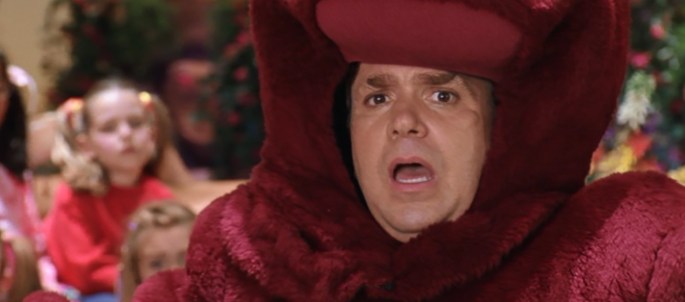
Death to Smoochy has got to be one of the ultimate “love it or hate it” movies. I think it’s absolutely hysterical and one of the funniest, sharpest critiques of pop culture entertainment that’s been put up on the big screen in years. Mercilessly directed by Danny DeVito and written seemingly without limits by Adam Resnick, the film opened to savage reviews and audience indifference back in 2002, but for me, easily ranks as one of the craziest black comedies in recent memory. Starring Robin Williams, in one of his absolute best performances, as a cracked-out and morally bankrupt children’s TV show host named Rainbow Randolph, the story charts his very public firing due to an off-camera bribery scandal, while detailing the rivalry that erupts between him and his replacement, a completely naive and ridiculous Edward Norton, doing unexpectedly great comedic work as a simpleton with his own costumed creation: Smoochy the dinosaur. The supporting cast was superb, with the likes of extra-sardonic Jon Stewart (dig the bowl cut!) and extra-hot Catherine Keener delivering some scaborous jabs towards at the TV industry, both playing jaded and cynical network execs who are mostly only interested in the bottom line. But the film is repeatedly stolen by the great character actor Michael Rispoli, who portrays a punch-drunk and mostly deaf former boxer who takes a shine to Norton and the Smoochy character, and who wants to get in on the fun himself. How his character is integrated into the plot yields some serious laughs. Pam Ferris, Harvey Fierstein and Vincent Schiavelli all landed some great jokes with perfect comic timing.

Death to Smoochy is a film that revels in its cruelty, delighting in the pschological terrorization of children, the mental anguish of numerous adult characters, and brazen comic violence that pushes the limits of taste and respectability on more than one occasion. In short, it’s fun for the entire family! It’s no surprise that DeVito ended up on the long running FX comedy series It’s Always Sunny in Philadelphia, as all of Death to Smoochy feels like it was cut from the same exuberantly devilish cloth as that wild and woolly show. The dynamite script leveld insults at everyone, never backing down from any challenge it presented to itself within the narrative, and finding the perfect balance between funny-nasty and outright off-putting. Cinematographer Anastas N. Michos knew exactly how to capture the harsh light of a TV soundstage, giving the picture a sickly visual texture that extends to the grotesque actions of the characters. The purposefully tacky production design was spot on, too. And damn, it really can’t be undersold how sexy Keener was here; she’d do similarly icy-hot work in Being John Malkovich, 8mm, Your Friends and Neighbors, and Full Frontal, before dropping a charming bomb in The 40 Year Old Virgin. This is a ribald, filthy, risk-taking, and completely mean spirited film, crafted with an anarchic spirit all throughout, and a work that deserved to gross a lot more than $9 million at the domestic box-office.

INVASION OF THE BODY SNATCHERS (1956) – A REVIEW BY J.D. LAFRANCE

There have been three remakes of the classic 1956 film, Invasion of the Body Snatchers — 1979, 1994, and 2007 respectively. This does not include the countless rip-offs and homages that have been made since the original graced the screen: some good (They Live), some bad (The Astronaut’s Wife) and some just plain ugly (Body Snatchers). By far the superior film in every way is the 1956 version directed by Don Siegel, which continues to thrill and entertain while hopeless rehashes like Abel Ferrara’s film try in vain to recapture the power and the impact of its predecessor. What Ferrara and other imitators don’t understand is that extravagant special effects and elaborate chases do not compensate for a non-existent story and weak characters — something that Siegel understood implicitly and wisely avoided in his film.
Adapted from Jack Finney’s excellent novel The Body Snatchers (1954), Siegel’s film is the best of all the versions made because it is the most faithful to the novel. The film begins with suspenseful music while the credits are shown over a sky filled with rushing clouds. After the credits end we meet a frantic Dr. Miles Bennell (Kevin McCarthy) who is being questioned by the police. When a psychiatrist arrives Miles goes wild, until reassured that his story will be heard. What follows is a flashback account of how Dr. Bennell, with the help of an old girlfriend, Becky Driscoll (Dana Wynter) uncover a secret plot by aliens from outer space to take over the inhabitants of the small town of Santa Mira. It is a subtle invasion that at first glance does not appear to be that much of a threat, but as Miles and Becky soon discover, its implications reach far and wide, threatening not only close friends like Jack and “Teddy” Belicec (King Donovan and Carolyn Jones), but all of humanity.
Like the novel, Invasion of the Body Snatchers is a real marvel of pacing — achieved by gradually building the suspense, until the tension is too much. When Miles begins to tell his story, he starts by saying, “At first glance everything looked the same. It wasn’t. Something evil had taken possession of the town.” While these words are spoken, Siegel presents an ordinary looking small town. Miles’ words are a teaser that makes us curious. We want to know what this evil force is, how it has taken the town captive, and why it seems so normal. It is this curiosity that draws us into the story. At first everything seems normal, but little details appear that suggest otherwise. Maybe it is the scared child running out in front of Miles’ car, the same boy who later claims that his mother is not his mother, crying, “Don’t let her get me!” These events are all warning signs that point to a larger, impending danger that threatens the small town.
The film’s inception lies in the hands of producer Walter Wanger who had read Finney’s story in its original serial form in Collier’s magazine. He felt that it would make a good low-budget film for Allied Artists and asked Don Siegel to direct. After convincing screenwriter Daniel Mainwaring to join the production, the film began to take shape. From the start, the three men shared the same approach to the material. Their intention was to have the film act as a metaphor for the way “the majority of people in the world unfortunately are pods, existing without any intellectual aspirations and incapable of love,” remembers Siegel.
Originally, producer Walter Wanger and director Don Siegel wanted to shoot Invasion of the Body Snatchers on location in Jack Finney’s model for Santa Mira, Mill Valley, just north of San Francisco. In the first week of January 1955, Siegel, Wagner, and screenwriter Daniel Mainwaring visited Finney to talk about the film version and to take a look at Mill Valley. The location proved to be too expensive and Siegel and some Allied Artists executives found locations resembling Mill Valley in nearby Sierra Madre, Chatsworth, Glendale, the Los Feliz neighborhood, and in Bronson and Beachwood Canyons. However, much of the film was shot in the Allied Artists studio on the east side of Hollywood. Invasion of the Body Snatchers was originally budgeted for a 24-day schedule at $454,864 and the studio asked Wanger to cut the budget significantly. The producer proposed a shooting schedule of 20 days and a budget of $350,000.
Initially, Wanger considered Gig Young, Dick Powell, Joseph Cotton, and several others for the role of Miles. For Becky, he thought of casting Anne Bancroft, Donna Reed, Kim Hunter, Vera Miles, and others. With the lower budget, Wanger had to abandon these choices and cast Richard Kiley who had just starred in Phoenix City Story for Allied Artists. Kiley turned the role down and Wanger cast two relative newcomers in the lead roles: Kevin McCarthy, who had just starred in Siegel’s Annapolis Story (1955), and Dana Wynter, who had done several major dramatic roles on television but had not done a film.
The film was shot in 23 days between March 23, 1955 and April 18. The cast and crew worked a six-day week with only Sundays off. The production went over schedule by three days because of night-for-night shooting that Siegel wanted. The final budget was $382,190. Siegel used his lack of budget and unknown actors to create an authentic, natural feeling of normalcy to the proceedings. This became one of the strengths of the film. We so easily believe that this is Smalltown, U.S.A. that when the horror of what is really happening becomes apparent the shock is that much more significant. Siegel, a former special effects expert, knew full well the pitfalls of relying too much on effects and not on the plot. “Instead of doing what so many science fiction and horror films do — spend all their money on special effects and put poor actors on the screen — we concentrated on the performers. The main thing about the picture, however, was that it was about something and that’s rare.” And so Siegel actually used the handicap of a small budget to his advantage by downplaying the special effects in favor of creating strong, three-dimensional characters and telling a suspenseful, often scary story.
The project was originally called, The Body Snatchers after the Finney serial. However, Wanger wanted to avoid confusion with the Val Lewton 1945 horror film with a very similar title. The producer was unable to come up with a title and accepted the studio’s choice, They Come from Another World that was assigned in summer 1955. Siegel protested this title and suggest two alternatives: Better Off Dead and Sleep No More, while Wanger offered Evil in the Night and World in Danger. None of these were chosen as the studio finally settled on Invasion of the Body Snatchers in late 1955. Wanger saw the final cut in December 1955 and protested the use of the Superscope format. Its use had been a part of the early plans for the film but the first print was not made until December. Wanger felt that the film lost sharpness and detail. Siegel had originally shot Invasion of the Body Snatchers in the 1.85:1 aspect ratio. The Superscope look was a post-production lab process designed to make the film resemble the popular Cinemascope format.
The studio scheduled three previews for the film on the last days of June and the first day of July 1955. According to Wanger’s memos at the time, the previews were successful. However, later reports by Mainwaring and Siegel contradict this, claiming that audiences could not follow the film and laughed in the wrong places. In response, the studio removed much of the film’s humor, “humanity”, and “quality”, according to Wanger. He scheduled another preview in mid-August that did not go well. The studio decided to change the film’s title to a more conventional science fiction one. In later interviews, Siegel pointed out that it was studio policy not to mix humor with horror. Both Siegel and Mainwaring were satisfied with the film as shot. It was originally intended to end with Miles screaming hysterically as truckloads of pods pass him by. The studio, wary of such a pessimistic conclusion, insisted on adding a prologue and epilogue to the movie that suggested a more optimistic outcome to the story which is thus told mainly in flashback. Siegel decided to shoot these scenes because he knew the studio would put them in regardless and if he filmed them then perhaps he could do a little damage control. Mainwaring scripted this framing story and Siegel shot it on September 16, 1955 at Allied Artists.
Siegel had problems with these sequences because as he saw it, they let “you know right away that something unusual is going on. If you start, as I wanted to, with McCarthy arriving in the town of Santa Mira, it reveals it slowly, we understand why McCarthy can’t readily accept the terrible thing that appears to be happening. And the dramatic impact of the ending is reduced with the epilogue.” Allied Artist also made Siegel cut out a lot of the humor in the film, but enough survived for the director’s intended effect. “I felt the idea of pods growing into a likeness of a person would strike the characters as preposterous. I wanted to play it that way,” Siegel remembers, “with the characters not taking the threat seriously. For example, if you told me now that there was a pod in my likeness in the other room, I would joke about it. However, when I opened the door and saw the pod, the full shock and horror would hit me and the fun would be gone. I wanted the people in the film to behave like normal people.” Despite the studio’s constant meddling, Siegel managed to create an impressive film whose impact has not diminished over the years.
In addition to these bookends, Wanger wanted to add a variety of speeches and prefaces. He suggested a voice-over introduction for Miles. While the film was being shot, Wanger tried to get permission in England to use a Winston Churchill quotation as a preface to the film. The producer also tried to get Orson Welles to voice the preface and a trailer for the film. He wrote speeches for Welles’ opening on June 15, 1955 and spent considerable time trying to convince Welles to do it but was unsuccessful and considered science fiction author Ray Bradbury instead but this also did not happen. Mainwaring eventually wrote the voice-over narration himself. The shorter version of the film was often rerun late at night on T.V. stations and one PBS showing in 1988. The full theatrical version was not widely released until 1978 when a remake was produced starring Donald Sutherland.
By giving us only bits and pieces at a time, Siegel slowly begins to reveal the threat of alien invasion. People act normal enough, but something is slightly askew. People seem to have emotions, but as one character observes, “There is just the pretense of it.” Body Snatchers feeds on our fear of dehumanization and conformity — not only of ourselves, but our family and friends. A lot of the suspense in the film is derived from the fact that the characters must stay awake to remain human; to sleep means becoming a pod. Sleep is an important motif of the film, to the point where Siegel originally wanted it to be called Sleep No More, a reference to Shakespeare’s play, Macbeth. For Siegel, sleep is a metaphor for conformity or the stifling of any intellectual curiosity. People often sleepwalk through their whole lives — never truly alive. And like Miles in the film, we are surrounded daily by these intellectual sleepers, being subtly invaded by their ever-growing numbers. Again, the studio stepped in and imposed a more science fiction/horror-like title which the filmmaker had no choice but to accept.
Despite the compromises Siegel was forced to make, his original intentions were not diminished. Through subtle references and imagery, he managed to convey his fears of conformity and present the solution to this problem in the form of its hero: Miles Bennell who embodies individuality and humanity — something that the pods (read modern industrial society) try to destroy. Unfortunately, Invasion of the Body Snatchers was not blessed with a big budget or big name stars and as a result critics and box office success ignored it upon initial release. Over the years, film buffs and student groups began to take interest in the film and an ever-growing cult following developed leading to its rediscovery in the 1960s by French New Wave critics who declared it to be one of the best and most influential science fiction films of the 1950s, alongside such classics as The Thing (1951), The Day the Earth Stood Still (1951), and Them! (1954).
American critics underestimated the widespread influence it has had since its initial release. A much imitated (see The Hidden amongst many others) film, it still manages to captivate and delight people today. The film has been read on many different levels, most often as a subtext for protesting Senator Joseph McCarthy and his Red Scare mentality or as an anti-Communist allegory. First and foremost it is an entertaining film that blends a science fiction premise with film noir and horror elements (in particular, its use of unusual camera angles, close-ups, sharp editing, music, and lighting). Despite three remakes, the original film is the superior version because its director, Don Siegel understood Finney’s novel and was able to translate its intent successfully to the screen without relying on flashy special effects and trickery like so many contemporary science fiction films.
STANLEY DONEN’S TWO FOR THE ROAD — A REVIEW BY NICK CLEMENT

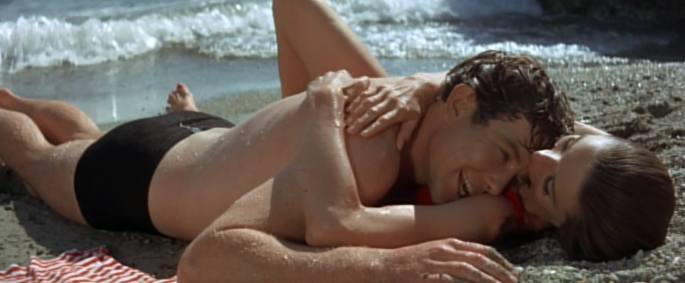
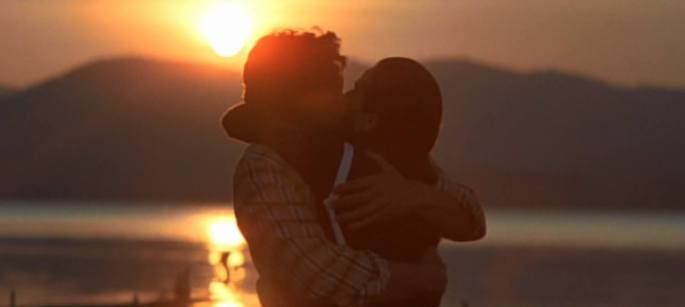
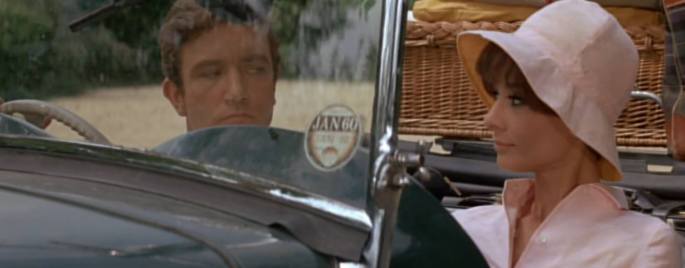
Stanley Donen’s 1967 British marriage dramedy Two for the Road is a film that I feel like a schmuck for not seeing sooner. Written by Frederic Raphael (who would receive an Oscar nomination for his brilliant work and who would later collaborate with Stanley Kubrick on Eyes Wide Shut), the film is a witty, serious, subtle, and totally late ‘60’s style and acting piece with fabulous performances from Albert Finney, Audrey Hepburn, Eleanor Bron, William Daniels, and a child performance of purposefully staggering annoyance by Gabrielle Middleton, who you literally just want to leave on the side of the road. The film centers on a husband and wife (Finney and Hepburn) who begin to examine and reminisce about their 12 year relationship while taking an emotionally taxing trip to Southern France. Various events from their lives are crisscrossed throughout the script, with former lovers making appearances, potential new lovers becoming a possibility, and a constant sense of “anything-might-happen” driving the story. Raphael’s boldly non-linear screenplay makes some modern movies feel downright conventional, and I’d have to assume that back in the day, this narrative style really took people by surprise.

The relationship on display is examined from multiple perspectives in multiple time periods, with both Finney and Hepburn running a gamut of emotions while hitting major life milestones, and contending with the birth of their daughter. Finney, in what can sort of be considered a warm up to his blistering work in Alan Parker’s 1982 masterpiece Shoot the Moon, is fantastic as a man caught between his desire to be a loving husband and the man who he believes he is deep down inside, even if that’s not who he is in actuality. Hepburn, stunningly photographed and costumed in every scene, gets lots of laughs and enjoys playful banter with Finney, while also getting a chance to explore her dramatic side, especially during the emotionally volatile last act. I loved how in certain scenes, Donen would edit a bit sooner than normal, thus forcing the viewer to put some of the story pieces together on their own, and while nothing is left up in the air, the way that Raphael devised his tricky but coherent screenplay allows for all sorts of speculation about what’s in store for the various characters by the film’s conclusion. The jaunty and spirited original score by Henry Mancini peppers each scene with distinct personality, and Donen’s New Wave-inspired aesthetic touches keep the film visually interesting and narratively unique. The film is also a feast for the eyes for anyone who considers themselves a vintage car enthusiast.

The Onion Movie: A Review by Nate Hill
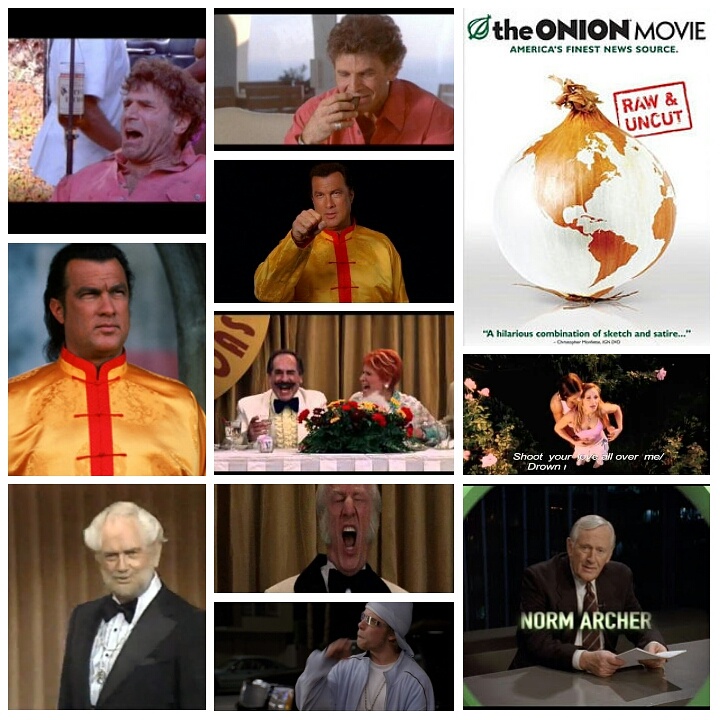
That’s right, the Onion News Network made a movie, back in 2008, and it’s every bit as irreverent, satirical and wantonly bizarre as you would imagine. They have been comically killing it for years with their online platform, and the film is a nice extension of that. It’s episodic, meandering and devoid of plot, made up of many little sketches and vignettes, some gut bustingly funny, others just plain odd. I have three favourites which pretty much sum up their inane, Monty Python type shtick: An out of work actor named Bryce Brand (Nick Chinlund is priceless I just a few minutes of screen time) arrives back home from drug rehab and is hounded by his agent to nab new scripts. He promptly falls into a weird new addiction that gets slapped sillily onto the headlines, thus ending his arc with deranged efficiancy. Steven Seagal shows up as a fat slob of an action hero aptly named ‘The Cock Puncher’, a lumbering buffoon who punches people in the cock, naturally. The third, and funniest sequence features a riff on the celebrity roasts of the 60’s, with some kind of amazing group of crusty old crooners hurling stinging and incredibly raunchy insults at each other with the subtlety of a sledgehammer. It’s tough explain just how funny that bit is in a review, but suffice to say it had me roaring as loud as the obscene bunch of wrinkled baboons in the in the skit. There’s a plethora of other sequences which I’ve since gotten hazy about, but I remember many other instances of pure hilarity to be had. Watch for further celebrity appearances including Eric Stolhanske, Michael Bolton, Richard Fancy, Daniel Dae Kim, Brendan Fletcher, Rodney Dangerfield, Joel McHale and more. Side splitting stuff, if you’re into this type of humour.