THE INVITATION: A Review by Joel Copling

Rating in Stars: ***½ (out of ****)
Cast: Logan Marshall-Green, Tammy Blanchard, Emayatzy Corinealdi, Michiel Huisman, Michelle Krusiec
Director: Karyn Kusama
MPAA Rating: NR
Running Time: 1:40
Release Date: 04/08/16 (limited)

(Note: It is impossible to discuss The Invitation without potential spoilers. Part of the film is about the inevitable outbreak of climactic violence, but I have done my utmost not to give away the film’s motivation to get to that point. Proceed with caution if you must, but you might want to see the film before reading this review.)

The Invitation gains most of its considerable mileage from moments of silence and consideration. It’s difficult to talk about the film’s achievements without delving too deeply into spoilerish territory, but let it be noted that screenwriters Phil Hay and Matt Manfredi are dealing with heavy thematic material here, and their movie climaxes in an even more desperate emotional state. Yes, this is a psychological thriller that adds up to a scene of extended violence, but the sense of inevitably reaching that violence is more upsetting than the ultimate shift toward it. When it comes, the narrative has earned it, and the intimacy of the act makes it all the more appalling.

It helps, too, in a feeling-of-helplessness sort of way, that the characters feel human from the moment we meet them. After a highly suggestive prologue involving our principal protagonist (who leads what ultimately becomes something of an ensemble) and his wife hitting a wolf on their way to the house in and around which the rest of the film will take place, Will (Logan Marshall-Green) and Kira (Emayatzy Corinealdi) arrive as his old place of residence. It was the family home until tragedy struck (We see flashes of a birthday party and some commotion; our imagination goes into overdrive with details involving, perhaps, a piñata), and Will hasn’t been back inside its walls since then. It’s painful, having to return to this place, like rubbing salt on a wound that may never truly heal.

It’s about to become unthinkably worse. Will has been invited to this house, which was once his own with ex-wife Eden (Tammy Blanchard), by the woman herself, who has settled down with a new beau named David (Michael Huisman) and reappeared after two years of being in Central America. They’ve brought back with them a newly found wisdom–or so it seems–borne of a desire to let go of the material things and all the usual trappings of a cult. A disconcerting and disturbing video tells another story, and the party that has formed–consisting of mutual friends played by the likes of Michelle Krusiec, Mike Doyle, Jordi Vilasuso, Jay Larson, Marieh Delfino, and Karl Yune, all inhabiting their roles very well–suddenly feels like a group of incarcerated victims of kidnap.

David keeps the doors locked, claiming local robberies as the reason why. There are a couple of strangers in their presence, including a free spirit named Sadie (Lindsay Burdge) and the soft-spoken Pruitt (John Carroll Lynch). Will questions why, exactly, these intruders upon what is supposed to be a nostalgic evening with old friends are present as company, and Eden simply won’t allow him to question it (She slaps another guest when he suggests the group’s lessons are a bunch of baloney). The evening becomes downright nightmarish–and, later, in a different way–but there is more at stake here than simple, genre-related matters of payoff to build-up.

The screenwriters and director Karyn Kusama do an superb job of following through with the inevitable, and the performances do most of the legwork on this score. Marshall-Green, in particular, is superb at allowing the audience to question whether Will’s suspicion is legitimate or his own psyche. Blanchard is very good as a woman barely veiling her own shock and grief at the loss of a child. Lynch is unnerving as Pruitt, able to convey threat and detached amiability without so much as a shift in expression. After the potential for violence becomes active during the climax, he final shot introduces an apocalyptic and pitiless element into the thematic structure of The Invitation, and it’s downright terrifying to consider.

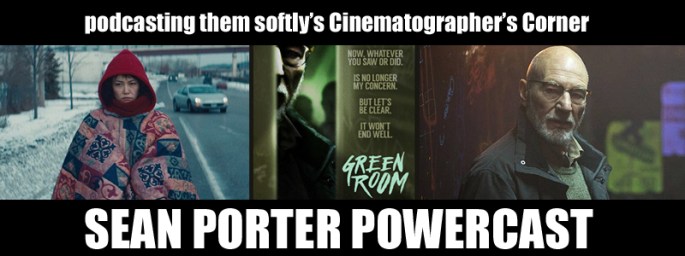
PTS Presents Cinematographer’s Corner with SEAN PORTER

porter powercast


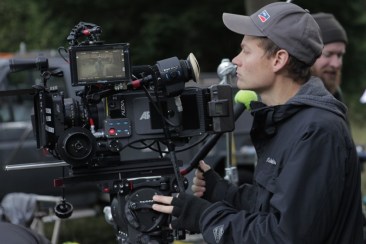
sean_porterPodcasting Them Softly is thrilled to present a chat with cinematographer Sean Porter, who recently shot the film KUMIKO, THE TREASURE HUNTER, and who has the highly anticipated thriller GREEN ROOM set for release later this year from A24. He’s also finished a pair of very intriguing projects with THE TRUST, which stars Nicolas Cage, Jerry Lewis and Elijah Wood, and 20TH CENTURY WOMEN, from director Mike Mills, and starring Elle Fanning, Alia Shawkat, Greta Gerwig, and Annette Benning. Sean got his start working on a variety of shorts, features, and documentaries, and has roots firmly planted in indie film community, and you can just tell from observing his work that he’s a talent to seriously look out for in the near future. His work on KUMIKO was beyond striking, announching an exciting and dynamic new visual eye to emerge on the cinematic scene, and it’s a film that we here at PTS are massive fans of and hope everyone will get a chance to check out. We hope you enjoy this most excellent discussion!

WALTER HILL’S THE WARRIORS — A REVIEW BY NICK CLEMENT

warriors

Walter Hill’s The Warriors is a fever dream action thriller, made at a very specific juncture in American pop culture history, as one radical decade of filmmaking was ending, with the start of something new forming in a period that would reinvent the expectations of the studio blockbuster and pave the way for more independent modes of filmmaking. The influence that Hill’s energetic and extremely entertaining film has had on filmmakers over the last 30 years can’t be ignored or denied; it’s been riffed on in numerous other films, and remakes have been proposed more than once, only to rather wisely fall apart (even with Tony Scott at the helm of one reimagining at one point). The streamlined plot played to Hill’s extreme strengths as a visual storyteller, as he’s always been a director obsessed by visual texture and the ways that a bold image can tell a story without the need for many words. Look at his body of work as a whole and just ponder some of the classics on his filmography; if there’s another once major American filmmaker deserving of career reconsideration it has to be Hill.

The Warriors rightfully sits near the top of his greatest accomplishments, if for no other reason than it served as a socio-political wake-up call in the form of filmed entertainment, taking the issue of gang violence and vigilante justice and tweaking the formula, with Hill taking bold chances with the terse screenplay he co-wrote with David Shaber, which favored forward physical momentum with the energy of rock and roll and comics. Andrew Laszlo’s muscular and endlessly stylish cinematography brought out an almost hallucinatory quality to the nighttime NYC streets, while the infectious musical score by Barry De Vorzon set a spirited yet dangerous tone right from the start. And the vintage cars and flashy costumes totally seal the aesthetic package. Hill would release an expanded Ultimate Cut in 2005 on DVD, which would include scene transitions done in the style of comic book panels, as this had always been his original intention. At the time of its release, critics came down harshly on the film, criticizing the violence and spectacle, but over time, the film has earned a massive and deserving cult following, despite actually being a box office hit to the tune of $22.5 million dollars.


Tony Scott’s Spy Game: A Review by Nate Hill


Tony Scott’s Spy Game is a kinetic yet heartfelt espionage thriller that sees the director maintain considerable shards of his assaulting sensory overdrive of style, whilst pausing along the way for a story that is really rooted in the personal story of the bond and friendship between two men. A lot of his films are predominantly visual and auditory, a bullet train of sound and fury, with plot and characterization as passengers onboard. Here those elements are cogs in the machine, resulting in a very touching, extremely exciting outing and perhaps the director’s most overlooked piece. Robert Redford used to be the younger, more naive faction in a lot of cinematic pairings, especially with Paul Newman. Here he flips the coin, taking on the grizzled mantle of both father figure and mentor to Brad Pitt. Pitt is Tom Bishop, an operative taken under the wing of veteran agent Nathan D. Muir (Redford). Nathan no doubt sees some of himself in the lad, and takes a shine to him, grooming him with all the skills and cunning that a lifetime in the business has given him. Life throws curveballs though, and more often than not they involve love. Bishop has gone rogue in an attempt to rescue relief worker Elizabeth Hadley (the brilliant Catherine McCormack, who needs to be in more movies) from a Chinese prison. In his eagerness he is captured, leaving Muir to make some tough decisions, pull some hidden cards and use all of his talent and resources to extract them. Now in many films like this there would be several blistering action set pieces to show how it’s done. Scott instead chooses to give Redford the intellectual grit and subversive genius to pull hidden strings and come up with a wicked fun solution that is endlessly more satisfying than an explosion ridden shock and awe campaign. His struggle to get his friend back is laced with flashbacks of his training, with a 70’s flavour that feels authentic and writing that lovingly builds the blocks of their dynamic. Stephen Dillane provides wonderfully understated work as a quietly smarmy CIA prick, and watch for a quick appearance from the great Charlotte Rampling. To see Scott’s frenetic aesthetic hired for a script that takes its time and plays out less like a conventional thriller and more like the paced, elliptical spy thrillers of years past (vaguely reminiscent of aspects of Le Carré) is a somewhat rare treat. Terrific thriller with Redford at his best, highly, highly recommended. 

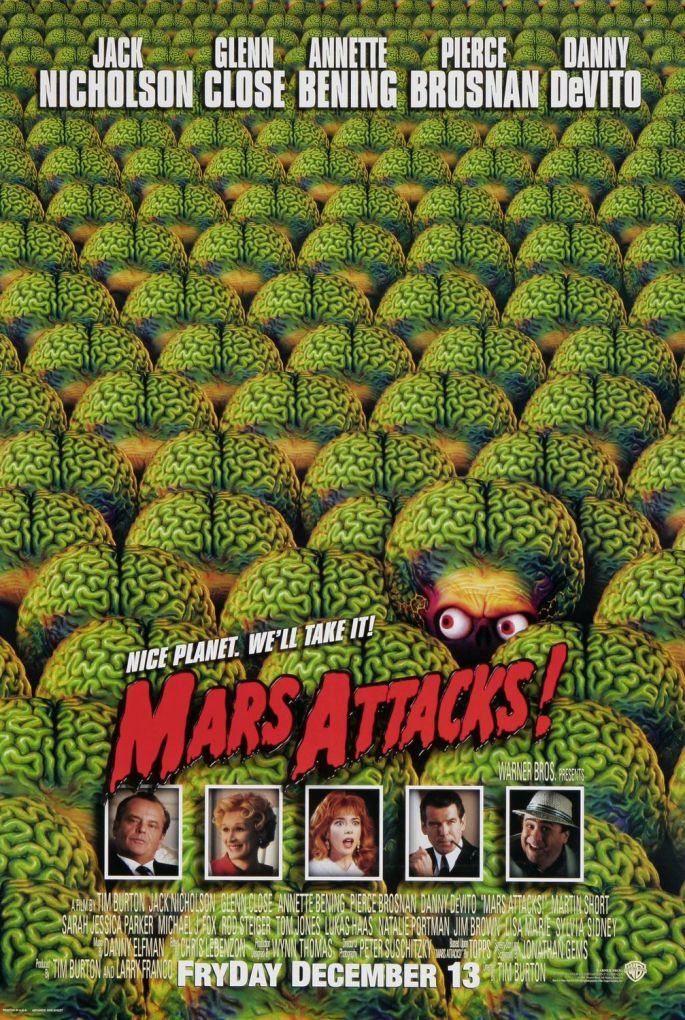
TIM BURTON’S MARS ATTACKS! — A REVIEW BY NICK CLEMENT

mars_attacks_ver1_xlg

This movie makes me happy. It makes me laugh. It leaves me with a fat grin on my face every time I see it. Jack Nicholson as POTUS and a sleazy car salesman in the same film! I can remember seeing this bit of craziness on opening night 20 years ago (this December!), hot on the heels of Independence Day, and holy moly this was NOT ID4. Laying a fat egg at the domestic box office, Mars Attacks! remains one of Tim Burton’s most underrated and underappreciated films. It’s a hoot and a holler, completely entertaining, with its tongue planted very, very firmly in its cheek. It’s silly, it’s reverential, and it looks absolutely fabulous in a purposefully low-tech and kitschy manner. The playful score by Danny Elfman is one of his best, the opening title sequence is an all-time classic, and the absurdly star studded cast is a roll call of the likes that is rarely seen outside of one of the old-school Irwin Allen disaster films.

The film had a very long development process, with names like Alex Cox and Martin Amis taking early and separate stabs at the property, which was famously based off of the 1950’s era Topps Trading Card series, before final screenwriters Jonathan Gems, Scott Alexander, and Larry Karaszewski put the finishing touches on this most ridiculous and clever and all together wild film. In retrospect, it’s very easy to see how this material must’ve set Burton’s world on fire, as it was a chance for him to make an outsized version of an Ed Wood movie, and given his love for that iconic filmmaker, seems almost like one of the most expensive personal love letters that a director has ever made.

The visual design of the aliens is aggressively awesome, I love the fact that they only say the phrase ACK-ACK, and when their heads explode inside of their space helmets – priceless! It’s a pity that critics couldn’t just embrace this film for what it was and have some fun, as they seemed eager and almost happy to pounce on this back in the day. And audiences weren’t likely expecting the light and breezy and absurdist tone, especially after the traditional heroics and bombast from Independence Day just a few months earlier. Mars Attacks! is a film that I could watch any day of the week, and whenever I come across it on the movie channels, I almost always have to pick it up in progress, as it’s never not a delightful pisser.

FLETCH – A REVIEW BY J.D. LAFRANCE

chevyfletchlives-xlarge

Has it really been more than 30 years since Fletch (1985) was first released in theaters? For my money, it is still the best film Chevy Chase ever made (with Caddyshack a very close second). I can put the film on at almost any time and still find it just as funny, no matter how many times I have seen it. And yet, it is too often dismissed as just another dated piece of 1980s pop culture. To be sure, the soundtrack is horribly dated (Stephanie Mills’ “Bit by Bit” anyone?) but this part of the film’s charm. It is also often cited as the rare highlight of Chase’s career that subsequently went downhill over the years. But Fletch has endured, thanks in large part to repeated broadcasts on television channels like TBS and rock-steady video rentals (with revenues of $24 million in the United States alone). So why does Fletch continue to inspire such a strong and loyal following after all these years? It is simple: insanely quotable dialogue, a colorful assortment of character actors and, of course, Chase’s inimitable, vintage smart-ass persona.

When he’s not avoiding his ex-wife’s attorney – Arnold T. Pants, Esq. (George Wyner) – Irwin “Fletch” Fletcher (Chase) is an investigative reporter who writes under the anonymous pen name Jane Doe for a Los Angeles newspaper. He is currently looking into the local drug trade on the beach and its links to police corruption when he is approached by Alan Stanwyk (Tim Matheson), a rich businessman who tells him that he is dying from bone cancer. He wants to pay Fletch $50,000 to kill him. After doing some digging, he finds out that Stanwyk is lying and may also have some kind of involvement in the city’s drug trade. His investigation ends up connecting these two seemingly unrelated plots for an exciting finale.

Fletch originated from a novel of the same name by Gregory Mcdonald. According to the author, the idea for the character came from hearing “from other people in the newsroom about other reporters doing these things for stories, and that gave me an idea. He was running around in my head for quite some time before I actually wrote the book.” The novel was very successful and soon Hollywood came calling. His Fletch books were optioned around the mid to late 1970s but the author had the option of approving the actor cast to play Fletch. Mcdonald remembers that “everybody from 12 to 72 in Hollywood wanted to play Fletch. But I kept throwing a monkey wrench into their plans.” He rejected the likes of Burt Reynolds and Mick Jagger when the studio mentioned Chevy Chase as Fletch. Despite never really seeing the comedian in anything, Mcdonald agreed to this choice. Years before, the comedian’s manager had recommended Mcdonald’s books to him but showed no interest in them or playing Fletch. However, when an old friend and producer Alan Greisman and screenwriter Andrew Bergman got involved, Chase agreed to do the film. Mcdonald sent him a telegram saying, “I am delighted to abdicate the role of Fletch to you.”

Chevy Chase started out as a satirical writer for the Smothers Brothers, National Lampoon magazine, and Mad magazine. He started acting in a comedy workshop called Channel One in Greenwich Village in New York City. Chase learned the art of comedy through improvisation during his stint at the workshop. “A laugh is a surprise,” he once said in an interview, “and all humor is physical. I was always athletic, so that came naturally to me.” Chase shows a stellar range of physical comedy in Fletch. His technique ranges from broader displays, such as the dream sequence when he imagines himself as the unusually aggressive L.A. Lakers star power forward (“6’5″, 6’9″ with the Afro”), to more subtle bits such as when he bangs his nose into a door, posing as the accident-prone Mr. Poon.

Andrew Bergman was hired to adapt Mcdonald’s book into screenplay form. He was only 26-years-old when Mel Brooks transformed his first script, “Tex X,” about a black militant cowboy, into Blazing Saddles (1974). The money Bergman made from that script allowed him to stay in New York City where he wrote The In-Laws (1979), a brilliant black comedy starring Alan Arkin and Peter Falk. Bergman went on to write several more screenplays for mediocre films in the ’80s before working on Fletch. Bergman remembers that he wrote the screenplay “very fast – I did the first draft in four weeks …Then there was a certain amount of improv, and something that we used to call dial-a-joke. Michael [Ritchie, the director] found this aircraft hanger, and called me and said we need a scene set in an aircraft hanger. So I wrote it that afternoon.” This, of course, became the scene where Fletch poses as an airplane mechanic by the name of G. Gordon Liddy and famously chastises the real mechanics that confront him about not using ballbearings. “It’s all ballbearings nowadays,” he says with hilarious mock-indignation. However, Mcdonald read the script was upset by how much it differed from his novel. He wrote the studio and listed his numerous issues with the script. Ritchie invited the author to the set of the film and then took him out to dinner where, according to Mcdonald, “Point by point, he showed me where I was wrong. I was beautifully chewed out.”

Director Michael Ritchie had much the same career arc as Bergman. He enjoyed success early on in theater and television, directing episodes of The Man From U.N.C.L.E. and Dr. Kildare in the 1960s, before breaking into feature films with Downhill Racer (1969) and The Candidate (1972) – both starring Robert Redford. After a successful run of films in the 1970s that included The Bad News Bears (1976), Ritchie directed mostly forgettable fare, like The Island (1983), until Fletch came along. According to actor Tim Matheson, Fletch was the first film Chase did after cleaning up a problem he had with drugs. Regardless, the studio hedged their bets and hired Ritchie to keep tabs on Chase. However, during principal photography, the director would do one take that adhered to the script and then another take where Chase was allowed to improvise. The comedian enjoyed the role and working with Ritchie as it allowed him to play a diverse collection of characters. He once said in an interview, “I love props, like wigs and buck-teeth and glasses. At one point I wear an Afro and play basketball with Kareem Abdul-Jabbar. There were some scenes where I didn’t recognize myself.”

Fletch is essentially a vehicle tailor-made for Chase. It plays to the comedian’s strengths; in addition to his affinity for physical comedy, the film is famous for showcasing his trademark deadpan smart-ass delivery of dialogue and his knack for playing a wide variety of characters – abilities he perfected on Saturday Night Live. Chase expertly juggles Fletch’s numerous aliases. From the likes of the absent-minded, Dr. Rosenrosen to Mr. Underhill’s racquet club “friend” John Cocktosten, Chase makes each one distinctive and hilariously memorable.

Fletch spends the film skewering all sorts of authority figures, from wealthy businessman Stanwyk to the scary chief of police Karlin (Joe Don Baker). He always has a snappy comeback for any given situation. For example, there is a scene early on where Fletch has a funny exchange with Frank (Richard Libertini), his long-suffering editor at the newspaper, about the identity of the reporter’s source to the drug trade going on at the beach. Frank asks Fletch for more information to which he replies, “Well, there we’re in kind of a gray area.” Frank asks, “Alright, how gray?” Without missing a beat, Fletch replies, “Charcoal?” Infuriated, Frank’s hand trembles with anger as he holds a pot of coffee to which Fletch responds by holding an empty styrofoam cup and shakes it also. I think that why the film appeals to so many is that in some way we wish that we all could walk through life like Fletch delivering smart-ass one-liners and getting away with everything. Chevy does it in such a casual, nonchalant way that seems so effortless. It was just a perfect marriage of Bergman’s script and Chevy’s knack for improvising and physical comedy.

Capitalizing on the immensely popular action comedy, Beverly Hills Cop (1984), Fletch adheres to the same formula: the maverick protagonist who has a problem with authority, the use of multiple disguises to get in and out of dicey situations for comedic effect, the obligatory car chase, and even the hopelessly dated synth-soundtrack by Harold Faltermeyer who seemed to be everywhere in the ‘80s, scoring major hits like the aforementioned Beverly Hills Cop and Top Gun (1986). His distinctive minimalist synth beats are the glue that holds the collection of forgettable ‘80s songs together. Fletch deviates in one significant aspect: Chase’s character never uses a gun (he also repeatedly gets the crap kicked out of him).

Another aspect of Fletch that makes it so unforgettable is the strong supporting cast. The film features character actors like Joe Don Baker as the slimy Chief of Police Karlin (who brings a wonderfully scary intensity to his role), George Wendt as the amicable drug dealer Fat Sam, Tim Matheson as the double-dealing bigamist Alan Stanwyk, M. Emmet Walsh as the probing Dr. Dolan, and a young, pre-Thelma and Louise (1991) Geena Davis as Larry, Fletch’s ever loyal co-worker. I’ve always harbored a cinematic crush on Dana Wheeler-Nicholson (playing Stanwyk’s wife, Gail) thanks to this film. Her first encounter with Fletch at the racquet club, decked out in a cute, white tennis outfit, is a memorable one. She essentially plays straight man to Chase (who doesn’t in this film?) and they have pretty decent chemistry together. One of the joys of the film is how Chase interacts with all these people and how they react to his flippant, off-handed remarks. Watch him in action in the hospital sequence as he confuses and befuddles the staff in order to get the information he wants (even offhandedly ordering a cup of fat and making a sly reference to Bring Me the Head of Alfredo Garcia) – it is not only what he says to them but, more importantly, how he delivers the dialogue that makes it so funny.

There are the little asides that are a constant source of amusement, like when researching Stanwyk’s past, Fletch comes across information about the man’s parents and their hometown. Chase deadpans, “that’s three names I enjoy. Marvin, Velma and Provo.” There’s also the recurring gag of Fletch running up an expensive tab on the Underhills, an obnoxious member of the racquet club that Gail frequents, and who Fletch overhears berating the waitstaff upon his initial visit. From that point on, whenever he gets a chance, Fletch orders all kinds of exotic foods and drink, sticking it to this arrogant jerk.

Since Fletch, Michael Ritchie continued as a director-for-hire on a number of movies that didn’t make much of an impact, except for Fletch Lives (1989) and the highly enjoyable James Woods con-man comedy, Diggstown (1993). Sadly, Ritchie died on April 16, 2001 from complications of prostate cancer. Andrew Bergman, on the other hand, enjoyed critical and commercial success with The Freshman (1990), which he wrote and directed, and also made two successful, box-office-friendly romantic comedies starring Nicolas Cage – Honeymoon in Vegas (1992) and It Could Happen To You (1994). Sadly, Chase’s post-Fletch career has not been as triumphant. He starred in Fletch Lives, which has its moments but let’s be honest, it is a pale imitation of the original. He has done a series of forgettable family-oriented films (Cops and Robbersons anyone?) that feature Chase on auto-pilot. Even the man himself admits, “I made about 28 movies and I think about five of them were good.”

More so than in any other film, Fletch is classic Chevy Chase. While he is in exceptional form in Caddyshack and National Lampoon’s Vacation, they do not showcase his unique talents as well as in Fletch. In every scene, Chase does a fantastic job carrying the picture with the right mix of comedy and drama. Fletch has aged surprisingly well over the years. The jokes are still funny and many of Chase’s one-liners are insanely quotable. So much so that it has become a cult film. In an interview for the New York Post, Bergman tried to explain its appeal. “It’s so bizarre, but Fletch strikes a chord. There’s a group of movies like that in the ‘80s, like Caddyshack, too, that captured a certain wise-ass thing.” Chase also looks back on the film with fondness. “It was at the height of my career in film, and it was as close to me as a person as any part I’d played.” Perhaps the most meaningful praise comes from Gregory Mcdonald himself: “I watched it recently, and I think Chevy and Michael Ritchie did a good job with it.” As Fletch would put it, “and a damn fine answer if I do say so my damn self.”
STAR WARS EPISODE I: THE PHANTOM MENACE – A Review by Frank Mengarelli

It’s no secret that many high brow cinephiles have their knives out when it comes to STAR WARS, but in particular the prequels.  To be fair, my film snobbery overflows onto big blockbuster franchises, but STAR WARS, all aspects of it; the films, the novels, the video games, collectibles are so ingrained in my life since childhood that it’s fair to say I will never have as much passion for anything as I do for STAR WARS.

image

THE PHANTOM MENACE is a stark contrast from the original trilogy, and that’s exactly what it is supposed to be.  Yes, there are many missteps, including the casting of some actors, and the dialogue at times is lackluster and unintentionally laughable but there is so much more at stake when you look at the big picture.

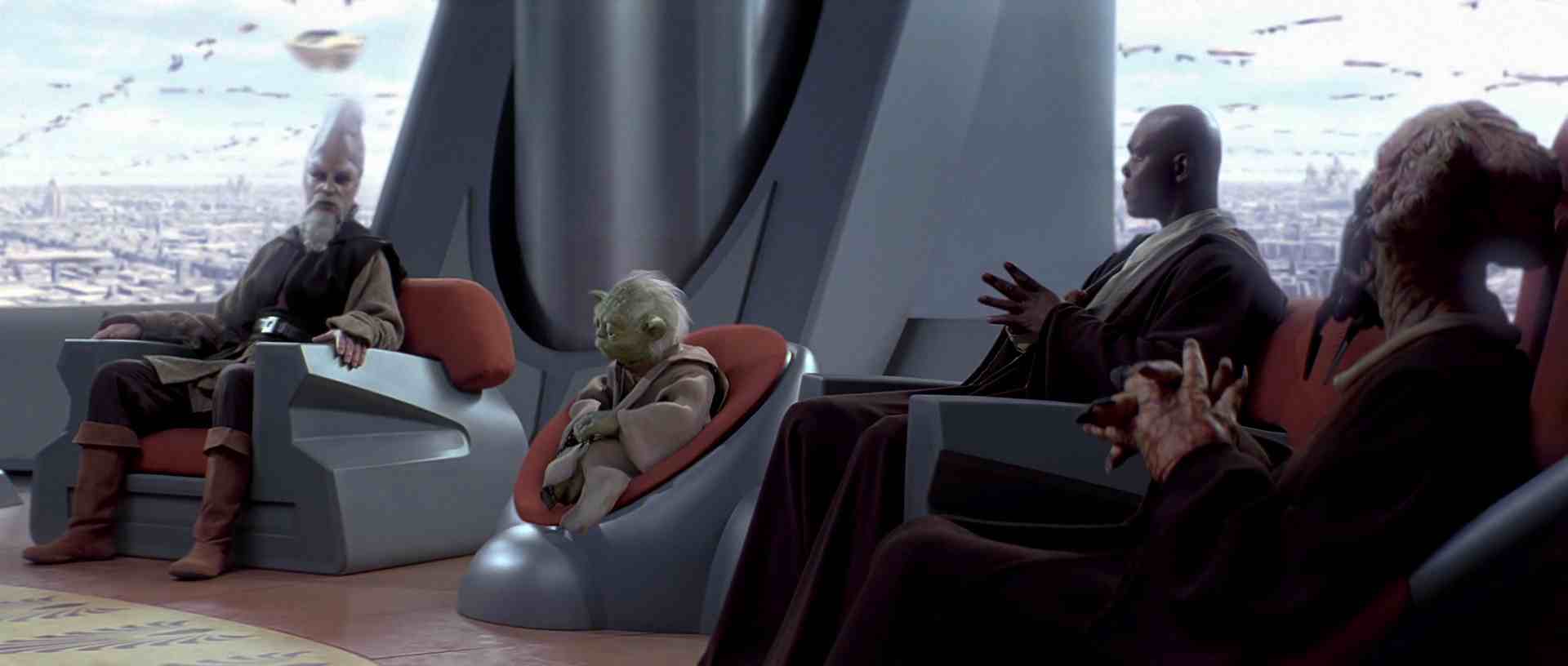
Set decades before A NEW HOPE, Episode I shows us the beginning.  We see a vibrant and fertile galaxy before the desolate dilapidation that the Empire brings to not only the aesthetics but also thematically in the original trilogy.  This is a time of prosperity, a time when the Jedi oversaw peace in the galaxy.

image

But.  This is also the beginning of the galaxy being divided in a full-out war.  Planets pitted against each other by fear and economics.  All the workings of seminal STAR WARS villain, Emperor Palpatine, who in Episode I is nothing more than the affable senator from the peaceful planet of Naboo.  His Sith alter ego, Darth Sidious, does all the dirty work.

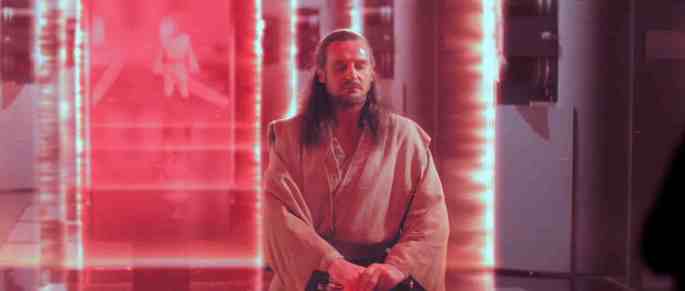
I know.  Jar Jar Binks is the go to hangup.  Yes, Jar Jar is annoying until you get over it and embrace him.  Liam Neeson as the Jedi Master who is the hierarchy of the Skywalker lineage more than makes up for Jar Jar.  As does John Williams’ AMAZING score, particularly DUEL OF THE FATES which loudly surrounds the greatest lightsaber battle in the STAR WARS saga: Qui Gon Ginn AND Obi Wan Kenobi versus fan favorite, Darth Maul.

Yes, THE PHANTOM MENACE is the weakest of the STAR WARS saga, but it is also a solid foundation of what’s to come after.  The chaos that engulfs the galaxy.  The tangible rise of Palpatine’s dark powers.  For all of Lucas’ faults, he does an excellent job guiding the camera through the birth of galactic turmoil.  His casting of Liam Neeson, Ewan McGregor, Samuel L. Jackson, and Terence Stamp are wonderfully perfect additions to the series, and his vibrant aesthetic is a pleasant contrast from the darkness of the original trilogy.

Deceiver: A Review by Nate Hill

image

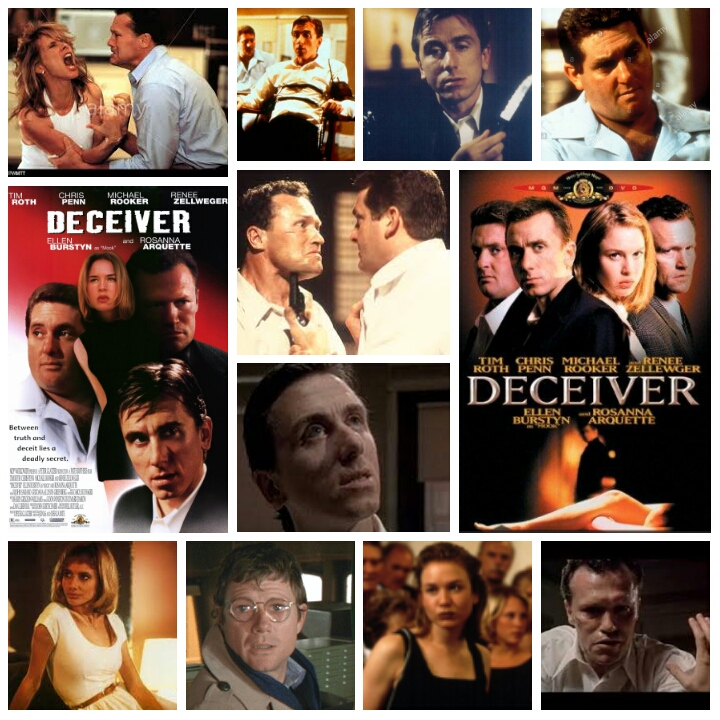
Deceiver is classic 90’s noir, with a dash of trashiness and a unique cast all suited to the bottom feeding material. It trips along in the same gutter as stuff like Basic Instinct, another film that is simultaneously aware and smugly indifferent to the fact that it’s scummy stuff. Almost every character is a reprehensible, unlikable twat, save for one surprise cameo. I may have just put you off the film, and to many who don’t see this type of thing as your cup of tea, please avoid it. But to those like me who appreciate a nice bit of grimy fun, well this is your ticket. Tim Roth plays Wailand , a wealthy and arrogent young heir to a textile mill. He is under suspicion for the brutal murder of a prostitute (Renee Zellweger) who was found in a park, cut in half. The two detectives who are tasked with hassling him seem almost as dodgy as he is, and when you look at the edgy character actors who play them it’s easy to see why. Detective Braxton (Chris Penn) is buried in gambling debt, owing a tidy sum to nasty loan shark Mook (Ellen Burstyn). Detective Kennesaw (Ann explosive Michael Rooker) is a rage fuelled whacko who is furious at his wife (Rosanna Arquette) for having affairs on him. Wailand has both the cunning nature to see this weaknesses in both of them, and the money to do something about it. This makes the detective’s job very hard, being stymied by their quarry every step of the way. Wailand also has mental issues including blackouts and strange episodes of personality alteration that Roth takes full advantage of in the scenery chewing department. It’s pseudo psychological mumbo jumbo that the actors play straight faced for a thriller that’s quite the endearing little flick. Rooker stands out with his trademark volatility that will put anyone’s nerves up to defcon 4. Roth has a ratty, evil looking face. Nothing against the dude, he just looks like he’d slit your throat in your sleep for a dollar. He’s great as suspicious characters, and has fun here being the wild card. Penn is his usual huff and puff self. Character actor Michael Parks has an awesome cameo as a psychiatrist with a monologue that almost lets the film wade out of cheese territory. Great cast, great flick.

Kalifornia: A Review by Nate Hill

image

Dominic Sena’s Kalifornia is a brilliantly vicious dark fable, a moody cautionary tale regarding the dangers of trust, the true nature of the sociopath and the ironic way in which demons sneak up on us while we are to busy looking for them with our backs turned. It’s also damn fine thriller filmmaking and fits nicely into a subgenre which I happen to be an avid fan of: the American road movie. The highways, byways and back roads of desolate rural USA have a bitter menace that clouds the air like the desert dust kicked up by many a vehicle on their way through. There’s endless possibility out there, for great and terrible evil, in a place where help is always a county away and opportunity looms on the horizon like the bloated California sun. From The Hitcher, to U Turn, to Thelma & Louise, to Duel and everything in between, it’s a setting that hums with cinematic potential. David Duchovney and Michelle Forbes play a yuppie couple who unwittingly wander into the path of extreme danger. Duchovney is a writer who is working on a book about American serial killers. Their journey takes them to many bloodstained locales where incidents took place. Eventually they decide to carpool with rugged redneck Earley Grayce (Brad Pitt), and his bimbo girlfriend Adele Corners (Juliette Lewis) whose IQ appears to be lower than the cut of her blouse. The two couples couldn’t be more different, yet get on well enough. Slowly it becomes clear that there’s something very off about Earley though, noticed keenly by Forbes’s intuition. Duchovney is enamored by the tumbleweed hick, and thinks he’s made a friend. He’s half right, and not even in the way he thinks. The film takes its time letting Earley’s true nature emerge, Pitt slowly detaches and unravels until the tarp is fully torn off and we see the sociopathic monster within. All set in abandoned clusters of former Americana and given slick, almost action movie direction from Sena, it’s not one to miss for any fan of a crackling psychological thriller. 

NOAH BAUMBACH’S WHILE WE’RE YOUNG — A REVIEW BY NICK CLEMENT

1

In film after film, writer/director Noah Baumbach continues to ask us to observe complicated, truthful, stressed out people who are looking for clarity in their lives and who make decisions that sometimes aren’t the best way to go. While We’re Young is incredibly funny without ever resorting to stupidity to earn those laughs, with a barbed screenplay that has one terrific line of dialogue after another, all of it witty and clever and all too knowing. The open contempt that’s ladled on our parent-child-obsessed society and the millenial generation was bracing and critical and hilarious. The final moments of the movie sting with the harsh truths of where the youth of today are headed. Without spoiling anything, this is the story of two couples, one in their early 40’s and the other in their early 20’s, and how their paths cross, and how everyone slowly realizes just how out of touch they all are with those around them. Ben Stiller is great here, doing more great work for Baumbach after his pained and stinging performance in the monumentally underrated Greenbergh, in total synch with the material, as was Naomi Watts, who delivered an emotionally complex performance which registers as one of her best. And Adam Driver continues to prove that he’s a reservoir of comic talent in so many unique ways, presenting a character that’s equal parts off-putting and weirdly engaging.

Cynical, intelligent, dry as the Nevada desert, and consistently funny both in a laughing-out-loud and LQTM manner, this is Baumbach’s finest overall effort since The Squid and the Whale (I’ve still not seen Mistress America but that disc is on its way from Netflix). I love how incisive his writing is, how he’s able to get great dramatic work out of Stiller, and how he loves to make us squirm in all the best ways. Oh, and it’s a total pisser to see Beastie Boy Adam Horovitz absolutely nail his supporting role. And it goes without saying, Charles Grodin POWER, as he completely steals every single scene he appears in. Thanks A24 for yet again providing us with another EXCELLENT movie that has something relevant to say, doing so with class and integrity. For me, this is a virtually faultless film, with one fantastic scene after another occurring, spiked with great writing and observant direction, a work that’s sad and funny in equal measure, with its finger on the pulse of a generation of people who don’t exactly know what to do with their lives.