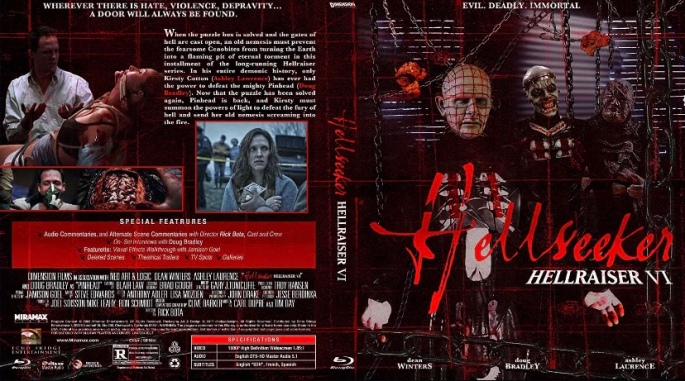
The fifth Hellraiser sequel, Hellseeker, is nowhere near as fun or inspired as the fourth, sad to say. It’s hard to follow up a sequel that includes journeys into both French Revolution times and outer space, but even so this is a pretty dreary attempt other than the fact that it brings back Ashley Lawrence’s Kirsty from the first two films, albeit all too briefly. Most of the film focuses on her husband played by Dean Winters who seems out of place here and who I can never see as anyone else but the human personification of the OnStar navigation guide thing ever since he did those commercials. Kirsty is mostly out of the picture and he’s wandering listlessly through a drab desk job, a philandering lifestyle full of cheating and lying and strange memories of a hazy car accident where she apparently died, but he can’t quite get the facts or the recollections straight. Grisly murders start to happen in the city, crime scenes that he’s always conveniently around, and soon two suspicious detectives are on his trail, then slowly but surely Pinhead and his gang start to make themselves known. The first two thirds of the film are interminable, as it tries to be a noirish character study of this guy but I just. Didn’t. Care. He’s less than non-interesting and even a guy with Winters’s natural charisma just cannot bring him to life. Then the third act happens and there’s some sparks of life, with a twist that, although fascinating and unexpected, sort of negates the whole silly stream of events we see before with his character and kinda made me go WTF. This is by far the weakest story of the seven sequels I’ve seen so far. Not much in the way of memorable kills, gore, atmosphere or effects, a muddy, murky story, flatlined protagonist and a serious lack of screen time for Doug Bradley, who was all up in the fourth one like a scene stealing mad dog. This one can be avoided and skipped over for the sixth one, which is a fantastic return to form and I’ll get to reviewing tomorrow.
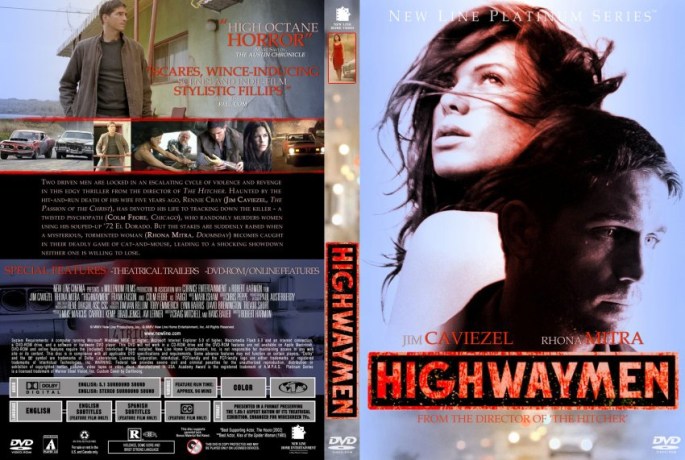
I love horror movies set on the road, it’s such a great breeding ground for paranoia, vehicular mayhem and fear of the great unknown. Setting out on a road trip is always an amazing feeling of freedom, but the vast interlacing network of desolate highways that lie just outside the structured, familiar peripheries of any big city ways have an innate, sleeping menace to them; anyone, or anything could be out there. Some of the best films in horror overall come from this idea, including Joyride, The Hitcher, Steven Spielberg’s Duel, Tarantino’s Death Proof, Roadgames and so many more. I finally got a chance to check out Robert Harmon’s Highwaymen and I can’t believe I didn’t sooner because it’s an absolute banger, and one that has always gotten terrible reviews and buzz, which to me is inexplicable. This has the hazy, moody early 2000’s thriller feel, an atmospheric yarn about a terrifying serial killer (Colm Feore) who murders woman with his souped up, rampaging Cadillac El Dorado and the lone man (Jim Caviesel) whose wife once fell under his tires, has now made it his quest to bring the monster down. He spends his days attentively scanning CB radio stations and trawling the vast nebula of backroads looking for any sign of this guy resurfacing, and when he does rear his hood ornament once again, the chase is on. An innocent woman (Rhona Mitra) and her ill fated friend (Andrea Roth) find themselves in the crosshairs of his malicious intent and Caviesel takes full advantage of the situation to try and stop him, with the help of an intrepid rogue traffic authority officer (Frankie R. Faison). Feore is intense as ever as the truly vile killer but what makes the character so fascinating is that without his car he is useless; So many years of disastrous collisions have left him a mangled multiple amputee who is wheelchair bound and uses fearsome homemade steel appendages to operate steering wheel, pedals and gearshift, giving him the appearance of some demented crippled cyborg, it’s quite the character choice for a villain. Director Harmon also did the original 1986 Hitcher film which is a classic and while there are shades of his original vision at work here, this is a different beast altogether. It’s moody, shot in deep saturated colours to illustrate the dusty days and inky black nights that hover over the rural roadmap, has a dark, portentous score by Mark Isham (also composed for Hitcher’86), tons of atmospheric unrest and profoundly brutal, stunningly reckless car chases that constantly threaten to spin wildly out of control into outright carnage and keep the viewer on edge splendidly. Powerful horror film.
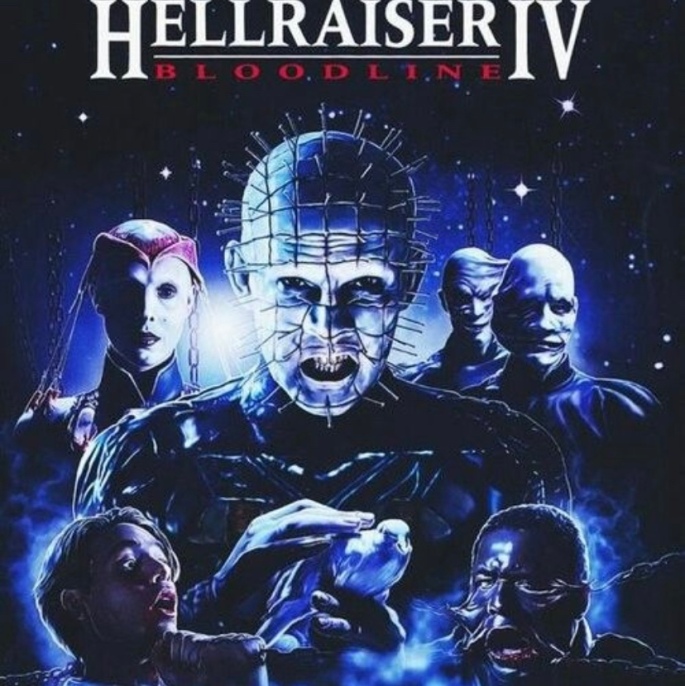
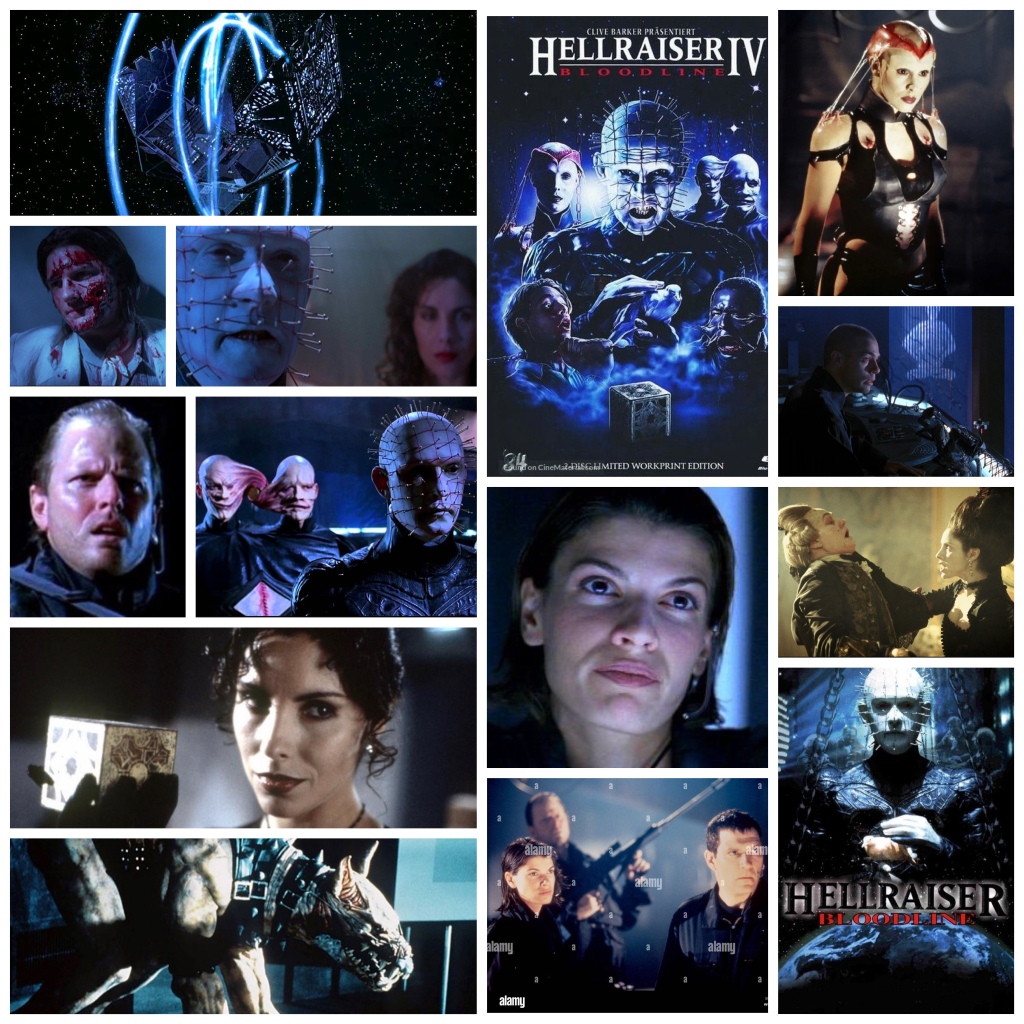
I recently binge watched all the Hellraiser sequels and man, they are one wild ride. One of my favourites is the fourth one, titled Bloodline, that traces a family lineage from French silly wig times where a toymaker first crafts the evil puzzle box for a dark magician, who initially conjures up Pinhead and his homies. The film traces this genesis into the 90’s art-world scene in a big city where the cube has been embedded into the architectural foundation of a skyscraper where it causes havoc, and then yet another timeline far, far into the future where a scientist on a massive deep space station experiments on the box, trying to put a stop to Pinhead and close the hellish portal for good. It’s an ambitious, wildly entertaining, boundlessly imaginative sequel that covers thousands of years and many characters including a sultry demon princess (Valentina Vargas) who is first summoned in French silly wig era by a very young Adam Scott, who wishes he never met her. She’s terrific and adds a sort of supernatural femme fatale aesthetic to the mythos. Doug Bradley is off the chain here and this is by far my favourite of his Pinhead turns in any of the films. He gets a whopping amount of screen time (often not the case in these sequels) and is a terrifying, antagonistic asshole who feels like an actual tangible threat here instead of his sometimes illusory, half-there half-not theatrical presence. I appreciate such ambition in horror sequels, where the same retread or motifs aren’t just tiredly recycled through new characters and settings, but actual innovation is employed and new lore is pioneered into the canon. The outer space stuff is a fucking blast, as the team of mercenaries played by recognizable faces (Christine Harnos & Pat Skipper are awesome) race against time to find the scientist before all hell breaks loose where no one can hear you scream. The finale is a jaw dropper and one of the most creative moments in the entire franchise as the space station becomes… something more, it’s a slow-clap moment of adrenaline pumping sound and fury and, in a way, the final narrative beat of the entire Hellraiser legacy, despite the fact that there are many more films to come. I would say this is tied with the second film, Hellbound, as my favourite in the series, it’s so well structured, gory as ever, creatively inspired and just so much fun. Oh yeah and there’s a Cenobite dog, too! So badass.
Lady In White is one in a handful of films I like to think of as the “child oriented yet still pretty terrifying live action horror” sub-genre, it sits alongside a few ones that Disney did like Watcher In The Woods, Something Wicked This Way Comes and the British produced Afraid Of The Dark. They’re geared towards younger audiences in a sense, but they still have dark, macabre, uncompromising themes and seriously spooky aspects. It’s taken me a long time to find this one but it was worth that wait as it’s pretty much the best of the bunch, a sensational ghost story/mystery/serial killer procedural with wonderful performances all across the board, some gorgeous upstate New York autumnal vibes and warmhearted Italian American family dynamics sold splendidly by all among the cast. As a grownup writer from the city (Frank LaLoggia, also the immensely talented writer/director) revisits his childhood home in the country, he recounts, in blessedly hushed campfire tones, a few years in his life as a boy (played by Lukas Haas) where he encountered several ghosts in a hair raising series of events. As an elusive child murderer plagued their township and the surrounding area eluding police for years, the boy is visited by the wandering spirit of one of his victims (Joelle Jacobi, unsettling and sympathetic in the same beat) who can’t find her way to the other side until her killer is caught. So begins a rousing tale of fright and menace as the murderer, lurking in plain sight, is slowly sought by the living and the dead alike in spectral collaboration. A lot of time is spent with the boy and his family, and one gets the sense of a realistic, loving, hectic atmosphere of growing up in that era. Alex Rocco from The Godfather is sensational as the boy’s father, who has a tough guy exterior but a very vulnerable heart underneath. The film exudes genuine warmth and affection between the human beings who are alive, truly authentic sadness and melancholic longing for those that are not and offers some of the most severely frightening ghost encounters I’ve seen in film, particularly a sequence where the boy observes a flashback in real time of the exact moment the girl was murdered that is soul shaking in its blunt, disturbing honesty and raw performance from the young actress. Lots of time passes in the story so not only do we get to see a chilly, bucolic Halloween pass by in this lovely little county, we also see Christmas come for some bonus holiday vibes. It’s a brilliant film, full of grand set pieces, down to earth characters, a sense of dark realism that doesn’t sugarcoat the more unpleasant realities in life, an absolutely horrifying villain, effective special effects for the ghosts, tons of shadowy, elemental, earthen atmosphere and a showstopper of a climax set atop windy bluffs overlooking stark, deadly cliffs high above the ocean below. About as close as you can come to a perfect spooky season film.
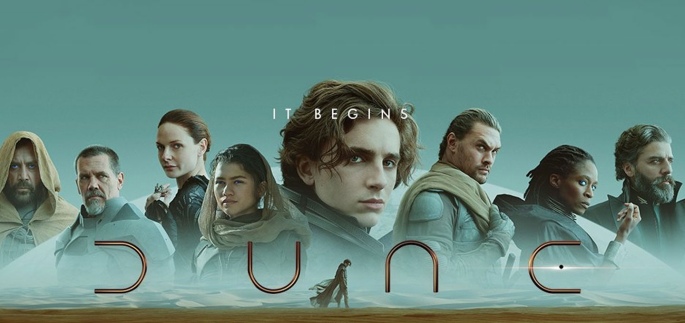
It’s been a long wait for Dune, but it’s finally here and let me tell you it was worth it. I didn’t get to see it in theatres because my country has gone collectively insane for a minute (hopefully a temporary situation) but it’s a strong testament to Denis Villeneuve and his entire creative team that even on my modest 55” TV with a JBL soundbar, this thing is one powerful spectacle of immense, grandiose science fiction storytelling, a Shakespearean space opera for the ages and the culmination of this filmmaker’s work so far reaching a fever pitch of visual creative energy, motion and sound. Obvious comparisons will be drawn between this and David Lynch’s notorious 1980’s version of Frank Herbert’s novel, but I won’t be making any other than to say I deeply love both films for different reasons, and they are so far removed from one another in style, tone and essence I can’t even place them on the shelf next to one another. The story is told in broad, sweeping strokes with an elemental momentum to both the set pieces of thundering action and soulful, dialogue driven character interaction. Keystone sequences like the Harkonnen invasion, the spice harvester rescue and the Atreides house triumphantly arriving on Arrakis are handled with massive scope, vision, beautiful world building and breathtaking, dreamlike production design. Hans Zimmer’s reliably supersonic score is a bass soaked deep space lullaby, a trancelike composition that echoes his work in Villeneuve’s Blade Runner 2049 while organically blasting into new neural pathways of what is possible in music for film. I thought that Timothee Chalamet might annoy me as Paul, but he’s stellar, almost underplaying the enigmatic budding hero with a layered introspection and genuinely discernible arc from naive youngling prince to rough, rugged desert wanderer. All of the other actors are superb and imbue the characters with a subdued, mesmeric and haunted aura that adds to the spacey atmosphere, apart from Jason Momoa as fierce warrior Duncan Idaho, his performance is lively, brusque and the closest any of the actors get to down to earth. Stellan Skarsgard gives the same sort of villainous turn here as he did in Antoine Fuqua’s King Arthur, a wistful, distant and detached yet quietly malicious and rotten bastard of a Baron, like an evil floating Humpty Dumpty, but in a good way. My favourite performance of the film goes to an unassuming Rebecca Ferguson as Lady Jessica, a character not featured all that heavily in the marketing but one that comes across as the desperate soul of the film, a loving mother torn between her fealty to a strange sisterhood of weird nun magicians and her love for Paul and Duke Leto (Oscar Isaac is superb) and her people. Ferguson is eerie, wide eyed and charismatic in the type of way that holds you attention raptly, the only performance in this film that feels like it might be at home in Lynch’s version of Dune. The world presented here is tangible, tactile, the special effects are a seamless blend of CGI and practical, the baroque design of dragonfly winged spacecrafts, mammoth ancient pyramids, impossibly detailed metallic frescoes depicting the lore and history of these civilizations are a magisterial tapestry of woven visual creativity, costume design, detailed wildlife and anthropological wonder that will sweep you away into this realm. My only complaint is that, because this is only part one, the air gets sucked out of the room narratively speaking when this thing ends and I felt an aching yearn for the continuation of the story, which it looks like we will now indeed get and I understand that Villeneuve made a wise choice splitting the novel up to let the story breathe, but it still finishes on an airy exhale that leaves you craving more. I’m excited for part two, there are several characters that *are* featured a lot in marketing that only show up for like, five minutes or less, I want to see this story develop further so that I may get to know them, experience more brilliant performances and sink deeper into this gorgeous, hypnotic, mythologically rich universe. Great film.
Ken Russell’s Gothic reminds me of one of those nights where you and a group of your friends all get hammered and take psychedelics together but accidentally forget to designate one amongst the group to stay sober and take care of the rest, so you all just kind of collectively lose it without a sane babysitter to steer you away from a bad trip. In this case the group of friends in question includes Lord Byron (Gabriel Byrne), his doe-eyed concubine (Myriam Cyr), Mary Shelley (Natasha Richardson), her poet husband (Julian Sands) and John Polidori (Timothy Spall), and if you’re even vaguely familiar with their real life literary works it wouldn’t even surprise me that the lot of them were out of their heads on all sorts of drugs. All metaphors aside this is a fantastic, warped, fever dream shock horror film that provides an abundance of perverse enjoyment, provided you have the strong stomach, deranged sensibilities and capacity for abstraction required to get perverse enjoyment out of what can only be described as really fucking weird shit. As the odd group engages in tantalizing swinger’s foreplay and picks each other’s brains, subtle supernatural things start to show up, then all hell breaks loose after they conduct an impromptu seance around a supposedly enchanted skull. This is my first Ken Russell film and I already love his work, the guy just likes to roll up his sleeves and get unapologetically bizarre for the sheer joy of it. Natasha Richardson’s Mary Shelley is the eventual main focal point of the group and both her wonderful, edgy performance and the night in question subtly suggests what past traumas and diabolical new inspirations led to the genesis idea for her iconic Frankenstein novel, while Byrne’s impossibly sleazy Byron hovers in the background, a hedonistic tornado of deviant sexual energy and debutant petulance that the actor, still early in his career, tears into with seething voracity. Russell himself is a wizard of hallucinatory panic, visual madness and disorienting, hair raising sound design, with a lot of help from a terrifically spine chilling score by the one and only Thomas Dolby. The experience is one of dementedly strange horror, with indescribable monsters lurking around every corner and edifice of Byron’s spooky mansion, a constant state of mental disarray, existential confusion and otherworldly anxiety inflicted both upon the characters and audience alike, a truly immersive realm of a film. It’s a shame this isn’t really more widely available, streaming, physical or otherwise because it’s essential for any horror fan. I watched it on YouTube with surprisingly decent picture and sound quality, I suppose that will have to do for now. Excellent film.
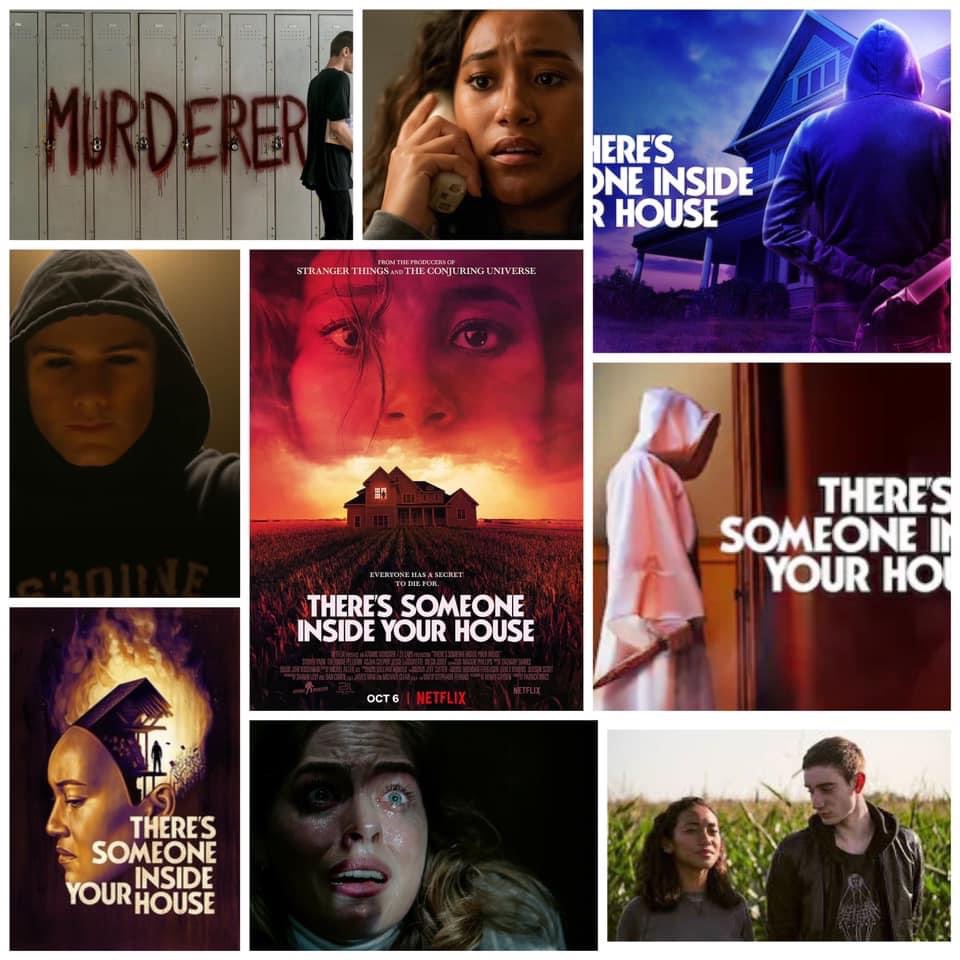
Netflix and filmmaker Patrick Brice (the effective DIY Creep films) try their hand at a classic slasher frolic with 80’s influences for There’s Someone Inside Your House, a surprisingly grisly horror that works, for the most part, when the script isn’t trying to be too contemporary and ‘of the minute’ with tiresome buzzwords. It concerns a group of teens from one of those football, cornfield, jock jacket Midwest towns where the local high school has all the regular archetypes, here written through a prism of updated millennial banter that probably should have been dialed down. Someone is going around ruthlessly murdering people, each victim with a terrible, life changing secret that gets exposed alongside their killing, the murderer wearing a 3D printed mask of their prey each and every time. It’s a cool idea; a killer who uses secrets as lethally as blunt objects or blades, and when they come for you, you see an unsettlingly pristine prosthetic mirror image of yourself staring back at you. The film’s third act and Scream-esque revelations based on the killer’s identity reveal feel a bit anticlimactic, while the setup and ferocious midsection boast some truly inspired and gruesome kills, the opening murder involving severed Achilles’ tendons will be enough to make even the most seasoned gore hound wince. Much use is made of the cornfield setting, the locations have a desolate, wide open feel to them and of course they fucking shot it in Vancouver and Chilliwack and tried to pass it off as the States because they’ve got no imagination. It’s the sort of mid level, not classic but still pretty enjoyable slasher flick you’d see in the 80’s and 90’s, something like a tribute to Urban Legend or I Know What You Did Last Summer that isn’t destined for greatness or franchise notoriety, yet still does the trick. The woke stuff could have been toned down though, it takes you right out of the era they’re trying to place you in as it’s so obviously shoehorned in. Good kills and atmosphere though, and just check out that gorgeous poster.
Josh Ruben’s Werewolves Within is the second snowbound, dark comedy werewolf movie made this year, which seems like a crazy coincidence until you remember stuff like Armageddon and Deep Impact or Volcano and Dante’s Peak, both pairs from the same year. It’s a popular trend and there’s always one that stands out as the better version of whatever sub genre they’re exploring, and this is certainly a far stronger film than Wolf Of Snow Hollow, which I was underwhelmed by. I don’t want to compare them too much but this one just nails the mile a minute dialogue, quaint characterization and pitch black comedic notes way better, and the inevitable whodunit of which character is the wolf is far more fun too. In a ski resort town in upstate NY, a various motley skeleton crew of local residents are being hunted and attacked by a werewolf, and one amongst them is responsible for it, hiding in plain sight. The twitchy, meek rookie park ranger (Sam Richardson) and bubbly, hyperactive mailwoman (Milena Vayntraub) try to keep the peace but these people love to bicker like I’ve never seen before, they’re worse than a room full of divorced parents. Some cast standouts include Wayne Duvall (Prisoners, O Brother Where Art Thou) as a smarmy, booze guzzling industrialist trying to buy out the town for an oil pipeline and Glenn Fleshler (True Detective, Hannibal) as a pelt adorned, perpetually grumpy mountain man who is sometimes indistinguishable from the werewolf itself and looks like he just walked in from Last Of The Mohicans. So begins an Agatha Christie type countdown as characters are dispatched in bloody fashion and the unveiling of the wolf’s identity draws nearer. The film is tons of fun thanks to a sharp, pithy script and a host of appropriately caffeinated actors who hit the ground running and all give wonderfully lively work. It’s kind of a slight, mild horror with the emphasis on comedy, it careens by like a rogue snowdrift and is a solid good time.
When David Gordon Green’s 2018 Halloween dropped I didn’t quite believe that talk of an entire trilogy was true because we’ve heard that one before. As such, there were things that felt unwieldy, strange and open ended in the narrative that are explored further and deeper in Halloween Kills, a film that is getting some serious bad mojo out there in internet land. Well, it’s certainly not perfect, but I still enjoyed it for what it was: an expansion on the 1978 Halloween night and Myers lore with a whole circus tent of new characters, comic relief asides, callbacks, fresh themes and a surprising amount of actors from Carpenter’s original film returning once again. It’s hectic, it’s cluttered, at times it feels like far too much is going on but there’s also this feverish momentum to it as Jamie Lee Curtis’s Laurie and her whole band frantically run about trying to track down Michael and kill him. There’s her daughter Karen played by the always lovely Judy Greer and granddaughter Allyson played by Andi Matichak, a wonderful actress who creates a character you care about and is the emotional lynchpin of this new vision, I like the dynamic between the three of them that is given more room to develop here. Will Patton returns as Haddonfield’s toughest Sheriff’s Deputy, it’s always nice to see him and I’m not sure what’s spoiler territory or not in mentioning who shows up but none of it seems to really be a secret, they are kind of hit and miss across the board. Anthony Michael Hall is oddly stilted and stiff as grown up Tommy Doyle (where’s the 78 Doyle actor?) , while Kyle Richards is utterly sensational reprising her role as now adult Lindsay Wallace, she has become a terrific actress, a beautiful woman and the closest the film gets to a true retro Scream Queen, she rocks it in the single most suspenseful Michael sequence I’ve seen in these intense new visions. Equally effective is the wonderful Robert Longstreet as adult Lonnie Elam, exuding the same gritty humanity he brought to Mike Flanagan’s Haunting Of Hill House and Midnight Mass. This might be the most ambitious Halloween sequel we’ve seen yet and, naturally, not all of it works or clicks into place in a way that feels earned and organic, but look back at each instalment in the canon and you’ll find films that aren’t perfect, are rough around the edges but to a true diehard fan of this franchise (raises hand) all have some lovable quality or aspect that can be enjoyed and held dear. Except for for Resurrection, fuck that movie right up it’s Jack o’ lantern ass. But Kills is a sequel with a lot of inspiration and heart for the Myers mythos, the overarching Haddonfield saga and the slasher motif. There’s a sequence in the film where Haddonfield’s residents are whipped up into an angry, frenzied mob trying to hunt down Michael, but they become a maniacal, non thinking rabble with tunnel vision instead of carefully examining their situation and forming a tactical, realistic plan. I see a lot of that on the interwebs, where one bad review snowballs into a fervour of keyboard mashing until a big dumb mob forms to rip the film a new one. But did that first guy even see the thing, or form a focused, logical assessment of why the film is bad? Did you, dear critic, even read that before suiting up and joining the ranks? If you saw Halloween Kills and genuinely thought it was a bad film and can concisely articulate for us why it didn’t work for you, then carry on. But don’t just pitch your voice in tune with the din because that’s the way the fish are swimming, because that doesn’t make you cool, babe, it just makes you boring. I for one got a lot of enjoyment from the film, both in that special nostalgic spooky way the original two films made me feel and in a fascinating expansion of lore sensibility too. It’s not a perfect film and maybe not even a great one, but it sure works as an effective, formidable and entertaining chapter of the Michael Myers legacy for me.
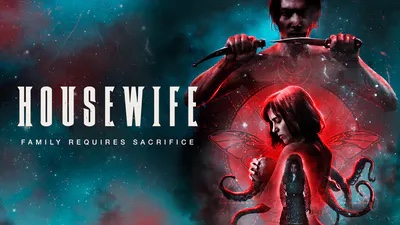
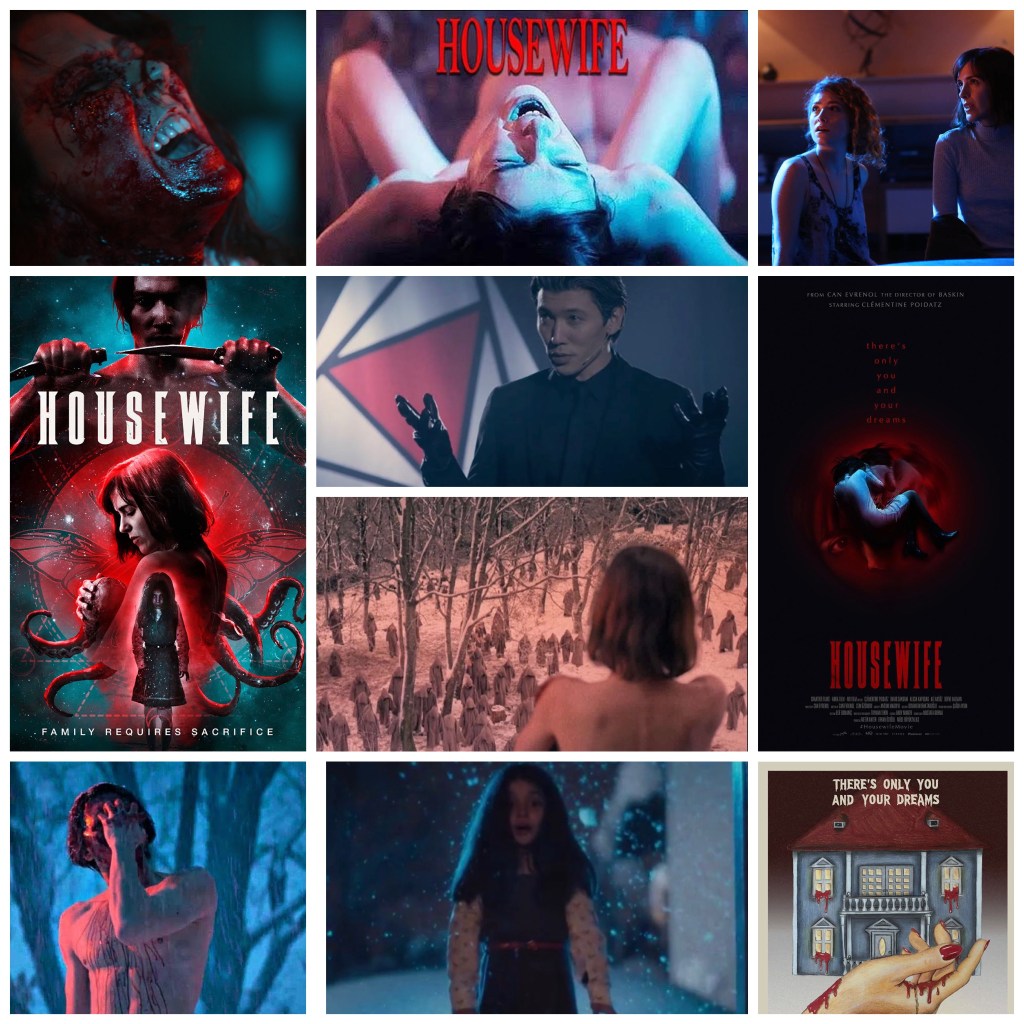
I wasn’t quite prepared for Can Evrenol’s Housewife, a disarmingly gruesome slow burn horror flick that I went into blindly on purpose. Had I looked it up first I might have seen that Turkish director Evrenol is also responsible for another notoriously fucked up horror called Baskin, which I’ve heard many a rumour about but have been circling for years as I just don’t have the stomach for the heavy stuff like I used to. Anyways I waded into Housewife uninformed and unassuming and, well… it’s quite the fucking experience. It tells of a girl (Clémentine Poidatz) living in Istanbul with her husband, who is troubled by nightmarish dreams of her traumatized youth where she watched her mentally ill mother murder her older sister, for starters. She always feels on the edge of that same mental instability, which is put to the test when she reconnects with an estranged best friend who has become deeply involved with a dangerous doomsday cult, particularly it’s charismatic leader (David Sakurai). The film starts off as an eerie, cerebral, glacial buildup full of terse atmospheric visuals and a truly genius, beautifully spooky musical score but as soon the cult angle barrels into the narrative it gets wild and bloody pretty quick, which is a shocking left turn. The ever present yet unseen threat of something bad turns into a geyser of gore, torn off faces, ruthless umbrella shankings, slimy demonic babies, hooting and hollering insanity of clamouring cult members and a third act that is so far beyond the stratosphere of subtlety that all I could do was laugh with the characters as they succumb to the frenzied, maniacal final beat of the narrative that would be too much if it wasn’t just too damn hilarious in a “throw your hands up and surrender to the shenanigans” type of way. I think I liked the first half of the film more, it feels like the measured, dread soaked first two acts of Rosemary’s Baby in tone and atmosphere, obviously way more R rated, contemporary and balls-out psychosexual than that creaky old classic. And where that one never showed the grisly viscera in person, only ever suggested it, this film shows *everything*, and trust me it ain’t pretty. There’s an ethereal beauty and calculated, delicate menace to the buildup and while the third act fells a tad cluttered, a bit too grotesque in some frames and nothing like the hushed, reverent opening acts, I admired its sheer willingness to plough head on into kinky, perverse, violent sex games and some hysterically over the top Lovecraftian cosmic pandemonium. It’s good, but bring a titanium lined stomach or a Costco orders worth of barf bags because it’s a truly sickening experience, the kind of gross-out Euro erotica shocker madness that most North American audiences just are not used to.










 Podcasting Them Softly