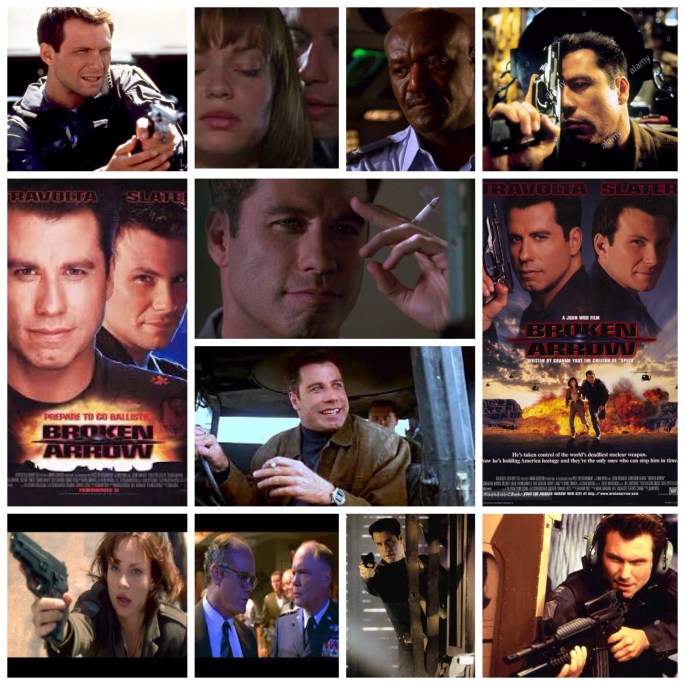
When Hong Kong action alchemist John Woo mixes up his gracefully brutal aesthetic with big budget Hollywood high gloss, the results are an irresistible flavour. While not quite the balls out, blitzkrieg masterpiece that Face/Off is, his military gong show Broken Arrow is still one walk on the wild side of stunts, explosions, overblown madness and maniacal behaviour from John Travolta, who seems to be amping up the histrionics in double time just to cover Nicolas Cage’s shift this time around. He’s a navy pilot psycho called Deakins here, an unstable traitor who hijacks a volatile nuclear warhead and holds congress hostage, giggling like a schoolgirl the whole time. It’s up to his trainee and former partner Hale (Christian Slater) to hunt him through Death Valley where they’ve crashed, causing as much pyrotechnic commotion as possible and prep for the inevitable one on one smackdown that’s neatly foreshadowed by an opening credits boxing sequence between the two that’s an appetizer for the adrenal glands in prep for the chaos to follow. The action is fast, fierce and extremely violent, as is the amped up macho banter between the two, but Travolta really takes the role and sails off the charts into the ‘here there be dragons’ realm of acting reserved for only the most memorably over the top performances in history. “You’re fucking insane”, Slater sneers at him; “Yeah! Ain’t it cool?” Travolta smirks back with a face that would be straight if not for the knowing glint in his eyes. Park ranger Samantha Mathis helps Slater in his quest to bring the lunatic down, and there’s an impressive laundry list of character actors rounding out the military faction including Howie Long, Delroy Lindo, Frank Whaley, Bob Gunton, Chris Mulkey, Daniel Von Bargen, Vondie Curtis Hall, Jack Thompson, French Stewart, Raymond Cruz and Kurtwood ‘Red Forman’ Smith. Hans Zimmer does the score here and it’s an undervalued composition in his canon, a chromed up tune that drips cool and hurtles alongside the action awesomely. Woo has had some dodgy luck in Hollywood since (Mission Impossible 2 and Paycheck are painful), but this is one of his best stabs at the Western style of action, brought to eccentric life by Travolta’s oddball psycho and full of crazy ass action spectacle.
Russell Mulcahy’s Ricochet is a fucking balls out, crazy ass flick. I thought I’d get s routinely hard boiled Denzel cop flick a lá Out Of Time or The Mighty Quinn, but this thing is more aligned to the nasty grindhouse flicks from the 70’s, starting with its terrifying villain played by John Lithgow. Lithgow has always had a flair for playing heinous creeps in everything from Cliffhanger to Raising Cain to Showtime’s Dexter. His character here though would intimidate all of those dudes put together he’s such a monster. Cornered by rookie cop Nick Styles (Washington) at an amusement park, hitman Blake (Lithgow) is captured and put away for life. Styles goes on to become Assistant D.A. Years later Blake hatches an ultra violent plan to bust out of prison that includes killing Jesse Ventura, maiming guards with various power tools, inciting a riot, hijacking an ambulance and shooting the old dude that brings the book trolley around to the inmates. If that sounds bad, you wouldn’t believe the lengths of evil stored in his plan for revenge against Denzel, he’s just a sadist and then some, Lithgow really has fun with the role and it’s the twisted core that powers the film through its dark beats. This thing reaches Abel Ferrara levels of grit and urban mayhem, and maybe even exceeds them. Styles finds himself at a loss when he’s framed for murder by the guy, and turns to his old pal Odessa for help, a gnarly street thug played by Ice T, customary verbal attitude fully intact. One could say that Mulcahy has made a pretty great career out of making lurid, bear exploitation style films. This is definitely the benchmark of how down n’ dirty he’s gotten with a project though, it’s deliciously wicked, cheerfully in bad taste and mean to the bone, and I loved it for that.
Hard Cash, aka Run For The Money in some regions, is a silly piece of junk, with its low budget passport grasped firmly in hand. Every actor doing the hammy shtick, every pulp B movie cliche present and accounted for. Christian Slater seems to have peppered his career with a bunch of such flicks, and he’s front and centre here as the Robin Hood-esque leader of a buncha’ thieves. He’s a bit of a legend, and goes for one job too many, a job that lands corrupt, scheming FBI Agent Val Kilmer straight in his lap when he lifts some marked bills. Kilmer wants it only to take them down, but a giant piece of the loot for himself and basically is just a greedy bastard, while Slater wants to break even and get away with his crew. It’s okay-ish stuff, decidedly low brow but that’s the arena. Kilmer is actually really fun in a candid, often improvised take, and his description of himself when he gets to little sleep is priceless. The cast is fairly strong, with work from Bokeem Woodbine, Sara Downing, Vincent Laresca, Balthazar Getty, Daryl Hannah, William Forsythe as a nastily racist fence and the late Verne ‘Mini Me’ Troyer as Slater’s most valuable lil’ asset as he can fit in tight spaces the rest of the crew can’t. It’s breezy trash, decent enough for what it is.
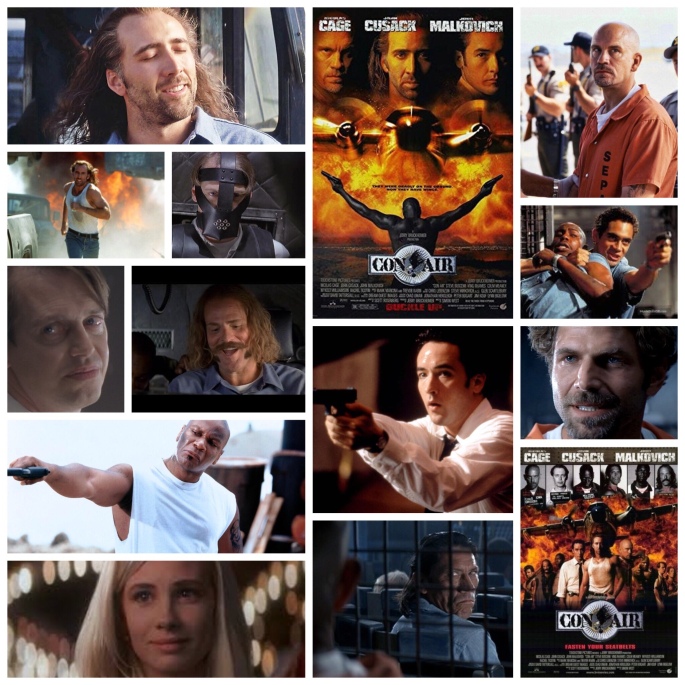
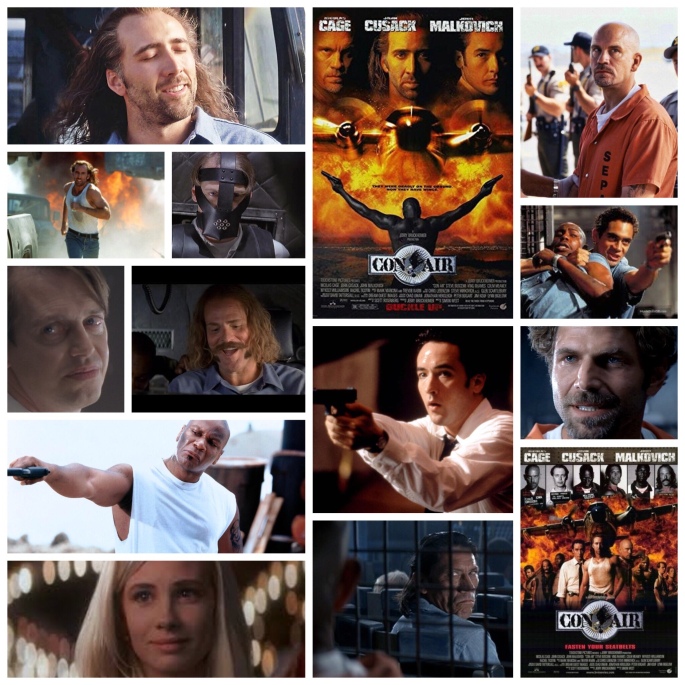
Con Air, man. Is there a better movie about inmates who take over an airplane and hold the guards hostage? It’s actually the only movie about that, but in all seriousness it’s one hell of a blast of summer action movie fireworks, and it holds up like a fucking diamond to this day. It’s ridiculous and it full well knows it, but producers Jerry Bruckheimer and notorious pyrotechnics enthusiast Don Simpson start at outlandish and only ascend from there, until there’s so many explosions, crashes, bangs, tough guy banter, graphic violence and commotion that it reaches a fever pitch and you kind of just surrender to the onslaught and get lost in hyperkinetic bliss for two glorious hours. One of the biggest assets the film has is the script by cunning linguist Scott Rosenberg (Things To Do In Denver When You’re Dead), who gives every character at least a handful of one liners and keeps the dialogue fresh, cynical and never short on laughs. Nicolas Cage and his tangled, flowing mane of hair play Cameron Poe, a good ol’ Alabama boy just off of a jail stint for accidentally killing a redneck asshole (Kevin ‘Waingro’ Gage) who verbally assaulted his beautiful wife (Monica Potter). Here’s the setup: he’s paroled and stuck on a giant aircraft thats sole purpose is to transport convicts around the country. Now the department of corrections being the geniuses that they are (John Cusack is the head genius in this case), they decide to populate this particular flight with literally the worst group of psychotic, ill adjusted, murdering dissidents that ‘Murcia has to offer, because staggering them over a few flights or peppering just a few monsters in with the regular convicts every third or fourth flight just makes too much sense, or, as we the audience must remember and revere, there would be no bombastically entertaining hook for a story like this. Of course the plane gets taken over, the inmates run a very big flying asylum and many people die in many different ways, while Cage sticks around to play hero, protect his cell mate friend (Mykelti Williamson) and take out as many of these bastards as he can, often with his bare hands. Talk about eclectic, layered casts; everyone is in this flick, starting with scary John Malkovich as Cyrus ‘The Virus’ Grissom, a career criminal who claims he’s killed more people than cancer. Yeah. Ving Rhames is a hulking lunatic called Diamond Dog, vicious Nick Chinlund scores points as mass murderer Billy Bedlam, Danny Trejo is a heinous piece of work called Johnny 23 on account of his numerous rape charges, and there’s all manner of creeps, scoundrels and scumbags including Dave Chappelle, M.C. Gainey, Juan Fernandez, Emilio Riviera, Doug Hutchison and more. Colm Meaney, Don S. Davis, Rachel Ticotin and Powers Boothe make impressions as well, but it’s Steve Buscemi who takes the cake as a Hannibal Lecter-esque nutjob named Garland Greene, who’s so dangerous that corrections officers will literally only touch him with ten foot poles. It’s an action movie that dares to get really down n’ dirty, and probably wouldn’t get made today, or at least not without a few tweaks to its very profane, deliberately messed up script. I wouldn’t have the thing any other way though, not only is it mean and nasty, it’s got all the bells and whistles of a summer blockbuster, plus the Lerner Airfield sequence and the Vegas strip landing set piece are two of the most monumentally raucous action undertakings I’ve ever seen, not to mention the subsequent fire truck chase that destroys half the city and makes gruesome use of a pile driver. This film is as far over the top as the altitude that the plane flies at, and then some.
I love scrappy little cop flicks like Clint Eastwood’s The Gauntlet, a short, trashy exercise in exploitation that’s not only a departure from the heady, cerebral detective flicks he does but also miles off of the focused, gritty machismo of the Dirty Harry films. This is a low rent B movie and is proud of it, which is a rare commodity in Eastwood land. Boasting a terminally silly plot, lovably incapable protagonist and more bullets fired than all three Matrix movies stacked together, it’s a great way to spend a Saturday night when you have a hankering for old school action. Eastwood is Ben Shockley here, a disheveled mess of a Phoenix cop, heavily on the sauce and in no mood for the mission his uptight commissioner (William Prince, needing a moustache to twirl in his portrait of unapologetic evil) dispatches him on. He’s to escort a troublesome hooker (Sondra Locke) from Vegas back to Arizona where she will testify at a high profile mob trial. Of course every bent cop and his mother is on their trail, they can’t trust anyone in law enforcement and they’re on their own, forced to run a gauntlet of gunfire and corruption to bring her in. There’s three very odd, very hilarious set pieces that involve gunmen just fucking unloading clip after clip after clip in a way that the you might see on the Looney Toons, until the house they’re firing at *literally* falls apart. That’s the sort of slapdash style the film has, but it works in its dense specificity. Eastwood and Locke have chemistry, and it’s always cool to see the chicks in his action films have their own personality and impact on plot, not just part of the scenery or eye candy. Prince is so nefarious as the Commissioner that one wonders how a man like that ascended the ranks to that position, but in a film where’s he’s allowed to shut down a city block and order the *entire* Phoenix police force to empty boxes of bullets into an oncoming bus that Eastwood rolls up in, it isn’t that much of a stretch to believe. It’s just that kind of film, and I dug it a lot. Oh and look at that epic one sheet of a poster, whoever designed that should get a few medals. Great flick.
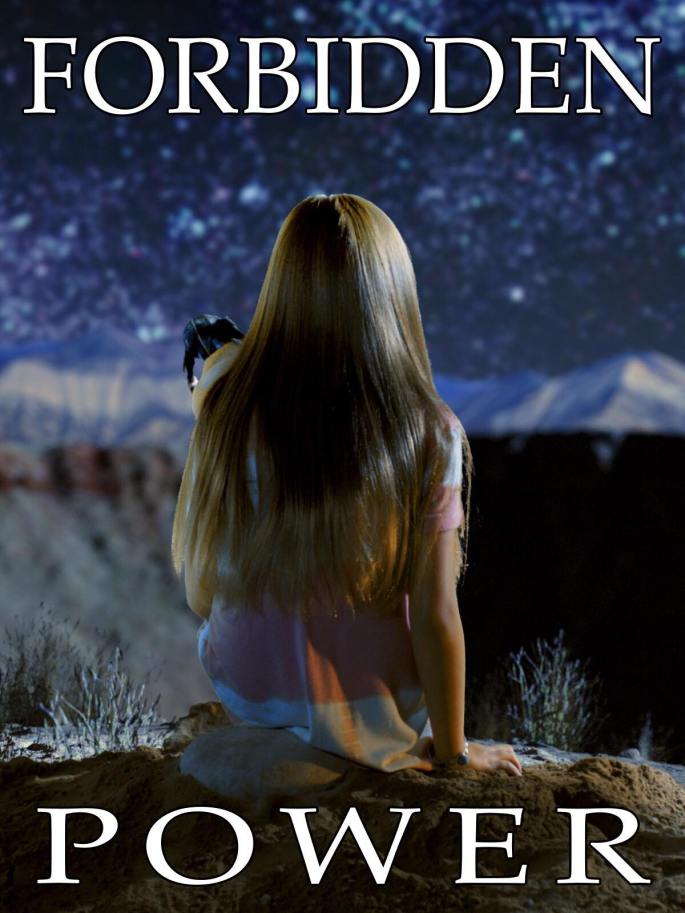
The films of Paul Kyriazi hold a special place in my cinema-viewing adventures throughout the years. I, naturally, encountered them during the heady days of the era of VHS – I still have my copies in that format of Paul’s work. Then, not unlike Terrence Malick, Paul disappeared, and I lamented his absence having come to admire his film-making style and diversity.
So, rejoice I did, when I learned that he had returned to the director’s chair. Eagerly I sat down to watch Forbidden Power – and I was not disappointed. With his new film, Paul returns with his unique voice, his visual dexterity and his great command of unfolding an exciting thriller that doesn’t release its grip on you till it’s time to fade to black.
Fascinated by his study in the field of personal empowerment, Paul takes us on a journey where the achieving of super-human abilities is contracted via sexual intercourse. The character at the center of the story is a mysterious and provocative woman – who seemingly hypnotizes her partners with a type of mystical persuasion. The character we follow, after his eerie yet passion-fueled encounter with the female antagonist, wakes to find her vanished, but also having left behind for him a gift of sorts.
In this superhero-movie-saturated age we find ourselves, it was refreshing to witness a different spin on the getting of super-powers. Our hero, just like in any superhero origin story, has a delightful time discovering the extent of his new-found abilities. But, as it is with the coming of great power, there comes along with it, great responsibility.
Thus we go along on the adventure, and soon discover that plot is deeper than one might first imagine. I’ve no intention of spoiling it for you here, because I want you to see the movie. What it will say is – this is well crafted film-making that you can definitely become immersed in.
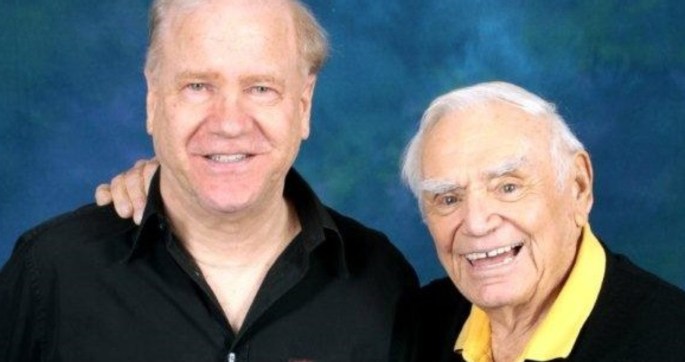
It was a true honor for this fan, not only to talk to Paul, but also to two of the film’s stars – the stunning and talented Nazanin Nuri and the man, the legend, Harry Mok (another exceptional, multi-talented performer whom I too, like Paul, encountered first in the heyday of home video).
I encourage you to seek out Forbidden Power, if you are a fan of Kyriazi cinema or not. I promise you, you will not be disappointed…
At age 8, I see The Making of 20,000 Leagues Under the Sea on Disneyland TV and decided to become a movie director. Age 16, I start filming 20 minute action stories using my father’s 8mm camera. Age 18, my father bought me a used Bolex camera. I film a 30 min color action movie titled Trapped and it wins the Berkeley Film Festival. I start taking karate to be like James Bond. My Sensei introduces me to samurai movies. Seeing that action with great film techniques of the Japanese directors, moves me into martial arts movies, even before the TV show Kung Fu. I transferred to San Francisco State University making more 20 minute karate stories and placing 3rd in the next Berkeley Film Festival. I graduate with a BA in film. I join the Air Force movie department and film space launches for NASA. I take leave to film my first feature Drawn Swords in 35mm black & white Techniscope. It’s about 3 samurai going to England to enter a fencing tournament. I use all my cash and credit cards, loans, and refinancing my car. I get out of the Air Force and return to San Francisco unable to sell my movie. I promise myself if I get another break I will make a color movie that is so commercial the distributors will have to buy it. I meet karate tournament fighter Ron Marchini who has me re-edit and sell his Philippine produced movie Murder in the Orient. Ron then hired me to write and direct Death Machines. To be commercial, we come up with a story of 3 karate killers (white, black, Asian) to cover all markets. Then we add a cop/gangster plot, big fight scenes in a karate dojo, bar, and police station, and we actually blew up a piper cub airplane. The completed movie is immediately picked up by Crown International Pictures with big advertising. It opened in 50 theaters in LA making it a #14 top grosser. However, I still can’t raise the money to produce my own movie, so I direct a sequence for Sesame Street. I pick up a copy of The Million Dollar Secret Hidden in Your Mind by Anthony Norvel. I take his classes for three months in LA, then return to the San Francisco. In 10 days I raise the money to produce and direct Weapons of Death. The panavision film plays all over the USA breaking a house record in a New York theater. I next produce and direct Ninja Busters. This was followed by the cops and gangsters story One Way Out. Next came writing and directing Omega Cop starring: Adam ‘Batman’ West, Troy Donahue, and Stuart Whitman. An actress from Weapons of Death hires me to produce a travelogue in Phuket, Thailand, Thailand Adventure proving you never know what contact will end up getting you movie work. I write two novels in hopes of getting them produced as movies. When many people ask me “How do you survive as a freelance?” I write How to Live the James Bond Lifestyle. In 2003, I produce In the West – a 90 minute travel production for Japan. Appearance by Pat Morita. In 2005, I produce my novel Rock Star Rising as an audio-book narrated by Rod Taylor, performed by Russ Tamblyn, George Chakiris, Robert Culp, James Darren, and Kevin McCarthy. It has full effects and music, making it an “audio movie” of sorts. In 2006, I direct the largest production in audio-book history, McKnight’s Memory. Narrated by Frank Sinatra Jr, it stars Robert Culp, Nancy Kwan, Don Stroud, Henry Silva, Alan Young, David Hedison, and Edd Kookie Byrnes. In 2007, I Direct Edd Byrnes’ My Casino Caper audio-book. It’s Edd’s memoir of being stalked for his 3 million dollar Las Vegas win. With Alan Young, Henry Silva, and David Hedison playing themselves, recreating the incident that happened in 1977. Michael Callen plays the part of criminal that stalked Edd. In 2008, I direct Barbara Leigh’s The King, McQueen, and the Love Machine audio-book. Her memoir of being a top model involved with Elvis, Steve McQueen and MGM president Jim Aubrey. Joe Esposito introduces it and plays himself in the dramatizations. In 2012, I update & expand the James Bond Lifestyle on Kindle, Nook, iTunes & Kobo. In 2013, I write & produce – 3 Wild Thrillers – Three fiction stories on Kindle that includes the audio-book. In 2014, I produce The Mexican Swimmer, a 3 hour audio-book performed by Julian Scott Urena. I also write Wicked Players, a story of gambling and survival in wild Las Vegas
I always imagined moving to New York City, before even really knowing what that meant. As a child, I spoke gibberish, pretending to be American, and constantly begged my family to travel to New York. Somehow, without having ever seen any of it in person, I was fascinated by the skyscrapers, Statue of Liberty, and the opportunity New York City had to offer. For as long as I can remember, I had this recurring dream, where I was swimming for so long, exhausted and not sure where I was going, until finally I’d look up and realize I’d swam all the way to New York City. I’d wake up screaming, “I made it! I made it!” I finally left everything in Switzerland behind and made my way to US as an Au Pair. In 2012, with just two suitcases, I moved to San Francisco and lived with a host family. After a year in the states, I began to feel comfortable communicating and expressing myself in English. I extended my job for another year and moved to Long Island, New York. After working for two years as an Au Pair, I was ready to pursue my dream. I moved to New York City and signed up for ESL classes to master my English. As fate would have it, I stumbled upon The William Esper Studio, an acting school that changed my life forever. I was honored to be accepted in Bill Esper’s acting class and enrolled in the two year full-time program. As cheesy as it sounds, acting found me! As I studied the art and spent time learning the craft in my classes, I increasingly realized that my entire journey led me to what I really love. Acting is my calling and all I want to do in my life. At the end of my first year of acting school, I spent the summer of 2016 in Switzerland. I wrote and starred in my first short film entitled “Where Am I”. The film was very well received at the Wellington Film Festival with an honorable mention as it won the “Best Narration” category. I graduated from The William Esper Studio in summer 2017 and was right away cast as the lead – playing Veronica Hawthorn – in Paul Kyriazi’s feature film “Forbidden Power”. After we were done shooting “Forbidden Power” in Seattle I traveled to Utah to film an experimental short film that I wrote, produced and starred in. That untitled short film is in the editing phase and expected to be released in 2018
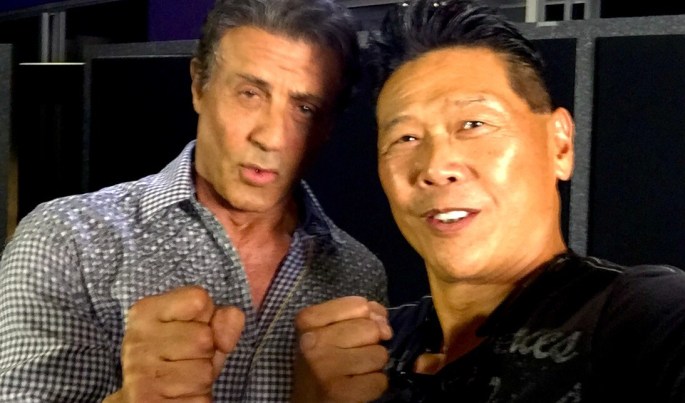
Harry Mok’s career in the entertainment industry is attributed to his well-known expertise in the martial arts field. His career began as an actor and stuntman, performing and or starring in such films as Rambo II, Uncommon Valor, TC 2000, Talons of the Eagle, Femme Fontaine, For Life or Death, College Kickboxers, The Vineyard, Tiger Claws II, Ninja Busters, and more. In 1987, Harry produced and wrote his first feature film, The Vineyard, which was released by New World Pictures. Shortly after, he began producing, creating, and designing action games for Atari/Time Warner Interactive. During this period, Harry invented a new filming technology, a 180 degree five camera blue/green screen system that would revolutionize digitization of 2D characters. He filed a patent for this technology. In August of 2005 Harry was honored with induction into the prestigious GSKA Black Belt Hall of Fame. In January 2007, he was inducted into the World Martial Arts Masters Hall of Fame. He is currently based in Northern California. He is one of the founders of 10+ Entertainment and is currently involved with producing a new reality show, New Hollywood Stars.
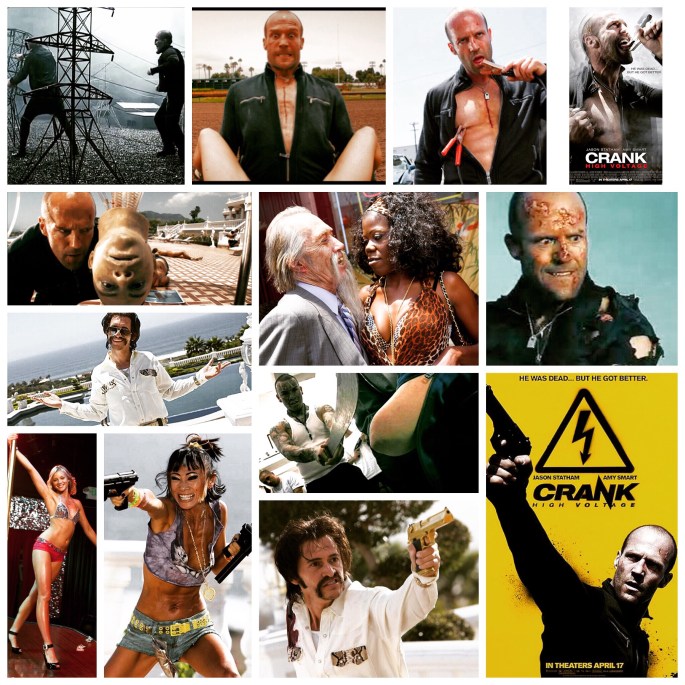
If you took Grand Theft Auto, The Looney Toons, bath salts, nitroglycerin, raw adrenaline, a bucket of piss, a spoonful of vinegar and a few ounces of C4 and chucked them all in a blender, you’d have something almost as utterly fucked as Neveldine/Taylor’s Crank 2: High Voltage, a sequel that leaves the first film somewhat in the dust, and if you’ve seen their initial Crank effort, you can imagine what a sheer feat that is. Cheerfully racist, unapologetically sexist, hedonistic in heaps and fully committed to being as mean, sleazy and batshit as movies can get, it turns an action movie into something truly out there. Jason Statham is the invincible Chev Chelios, a contract killer who gets put through the wringer when pretty much the entire organized crime faction in Los Angeles decides they want him dead. In the first film it was adrenaline that kept him going and here it’s electricity. Saddled with a weird synthetic heart, he’s on a mad roadrunner odyssey to get his original ticker back from legions of gangsters who want to sell it on the black market or transplant into the body of a weird old goat of a Triad boss called Poon Dong, played by David ‘do anything for a paycheque’ Carradine. Statham is a trooper, getting every part of his body fully zapped by all kinds of dangerous objects, engaging in shameless public sex once again with his spunky girlfriend (Amy Smart), this time in the middle of a horse racetrack. Explaining the plot is pointless because things just sort of… happen, in their own madcap way and it’s really hard to keep up with the kind of deranged marathon this thing runs. A frenzied strip club owner (the late Corey Haim) a thoroughly psychotic Asian hooker (Bai Ling), Chev’s ever loyal off-the-books Doctor (Dwight Yoakam) and all manner of punks, freaks, mafiosos and maladjusted urban monsters make appearances. Clifton Collins Jr. is equal parts terrifying and hilarious as El Huron, a flamboyant Cholo boss hellbent on killing Chev, but not before a few sadistic sideshow games first. The real heroes here are Neveldine and Taylor, two hyperkinetic ringmasters who aren’t afraid to get absolutely mental in their filmmaking process, injecting every bit of madness, mayhem and debauchery they can stuff into the script. Strippers getting shot in the tits and leaking silicone everywhere, a Mexican vato slicing off parts of a Chinese rival gang member and gleefully saying “check it out.. sushi!”, a severed head kept alive in a fish tank and a Godzilla inspired animated interlude are all but a taste of the bizarre pitstops this film makes on its hyper-violent, coked out flight path towards breaking the sound barrier. It’s either your thing or it isn’t, I mean I wouldn’t show it to my grandparents, it’d be a monumental exercise in tolerance for anyone with views that verge on conservatism. But fuck if it ain’t impressive for just for how far past the stratosphere it goes though, it’s like the first Crank film fell asleep, had a fever dream about itself and then this thing was birthed from that vision out of the death of a neutron star, mid explosion. I’ll stop because I’m running out of adjectives for ‘crazy’.
John Wick: Chapter 2 expands nicely on a mythology that we caught a glimpse of from behind the shadowy curtain of assassin’s anthropology in the first film, a fantastic meld of stylish world building and hyper violent, stunts driven action that saw Keanu Reeves come blasting back onto the big screen in probably the best role so far of his career. Chapter 2 has one big challenge to face though: the first one was driven by the fact that those fuckers killed his dog, and the man’s subsequent bloodlust over it. That was the crux, the catalyst, the reason we cheered so loudly each time he maimed or mauled someone. Now, I don’t need an excuse like that to watch an antihero slaughter people, but some might, and the dog thing just propelled him forward faster and furious…er. What’s the catalyst here? Well, they destroy his house. Not quite the emotional kick in the nuts you get from seeing a beagle murdered, but it seems to be enough to light Wick’s fuse again, so there you go. He’s faced with a figure from his past here, some fruitcake of an Italian mobster (Ricardo Scamarcio) who wants him to come out of retirement and kill his powerful sister (Claudia Geroni) to ensure his seat at a revered council table of international crime figures. It’s basically John Wick’s Eurotrip, as he treks across the pond to kill more goons and thoroughly destroy more night clubs and other such convenient set pieces than you can shake a stick at, before returning back to New York for an ultra-violent third act. John Leguizamo, the always awesome Ian McShane, Lance Reddick, Bridget Moynahan and David Patrick Kelly all reprise their wicked cool roles, whilst Common, Ruby Rose, Peter Serafinowicz and Franco Nero create new characters that flesh out this fascinating world of killer’s mythology even further. The film is special though for two important reunions for Reeves that give wonderful callbacks to earlier in his career: the prologue sees Wick ferociously reclaim his stolen car from Abram Tasarov (Peter Stormare) the more gregarious brother of Viggo, villain from the first film. Reeves and Stormare played Constantine and Lucifer in the underrated 2005 comic book adaptation, where they faced off with just as much menace and charisma we see in their little bit here. It’s also a reunion for Neo and Morpheus, because Laurence Fishburne shows up as the godlike Bowery King, a rooftop dwelling, pigeon keeping derelict who runs a vast crime syndicate that all disguise themselves as dishevelled hobos. It’s wonderful references like these that pack the pedigree with solid gold and moments to remember, not to mention it’s just a worthy sequel, a slam bang screamer of an action flick and a great time all round. Bring on Chapter 3, and I request an Al Pacino villain turn so we can get nostalgic for The Devil’s Advocate all over again.
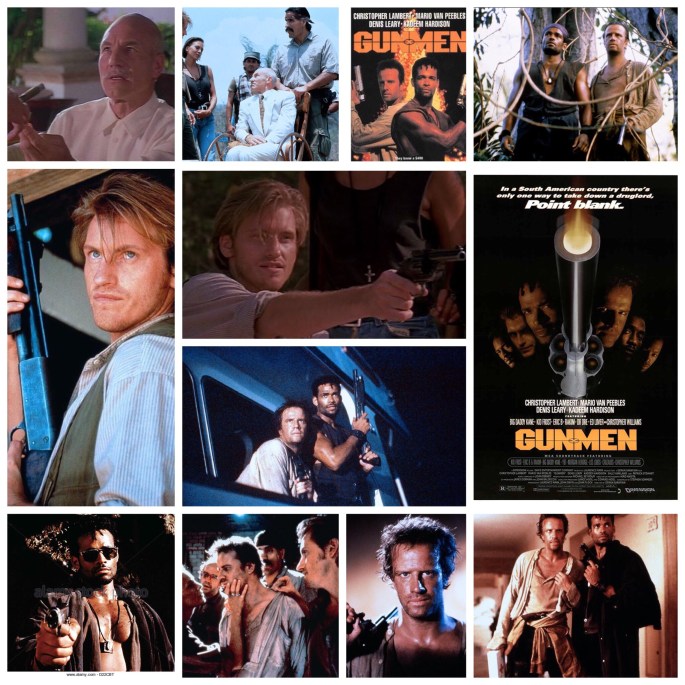
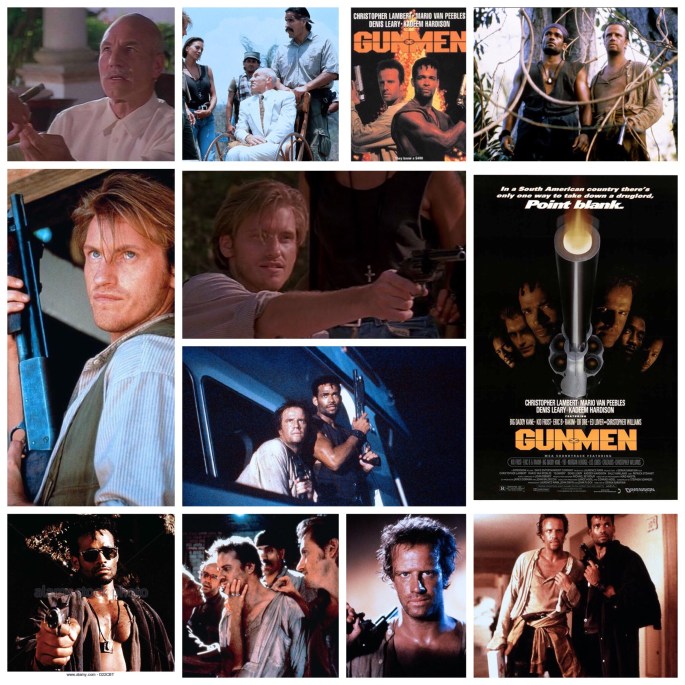
Gunmen is one of those sleazy, inconsequential pieces of shizz you’ll find on TBS Superstation (I’m aware that channel’s shelf life expired over a decade ago) at like 2am, full of guns, tits, dust, sweat, double crossing and whatnot. It’s a fun one because sometimes I’ll bring it up in conversation and say “the one where Patrick Stewart is in a wheelchair” and people will be like “yeah, X Men”, and I’ll say “no the other one” with a straight face and watch how confused they look. Heh. It’s a Mario Van Peebles flick, an actor I could never get that excited about, but it’s also a Christopher Lambert flick too, a guy I’ve always inexplicably loved, like a scrappy lost puppy that just won’t go away. I don’t remember the plot so don’t even ask, I’ll just spark-note it in bullet points: guns. DEA. South America. Violence. Incomprehensible storyline. Shootouts. More guns. One thing that was cool was Denis Leary as a psychotic arms dealer, gunning down a ten year old girl’s parents in cold blood and than calmly reassuring her, “trust me kid, you’re better off without them.” Yeesh. He plays Armour O’Malley, lieutenant to drug baron Patrick Stewart, which leads to predictable bad blood, and so it goes. Peebles and Lambert are a DEA agent and a weirdo smuggler on the run from all the crazy dudes I just mentioned above. It’s trash though, and as I type I’m recalling a scene where Lambert is ploughing a chick in some whorehouse and she begs for more, but he sweatily laments in that horrendous accent of his, “there is no more!!”… Then two seconds later Peebles busts in and kidnaps him at gunpoint. You know your flick has abandoned plot for cheap thrills and gotten so stuck in B movie quicksand that not even AAA can snag you out when that happens. That’s about all I remember, I was way too stoned to soak in all the cheaply rendered exploitive excess when I watched it way back when, I wish you the best of luck though!!
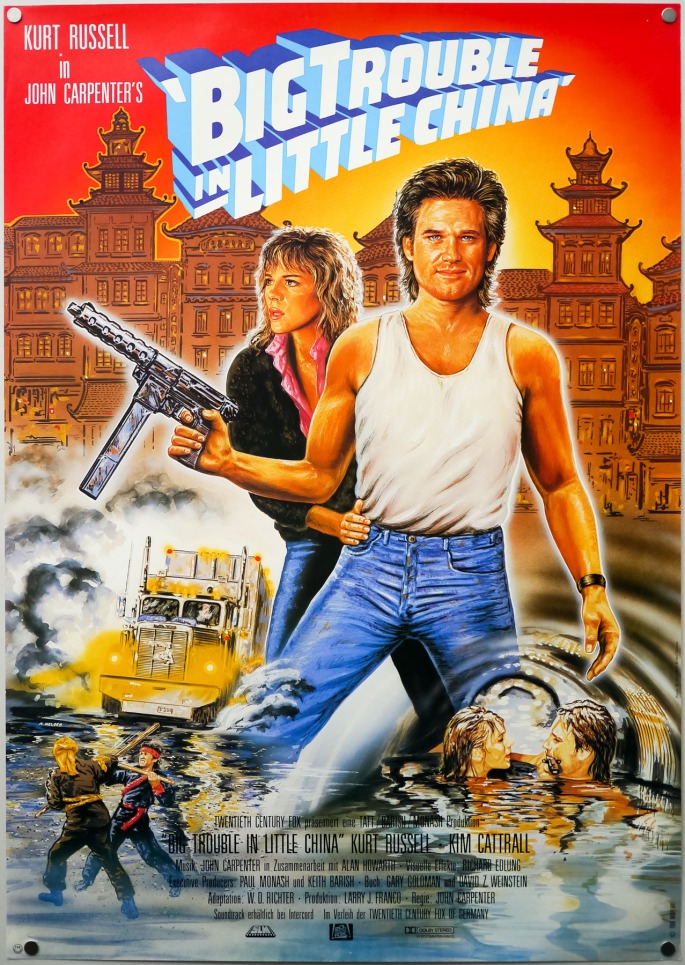
To talk about W.D. (Rick) Richter, is to talk about one of my all-time favorite films, Big Trouble in Little China. It is, to put it simply, one of those films that comes along (not so much anymore) once in a generation. As we know in this age of remakes, reboots and re-imaginations, there is a very good chance that this film, because of its staying power and built-in fan base, will more than likely resurface with Dwayne Johnson playing Jack Burton. Just like Hansel in Zoolander he is, as far as the Studios are concerned, so hot right now!
And you can be your bottom dollar that it will try like hell to recapture the magic of what was – and more than likely – crash ‘n’ burn in its attempt to do so. I might be wrong. Because, BTILC, was and is what is often referred to as a “happy accident”. What began as a seemingly awkward combination of a western with a plot that involved Chinese black magic became, thanks to my guest, a glorious blending of genres that there is really no recipe for.
I rarely get nervous doing interviews, but I was glad to be sitting down for this one. When the person on the other end of the line had a hand in creating a couple of the seminal film of one’s existence . . . it is tough to play it cool, plus for the first time in a long time, I found the need to have my questions written, rather than merely see what the conversation would provoke. Primarily because I knew I was only going to have a limited time, and secondly because during our email exchanges prior to the chat, I found Rick to be extremely matter-of-fact and, wishing not to have the interview published in audio form, he merely wanted to be concise and not ramble on as, he says, has happened in the past.
So I sat and pondered questions. Having read other interviews with him in the past, before he’d stepped away from the business, the focus was on the films he had released at the time and didn’t really get below the surface. Off the record, we spoke about a few of the things that were beneath the polished exterior of the press kits, but that was not all that interested me. There have been many books and articles on his films, as well as many having excellent special features and commentary tracks which mine their depths – so I wasn’t going to waste time there.
In the end I waited till the last minute and scribbled down the first questions that popped into my head. Some of course are elementary, but one or two I’ve had on my mind for a while.
Well, it took a long time, but sometimes, good things do. It was well worth the wait and the frustrating silences in between messages from Rick’s friend who very graciously made the introductions, and I, as a fan first, was humbled, honored and thrilled at the prospect of speaking to yet another film-making idol of mine.
While Rick, early in our email exchanges said, “I prefer to let he films, for better or worse, speak for themselves.” I am and will be forever grateful he took the time to talk a little about his work. In the end I wasn’t nervous or scared at all . . . I felt kind of invincible.
KH: Did you always want to work in movies and if so what were the films which influenced you?
WDR: First I wanted a paper route. Then I wanted to run a circus. Then I thought about pursuing a career as an English teacher. Then I thought, “Why not aspire to become an actual tenured English professor?” But, by the time I got to college, graduate film programs were springing up here and there. Having loved movies since childhood, but never imagining there was a route available into the business, I suddenly saw a way to pursue a career in film in a structured, sensible way.
I went to a lot of movies of all kinds as a kid, but mostly B horror films from the mid-fifties through the mid-sixties. In 1964, I saw DR. STRANGELOVE and in 1965 THE LOVED ONE. They suggested a new direction and deeply influenced me.
KH: How did you break in to the business?
WDR: I wrote screenplays at USC, and one of them secured me an agent. I then worked as a reader for Warners and wrote on the side and continued to do so when Warners and Irvin Kershner let me work as his assistant while he was prepping DIRTY HARRY for Sinatra. That project fell apart, but a spec script I’d written, SLITHER, got to the director Howard Zeiff, and he set it up, odd as it was, and we shot it. Presto! I was a produced screenwriter.
KH: Your early career was full of greats like Dracula,Body Snatchers and your Oscar nod for Brubaker. How much does momentum play a factor in one’s career (films coming out and performing well) as well as recognition for one’s talent?
WDR: Actually, none of those films did perform well, but they were respected, and, as a result, I was respected as a young writer with perceived potential. You must remember that during the seventies and eighties eccentric characters in unusual, small stories were nothing Hollywood ran screaming from. That came later.
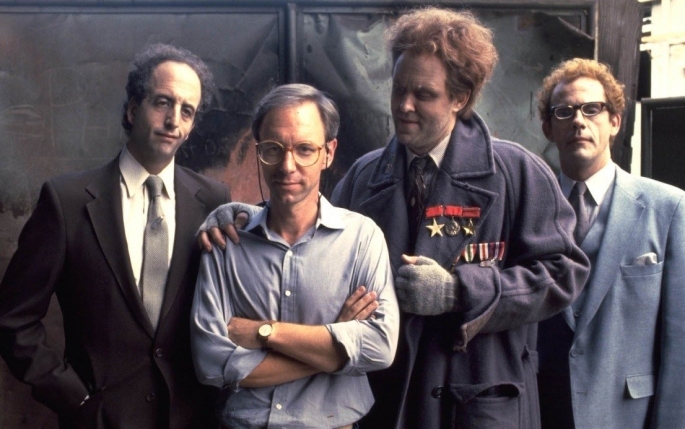
KH: You are a part of two of my favourite films of all time withBanzai and BTILC. How do you feel as an artist to be remembered for singular works rather than your entire body of creativity?
WDR: I’ve never given much thought to being “remembered”. After all, sooner or later, this whole planet is going to be forgotten.
KH: If people want the skinny on Banzai, you have already provided an excellent commentary. What I would ask is, did you ever see Kevin Smith’sQ & A whose guests were Wellerand Lithgow, and how did you feel about possible versions of the continuing story of Banzai?
WDR: I thought Kevin did a spectacular job that evening, and it was nice to learn how much the movie shaped him. As long as Mac Rauch is involved, I feel quite confident that a “new” BUCKAROO could be as startling as the original.
KH: BTILC was ahead of its time, in my opinion. What I’ve always wanted to know is, what the “western version” was like prior to your work on the script, and how much of the finished film remains your work?
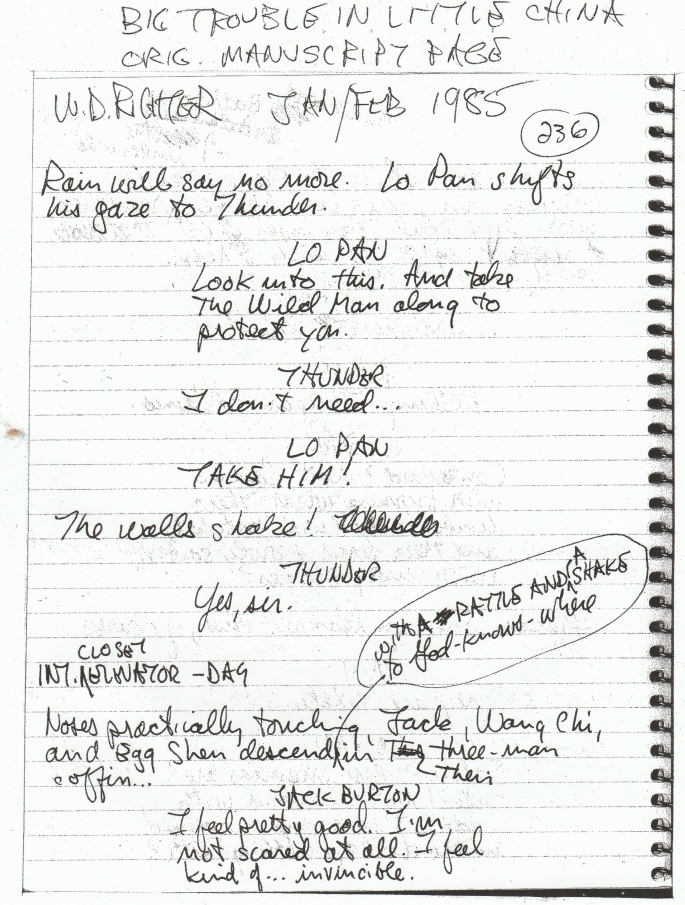
WDR: The “western version” just didn’t work for anybody, sad to say. It all seemed too distant…the Old West and the Asian occult, etc. So I proposed moving it to a modern, familiar setting and swapping the hero’s horse for a big rig. The pitch went over well, and, with a writers’ strike looming, I dug into the challenge of creating a contemporary script in about seven weeks, choosing to do that with a somewhat dim but hopefully lovable hero at the center. The finished film stayed absolutely true to my screenplay, apart from the inevitable ad libs here and there. Jack Burton’s John-Wayne cadences, though, are definitely nothing I wrote or endorsed. John and Kurt settled on that themselves.
You asked me prior to this conversation: “Did you write the line or was it improvised: I feel pretty good. I’m not, uh, I’m not scared at all. I just feel kind of… feel kind of invincible?”
Turns out I did write it. I wrote the whole script furiously in longhand in several spiral notebooks, and a typist transcribed them into script format.
KH: There was a significant gap between Home for the Holidays and Stealth. I have interviewed many writers who talk of these periods. They say, it’s not that I wasn’t writing, it’s just my scripts weren’t getting made. Was that true of your career at the time?
WDR: Definitely. I had movies actually green-lighted then cancelled when directors went over budget in pre-production.
KH: I understand Stealth was a troubled production.
WDR: STEALTH was just a bizarre and massively unpleasant experience. Directors and location scouts shouldn’t rewrite writers, if you want my opinion. Kind of like Presidents shouldn’t tweet.
KH: Did your involvement end after the writing?
WDR: The “writing” never really stopped. I was removed from the picture several times when my revisions failed to please the director. But I was repeatedly brought back by the studio to pull the script back from the brink after the director (who shall remain nameless) had worked it over again in his spare time. It’s the only film I’ve had made that, with great care, I kept my distance from during production and through release.
KH: I also love Needful Things. What was it like to adapt King?
WDR: Crazy. The book is 690-pages of single-spaced prose. My script was 124 pages, and you know how much “air” there is on a script page. I figured that if one were to retype the novel in a crude screenplay format, it might easily hit 1000 pages. So I lost roughly 876 pages while trying to keep King’s story and mood intact. I have no sense of how that worked out because I’ve never reread the book, but I always imagined a looser, grittier, less-arch movie.
KH: Any advice you would give to a struggling screenwriter – not unlike myself?
WDR: Write. Write. Write. But always try to imagine the movie itself playing to paying strangers. Why would they — or you! — want to watch it?
KH: Sir it has been a profound honor to converse with you. I cherish the moment and humbly thank you.




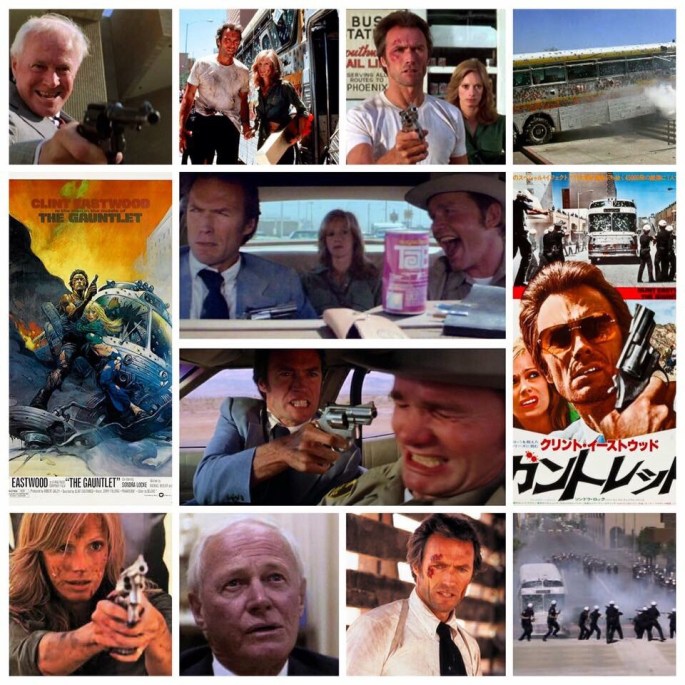 I love scrappy little cop flicks like Clint Eastwood’s The Gauntlet, a short, trashy exercise in exploitation that’s not only a departure from the heady, cerebral detective flicks he does but also miles off of the focused, gritty machismo of the Dirty Harry films. This is a low rent B movie and is proud of it, which is a rare commodity in Eastwood land. Boasting a terminally silly plot, lovably incapable protagonist and more bullets fired than all three Matrix movies stacked together, it’s a great way to spend a Saturday night when you have a hankering for old school action. Eastwood is Ben Shockley here, a disheveled mess of a Phoenix cop, heavily on the sauce and in no mood for the mission his uptight commissioner (William Prince, needing a moustache to twirl in his portrait of unapologetic evil) dispatches him on. He’s to escort a troublesome hooker (Sondra Locke) from Vegas back to Arizona where she will testify at a high profile mob trial. Of course every bent cop and his mother is on their trail, they can’t trust anyone in law enforcement and they’re on their own, forced to run a gauntlet of gunfire and corruption to bring her in. There’s three very odd, very hilarious set pieces that involve gunmen just fucking unloading clip after clip after clip in a way that the you might see on the Looney Toons, until the house they’re firing at *literally* falls apart. That’s the sort of slapdash style the film has, but it works in its dense specificity. Eastwood and Locke have chemistry, and it’s always cool to see the chicks in his action films have their own personality and impact on plot, not just part of the scenery or eye candy. Prince is so nefarious as the Commissioner that one wonders how a man like that ascended the ranks to that position, but in a film where’s he’s allowed to shut down a city block and order the *entire* Phoenix police force to empty boxes of bullets into an oncoming bus that Eastwood rolls up in, it isn’t that much of a stretch to believe. It’s just that kind of film, and I dug it a lot. Oh and look at that epic one sheet of a poster, whoever designed that should get a few medals. Great flick.












 Podcasting Them Softly