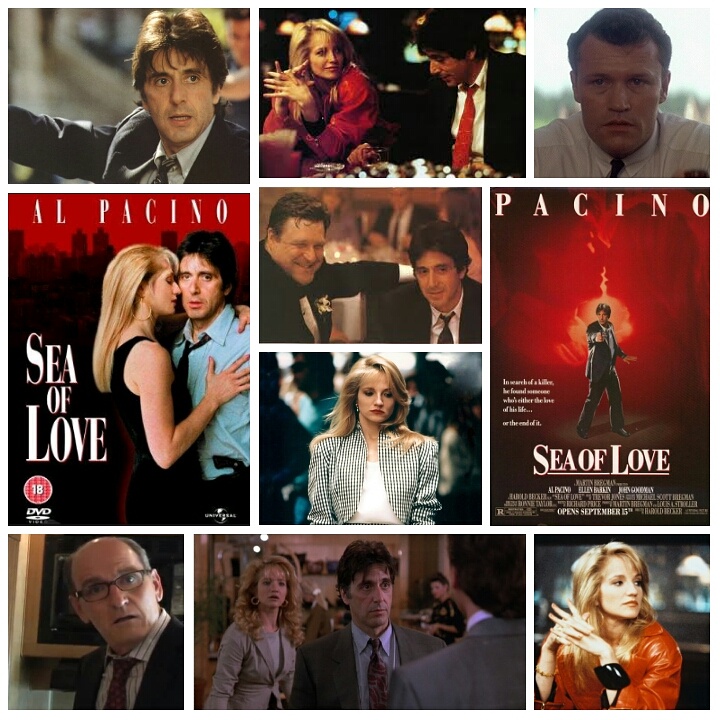
Sea Of Love is one of my favourite romantic thrillers of the 80’s. It’s perfectly structured, riveting the whole way through, and just as steamy as you’d imagine a pairing between Al Pacino and Ellen Barkin to be. It’s so well made that we don’t even notice pieces of the puzzle falling into place until the image they make is staring us right in the face and we sheepishly snap out of the sensual trance the film has laid upon us. It’s never too grisly, never sappy, but strikes every note in time with the rhythm of both its script and the acting style of the two leads. Pacino is Frank Keller, a police detective pursuing a killer who is choosing their victims based on personal ads placed in the newspaper. This provides a readily made paper trail for him to follow and hopefully find his man, but in the process he must stage a bunch of blind dates that are essentially theatrical stake outs, in attempt to lure his prey into the open. Pacino is always keen and sharp when playing detective roles, but only in this one does the romantic side of his life play just as important of a part as the thrill of the hunt and the crime dynamics, which makes the role unique in his career. Things get complicated when he gets involved in a torrid and unpredictable affair with Helen, a mysterious girl who replies to one of the adds and quickly becomes a prime suspect. Aided by another detective (John Goodman is fantastic as always) from a few precincts over, he tries to race against both time and the spiderweb of danger which is unseen yet slowly winches tighter on everyone involved, as the killer circles them all. Watch fpr suppoetin turns from Michael Rooker, William Hickeyn, Paul Calderon, Richard Jenkins, Larry Joshua, John Spencer and a cery young Samuel L. Jackson who is simply credited as ‘black guy”, which cracked me up. It’s got rocket fuel for pacing and I mean that as a compliment; It’s pure cinema from both a genre standpoint and in general. Fairly forgotten these days, but one of the very best to come out of its era.
Tag: Al Pacino
OCEAN’S THIRTEEN – A REVIEW BY J.D. LAFRANCE

Despite its impressive box office returns, Ocean’s Twelve (2004) was considered something of a disappointment by its director Steven Soderbergh who felt that the plot was too complicated. While not quite as fun as Ocean’s Eleven (2001), it was a fine film in its own right – one that had a more satisfying emotional pay-off and doesn’t deserve the lousy reputation that it seems to have. Ocean’s Thirteen (2007) was seen as a return to the fun, breezy vibe of the first film by bringing it back to Las Vegas with style. The result was a very satisfying conclusion to the Ocean’s films.
As the revenge picture cliché goes, this time it’s personal. When Reuben Tishkoff (Elliott Gould) is muscled out of a business deal by slick businessman Willy Bank (Al Pacino), resulting in a heart attack, Danny Ocean (George Clooney) and his crew reunite for one last job: to ruin the opening night of Bank’s casino, The Bank, by making sure he loses a huge amount of money, which involves rigging all the games and slot machines. Bank wants the Five Diamond Award – the top accolade for hotels and will do anything to get it. Danny and the boys use this as a way to get at Bank. To this end, they devise an elaborate plan with the help of their arch-nemesis Terry Benedict (Andy Garcia) who bankrolls the operation. They also bring in Roman Nagel (Eddie Izzard) from Ocean’s Twelve to crack a state-of-the-art artificial intelligence security system.
Soderbergh kicks things off rather stylishly as we get a beautiful shot of Rusty Ryan (Brad Pitt) walking across a runaway tarmac to an awaiting plane at dusk with the sky an impossibly deep dark blue that, accompanied by David Holmes’ groovy score, is absolutely breathtaking. Once again, the director shoots the hell out of the film by employing all sorts of zoom ins and outs, pans and split-screens that, along with a saturated color scheme, keeps things visually interesting.
This time out, Matt Damon gets a juicy subplot where he goes undercover as Lenny Pepperidge, the assistant to a Mr. Weng (Shaobo Qin as The Amazing Yen, also undercover), a very high roller, in order to get close to Bank’s lovely assistant, Abigail Sponder (Ellen Barkin). Part of his disguise involves wearing a ridiculous fake long nose – a sly fuck you to Harvey Weinstein who wouldn’t let Damon wear said nose for his character in Terry Gilliam’s The Brother’s Grimm (2005) because he felt it would obscure the actor’s good looks and hurt the film’s box office potential. Well, it didn’t hurt Ocean’s Thirteen box office as the film went on to gross a very respectable $311 million worldwide.
It is also a lot of fun to see Ellen Barkin reunited with her Sea of Love (1989) co-star Al Pacino. She appears to be having a good time playing a confident businesswoman succumbing to Damon’s “seductive” charms. It is also fun to see Pacino go off autopilot for a change and sink his teeth into a juicy bad guy role. Who else could Soderbergh get to pose as a credible threat to the likes of George Clooney and Brad Pitt but someone of the legendary star caliber like Pacino? He plays Bank like the offspring of his take on Ricky Roma from Glengarry Glen Ross (1992) and Gordon Gekko from Wall Street (1987) – a smooth-talking unscrupulous bastard. In another nice bit of casting, the inventor of the artificial intelligence security system is played by none other than Julian Sands, an actor whose big break through came in A Room with A View (1985), but whose career settled into mostly direct-to-home video fare so it was a pleasant surprise to see him appear in a big mainstream film like Ocean’s Thirteen.
Another amusing subplot involves Virgil Malloy (Casey Affleck, sporting a ridiculous-looking mustache) organizing a revolution/strike among the workers at a dice-making factory in Mexico. He goes from complaining about a lack of air conditioning to tossing Molotov cocktails on the strike lines. At one point, he and his fellow co-workers drown their sorrows at a local bar and Virgil asks them, “Have all of you forgotten Zapata?” He goes on to offer inspirational words that fire them up. How this whole subplot plays out is quite funny. In another nice twist, Terry Benedict is helping Danny out albeit with all kinds of conditions. After all, he resents Bank’s lack of taste and the competition he represents. There can only be on top dog in Vegas and Benedict clearly feels that he is the one. Andy Garcia looks like he relished the opportunity to be in on the joke instead of being the target as he was in the last two films.
While working on Ocean’s Twelve, Steven Soderbergh began thinking about Ocean’s Thirteen. He thought about how fun it would be to set it back in Las Vegas. The motivation to make the film was a desire to work with everyone again but all eleven cast members had to want to do it. Producer Jerry Weintraub contacted them 18 months before hand and told them filming would take place during the summer of 2006 and to clear their schedules. He was able to find a way to juggle all these movie stars’ busy lives and add Al Pacino and Ellen Barkin into the mix.
For the film’s story, Soderbergh felt that Danny and his crew weren’t driven entirely by money and that they would reunite for friendship and revenge. The director came up with the notion of Reuben being betrayed and his friends helping him out. Weintraub hired Brian Koppelman and David Levien to write the screenplay. They had written the script for Rounders (1998) and created the gambling television cable show Tilt, and so they were familiar with the world of con men and gamblers. Soderbergh and Weintraub were both big admirers of Rounders and the director met with the screenwriters in New York City over lunch. They talked about great con movies, the nature of heists, and how the characters had evolved since Ocean’s Eleven. Within minutes, Soderbergh knew they were who he wanted to write the script and were working on it within minutes: “There was not a long list of people that we thought could step into this specific universe and pick up the language and the sense of humor.”
Koppelman and Levien had spent years exploring Vegas culture and the gambling lifestyle. They had every book they could find about con artists and thieves. Early on, Soderbergh told them that he wanted the film’s focus to be on the friendship between Danny and his crew. They understood that getting revenge on Willy Bank was what drove the entire story of Ocean’s Thirteen. They also wanted to “’flip’ the casino so that the patrons would win every time, which would spell disaster for Bank.” Soderbergh also told them that the bad guy should be a casino owner and they imagined Al Pacino and wrote Bank with him in mind. George Clooney also offered some ideas, mostly things to do with the revenge scheme that reunited the crew.
Some exterior scenes were shot in Las Vegas, but the casino interiors were mostly shot on one of the largest soundstages on the Warner Bros. lot in Los Angeles because it would have taken too long to film in actual casinos as they had done with Ocean’s Eleven. Soderbergh said, “In order to get the shots that I wanted, I needed to completely control the environment.” He instructed production designer Philip Messina to build a hotel and casino that would reflect Bank and his huge ego. Messina decided to go with a quasi-Asian theme and make it visually overwhelming. He purposely broke the rules in Vegas by designing a multi-level gaming floor because the production didn’t have a lot of horizontal space to work with.
Like Ocean’s Eleven, Ocean’s Thirteen pays tribute to the classic era of Vegas as Danny and co. restore Reuben’s honor. He’s an old school player who still believes in following a code and prides himself in being part of a select group of insiders that got to shake Frank Sinatra’s hand back in the day. Like Benedict, Bank represents the current corporate mentality of making money over the personal touch that the Mob-run casinos used to provide. If the first two films were about Danny and Rusty’s respective relationships with the loves of their lives, then Ocean’s Thirteen is about their friendship with Reuben. He mentored them when they were just starting out and taught them about respecting history as well as those who came before them. Like with the previous films, going after the bad guy is a matter of personal honor and hitting them where it hurts – in Bank’s case it’s his monster ego. Ocean’s Thirteen ends much like Ocean’s Eleven did thus bringing the trilogy full circle and with a truly satisfying conclusion as the bad guy gets what’s coming to him and Reuben’s honor is restored. Likewise, the film did very well at the box office and garnered fairly positive reviews going out on a well-deserved high note. It serves as an example of a star-studded big budget Hollywood film that entertains without insulting your intelligence.
Michael Mann’s The Insider: A Review by Nate Hill
There are some films that are so perfectly made in every way possible that
I sit there thinking ‘Every persons effort and every element of creative energy that went into making this movie has been implemented flawlessly, arriving here and now to give me the viewing experience I’m getting. A perfect movie’. Michael Mann’s The Insider is such a movie. I held off on reviewing it for a couple days after seeing it, partly to let it sink in but mostly to see if I’d feel any different about it once my synapses had cooled down and the frames had dimmed from my consciousness. Perhaps the fiery reaction it drew from me in the moment was cheaply earned, or I was just in the right mood to love it at that time. Not a chance. If anything I’ve become more enraptured by it as time has passed, already aching for a second viewing. Every performance and aspect of is just so rich, deep and rewarding that for its two and a half hour runtime I found myself externally distracted not once. Occasionally Mann deviates from his comfort zone in the nocturnal crime zone. The occult themed period piece, the colonial adventure, the psychological horror, and this, the blistering drama based on a true story. One might not think the subject matter deserves a two and a half hour film, let alone would make a great one, but Mann has the cinematic Midas touch, and never half asses it. His films always contain traces of a true master at work, telling little details that engrave the film with a sense of immaculate skill and unwavering dedication to telling the story in its finest, and most honest form. The Insider tells the story of Jeffrey Wigand (Russell Crowe), a chemist who turns whistleblower on the tobacco corporation he was once employed by, finding shelter under the wing of CBS News’s 60 minutes, and particularly hard nosed reporter Lowell Bergman (Al Pacino). The network wants his take, in order to do an exposé on Big Tobacco, a plan with predictably disastrous and dangerous results, for both Wigand and CBS. The film shakes off any impending sensationalism or deliberately emotional stylistic cheats, instead keeping a microscope focus on the three lead performances and letting all the hurt, determination and emotion come forth naturally through their work, as opposed to smothering their story with an overbearing score and cheap cinematic manipulation. I’ve never been that won over by Russell Crowe until now. He always seems ‘halfway there’ in his work, like he’s missing something. This changed things for me. He’s like a raw nerve here, a family man pushed to the precipice of an impossible decision. One can almost see him wrestling with his conscience behind those haunted eyes, a storm with a lid barely kept on and anchored by Crowe in his finest hour. Pacino holds us captive with his work until we realize we’re not breathing. He’s the moral compass of the piece, and to see him explode at the injustices served up to him will give you goosebumps. The third leg of the table is Christopher Plummer as Mike Wallace, the 60 minutes anchor who also struggles morally with the situation they are in. Plummer is so good you forget you’re watching a film, giving Wallace buried gentleness and chiselled emotional intensity that you can scarce believe is even possible through the craft of acting. The supporting cast is peppered with bushels of talent. Colm Feore, Philip Baker Hall, Gina Gershon, Stephen Tobolowsky, Diane Venora, Nester Serrano, Rip Torn, Michael Gambon and an unusually sedated Debi Mazar are superb. It’s Bruce McGill, however, who almost steals the film in one blistering scene, playing a lawyer with enough righteous anger to shatter your tv screen. A career best for him. No one puts you into a story by forcing you to feel alongside the characters quite like Mann. Here he guides us through the trials that Crowe, Plummer and Pacino face with steady hand and heart until we are invested. Then he pulls the ripcord and let’s the sparks fly, making monumentally intense work of events that could seem pedestrian in lesser hands. We really feel for Crowe and clutch the seat with the same desperate intensity that he clings to his family, and sanity. We feel the same jilted fury alongside Pacino as he wades through sickening bureaucracy for a shot at retribution. We take pause with Plummer as he ponders his legacy and are incredulous with all three at the snowball effect the entire proceeding has had on them, devastating us as an audience the same as them, in turn making us feel closer to them. This is all laced with the incredibly heartfelt music from Lisa Gerrard, who sang alongside Crowe in Gladiator and was a favourite of Tony Scott as well. Mann is a ceaseless monster of storytelling, tone and pacing. The story has flair simply because he doesn’t wantonly throw it in the mix; the feeling and reaction come from story and character and not the razzle dazzle. Mann knows this, and let’s the fireworks naturally spring from the absence of deliberation, like music in the vacuum of space. This one will live on to stand the test of time far longer than the decade and a half its help for already. It’s a revelation.
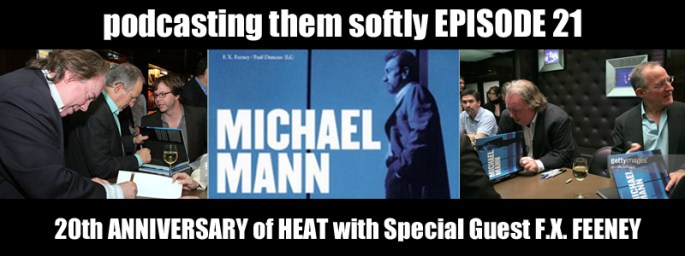
Episode 21: 20th Anniversary of HEAT with Special Guest F.X. FEENEY

It was an absolute honor to be joined by film critic, historian, screenwriter, and author F.X. Feeney to discuss the 20th Anniversary of Michael Mann’s masterpiece Heat. His latest book, Orson Welles: Power, Heart and Soul, is available from The Critical Press and through Amazon. Prior to dealing with Welles, F.X. contributed to the great filmmaker book series from Taschen with the definitive exploration of Michael Mann and his works. He’s written two screenplays, The Big Brass Ring which was directed by George Hickenlooper and was based on an unproduced script by Orson Welles, and the Roger Corman classic Frankenstein Unbound. He served as film critic and creative consultant for the now famous Z Channel back in the mid 80’s, and his articles have appeared in LA Weekly, Movieline, People Magazine, Variety, Vanity Fair, and the magazine for the Writers Guild of America West. He also wrote the Roman Polanski filmmaker book for Taschen which is an extraordinary resource on that filmmaker, and served as a co-producer on the fantastic documentary Z Channel: A Magnificent Obsession. This was a total thrill to discuss one of our favorite films with one of the true experts on Mann’s oeuvre, and we hope you enjoy this most passionate and informative chat!
MICHAEL MANN’S THE INSIDER — A REVIEW BY NICK CLEMENT
While his 1995 crime epic Heat will likely always be my “favorite” film by master filmmaker Michael Mann, his 1999 journalism thriller The Insider is likely his “best” overall theatrical effort. Simply by virtue of avoiding any sense of melodrama (no matter how rarefied as in Heat or Miami Vice) and making a film as good, or nearly as good, as Alan J. Pakula’s immortal classic All The President’s Men, The Insider stands as one of the most underrated movies ever to have been bestowed with nine Academy Award nominations (it won nothing). Mann’s usual brilliant sense of place and atmosphere is on firm display here, with Dante Spinotti’s elegantly stylish 2.35:1 cinematography maximizing space within the frame, with certain camera moves meant to dive deep into the consciousness of the characters within any given scene. The emotional and informational depth to the screenplay, co-written by Mann and the estimable Eric Roth (Forrest Gump, The Good Shepherd), is staggering to behold, as it’s the rare drama where everything is motivated by intelligent, dramatic discourse and plausible actions and situations rather than the cheap demands of plot or genre conventions. Al Pacino was terrific here, subverting expectations to a certain degree, reteaming with Mann a few years after their iconic work on Heat. But it’s the Russell Crowe show all the way, and in The Insider, this tremendous actor delivered the best performance of his impressive career, painting a portrait of a morally and spiritually conflicted man who had to face some serious personal challenges in order to get his life back on track. The dynamite supporting cast includes one of my personal favorite scene stealers Bruce McGill (show-stopping moments during the deposition sequence!), Colm Feore, Diane Venora, Christopher Plummer, Michael Gambon, Philip Baker Hall, Debi Mazar, Stephen Tobolowsky, Lindsay Crouse, Gina Gershon, Rip Torn, Michael Paul Chan, Wings Hauser, and Nester Serrano. The haunting and introspective score from Lisa Gerard and Pieter Bourke is classic Mann, perfectly complimenting Spinotti’s lucid and mobile images, which feel as if they’re always searching for thematic truth, while the various key characters consistently stare down their own existentialism in hopes of finding catharsis.
CHRISTOPHER NOLAN’S INSOMNIA — A REVIEW BY NICK CLEMENT
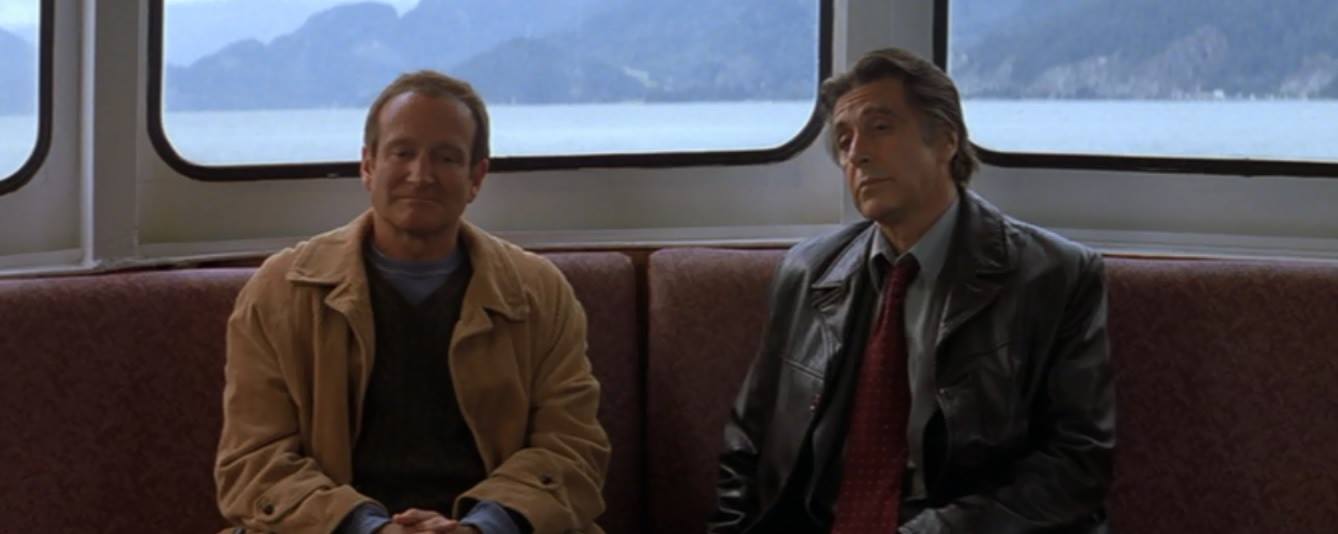
Attempting a remake of any great film is always a questionable endeavor. I can remember seeing Erik Skjoldbjærg’s terrific Norwegian psychological thriller Insomnia at the theater on my college campus back in 1998 and thinking that an American remake would be rather pointless. The themes would never travel (especially the underage sexuality), how could one outdo Stellan Skarsgård, and how could a filmmaker capture that eerie atmosphere in a new and unique way? It was never going to be an easy task, but Christopher Nolan continued his hot streak with his stylish and underrated 2002 updating, which felt like the next logical step for him as a filmmaker after his breakout indie success Memento. Al Pacino gave a tired and tortured lead performance as a cop struggling with intense inner demons not to mention the inability to get any sleep; this is a film that touches on noir (daytime noir!) and the serial killer genres but still remembers to load the narrative with interesting character beats and small bits of surface details that all add up to a riveting mystery. Robin Williams gave one of the best performances of his career as a chilling psychopath who always seems to be one step ahead of Pacino and the authorities – that chase sequence he has with Pacino across those drifting logs in that chilly river is spellbinding stuff, with Nolan using incredible sound effects and expert spatial geography to heighten the tension. Williams brought a devilish smile to numerous scenes, and his unpredictability always kept you guessing, even within the relatively predictable confines of studio based genre entertainment. Martin Donovan, Nicky Katt, Hilary Swank, and Maura Tierney all offered solid support. This was a nervous, jittery piece of work from Nolan, who would later fashion a more controlled, rigid aesthetic in Inception and The Dark Knight trilogy (The Prestige looks even more unique these days) before moving on to his magnum opus, Interstellar. Wally Pfister’s slick yet gritty cinematography worked in perfect tandem with David Julyan’s haunting music and Dody Dorn’s taut editing. Remakes of already excellent films are rarely this effective.
Episode 2: Michael Mann’s HEAT and Top Five Mark Ruffalo and Jessica Chastain performances.
Episode 2 is now up. Thank you everyone for listening! Hope you enjoy!
Frank’s Thoughts on Michael Mann’s HEAT
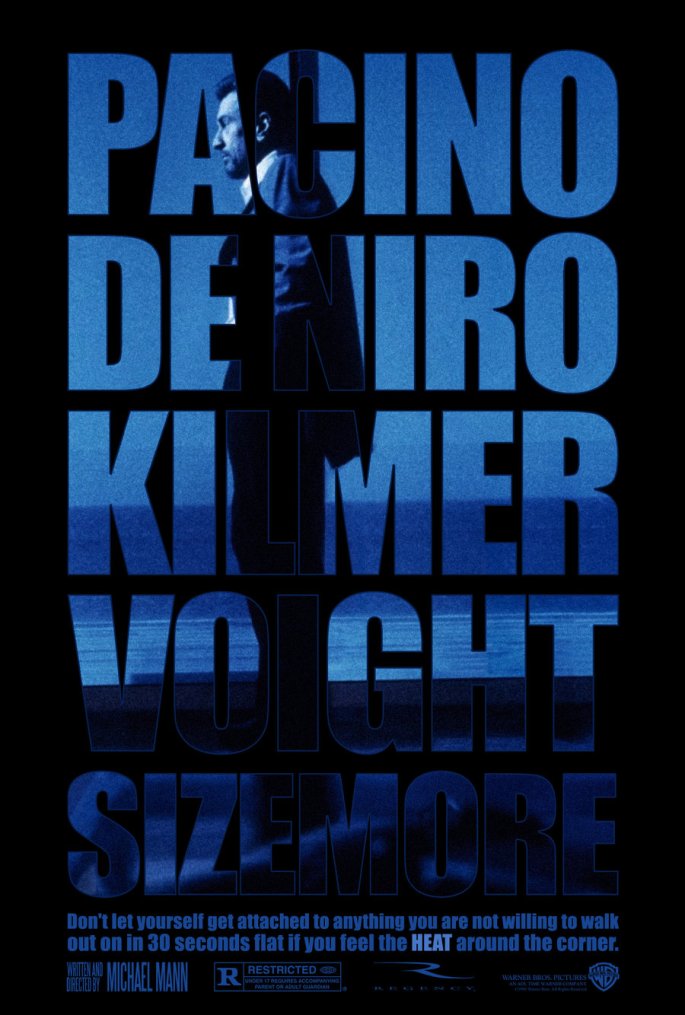
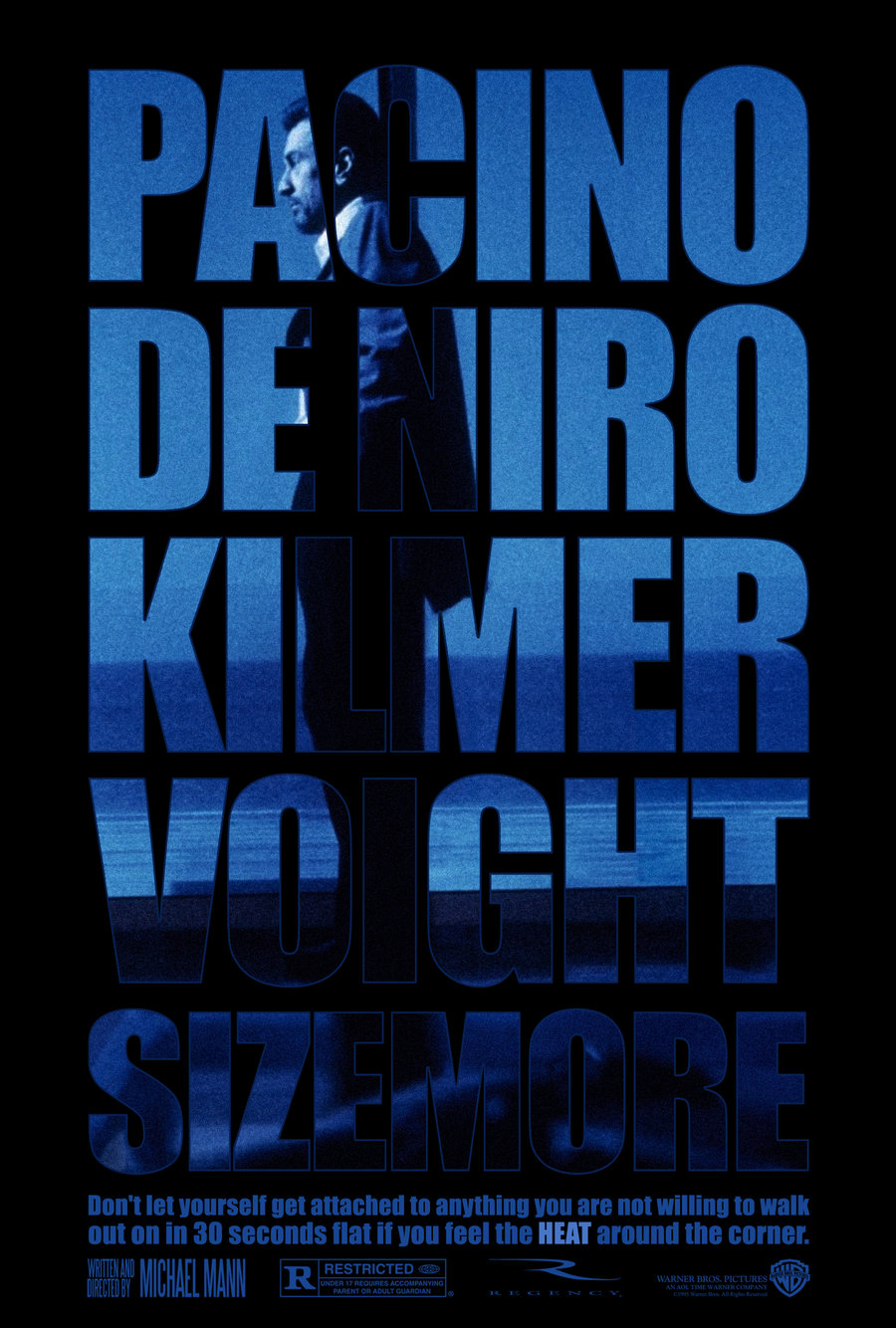
When it comes to Michael Mann, who is one of my absolute favorite filmmakers, his most epic film is undeniably HEAT. When it comes to overt machoism mixed with an incredibly gritty street film, it doesn’t get any better than this film. Only Michael Mann could bring together Robert De Niro and Al Pacino in a film like this.
Playing off the clout of Pacino and De Niro, Mann creates this layered film, showing two men who are essentially the same, yet took two different life paths. Both men have a foundation of honor and respect, and live by the code of the street, yet their paths have crossed, and there will only be one that comes out on top.
The fact De Niro and Pacino share two scenes throughout this long film, further solidifies Mann as one of the world’s best living filmmakers. Mann also used the “less is more” technique in my favorite film of his, MANHUNTER. In that film, Mann rarely shows us Hannibal Lecter, creating a more effective character. The fact that Pacino and De Niro share two scenes, and in the grand scheme of the film they are rather brief, works tremendously well. It all builds to a shattering climax between the two of them.
Mann’s authorship is making a visual striking film using overt color tones to each of his films. Mann loves color, because he knows with his audience, everything is seeing. With HEAT, the entire film is layered in blue tones. There are not any vibrant shades of blue, the blue tones are dark, and darker.
In this film, what do the blue tones tell us? How do they make us feel? The way I view the film, through different shades of blue, are two major themes. Masculinity and authority.
Al Pacino, Robert De Niro, Val Kilmer, Jon Voight, Tom Sizemore, Danny Trejo, Dennis Haysbert, Ted Levine, Henry Rollins, Tom Noonan, Wes Studi and William Fitchner are all masculine actors, and all bring gravitas to this film. In HEAT, we’re living in an alpha male world, and there is little room for anything less. From the start of the film, we see an incredible armored car robbery by bad men in hockey masks, adding to their size.
Cut to Pacino’s introduction, where he’s making love to his wife. Pacino is the alpha in his relationship, and is apathetic to his marital problems, because where his fire lies is with other alphas. Whether working with them (Levine, Wed Studi) or chasing them (De Niro and his crew).
Val Kilmer’s marital problems parallel Pacino’s. I imagine Kilmer being the younger, more flamboyant alpha. Of course, all of them are seen in different shades of masculine blue.
Authority is the other major theme, not necessarily the authority of law enforcement, but authority of a code of the streets. Honor, respect, loyalty. While these two groups of hard men are on opposite sides of the law, they both live by the same code, and have nothing but admiration and respect for one another.
Pacino and De Niro are the same man, but on flip sides of the same code. They both know who they are, and what they want, and they’re secure in it and admire one another for it.
I have much more to say about this film, and if you’re reading, you’ll just have to wait for our next podcast this Sunday.
Nick Clement on Michael Mann’s masterpiece HEAT
Michael Mann’s Heat represents the finest distillation of the filmmaker’s stylistic and narrative obsessions, the ultimate synthesis of plot, character, and action, all fused together in a nouveau package that still feels fresh and contemporary 20 years after its initial release. Mann, a writer/director who has often reached greatness throughout his career, appears to be most comfortable when telling stories about crime and its effects on the various people that surround his multilayered stories. A reworking of his earlier NBC movie of the week, L.A. Takedown, Heat still holds up now even in the face of stiff genre competition, and looking back on it, it’s incredible how little it has aged, and even more remarkable to notice how many other filmmakers have been lifting Mann’s striking visual aesthetic after all of these years. Critics took Heat a bit for granted when they first encountered it, as response was mostly positive and respectful, though not overly effusive, and while a solid success at the box office, it didn’t do massive numbers. However, over the years, audiences have turned the film into a cultural touchstone, as it represents the type of film that rarely gets made anymore: The introspective Hollywood drama with smarts and action that features big stars and a name director all working at the top of their games. The films that Mann had done preceding Heat (Thief and Manhunter most especially) clearly influenced numerous decisions on his magnum crime opus, and the works he’d go on to make in the future have all been fairly (or unfairly) compared to this epic 1995 crime saga.
Mann has found his obvious home in the crime genre, with his name associated on TV projects (Starsky & Hutch, Police Story, Police Woman, Miami Vice, Crime Story, and the wildly underrated Robbery Homicide Division) and on various feature films (Collateral, Miami Vice, Public Enemies, and Blackhat), all of which hum with a distinct personality and unified vision, no matter in what capacity Mann served. Part of what differentiates Mann from other filmmakers is his unique sense of habitation and dedication to realism; no matter how busy the narrative or how jargon fueled the dialogue may be, there’s always a clear sense of how every detail might fall into place, allowing the audience to follow the demands of the plot while still having the capacity to be surprised and draw conclusions on their own. And in Heat, there’s a level of streamlined perfection to the story that might have been unattainable by another, less in-control filmmaker, considering just how many moving pieces are involved in making Heat the success that it became. What I love so much about Heat is that, like James Mangold’s 1997 policier Cop Land, the film operates as a sly, contemporary Western, but Heat, unlike many other genre efforts, transcends the themes that it so dutifully explores, vaulting the picture into rarefied, existential territory that Mann always seems interested in exploring no matter the milieu. He also managed to craft the Ultimate Los Angeles Movie, but more on that later.
Not that a plot explanation should be necessary at this point, but I’ll break down the basics. Robert De Niro is a master thief. Al Pacino is a master cop. They both have dedicated crews (Val Kilmer, Tom Sizemore, Danny Trejo, and Dennis Haysbert on Team De Niro; Wes Studi, Mykelti Williamson, and Ted Levine on Team Pacino), that will follow them anywhere. The city of Los Angeles is their deadly playground. The film revolves around the notion of duality, and how the De Niro and Pacino characters are essentially the same person, just on opposite sides of the law, completely consumed by their work, with a constant sense of professionalism and integrity guiding them through their perilous daily life. De Niro assembles his team to do a major score, the daring robbery of a bank, and it’s up to Pacino and his band of fellow officers to bring them down. Mixed into the main story are the various relationships that De Niro, Pacino, and their men have with the women in their lives: Wives, girlfriends, and in one instance, a step-daughter. Instead of just a nuts and bolts crime film, Mann opened up his generous narrative to include real conversations between real people that drive all of the action in a grounded, thoughtful manner. How it all ends is the stuff of cinema legend, and if you don’t know by now I’ll allow you to discover for yourself, but I will concede that Heat operates on multiple narrative tracks all at once, with side-jobs bringing along potentially fatal consequences for De Niro and his men, and the emotionally taxing rigors of having to balance your family life and your cop life for Pacino.
De Niro’s Neil McCauley is a criminal driven by and to perfection. He lives by a serious, permanent moral code: Never become attached to something that you can’t walk out on in 30 seconds flat if you spot the heat around the corner. No wife, no family, a true lone wolf in a sharp gray suit (a costume obsession of Mann’s for years), McCauley is the kind of man who thinks he has everything under control, and is used to getting his way in almost every situation. Then, things change when he meets a woman who might be a reason to leave his dangerous life behind for. She gives him a new reason to live, or at least he thinks she does from time to time. Because of the way that De Niro brilliantly plays the character, all inward quiet and small glances to suggest intent and feeling, you never truly know what he’ll do at any given moment. We know he’s pulled off various high-stakes jobs with total ease and precision, but he’s not used to letting his emotional guard down, and then when coupled with the fact that he’s got a Super Cop looking for him, he understands the need to take decisive action in an effort to complete his goals. This is one of De Niro’s least flashy and totally reserved performances, bringing a masculine grace to the role of leader and friend to his teammates, and while clearly a man capable of more than just violent action and air-tight planning, he’s still a human being, capable of making emotionally misguided mistakes which could prove to be his undoing.
In Pacino’s Vincent Hanna, Mann has created an amazing dichotomy with McCauley, because while both men certainly share similar traits and attributes, the recklessness of the Hanna character is what allows him to constantly move throughout the night, never resting for a moment, constantly thinking and plotting, always trying to one up his stealth opponent. Pacino brings a live-wire spark to the role of this driven detective, hollering out orders at his underlings, busting down doors, always ready to mix it up with an opponent. While listening to the Blu-ray audio commentary with Mann, it’s revealed that he had written a casual but possibly slightly out of control cocaine habit into the Hanna character, which would help explain the sudden outbursts of physical energy and verbal profanity, as well as all of the jaw chomping and twitching that he exhibits all throughout the film. I’m not fully sure why this angle was cut out of the film (I guess it cuts down on the sympathy factor for the character), but I really do wish that Mann had kept this edgy bit of business in the final cut, as it would have further contextualized Hanna as a man of steady habits and unpredictable behavior. Pacino, no stranger to large emoting, especially during the 90’s in films such as Scent of a Woman and The Devil’s Advocate, chews the scenery when called for, but also allows small moments of stern quiet to seep in around the edges. He’s a man who is always assessing the situation, whether on the job or at home, and it’s the way that Pacino burrows deep into Hanna as a man that we come to understand the method to his madness. I also find it curious how Mann introduces his top-cop character at the start of the film, during a morning lovemaking session with his wife, as opposed to on the streets chasing down some random bad guy. Romance is another aspect that Mann’s films always deal with, and the way that Pacino balances his home life and professional life is of key consequence to his character and the story in general.
The romantic angle and the concentration on the female characters also help separate Heat from lesser genre entries. Not content to tell an all-boys story with guns and explosions, Mann, as he’s been prone to do in the past, allows for the leads to have personal relationships which amp up the narrative tension and reason for being. McCauley meets an enchanting young woman who he feels might be worth running away with (a super young Amy Brenneman), and it isn’t until the film’s final moments where you learn his ultimate decisions regarding their unique relationship. This relationship takes the normally rigorously disciplined McCauley out of his comfort zone, which allows for shards of humanity to creep in around the edges. Hanna, meanwhile, is a two time divorcee who is in the middle of an about to fail marriage (Diane Venora is his sharp witted wife); it’s clear that he can’t keep things on the up and up at home while still traversing the streets of Los Angeles looking for all of the city’s transgressors. The scenes between Pacino and Venora have a palpable tension, because while they clearly loved each other once, they are so obviously drifting away from each other, and their confrontations carry a verbal weight and sting that elevates the material from mere soap opera to fully fleshed-out human dramatics. To further complicate Hanna’s life, his mentally unstable step-daughter (played by a then emerging star Nathalie Portman) also looms over the proceedings, creating a sense of unease that becomes essential to one aspect of the script. In retrospect, Heat does sort of resemble a male soap opera of sorts, as the two lead characters are emotionally stunted and need to sort out their issues through a variety of ways, some involving words, and others involving guns and violent conflict.
Heat has action peppered all throughout the runtime, but the film’s opening set-piece, involving the robbery of an armored truck, and the unfortunate execution of the truck’s drivers, immediately grabs the viewer by the throat, never letting you up for air. De Niro and his team orchestrate the perfect smash and grab, stealing only what they need, and leaving hardly a trace of evidence. It’s a brilliant way to establish the effectiveness of De Niro and his outfit, and it allows Mann the chance to show his methodical directorial style, almost journalistic in its small details, while you watch De Niro plan and then execute what should be the perfect heist. But you can only prepare so much, and because you never truly know who you’re working with, there’s a wild card in the equation that De Niro could never have prepared for. He goes by the name Waingro (the scary Kevin Gage), and he hovers over the narrative like the Devil himself, always appearing at the proper moment to set something in motion. But the scene that everyone loves to discuss and re-watch is arguably the greatest single sequence of action fireworks ever put on film, the robbery of a downtown Los Angeles bank in broad daylight, with all manner of civilians running for their lives, and an armada of cops battling De Niro and his crew. This bravura sequence is nothing short of staggering, with very few (if any) other films from over the years capturing the same sense of immediacy and violent impact that this monumental sequence contains, no matter how hard they try, Mann included (the gun battles in Public Enemies, Miami Vice, and Blackhat are terrific and at times extraordinary, but none match the rawness of what was captured in Heat). While never overly bloody, the street rampage is filled with all sorts of deadly implications, from numerous police officers and innocent bystanders being killed in the crossfire, and various members of De Niro’s crew either getting hurt or killed. Thousands of rounds of ammunition were expended during this blistering sequence of sustained fury, with the sensational sound team capturing every single bullet strike and muzzle blast. Mann saves the bloodiest bits of violence for the moments that really count (Waingro, Van Zant, the climatic moments between McCauley and Hanna), so that when we see someone go down hard and viciously, the consequence can be felt on a stark and visceral level, rather than everything becoming a senseless blur of unending and gratuitous graphic violence. As a filmmaker, Mann knows more about what to show and when to show it than few other currently working directors.
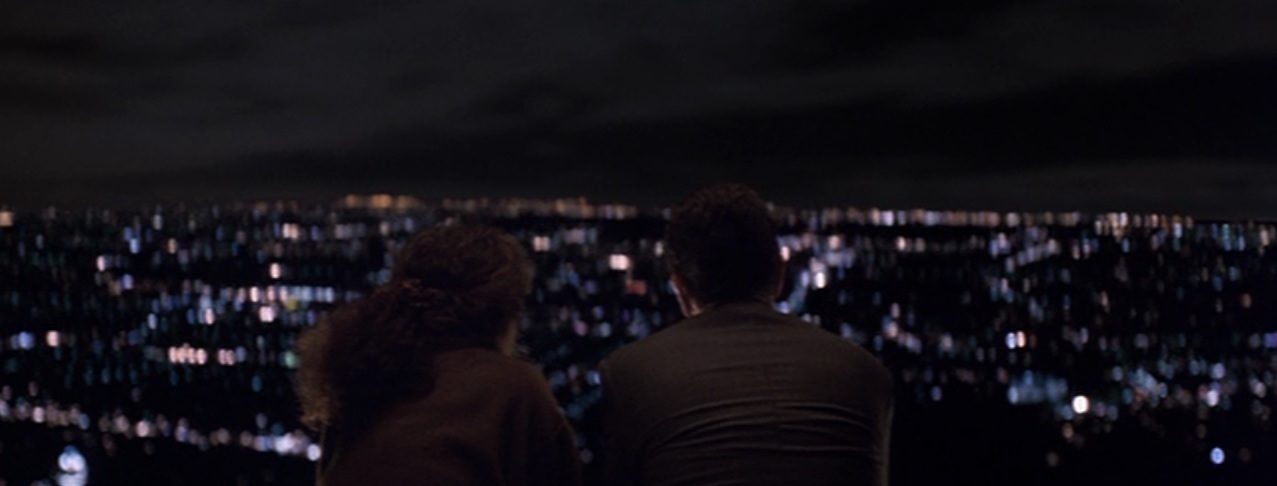
The cinematography, editing, music, and production design are all in total harmonious synch in Heat. Dante Spinotti’s naturalistic if at times slightly heightened images, in full 2.35:1 anamorphic widescreen, fill the edges of the frame with visual information and precise detail, with Mann’s “always-looking-into-the-future-of-the-night” style mixing with Spinotti’s elegant use of color and depth of field. Shots are framed a tad off center, with the character’s heads filling the foreground or background or side of frame, almost so that the camera is entering the minds of the story’s inhabitants, creating a lyrical and thought provoking tone that suggests a cerebral nature as much as it does anything else. The physical locations chosen for Heat showcase Los Angeles in all of its ethnically diverse and cement-sexy splendor, with the vapors and reflections of street lamps bouncing off the flat concrete surfaces, as industrial landscapes dot the horizon, with parking garages, empty lots and fields, side-streets, and the vast expanses of the city’s various skyscrapers and office buildings suggesting endless possibilities. And then there’s the amazing musical score, which ranges from ambient to grand, sweeping to soft, always in perfect tandem with the bright daytime and dark nocturnal images on screen, with some Miami Vice-inspired guitar riffs thrown in for those paying close attention. Heat is a nearly three hour picture, but because of the crispness and the judiciously timed editing, the film never sags or allows itself to slow down; once the story kicks into gear it never lets up, with a final hour that packs various dramatic conflict and incident into the narrative yet never feels rushed or forced. The swift pace created by the seamless editing patterns goes a long way in keeping this lengthy but forceful film moving along, with Mann pulling all the elements together in a way that few could ever have when it comes to material such as this.
By its powerful and well-earned conclusion, Heat is a film that is consumed with the ideas of studied professionalism, and the costs of committing 100% to any area of life. It’s just that in this story, that area of life is the criminal vs. the cop. And during the film’s electric final moments of action at a busy LAX and in the galvanizing final scene accompanied by Moby’s epic and poetic song God Moving Over The Face of The Waters, you get the sense that Mann has crafted two characters that, while resting on opposite sides of the law, have come to mutually respect each other as men and as adversaries. It all goes back to their fantastic meeting at the coffee shop at the film’s midsection, and how the two of them look clear into each other eyes and tell one another that the life they’re living is the only life they know how to live. More than any other great piece of work from Mann, Heat is his definitive masterpiece of filmmaking, the sublime end result of all of his ticks and tendencies as a storyteller, filtered through that indelible and totally dynamic visual aesthetic that has subtly morphed over the years while still retaining its core elements. It’s a film that I remain blown away by every single time I take in a viewing, and I love how I can vividly recall the first time I experienced it on the big screen with my father back in my high school days. Years late, I had a second opportunity to see the film in theaters, this time with Mann doing live Q&A (he took a break from editing duties on Ali to run over to LACMA for the screening). Heat will always be one of my favorite films of all time, for so many reasons, not the least of which is that, simply stated, it is great, enduring cinema that stirs the soul.