Barry Sonnenfield’s Wild Wild West: A Review by Nate Hill

image

I don’t get the hate for Barry Sonnenfield’s Wild Wild West. I just don’t.  It’s like I saw a completely different film than the entire rest of the continent. To my knowledge, there’s me and a couple other friends I know who love and cherish it, and the rest of the world has seemingly cast it out into the cold, inexplicably bashing it no end. Wtf. It’s a rollicking good time, full of a brilliant blend of situational and slapstick humour, lively characters from a great group of performers, incredible production design, and a dash of swash and buckle. It may not have much in common with the 1960’s era tv show its based on, but kudos to it for breaking new ground. Will Smith plays Marshall Jim West, a cocky (there’s literally a small window of freeze frame where you can see his ebony schlock in full glory. And don’t even ask me how I know that), ballsy (ok sorry I’ll stop) secret service cowboy badass who is working a case against some nasty villains who want to use president Ulysses S. Grant for diabolical ends. He’s led to old foe General ‘Bloodbath’ McGrath (Ted Levine in a show stopping, wickedly devious southern psycho role) a confederate lowlife who will hopefully lead him to whoever is kidnapping the nation’s best and brightest scientists for some Bond villain-ish scheme. West is joined by kooky inventor Artemis Gordon (a classy Kevin Kline) and the two embark on a shoot em up quest to thwart the evil plan of Dr. Arliss Loveless (Kenneth Branagh), a dastardly mega villain with plans for America that don’t involve presidents or laws or anything sane. The film is endlessly inventive, wildly funny and parades forth a reel of set pieces, each more amazing than the last until we realize we’re actually watching a fifty foot tall steam punk mechanical spider stomp all over the Utah desert (there’s a priceless story involving that and the film’s odd duck of a producer Jon Peters, which you can watch Kevin Smith regale an audience with over on YouTube). West and Gordon are joined by sultry Rita (Salma Hayek) a Femme Fatale with a hidden agenda who tags along under the guise of damsel in distress. It’s just plain fun and I still don’t get how anyone could dislike it. Witty barbs, raunchy double entendres and sarcastic banter permeate the wonderful script. Nifty gadgets, detailed costumes and clanking machinery speckle the epic production  design. An atmosphere of playful fun oversees all of it from beginning to end. Smith and Kline make a dysfunctional buddy duo for the ages, squabbling right up until the last frame. Branagh hams it up so far over the top as the bad guy that he nearly implodes on himself. Levine is deliciously creepy and crusty. Watch for other gem performances from Bai Ling, M. Emmett Walsh, Debra Christofferson, Sofia Eng, Rodney A. Grant and Musetta Vander. If you’ve seen it and already love it, good for you let’s go have a beer. If you’ve seen it and hate it, you’re a silly bum (to put it mildly). If you haven’t seen it, do so, form your own opinion and fall into one of the above two categories. It’s a classic for me.

Guy Ritchie’s Rocknrolla: A Review by Nate Hill

image

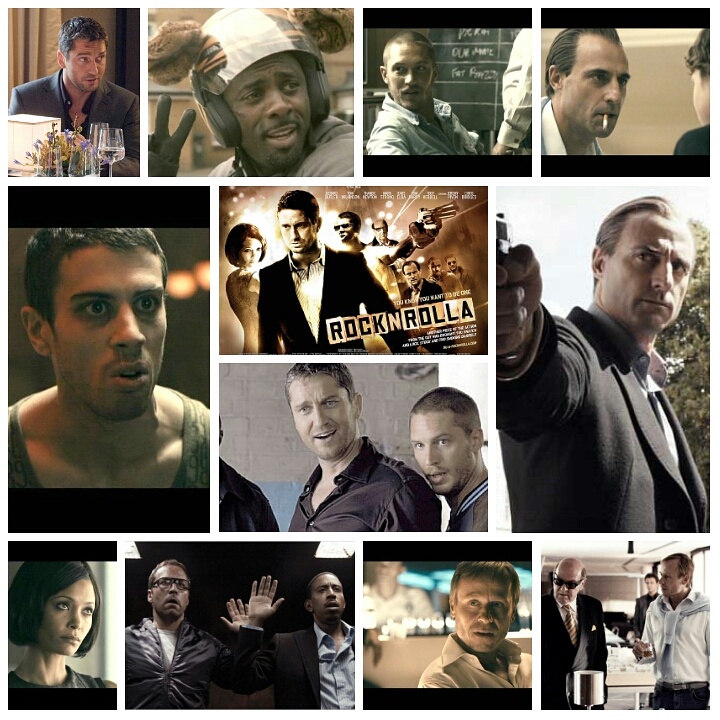
Guy Ritchie’s Rocknrolla was the third British crime comedy caper for the director, and it could have easily been the misstep that signaled him wearing out his welcome. Happily I can tell you that it’s a winner, and although not as cracking as Lock Stock or Snatch, it sinks into its own distinct groove that’s fairly removed from it’s two predecessors. Once again we are treated to the life and times of a bunch of hoods and gangsters in London, but not the grungy, back alley soup kitchen London that we’re used to from Ritchie. No, this is a glistening, prosperous London, filled with real estate money ripe for the taking and developers making underhanded deals with shady businessmen. The climate has definitely changed in Ritchie’s aesthetic, but the characters remain the same, just as witty, eccentric and chock full of piss and vinegar. The story centers around the wild bunch, a cozy little clan of East end petty thieves led by One Two (Gerard Butler) and Mumbles (Idris Elba). Their third musketeer is Handsome Bob, played by a hilarious Tom Hardy who has a secret up his sleeve that spills out in what is the most adorable scene Ritchie has ever written. The gang is hired by a mysterious chick (Thandie Newton) to rob some dudes, and that’s where the trouble starts. Elsewhere in town, arch gangster Lenny Cole (a frothing Tom Wilkinson) negotiates a land deal with dangerous russian billionaire Uri (Karel Roden switches up his trademark psychosis for smooth talking menace here) that hinges on a missing painting. Lenny dispatches his right hand bloke Archie (Mark Strong, subtly trolling us) to find it along with his rock star nephew Johnny Quid. Got that? Nevermind, half the fun is the how and not the why of Ritchie’s stories, and I find it best to just let the flow of it wash over you as opposed to thinking out each detail and missing the sideshow. Toby Kebbell is off the hook as Quid, a wiry stick of dynamite and a comic force to be reckoned with, truly the most exciting performance of the film. Ritchie has a knack for bringing out the funny side in actors, even ones that aren’t usually the type to make you laugh. Strong is terrific, with a few carefully timed moments of sheer hilarity that deftly make you forget how dangerous he is. Ludacris and Jeremy Piven are fun, if a bit out of place as two event promoters. Butler and Elba have an easy-peasy rapport that’s light, friendly and believable. Wilkinson dances between alpha assuredness and aging buffoonry nicely, always commanding the scene and oddly reminding me of Mr. Magoo. There’s a playful tone to this one, glitzy and celebratory in places where Snatch was grim and sketchy, and the whole affair feels like a new years party with a bunch of old friends. Watch for cameos from Matt King, Nonzo Anonzie, Jimi Mistry, Mundungus Fletcher and Gemma Arterton. Very fun stuff.

The Fifth Element: A Review by Nate Hill

  
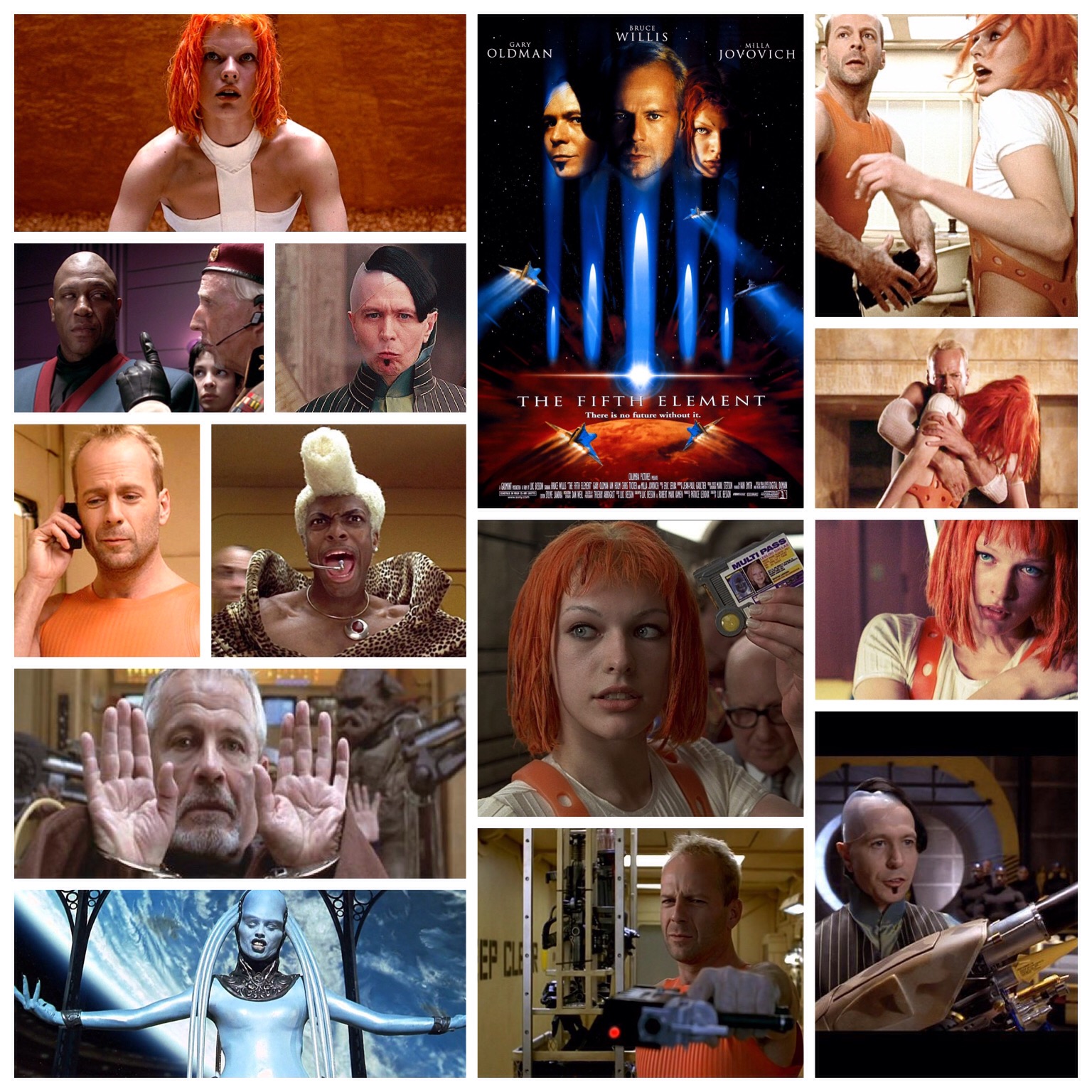
Luc Besson’s The Fifth Element is what you get when you give a massive budget to a director who has an otherworldly flair for imagination and a creative pulse that doesn’t subside for one single second. It’s one of the best sci fi films ever made, a pure intergalactic rush of absurdist qualities anchored by a solid blueprint that’s both akin to and far removed from countless space movies out there. The surprise, and what works so well, comes from Besson and his team crafting a warped and almost Dr. Seussical world that dabbles in cartoonish territory, boggles the eyes endlessly and continually assures you that anything goes in terms of style and tone. It’s an all timer for me, a blast of zany ideas, lovable characters (even the villains are teddy bears to me), a celebration of off the cuff production design and a goddamn certified barrel of fun. Most who read this will know the plot inside out and up and down, but we all know how much I love babbling on about actors and events, so bear with moi. There’s an adorable prologue (“Aziz, light!!!!”) In which an alien race called the Mondosheewans arrive on earth to remove a sacred and very powerful item from an Egyptian pyramid. They resemble shambling steam punk Volkswagen beetles, and are a force of good. This takes place in the 1800’s, and before you can say Luke Perry, we’ve flashed forward to a dazzling futuristic New York City where the events that came before come full circle. Self depracating cabbie Corben Dallas (Bruce Willis) has a day of unending bad luck, until a gorgeous humanoid being named Leeloo (Milla Jovovich was my first cinematic crush in this role ♡) literally falls into his lap, or rather, crashes through the roof of his cab and incites a high speed chase in hover cars, a fantastic sequence, I might add. It turns out this slender, orange deadlocked babe is the human manifestation of the coveted artifact that the Mondosheewans took into their possession. Willis and Jovovich have an immediate exasperated chemistry that practically leaps off the screen as giddily as your heart does whenever they’re seen together. They’re one of the cutest couples in history, and soon embark on a wild adventure to prevent mass destruction at the hands of a giant ball of pure evil that threatens earth (and no I didn’t make that up). Also threatening them is Jean Baptiste Emanuel Zorg (wish that was my name), played by Gary Oldman in a preening, gaudy display of theatrical evil that must be seen to be believed. Zorg is an arrogent megalomaniac who basically runs the city, out to find the ancient stones that are the key to stopping that malevolent force that hangs out just outside of earth’s atmosphere. This is the only film that can claim it has a scene where pure evil itself calls up Gary Oldman on the phone for a chat, which has to be some kind of achievment. There’s a gaggle of incredible actors running around as well, including Bilbo Ba-, I mean Ian Holm as Father Cornelius, a priest of an ancient order sworn to protect Leeloo, the president of the united states (Tiny Lister, once again I’m not making this up), a hapless general (John Neville), a tweaked out petty thief (Mathieu Kassovitz in a scene of pure WTF), Brion James, Lee Evans, and Chris Tucker. Oh good lord Chris Tucker. I don’t know how the guy has the energy, but he keeps it in mania mode as Ruby Rod, a flagrantly horny loudmouth prima donna radio DJ that tags along with Corben for a few gunfights and explosions and shrieks like a banshee all the while. Willis has never been as amiable as he is here, it’s as if John McClane wandered into an episode of Mystery Science Theater 3000 and decided to have some fun. Truly a great protagonist. You will fall deeply in love with Milla as Leeloo. Her lithe physicality, unearthly dialect that she actually learned in full for the film, striking naivete and burgeoning compassion all make her one of the most unique and mesmerizing heroines to ever exist in a film. Oldman mugs, chews scenery like a bulldog, prances about like he’s in a grade school play, and is a sheer diabolical delight. The scene where he demonstrates the ‘swiss army gun’ for his dimwitted extraterrestrial cohorts is time capsule worthy, as is the entire film. Besson directs and stages his world with a reckless abandon that plays like a watercolor painting of pure expression. If there’s an idea someone had, it ended up in this film no matter how outlandish and random it is. That’s the kind of carefree artistic qualities that all movies should have; a willingness to be silly, to be crazy, to step outside the box and then trample on it whilst hurling confetti all about the place. This film is a shining example of that, and stands out as not only one of my favourite films of all time, but one of the best ever made. Big BADABOOM.

Dracula 2000: A Review by Nate Hill

image

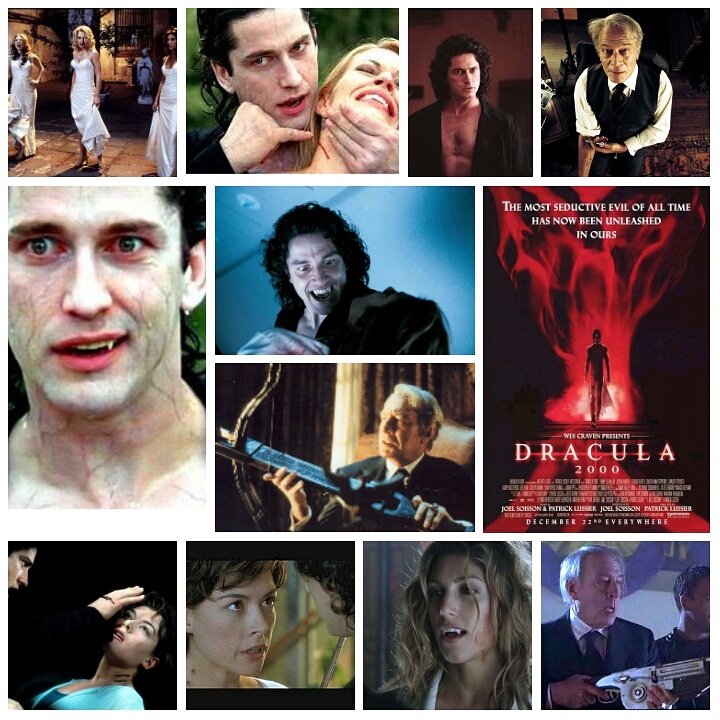
Wes Craven’s Dracula 2000 is one of those horror flicks that proudly slaps his name over the title like he runs the show, when in fact he’s only participating under a vague executive producer credit. Now that we’ve got that little detail out of the way we can talk about what a thoroughly awesome movie it is, and how the haters can go suck it. It’s a high concept slice of bloody fun and has easily one of the best pairings of an actor with the Dracula mythos ever: Gerard Butler. He’s young and lean here, before he turned into a tank later in his career, and he makes one hell of a kick ass Dracula. The story is too good to be true: a team of arch criminals, led by Omar Epps and also including Hyde from That 70’s Show (lol) break into the European mansion of Dr. Abraham Van Helsing (Christopher Plummer) and steal the heavy duty coffin which he has stashed in his basement and used to contain Vladdy for over a hundred years. Helsing has always used a compound derived from his blood to keep himself alive all that time and ensure that he never gets loose. The burglars have no idea what they’re on for, and pretty soon Butler is loose and ready to get freaky, tearing apart their getaway plane and running off into the chaotic streets of New Orleans during Mardi Gras. He’s searching for a girl (Justine Waddell) to have sex with her and fulfill some horrific prophecy (nice little nod to End Of Days there). Dracula, Mardi Gras, Gerard Butler, Christopher Plummer; four ingredients to pretty much ensure your movie is gonna rock. Plummer makes one of the best onscreen Van Helsings in my books, rivaled only perhaps  by Anthony Hopkins. Butler is a sleek, hip and sensual Dracula, playing the role to the bloody hilt and sedimenting a really cool rendition of the character, with a surprising twist ending that adds some depth to the guy. Watch for work from Jennifer Esposito, Sean Patrick Thomas, Shane West, Lochlyn Munro and Nathan Fillion as well.
Great retelling, or rather addition to the legend, held up by Butler.

Out For Justice: A review by Nate Hill


As much of a goof as Steven Seagal is these days, he does have a few very solid and badass flicks from back in the day, the best of which is probably Out For Justice. There’s a whole pile of his flicks out there both new and old, and you have to know how to approach this particular minefield. There’s a bunch that are awesome (Under Siege, The Glimmer Man, Above The Law) and an even bigger bunch that stink to high hell (literally anything after 1999). You can’t go wrong with this one though. It’s a violent, nasty gut punch of criminal activity set on the very mean streets of NYC. Seagal is pathetic in the sense that he doesn’t even realize that every single film he does is stolen from under his very nose by the villain, both in terms of acting and character. I rent a Seagal flick not for Seagal, but for whatever grizzled character actor plays his nemesis, and here that slot is thoroughly rattled by a psychotic William Forsythe. Seagal plays NYC cop Gino, who is on the hunt for the killer of a childhood friend, perpetrated by unhinged lunatic Richie Madano (Forsythe), a maverick of a villain who constantly eludes Gino and plays a deadly, reckless game until he is finally caught up with. Forsythe is a juggernaut, whether trash talking his own henchman and kicking the shit out of them or taking road rage to a whole new level when he shoots a mouthy motorist in the head for looking at him the wrong way. He’s the homicidal life of the party here, and Seagal struggles to live up to his talent, which he can only do via his undeniable physicality. Gina Gershon has a sheepish, slutty bit as Richie’s sister, and watch for Jerry Orbach doing his thing as well. About as awesome a flick as you’ll find in Seagal’s career, and a total blast. 

Wake In Fright: A Review by Nate Hill

image

Wake In Fright is like one of those clammy nightmares where you are stuck in some godawful place full of ugliness and depravity, and try as you might, you simply can’t escape or outrun the horror around you. Such is the plight of John (Gary Bond) a schoolteacher in a desolate county of the Australian outback, on his way to Sydney for a little R&R on winter break. His journey takes him to a pit stop in Bundanyabba, an ass backwards mining town in the middle of the middle of nowhere. He stops by the bar, where the leathery sheriff (Chips Rafferty) offers to buy him a beer. And another. And another. And another. You see, the Yabba is such an isolated doldrum of a place that it’s inhabitants resort to extreme alcoholism on a daily and nightly basis, which combined with their sun baked brains leads to some harrowing displays of excessive and whacked out behaviour, that poor John comes face to face with. It’s funny that his last name is Bond, because he has the air of sophistication akin to our dear old 007, and it clashes with these yowling yokels like baking soda and petrified vinegar. His composure starts to creak as each pint of lager cascades it’s way down his esophagus, until the line between civilization and primal Instinct starts to scare him. But is it too late by then? He somewhat befriends Doc Tydon (Donald Pleasence) a raging drunkard who hangs around with a group who do nothing but drink, howl like lunatics, fight and hunt kangaroos. Pleasence is transfixing as a once cultured man of medicine whose soul has been drenched in the endless consumption of beer and calcified by the mad, acrid sun, until the whites of his eyes begin to reveal the decay beneath. The scenes of alcohol drinking in this film are staggering, frequent and very, very disturbing. The lonliness has bred this behaviour and these people know nothing else but inebriation and idle time wasting, their lives reduced to one long episodic bout of day drinking and nocturnal revelry. John veers eerily close to falling directly in line with them and going to far down that path, especially during a nighttime kangaroo hunt that serves as some perverted form of an initiation ritual. I must warn you: not only are the hunting scenes very, very graphic, but they’re completely un-staged. The adage “it’s just a movie” doesn’t apply to these sequences, and the carnage we see unfold is horrifying geniune. The hunts were supervised by the Australian government and conducted in an overpopulated area by experts. None of that makes them any easier to watch. This film serves as an anthropological treatise on what happens to human beings who live in the farthest and most remote corners of the world, left to their own devices by seclusion and time, relegated to near animalistic states that to them is just another day in the Yabba. Billed as a horror film, but the horror comes solely from the human elements, which to me is always far scarier. Deliverence ain’t got nothing on this baby, and we’re lucky we even got to see it at all. Some years after the film’s bitterly received release (Australians were pissed at the depiction of their people, and probably stung deep by the truth of it) it disappeared so far into obscurity that all prints seemed to be gone, and the consensus was that it was lost forever. One day the editor was cleaning his garage on the very day he was going to liquidate everything he didn’t need, and found a single print. This was nearly twenty years after the film’s release, and today you can watch it on netflix Canada. Quite the story, quite the film. Just strap on a thick skin, it’s a sweaty, dusty, boozy rollercoaster that dips to the very rock bottom of the human condition.

THE NINTH GATE – A REVIEW BY J.D. LAFRANCE

The-9th-Gate-the-ninth-gate-16058196-960-414

Critical and commercial reaction to Roman Polanski’s films has always been mixed at best. To say that they are an acquired taste is an understatement. The Ninth Gate (1999) is no exception. Despite what the film’s misleading trailer promoted at the time of its initial release, it is not a straight-forward supernatural thriller but rather showcases the auteur in a darkly humorous mood as he plays around with the conventions of the genre.

Dean Corso (Johnny Depp) is an unscrupulous book dealer whose motivation is purely for financial gain. He swindles a naïve couple from a set of rare and priceless books in an amusing scene that sets up his character beautifully. A very rich book collector by the name of Boris Balkan (Frank Langella) hires Corso to validate his recently purchased copy of The Nine Gates of the Kingdom of Shadows, one of only three copies that exist in the world. The book contains nine engravings which, when correctly deciphered and the interpretations properly spoken, are supposed to conjure the Devil. Balkan believes that only one book is authentic so he hires Corso to track down each copy and verify their authenticity. It seems like a simple enough task but as Corso soon finds out, someone does not want him to complete the job. He crosses paths with an odd assortment of characters, from a mysterious woman (Emmanuelle Seigner) who seems to help him in his quest, to another, more obviously evil woman, Laina Telfer (Lena Olin) intent on impeding his progress and quite possibly trying to kill him.

Polanski received the screenplay by Enrique Urbizu and was so taken by it that he read the book it was based on, El Club Dumas by Arturo Perez-Reverte. He liked the novel because, “I saw so many elements that seemed good for a movie. It was suspenseful, funny, and there were a great number of secondary characters that are tremendously cinematic.” The novel featured several intertwined plots and so Polanski decided to write his own draft with long-time screenwriting partner, John Brownjohn (they had collaborated previously on Tess, Pirates and Bitter Moon). Perez-Reverte’s book contains numerous literary references and a subplot concerning Corso’s investigation into an unpublished chapter of The Three Musketeers. Polanski and Brownjohn jettisoned these elements and focused on one particular plot line: Corso’s pursuit of the authentic copy of The Nine Gates. For Polanski, the story had “all the ingredients that I like. It’s a great dose of a certain kind of irony and humor, and a bit of the supernatural or metaphysical or whatever you call it. Suspense and a central character, which I found very appealing.”

Johnny Depp became attached to the project as early as 1997 when he met Polanski at the Cannes Film Festival promoting his directorial debut The Brave (1997) that was in competition. Initially, the veteran filmmaker did not think that Depp was right for the role of Corso because the character was 40-years-old. Polanski was thinking of casting an older actor but Depp was persistent and wanted to work with him. According to the director, Corso’s disheveled look was modeled after Raymond Chandler’s famous sleuth, Philip Marlowe and there is a hint of that rumpled cynical vibe that is the trademark of that character. Hints of friction between Depp and Polanski while working on the film surfaced in the press around the time of its North American release. The actor said, “It’s the director’s job to push, to provoke things out of an actor.” Polanski told one interviewer, “He [Depp] decided to play it rather flat which wasn’t how I envisioned it. And I didn’t tell him it wasn’t how I saw it.”

Polanski cast Frank Langella as Balkan after seeing him in Adrian Lyne’s version of Lolita (1997). The director liked how the actor could be “charming and disturbing at the same time.” Polanski cast Lena Olin as Liana Telfer because he needed “an actress who could give the impression that she’s an intellectual and, at the same time, a very sensuous woman capable of great bursts of violence.” Barbara Jefford was a last minute casting decision because the German actress originally chosen was struck with pneumonia and another actress could not learn the lines. Jefford came in with only a few days notice, learned her lines, and affected a German accent. Casting Jefford was a nice nod to her role in the Hammer Horror film, Lust for a Vampire (1971), where she played a countess who conducts a satanic ceremony to resurrect the body of her daughter.

Polanski admired the work of director of cinematography, Darius Khondji. “I love his lighting, because he knows how to make it both sophisticated and realistic. It keeps you on the fringe of fantasy so when you tip over into the supernatural, it doesn’t feel artificial at all,” he remarked in an interview. Khondji was also keen to work with the director. “I’ve always wanted to make a movie with a witchcraft or supernatural subtext – I love those kinds of stories. Roman is obviously one of the best directors in the world to work with in that genre.” Filming took place in France, Portugal and Spain during the summer of 1998.

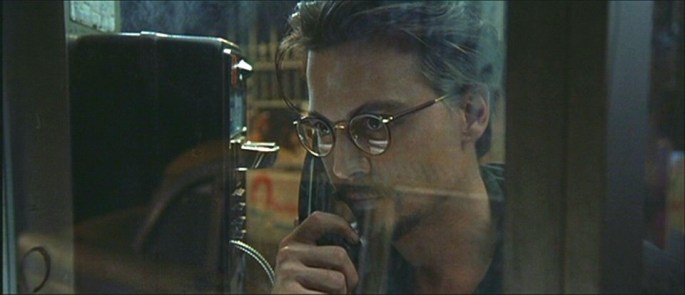
While the film’s slow, deliberate pacing turned off many, there is a method to Polanski’s madness. The gradual pacing draws one into this engaging world. Perhaps it is the European setting but The Ninth Gate has an otherworldly atmosphere that is well done. The attention to detail and Khondji’s richly textured cinematography is exquisite and contributes to the overall mood of this vivid world. For example, the New York City scenes have a very 1940s vibe to them, utilizing brown and blacks with a warm gold glow from the street lamps. This is, in turn, contrasted with the green and red in the phone booth when Corso is trying to contact Balkan.

hQFD1However, The Ninth Gate does not just have atmosphere going for it. Johnny Depp adds yet another intriguing character to his roster of unconventional roles. Corso is an unethical cheat who would do anything to make a buck. A rival describes him as a “vulture” and “unscrupulous” to which he freely admits to as he swindles four volumes of a rare edition of Don Quixote. He really does not care about others and yet, despite all of his reprehensible qualities, Depp’s natural charisma and charm make him kind of an endearing character that you care more about as he delves deeper into dangerous waters.

Balkan is a pompous windbag filled with self-importance but Frank Langella stops just short of being a cliched, moustache-twirling villain. He’s melodramatic and his presence is a nod to horror fans who recall his most famous role in Dracula (1979). Lena Olin’s dangerous Telfer widow evokes her femme fatale character from Romeo is Bleeding (1993). She smokes and even flashes a suggestive shot of her black garter-clad thighs in an attempt to seduce Corso and draw him into her web. She uses sex to get what she wants and when that fails she resorts to violence, attacking him in an animalistic frenzy.

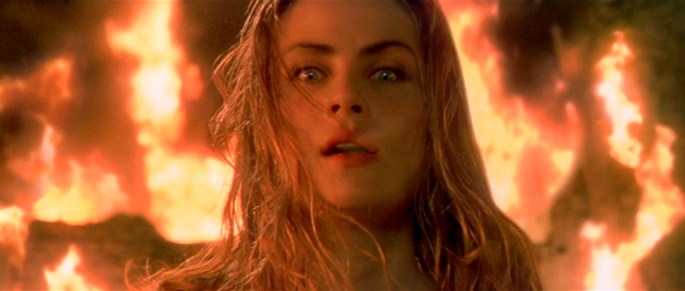
Emmanuelle Seigner plays a mysterious woman who constantly shadows Corso and sometimes helps him out when gets in dangerous situations. Her motives do not become fully apparent until the end and even then it is open to interpretation. She helps him get inside the Fargas house and flies with him to France. Who or what is she? At one point, she literally glides down a flight of stairs and saves Corso from getting a beating at the hands of Telfer’s henchman.

This movie is ample with clues, a puzzle waiting to be solved. For example, in Balkan’s lecture at the beginning of the movie, he suggests that all witches are evil and in league with Satan. The irony is that Corso sleeps through this important clue to Balkan’s real intentions. There is also the odd, disregard for The Book of Shadows, a book worth an estimated $1 million. It is placed in constant peril and is even flicked with ash when the Ceniza brothers analyze it.

As for the cliché aspects of the film, one should be less concerned at anticipating plot twists and predictable elements in favor of simply enjoying the ride. Polanski probably was aware of this and decided to have fun with them. There is Balkan’s “666” password, Corso’s perchance for getting the crap kicked out of him, and the one-armed woman book dealer that all contribute to a playful mood that punctuates the film whenever it runs dangerously close to being too pretentious or self-important.

Polanski approached the subject matter with a certain amount of skepticism as he said in an interview, “I don’t believe in the occult. I don’t believe. Period.” He wanted to have fun with the genre. “There is a great number of clichés of this type in The Ninth Gate which I tried to turn around a bit. You can make them appear serious on the surface, but you cannot help but laugh at them.” For Polanski, the appeal of the film was that it featured “a mystery in which a book is the leading character” and its illustrations “are also essential clues.” The film has a playful tone but Polanski knows when to reign things in. As the horror is heightened so is the film’s dark comedy during the climactic moments. The screenplay is in perfect synchronicity with the direction.

For a film supposedly steeped in literature, the text, and by that I mean the story, is irrelevant. There are many clues scattered throughout the film that suggest this to be the case. One has to understand that among the characters there is a hierarchy. At the bottom level is the Frenchman that Corso meets early on. He owns one of The Nine Gates but is not all that interested in it except for the craftsmanship of its binding. Then, there is the Baroness who has spent her life writing about The Devil but never considered the meaning behind the images in her copy of The Nine Gates. And, if you take her word, she had the best clue because she claimed to see the Devil when she was a child. At the next level is Laina who is aware that the book has some power but is still focused on the words and not the images. Above her is Balkan who knows that the text is irrelevant and that the pictures are crucial but incorrectly thinks that the key to summoning the Devil lies in them.

The Ceniza brothers have the ability to tinker with the power of the pictures. They are allusive figures that seem whimsical when Corso first meets them and then are gone when he visits their now defunct store at the film’s end but thanks to the movers who are disassembling the store he gets the final piece of the puzzle. Corso starts off at the bottom because the value of books are neither in the text nor in the pictures but in their binding and availability. By the film’s end he realizes that the power is not in the pictures but the quest itself. There is the mysterious woman who resembles one of the figures in the engravings and actually provides the final clue for Corso to reach the end of the quest. The final layer is the viewer. That makes nine players and eight levels of consciousness created by Polanski.
fhd999TNG_Emmanuelle_Seigner_037The Ninth Gate
was a refreshing change from the trend of mundane Hollywood supernatural schlock at the time (i.e. The Bone Collector, Stigmata, End of Days, et al.) that took itself way too seriously and tried too hard. Unlike those films, The Ninth Gate never falls into that trap. It contains some truly vintage Polanski black humor that, alas, North American audiences and critics alike did not appreciate. They wanted meat and potatoes filmmaking that he has always resisted in favor of subversive thrills and following his own muse come hell or high water.

Bound: A Review by Nate Hill

image

Before the Wachowskis rocketed into the stratosphere of cinema with their big budget world building and brilliant, lofty ideas, they made Bound, a down n’ dirty, kinky little slice of mob pulp that’s as much fun as it is sexy, potent and dangerous. Gina Gershon plays Corky, a hard nosed opportunist with a keen eye for making money and a fondness for beautiful women. Jennifer Tilly is Violet, the bored wife of weaselly gangster Ceasar (a lively Joe Pantoliano), who has just come into a whole wacky of shady cash via his employer Mickey, played by one of the great character actors of his generation, John P. Ryan, who is sadly no longer with us. Ceasar has been given the money to launder, but Violet has other plans that involve double crossing him and making off with it. When she happens to wander into the gay bar that Corky frequents, sparks fly. And I really mean it, for soon enough the two are in bed together for one of the single most hot and heavy sex scenes you will ever see in a film. Seriously, you’ll want to open some windows for this baby. As soon as Corky gets wind of the money, the plot simmers as everyone makes a discreet mad dash for riches and no one is sure who is screwing over who. Gershon is tough, sexy as hell and leaves a faint trace of vulnerability in her excellent performance. Tilly is crafty and secretive, deliberately making people underestimate her until it’s too late. This was Ryan’s last film role, and he makes the most of it as a salty old thug with a dash of class, a touch of kindness and the unnerving tendancy to snap at the drop of a hat. Christopher Meloni is hilariously pathetic as his second in command who irritates everyone around him, especially Ceasar, who has a scary little temper of his own. One senses real danger for our two female leads, because despite the somewhat playful and often satirical tone towards tell gangsters, the Wachowskis have still fashioned them to be formidable and cruel, a wise tonal choice that grounds the viewer and distills geniune suspense. The characters are all brilliantly written and realized, so if you read this review thinking this was a trashy little lowbrow affair, it’s not. It’s It’s a real world tale that just so happens to take place in a lurid part of movie town, and contains one scorcher of a lesbian love affair that is as affecting in dialogue and body language as it is with sex. A special film, and not one to be missed.

TROPIC THUNDER – A REVIEW BY J.D. LAFRANCE

large20tropic20thunder20blu-ray6

For the years leading up to Tropic Thunder (2008), Ben Stiller had been coasting on his patented, one-note neurotic doormat shtick in films like Night at the Museum (2006), The Heartbreak Kid (2007), and others. What happened to the guy who could play a self-destructive junkie screenwriter in Permanent Midnight (1998) and a dorky romantic in There’s Something About Mary (1998)? Stiller, at times, is more interesting behind the camera as director of the Generation X comedy Reality Bites (1994), the black comedy about stalking and television, The Cable Guy (1996), and the hilarious fashion world satire Zoolander (2001).

With Tropic Thunder, Stiller returned to being behind the camera (and also in front of it) and decided to take on the Vietnam War sub-genre. In an odd way, we have Oliver Stone to thank for this film. Not just because he made Platoon (1986), which really popularized the sub-genre, but he also rejected Stiller when he auditioned for a role in the film. Stiller never forgot it and now he’s parlayed those feelings of rejection into a film that not only lampoons war films but Hollywood in general.

Tugg Speedman (Stiller) is an action film star on the decline, still flogging his Scorcher franchise – films that resemble a cross between something Tom Cruise might do and Roland Emmerich’s brain-dead special effects epics. Jeff Portnoy (Jack Black) stars in low-brow comedies filled with fart jokes that allow him to play multiple characters a la Eddie Murphy (Norbit, anyone?). Australian actor Kirk Lazarus (Robert Downey Jr.) is a five-time Academy Award winner who appears in “serious” films that win all of the important awards just like Russell Crowe.

They are all starring in a Vietnam War movie called Tropic Thunder that is currently being made on location in South Vietnam. The production is on the verge of being in the kind of trouble that almost consumed Apocalypse Now (1979) as Lazarus is upstaging Speedman. First-time director Damien Cockburn (Steve Coogan) can’t control his actors, which is causing the movie to go behind schedule, much to the chagrin of Les Grossman (Tom Cruise), the blustery, Harvey Weinstein-esque head of the studio.

In an effort to save the movie, Cockburn takes the five main actors to a remote jungle area to shoot a bunch of scenes guerrilla-style only to stumble across a rag-tag group of Vietnamese drug runners who assume that the clueless movie stars are actually DEA agents. At first, Speedman and his co-stars think that this is all part of the production but they (except for Speedman) quickly realize that this is for real.

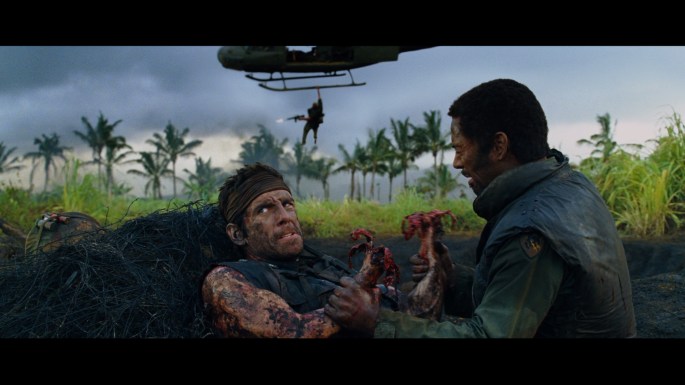
Robert Downey Jr. was rightly praised for his hilarious performance as an actor who goes so deep into character that he undergoes “pigmentation alteration” surgery to darken his skin in order play an African American soldier. Downey’s commitment to the role is almost as dedicated as Lazarus’ and he gets some of the film’s best lines, including such gems as “Man, I don’t drop character ’till I done the DVD commentary,” and “I know who I am. I’m the dude playin’ the dude, disguised as another dude!”

It’s not too hard to figure out the real-life Hollywood power players that Stiller’s film satirizes with Cruise’s Grossman channeling the abusive reputation of the aforementioned Weinstein and Downey poking fun at the way-too serious on-and-off-screen antics of Crowe. Unlike all of those Scary Movie spoofs, Stiller understands that a good satire plays it straight on the surface. Admittedly, he’s got a much bigger budget to play with ($100 million+) than any two of those dime-a-dozen spoof movies so he’s able to hire the likes of A-list cinematographer John (The Thin Red Line) Toll and cast marquee name actors like Robert Downey Jr. and Jack Black instead of C-listers like Carmen Electra to make Tropic Thunder look like the slick war films he is sending up. Of course, the danger in doing this is to become the very thing you’re trying to parody, but fortunately Stiller doesn’t fall into this trap.

Every generation needs a Mel Brooks and Stiller takes up where the legendary comedian left off – before he became irrelevant and painfully unfunny. Stiller goes after the usual suspects of the genre: Platoon, Apocalypse Now, The Deer Hunter (1978), and even a sly reference to a scene from Predator (1987), but Tropic Thunder is more than a game of spot-the-reference that spoof movies tend to devolve into. It actually has something to say other than Hollywood is excessive. This is one of Stiller’s most ambitious film to date and demonstrated that he can play in the same big leagues that fellow comedian-turned-filmmaker Jon Favreau has also graduated to with Iron Man (2008). They both started off with very modest films and have shown a very definite learning curve with each subsequent film they’ve helmed. Tropic Thunder has everything you’d want from a big budget, R-rated comedy.

In Bruges: A Review By Nate Hill

  
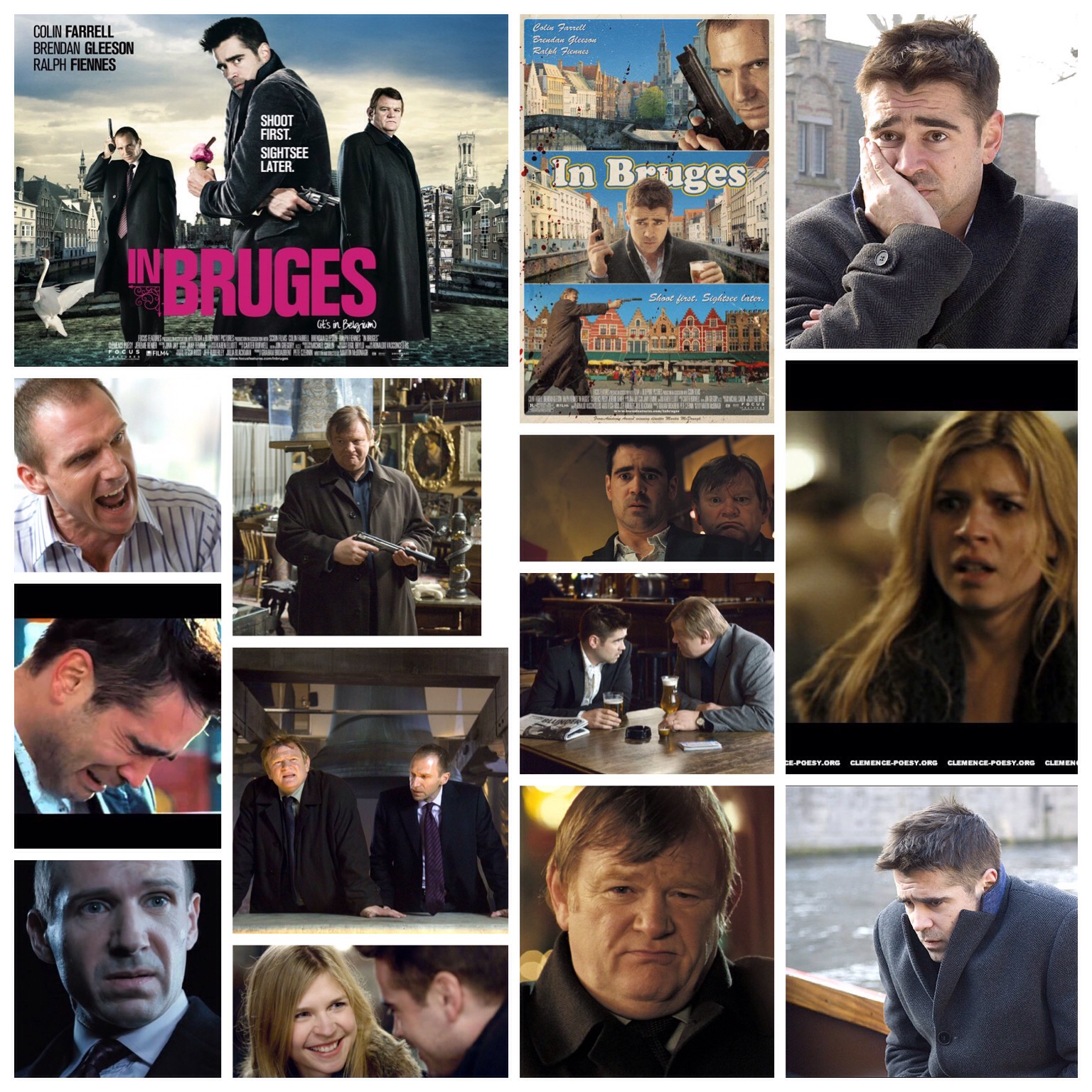
I can’t really say in enough words how much I love In Bruges. In fact there aren’t words in my language which can express how deeply in tune to it I feel every time I put the DVD in for a watch, which is at least every four months or so. The dual forces of comedy and tragedy have combined here using Martin McDonough’s genius scriptwriting as an avatar to create something raucously funny and profoundly moving. The comedy is of the spiciest and very darkest nature (my favourite), and the tragedy tugs at both the heart strings and the tear ducts, scarecly giving you time to wipe away the tears of laughter from the scene that came before. The best in UK crime fare, some of the most balanced, peculiar writing and fully rounded characters who are as flawed as human beings get. Colin Farrell delves deep and gives the performance of his career as Ray, a would be hitman who has fucked up bad, and now heads for Bruges (it’s in Belgium) with his mentor Ken (Brendan Gleeson, pure brilliance and humble class). Ken loves eccentric little Bruges, with its historical architecture and quaint townsfolk. Ray is bored to tears and pouts like a toddler. They meander around the town getting into all sorts of mischief including a dwarf (who has fascinating ideas about the ultimate race war), museums, cocaine, the Belgium film industry and more. Ray sets his sights on the gorgeous Chloe (), and Ken does his paternal best to keep him out of trouble while wrestling with his own gnawing guilt. The film gets a shot of pissy adrenaline when their boss Harry comes looking for them, in the form of a knock it out of the park funny Ralph Fiennes. Fiennes rarely cuts loose and bounces off the walls like he does here, and his Harry is a delightful creature to watch in action. Angry, petty, volatile, clever and out for blood, just a joy to behold. As playful as the script is, there’s a purgatorial sadness to Ray’s situation, a fateful sense that he’s been dumped in Bruges not just to fool around, get drunk and utter witty barbs in that brogue (which he does do a lot) but to deeply ruminate on his choices and ponder where his actions will lead him moving forward from his terrible deed. Maturity permeates each exchange between him and Ken, a fledgling and an old timer shooting the breeze about heavy topics which neither of them pretend to understand, but both are neck deep in. I always cry at certain scenes, always laugh my ass off at others, and never cease to be affected right to my emotional center and the marrow of my funny bone each time I watch this. Look for a brief cameo from Ciaran Hinds in the opening few minutes. Every second of this piece is filled with lush, thought provoking dialogue, awesomely un-politically correct dialogue that doesn’t censor a single impulse from its characters, and a yearning to explore the decisions which cause people to be labeled ‘good’ or ‘bad’, something that’s inherently complex yet feels lightly treaded on here. Masterpiece.