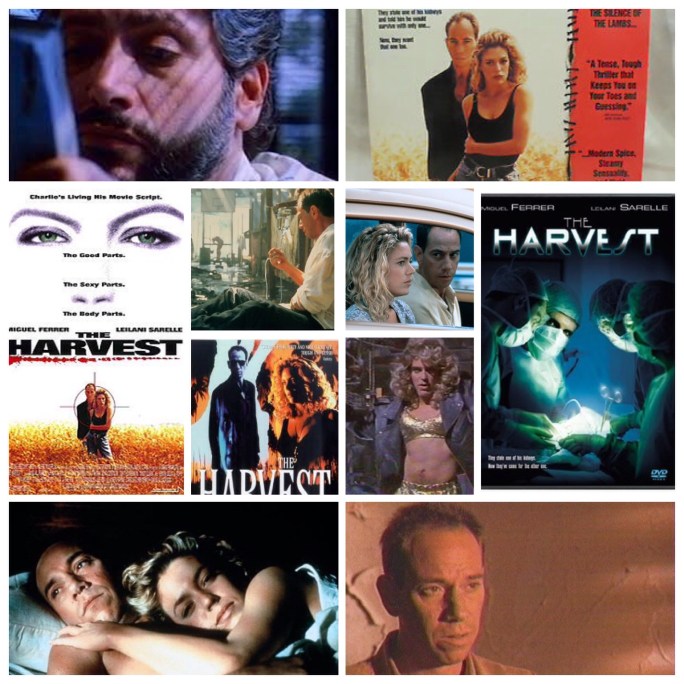
The Harvest is the very definition of a hidden gem that one stumbles upon while watching late night cable and sits through to the end just because it’s such a wickedly nasty little thriller. Erotic and steamy, dangerous, very darkly funny are qualities that all reside within a terrific script that has one kicker of an ending that’s quite the chuckle inducing payoff. No one wants to have their organs taken while on vacation in some sketchy South American country, let alone consider the thought of it. Hard luck screenwriter Charlie Pope (an intense Miguel Ferrer in one of his few lead roles) falls right into that unthinkable scenario. He’s sent to Mexico by his bad tempered boss Bob Lakin (a sleazy Harvey Fierstein, who REALLY needs to be in more movies), and marinates in the sweatiness trying to get some work done. After a hot and heavy night with a gorgeous local babe (Leilani Sarelle) he wakes up with the mother of all hangovers and is horrified to find that one of his kidneys has been removed. From there it’s a stomach churning mad dash to figure out where the smugglers have gone, and evade the, at the same time, because they’re coming to try and get his other one and silence him forever as well. It’s an uncomfortable little piece of white knuckle trash, but it’s made with solid flair and like I said, the script is top shelf stuff. Ferrer is the running man here, trying to keep one step ahead of some very dangerous people, his bountiful acting talent putting us right there with him. Fierstein is always a gravel voiced gem, and gets two penultimate scenes that spin the plot on its cogs, both which will have you laughing uncomfortably. There’s also an early career appearance from George Clooney, who is Ferrer’s cousin. His credit here, and I’m not even making this up, is ‘Lip syncing transvestite’. How’s that for a leg up in the industry. Lowbrow, gut churning black comedy mixed with the exotic fish out of water thriller makes for a neat little piece of genre bending, grotesque shocker fun.
Tag: film review
Robert Atman’s The Gingerbread Man: A Review by Nate Hill
Robert Altman’s The Gingerbread Man isn’t the director’s best, but it’s worth a looky-loo just to see this solid cast cavort around in a sweltering Georgia atmosphere and play out a narrative that’s part sultry seduction thriller and part hard boiled whodunit. I remember watching it and going ‘meh, I’ve seen this type of thing a thousand times and this one didn’t raise the bar at all.’ I’m thinking now that perhaps my mindset was in the wrong space, and that Altman set out to simply bring us the romantic murder mystery in its purest form, without deviation or higher ambitions. In that case he’s made a neat little potboiler with a suitably ludicrous ending, some truly effective red herrings and a really great troupe of actors, so,e going nicely against type. The multitalented Kenneth Branagh plays suave Georgia lawyer Rick MacGruder, who finds himself in deep trouble when he has an affair with sexy, slinky and shady Mallory Doss (the very underrated Embeth Davidz). She’s a good enough girl, but she has a backwoods nutcase of a father named Dixon (Robert Duvall being uber strange and loving every second of it) who is stalking and threatening her. Dixon is a bedraggled, cult-leading swamp rat and Duvall plays him to the frenzied hilt of uncomfortable ticks and unkempt theatrics. MacGruder, being smitten with Mallory, is of course compelled to use his legal and personal power to help her, and concocts a convoluted scheme involving a subpoena to Mallory’s belligerent ex husband Pete Randle (a cranky Tom Berenger blusters about in the third act). This of course sets off all kinds of back door motivations and sweaty double crosses that are hard to keep track of until all is revealed in the final act, prompting a collective audience reaction of “huh??”. It’s all in good fun though and at times it seems like Altman is deliberately dipping into B movie territory just to shirk his high art mantle and spice up this gumbo with some trashy, lowbrow flavour. I say bring it, that’s exactly the way to my heart. Writing this review I’m now realizing I probably like this film way more than my ending statement might suggest, but sometimes we need to hash it all out on paper (or in this case a cramped iPad keyboard) to reevaluate our perception of a certain piece. The cast gets juicier, with Robert Downey Jr. doing a quick bit as Macgruder’s slick buddy who works as a private investigator for the law office, Daryl Hannah and Famke Janssen as Rick’s jilted wife as well. It’s based on a John Grisham novel, and Altman seems to be the first director to adapt his work with a ramped up style and personal flair that goes beyond the academic thrills on the page. This one feels heightened, sultry and oh so sweaty in the way that only a southern set thriller can be. Cool stuff.
House Of Sand And Fog: A Review by Nate Hill
House Of Sand And Fog is an emotional thunderclap in ways you won’t see coming, leaving the viewer gutted after a finale that feels spare and detached yet wracked with emotion in the same moment. You feel haunted after witnessing the story unfold, and I was particularly affected by Ben Kingsley’s determind, tender performance for days after my viewing of the film. He plays an Iranian man, a proud man who was a Colonel in the air force in his home country, and has been forced to work construction labor jobs in America to support his family, and to keep up the appearances of their lifestyle. When neglected taxes force a troubled woman (Jennifer Connelly) out of the house she grew up in, Kingsley sees an opportunity to buy the the property for a fraction of what it’s worth, essentially leaving Connelly homeless. She has a history of alcoholism and instability, and this unfortunate situation really worsens her condition, leading to angry and confrontational behaviour towards Kingsley. He has no ill will towards her, he’s simply trying to make a better life for his family whom he loves very much. His wife (Shohreh Aghdashloo) is still very much rooted in Iranian culture, and much of what’s going on goes over her head. There’s also a cop (Ron Eldard) who strikes up a reckless romance with Connelly and tries to strong arm Kingsley into selling the house back to her, pretty much reasoning with his dick instead of his brain. This is a film that refuses to take a side, showing us unblinking and compassionate views of both people within the conflict, and never lifting a judging eyebrow. It’s a sad, sad turn of events and the film wants to show us the tragedy, but it does so with the utmost care, and always has a loving hand in presenting it’s two lead characters. Connelly is heartbreaking, showing us the burning humiliation that frays her spirit to the last sinew. Kingsley is flat out brilliant in the kind of performance that holds up for decades to come. He rightly won an Oscar for his galvanizing turn that breaks hearts and opens tear ducts. Ron Eldard is the only piece that doesn’t fit, because he’s usually not fund in this type of stuff. He’s really talented as an offbeat character actor, but just seems out of place here playing it straight, and it also doesn’t help that his character is just damn unlikable. Aghdashloo is the third leg of the acting table, and her work earned her an Oscar as well, she is plain superb. Be careful of what mood you’re in when you give this one a go, it’s pretty devastating. It’s also powerful cinema, and a story that could happen to anyone, anywhere in the world, giving us something real to latch onto and connect with.
PUNCHLINE – A REVIEW BY J.D. LAFRANCE

The harsh reality of stand-up comedy is that for every Jerry Seinfeld that makes it, there are hundreds of comedians who don’t. There are comedians who work dead end jobs during the day and spend the rest of their time working comedy clubs in the hopes of getting that “big break” on a late night talk show or a role in a film or a television sitcom. Some of them have what it takes but most do not. David Seltzer’s film, Punchline (1988), is dedicated to and about these men and women who try to make us laugh. It also explores the dedication, the discipline, and the sacrifices that must be made in order to make it.
Steven Gold (Tom Hanks) is a struggling medical student who moonlights as a stand-up comedian. It quickly becomes evident that he is lousy at the former and excels at the latter. And yet, when he is given a chance at the big time, he cracks under the pressure. Lilah (Sally Field) is a dedicated housewife that also yearns to be a comic. She has the raw talent but not the command of craft that Steven possesses. At first, he doesn’t give Lilah the time of day but slowly they bond and he teaches her the fundamentals of stand-up comedy. “All you need is the right gags,” Steven tells her, and he’s right. Once Lilah has some decent material she discovers her natural gift of making people laugh. An uneasy friendship develops between the two and the personal conflicts they must resolve: Steven’s desire to make it big vs. his inability to do so and Lilah’s love of comedy vs. her love for her family.
David Seltzer wrote the first draft for Punchline in 1979 after becoming fascinated by comedy clubs while looking for someone to play a psychiatrist on a T.V. pilot that he was writing. He had a development deal with the movie division of ABC. Originally, the tone of the film was more good-natured a la Fame (1980) with more characters and less of an emphasis on Steven Gold. Bob Bookman, an executive, sponsored the script but left for Columbia Pictures. He bought the screenplay because Howard Zieff (Private Benjamin) was interested in directing it. When Zieff lost interest (he ended up doing Unfaithfully Yours in 1984), the script was buried for years.
In 1986, producer Daniel Melnick found the screenplay for Punchline among twelve other scripts collecting dust in the vaults of Columbia Pictures. Seltzer’s screenplay had gone through three changes of studio management because the executives didn’t like the mix of comedy and drama. They also didn’t like the Steven Gold character because they thought he was, according to Melnick, “obsessive, certainly self-destructive and could be considered mean-spirited.” The studio couldn’t get a major star to commit to the material and so Melnick decided to make the movie for $8 million and with no stars. Interim studio president Steve Sohmer didn’t like that idea and sent the script to Sally Field, who had a production deal with Columbia. Field agreed to star in and produce the film. Once she signed on, the budget was set at $15 million.
Field didn’t mind sharing the majority of the screen time with Tom Hanks and taking on the role of producer because, as she said in an interview at the time, “as a producer I am not developing films in which I can do fancy footwork. I don’t have to have the tour de force part.” New York comic Susie Essman and sitcom writer Dottie Archibald coached Field. The writer also served as comedy consultant for the film, recruiting fifteen comics to populate the comedy club Steven and Lilah frequent. Field’s research often mirrored her character’s as she remembered working “for about six months to find where Lilah’s comedy was, which is what my character was going through. So it was actually happening to both of us.” As one of the producers on the film, Field found working behind the scenes very demanding, disagreeing with Seltzer about the content of Lilah’s act and how much of it should be in the final cut. The filmmaker said, “Sally had a high degree of opinion and certainty about things. She ain’t the flying nun.”
Two months before the Punchline went into production, Hanks wrote a five-minute stand-up act and performed it at the Comedy Store in Los Angeles. As Hanks recalled, “It was pure flop sweat time, an embarrassment. That material lasted 1 minute 40 seconds, and it had no theme.” Hanks tried again and again, sometimes hitting three clubs a night. It took a month before the actor “didn’t sweat like a pig” on stage. By that point he had enlisted an old friend and comedy writer Randy Fechter and stand-up comic Barry Sobel to help him write his routine. Hanks ended up performing more than thirty times in clubs in Los Angeles and New York City.
The first half of Punchline is a fascinating look at the inner workings of stand-up comedy and what it takes to make it. In this respect, Seltzer’s film is an unflinching portrayal of this profession. As Steven tells Lilah, “It takes every night, six clubs a night, all night. It takes working stag parties and elk club parties where you’re opening for a fucking accordion player.” It is this kind of dedication that is clearly needed in order to be successful. Stand-up comic Sobel felt that the atmosphere of the film’s comedy club was very authentic. “There’s a lot of desperation in the movie on the part of a lot of the comedians, which I feel is on the nose of what it is to be a stand-up.”
The film’s weakness lies in Lilah’s family life. Except for a wonderfully choreographed sequence where Lilah has to rush to get dinner ready for her husband (John Goodman) and his guests before they get home, the moments that feature Lilah with her family are where Punchline loses its energy and becomes a maudlin drama. This aspect of the film just isn’t as fascinating as the parts dealing with the art of stand-up comedy.
Punchline‘s best moments are when Steven’s manic presence dominates the screen. Tom Hanks’ characterization deftly shows how tragedy and comedy are entwined. In one scene, his character has a gig at a hospital where he entertains a group of patients and doctors. Hanks is genuinely funny as he works the crowd, making fun of people’s injuries so that they forget their own pain for a moment. The beauty of this scene is watching how Hanks interacts with his audience and how convincing he is as a stand-up comic. For the actor, the allure of doing stand-up comedy was “walking into a room of 400 people and taking them wherever you want for 20 minutes. Steven is god of his universe as long as he’s got a microphone in his hand.”
Hanks is also able to show us the darker side of his character in a brutal scene where he has a shot at being discovered and ruins it. Steven does his act at a club with a talent scout watching only to realize that his father, whom he fears and loathes, is in the audience. The look on Steven’s face before he does his act says it all — he knows he’s going to blow it but goes on anyway. The scene is so painful to watch because it is in such a sharp contrast to the hospital scene. To a deafening silence, Steven starts talking about his relationship with his father before breaking down and crying in front of the audience. It is an emotionally powerful scene that is tough to watch and one that the film is never able to surpass.
And this is due in large part to Hanks who goes all out with his performance by showing such a wide range of emotions that swing from euphoria to bitter resentment. It’s an unusual role for Hanks who usually plays nice guys. As the actor recalled in an interview, “He’s not a lovable goofball. His difficulties don’t make him a nicer character or a more sympathetic character but they do make him a darker character.” Under Steven’s very funny facade lurks a self-destructive, jealous person who will do anything to succeed. Is this what it takes to make it as a comedian? The film never really answers this question. Instead, it is left up to the audience to decide one way or the other.
Chairman of Columbia David Puttnam wanted to release Punchline during the Christmas of 1987 but the film wasn’t ready. Puttnam eventually left and Dawn Steel moved in and decided to release the movie after Big (1988) became a huge hit. Punchline grossed a respectful $21 million in the United States.
The best comedy is about yourself, your life, what you know, and finding what is funny in that. Punchline taps into this truism by showing that comedians not only comment on their own lives but what they see around them as well. This film is at its best when it shows us the inner workings of the stand-up comedy profession and how tough it really is. There is a ring of honesty to these scenes that the rather sappy happy ending cannot diminish.
Judge Dredd: A Review by Nate Hill
Ah yes, the 90’s version of Judge Dredd, featuring a hopped up Sylvester Stallone as the titular comic book lawman. There is so much hate floating around for this flick that I feel like radios have picked up some of it right out of the air. There used to be a lot more loathing, but then the 2013 version graced our presence, and it was so good, so true to the source material and such a kick ass flick that the collective bad taste left the fan’s mouths, leaving this version somewhat forgotten and to many people, for good reason. But.. but… bear with me for just a moment, readers, and I’ll tell you why it’s not as bad as it’s utterly poopy reputation. Yes it’s silly, overblown, altogether ridiculous and Stallone takes off his helmet to yell about the law a lot. Basically pretty far from the source material and weird enough to raise eyebrows in many others, and prompt the torch and pitchfork routine from fans of the comic series. But it’s also a huge absurdist sci fi spectacle that will blow up your screen with its massive cast, opulent and decadent special effects and thundering, often incomprehensible plot. It’s in most ways the exact opposite of the 2013 version, all the fat that was trimmed off of that sleek, streamlined vehicle is left to dangle here, resulting in a chaotic mess that looks like a highway pileup between Blade Runner, Aliens and some Roger Corman abomination. But.. is it terribly unwatchable? Not in the least, or at least not to me. Like the highway pileup, it’s so off the rails that we can’t help but gawk in awe, and if we’re not some comic book fan who is already spiritually offended to the core by it, even enjoy that madness and lack of any rhyme or reason in it. Stallone uses his bulk to inhabit the character, and infuses a level of stagnant processed cheese to his dialogue that would be distracting if it weren’t for the electric blue contact lenses he sports the whole time, which look like traffic lights designed by Aqua Man. He’s embroiled in one convoluted mess of a plotline involving a former sibling (a hammy Armand Assante with the same weird eyes). Joan Chen and Diane Lane fill out the chick department, the former being some kind of cohort to Assante, and the latter a fellow judge alongside Dredd. Dredd has two superiors, the noble and righteous “” (Max Von Sydow in the closest thing he’ll ever make to a B-movie), and the treacherous Griffin (a seething, unbridled Jurgen Prochnow). The cast is stacked from top to bottom, including a rowdy turn from James Remar who sets the tone early on as a rebellious warlord who is set straight by Dredd. Rob Schneider has an odd habit of following Stallone around in films where his presence is wholly not needed (see Demolition Man as well), playing a weaselly little criminal who pops up whenever we’re off marveling at some other silly character, plot turn or risible costume choice. Scott Wilson also has an unbilled bit as Pa Angel, a desert dwelling cannibal patriarch, and when one views his scenery chomping cameo, although no doubt awesome, it’s easy to see why he had his name removed from the credits. The whole thing is a delightful disaster that shouldn’t prompt reactions of hate, at least from the more rational minded crowd. Yeah its not the best, or even all that good, but it’s worth a look just for the sake of morbid curiosity, and to see an entire filmmaking, acting and special effects team strive way too hard and throw everything into the mix, forgetting that less is more as they pull the ripcord of excess. Sure I’m generous, but I’d rather be puzzled and amused rather than bitter and cynical when a lot of work still went into this and me as an average joe has no right to bring down artists when my greatest life accomplishments so far are riding a bike with no hands while I have a beer in one and check my phone in the other. Such silliness is what we find in this movie, and I gotta say I was tickled by it.
PUBLIC ENEMIES – A REVIEW BY J.D. LAFRANCE

Public Enemies (2009) marked Michael Mann’s fourth foray into American history with The Last of the Mohicans (1992), The Insider (1999), and Ali (2001) being his previous efforts. The director got his start making documentaries and always been interested in achieving absolute authenticity in the depiction of the professions that his protagonists practice, be it safecracking in Thief (1981) or serial killer profiling in Manhunter (1986). Born and raised in Chicago, it is easy to see what drew Mann to the story of John Dillinger, a famous bank robber during the 1930s. He and his crew were the best of the best at the time and so, he certainly fits the kind of protagonist Mann is drawn to.
Public Enemies begins in 1933 during the golden age of bank robbery and Mann wastes no time getting into it as he opens the film with an exciting escape from an Ohio prison orchestrated by Dillinger (Johnny Depp) and his crew. Soon after, we meet FBI agent Melvin Purvis (Christian Bale) in action as he takes down Pretty Boy Floyd (Channing Tatum) with a hunting rifle from an impressive distance. In no time at all, Mann has established the film’s protagonist and antagonist. They are smart, super efficient men of action that are single-minded in their respective goals.
Unable to get funding and criticized by his superiors, FBI Director J. Edgar Hoover (Billy Crudup) needs high-profile busts and enlists Purvis to find and stop the country’s Public Enemy No. 1 – John Dillinger. The more notorious he becomes the more this angers not just the FBI but also the Chicago mob because his actions put extra heat on them. There is a nice scene where he meets with a mob representative who basically tells him that he is a dying breed. The money he makes knocking over one bank, they make in one day through illegal gambling.
Mann demonstrates that he is a master at orchestrating action sequences. They are cleanly photographed and edited so that there is no confusion. You can always tell what is going on and who everyone is instead of the kamikaze, headache-inducing editing and slapdash camerawork in films by the likes of Michael Bay and McG. The shoot-out at Dillinger’s hide-out in Little Bohemia is the film’s show-stopping action sequence much like the bank heist in Heat (1995) and the nightclub shoot-out in Collateral (2004). It is powerfully executed and full of tension and excitement as well as an impressive display of firepower with the deafening blasts of tommy guns and shotguns.
Public Enemies reunited Mann with key collaborators, chief among them cinematographer Dante Spinotti who has shot his most memorable films (including Manhunter, The Last of the Mohicans, Heat, and The Insider). Mann has come under considerable criticism for making the move to digital cameras and even more so with Public Enemies because it is a period film and audiences are used to seeing them done on traditional film stock. However, it looks great with crisp, clear images, especially at night where there is an impressive depth of field. Certain scenes have a graininess to them inherent with digital cameras but, in this case, it gives a tangible, gritty texture that works. There are some truly beautiful shots in this film, like one in which a car carrying Dillinger and his crew hurtle down a road surrounded by a vast forest of trees that tower over them.
Mann is also reunited with composer Elliot Goldenthal who worked on Heat. Since The Last of the Mohicans (1992), Mann has relied on soundtracks comprised mostly of disparate tracks from various sources. Being a period piece, obviously Public Enemies really doesn’t lend itself to that kind of a soundtrack and Goldenthal expertly augments the drama that unfolds in various scenes, creating one of the best scores in a Mann film to date.
The attention to period detail is fantastic with classic trains, cars, and classic gangster iconography like tommy guns, fedoras and trenchcoats permeating the film. Mann really immerses us in the time period but not in a way that calls undo attention to itself. It’s just there in the background of every scene with vintage period architecture. Ever the perfectionist, Mann shot on location, often at the actual locations that Dillinger and his gang frequented. Whether you are consciously aware of this or not, the film just oozes authenticity.
Dillinger certainly enjoys the fruits of his labor but is always planning his next job. He follows his own personal code: he doesn’t kill unless absolutely necessary and doesn’t think about the future, living only in the present because he could easily end up in jail or dead. He is also very conscious of how he’s perceived by the public, enjoying the notoriety his exploits create. Johnny Depp portrays him as a very confident guy who is always in control. There is often this mischievous glint in his eye like he’s in on a private joke. Depp plays Dillinger with a lot of charm, like when he addresses the media while being booked in an Indiana jail. He knows how to work the crowd and the charismatic actor is excellent in this scene. However, Public Enemies is not afraid to point out that Dillinger is no hero. The man has no problem with killing someone if they got in his way but the film goes to great lengths to point out that he did so only when there was no other option. Dillinger was clearly a man who didn’t believe in wasting time, much like Frank, the safecracker in Thief. Depp inhabits the role with his customary dedication, adopting a specific voice, accent and effortless delivery of period lingo that sounds natural and genuine.
Christian Bale is quite good as the very determined Purvis. While Mann doesn’t create the balance of cop vs. robber as he did in Heat, Bale has a significant amount of screen-time in the film. Like other law enforcement figures in Mann’s films, Purvis uses state-of-the-art technology, for the time, to track Dillinger and his crew. As determined as Purvis is, Mann allows some humanity to seep in, like when he stops the brutal interrogation of Dillinger’s girlfriend Billie Frechette (Marion Cotillard) and personally helps her get cleaned up. It is this small moment that adds a welcome layer to his character.
There are all kinds of parallels between Public Enemies and Heat. In both films we are meant to sympathize with the bank robber. Also, the two leads only meet face-to-face in one scene. There is a climactic gun-battle where both sides take on significant casualties that alter the conclusion of the story. And, like McCauley in Heat, there is an inevitability to Dillinger’s life; that he will run out of time and luck; that Purvis and the FBI will close the net around him. That being said, Public Enemies is not a carbon copy of Heat. Personality-wise, Dillinger and McCauley are very different people with the former being a risk-taker and the latter being overly cautious. The same goes for the lawmen. Purvis is not the larger-than-life extrovert that Hanna is, but rather a no-nonsense man who gets the job done and that’s it. There’s even a loose cannon in the form of Baby Face Nelson (Stephen Graham) who is to Public Enemies what Waingro was to Heat. A psychopath that the bank robbers initially ally themselves with but end up cutting loose when he proves to be too unstable. Structurally, both films couldn’t be different as Mann continues to experiment with narrative structure in a fascinating way. This isn’t your typical, cookie-cutter A to B to C plotting, which may frustrate some (see Ali or Miami Vice) but if you the patience and can get into it, watching Public Enemies is a very rewarding experience.
The Excorcist III: A Review by Nate Hill
William Peter Blatty’s The Excorcist III is my favourite in the series, and if that leaves some people aghast with disbelief, I’ll still hold my stance. Don’t get me wrong, the first film is a classic of atmospheric dread, the sequel is a psychedelic oddity that’s also very underrated, but there’s something about this one that just sat better with me than any of the others, including the two prequels with Stellen Skarsgard. This one deviates from the pattern as well as lifts the focus from Linda Blair’s character, paving a cool new story for itself and breaking new ground. It’s also got one of the single most terrifying moments I’ve ever seen on film, orchestrated perfectly enough to give a good dose of goosebumps to the strongest of spines. The immortal and always excellent George C. Scott plays Kinderman, a police lieutenant who is on the trail of a bloodthirsty serial murderer nicknamed The Gemini Killer. The killer himself has actually been long deceased, but uncanny similarities in the current crimes have freaked the police right out, and so he follows the clues to a foreboding psychiatric facility. It soon becomes clear that there’s something very mysterious going on, and something very wrong with the patients. Skittish Dr. Temple (Scott Wilson) seems to know what’s going on, but also seems not to, or to be too scared to divulge anything. A terrifying patient named James Venuman (Brad Dourif is so scary you’ll want to hide behind the couch) seems to contain something malevolent inside him, his ravings making eerie sense to the detective. There’s a few surprise cameos from veterans of the franchise, as well as work from Ed Flanders, Nicol Williamson and, believe it or not, an appearance from Fabio, of all people. The atmosphere is so thick you could choke on it, the dread hanging in the air like clammy mist, helped in part by the disturbing choice of location, Dourif’s sheer ghoul act and cinematographer Gerry Fisher’s camera, which lurks along walls and corridors and turns the facility into a haunted house, and our nerves into a jittering mess. Underrated as both a standalone fright flick and as an entry in the Excorcist series. Top notch creepfest.
Michael Cimino’s Year Of The Dragon: A Review by Nate Hill
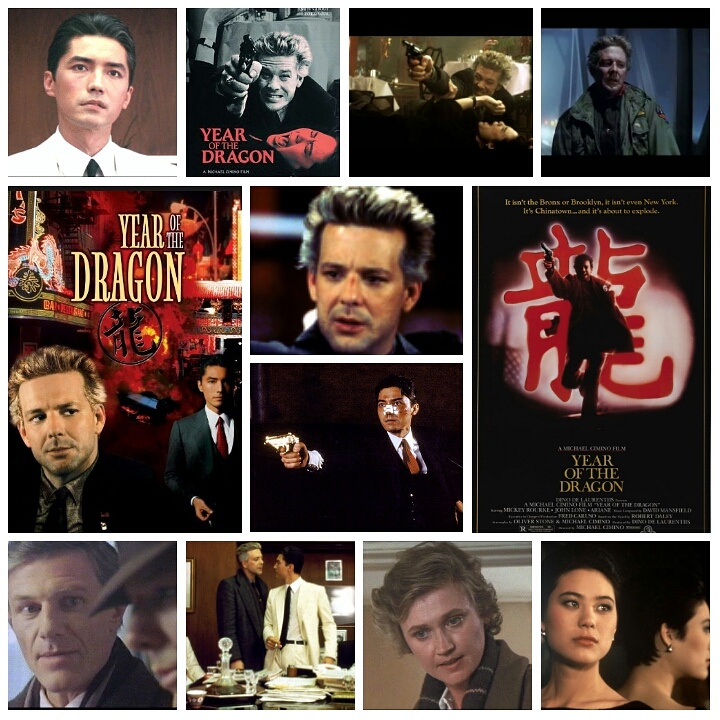
Michael Cimino’s Year Of The Dragon is a visceral blast of pure Americana as only the man could bring us. It kills me that he suffered through that whole Heaven’s Gate fiasco (which is actually a really good movie, but that’s another story and argument entirely) because it extinguished any hopes of him making future films, and in doing so the studios effectively committed genocide against their own. Sure the guy was crazy as hell, but damn could he ever make a great film. This one is one of the most criminally overlooked cop flicks of all time, partly due to Cimino’s scorching direction and partly due to a a performance of monolithic grittiness from Mickey Rourke as Captain Stanley White, the cop who won’t stop. White is fresh out of Nam and mad as hell, launching a unilateral crusade of racist violence and self righteous fury against the Chinese crime syndicate in New York City, particularly a young upstart in their organization named Joey Thai (John Lone). Thai is as ruthless as White is determind, and the two clash in ugly spectacle, causing leagues of collateral damage on either side and inciting them both to roar towards an inevitable, bloody conclusion. Thai’s elderly superiors warn him of men like White, men who are fuelled purely by anger, bitterness and nothing else, smelling the fire and brimstone in the air and wisely stepping out of the way. Thai is of a younger, more petulant generation and foolishly decides to meet the beast head on by essentially kicking the hornet’s nest. White is warned by his caring wife (Caroline Kava) and fellow cop and friend Lou (Raymond J. Barry is excellent, firing Rourke up further with his work) not to mess with such a dangerous crowd. He has a volatile relationship with a beautiful Chinese American reporter (Arianne is the only weak link in the acting chain) who puts herself on the line for him by digging around in dangerous corners. The intensity level of this film is something straight from the adrenal gland; even in episodic scenes of introspect we feel the hum of the character’s emotions, and when the conflict starts again, which it does in fast and furious amounts, the actors are simply in overdrive. Rourke has never been better than he was in the 80’s, it was just his zenith of power. This isn’t a role that gets a lot of recognition, but along with Angel Heart, Rumble Fish and Pope Of Greenwich Village, I think it’s his best. He puts so much of himself into Stanley White that the edges which separate performer from performance begin to blur and waver, until we are locked into his work on a level that goes beyond passive consumption of art and elicits something reflective in us. Not to sound too hippie dippy about it, but the guy is just that fucking good. On the calmer side of the coin, John Lone brings both evil and elegance to Joey, a slick surface charm that’s constantly disturbed by Rourke’s hostility, leading to an eventual meltdown that’s very cool to see in Lone’s expert hands. This is one for the ages and should be in the same pantheon with all timers like Heat, Serpico, The French Connection and others. Rourke fires on all cylinders, as do his colleagues of the craft, and Cimino sits cackling at the switchboard with a mad calm, yanking all the right levers in a frenzy of unhinged genius. Not to be missed.
NIXON – A REVIEW BY J.D. LAFRANCE

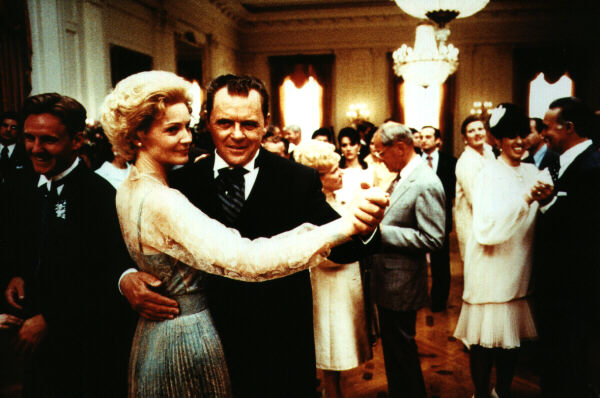
Oliver Stone’s film, Nixon (1995) portrays the American political process as an unpredictable system that politicians have no hope of ever fully controlling. The best they can do is keep it in check most of the time. This theory can be seen in its embryonic stage in JFK (1991) with President John F. Kennedy being assassinated by shadowy forces within the political system, but it was not until Nixon that Stone was able to fully articulate it. As film critic Gavin Smith observed, “Nixon is a historical drama about the constructing and recording of history, assembled as we watch.” Stone has created a unique version of the historical biopic that combines fact and speculation with a cinematic style that blends various film stocks in a seamlessly layered, complex narrative. This fractured, overtly stylized approach draws attention to the fact that we are watching a film. As Stone has said in an interview, “I don’t pretend that it is reality.” This, in turn, allows him to deliver his message with absolute clarity.
Like Citizen Kane (1941) before it, Nixon traces the dramatic rise and fall of a historical figure who tried so hard to be loved by all but ended up being infamous and misunderstood. While Orson Welles’ film was a thinly-veiled attack on newspaper tycoon, William Randolph Hearst, Stone paints an almost sympathetic portrayal of Richard Nixon (Anthony Hopkins). Stone may not like Nixon personally, but he does try to explore what motivated the man’s actions and really get inside his head. The director even throws in a stylistic nod to Kane as part of the opening credits play over a shot of a dark and stormy night at the White House. The camera moves through the fence in a way that evokes the opening of Welles’ film with Kane’s imposing estate. And like Welles’ film, Nixon employs a flashback device as Nixon listens to the Watergate tapes and reflects on his life, from his tough childhood in Whittier, California, to his beleaguered political career that culminates with his tumultuous stint in the White House.
The first real indication of Stone’s thesis of the political system as a wild, untamable animal comes when Nixon talks to FBI director J. Edgar Hoover (Bob Hoskins) at a horse race about running for President. There are all kinds of shots of horses snorting wildly – the first hint, visually, of what Stone is trying to get at. Hoover makes it known that he will support Nixon if he, in turn, supports him, and is willing to supply him with dirt on Robert Kennedy to help the cause. Hoover makes an intriguing comment when he tells Nixon, “I look at it from the point of view that the system can only take so much abuse. It adjusts itself eventually … But there are times there are savage outbursts.” He cites Martin Luther King’s promiscuity and continues, “Sometimes the system comes very close to cracking.” The implication in this scene is that Hoover is a significant cog in the United States political machine and one that Nixon must respect and work with.
The second significant example where Stone gives support to his thesis is when Nixon meets with Richard Helms (Sam Waterston), director of the CIA. Like Hoover, Helms is a powerful man within the system because he knows and protects so many of its dirty little secrets. They get to talking about Cuba and Nixon’s involvement to assassinate Fidel Castro, which Helms has evidence of via memos. He refers to it as “not an operation so much as an organic phenomenon. It grew. It changed shape. It developed appetites.” Helms is fiercely protective of his position and of the CIA, resisting Nixon’s request for incriminating documents. Where Hoover is portrayed as gruff and obvious, Helms is elusive and distant, played with icy intensity by Sam Waterston.
The third and most important example occurs when Nixon spontaneously meets with war protesters on the steps of the Lincoln Memorial. This is where Stone lays it all out and the film features a fascinating exchange between the President and a female protester (Joanna Going):
Protester: You can’t stop it can you? Even if you wanted to. ‘Cause it’s not you, it’s the system. The system won’t let you stop it.
Nixon: There’s more at stake here then what you want or what I want.
Protester: Then what’s the point? What’s the point of being President? You’re powerless!
Nixon: No. No, I’m not powerless. ‘Cause I understand the system. I believe I can control it. Maybe not control it totally but tame it enough to do some good.
Protester: Sounds like you’re talking about a wild animal.
Nixon: Maybe I am.
Of this scene, Stone has said that Nixon realizes that the system is “more powerful than he is. We can’t get into it that much, but we hint at it so many times – the military-industrial complex, the forces of money.” Stone’s film argues that Nixon really did want to institute change and make a difference in the world, but his own shortcomings, coupled with the complex infrastructure that is the United States political system, ultimately led to his downfall. Stone and the screenwriters conceived of the concept of the political system as “the beast,” which one of the film’s screenwriters Christopher Wilkinson described as “a headless monster that lurches through postwar history,” and served as a metaphor for a system of dark forces that resulted in the assassinations of the Kennedy brothers and Martin Luther King, and the Vietnam War, as well as helping Nixon’s rise to power and his fall from it. In an interview, Stone elaborated further. He saw “the beast” as a “system … which grinds the individual down … it’s a system of checks and balances that drives itself off: 1) the power of money and markets; 2) state power, government power; 3) corporate power, which is probably greater than state power; 4) the political process, or election through money, which is therefore in tow to the system; and 5) the media, which mostly protects the status quo and their ownership’s interests.”
Anthony Hopkins’ stunning portrayal of the former President humanizes this historical figure. From the way the film is shot and edited, we are seeing the events of U.S. history through Nixon’s perspective. This approach also helps in creating a sympathetic portrait of the man. Hopkins wisely does not opt for a Rich Little imitation but instead captures the essence and spirit of the man. He shows Nixon’s aggressive side, where he speaks in football metaphors and refers to himself in the third person, and also a vulnerable one in the scenes with his wife, Pat. It’s a wonderfully layered performance that Hopkins hasn’t equaled since because he hasn’t been given material and a director that has challenged him in quite the way that Stone did with Nixon.
Opposite Hopkins is Joan Allen as Pat Nixon. She more than holds her own with the Academy Award-winning thespian, portraying Pat as a long suffering yet incredibly strong-willed wife who has to sit by and watch her husband strive for unattainable goals. There’s a scene where she reacts in private to her husband losing the 1960 Presidential election to John F. Kennedy and she looks visibly upset, wiping away tears while trying to maintain her composure. In the following scene with her husband, Pat tells him about the toll his political career is taking on their family, which comes across as quite touching. Tears well up in Pat’s eyes as she consoles her husband while he looks tired and defeated. It’s a wonderfully intimate moment that humanizes both of them considerably. All of the scenes between Allen and Hopkins crackle with a kind of tangible intensity as we see the toll politics takes on them. This is not one of those token wife roles that is so often seen in these kinds of films. The well-written screenplay and Allen’s performance flesh out Pat Nixon into a three-dimensional character.
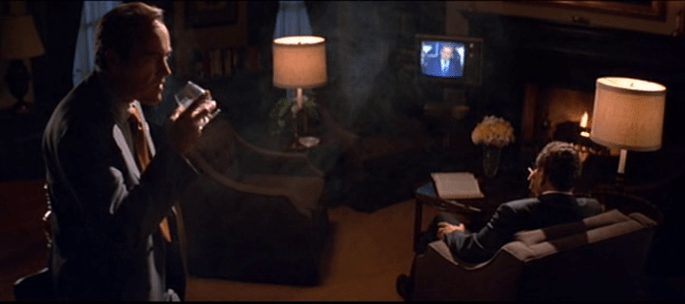
As always, Stone’s knack for casting is impeccable. Much like he did with JFK, Stone surrounds his leads with an impressive roster of big names in the supporting roles: James Woods, Ed Harris, Bob Hoskins, David Hyde Pierce, Paul Sorvino, Powers Boothe, J.T. Walsh, and, in a restored scene, Sam Waterston delivers a deliciously chilling performance as Richard Helms. These recognizable faces help one keep track of the historical figures that pop up throughout the film.
Originally, Stone had been developing two projects – the musical Evita (1996) and a film about Panamanian dictator Manuel Noriega. When they both failed to get made, he turned his attention to a biopic about Nixon with the president’s death in April 1994 being a key factor in the director’s decision. The project actually originated with Eric Hamburg, a former speechwriter and staff member of the House Foreign Affairs Committee, after having dinner with Stone. In 1993, Hamburg mentioned the idea to writer Steve Rivele with the concept being that they would incorporate all of Nixon’s misdeeds, both known and speculative. Hamburg encouraged Rivele to write a screenplay with his partner Christopher Wilkinson. They wrote a treatment in November 1993. In it was the concept of the political system as a beast and this is what convinced Stone to get involved. He immersed himself in research with the help of Hamburg.
Stone commissioned the first draft of the film’s screenplay from Rivele and Wilkinson and it was completed on June 17, 1994, the anniversary of the Watergate break-in. The script was based on research from various sources, including documents, transcripts and hours of footage from the Nixon White House. Early on, Rivele and Wilkinson hated Nixon but the longer they worked on the film, and “the more we knew about him, our contempt was slowly eroded to the point where we more than pitied him, we empathized with him.” Stone structured his film into two acts with the first one about Nixon’s loss of power and the second one about Nixon in power only to lose it again.
Stone pitched the project to Warner Bros. but, according to the director, they saw it “as a bunch of unattractive older white men sitting around in suits, with a lot of dialogue and not enough action.” They also didn’t agree with Stone’s choice to play Nixon – Anthony Hopkins. Instead, they wanted Tom Hanks or Jack Nicholson – two of Stone’s original choices and both of whom had passed on the role. Stone even met with Warren Beatty but the actor wanted to make too many changes to the script. Stone went with Hopkins based on his performances in Remains of the Day (1993) and Shadowlands (1993). The director remembered, “The isolation of Tony is what struck me. The loneliness. I felt that was the quality that always marked Nixon.” Upon meeting Stone for the first time, Hopkins saw the director as “one of the great bad boys of American pop culture, and I might be a fool to walk away.” He was convinced that to take on such a challenging role that would require him to “impersonate the soul of Nixon” by the scenes in the film when he talks about his mother and father. “That affected me,” he said. To prepare for the role, Hopkins watched a lot of documentary footage on Nixon. At night, he would go to sleep with footage playing so that it would seep into his subconscious.
Joan Allen auditioned for the role of Pat Nixon over a period of several months. During one of these auditions, she read opposite Beatty when he was briefly interested. After this audition, Beatty told Stone that he had found his Pat Nixon. She learned, through her research, that Pat was a strong person who had a difficult life. Allen based her performance on interviews with former Nixon aides, books about the First Lady and a Barbara Walters interview in the early 1970s. Stone, Hamburg, Hopkins, and Woods flew to Washington, D.C. and interviewed the surviving members of Nixon’s inner circle: lawyer Leonard Garment, Attorney General Elliot Richardson and Robert McNamara, a former Secretary of Defense under the Kennedy and Lyndon Johnson administrations. In addition, Stone hired Alexander Butterfield, a former secretary in the cabinet and special assistant to Nixon and who first revealed the existence of Nixon’s secret tapes of his oval office conversations, John Sears, former deputy White House counsel, and John Dean as consultants. To research their roles, Powers Boothe, David Hyde Pierce and Paul Sorvino met with their real-life counterparts, but J.T. Walsh decided not to contact John Ehrlichman because he threatened to sue the production after reading an early version of the script and was not happy with how he was portrayed.
Stone’s producing partner and financier Arnold Milchan had a deal with the director to make any film he wanted up to a budget of $42.5 million but refused to honor their agreement, saying that he would put up no more than $35 million because he felt Nixon was an uncommercial project. Stone refused to make the film with that budget and a week before shooting was to begin he approached Hungarian financier Andrew Vajna who had a co-financing deal with Disney’s Hollywood Pictures. At the time, Vajna was hoping to get some respectability in Hollywood and possibly an Academy Award and agreed to provide the $43 million budget. In order to cut costs, Stone leased the White House sets from The American President (1995).
Reportedly, there was a lot mischievous jokes exchanged between the actors on the set. Early on, Hopkins was intimidated by the amount of dialogue he had to learn, more of which was being added and changed all the time, and then Sorvino told him that “there was room for improvement” and that he would be willing to help him. According to James Woods, Sorvino told Hopkins that he was “doing the whole thing wrong” and that he was an “expert” who could help Hopkins. Sorvino took Hopkins to lunch and then afterwards the British thespian told Stone that he wanted to quit the production. The director managed to convince him to stay on. Hopkins remembered, “There were moments when I wanted to get out, when I wanted to just do a nice Knot’s Landing or something.” Woods also cracked several good natured jokes with Hopkins. He said, “I’d always tell him how great he was in Psycho. I’d call him Lady Perkins all the time instead of Sir Anthony Hopkins.”
What is perhaps most stunning about Nixon is the style of the film. Employing the editing techniques and innovative camerawork he perfected in JFK and Natural Born Killers (1994), Stone created a unique version of the historical biopic that combines actual documentary footage with fictional material and that blends various film stocks in attempt to shed light on a figure most people knew very little about. This fractured, overtly stylized approach suggests that we are seeing historical events through the prism of Nixon’s perspective. The film is not meant to be the definitive word on the man but rather, as Stone said in an interview, the “basis to start reading, to start investigating on your own.”
Stone had his editors in three different rooms with the scenes from the film revolving from one room to another, “depending on how successful they were.” If one editor wasn’t successful with a scene it went to another. Stone said it was “the most intense post- I’ve ever done, even more intense than JFK” because he was screening the film three times a week, making changes in 48 to 72 hours, rescreening the film and then making another 48 hours of changes.
Seven days before Nixon was to be released in theaters, the Nixon family issued a statement calling parts of the film “reprehensible” and that it was designed to “defame and degrade president and Mrs. Nixon’s memories in the mind of the American public.” The statement also criticized Stone’s depiction of Nixon’s private life and that of his childhood and his part in planning the assassination of Castro. This statement was actually issued by the Richard Nixon Library in Yorba Linda, California on behalf of the Nixon family based on a published copy of the script. Stone responded that his “purpose in making the film Nixon, was neither malicious nor defamatory,” and to attempt “a fuller understanding of the life and career of Richard Nixon – the good and the bad, the triumphs and the tragedies, and the legacy he left his nation and the world.” The attacks didn’t stop there. In a letter to Nixon’s daughters, Walt Disney’s daughter, Diane Disney Miller, said that Stone “has committed a grave disservice to your family, to the presidency, and to American history.”
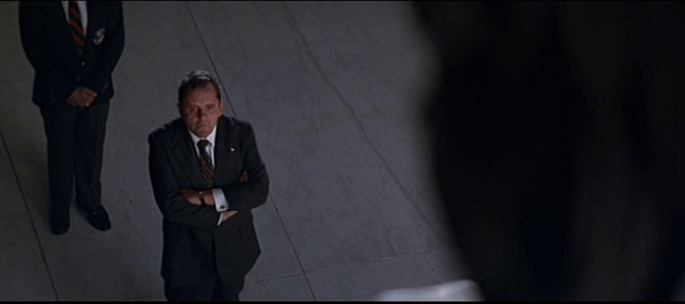
Nixon is a powerful historical biopic – arguably the last great film Oliver Stone has made to date. It is also, coincidentally (or maybe not), the last film he and regular collaborator Robert Richardson made together. The legendary cinematographer was as much responsible for defining the distinctive style of Stone’s films as the director himself. Stone’s work has never been the same since they parted company. Nixon was also the last time he had enough juice in Hollywood to command such an impressive cast of actors. Admittedly, Hollywood has changed considerably since this film was made and Stone has had to adapt with the times but hopefully he has another great film like Nixon left in him.
Sinner: A Review by Nate Hill
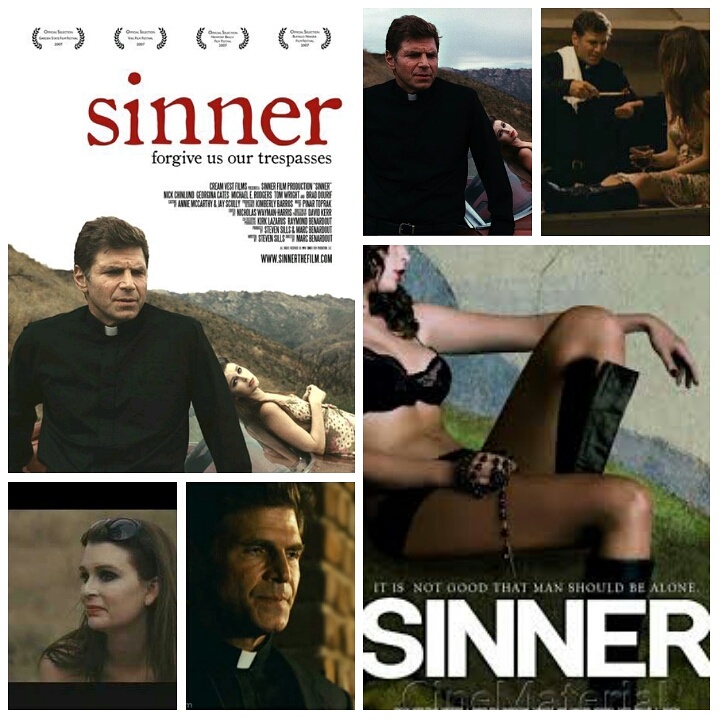
Sinner is a 2007 indie buried in the depths of obscurity, and defined by its very bold choice to cast an actor in the lead role whose career so far has been so different from the type of character he plays here, it’s a true blessing for fans to see him in this new light. The actor in question is Nick Chinlund, a rough looking bruiser with a filmography almost entirely made up of villainous creeps, grizzled detectives and other assorted hardcases (see Con Air, Training Day, The X Files and The Chronicles Of Riddick for his most critically celebrated work). Here he drops every trait he’s been known for, playing small town catholic priest Anthony Romano, a man with a troubled past and an almost bankrupt parish who is facing an internal crisis, only made worse by the arrival of skanky grifter Lil (Georgina Cates) who preys on celibate priests, amongst other bottom-feeding life choices. After an incident involving Romano’s lecherous fellow preacher, he allows Lil to take refuge from the police in his rectory, against better judgment. She’s a nasty piece of work at first and Cates’s performance is far too over the top, only simmering down to meet the character arc in the script long after it calls for action, making her work too little, too late, yet still rather affecting. Chinlund is nothing short of mesmerizing, giving Romano the internal conflict and vulnerability the character deserves, which is not an easy task when one considers the complex nature of the writing. Underrated doesn’t begin to describe this actor, and lately I’ve been sad to see he hasn’t been given many roles that are worthy of his talent. I’ve searched far and wide for Sinner many years, finally finding an amazon seller who would send me a copy. I loved it, and it made me so happy to see Chinlund get the kind of role that goes against the grain of much of his work. Romano uses the sort of golf as a release from priestly and personal hardships, the script using lots of golfer’s lingo as sly similes for his personal issues. Tagging along with him is his scrappy and seemingly imaginary Caddy, played by Brad Dourif. Dourif can make any role, and I mean any, into pure magic with his dedication to the craft. Seeing him and Chinlund share a few wonderful scenes with bushels of chemistry was a nerd’s dream come true for me, and part of the reason I searched so long for a copy of this film. For casuals this may be a bit offbeat to really sink into, but for fans of the actors and idiosyncratic indie flicks, this is a bona fide goldmine.