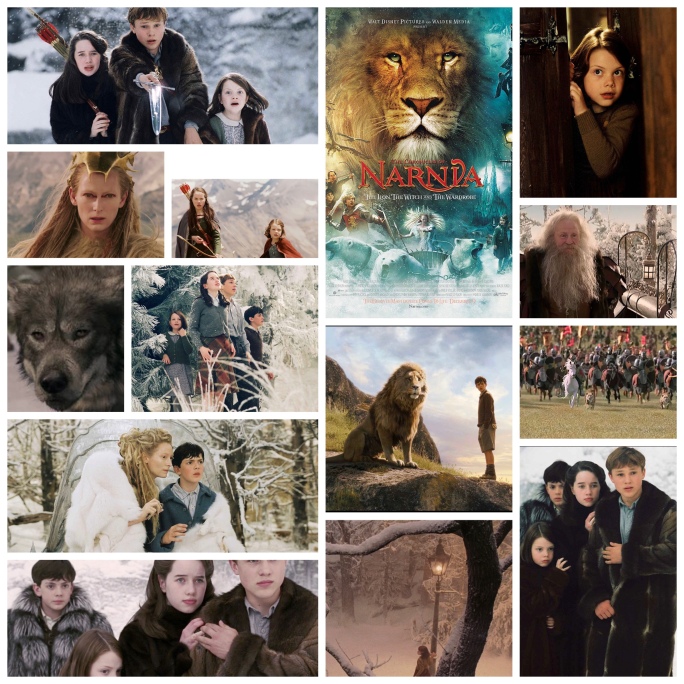
The Chronicles Of Narnia: The Lion, The Witch & The Wardrobe

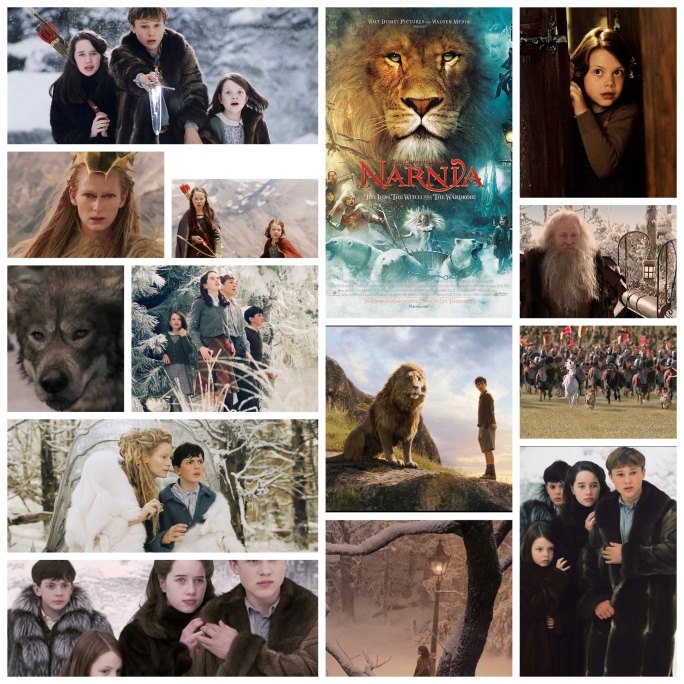
The Chronicles Of Narnia: The Lion, The Witch And The Wardrobe is a dazzling, indisputable success, as both a standalone film and when viewed next to its literary counterpart. It stands as a milestone for me, in the sense that it’s pretty much the only film adaptation of a book that was very special to me growing up to not only do the story justice, but to come out a winner as the best cinematic vision of it possible. It’s a feast for the eyes, ears and spirit, and remarkably, a lot of it plays out exactly how my memories of the book do. Having said that, I would advise avoidance of the sequels, one of which I’ve seen and it put me off going any further. Prince Caspian felt lazy, rushed and cheap, all the mystery and wonder found here was gone, not to mention they fudged up the progression of the series and completely skipped The Horse And His Boy, one of my favourites. This one is the real deal and hits the right notes, and from the opening frame when a rattling POV shot of bombs descending on a WWII ravaged London, the film assures us that it means business, and isn’t going to slip into the pandering, glossy, watered down Young Adult world of adaptations. The Pevensie children, four precocious English youngsters, are sent away from the conflict to live with a distant relative in the country. There, they find a desolate old mansion, populated only by a starchy old goat of a housekeeper and the eccentric Professor Kirke (Jim Broadbent, brief but memorable). They also stumble upon a magical wardrobe leading to a vast kingdom called Narnia, filled with talking beasts, castles, forests and more legendary creatures than you can shake a stick at. Lucy (Georgie Henley is the perfect, darling Lucy I imagined), the youngest and most intuitive of the four, is first to venture through, meeting kindly fawn Mr. Tumnus (James Macavoy) who tells her that Narnia has fallen on hard, wintry times. Her siblings back in our world don’t believe her, until they too are whisked through into the land, unknowingly thrust into an adventure to save Narnia, which will well likely put them in more danger than anything WWII has to offer. The four are uncannily well cast: William Moseley brings the humbled nobility and budding leader in Peter magnificently, Anna Popplewell shows the compassionate warrior’s heart in Susan, and Skandar Keyes expertly handles the arc of Edmund, the black sheep of the group with lessons to learn, both bitter and sweet. They are pit against Narnia’s resident villain and warlord, the malicious White Witch Jadis (Tilda Swinton will freeze your heart), with the help of many a talking animal, including friendly Mr. Beaver (Ray Winstone), and the messianic lion and all around badass Aslan (Liam Neeson, because who else would you cast?). Michael Madsen provides his raspy growl to the voice of Maugrim, the Witch’s top wolf lieutenant in her lupine secret police force, and other hidden Easter eggs of voiceover work can be heard from Dawn French as Mrs. Beaver and Rupert Everett as a Fox. Scope and spectacle are paramount in bringing the world of Narnia to life, and the filmmakers spared no expanse here: The children delve into chases, battles, betrayals, icy encounters with the witch, sword fights and all sorts of wonder, including a surprise visit from Father Christmas himself, warmly intoned by James Cosmo. Equally important as the razzle dazzle are the quiet, contemplative conversations that flourish into important character beats and lessons for all involved. The four are at a crux of human development, and vulnerable to stimuli both internal and external. Even though the story takes place in a magical, heightened world of fantasy, the interactions and human behaviour couldn’t feel more real. It’s beautifully carried over from the book, violent darkness and uplifting light included and born on the gilded wings of a stirring musical score from Harry Gregson Williams that swells to near transcendent heights when we reach that climactic battle. Swinton switches up the traditional theatrics that Barbara Kellerman brought to the BBC production (that version is a whole other story) in favour of a vicious, unrelenting and at times almost extraterrestrial portrayal of the witch, she’s cunning, manipulative and oh so evil. Director Andrew Adamson brings magisterial beauty to it visually and stages the battles with kinetic but focused energy. I love this film, not a note felt false to me when keeping the book in mind as I sat in the theatre, and that is incredibly rare if the source material means something to me.

-Nate Hill

Office Christmas Party

There’s something about a bitchy Jennifer Aniston telling an eight year old girl to fuck off in an airport lounge that puts me in the Christmas spirit. She also fake calls Santa on her cell and tells him to put her on the naughty list. Such is the stuff of Office Christmas Party, one of those improv heavy, uber raunchy, disposable comedies with a disposable title and a whole host of ‘flavour of the month’ standup talent that despite itself, actually turns out pretty great. Aniston and TJ Miller play rival siblings who squabble over the corporate syndicate they’ve inherited, he wants to have an epic, balls out holiday fiesta and she won’t have any of it. The party does happen, complete with hookers, blow shot through a snow machine, rampant destruction of corporate property, ice sculpture penises and more. And.. that’s the plot, but what more could you ask for in a flick called Office Christmas Party. Jason Bateman plays yet another beta dude who sort of hovers on the cusp of being an alpha, he could probably do the shtick in his sleep by now but is charming enough. Mad Max’s Abby Lee is a persnickety escort, Jillian Bell her pimp with major anger issues, Randall Park another office drone with a kinky fetish, while Olivia Munn and Rob Cordry run about as well. Courtney B. Vance doesn’t so much run as dangerously swing on a Christmas light Tarzan rope when he’s given a Santa sized dose of blow by accident, and Kate McKinnon plays hilariously against type as the prudish HR manager. The film doesn’t have much to say other than ‘lets gets fucked up into oblivion’ (who can argue that this time of year), plus a vague underdog subplot that’s lobbed in and a few notes about taking a stand to save the company from going under, a prospect that Aniston’s cunty pessimist readily embraces. Most of it is just wanton debauchery though, which is what these comedies do best. I enjoyed Fortune Feimster as an Uber driver with some trouble reading social cues, McKinnon scaring the shit out of Vance with by singing a German nursery rhyme out of nowhere and other funny bits. It has that distinctly self aware vibe that R rated comedies often do these days, following the genre pioneering trickle down effect of Seth Rogen and others, which can work or can run amok and feel straight up dumb sometimes. Here it’s a loosely plotted throwaway flick about a party anyways, so it works great and the film is highly enjoyable.

-Nate Hill

Steve De Jarnett’s Miracle Mike

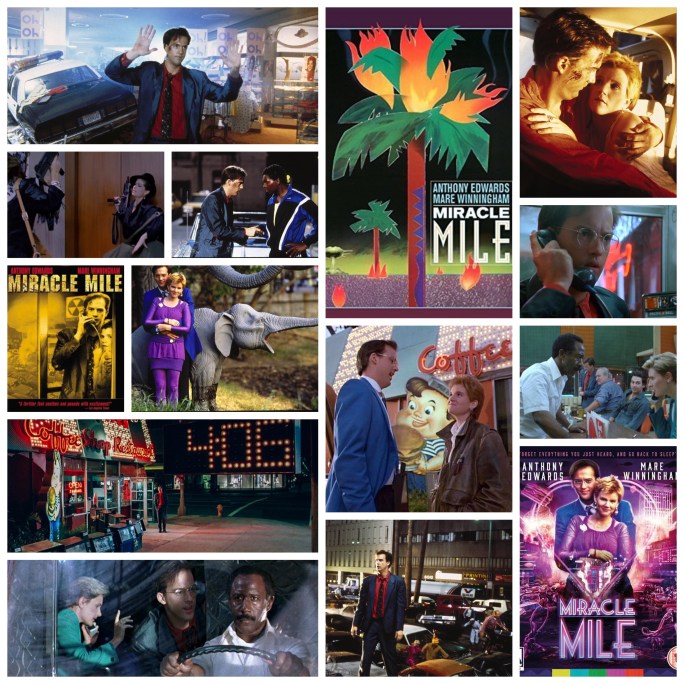
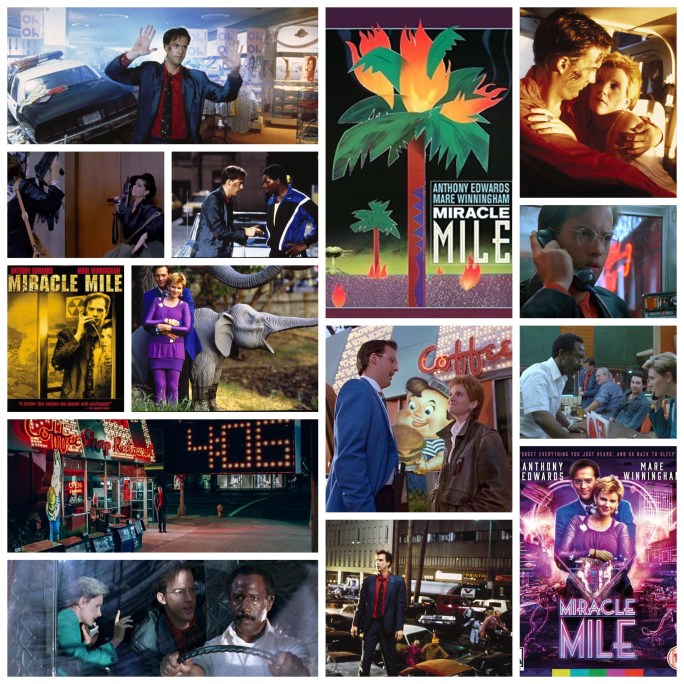
Ever had one of those clammy nightmares where you’re dead sure that some catastrophic disaster is imminent, but are next to powerless to do anything about it, run or escape what’s coming? Steve Dejarnett’s Miracle Mile captures that feeling uncannily well, and is now one of my favourite films for that as well as many other reasons. It’s not that that sensation is pleasant or at all enjoyable to relive outside of a dream, but it’s so hard to tangibly recreate on film that what Miracle Mike achieves is a rare commodity among mood-scapes. The film is disarmingly benign as it opens: a young man (Anthony Edwards) and woman (Mare Winningham) meet and fall in love outside a neon adorned diner in dreamy, pastel hued Los Angeles. They make plans for later that night, and a whimsical note takes hold. We’re treated to some of the most inspired foreshadowing I’ve ever seen involving a pigeon, a lit cigarette and an open power line. As night descends on the Miracle Mile neighbourhood of LA, Edwards finds himself back at the diner when the pay phone outside rings. He answers it, and a frantic voice warns him that nuclear attack is coming to the city in just over an hour. What would you do? Who would you tell? He races right back into the diner and, panicked, informs the rogues gallery of oddballs you’d find at such an establishment after midnight. Naturally they all freak out too, and as soon as that cat is out of the bag, it’s a feverish, mad dash to exit the city before the threat arrives, if indeed it is a credible danger. That’s part of the beauty here; whether or not this is a hoax is not clearly revealed until the absolute last minute of the film, but would you risk not taking it seriously? These characters react in a variety of ways, but Edwards just wants to find that special girl he met earlier when things felt so sunny and full of possibility, to find her and escape together. It’s one of those ‘real time, one night in the crazy city’ films that unfolds over a short period of time but couldn’t be more full of instances, encounters and the kind of strange occurrences only the witching hour has to offer. The romantic angle, usually played to the hilt of melodrama in these kinds of films, is somehow so frank and truthful that we buy it, we care about these two kids and it makes the thought of apocalypse all the more dreadful. For all it’s focus on death and potential destruction, this is a beautiful film that is so full of life and character, a sly cross section of LA’s invisible working class under the nocturnal skies and a bubble gum, eye popping display of colour, design and eccentricity. The cityscape is populated by an ever present cast of brilliantly used character actors including O Lan Jones, Robert Doqui, Kurt Fuller, Mykelti Williamson, Edward Bunker, John Agar, Lou Hancock, Denise Crosby, Kelly Jo Minter, Allen Rosenberg, Earl Boen, Brian Thompson, Peter Berg and a quick but badass cameo from Aliens’s Janette Goldstein, once again waving around a big gun in exuberant fashion. A film needs a good score, and whenever Tangerine Dream is hired to compose, unfiltered magic happens. Their music here is a driving force to the action, an atmospheric lullaby that exudes both beauty and danger in its synth laden, melodic pulse. This is such a unique film, such a deft melting pot of genres that the recipe can’t really be defined as anything but a flavour all it’s own, an experience that makes you feel primal fear while wowing you with cinematography, editing and one shots that practically pull you right into the action. Points also awarded for bravery in pulling off that ending without compromise. The very definition of a forgotten gem, and a film that should be on every shelf.

-Nate Hill

Renny Harlin’s Die Hard 2

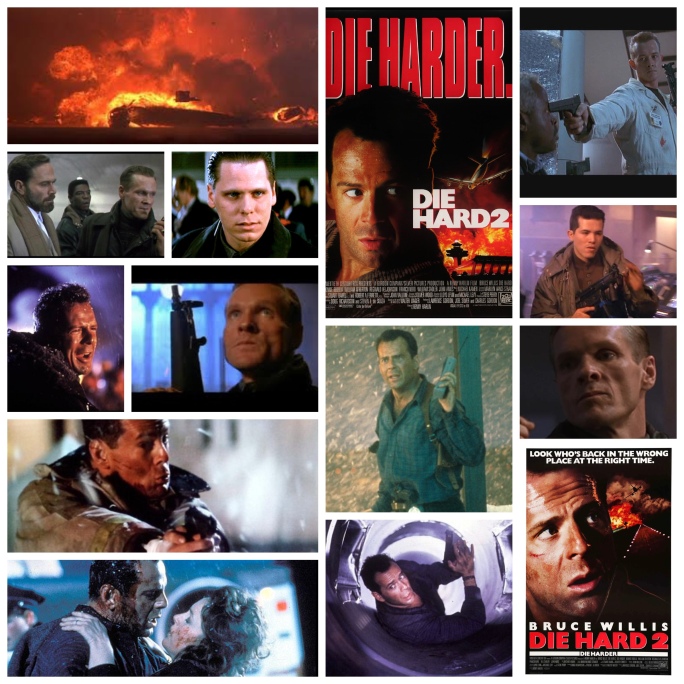
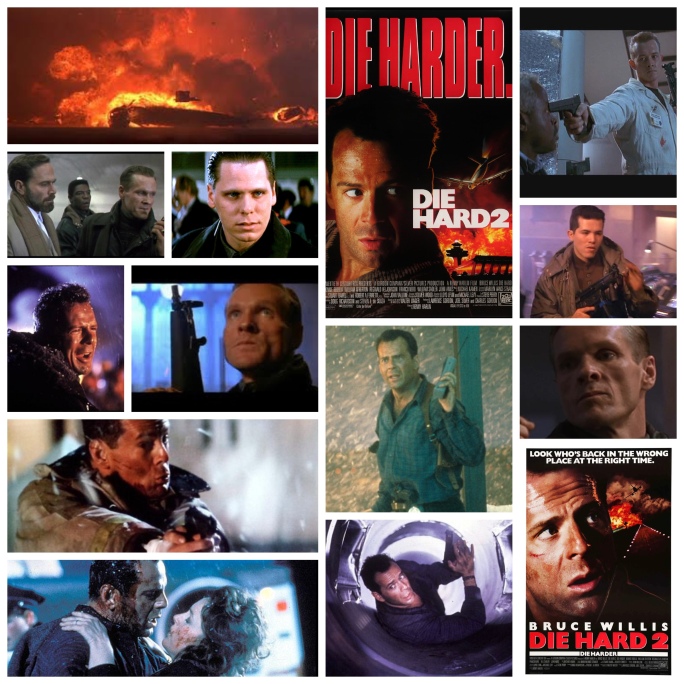
Renny Harlin’s Die Hard 2 trades in the Nakatomi Plaza skyscraper for a giant 747, which is basically just a skyscraper barrelling through the air anyways, but it also expands action from the one location concept to a sprawling, chaotic LAX airport during the Christmas Eve rush. Bruce Willis returns as eternally exasperated underdog cop John McClane, whose wife (Bonnie Bedelia) is stranded on said aircraft while a severely violent band of terrorists clutters up the whole thing and makes it impossible for them to land. While not blessed with the malicious exuberance of Alan Rickman’s Hans Gruber, Harlin finds a steely replacement in William Sadler’s Colonel Stuart, the sociopathic, seriously scary dude in charge of the hostile takeover who has no reluctance in shooting his own guys just for fun. Franco Nero is the foreign dictator whose imprisonment ties into the airport fiasco, while the villains provide intense early career work for cool actors like Don Harvey, John Leguizamo and Robert Patrick. There’s something so relatable about McClane, Willis plays him as an everyday joe who is constantly second guessed by people way dumber than him and sort of has to go it alone based on the sheer level of incompetence he’s surrounded by, especially that of an ignoramus cop (Dennis Franz) who has it in for him big time. The action here is top tier, from the big bucks spent on the plane antics hundreds of feet above to the shootouts, explosions and combat thundering through LAX. Gotta give a special shout out to these terrorists, they possess a sadism and ruthless edge that is impressive even by franchise standards. I love this film, I think it’s every bit the worthy sequel and on the same level as the first.

-Nate Hill

Richard Curtis’s Love Actually

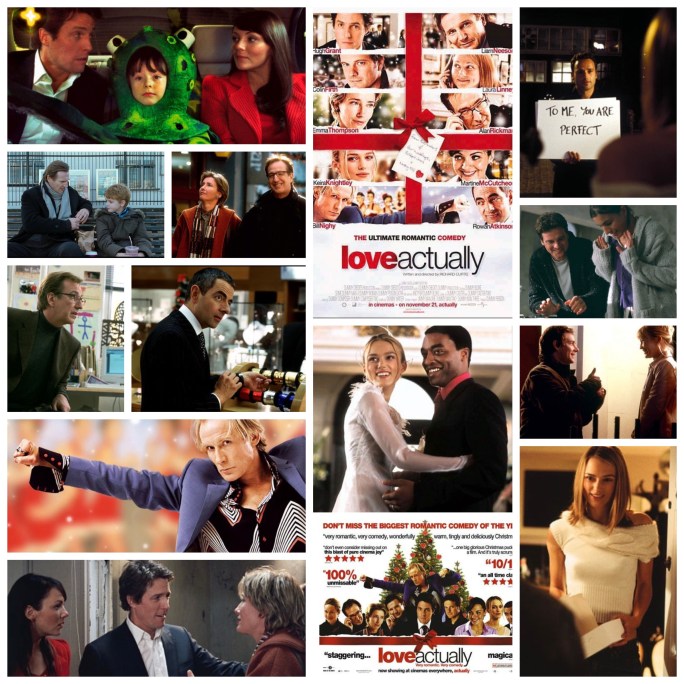
Who doesn’t love Love Actually? I know I do. It’s such a sentimental, goofy, overblown pile of mush and I love it even more for being so. It can be sappy, but a lot of the situations and character interactions it entails are blunt, awkward truths made even more hilarious by an even more awkward cast, and encapsulate the meaning of Christmas. Not all the couples work out, not all of the individual stories end well or in satisfaction for characters or audiences. But that’s life, and they make the best out of what they have at this time of year, which is what it’s really about. Some turn out splendidly for the characters, leaving them beaming. Some learn tough lessons that are necessary for growth, some find love in storybook fashion and others are simply there for comic relief. What comedy and tearful drama we get as too, delivered by an astoundingly massive cast of British legends, speckled with a few familiar Yankee faces just to garnish the giant British figgy pudding. Liam Neeson plays a grieving father whose son (Thomas Bodie Sangster) is sick with love. Neeson’s sister (Emma Watson, grounded, real, heartbreaking) deals with her irresponsible husband (Alan Rickman, incapable of a false note). The newly elected Prime Minister (Hugh Grant in full flustered, fumbling glory) is attracted to his cute secretary (Martine Mcutcheon) and aloof writer Colin Firth feels pangs for his Portuguese housekeeper (Lúcià Moniz) who speaks not a word of English. Laura Linney has a steamy office romance with Rodrigo Santoro whilst dealing with an ill sibling, Bill Nighy is hysterical as a cynical Grinch of a pop star with a jaded facade, Keira Knightely, Chiwetel Efjor and Andrew Lincoln are involved in a subtle love triangle, and there’s all kinds of interwoven vignettes including Martin Freeman, Elisha Cuthbert, Ivana Milicevic, January Jones, Claudia Schiffer, Shannon Elizabeth, Denise Richards, Joanna Page, Sienna Guillory, Billy Bob Thornton as the sleazy US President and a priceless Rowan Atkinson as the world’s weirdest jewelry salesman who gives new maniacal meaning to holiday gift wrapping. It’s a big old circus of Christmas spirit with all kinds of different desires, motivations and relationships that reaches a festive fever pitch before erupting into a joyous finale of giddy Yuletide melodrama and cathartic good times that is impossible not to smile at. An annual watch for me.

-Nate Hill

John Frankenheimer’s Reindeer Games

I’ve always enjoyed John Frankenheimer’s Reindeer Games, despite its chilly critical reputation. It’s a sleazy, nihilistic piece of ultra violent, stylized Christmas noir populated by mean, nasty characters who navigate deliciously convoluted plot turns, double crosses and backwoods criminal enterprise. Ben Affleck plays a hapless ex con having the worst Christmas of his life when his attempts to pose as a murdered cellmate (James Frain) and meet up with the guy’s sexy pen pal (Charlize Theron is next level hot in this) don’t quite go as smoothly as envisioned. He unwittingly gets caught up in a botched casino robbery orchestrated by her volatile career criminal brother (Gary Sinise) and his crew of murderous miscreants. This sets in motion an impossibly elaborate parade of shifting loyalties, multiple seductions on Theron’s part, inventive ways to murder people, Santas with guns, shootouts, chases and car explosions. Much of it is admittedly ridiculous and overblown but it’s never not fun, plus the Grinchy, misanthropic attitude and maladjusted vibe is somehow so infectious. Sinise’s merry little gang are brought to life by recognizable character faces like Donal Logue, Clarence Williams III and Danny Trejo, all charismatic and evil to the bone like a bunch of warped Christmas elves. The late great Dennis Farina plays an obstinate casino owner who makes the heist difficult for everyone, and Isaac Hayes has a bizarre cameo as an inmate who thinks there’s monsters in the prison food and causes an almighty ruckus. Affleck is a mopey guttersnipe here, a ‘wrong place wrong time’ sap who learns to cultivate a badass edge and deal with the kind of psychos he’s up against. Sinise is reliably violent and dangerous, but Theron really steals the show as a crafty, manipulative femme fatale whose true nature is cleverly hidden under a smokescreen of faux intentions. This isn’t an especially classy thriller, doesn’t set any new standards or anything, but what it does do is provide a nut punch of lowbrow thrills, lurid melodrama and bloody action to meet your masochistic Yuletide needs. Great stuff.

-Nate Hill

Gore Verbinski’s Rango

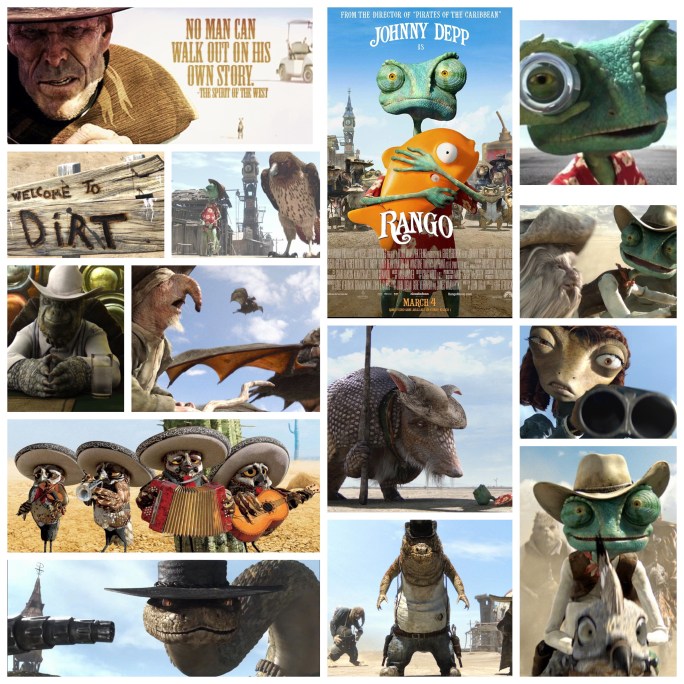
Gore Verbinski’s Rango is a wonder among animated films. Naturally the colourful, larger than life medium lends itself to the eyes, ears and hearts of children, which is the direction most of them take. But Rango presents a mature, raunchy, surreal, absurd spectacle rife with a mischievous buzz and peppered with laughs just bordering on the inappropriate, even though they’d go right over their heads anyway. This film broke the record for how many times my jaw hit the floor seeing what they could do with the visuals. It’s detailed, meticulous, gorgeously rendered and beautifully crafted, not to mention speckled with subtle references to other films, literary works and themes that Verbinski no doubt holds dear and uses to amplify the story nicely. Johnny Depp gives wit, endearing naivety and a sense of childlike wonder to his creation of Rango, a little lizard in the big desert, violently thrown from a car wreck into the greatest adventure of his life, and the archetypal heroes journey. He wanders through the baking Mojave desert into the town of Dirt, inhabited by sassy, loveable creatures modelled after all our favourite western characters and carefully constructed from the biological blueprint of wildlife in that area. He blunders his way into becoming the sheriff, and leads the whole town on a quest to locate their most sought after resource: Aqua. Verbinski directs with a snappy, take no prisoners sense of humour, throwing joke after joke after one liner after tongue in cheek nod at us, until we feel so bombarded with fantastic imagery, brilliant voice acting and just plain fun, that we more than feel like we’re getting our money’s worth. Each animal is beautifully designed, from the evil Rattlesnake Jake (Bill Nighy having a ball with a mini gun tail and evil amber eyes), to Beans (a fellow lizard and love interest for our scaly hero), to the sleazy mayor (Ned Beatty, that old turtle), to a rampaging band of bank robbing moles led by a blind Harry Dean Stanton. The cast includes everyone from Timothy Olyphant to Stephen Root, Ray Winstone, Abigail Breslin, Isla Fisher, Lew Temple, Ian Abercrombie, Gil Birmingham and Verbinski himself in multiple roles. There’s just so much going on here visually, from a dusty cameo by The Good, The Bad & The Ugly’s Man With No Name to eerie trees that wander the desert searching for water, a cameo from Hunter S. Thompson’s Raoul Duke and Dr. Gonzo themselves and don’t even get me started on the batshit crazy aerial chase scene set to a mariachi version of Ride Of The Valkyries. The film is so full of detail, beauty and ambitious artistry that it has taken me at least three viewings to feel like I’ve noticed every character, one liner and cheekily brilliant little touch. It’s that good. Among the whacky antics there’s a theme of owning up to ones identity, becoming responsible for people you save, and finishing the work or task you set out to do, lest you leave your legacy unwritten. A classic.

-Nate Hill

Daniel Alfredson’s Blackway

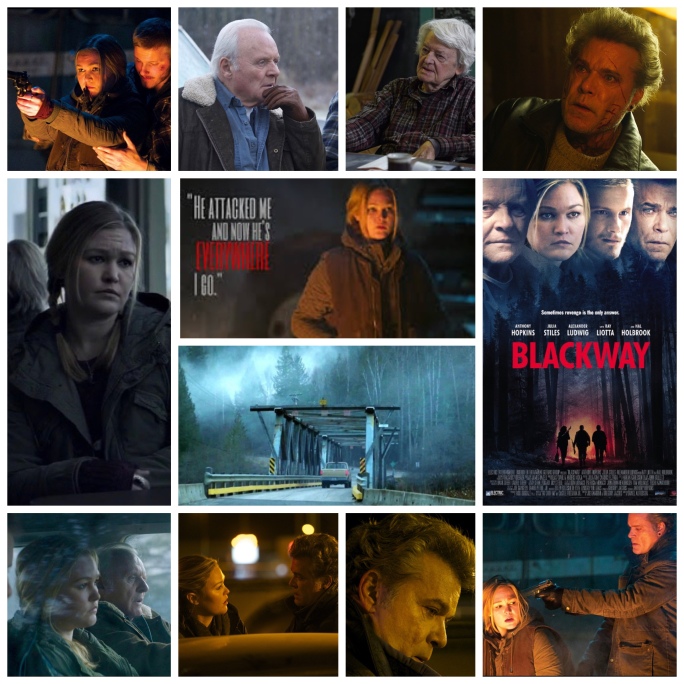
Daniel Alfredson’s Blackway (aka Go With Me) is a bizarre disaster that would have made for a cool flick if… well if it didn’t turn out so darn shitty. I suppose you could blame editing, there’s elements that work, some decent performances and genuinely terrific photography but I’m not sure what they were going for in terms of tone and story because it’s an unholy mess. Anthony Hopkins is always a welcome presence, but he has a silly habit of sleepwalking through roles that he’s clearly only taken on to grab a buck (that twitter video of him spazzing out to music in his living room had more charisma than he musters up here), and although he never fully phones it in, there’s a somewhat listless lack of clarity in a lot of his later career work, this included. He plays an ex logger here with tragedy in his past, living the quiet life in the Pacific Northwest, until trouble brews in his small lumber town. Julia Stiles plays a new waitress in town who catches the eye of titular Blackway (Ray Liotta) an ex cop turned powerful crime lord with a hefty anger problem, violent tendencies and an overall scary reputation. He stalks, harasses and won’t leave the poor girl alone, and since he owns the pitiful excuse of a local police force there’s not much she can do but run and seek help elsewhere, supplied by Hopkins and a few of his pals including Alexander Ludwig and Hal Holbrook. If I was a powerful producer with the clout to green-light projects and you pitched me a noir-esque stalker thriller with Hopkins, Liotta and Stiles set in the Northwest I’d chuck my wallet at you and give my blessings. I’d later learn a hard lesson though, because as well as this looks on paper, or rather the alluring one sheet and exciting trailer, it really tanks and blows just about all of its potential. Stiles is always fantastic, she’s one of my favourites and can do no wrong in my book, she shines here. Liotta is a master actor and does a truly terrifying villain turn but he’s sort of in the wrong film. He has a big city gangster vibe that’s decidedly urban and bereft of the rustic trappings you need to pull off a mythic mountain man kingpin, and as such he feels out of place despite his great talents and considerable efforts. There’s a few decent set pieces like a face off at Blackway’s backroads whorehouse, but this thing is paced so oddly it’s hard to keep up or care. Alfredson is an accomplished filmmaker who gave us the original Lisbeth Salander trilogy, but I think he tried too hard to make this into something of an art film or really mean something when in reality there’s nothing more than a painfully average thriller. Worth it for the actors and the drop dead gorgeous scenery (I will forever be a sucker for films shot and set in this region), but other than that it’s a big swing and a bigger miss.

-Nate Hill

Steven Soderbergh’s Solaris

Concept: Steven Soderbergh’s Solaris is not a remake of the 70’s version but a separate adaptation of the novel by Stanislaw Lem, existing as its own vision of that story. Many people ripped on this as being an inferior retread of Andrei Tarkovsky’s strange, deliberately slow film (which didn’t work for me). Now bear with me: in my humble and frequently disputed opinion, Soderbergh’s is not only the better film but the definitive version of this story. It’s shorter, less theatrical, far more accessible but in the end it’s timbre simply struck a far more resonant chord with me, and I never argue with that intuitive barometer. This version is also slow, but finds a hypnotic, mesmeric cadence to the story of psychologist Chris Kelvin (George Clooney), his deceased wife Rheya (Natascha McElhone) and the mysterious sphere of luminescence, the planet Solaris. Kelvin has been called there by his friend and colleague Gibarian (Ulrich Tukur) after some… odd things start happening to the astronauts aboard, and it’s here on this quiet, near abandoned space station that he undergoes an intense, otherworldly and very personal metaphysical journey that is catalyzed by the forces of the planet sparkling below them and deepened further by the difficult, unexplored regions of human psyches and behaviour. The planet below has a habit of resurrecting Kelvin’s wife who died years before and placing her on the station with him. Why? Who can say, but it certainly provides everyone involved with all sorts of dilemmas both internal and external, starting with the nature of love, loss and grief. This version of Rheya is clearly not Chris’s wife, but a copy made by the planet based on his memory, mental images and unresolved emotions surrounding her. He struggles at first to see this, then he does. She too struggles at first with existential confusion, and comes to a similar realization, with heartbreaking results. This film is thoughtful and ponderous even by Science Fiction standards, there isn’t a single action scene or anything like that, it is solely character based, atmospheric storytelling that draws you in ways some people have forgotten film is capable of. Clooney is at his most vulnerable here, the charm, affability and mile wide smile nowhere in sight. This is a man whose grief has come back full circle to him, and the haunted, staggered reaction upon seeing his wife again for the first time is my favourite work he has ever done. McElhone is an actress who rarely gets the chance to exercise her full potential, but this is a career best for her, she goes to some places that are hard to get to, and her methods of getting there in her obvious scene prep and meditative focus are beautiful to behold. The scenes near Solaris are interlaced with their complicated, stormy yet devoted relationship years prior, which is the lynchpin and mapping schematic that Solaris later draws on for… whatever it thinks it’s doing. Composer Cliff Martinez often works with Soderbergh, and their collaboration here is succinct and tandem, the soft, rhythmic electronic beat pulsing along to images of sleek, still hallways of the station and the vividly coloured planet below, holding secrets that seem just out of reach. The film questions not only love and life but the way human beings perceive each other, whether a tangible person can exist based only upon someone’s dimming memory of them, and what part exactly does the soul play in all of this. “We don’t have to think like that anymore”, Rheya lovingly reassures Chris when he worriedly questions the semantics of Solaris’s plan. Opaque is the nature of this story, but through it we are invited to feel our way to truths that hide behind the swirling pulsars adorning Solaris and the ongoing relationship between these two lovers who are star crossed in more than just a metaphorical sense. Complex, difficult themes to be sure, but it’s all dealt with in organic, rapturous fashion as Soderbergh lets glances, body language, music and affection tell the story instead of heaps of dialogue or obvious beats. A love story wrapped up in a gorgeous musical tone poem gilded by an intelligent, thought provoking science fiction story that questions the essential, reaches for answers in unconventional ways and does things with film that the medium was meant for. One of my top ten favourite films ever made, and up there with the very best Sci Fi’s out there.

-Nate Hill

Tony Scott’s Domino

Domino is Tony Scott’s fire roasted, charbroiled, turbo charged masterpiece. I’ve seen it over fifty times and every time I seem to enjoy it more. It’s pure unfiltered Scott, free from the nagging pressures of the studio, financed by his own company, a loving treatise of pure style and breakneck kamikaze energy that doesn’t let you breathe for a second. It’s loosely based on the life of Hollywood baby turned rough and tumble bounty hunter Domino Harvey (Keira Knightley), daughter of actor Laurence Harvey. She leaves the 90210 world of rich snobs and gilded mansions to pursue a grittier path, in the form of restless underground law enforcement. Now, the film sheepishly admits it’s not entirely based on a true story before the credits even start, so as long as you know that much of it is fantasy going in, you won’t feel cheated. Knightley is a pissed off, sparking roman candle in the role of her career, shedding the dainty image and going full furious grunge, giving Domino an alternative edge and damaged pathos that fuels much of the film’s kinetic energy. Mickey Rourke plays her grizzled boss Ed Moseby, a veteran bounty hunter with a trail of violence behind him, who’s weary and tough in equal parts. Rourke fires on all cylinders, giving some of his simultaneously hilarious, heartbreaking, badass and best work. Edgar Ramiraz plays scrappy Choco, third musketeer and eventual lover to Domino with fiery Latin charisma. Christopher Walken, weird mode fully activated, waltzes in as a reality TV producer with the attention span of a ferret on chrystal meth, Mena Suvari as his squirrelly assistant, Lucy Liu as a prim, OCD afflicted federal agent who verbally spars with Knightley in flash forwards, Delroy Lindo is excellent as their bail bondsman handler Claremont Williams, and there’s scuzzy work from Dale Dickey, Lew Temple, Macy Gray, Monique, Dabney Coleman, Jacqueline Bisset, Jerry Springer and more. Just to sample some of the esoteric weirdness that goes hand in hand with the hard boiled crime elements, Tom Waits has a beautifully perplexing cameo as a spiritual wanderer who has a mysterious meeting with Domino and her friends in the Mojave desert, imparting some prophetic truth to them that only Scott and the sand dunes are in on. This is the kind of film that grabs you by the collar and hurls you down an asphalt horizon of hallucinatory camera work, brings you an intricate, lurid story of true crime gone wrong, and a balls to the wall depiction of life at its fastest, wildest and most out of control, as only the maestro of such things, Scott, can bring you. Domino, at least in this film, lives a crazy life that culminates in a hellish Mexican standoff and subsequent shootout atop a Space Needle-esque Vegas casino, a fitting way for a Scott film to come full circle and certainly not the first time he’s ended one in that situation. He uses cinematic magic to create visual poetry here, his sucker punch editing, nebulous display of scorched out colours, thunderous symphony of sound design and hectic, buzzing aesthetic isn’t for everyone but it’s something truly unforgettable and a style wholly his own, I truly miss the guy and believe he was one of maybe the ten best filmmakers to ever work in Hollywood. This is by far his best film, definitely his most personal and also the most arresting vision he’s ever sculpted, it will leave you haunted, pummelled, fired up and deliciously puzzled. Domino ironically says in voiceover near the end, “I’ll never tell you what it all meant”. Scott tells you, in his own special way, and if you’re tuned in to his otherworldly frequency you’ll treasure this masterwork as much as I do, and will continue to for years to come.

-Nate Hill