
Suicide Squad has left me so torn. On the one hand I just want to belligerantly profess my love for certain key aspects which I have salivated for for a long time now, to blindly just say ‘nope. Fuck it, it’s great’, like that one stupid kid in class who just won’t back down from an argument he is clearly losing. On the other hand I do have to come to terms with the very real, very problematic aspects to the whole thing, weigh it out rationally (not something I’m great at) and make heavy mention of what didn’t work (not something I enjoy doing). I also have a massive bias towards DC as well, particularly all things Batman and foes, so that needed to be taken into account too.
Let’s get what didn’t work out of the way: everyone is hearing that the film is a mess, and I can indeed say that yes, it’s one huge jumbled mess, like twenty unmade beds tossed into a washing machine together. It’s heavily edited in places that could have used fluidity, and flatlines in other spots where a bit of frenzy would have worked better. It’s scant on character, frankly because there are too many, packed with a soundtrack that has it bursting at the hastily sewn seams, drastically and obviously cut in specific places that are noticeable holes in which you could drive the Batmobile through, and burdened with a lazily assembled antagonist who doesn’t deserve the heroes they rumble with. That’s just off the top of my head.
Now, what worked: There’s a silver lining to the inane madness of the film, because in it’s confusing symphony of random candy coated antics it almost finds a trace of a beat, a rhythm that’s almost decimated by the chorus. I’m not excusing the hackjob of editing or cuts, merely saying that with all taken into account, it kind of takes on a life of it’s own that while completely tone deaf, is never boring. Let’s talk about Harley Quinn and The Joker. When the Blu Ray comes out with all them deleted scenes, I’m going to make a personal fan edit that sheds the spotlight on all the nastier stuff we missed in the theatrical version. The stuff we do get to see with Harley is pure magic, and Robbie owns the film. Maddeningly sexy, sketchy, dangerous, cute, and gloriously insane, she nails it to the wall in terms of what makes the character so special. Jared Leto as The Joker is…. different. While I didn’t like the laugh (he sounded like a geriatric hyena), I really took a shine to the direction they went with the clown this time around. A pasty ghoul who is sick with weirdo ‘love’ for Harley, this is a Joker who is way more in tune with the comics version than Ledger was. There were a few off key mannerisms and questionable little things, but for the most part I’d say he rocked it, and I’m stoked to see him square off with Batman in a standalone flick.
So, the rest of the squad. They’re a random bunch of nut bars who are hastily and over enthusiastically hurrah-ed onto stage by stone cold suit Amanda Waller (a terrifying Viola Davis), who is far more villainous than any of them. Davis is the consummate amoral politician, fuelled by gnawing xenophobia and given the power to push her unholy agenda to scary heights. Will Smith is a hoot as Deadshot, he just needed a little less mirth and a tad more menace in the mix. A joke or three sits well with me, but I don’t like wading through quip stew with thoughts of serious threat on the other side, only to find a backbone replaced by pining for his young daughter. Nothing wrong with pathos, but remember guys, Deadshot is a villain, and too much mush takes away from the street cred. Killer Croc is great when he’s around, which isn’t much until the climax where he gets a nice action bit, but still overall underused. I’ve been an avid non fan of Jai Courtney thus far, he’s just reeked of blandness. Well crikey, the guy does a nice job here of being the rambunctious bad boy of the pack, even if the reason for his inclusion in the squad doesn’t extend much farther than ‘he robbed every bank in australia’. Like… what? Joel Kinnaman holds his own as special ops asset Rick Flagg, and Cara Delevingne much less so as the gyrating, Grudge inspired Enchantress. She’s just not a powerful villain in any way, but damn if she didn’t turn heads in that little outfit. Cara actually fared way better as Dr. June Moon in what little time we spent with her, of which I would have loved to see more. Jay Hernandez is on fire (sorry) as Diablo, a flammable ex gang banger who grew a conscience to go with his pyrotechnic prowess. As far as Slipknot (Adam Beach) goes, there was literally no reason, no reason at all for him to be in the film. Introduced as ‘the man who can climb anything’, he climbs like… one wall that anyone with his tools could scale….and then dies. Poor Adam. Karen Fukuhara is cool as Katana, but we’ve seen the hot Asian samurai shtick done to death, so it’s nothing altogether new.
No, the film rests on Joker, Harley and to a lesser extant, Batman. Old Bats is in it for two crucial scenes, one of which had me give out a roaring cheer, as it’s the type of thing I signed up for when I shelled out 22 goddamn dollars to see this in VIP mode. I kept wishing the whole time that I could make my own edit with all of David Ayer’s footage, because there’s so much gold found onscreen, and I know there’s more to be mined on the floors of his editing room, left there by the prudish anxieties of studio heads that just don’t. Ever. Learn. I want to see Batman and his villains thunder out in this blooming DC franchise, and while the rest of the more obscure faces in the squad are fun, I was in it for the core villains. All the stuff with Joker and Harley is inspired, and the car chase where the Batmobile tears after Joker’s purple Hotwheels Lamborghini is pretty much the best part of the whole film. I want more Batman and Co., for shit sake. In any case, there’s a lot of fun to be had, an endless grab bag of stylistic tricks, fonts, gimmicks, colors, sounds and chaotic hullabaloo running around. Some of it works. Some of it doesn’t. Tough shit. It’s certainly not a terrible movie, and I feel many critics resorted to the oft employed ‘knee jerk’ reaction instead of internalizing it all before brandishing pen and keyboard. Critics are a spastic lot of baboons who have have a tendancy, especially these days, to jump the gun and hurl verbal feces at stuff before it’s had a chance to sink in. I’ll concede that there are huge issues, but huge amounts of fun can be found too. Or not. It’s up to you. I certainly had some fraction of a blast watching it, and the only way I can describe the thing as an whole is the Looney Toons having a food fight with a bunch of fluorescent Lucky Charms. If that abstract picture chimes with you, chances are you’ll at least get some kind of kick from the this baby, and probably be just as perplexed by certain areas as I was. Good luck.
Tag: movie review
The Last Outlaw: A review by Nate Hill
The Last Outlaw is a revenge themed western written by Eric Red, and if you’re at all familiar with his other works (he also penned The Hitcher and Near Dark), you’ll have some idea of how bloody and intense it is. It’s a smile story populated by hard bitten, gruff sons of bitches, and the violence comes fast and hard from all directions as soon as a few backs are stabbed, and several ravenous tempers ignited. Often in westerns the violence is clipped and minimal, the damage which a six gun does to flesh oddly shirked in favour of theatricality. This one has no use for that, and messily displays exactly what such a weapon does to people, repeatedly and with no discretion. It’s rough, gritty, Walter Hill style stuff, with not a trace of levity, smash or buckle, and every character kicking up dirt and anger the whole time. The film opens with a daring bank robbery, executed by former civil war Colonel Graff (Mickey Rourke), and his brutal gang. Their victory turns sour when mutiny looms among them in the form of Graff’s second in command, Eustos (Dermot Mulroney). He can’t abide by Graff’s sadistic methods, and bitterly betrays him. The rest is a bullet ridden cat and mouse game in the dusty deserts and shanty towns of the southwest, as the bodies pile up and the blood spatters in the dirt time and time again. Rourke is an implosive, grade A dickhead as Graff, a man less concerned with the fruits of his labor and more driven by the desire to exact violent retribution. One wonders if that’s what he’s in the game for anyway, to bide his time until something goes amiss, and the revel in the carnage. The supporting cast is just epic, with work from Steve Buscemi, Ted Levine, Paul Ben Victor, Richard Fancy, John C. McGinley and Keith David. It’s essentially one big stylish bloodbath, a pulpy ride through the gutter of arrogant machismo. Terrific fun, if that’s your thing.
ULTRAVIOLET – A REVIEW BY J.D. LAFRANCE

Ultraviolet (2006) presents a future ravaged by a disease known as hemophagia that mutates its victims giving them enhanced speed, strength and intelligence but with a drastically shortened life-span of 12 years. The government tried to eliminate all of the diseased but a number of them eluded capture and formed an underground terrorist group dedicated to bringing down the oppressive regime. Caught in the middle is a deadly infected agent named Violet (Milla Jovovich), who retrieves a case that provides the key to destroying all of the infected people or it might save her because her limited life-span has almost expired.
Director Kurt Wimmer packs in a lot of exposition in the first ten minutes (almost too much) forcing the viewer to absorb a lot information as this world and its rules are established. He certainly doesn’t waste any time, getting right down to the story but at the expense of any kind of character development. Ultraviolet doesn’t settle down until halfway through its 94-minute running time as it attempts develop its characters but by that point we really don’t care because we have been bombarded with all of this eye-popping action and vibrant set design. After awhile, all of the exposition becomes too much to absorb and you just have to surrender to the film’s arresting style.
Like he did with Equilibrium (2002), Wimmer has created a protagonist that can kick major ass and look really cool doing it – what more could you ask for from a film like this? Sadly, Milla Jovovich still can’t act worth a damn but fortunately the movie doesn’t give her much of a chance to as it goes from cool action sequence to the next at a near breathless pace. After working with such a talented actor like Christian Bale in Equilibrium what possessed Wimmer to work with the acting black hole that is Jovovich?
That being said, Wimmer ups the ante with the action sequences, using way more extensive CGI in this movie, most notably in an eye-popping chase sequence where an attack helicopter pursues our heroine along the side of a building, defying gravity as she rides along its face. Even the fight scenes feature a lot more CGI, which is a shame as part of the charm of Equilibrium was the au natural combat.
Wimmer adopts a striking primary color scheme against bleached out silvers befitting Violet who can change the color of her hair and clothing at will. In the background of a given scene there can be splashes of yellow or purple and then someone could walk by in a red outfit. It sounds like a jarring effect but Wimmer makes it work somehow. His command of composition of what is contained within the frame has become more advanced and his skill as a director has improved greatly (as has his budget, apparently) – this is a great looking movie.
Ultraviolet is similar in terms of story to the live-action Aeon Flux (2005) movie only with infinitely better action sequences. However, Wimmer’s screenplay is quite weak with very wooden dialogue. He should have adopted the less is more approach of Aeon Flux, which was a nice example of visual storytelling. The set design and visual effects are much slicker and infinitely more colorful compared to the almost monochromatic color scheme of his previous film. Ultraviolet is all a bit silly – scratch that, very silly – but it is completely committed to its own sci-fi hokum in a way that is strangely admirable. In a perfect world, the major Hollywood studios would give Wimmer $100 million to make a big, splashy summer movie instead of hacks like Brett Ratner who has no personal style. What Wimmer needs to do is stop writing his own screenplays and work with somebody who can – that would surely result in an infinitely better movie that he is clearly capable of making.
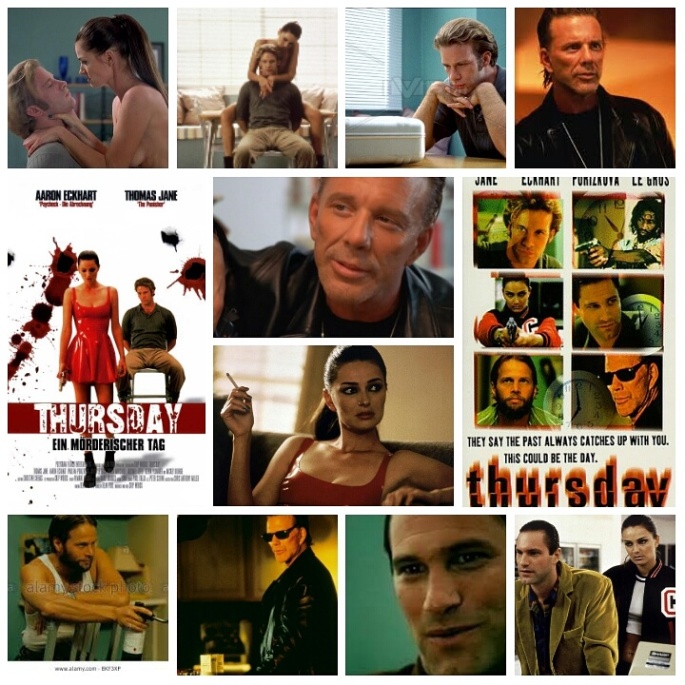
Thursday: A Review by Nate Hill
Thursday is one of the great forgotten neo-noir comedies of the 90’s, floating on the wake of everything from Tarantino to Verhoeven. It’s almost impossible to find these days (I watched an old youtube version years ago), but worth hunting down for its vehement hedonism, mean spirited dark humour and cast members who take a walk down the dark end of the street, and clearly have fun with the shamelessly disgusting material. There’s a spirited willingness to be nasty, a bottom feeding urban sleaziness that almost reminded me of Wayne Kramer’s Running Scared, or Joe Carnahan’s Stretch. Thomas Jane, riding the wave of a supporting role in Face/Off, plays Casey, an ex drug dealer trying to go straight and adopt a child with his wife (Paula Mitchell). Suddenly his old buddy Nick (a ferocious Aaron Eckhart) blows back into his life with big ideas and an even bigger amount of heroin he stole from god knows where. This sets off a wild and exceedingly weird chain of events including convenience store robbery, murder, a psycho named Billy (James LeGros) with a penchant for elaborate torture, a kinky femme fatale (Paulina Porizkova) and a scary rogue cop (Mickey Rourke). It’s a big bloody hot mess, but a brilliant one that nails the feverish tone of stuff like Natural Born Killers, a complete disregard for discretion or moderation, tossing everyone and everything into the fire until the audience feels like they need a big collective shower. Eckhart is a treat to watch, taunting the laid back Jane with a knowing glee, waiting for that inevitable revert to bis old, crazy self. Rourke is relegated to what is essentially an extended cameo, but he makes the most of it with quiet tension and the menace of a junkyard dog. This film has what is probably the weirdest sex scene I’ve seen, which the youtube version won’t show (being the sicko that I am, I had to track it down elsewhere). Brutally reckless stuff, and a howl if this is your type of thing. Watch for a brief and hilarious cameo from Michael Jeter.
WHERE THE BUFFALO ROAM – A REVIEW BY J.D. LAFRANCE

Many filmmakers over the years have tried to make films out of Hunter S. Thompson’s books but the first completed effort did not surface until 1980 with Where The Buffalo Roam. It is not a good film. And yet, I find myself oddly fascinated by this deeply flawed effort. Perhaps it is Bill Murray’s truly inspired one-note performance and the stories of his deep immersion into the role. So deep that he has never fully been able to shake Thompson’s persona since. From articles that appeared at the time of its release, the project seemed doomed from the get-go with a first-time director clearly out of his depth and a problematic screenplay that Murray and Thompson tried in vain to improve during filming. The end result speaks for itself.
The film begins with a situation familiar to anyone who’s read Thompson’s work – under pressure to get an article done by a strict deadline for Blast magazine (aka Rolling Stone) for his long-suffering editor Marty Lewis (Bruno Kirby wasted in a thankless role). Up against it, he decides to write about his friend and attorney at law Carl Lazlo, Esq. (Peter Boyle). The film proceeds to flash back to San Francisco, 1968 and Thompson is holed up in a hospital room with a Wild Turkey I.V. drip (nice touch) and his own private nurse. Lazlo shows up (through the window no less) and springs his client for a road trip in a muscle car that bears more than a passing resemblance to the one James Taylor and Dennis Wilson drove in Two-Lane Blacktop (1971).
After this promising start, the film stalls with a bit where Thompson pretends to draw a lady’s blood which is pointless and painfully unfunny. Although, things perk up slightly in the next scene where he attends a court case that Lazlo is working. In the courtroom, he proceeds to mix up a Bloody Mary while he waits for the proceedings to begin, which is fairly amusing. Lazlo’s defense of four hippies stops the film cold. It is supposed to show his righteous fight for the underdog and the futility of working within the system. It is supposed to set up the struggle between the counterculture and the establishment, which epitomized the 1960s. Instead, it just comes across as dull and preachy.
Where the Buffalo Roam jumps to Los Angeles, 1972 as Thompson covers the Superbowl as depicted in the book Fear and Loathing on the Campaign Trail ’72. After a tedious bit where he checks in, the film reaches its funniest point (not a hard feat, mind you) as Thompson stages his own Superbowl in his hotel room. He corrals a maid and a room service waiter into playing an impromptu game and, in the process, trash the room in a humorous scene that is the closest this film gets to realizing Thompson’s writing that was often filled with absurdly comical passages.
However, the film stalls yet again when, surprise, Lazlo shows up to take Thompson (and us) away from fun and sidetracks the narrative with painfully obvious political and social commentary as the crazy attorney tries to get his client to join a band of revolutionaries. The whole sequence makes no sense and is a total bore but does make you thankful for the fast-forward button. At this point, I really appreciated what a great job Terry Gilliam and Johnny Depp did adapting Fear and Loathing in Las Vegas (1998) to the big screen.
Fortunately, Thompson doesn’t have much time for Lazlo’s revolution and splits. The film segues into an amusing example of one of Thompson’s infamous college lecture appearances where he conducts a rowdy Q&A session to an adoring crowd of students. It is here where he utters one of his most famous pearls of wisdom: “I hate to advocate weird chemicals or insanity to anyone but they’ve always worked for me.” For anyone who has seen vintage footage of Thompson at one of these college campus appearances, the film’s recreation is spot on – a rare moment of verisimilitude.
Where the Buffalo Roams ends on a high note as it traces Thompson’s misadventures on the campaign trail, pitting him against the elite press corp. as he invades the plane carrying respectable journalists from newspapers like the Washington Post, much to the consternation of a White House representative (played by Animal House alumni Mark Metcalf). Not surprisingly, Thompson gets banished to the “zoo” plane with all of the technicians. It’s a chaotic, noisy crowd where Thompson fits right in. He proceeds to get a straight-laced journalist (played wonderfully by Rene Auberjonois) whacked out of his skull on prescription drugs (he’s later found in the plane bathroom singing, “Lucy in the Sky with Diamonds”). This allows Thompson to steal his press credentials, which he uses to meet President Richard Nixon in a bathroom where he proceeds to freak the man out with his Gonzo behavior.

Bill Murray certainly has Thompson’s distinctive voice and unique physical mannerisms down cold. In the opening scene, he nails the man’s tendency to sudden outbursts of anger and conveys his love and use of guns. Thompson also had a tendency to mutter to himself, often dictating into a tape recorder, which Murray does quite well. Best of all, the comedian spouts many Thompson-erisms at certain points that make you wonder if they were the parts that Murray and Thompson rewrote or that Murray, channeling Thompson, improvised. But for all of this hard work it still feels like a caricature of Thompson, or rather his public persona, like the Uncle Duke character in Doonesbury, but it is still fun to watch. Murray’s performance does contain moments of inspired lunacy, like the hospital room scene and the hotel Superbowl sequence. He does the best with what he has to work with but it’s an uphill battle and he’s constantly thwarted by the unorganized screenplay and ho-hum direction.
In the late 1970s, Thompson’s agent Lynn Nesbit called him one day and told him that movie producer Thom Mount wanted to pay $100,000 for the rights to “The Banshee Screams for Buffalo Meat,” a eulogy for his attorney Oscar Zeta Acosta, which appeared in the October 1977 issue Rolling Stone magazine. Thompson agreed to have it optioned without seeing a script figuring that the film would never get made because Fear and Loathing in Las Vegas had been optioned several times and never made. He remembers, “Then all of a sudden there was some moment of terrible horror when I realized they were going to make the movie.” In 1978, illustrator Ralph Steadman (who had worked with Thompson on numerous occasions) was asked to create a poster for the film. He used a drawing entitled, Spirit of Gonzo as the basis but this incarnation disappeared and in 1979 he created a completely different poster.
Thompson met with the film’s screenwriter John Kaye but felt that the man understood more than what was in the script. “I was very disappointed in the script. It sucks — a bad, dumb, low-level, low-rent script.” By his own admission, Thompson admitted that he signed away having any control so that he couldn’t be blamed for the end result. In the early drafts, Lazlo’s surname was Mendoza but this was changed after Nosotros, a group of Chicano actors and filmmakers, threatened to generate controversy if the character was played by Anglo actor Peter Boyle.
Before principal photography began, director Art Linson took a four-month crash course on directing. Steadman observed the first-time filmmaker on the set and said that it was “pretty obvious that he was in no frame of mind to catch the abandoned pure essence of Gonzo madness, which can only happen in uncontrolled conditions.” However, Steadman also felt that Linson’s “fanaticism for the subject he was trying to portray was undoubtedly there, and his sincerity, too,” but that the director was under the impression that the film was going to be a runaway hit before he’d even begun filming it and therefore refused to take any chances with the material.
While making Where the Buffalo Roam, Murray hung out frequently with Thompson. They were known to pull some wild stunts, like the time, at Thompson’s Aspen, Colorado home, after many drinks and arguing about who was the better escape artist, the writer tied the comedian to a chair and threw him into the swimming pool. Murray nearly drowned before Thompson pulled him out. The comedian also hung out with Steadman, who gave Murray his impressions and observations of Thompson’s mannerisms. According to Steadman, within two weeks of Thompson being on set, Murray had transformed into him.
Just before principal photography began, Murray became apprehensive because of the shortcomings of the script. Kaye claims that Thompson and Murray changed parts of it during filming and, at that point, he chose to no longer be involved. Linson did allow Murray, with Thompson’s help, to add lines on the set. Years later, Thompson said that he and Murray wrote and they shot several different beginnings and endings for the film but none of them were used. Murray and Thompson continued to be concerned with the film’s lack of continuity and in early 1980 added voiceover narration. Where the Buffalo Roam was sneak-previewed in late March and the last two scenes and most of the narration were missing. Murray was reportedly furious. Universal ended up shooting a new ending and three days before release, a press screening was canceled because of editing problems.
Thompson even served as a consultant on Where the Buffalo Roam but this did little to translate the author’s warped vision to the big screen. While watching the film, it becomes readily evident that, despite Murray’s inspired performance, Kaye and Linson had no idea what Thompson’s books were trying to say. The film seems more like a collection of rather tame highlights from the man’s work, including Fear and Loathing on the Campaign Trail ’72, The Great Shark Hunt and Fear and Loathing in Las Vegas. Where the Buffalo Roam owes more to the sensibilities of Animal House (1978), with its goofy humor, than Thompson’s savage political satire. Mount also produced Animal House and ended up casting a few of the supporting actors from that film in this one. With Terry Gilliam’s adaptation of Fear and Loathing in Las Vegas, we laugh along with Thompson and his attorney but at a certain point the film makes it a point to show that these guys aren’t very nice and are quite destructive – to themselves and those around them. It is this darkness that is missing from Linson’s film, which is a light-hearted romp, a slob comedy.
In an interesting post-script, Murray had a tough time shaking Thompson’s persona after filming. Murray made the film between the fourth and fifth seasons of Saturday Night Live. When the fifth season began, the comedian was still channeling Thompson, showing up to meetings with the long black cigarette holder and sunglasses. One of the show’s writers said, “Billy was not Bill Murray, he was Hunter Thompson. You couldn’t talk to him without talking to Hunter Thompson.” Early in the fifth season of the show, Murray sometimes looked bored on-air and was described as acting like “a tyrant” backstage by some. He seemed to be angry at everyone and very uncooperative. After the film was released and tanked at the box office, as well as being trashed by the critics, the studio quickly pulled it from theaters. Murray started to act more like himself and no one brought up the strange period where he acted like Thompson. Years later, Murray reflected on the film: “I rented a house in L.A. with a guest house that Hunter lived in. I’d work all day and stay up all night with him; I was strong in those days. I took on another persona and that was tough to shake. I still have Hunter in me.”
After the film’s dismal reception, no other adaptations were completed. It took actor Johnny Depp and his friendship with Thompson to get any kind of serious attempt at an adaptation of Fear and Loathing in Las Vegas even considered. In the end, I think that the problems I have with Where the Buffalo Roam are best summed up in a speech Thompson gives at the end of the film where he says, “it just never got weird enough for me.” Amen, my brother.
Shanghai Noon: A Review by Nate Hill
I forgot how much goddamn fun Shanghai Noon is. It’s pretty much the quintessential east meets west buddy flick (sorry Rush Hour, love you too bbz), and upon rewatching it I realized that it’s every bit as awesome, and more so, than I remember as a kid. You take Jackie Chan, a stoic, robotic Chinese fighting machine with the sense of humour god gave a sock, and pair him with Owen Wilson, a wishy washy surfer dude of a cowboy who can’t take one second out of the day to stop talking or cracking jokes, and you’ve got gold. Of course, they need a film to run about in that’s just as solid as they’re team up, and that’s just what we get. This is a bawdy, unapologetic roll in the hay, a genre bender that tosses the American western, the buddy cop flick and the Kung Fu picture into a big cauldron, fires a few bullets in and gives it a big old stir. It’s ridiculously fun for its entire duration, an achievement which the sequel just couldn’t keep up with. Chan is Chon Wang (say it fast), a Chinese imperial guard on the trail of runaway Princess Pei Pei (Lucy Liu), who has runoff to America. No sooner does he set foot on Yankee soil, he’s bumped into peace pipe smoking Natives, and clashed with a band of train robbers led by Roy O Bannon (Owen Wilson), a fast talking soldier of fortune who doesn’t seem to have much skill besides yapping his way out of a situation. The two are thrown into a mad dash across then west, Chon looking for the princess, and Roy after the missing gold from the train. It’s what movies were made to be, a pure rush of gunfighting and chop socky, kick ass action sequences, all given the boost of Chan’s insane talents. He’s like a rabid squirrel monkey, and Wilson a drunk sloth, constantly mismatched yet always coming out on top, like the best comic duos always do. They’re faced with taking dpwn a few baddies, including Walton Goggins as the dumbest outlaw this side of the Rockies, and a terrifying Xander Berkeley as a corrupt, homicidal marshal. The core of it rests on Chan and Wilson to entertain us though, and even in the down time between action, their energy is infectious, especially in a manic drinking game that just can’t be described in writing. Like I said, the sequel, Shanghai Knights, just doesn’t capture he magic quite like this one does, and seems to fall flat. You can’t go wrong with this original outing though, and it just gets better with age.
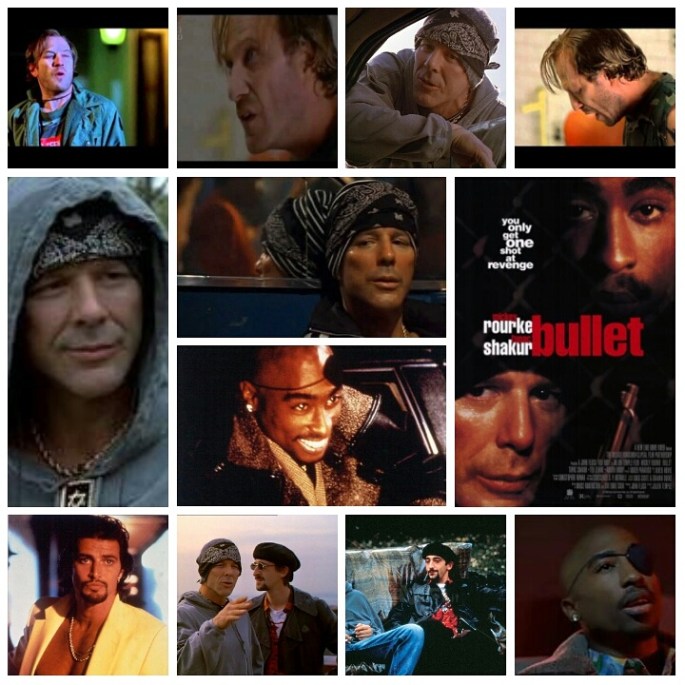
Bullet: A Review by Nate Hill
Bullet is a violent cautionary tale about what it means to live a life of crime in New York City’s brutal Hell’s Kitchen, to live (and die) with all the baggage and tragedy that comes along with it. Mickey Rourke is excellent as Butch Stein, a pathetic yet somehow endearing Jewish American hoodlum locked in a personal war with local drug dealer and gangster Tank (Tupac Shakur). Butch still lives with his family, and spends his nights slumming about with slick wannabe wiseguy Lester (John Enos III) and his gangly brother Ruby (Adrien Brody). One gets the feeling that all of them are essentially still little kids who never learned to grow up or use their words, but the sandbox they’re squabbling in now is a dangerous area of town, and their toys are heavy artillery. Butch has another brother, a reclusive weirdo played phenomenally by Ted Levine. He’s distant and strange, but there’s breaks of clarity that shine through, and in those moments he’s pretty much the voice of reason amongst all the tomfoolery that adds to the mortality rate in their district. Levine is unique and shelters the gold in his work until right at the end, letting off an emotional stinger of a cap to his performance that is yet another testament to his skill. Rourke broods through his work with sombre self loathing and a grim resolve, dead set in his ways, perhaps unable to live his life differently, and feeling helpless at the road he’s taken, a dark one that has strayed far from what might have been. Tupac’s role is somewhat underwritten, which isn’t quite fair to the guy, because he has more acting talent than pretty much any other rapper I’ve seen in film. Reduced to a mostly a jive talk sterotype gangsta antagonist, I would have liked to see them allow him to level with Rourke in a way that made their locking horns seem a little bit more than just a petty turf war. Director Julien Temple comes from a music video background, and transitions nicely into the world of the urban crime drama, shooting the seedy NYC locales with glittery precision that suggests festering rot below. It’s an anti-crime film, and I’m always curious to see if such a sentiment is undone by the glorification of such a lifestyle, intentional or otherwise (it’s easy to get caught up in sensation and cinematics, losing sight of what you set out to say in the first place). This one stays true to its word, showing us characters who have irreparably lost their way, and assuring bullet by bullet, death by death, that this isn’t any kind of life for anyone. Searing stuff.
Animal Factory: A Review by Nate Hill
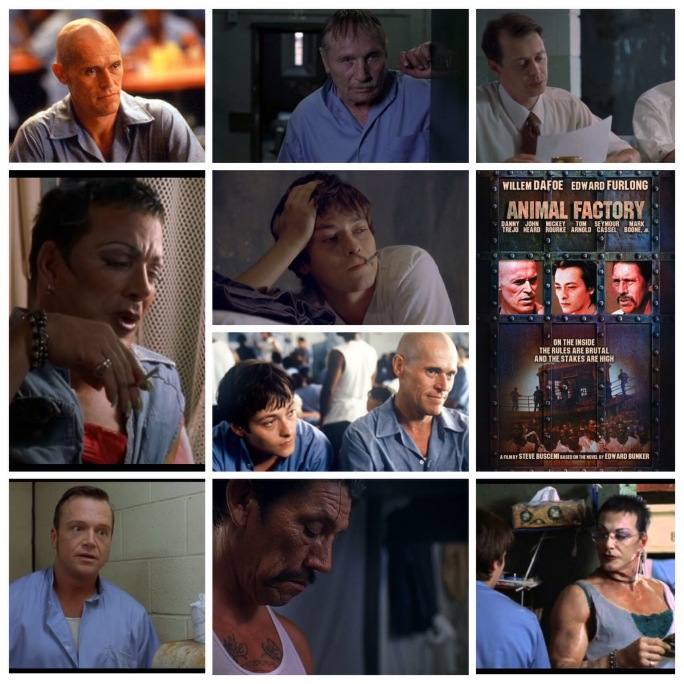
Animal Factory is a prison set film directed by actor Steve Buscemi and based on a novel and subsequent screenplay by Edward Bunker, a real life ex convict, who played Mr. Brown in Reservoir Dogs. If that sounds like an irresistible team up to make this type of thing work, you’re thinking right. And I haven’t even mentioned the epic cast yet. It’s a scrappy little film that almost takes stage play form, as we watch a plethora of raggedy and very diverse inmates navigate the difficult, tragic and often touching life of incarceration. Edward Furlong (before he ballooned out) plays a young man barely out of his teens, locked away for marijuana possession, essentially a victim of the extremely harsh system they got down there in ‘Murica. He’s a sitting duck on the inside, but receives kindness and mentorship from veteran con Earl Copen (Willem Dafoe, excellent). It’s all done in an almost Robert Altman style way; characters jump in and out, events trundle by in centrifugal motion with little regard for one solid narrative, instead choosing to arbitrarily shift focus from prisoner to prisoner, whilst periodically checking back in on Furlong, who is the closest thing to a main protagonist. The cast is wonderful: Danny Trejo shows up (another guy who has done time in real life), Tom Arnold plays a pervert sicko who preys on Furlong, and Mickey Rourke is an absolute standout as Jan The Actress, a transvestite cell mate with a peppy life lesson or two for young Furlong. Watch for Bunker himself, Seymour Cassel, Mark Boone Jr., Chris Bauer, Buscemi as a parole board member and John Heard as Furlong’s father. Bunker no doubt based much of the story on his actual prison experience, and the dedicated authenticity shines through in every aspect of the film. Buscemi is no doubt an actor’s director (being one himself), and he lets every player have their moment to shine, while always contributing to the story as a whole as well. Prison films don’t get much better than this. Not to be missed.
A Prayer For The Dying: A Review by Nate Hill
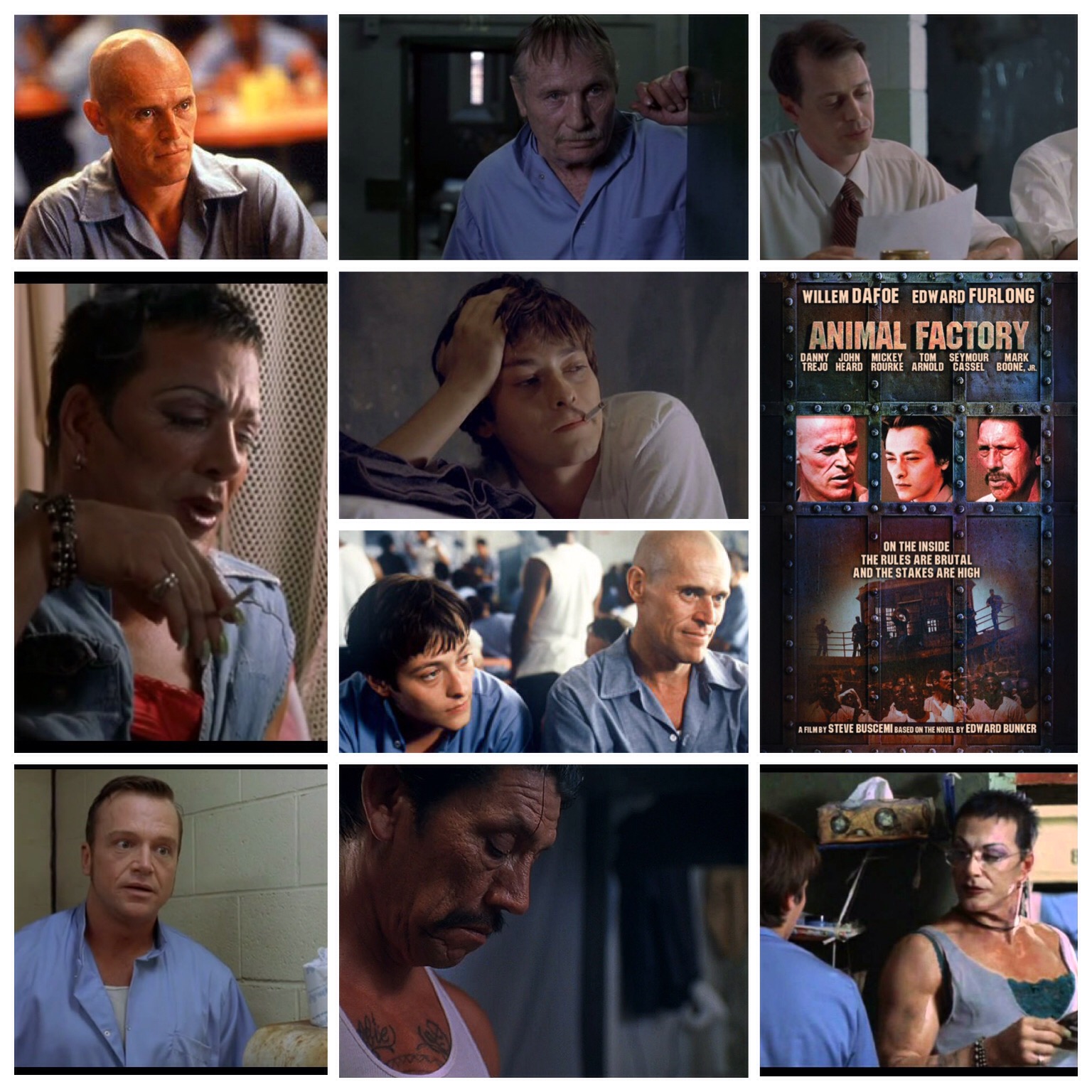
A Prayer For The Dying is a melodramatic romantic action thriller following IRA assassin Martin Fallon (Mickey Rourke), a man with a brutal path in life whose long buried conscience surfaces after an explosives mission goes awry, resulting in the death of schoolchildren aboard a bus. It’s a bold scene to start a film with, and in every instance after it Fallon has a haunted frenzy about him, clearly damaged by what he did and saw. As if that weren’t enough, he now finds himself compelled to murder a priest (Bob Hoskins) who witnessed one of his militant crimes. Fallon spends a lot of time hesitating, and in that hesitation he strikes up a romance with the Hoskins’s blind daughter (Sammi Davis), finding sanctuary and a modicum of redemption with the two of them. A lot of nasty people from his past are looking for him though, including his amoral former partner (Liam Neeson), an evil British crime kingpin (the great Alan Bates) and the kingpin’s murderous brat of a son (Christopher Fulford). Obligatory shootouts, personal and religious angst, sappy sentiment and dodgy accents, particularly from Rourke, ensue. He can blend into a lot of roles and pull off a lot of different characters, but it seems an Irish accent is a stretch, and it shows. As the character of Fallon himself, ethnicity aside, he does a bang up job though. Bates is razor focused in playing anyone, and his villain here is a spidery creepo. Neeson is young and doesn’t get much to do except hassle Rourke, but their confrontations are nicely done by both parties. Director Mike Hodges, whose other work I’ve never really seen, seems to like slow and deliberate action scenes, very old world and sometimes repetitive, but entertaining nonetheless. Not the best IRA thriller out there (most of the events here have little to do with the movement anyway, and focus more on Fallon), but a decent way to spend a couple hours.
B Movie Glory with Nate: 13 Sins
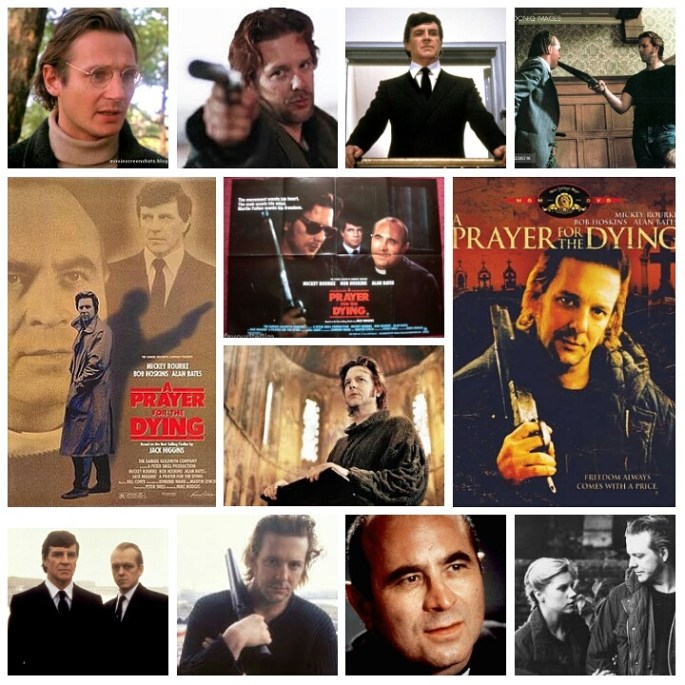
13 Sins is a mean, mean movie, one that pushes it’s audience as far as the central premise does it’s characters. By push I mean it gleefully tries to figure out just how many acts of nasty human depravity it can parade before you before the laughs turn to “oh damn, that’s actually horrible.” Me being the sicko that I am, I laughed pretty much straight through til the bombastic finale, but I recognized the rotten nature in the story and felt the weight all the same. The idea is simple: One day a financially troubled man (Mark Webber, who just has one of those faces you want to punch) gets a mysterious phone call from a game show host sounding dude, telling him to swat a fly, after which one thousand dollars will be deposited into bis account. Easy enough, right? Yeah, sure. Now he’s had a taste of money, wants in on the game and has no clue what soul crushing horrors await. Each new task gets more violent, disgusting, risky, disturbing and (if you’ve got the right mind for it) increasingly hilarious. Make a child cry. Push an old woman down a flight of stairs. Set a church nativity scene on fire. Cheery stuff. Then shit gets real and he’s asked to do things right out of a horror movie, all in the name of green money. The aim, besides of course amusement, is to prove that anyone can be turned into a monster if the price is right. As funny as it is, it leaves a sickening feeling in the pit of your stomach, like you’ve been kicked in the nuts by every horrible news report of late, a gnawing reminder of what levels humans are capable of sinking too when they have too much time and money on their hands. Ron Perlman plays the obligatory baffled police detective, always one step behind the action, and watch for veteran Tom Bower too. The film kind of falls apart near the end, as what little believability it had evaporates alongside the forced plot twists, but had it remained lean and simple I think it would’ve fared better. All its forgiven when considering the impact it makes though, both as action social horror story, extremely black comedy and alluring thriller.