Terry Gilliam’s Brazil

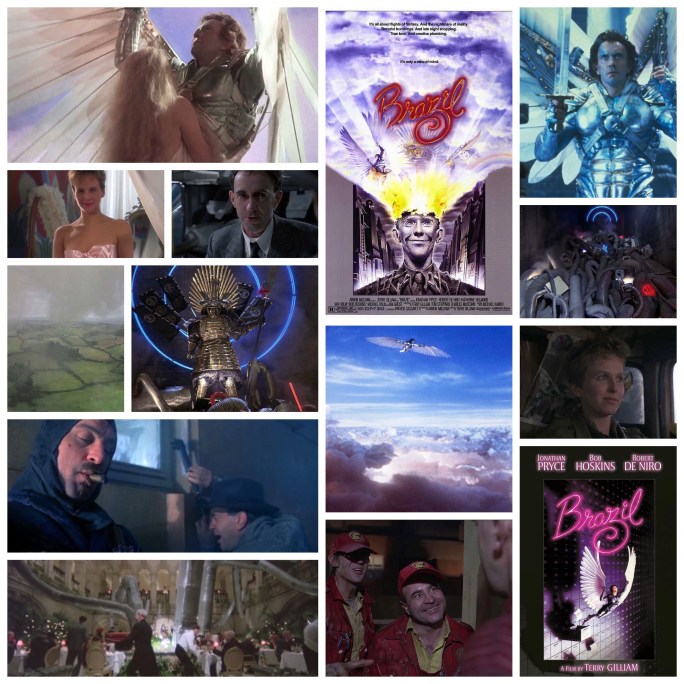
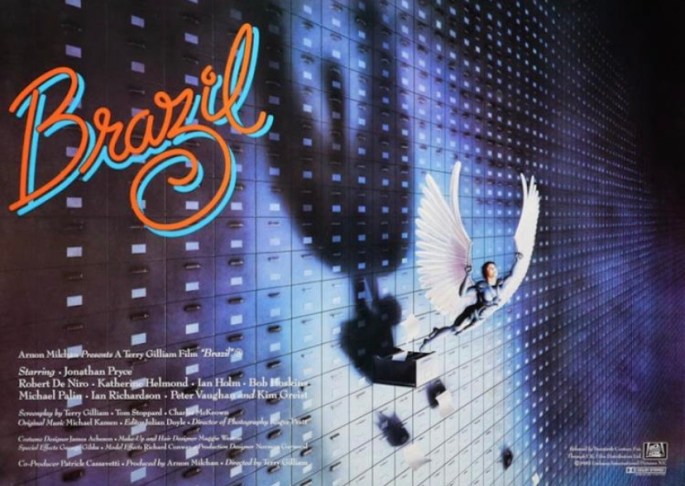
As a huge Terry Gilliam fan I’m embarrassed to say that I only saw his most celebrated film, Brazil, for the first time a few nights ago. I guess with some filmmakers we just unconsciously save the best for last in their canon? Anyways, thoughts: There are two visual aesthetics here that struck me, existing in a cacophonous plane of many sights, sounds, colours and spectacle. On the one hand you have the angular, grey, needlessly cluttered and perpetually chaotic business style world of the future, packed with asinine bureaucratic incident, excessive consumerism and, uh, a whole fucking shit load of ducts, snaking hither and thither to seemingly represent the kind of mental fog and psychological stress that living in a city choking on its own infrastructure might afflict one with. That is is the world for Sam Lowry (Jonathan Pryce), a put-upon peon of big business stuck in en endless, mad-dash hamster wheel of empty procedural diarrhea.

But there is another world for Sam, and another aesthetic for the film too. It shows up in periodic dream sequences and couldn’t be more different than his waking existence. Here he is free amongst an endless sea of clouds that promise freedom, gifted with Da Vinci esque winged contraptions and left to soar around the blessed blue. Here a beautiful goddess (Kim Griest) beams out at him from a veil of heavenly gauze like the Venus De Milo or any number of girls from a Renaissance painting. Unfortunately this dream world is just that: a phantasmic apparition not of his waking life, until he begins to see the girl from that realm in the real world, driving a hilariously oversized big rig truck no less.

It’s at that point that Sam’s world begins to get dangerous for him, the blurring of lines between fantasy and reality as well as this good natured desire to rectify the world’s most cataclysmic clerical error (that damn fly), seeing him go from mild mannered cog in the machine proverbial fly in the ointment, the stick which unknowingly lodges itself in the gears of the system and causes a hysterical meltdown. Along the way he meets many others including an opportunist colleague (Gilliam regular Michael Palin), his plastic surgery addicted mommy (Katherine Helmond), a shady corporate maintenance man (Bob Hoskins, looking more like Super Mario here than he did in the *actual* Super Mario film), his hyper anxious supervisor (Ian Holm) and a renegade duct repairman played by Robert DeNiro in a sly turn of antiestablishment derring do. So, overall? Folks are right for dubbing this Gilliam’s masterpiece, and while my heart will always call his 12 Monkeys my personal favourite, I just can’t argue that this isn’t his best film overall. It’s a sprawling canvas of ideas, nightmarish imagery, hope for escape that keeps getting quashed and reignited with each narrative beat, rib jabbing dark humour that calls Python to mind, jaw dropping production design and the kind of story that draws you right into this topsy-turvy realm. Sam exists in two worlds, as does the film, and the haunting fun is in seeing them crash, collide and each vie for presidency over one soul. Absolutely brilliant film.

-Nate Hill

Peter Weir’s The Mosquito Coast

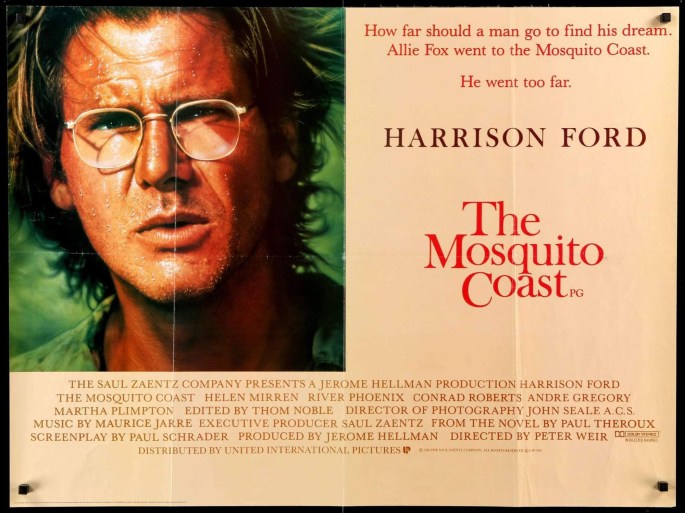
How far can one person take an ideology before it becomes extremism and they begin to put their life and those of their loved ones in danger? Peter Weir is a painstakingly meticulous filmmaker yet somehow lets his intensely focused visions breathe so organic and free, and he explores this notion in The Mosquito Coast, a curious and brilliant film that looks at the journey of one family from rural Massachusetts to the wilds of coastal Honduras.

Harrison Ford is Allie Fox, an inventor who loathes bloated American consumerism and wishes to leave for something more practical, more elemental. He packs up and along with his wife (Helen Mirren) and four children (River Phoenix, Jadrian Steele, Rebecca and Hilary Gordon), leaves the US behind for good in favour of the Central American jungle. Buying a solid few acres, he bands together with locals to create agricultural structure and engineering innovation in this nearly untouched frontier. For a while he’s successful, and life is good, if a little chaotic and unorthodox. But is it all enough? Obstacles arise as they naturally would in such a wild card of a region, but ultimately he finds that the biggest hurdle to face is his own stubborn, obstinate and eventually dangerous nature.

Allie is an undeniably gifted man whose work bears actual merit unlike many bumpkin blowhard inventors in cinema and he succeeds in some of his ventures. The thing is, and this is how the character struck me anyways, this guy has always probably had the seeds of an unstable trajectory in his personality for a while and such an upheaval of life probably accelerated it. He becomes borderline psychotic as the film wears on and I found myself feeling sympathetic, sad and finally downright scared for his family. But what to make of the man himself? Ford is absolutely brilliant and so unlike his usual heroic, steady eyed self. There’s a sinewy mettle that gets him a good distance of the way, but as soon as things start to not go *his* way for long enough, he unravels and it’s quite a disarming thing to see. Weir observes with tact and patience as Maurice Jarre’s ambient score bears witness and John Seale’s lush cinematography intoxicates the screen. This is a very compelling achievement but it’s somehow hard for me to describe exactly how it affected me so; it’s a difficult, often sad, touching and very unique experience that explores one man’s place in the world or at least how hard he tries to find it and flounders in the process. In doing so it makes one think of humanity across all the continents, our place in both nature and infrastructure and how both, one or even none of those may satisfy or make restless any given individual. I would say this is one of Peter Weir’s best films but considering the guy has uniformly made only excellent work throughout his career, the fact that it’s made by this wonderful artist should just speak for itself. Highly recommended.

-Nate Hill

Disney’s Togo

Man, Willem Dafoe is really on a roll this year, not to mention the last two decades in general. No other actor out there I can think of has balanced a career between appearing in edgy, fucked up arthouse and experimental stuff and then more accessible, Hollywood and conventional fare too with as much energy, enthusiasm and variety. The only thing he hasn’t done is made the jump to television, but everyone has their reasons. With Disney’s Togo he proves for the third time this year (see Motherless Brooklyn and The Lighthouse) what a commanding, distinct presence he has in either lead or supporting roles. Here he plays Leonhard Seppela, a real life Norwegian sled dog breeder whose unshakeable bond with his lead dog Togo is the stuff of legend and countless grabs for the Kleenex box throughout the film.

Togo was the runt of the litter, as we learn through decade ago flashbacks between the beginning of their friendship and a furious race through the Alaskan wilderness to bring medicine back for children dying of an illness outbreak. If this story sounds familiar it’s because it is: Another dog named Balto was slapped with most of the credit through happenstance it seems, but this film definitely makes it apparent that Togo was the uncanny and determined hero who turned the tide amongst one of the fiercest storms in Alaskan history.

Dafoe is so versatile he can play the freakiest, most otherworldly villains or the most affable and down to earth regular dudes. He’s an initial pragmatist here whose borderline callous way of training dogs is upended by Togo’s resilience and spirit that burns like a star’s reflection in the Alaskan ice. These two beings were made for each other and in the last haul of their respective lives (Leonhard looks to be in his late sixties and Togo is over twelve) they pull off a miraculous journey of courage, defiance and heartwarming friendship. It isn’t without its dangers or peril though, there’s a sequence where they have to navigate an inlet Sound coated in ice violently shattering all around them that is so harrowing to watch you won’t breathe until the outcome. That’s the power of these animal stories though and I suppose you have to be someone who loves all these creatures or a ‘dog person’ to be affected by it, but really at its core it’s about friendship no matter the species, not giving up on one another at any stage of either party’s life and how that can carry you onward. Both Dafoe and every dog in his team sell that and make this one of the best films of the year. A special mention to Mark Isham’s beautiful score and the use of emotionally galvanizing song ‘On The Nature Of Daylight’ by Max Richter in the third act, last heard in Scorsese’s Shutter Island at an equally penultimate point in the narrative. This one alone is worth the price of Disney+.

-Nate Hill

Ivan Reitman’s Six Days Seven Nights

Harrison Ford and Anne Heche are the last two people I would have expected to have romantic chemistry, but lord they do and it’s part of what makes Ivan Reitman’s Six Days Seven Nights such a charmer. It’s also interesting to note that Ford handpicked her for the role over more popular people like Meg Ryan. There’s something to be said for his intuition because the two of them take an averagely written, Romancing The Stone type shtick and turn it into something very watchable and believably endearing, mostly when they get to share the screen.

Heche is Robin, a mile-a-minute NYC publisher whose boyfriend (Ross from Friends) takes her on a south seas tropical vacation and proposes, which is kinda met with the most somehow enthusiastic yet lukewarm reaction I’ve seen. Ford is Quinn, the drunken bush pilot hired to fly them from island to island to their resort. When she has to dash mid vacation for work they wind up in a storm together, crashing in a remote area and you can imagine where it goes from there. Ross From Friends helplessly flounders around in a half assed rescue mission while they traverse the stunning tropical landscape (actually filmed in Hawaii), squabble a lot, eventually warm up to each other and are harassed by three South Seas pirates played by Temuerra Morrison, Cliff Curtis and Danny Trejo who, in typically obnoxious Hollywood casting fashion, are not remotely ethnically from that region.

This is fluff, there’s no way around it, but Ford and Heche elevate it far past what it can do on its own and are a delight. There’s something hilarious about him playing a short tempered, heavy drinking scoundrel who just chills out in the tropics and bangs the local exotic dancer when he isn’t flying his rust bucket plane around, his casual charm and cantankerous nature fits the role nicely. It’s really too bad Heche never became a bigger star (there’s a highly political reason for that which I won’t get into here) as she’s unconventionally attractive, full of charisma and never drops a beat when the camera is on her. These two actors are brilliant when onscreen together and make this worth watching, even if it is just a breezy time killer overall.

-Nate Hill

Frank Oz’s What About Bob?

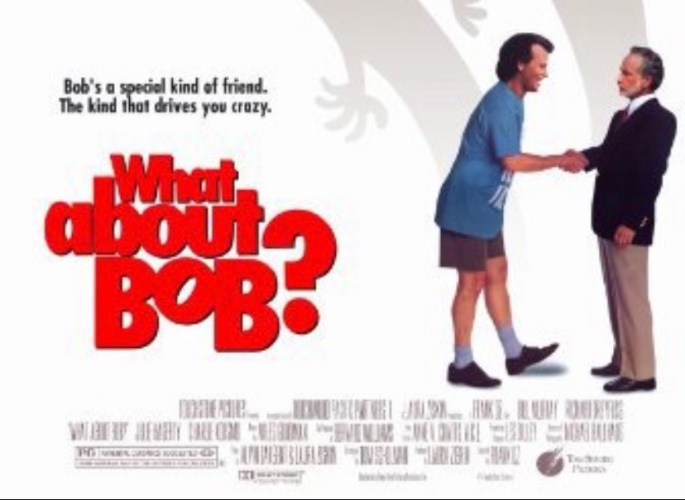
Frank Oz’s What About Bob? is one of those films that doesn’t know what wants to be and as such can’t settle down into one aesthetic. I can appreciate that sometimes but usually only when the film in question is a sort of patchwork amalgamation of different stuff on purpose, and not one simple story that should tune itself into one frequency before hitting go.

Bill Murray is Bob, a sweet guy who doesn’t quite understand the concept of boundaries and pushes them any chance he gets, sometimes unknowingly. He suffers from Obsessive Compulsive disorder and anxiety, which these days is being treated with much more thought and care in Hollywood and the real world. His psychiatrist (Richard Dreyfuss) brushes him off to head out from NYC to New Hampshire on vacation with his family, so what does Bob do? Follow him of course, and interrupt an already tense family retreat with his constant need for attention, validation and help with simple everyday things like opening a car door. Dreyfuss’s family (Julie Hagerty, Kathryn Erbe and the kid from Hook) love Bob and the good doctor can’t stand him.

The problem with this film is it can’t figure out who to sympathize with. Is Bob crazy and genuinely making this family’s life hell? Is he just a good dude and it’s the doctor who’s crazy for trying to get him out of his life? Are the rest of the family crazy for warming up to a total stranger/stalker so quick? Who cares? The script sure doesn’t seem to because when the third act rolls around and it should be time to wrap up arcs in a way that feels earned, it goes totally ballistic and characters begin to act fucking nuts, at least too much so for a benign ‘comedy’ like this anyhow. Murray’s performance is likeable enough to not be completely over the edge but the character is untethered from meaningful revelations or pathos. Dreyfuss starts at unlikeable and only escalates from there into a solid gold asshole, while the family is hit and miss. My favourite scene of the film shows Bob driving to the lake with the daughter (Erbe), discussing Bob’s issues and what makes them both anxious in life, respectively. It’s the only scene in the film that takes anything remotely seriously or gives a thought to this story, and the rest is just misguided noise. Avoid.

-Nate Hill

Yuletide Yarns: Nate’s Top Ten Christmas Films

Tis the season to check out Christmas in cinema! There’s a whole ton of festive films out there revolving around this time of year, ten of which I’ve picked out here as my cherished favourites! Oh and keep one thing in mind: A Christmas movie is a subjective thing and each individual is allowed to have whatever the hell they want in their Yuletide canon without a bunch of blockheads screaming “That’s not a Christmas movie” to the winds. Home Alone is a Christmas movie to many and perhaps to some The Mummy or Top Gun are also Christmas movies too for whatever personal reason or memory they hold dear. Anything you damn well please can be your “Christmas movie” and don’t let anyone tell you otherwise. Got it? Good! Enjoy my list 😉

10. John Frankenheimer’s Reindeer Games

An underrated one, to say the least. Pulpy, nihilistic and packed with ironically nasty energy substituting for holiday cheer, I love this ultra violent heist/revenge flick to bits. Ben Affleck, Charlize Theron and an off-the-chain Gary Sinise are various degenerate characters involved in a casino robbery and the ensuing aftermath, murder, betrayal and tough talk. They’re all having a blast and there’s great supporting work from Danny Trejo, Donal Logue, Isaac Hayes, James Frain, a scene stealing Clarence Williams III plus the late great Fennis Farina.

9. Bob Clark’s Black Christmas

A Christmas slasher yay!! This predates John Carpenter’s Halloween as the original genre prototype and is just such a fun, spooky old stalker flick with healthy doses of camp, plenty of creaky atmospheric portent and one of the freakiest villains the genre has to offer based on his voice alone. It’s Christmas break for a house of sorority girls in small town Ontario, which should mean rest, relaxation and good times. A deeply disturbed prank calling serial killer has other ideas though, tormenting them with perverse phone-calls and eventually outright hunting them through the drafty halls of the manor. Starring the beautiful, classy Olivia Hussey, Keir Dullea, John Saxon, Margot Kidder and Nick Mancuso as the killer’s terrifying phone voice, this is a holiday classic for me, it practically fills up your living room with atmosphere when you put it on.

8. Joe Dante’s Gremlins
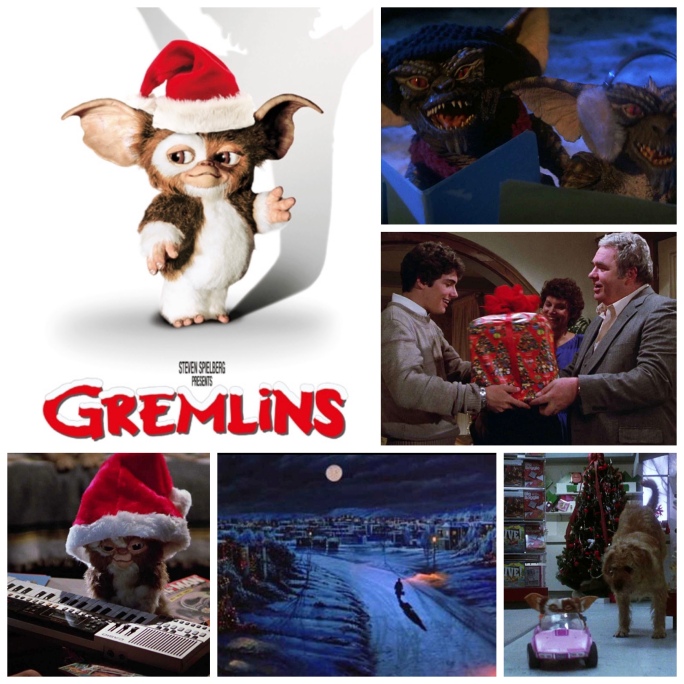
This is one of those ones that kind of works at Halloween too because it’s so gooey and horror-centric, but the quaint small town Christmas vibe is so pleasant and wonderful, right from the joyous opening titles set to Phil Spector’s ‘Christmas.’ One young man’s Christmas present goes haywire when cryptozoological Mogwai Gizmo and his clan get right out of control and cause a bigger holiday riot than Boxing Day at the mall. It’s like a Christmas party gone ballistic in the best, most mischievous ways and the fun lies in seeing these little green monsters terrorize, blow off steam and run around town destroying everything in their wake.

7. Renny Harlin’s Die Hard 2
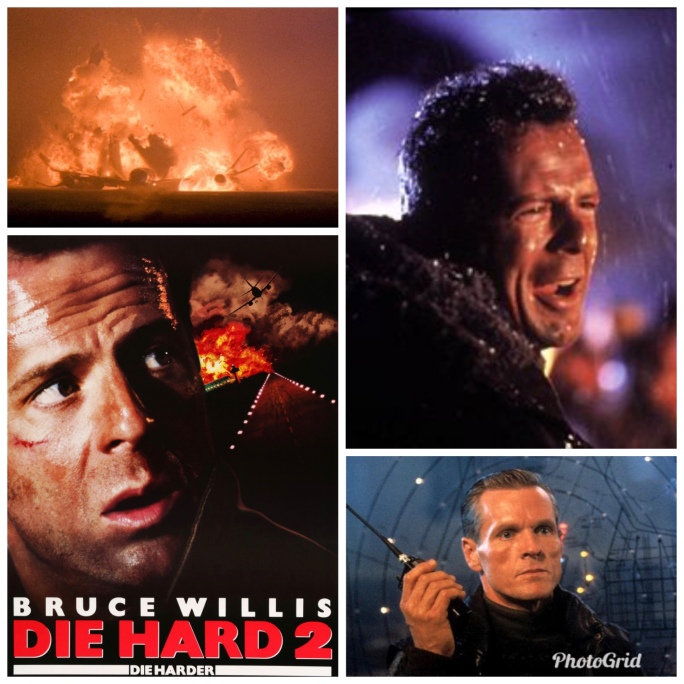
I know what you’re thinking, but I actually prefer this rambunctious sequel over the iconic first Die Hard film. Switching up the action from a skyscraper to hectic, bustling and heavily snowed in LAX on Christmas Eve is just such a cozier, more festive setting, not to mention ripe for so much action, villainy and comedic bits. Way more characters, tons of cool cameos, a blinding snowstorm to create atmosphere and so many gorgeous explosions.

6. Robert Zemeckis’s The Polar Express

What a majestic film. People rip on this for being way too elaborate and hectic when compared to the simple, direct timbre of its source children’s book, but I love how far they took it. It’s a thrillingly cinematic, highly immersive rollercoaster ride to the North Pole packed with Carols, stunning motion capture animation, Tom Hanks in like four different roles *including* Santa, breathtaking swoops over northern landscapes and a genuine sense of wonder.

5. Ted Demme’s The Ref
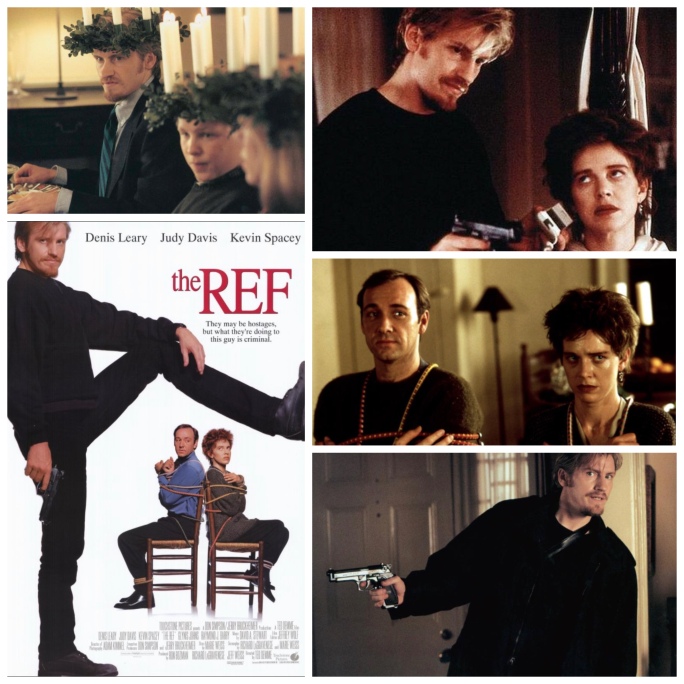
Christmas ain’t always a loving, cherished time of year as you’ll see in this acidic, cynical and jet black comedy of family dysfunction, misanthropy and petty crime. Denis Leary is one pissed off cat burglar who hides out from the law with a couple played by Kevin Spacey and Judy Davis who are basically the most unhappily married, hateful pair of grinches you could find in white suburbia. It’s a brilliantly satirical sendup of Christmas in the Midwest with terrific, off the wall performances from the three leads, a wicked sharp script and hilarious supporting work from J.K. Simmons, Christine Baranski, BD Wong and Raymond J. Barry.

4. Tim Burton’s Batman Returns
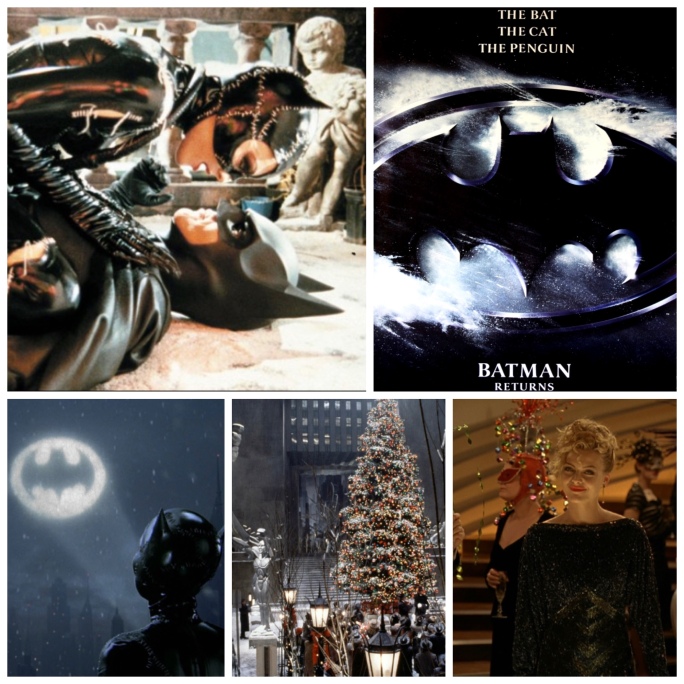
Christmas goes Gothic in my favourite of the initial four Burton/Schumacher Batman films. This is a seriously gorgeous gem of a film with Keaton at his moody best as Batman, Danny Devito creeping’ it up tons as the freaky weirdo Penguin, Christopher Walken embodying corporate evil like no other and Michelle Pfeiffer as the most absolutely sexy, dangerous, funny and commanding take on Catwoman ever. The film takes place over the holiday season in a Gotham highly reminiscent of bustling New York, all austere wintry edifices and decked out super malls.

3. Tim Burton/Henry Selick’s The Nightmare Before Christmas
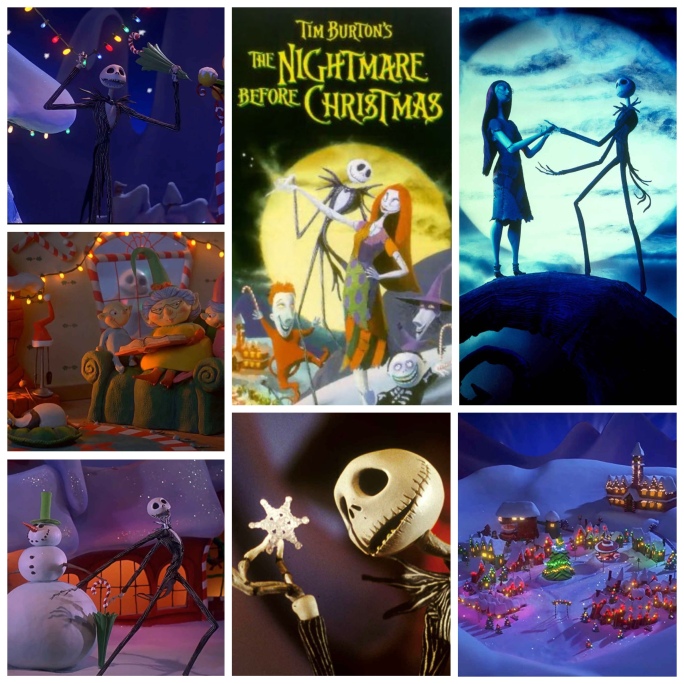
A double edged sword that works wonders as both Christmas and Halloween film, this is just a classic, iconic festive singalong with the OG beautiful Burton/Selick stop-motion animation and a wonderful host of vocal/singing performances from Chris Sarandon, Catherine O’Hara, Glen Shadix, Paul Reubens and Danny Elfman.

2. Harold Ramis’s The Ice Harvest
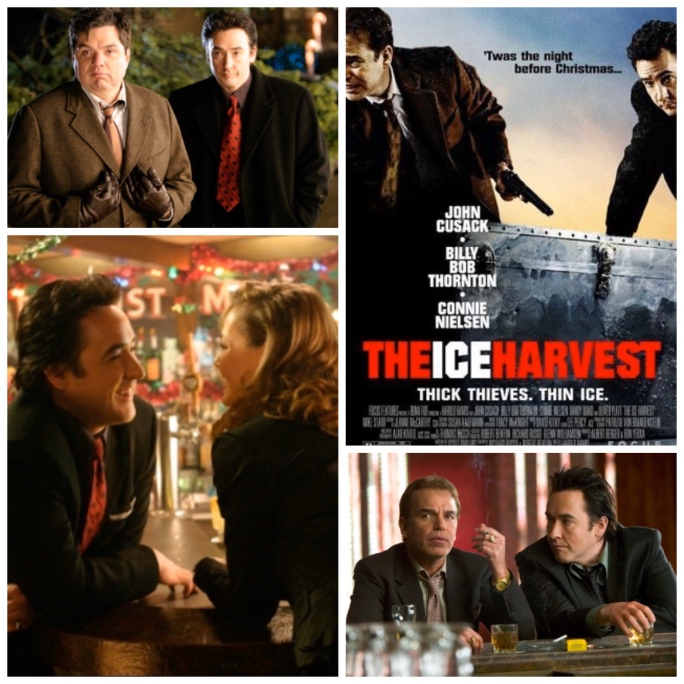
Another counterintuitive one, this is an icy, sardonic black crime comedy about a mob lawyer (John Cusack), his untrustworthy associate (Billy Bob Thornton), a slinky stripper (Connie Nielsen) and a big city gangster (Randy Quaid). They’re all neck deep in an underworld embezzlement scheme on Christmas Eve, out to kill, deceive, screw over and get rich by the time midnight rolls around. I love this film, it’s a Yuletide noir with healthy doses of deadpan comedy, a mournful rumination on what it means to be a family member around this time of year and how morality plays into a life of crime. Plus positively everyone steals the show including the lovable Oliver Platt as Cusack’s drunken buddy.

1. Robert Zemeckis’s A Christmas Carol

The number of Charles Dickens’s Christmas Carols film adaptations is near infinity but for me this one tops them all. Dazzling motion capture animation gives larger than life vitality to the classic story of Scrooge, his three ghosts and Victorian London. Jim Carrey outdoes himself playing the old dude and *all three* spectres while the cast is filled with beloved performers like Gary Oldman, Robin Wright, Colin Firth, Fionnula Flanagan, Cary Elwes and the late great Bob Hoskins in multiple roles. Zemeckis’s sure hand with this dynamic style of animation gives the film an impressive aura of sweeping visual movement and immersion, the performances capturing the essence of each actor in various modes while the colour, carols and rousing action make this the best produced version of this story I’ve ever seen, I watch it once a year without fail.

-Nate Hill
Rian Johnson’s Knives Out

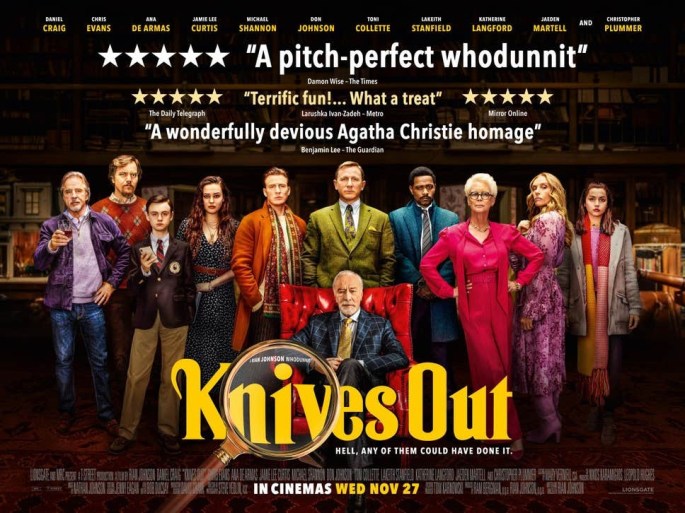
The coolest thing about Rian Johnson’s Knives Out, besides the lavish production design and the fact that the lovely M. Emmett Walsh is *still working* at his age, is it’s epic takedown of wealth, status and the deep seated delusion that goes hand in hand with being born into a rich family. That is, of course, not readily apparent until the stinging but satisfying final shot of the film and I can’t say much because this is the last thing you’d want spoiled going in, but the message is there, delicately wrapped up in a package of intricate plotting, beautiful set artistry and a whole ton of deadpan humour from a dense, scene stealing cast.

Celebrated mystery novelist Harlan Thrombey (Christopher Plummer) has been found dead, apparently by suicide. His raucous, dysfunctional family gathers to pay respects but it’s clear after a scene or two that this is a shady pack of wolves all out for the fortune he left behind. Southern gentleman investigator Benoit Blanc (Daniel Craig) “suspects foul play “ and so begins a whirligig of a search for truth, secrets and an elusive alleged killer who is naturally closer to home than anyone might suspect, except those who already know a thing or two. Thrombey’s family is played by a well rounded, eclectic bunch including Michael Shannon, Toni Collette, Jamie Lee Curtis, Katherine Langford, Chris Evans and a flat out hilarious Don Johnson. Rising star Ana De Armas is terrific as Harlan’s maid and confidante, a hard worker from some South American country that none of the family seem to be able to recall properly, highlighting their bemused selfishness and aloof nature further.

This is for sure a murder mystery and there is a serpentine narrative that does eventually arrive at a satisfactory conclusion but the whodunit aspect wasn’t as elaborate or lengthy as I was expecting. For me the enjoyment here came from these movie stars mugging for genuine laughs in a spoof of bickering families that is so dead on I felt like I was at Christmas dinner with my clan. These folks just can’t get it together or coexist and it provides come priceless exchanges of dialogue. There’s also a compassionate undercurrent between Armas and Plummer too, who between them give the two finest performances of the film, full of adorable camaraderie and flippant gallows humour. I can’t say much but the film serves to iterate and literally illustrate through circumstances that it doesn’t matter how many silver spoons you’re born with shoved up your ass or what kind of background you come from, you really only have claim to what you earn through hard work, be it laborious, interpersonal or other. I like that compassion and understanding woven into a film like this, it gives the Clue board a soul. Oh and I’ll also add that Daniel Craig has an absolute fucking one man party as Blanc who is an endlessly watchable, quaintly verbose delight and I love seeing him in eccentric roles that breach the surface of his cold, detached 007 persona. Good times.

-Nate Hill

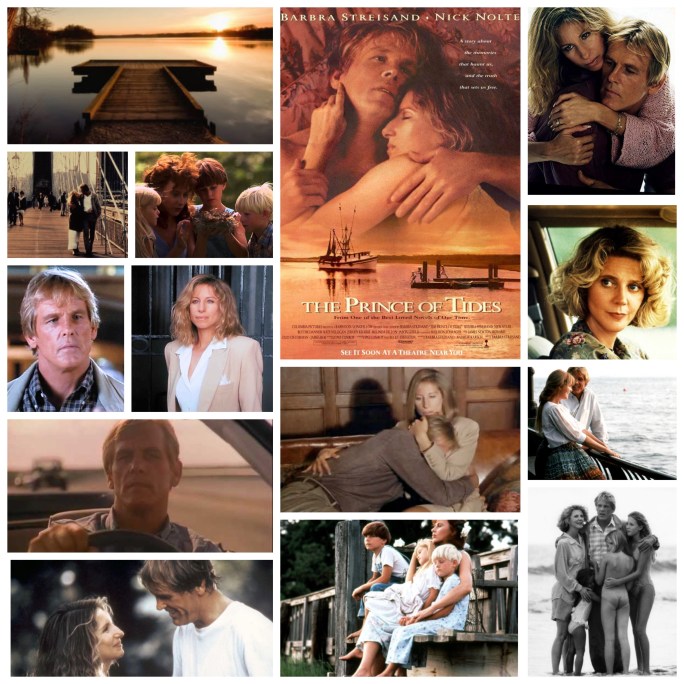
Barbra Streisand’s The Prince Of Tides

As Nick Nolte’s hazy, forlorn narration fades in over a dreamlike aerial view of the South Carolina lowlands, you aren’t quite sure exactly what The Prince Of Tides has in store for its audience, which I think was intentional on director Barbra Streisand’s part. This is a film of immense power, tough interpersonal relationships, courage, hope, love, hardships and trauma buried like a secret so deep it takes many story beats to unpack it, like a flower tossing petals to the wind until bit by bit we see the core of truth within.

Nolte is Tom Wingo, a southern family man who endured a tumultuous and horrific childhood, weathering out hardships in stronger fashion than his two siblings, one of whom is dead and the other in psychiatric care in New York City after repeated suicide attempts. Tom leaves his wife (Blythe Danner) and daughters for awhile to look after her and to speak with her doctor, Susan (Streisand), who is trying desperately to understand and help them. It’s then that his real journey inward begins, and he learns to unearth, process and begin to heal from an unspeakably heinous tragedy from his childhood. He also finds love with her, despite them both having spouses, children and being two people who are worlds apart in every aspect of their lives despite their deep attraction and bond to one another.

The film is structured in such a way that harbours secrets deep and dark, events that are key in Tom’s understanding of himself and willingness to move forward, but they only come to light when he’s ready to both tell her and remind himself what he’s tried so hard to forget. He’s a headstrong man, loving father and rowdy southern football coach who outwardly appears to have it all figured out and has an alpha, assured response to anything flung his way… except Susan’s desire to know his pain, and help him through it. Nolte is a blustery, stormy performer who can scarcely sit still for two minutes or light a smoke without tossing it away after one drag to belt out some retort at another character, and indeed this is the impression we get of Tom off the bat. But there’s an introspective stillness that creeps into his performance here, slowly turning him from a closed off, emotionally unavailable man into a deeply hurt one who has to slow down a bit in order to heal. There’s a key scene in his performance where Susan frankly and bluntly (perhaps as a last resort tactic) coaxes the truth out of him; he does the nervous leg bob, stares out the window, gruffs, grunts and does anything to avoid letting himself remember it, feel it, but when he does… well, let’s just say that it’s the most honest work I’ve ever seen from him and he owns it with absolute dignity, truth and clarity. It isn’t easy getting such can honest performance out of someone as a director, but Streisand shows a sure hand and clear eye as a creative force and ditches the bubbly, frazzled aesthetic in her acting work for something beautifully direct and down to earth. The film shows how time can both heal wounds and cover them up without the proper reconciliation and processing, leading to the kind of intense, life changing surge of midlife dramatic events we see here. Tom bookends the film with meditative, personal rumination imparted to us in voiceover as the deep orange sun saturates the Carolinas and keeps us afloat in his world, his story for a captivating, heartbreaking, unforgettable two hours. The film may not be from 2019, but it’s my favourite one I saw for the first time this year and it will remain in my memory for a long time to come.

-Nate Hill

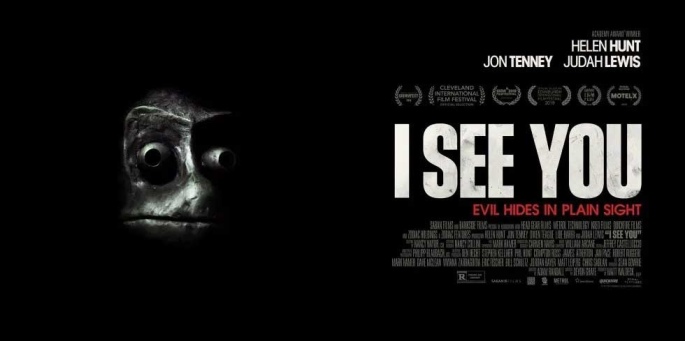
Adam Randall’s I See You

A lot of thrillers promise you’ll be “on the edge of your seat,” “white knuckling it” or other sensational claims, but few follow through on such guarantees. Adam Randall’s I See You doesn’t merely make good on the edge of your seat bit, it’s so fucking suspenseful it has you hovering *above* your seat in anticipation and screaming back down into it when the multiple instances of nerve shredding payoff hit. It’s a fantastic home invasion thriller, a skin drawling horror flick and somehow has this odd, surreal aura to it that it never fully explores but maintains on the fringes of our awareness like the unsettling memory of a mostly forgotten nightmare. I literally can’t explain more than the super basic premise here or I’ll ruin the many amazing, tantalizing and eerie surprises it has to offer, you just have to dive in blind for this baby.

So basically there’s this small town homicide detective (Jon Tenney from True Detective Season 3), his wife (Helen Hunt, where has she been this past decade?) and their kid (Judah Lewis) and they’re really not on great terms as a family. Young boys are disappearing around the town and he’s forced to put most of his energy into investigations while his wife and son try and coexist with civility. Then all of a sudden weird shit starts happening around their house like things gone missing, out of place, odd bumps in the night etc. Is it all connected somehow? The fun is in this superbly twisty guessing game of a narrative that will *actually* keep seasoned pros who think they’ve seen every turn of events in the dark. Some of the camera work here is downright brilliant, with swooping crane, fluid dolly and pan shots that give the illusion of gliding through this diabolical story. The score by William Arcane must be mentioned as well, not since the Sinister films have I heard a more disorienting, otherworldly collection of wails, moans and such ghostlike auditorial menace, it really adds to the whole deal in a dreamlike way. Aside from a few slightly murky plot details (to be fair, this is a tough rig to navigate through the canyon flawlessly) this is as close to a perfectly orchestrated thriller as I’ve seen in a while, not to mention about as suspenseful, immersive and scary too. Highly recommended.

-Nate Hill

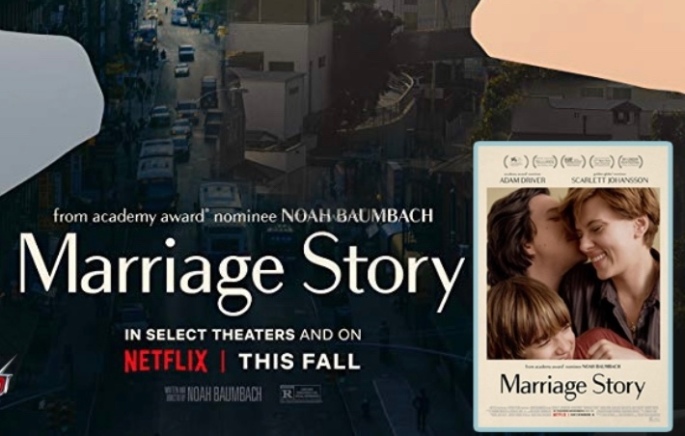
Noah Baumbach’s Marriage Story

Noah Baumbach’s Marriage Story is the kind of film I only watch occasionally as they take a lot out of me, but it’s an important, focused and purely distilled treatise on a relationship that is coming to an end that I greatly enjoyed. That’s not to say it’s a hopelessly bleak and hostile experience, there are many touching moments, humour breaks and passages of whimsy, but when it becomes all business we are flung headlong into both the emotionally oppressive and practically draining wheels of a divorce in motion and that is never a nice thing to witness. This is honest, dutiful work with a naturalistic feel for the way time passes, beautiful and affecting performances from the entire cast and deeply thought out direction from Baumbach, who I was impressed with considering this is his first film that I’ve seen.

Adam Driver and Scarlett Johannsson are Charlie and Nicole, a husband and wife who begin to sense the spark dimming. First they opt for a separation and we imagine them as two civil parents who can work this out easily, until we take a magnified look at their life and see that it’s more complicated than that, and then then the big guns come out. By big guns I mean two voracious divorce lawyers played by the always amazing Laura Dern and the ever intense Ray Liotta, chewing scenes like there’s no tomorrow but always giving the impression that these proceedings are believable, and sadly so. Also quite effective is Alan Alda as another attorney who comes across as more of a teddy bear when seated next to Dern and Liotta’s sharks. Julie Hagerty, Merritt Weaver, Wallace “inconceivable” and others all make vivid, hilarious impressions as well.

What I enjoyed most about this film is that it not only chooses to focus on the mammoth narrative beats and crucial cruxes of the story that are meant to and do make an impression. It also shines a light on the small talk, the spaces in between words, the benign and seemingly non important mundanities of human interaction that often end up speaking the loudest. There is one conversation between Charlie and Nicole (you’ll know as soon as it comes) that begins affably enough and in a few moments time has escalated into the kind of volcanic venom spewing that can only punch holes in the air and leave the room as silent as before they entered it. It’s an extraordinarily acted sequence but equally impressive are the small moments between the two and those around them, realistic depictions of awkward dialogue and behaviour that has you investing in this world for real. The big moments matter, but the small ones do too, I love and appreciate when a filmmaker realizes and implements this. Great film.

-Nate Hill