SING by Ben Cahlamer

Voice.  No, it is not the sounds uttered from your vocal cavity; it’s the inner courage to stand up for yourself; to be better than the “you” you were before a journey started.  Finding your voice is ultimately the catalyst for change and is one of the many key lessons in Garth Jennings’ vivid animated hit, “Sing”.  Christophe Lourdelet co-directs.

As a kid, Buster (Matthew McConaughey) was introduced to the theater, and fell instantly in love.  Following his heart into adulthood, he owns the Moon Theater, but can’t put a show on to save his life.  With the help of his friend Eddie (John C. Reilly), a doubtful Suffolk sheep and his trusty green iguana assistant, Karen (Garth Jennings), Buster sets up a singing competition, drawing every animal with a dream to Sing, including an overworked, but inventive piglet, Rosita (Reese Witherspoon), a streetwise mouse, Mike (Seth McFarlane), Ash (Scarlett Johansson), a young punk porcupine with big aspirations, Johnny (Taron Egerton), a mountain gorilla with a voice trying to find a path away from crime and Meena (Tori Kelly), a teenage Indian elephant with a desire to sing.  Gunter (Nick Kroll) is Rosita’s effervescent dance partner; Norman (Nick Offerman) is Rosita’s workaholic husband.  Jennifer Hudson, Rhea Pearlman, Leslie Jones and Larraine Newman round out the supporting voice cast.

Jennings’ script tries to establish each of the supporting character’s emotional states by interweaving their backstories with Buster’s struggles.  Some of the character’s stories work, certainly Johnny’s and especially Meena’s.  Unfortunately, these side stories overwhelmed the emotional impact of Buster’s story.  The songs chosen for each supporting character allows them their moment to shine during the third act, supporting their underlying emotion.

Similar story challenges arose in the inferior “The Secret Life of Pets” and “Minions”.  Hopefully, this is not a continuing trend for Illumination, which has a stellar track record in the 3D animation department; a strength in “Sing”.

Illumination Mac Guff delivered the 3D animation in spades, showing a range of motion and emotion.  Complex dance sequences with facial expressions, right down to the quivering lips carrying a note, thanks to the masters of animation, the entire experience is vibrant.  The movie was converted for 3D theaters in post-production.  The 2D image was stunning; one can only imagine what it looked like in 3D.

“Sing” is all about the audio.  And not just the music, but the ambient sounds, the voices; all of it conveys a sense of exuberance.  Then there’s the music!  Joby Talbot’s original score is breathtaking in its own right.  From Christopher Cross’s “Ride Like The Wind” to Van Halen’s “Jump”, Cyndi Lauper’s “True Colors”, Queen’s “Under Pressure” to an heartfelt rendition of “Hallelujah”, every song throughout the movie hit all the right notes in terms of finding your inner self

Despite a challenged script, “Song” ends on a high note and is Recommended.

Brighton Rock: A Review by Nate Hill


Brighton Rock is a character study focusing on one of the most delinquent, misanthropic, sociopathic, maladjusted pieces of work you’ve ever seen. The fiend I speak of is a wannabe British gangster named Pinkie, played by Sam Riley, an actor who doesn’t usually get this dark with his work, but makes quite the impression when he does. Pinkie lives in the seaside town of Brighton, and aspires to rule the crime faction there with a razor brandishing, snarling, self destructive death wish. Despite the quaint and quite pleasant coastal setting, this is a cold as ice story about a guy who brings nothing but despair and violence to everyone including himself. Showing up on the scene to oust local bigwig Phil Corkery (John Hurt), Pinkie declares personal war on everyone around him in a spectacular downward spiral of burnt bridges and furious confrontations. There’s also what has to be one of the most dysfunctional ‘love’ stories to be found anywhere, between him and a clueless waitress played by a very young Andrea Riseborough. She’s deluded by the bad boy effect, blind to the fact that Pinkie cares for her about as much as roadkill. She’s a plaything to him, a curiosity to be toyed with and eventually discarded, or worse. She loves him, or at least naively believes she does, making it quite sad and unfortunate to see their bitter courtship circle the sinkhole. Helen Mirren plays her restauranteur boss who feels the bad vibes coming off Pinkie in waves, and warms poor Andrea. Needless to say, these warnings go unheeded. Watch for Sean Harris, Phil Davis and Andy Serkis in appropriately scummy roles as well. This is Riley’s show, and he owns it with the force tyrannical pissant who is positively bursting with self loathing and homicidal hatred. A dour tale hiding beneath a picturesque shell, strangling us in malaise before we know what’s hit us.

“I’m not saying the universe is evil but it sure has a nasty sense of humour.” – A review of Passengers by Josh Hains

The following review contains mild spoilers that will describe events that occur during the first 25-30 minutes of the movie (the first act). If you do not wish to read what could be considered spoilers to some individuals, you can skip the fourth paragraph.

Science fiction, as a genre within the medium of film, has always been built on ideas, either that reflect societal issues or political stances, or that ask audiences thought provoking questions about Life, time, space, and our own morality codes. Since Gravity was released in 2013, I have asked myself what I consider to be a rather important question with each new science fiction epic related in the years since: does this story break new ground, does it try something different, or have I seen it all before? In the case of Gravity, I came to the conclusion that the story didn’t break new ground at all, though apparently there were possibly some ground-breaking methods behind the construction of the movie. Interstellar broke new ground, presenting us with the theoretical concept of astronauts travelling through a black hole in search of a new planet to colonize after mankind’s way of life ceases to be a sustainable enterprise. The Martian asked what would happen if a man was stuck on Mars for 4 years, how would he survive, and how would we get him back to Earth, and showed us with a great deal of scientific accuracy, how this might occur.

Passengers asks us some pretty deep and dark questions, such as what would you do if on a 120 year voyage to a new sustainable planet, you awoke from hyper-sleep 90 years early? How would you deal with the situation at hand and the idea that you’ll die before the voyage is over? How would you entertain yourself? Why were woken so early? Is this how your life ends?

The marketing team behind Passengers seems to have struggled immensely with concocting an effective way to advertise the movie to the two audiences who would undoubtedly want to invest in this movie: the science fiction lovers, and the romance-comedy-drama lovers. It’s as if half of the advertising was attempting to appeal explicitly to men with images of thrilling adventure and mind bending physics, while the other half of the marketing was aiming for a female demographic by hyping up the romantic elements and using odd pop-rock music. You can’t sell a sci-fi epic simply off the star power of your two leads, so a delicate balancing act showcasing the thrill and romance dramatics was needed, but sadly never achieved by a lazy marketing team. Thankfully, the movie itself is actually perfectly fine.

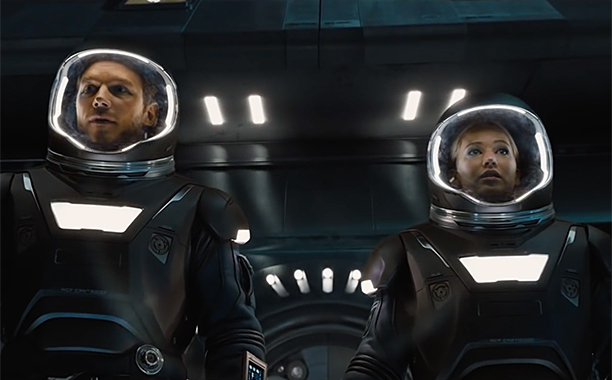
Jim Preston is awoken in his hibernation pod on the starship The Avalon, which is transporting 5000 colonists who have volunteered to travel in hyper-sleep for 120 years to Homestead II, a neighbouring planet to our Earth capable of sustaining human life. To his shock, Jim realizes he’s the only person currently awake on the ship because something in the ship malfunctioned and woke him 90 years early. Jim spends the next year of his life becoming acquainted with android bartender Arthur, trying to fix the pod and even send a desperate distress message that won’t reach Earth for 50 years, enjoying some of the luxuries of the ship, and becoming increasingly lonely, bored, unhappy, and suicidal. During a drunken venture through the ship, Jim sees an attractive young woman in a pod named Aurora Lane, and begins going through some of her person a effects, learning she’s a writer and other intimate details. He becomes obsessed with her, and after a bout of indecision, makes the choice to tamper with her pod and awaken her in the hopes of finally having a human companion and possibly finding some semblance of happiness with this seemingly perfect woman.

The dilemma the movie presents, being awoken 90 years early on a 120 year voyage through space, is a unique and thoughtful concept, and it’s interesting to see how our two leads, Jim Preston (Chris Pratt) and Aurora Lane (Jennifer Lawrence) grapple with this concept, and the knowledge that they will die before the voyage comes to a close unless they can somehow figure out how and why they were awoken so early. The actors do a great job of capturing the varying emotions and mental states their respective characters experience during the course of the movie, with Pratt working his trademark charm and sly humour, and even digging deep into some strong emotional work, giving us a performance that might actually be surprisingly stronger than his turn as Star-Lord in Guardians Of The Galaxy. Lawrence is every bit as charming and witty as Pratt, and even doing a splendid job with the more emotional scenes of the movie. This is probably Lawrence’s best work since her Oscar winning turn in Silver Linings Playbook.

Passengers doesn’t have plot twists that pull the rug out from underneath you, and even the real cause of the ship’s continuous malfunctions isn’t even that convincing an idea, or perhaps it’s just a lazy idea altogether, but that doesn’t make this a bad movie. The risks this movie takes don’t come in the form of jaw dropping spectacle or mind bending twists, but rather in the way the movie initially connects two characters in a less than desirable fashion. That this movie had the guts to bring the characters together in such a dark way and sustains that connection for as long as it does, and convincingly so, is worth praise aplenty. It’s really not the bad movie the Rotten Tomatoes collective are making it out to be, and while it’s not shocking or necessarily all that visually impressive compared against Interstellar for example, it is a perfectly fine movie. An unpretentious, enjoyable, entertaining, heartfelt, and thought provoking sci-fi drama, a voyage I won’t mind investing in again when the time is just right.


“Half of America just lost their Facebook.” – A Gravity review by Josh Hains

I love Gravity. Love, love, love it. L-O-V-E IT!

I mean, the unseen force that keeps us pinned to the ground so we don’t tumble about and float away into the depths of space. That Gravity. So thankful for it. As for the film, I love it too. You don’t even know.

Now let’s be perfectly honest with ourselves and admit, Gravity is kind of a difficult film to write a review about because there isn’t much of a story or plot for me to pick apart meticulously.

Russians blow up one of their own satellites and the fallout causes debris to collide with the several other satellites including American ones, as well as the Explorer space shuttle and its crew who are working on the Hubble Space Telescope. Two crew members, biomedical engineer Dr. Ryan Stone (Sandra Bullock), a newbie to space, and veteran astronaut Lt. Matt Kowalski (George Clooney), are the only survivors, and must make their way back to Earth without the assistance of Mission Control in Houston, who has gone offline thanks to those satellites getting trashed. That’s it. I’m not kidding, that’s all there really is to it. That’s so simple a caveman could write a review about it. No offence to cavemen.

I’m actually pretty glad there’s not much plot to the film. There was a time when a lack of plot could get a film places, when people didn’t care if a film had the most intricately layered plot, as long as it entertained the hell out of them, and they’d put it upon a pedestal high above other films, giving it some kind of a legendary status in cinema history. Like Blade Runner. Today, a film without much plot often gets ripped to shreds by critics before the audience has even seen the film, automatically creating a negative aura that engulfs the flick and rapidly builds an unwarranted bias and stigma toward the film. Just look what’s happened to Disney’s Tomorrowland. Original ideas aren’t enough for some people, blah, blah, blah, the film looks amazing if you ask me.

Wait…Gravity was one of the best reviewed films of the 2013 season? And it won Best Director, Best Cinematography, Best Film Editing, Best Original Score, Best Sound Editing, Best Sound Mixing, and Best Visual Effects at the 86th Annual Academy Awards? Oops. Guess I’m late to the party.

Gravity might not have much plot, but that isn’t even the slightest of a hinderance for this full throttle space thriller. In fact, the lack of plot actually works in its favour, allowing ourselves the opportunity to take in all the wondrous sights and sounds, rather than shovelling mountains of unnecessary exposition and plot-stuffings down our throats. Right from the first frames of the film, it’s evident moviegoers are in for a visual treat, thanks in large part to Emmanuel Lubezki’s uber-detailed cinematography, and the all-to-real CGI effects that make up I’d say about 98% of the film’s visual content – only the actors and their suits are real, to my knowledge. Again, this isn’t at all a hinderance, although at varying moments through the course of the film the two leads had a CGI sheen to them. I can only assume this was entirely intentional, given that this obscure look found its way into the final cut. The film is rich with detail, from the finest stubble on Kowalski’s chin that can be made out perfectly despite the camera being several feet away from the character, to the awe inspiring other-wordly view of our home planet; the detail is pronounced, immaculate, and gorgeous. Seriously, Gravity couldn’t look anymore beautiful than it already does. Can you believe me that their visors are CGI? Neither could I, they look so damn real.

In space, no one can hear you scream. In Gravity, sound is everything. From the thunderous score enhancing the urgency of the thrill-a-minute perilous sequences, to the subtleties of the character’s breathing as their oxygen levels dip. Between the stunning cinematography melded with the extremely lifelike visuals effects wizardry, and the moody music and pitch-perfect sounds effects, Gravity becomes an elevated immersive cinematic experience you have to see to believe. Simply hearing about the film or watching it’s then-popular trailer is not enough, you genuinely have to sit back and allow the ride to envelop you completely. If you’re into that sorta thing.

In terms of acting, in several elongated sequences strung throughout the film, we don’t get to see the actors faces as much as we get to hear them. Bullock’s Stone leans toward the panic-stricken side of things, being that she’s a space newbie and all, and she’s distressed enough from early in the film until the final frames to have next to no oxygen for an albeit short duration of the film, which is a bad thing in case you were wondering. Anytime something goes wrong, and believe me, the shit hits the fan (Murphy’s Law is in full, vibrant effect here), she goes into panic mode and can’t seem to keep her cool or maintain some semblance of self control, which again, is expected because she’s a…newb!On the other hand, Clooney’s Kowalski is the calm, cool professional. He maintains as much control as is feasible within the confines of their situation, but never overreacts or panics. He’s always cool, calm, collected, and does his absolute best to assist Stone and help calm her down at various points so she doesn’t use up all her oxygen. I couldn’t help but notice at a later point in the film, when Kowalski gives a motivational push to Stone, that George Clooney has possibly the most soothing male voice I’ve ever heard from a mainstream Hollywood actor. After the rigorous endurance test that is the early portion of Gravity, he actually calmed me down with his inspirational words of wisdom, I shit you not. In three noteworthy moments I don’t want to spoil for anyone who might not have sen Gravity, both actors, with little dialogue and very little of their faces available for our viewing pleasure, convey melancholic aspects of themselves without diving headfirst into sentimentality. These moments feel genuine and organically constructed, never once ringing falsely, and thus constructing raw moments of compassion we feel for their respective characters.

A hot topic surrounding the film has been the scientific accuracy of the picture, with everything from zero gravity to deceleration being scrutinized by the general public (why are people who know nothing about space given the time of day?), along with astronauts and Astrophysicist Neil DeGrasse Tyson. Tyson, after his viewing of the film, took to twitter to debunk some of the film’s key aspects, some of which were scientifically accurate, and some of which were simply movie mumbo-jumbo. The film’s director, Alfonso Cuarón, as stated that he is aware the film is not always scientifically accurate, but that these inaccuracies were necessary for the sake of the story. That’s something I can abide by.

As a whole, sure, Gravity has zip for a story. Nada, nothing, right?. But sometimes, watching a film isn’t about whether you’re sucked in by the story or not, but how the film affects you on a visceral, deeply psychological and emotional level. Sometimes, the best films don’t require the brains to navigate through overlong dialogues and meticulously crafted story lines, but rather, the sight to bear witness to the greatness being displayed before your very eyes. But a great film can’t be measured by such things, even though I’ve taken the time to acknowledge them. That’s what I love about cinema, it’s not about how great the story was, or how terrifically riveting the performances were, or how the special effects looked or the way the music rings through your ears. No, a great film is measured by how it makes you feel deep down in those places you don’t talk about at parties. A great film is measured by how deep it reaches you. How deeply it hits you square in the gut like a shotgun blast at point blank range, or how it sinks into the furthest recesses of your heart and makes you long for its company. Or how intimately it affects your mind, and resurrects your love for fine filmmaking. A great film can push the world and all its complications to the side, put you at ease, and take the time to entertain the living shit out of you, if only for a short time.

In Gravity’s case, it took just one incredible moment in a tremendous motion picture to make my jaw hit the floor with its beautifully rendered view of the Earth and the astronauts working near it.

And I’ve gotta admit one thing: can’t beat the view.
John Wick: A Review by Nate Hill


The reason John Wick works so well is a flawless mix of simplicity, earnestness and passion. The premise is a familiar one, and nearly identical to countless other slam bang action flicks out there, a simple and well travelled formula. It’s in the absolutely stylish, classy and distinct execution that it finds its uniqueness. The filmmakers (Chad Sahelski and Derek Kolstad) are stuntmen themselves, and therefore know what is needed to make a successful action film: well staged action. The terrific atmosphere that tagged along is a bonus and goes to further prove these guys have serious talent. They also care, want to have fun and want their film to exist within a memorable universe, and this all shows. An action film would be nothing without it’s star, and Keanu Reeves comes busting out of the gate in full rampaging glory as the titular ex-super hitman John Wick, an expert operative who can do things with guns that would make Neo nervous. John is grieving the death of his wife (the lovely Bridget Moynahan) and taking care of the puppy she left behind to console him, living the quiet life as it were, or at least as quiet as life can get for an ex mob assassin. Wick manages to chill out for a bit with the doggo, but that all ends when his path crosses with that of a spoiled mafia brat (Alfie Allen, played an even nastier snot rag than he did in Game Of Thrones) who steals his car and kills the poor pupper. This really lights Wick’s fuse, gives his brutal talents a new lease on life and throws him headlong back into the dangerous and often eccentric realm of covert contract killers. Allen was the son of a powerful, loose cannon Russian kingpin (Michael Nyqvist in a mirthful blend of funny, scary and just plain exasperated), and now John is at odds with hordes of his underlings and a few former associates who want his head. That’s pretty much all there is in terms of plot, but the film soars on the wings of propulsive, meticulously choreographed action and positively drips with cool, it’s main asset found in Reeves, who is an absolute boss in the role. Sporting a tailored suit, fiery attitude and lethal reflexes, John punches, kicks, stabs and shoots his way through endless unfortunate adversaries, seeming to be both fallible human and invincible archangel of destruction simultaneously. It’s the perfect role for him, a comeback of sorts and just a rip snortin action hero you can get riled up for. There’s attention to detail paid to his world too, the clandestine realm of killers given a mythology, currency and protocol all its own and perfectly original. Adding to the already impossible levels of class are a perfectly chosen roster of supporting talent too. John Leguizamo makes a peppy cameo as a cranky auto fence, Willem Dafoe plays a morally vague fellow hitman, watch for Lance Reddick, David Patrick Kelly, Daniel Bernhardt, Dean Winters, Adrienne Palicki and the always awesome Ian McShane as the suave proprietor of The Continental, a posh hotel that caters only to assassins. All characters encounter John Wick at some point and in some capacity, but Wick himself is the constant, the raw element which drives this film forward with the force of a stampeding bull, scarcely hesitating to breathe or seek medical attention on his quest for carnage. Reeves sells the character and then some, headlining one of the most flat out spectacular action films of the last decade.

Netflix’s The OA: A Review by Nate Hill 

I always try to find unique and original projects when choosing films and shows to watch, for we live in a time where many titles you see out there are sequels, nostalgia reboots or spinoffs. These aren’t bad things per se, but it’s also important to break new ground and produce organic material, something which Netflix has a fairly glowing track record for. Tapping the creative well that is the mind of young female director/actress/producer Brit Marling, the platform has given her the chance to tell one of the most striking, beautiful and altogether astonishing pieces of work I’ve ever seen from the long form storytelling format. Earlier this year, Stranger Things knocked me flat, and recently Westworld has captivated my attention and imagination. But The OA has done something different for me; stirred my soul in a way that few creative pieces can, with a story so unpredictable that it starts to feel like the forces of nature at work, forking off into tributary sections of narrative that you would never, ever have been able to to surmise ahead of the reveals. 

  Now, something I’ll say right off the bat: This won’t be for everyone, and I predict many confused, bitter reviews. Such is the case with work that requires effort and clarity of attention from the viewer, as well as the key ingredient: objective thinking. This is both a scientific and spiritual story, bereft of any religious implicatioms, incredibly vague, esoteric and at times left open to interpretation, or clarification we will get from a second season, fingers crossed. 

  It starts off simply enough, with the return of a girl named Prairie (Marling) to the home she disappeared from seven ears prior. Mysteriously cured of childhood blindness and very secretive of the events which have befallen her, her loving parents (Scott Wilson and Alice Krige in knockout performances) are just happy to see her again. It’s here the story turns off it’s headlights and hurtles blind into the night, going to places you’d never have thought it would, let alone be explored in a mainstream network series. Marling and Co creator Zal Batmanglij (yes that’s his real name) have outdone themselves in the originality department, presenting ideas and questions so far from the norm of what we’re used to that their story really and truly feels unique from anything else we’ve ever seen. Marling is incandescent in the role, which requires her to go to some fairly tricky places in terms of acting, handling it with the shimmering grace of an angel. It’s difficult for me to say anymore because I want you to open up this gift of a story on your own, without anything to go on, but I must mention her co star Jason Isaacs, who plays a scientific man involved in her disappearance. He’s obsessed in a feverish, sick way, and in any other actor’s hands the character may have come across as too villainous or intense. Isaacs is an unheralded genius of the craft though, and despite the callous nature of the role, he seems more human, more grounded than most. 

  I really can’t tell you much more at this point, and what I’ve said so far is much less than I usually do in reviews, as far as plot goes. This is one to binge watch, one to let wash over you like a blanket of stars, and one to think long and deep about as soon as the credits of the last episode make themselves known. For the thinkers, the wonderers, the ones who ponder what’s out there and what may be in store for us way down the road of the cosmos, The OA is a blast of nutrition for the soul.

Sam Raimi’s A Simple Plan: A Review by Nate Hill 

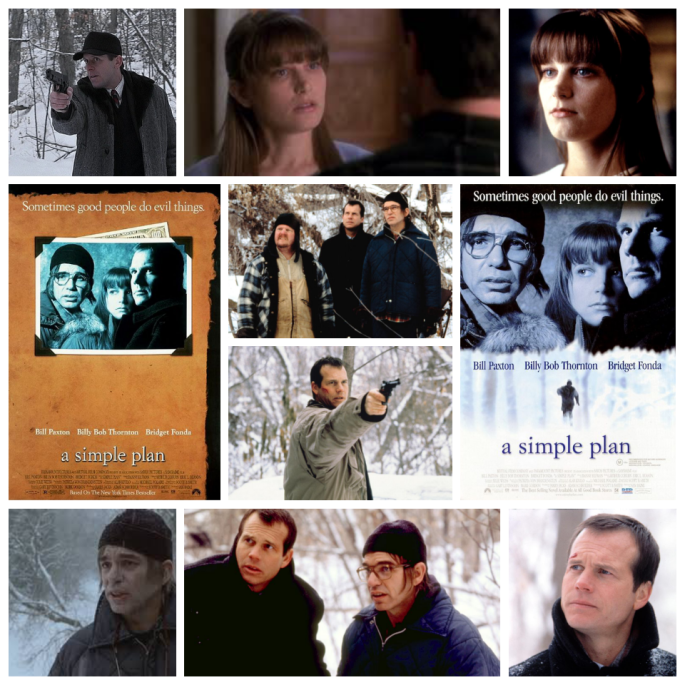
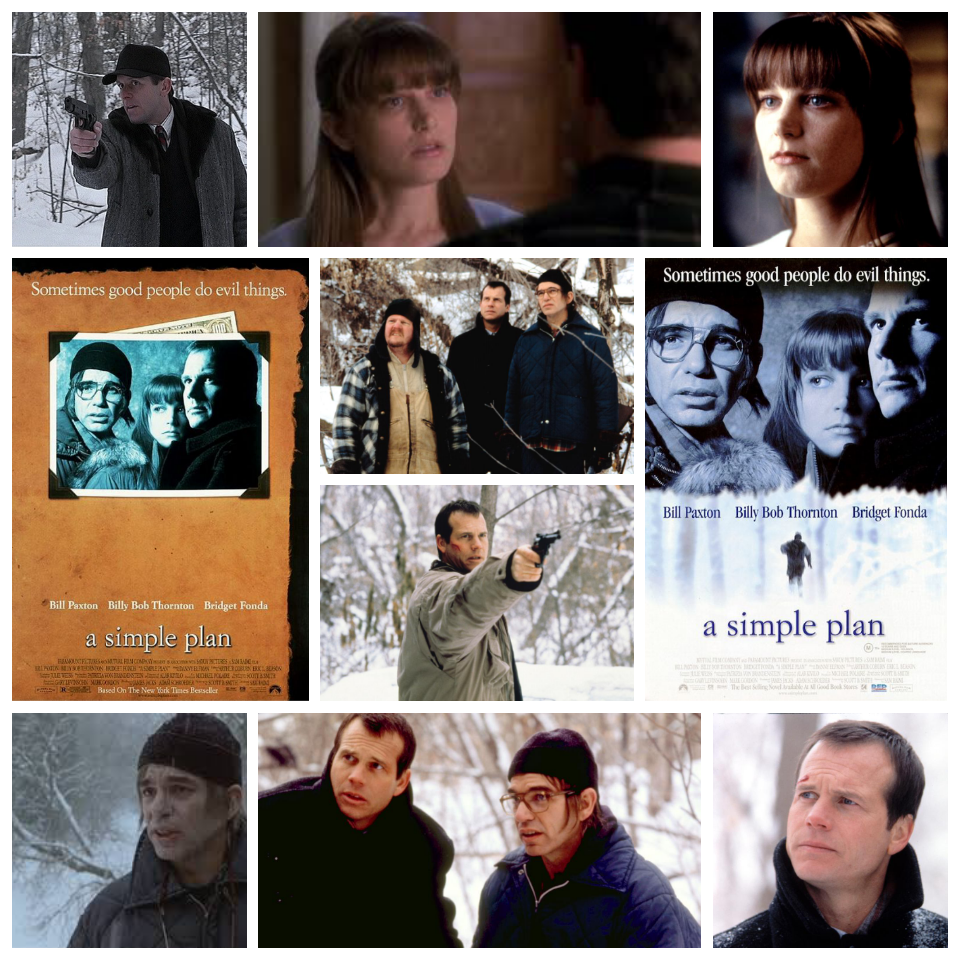
Crime doesn’t pay, and money is the root of all evil. There are countless stories of people who forsake such principles and venture down a dark, destructive path, but none quite so biting and tragic as Sam Raimi’s A Simple Plan. What haunts the viewer so much is not the fact that these characters suffer through horrific turmoil resulting from the promise of money, it’s that these are nice, good natured, everyday folks. These are the people next door, the blue collar, salt of the earth Americans, and it’s harrowing to see the downward spiral they fall headlong into. Bill Paxton is the mild mannered hardware store owner, Billy Bob Thornton his unemployed, dimwitted brother and Bridget Fonda his wife. Three regular people who could be any of us, until they find the money. Out in a snowy rural landscape, millions of dollars in cash is discovered by them, and that’s where the trouble begins. The three go to great lengths to keep their secret hidden from the local authorities, and eventually become paranoid, deceitful and hostile towards each other, leading to some truly heartbreaking outcomes. It’s not enjoyable watching these poor people go through this, because this isn’t some exploititive crime genre exercise. Although shades of noir are present, this film is set in the real world where human beings are neither good nor bad as a template, but have complex capacity for great evil or compassion. When something like the money gets in the way, though, that potential for malicious behaviour is dialed up considerably, and the resulting calamity looks something like what we see here. What’s scary about the whole thing is that it’s essentially their own fault; yes, the money turned up, and yes, its presence is what drives this wedge among them, but the money isn’t sentient, it doesn’t wish ill will, it’s simply *there*, leaving the characters to make decisions regarding it, decisions which in this case lead to their despairing downfall. What’s more, money is our own creation, not some outside influence eating away at them. This is surprising output for Raimi, who is the guy we know for rambunctious horror and genre pulp, but he shows a skilled and subtle hand with the down to earth material, letting his story be a window into a cold world of feverish greed, a world where plans are, in fact, anything but simple. 

Guillermo Del Toro’s Hellboy: A Review by Nate Hill


Guillermo Del Toro’s two Hellboy films are a wildly different pair, both incredible thrill rides and well worth anyone’s time, but I think I will always prefer the first. With the second he took the Pan’s Labyrinth approach, presenting a fairy tale world and showcasing makeup effects that were very similar to that film, an esoteric and elemental vibe. There’s just something about the Lovecraftian, steam punk WWII aesthetic of the first that works better for me, and seems to fit our red pigmented protagonist a little more. These films would be nothing without the essential and hard won casting of Ron Perlman, though. He brings a lively vitality, hulking physicality (he fits the part even before the prosthetics go on) and loveable sarcasm, and when you see him in action there is really no other actor you could envision bringing this character to life. It’s laughable to think that Del Toro fought the studio for years to get Ron in the role, turning down the likes of Vin Diesel and Nic Cage (what in the actual fuck were they thinking), not compromising for a second, knowing the film he wanted to make. Well, Ron got cast in the end, as we now know, and he’s not so much playing Hellboy, he just is Hellboy, he’s that perfect for the role. When he’s backed up by Del Toro’s near godlike creativity and imagination (the two partner on projects frequently and it’s genius every time), you get a piece of comic book escapism as exciting and adventurous as this. Hellboy was the result of a nazi experiment gone wrong, in which certifiable nut job Grigori Rasputin (freaky deaky Karel Roden) and his minions open a portal to a dark universe, in attempt to summon forth anything that could turn the tides of war (not the brightest idea, if you ask me), and instead out crawls infant Hellboy, a cranky crimson imp with a big stone appendage and an attitude to match. Kindly professor Trevor Broom (John Hurt) raises the creature to be a force of good and protection for our world, and soon enough he grows into eight foot tall, wise ass, cigar chomping, ass kicking Ron Perlman, now a valuable and formidable asset to the Bureau of Paranormal Research and Defense, an order who strives to keep the darkness at bay. Joined by his on and off flame Liz Sherman (pun intended, as she’s literally a firestarter), Professor Broom, rookie agent Meyers (Rupert Evans) and humanoid swamp thing Abraham Sapien (Doug Jones, dubbed out with David Hyde Pierce), he sets out to shield New York, the planet and the universe from Rasputin, who has returned with notions of finishing the cataclysmic work he started decades ago. The action is propulsive and rousing, initially in NYC streets and subway tunnels, and then in a far off arctic locale where a gateway to some dark dimension opens once more and a suspiciously Cthlhu esque deity of destruction peers out. Del Toro has stated before that he prefers to think of his work as ‘eye protein’ rather than eye candy. Well, call it what you will, his films are nothing short of dazzling on all levels, and Hellboy is no exception. There’s visual splendour in every frame, from the painstaking costumes, makeup and props (Perlman has a great big gun for that great big hand), to the production design and seamless computer wizardry, the world we see onscreen is immersive and entertaining for the entire journey. Roden makes a frothing madman out of Rasputin, always nailing the villain when he shows up, and stopping said show here with his theatrical and baroque insanity. My favourite has to be Kroenen though, a sharply dressed, mute nazi assassin with a face only a mother could love and a set of knives you’d be foolish to get in the way of. He’s an inspired and truly creepy villain that sets the apocalyptic dial on the highest setting when he shows up. Jeffrey Tambor provides additional comic relief as the long suffering suit who serves as the face of PR for the bureau, and props to Brian Steele as Sammael, a seriously pissed off demon set loose by Rasputin in the city streets, leading to one blockbuster of an action sequence. As far as comic book films go, this is a gold standard of filmmaking, world building and good old fashioned storytelling, all of which Del Toro is a master at. It wouldn’t have been the same without him, without Perlman and especially without the magic that happens when they work together. 

The Golden Compass: A Review by Nate Hill 

There’s a reason they never adapted another novel in Philip Pullman’s His Dark Materials series past the initial stab at The Golden Compass, and it’s the same infuriating reason why many adaptations of children’s and young adult novels fail: lack of appropriate atmosphere and true menace found in the source material. Everytime Hollywood comes along and decides to try their luck at a beloved series for youngsters or young adults, they feel this feverish need to shine it up with a candy colored, over lit vibe that leaves much of the darker elements by the wayside and as a result their final product feels neutered and bereft of any weight, stakes or attention to detail. Spiderwick. Skellig. Eragon. Hell, even Narnia only made it by the skin of its teeth, blasting out of the gate with a flawless entry, only to peter off into sequels afflicted by the very symptoms I outlined above, and not even make it to the end of the saga at that. Now don’t get me wrong, this doesn’t happen to every series they try to adapt, but to enough of them that it’s a problem, especially when a darkly creative, eerie and unique tale like this gets turned into a glossy, pandering misfire. It’s sad because some of the elements of a good film are in place, starting with casting. Dakota Blue Richards is on-the-nose perfect as Lyra, the adventurous heroine who gets swept away on a menacing voyage to arctic lands and beyond. She lives in a curious parallel universe where every human is forever accompanied by a ‘Daemon’, essentially a piece of their soul that takes animal form, and never the two shall separate. Lyra’s uncle Lord Asriel (Daniel Craig) is an explorer who has returned from the north lands with tales of a mysterious phenomenon called ‘dust’, a powerful substance purported to be able to unlock other worlds and dimensions. Lyra is curious at first and then nervous when she meets icy Mrs. Coulter (Nicole Kidman) a prim socialite with a devious agenda involving children that have gone missing in the city. She has a facility on the tundra where scary research and very bad experiments are conducted. Now in the books the descriptions and eventual confrontation with this would make your hair turn white. Pullman imparts it with weight and true blood freezing horror. The filmmakers *deliberatly* tone it down and castrate it, leaving anyone who was a fan of the series in total disgust. It just doesn’t have the same dark, otherworldly atmosphere it did on the pages, it feels too bright, chipper and lacking any real wonder. It does have some wicked visuals going for it in places, such as the two rival talking bears, voiced with baritone boom by Ian McKellen and Ian McShane, the landscape of the north as seen from the hot air balloon of grizzled sky-cowboy Lee Scoresby (Sam Elliott), and others. Eva Green also scores well as elemental witch Serafina Pekkala, but then she’s incapable of giving a bad performance anyhow. Scattered supporting cast includes Kathy Bates, Kristin Scott Thomas, Tom Courtney, Simon Mcburney, Derek Jacobi, as well, an impressive lineup all in all, but one that deserves a far better film for their talent. It’s just misguided and tone deaf. It may have been a series for adolescents, but the themes, implications and scenarios found in those books are harrowing, complex, very mature and not to be taken lightly, let alone given the full on Harry Potter theme park treatment. Shame, really, and a giant missed opportunity. Perhaps someday soon a network will get the rights and turn this tale into a film or tv show worthy of His Dark Materials.

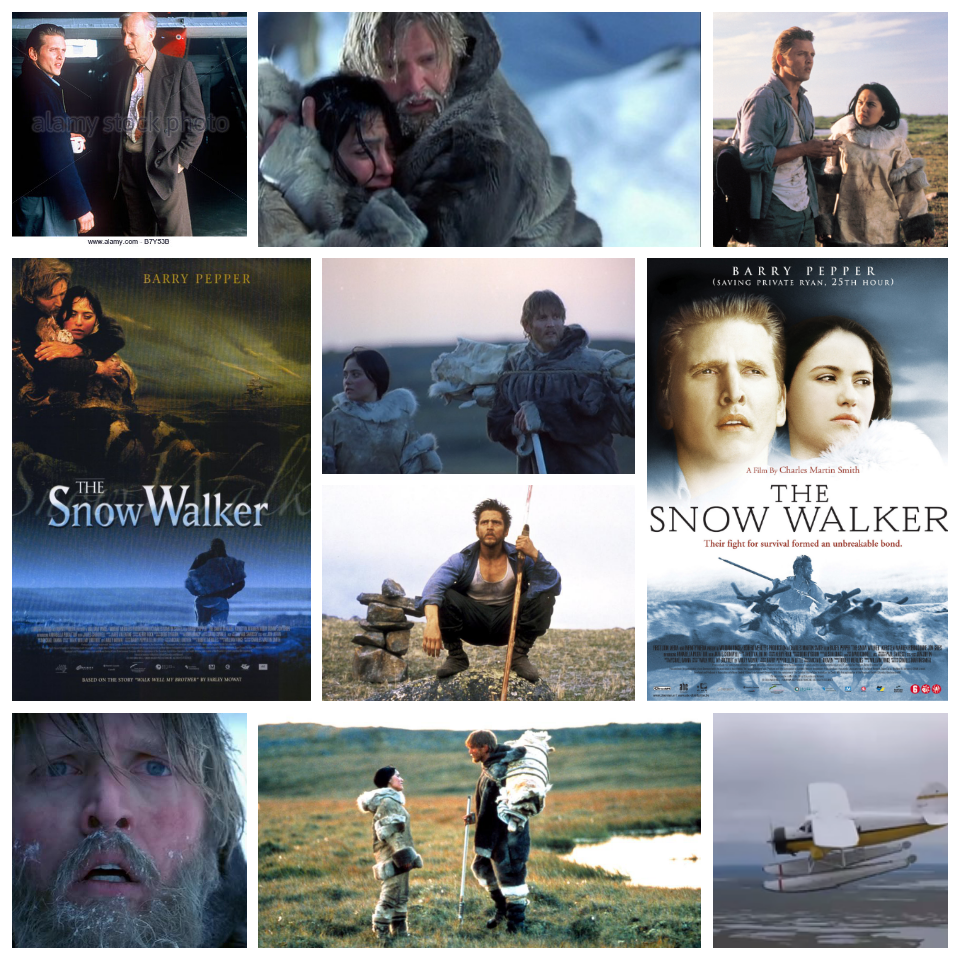
Indie Gems with Nate: The Snow Walker 

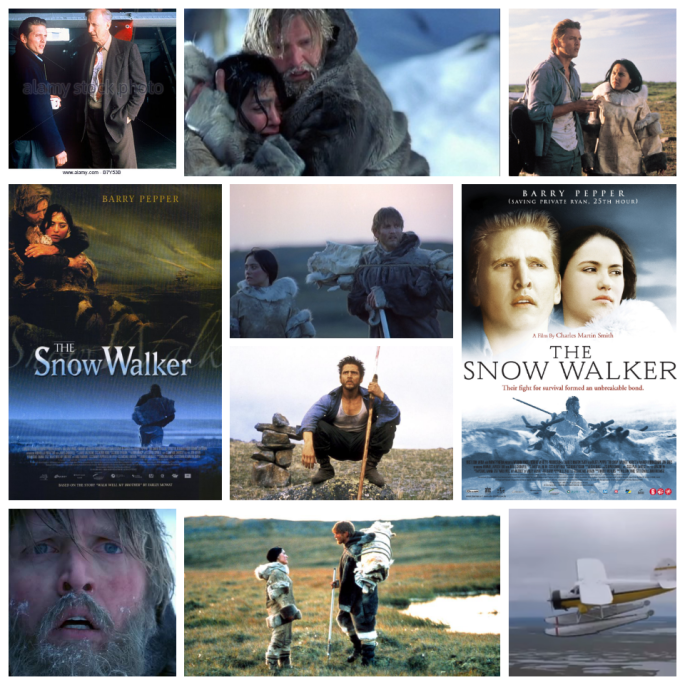
The Snow Walker is as bleak and tragic as they come, attempting to find scant traces of beauty, kinship and compassion  amidst a hopeless tale unfolding on the edge of the world. Charlie (Barry Pepper) is an ex WWII pilot who has flown a lot of missions, but none quite like the one he embarks on here. On a remote plane trip in the Arctic, he comes across a nomadic family of Inuits who are in desperate need of help. One among them, a girl named Kanaalaq (Annabella Piugattuk, fantastic), is sick with what appears to be tuberculosis, and will die if not treated soon. Charlie agrees to fly her back to civilization in exchange for a few wares, but during the voyage his plane develops mechanical problems and he is forced to make a crash landing in the middle of the wilderness. Stranded with little food, a sick girl and no hope of rescue, he and Anaalaq are brutalized by the incoming winter, tested beyond the limits of endurance by the harsh terrain around them and pushed to the point of despair. Charlie’s old friend (a sincere James Cromwell) sends a cocky bush pilot (Jon Gries) in hopes of locating him, but because Charlie took a detour end route, it’s worse than finding a needle in a haystack. There’s a mournfully poetic sense to the landscape around them, a dry and unforgiving vista that is shutting down as winter looms on te horizon, indifferent to the two of them, clinging to survival. Charlie is a loner, an outsider, and this situation tests his interpersonal skills as well as his stamina. Anaalaq speaks little to no English, and he not a word of Inuktituk, forcing deeper methods of communication and a trust in each other, warm compassion to ward off the cold anguish threatening their existence. This is not a Hollywood film (except for a random cameo from Michael Bublé, of all people), and as such is never predictable, easy or familiar. It walks it’s own road, a road into utter hopelessness. Watch something lighthearted after, your emotions will need the counterweight.