Titan AE: A Review by Nate Hill 

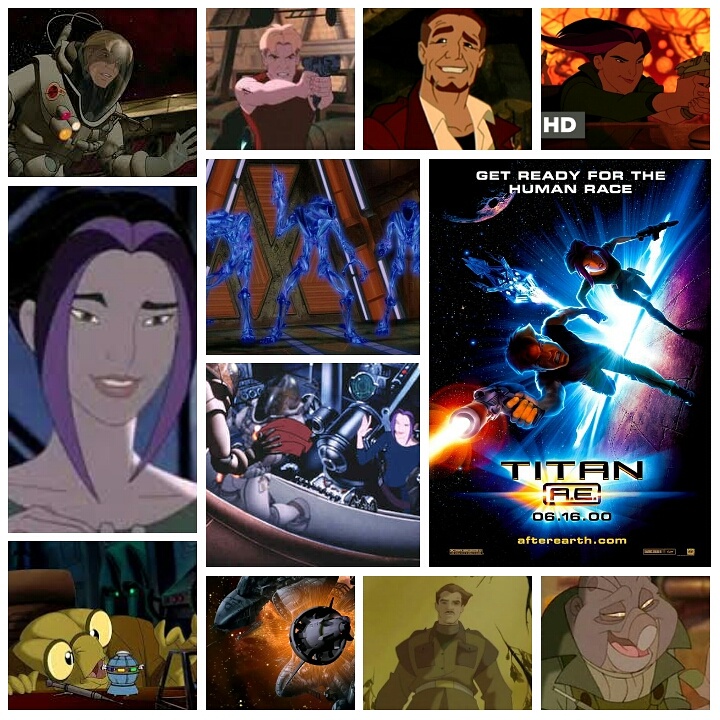
Titan AE is one of the best 2D animation ventures out there that isn’t Disney. Science Fiction and animation just seem to inherently go hand in hand (affirming my belief that Treasure Planet is the best one that Disney ever churned out, but that’s another story), perhaps because of the dazzling possibilities in a form of creation like that, tools which make the visual patterns of the artist’s dreams and beautiful renditions of the cosmos a reality. This one nails the visual aspect, but it was story that hooked me ultimately. Along with the artwork there is a boundless creative surge, a very human plotline that’s relatable to anyone who’s ever felt lost or like they don’t fit in. In the year 3028 A.D., a marauding race of aliens called the Drej decide that us humans are a threat, and obliterate earth, leaving few survivors. Dark way to kick off an animated movie, amirite? That’s another great thing about it, it’s not exactly for kids and reaches for themes that are a little more than your standard animated flick, getting fairly intense in the process. One of the few human survivors is young Cale (later played by Matt Damon), whose scientist father (Ron Perlman) was working on an idea that could have greatly advanced our civilization. In the years following the destruction, Cale has been left to wander the galaxy with the sparse, impoverished remains of the human race, now looked down upon by other alien tribes for essentially being homeless. When human Captain Joseph Korso (Bill Pullman) comes to him telling of a mysterious device created by his father long ago, Cale is reluctant, resenting his him for disappearing on the Titan ship so many years before. Soon it becomes clear that Perlman’s device is the key to creating a new earth, and reuniting humanity. Thus begins an epic race across the universe to find it before the Drej do. Drew Barrymore lends her sassy voice talents to Akima, Korso’s tough lieutenant, and there’s also work from John Leguizamo, Nathan Lane, Janeane Garofalo, Charles Rocket, Alex D. Linz and rapper Tone Loc who has a perfect voice for this kind of thing, playing a kindly alien mentor named Tek. This one is timeless, feeling fresh and vital with each passing decade it’s allowed to age through. A celebration of imagination and the creative force of will that lies inside each and every one of us humans, no matter how dire our situation. Classic stuff. 

Battle For Terra: A Review by Nate Hill

  
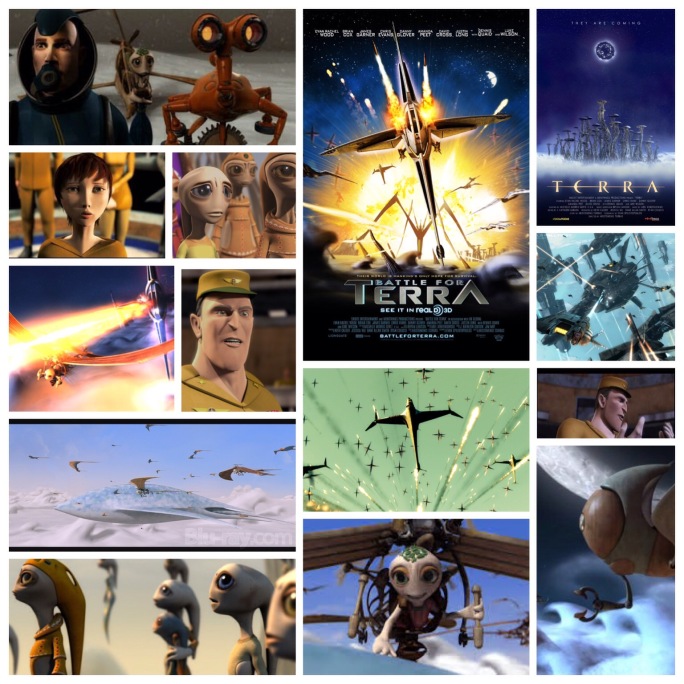
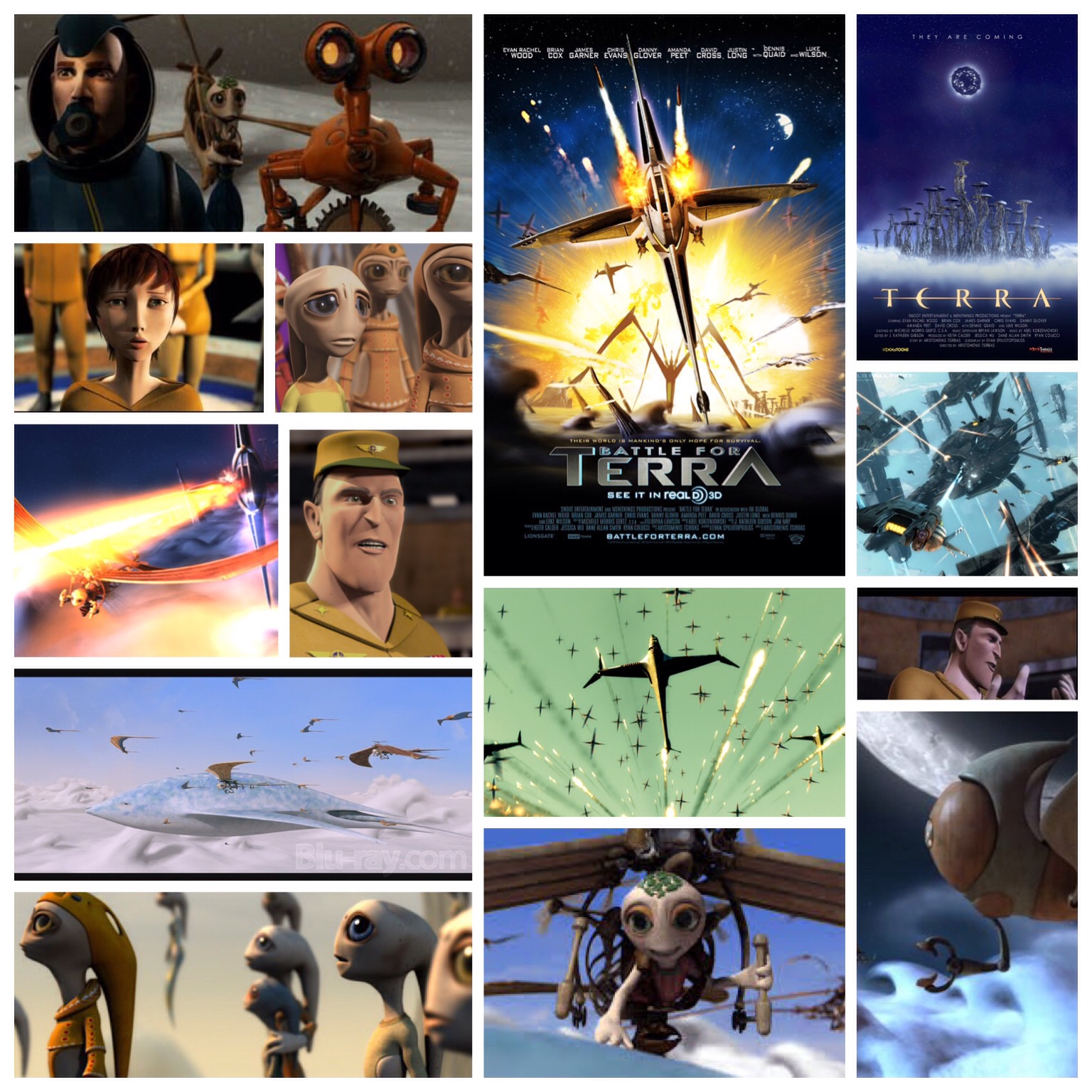
Battle For Terra is right up there with Titan AE as one of the most underrated animated films out there. It was shunted to the area off the beaten path of the genre, released quietly and inconspicuously back in 2009, sneaking just past people’s radar. Not mine. I waited eagerly for a theatrical release, which never came, and grabbed the dvd as soon as it hit shelves. It’s a dazzling science fiction parable not unlike Avatar, but a little softer, reverent and easy on the pyrotechnics. The story takes place some years after the remainder of the human race has been left to wander the stars in a giant spaceship called The Ark, left homeless after devastating the resources of earth, and three subsequent planets after. Soon they set their sights on a newfound world they dub Terra. Terra is populated by a peaceful alien race who spend most of their time in harmony, studying their heritage and bettering their existence. They now face annihilation, however, as the humans wish to settle, mine resources and deeply unbalance their way of life. One young Terran girl named Nala (Evan Rachel Wood) is a plucky young inventress and wonderer who finds one of the human astronauts (Luke Wilson) crash landed and stranded in her neck of the woods. They form a bond which may turn out to be the only way to find peace between humanity and the population of Terra. The story is wonderful, universal and carried out in a childlike manner full of earnestness that anyone can relate too. The Terrans resemble something like upright tadpoles crossed with sock puppets, and are fascinating to look upon. More interesting still is the natural world they inhabit; they sort of swim/glide through their thick atmosphere, and coexist with the many strange creatures and bioluminescence around them, including gigantic blue whale type things that fly around with them. I’m describing this to try and impart to you the level of thought and detail which went into creating this world, so you can see how high the filmmakers have jacked up the stakes in attempt to let you see the length humans will blindly go to further their survival, without voluntary compromise. The world the Terrans live on is a lush paradise in perfect balance, and the humans aboard The Ark, no matter how desperate, threaten it. They are led by stern General Hammer (Brian Cox), who is an antagonist, but not a villain in the least, a determind leader who will go to extremes to protect his people if his lack of empathy is allowed to go unchecked. The supporting cast is stacked high with incredible talent, and one can practice ones skill for identifying voices by listening for Danny Glover, Ron Perlman, Danny Trejo, Justin Long, Rosanna Arquette, David Cross, Beverly D’Angelo, Chris Evans, James Garner, Mark Hamill, Amanda Peet and Dennis Quaid. What a lineup. Imagination, storytelling ambition and visual genius govern this overlooked piece, and anyone who is a fan of animation (which is brilliant here, I might add) or science fiction needs to take a look.

B Movie Glory with Nate: Hardwired

image

The first IMDB review to pop up when you look up Hardwired has the log line “wtf?”, which just about sums up the movie. It’s straight up cow dung, a stunningly bad attempt to emulate everything from Blade Runner to Minority Report, failing in all imaginable ways. It does, however, possess a few deranged qualities which are worth a look purely for your own mirth and amusement. Let’s start with Val Kilmer’s hairdo. He sports a getup that looks as if someone threw the head of a mop into a wheat thresher, put it on his head and tried to style it like an emo anime character. It’s baffling, shocking and the hairpiece gives a better performance than the former Bruce Wayne sitting beneath it. Now,here’s the curious thing: on the dvd cover, Kilmer has a garden variety haircut, with no trace of the horror to come once you hit play. This makes not a bit of sense to me;  if I were the filmmaker and it was my movie and I’d chosen that epic Goku hairdo for Kilmer, let alone get him to agree to it, I’d advertise it loud and proud, and put his image like nine different times all over the cover art. It’s ironic that a film about excessive commercialism is guilty of false advertising, but there you have it. Anywho, Kilmer and the hair play Virgil Killiger, a whacky PR manager of a mega corporation  whose main revenue comes from serial advertising, in a half assed future where society has reached the oft imagined 1984 dystopia. He’s tasked with harassing Luke Gibson (Cuba Gooding Jr.), a man who owes a heavy debt to the company due to their products saving his life following an accident. Only problem is, it doesn’t end there. The corporation gets greedy and tries to insinuate itself into every aspect of people’s lives. Gooding bands together with a group of cyberpunk hackers led by Michael Ironside, and together attempt to bring down the company once and for all. It’s al big dumb dumb of a flick that doesn’t even put a modicum of effort in most of the time. Lance Henriksen fans beware: despite a credit, he’s not even in the thing, except for a single recycled photograph which sets the film up for sequels that I will bet my left testicle will never get made.

The 6th Day: A Review by Nate Hill

image

The 6th Day is a brash, in your face sci fi actioner with some deft scientific notions that it plays around with in near satirical fashion. It chooses to shoot most of its scenes in my hometown of Vancouver, including a set piece atop the spiral shaped Vancouver Public Library tat sends sparks raining down into the streets and choppers spinning wildly to their demise. I love when films shoot here, because it gives my city an exciting chance to be a part of escapism, and it’s amusing to watch them digitally maim all sorts of landmarks and then chuckle as I see them intact on my way to work the next day. Schwarzenegger, in one of his last great flicks before his deliberate hiatus (we shall not speak of the abomination that is Collateral Damage), plays Adam Gibson, a helicopter tour guide who has a strange blackout in mid flight while transporting the CEO of a swanky scientific corporation (slick Tony Goldwyn). He arrives back home to find a clone of himself living with his family, and things only get weirder from there. He has stumbled into the inner workings of extremely illegal experiments involving human replication, and Goldwyn & Co. are none too pleased about it. Goldwyn has secretly made human cloning an everyday thing for the company, hidden from the aging eyes of the moral upright doctor who founded the company (Robert Duvall). This is all enforced by a ruthless corporate thug for hire (Michael Rooker) and his foxy assistant (Sarah Wynter). Schwarzenegger is faced with the daunting task of taking down this un-sanctioned empire, reclaiming his family and blowing up some stuff along the way. It’s a terrific flick, and Arnie gets to say the best line he’s ever spoken, directed at Goldwyn, which I won’t spoil here but it’s pure gold. Goldwyn is hateable and malicious, the horrific third act prosthetics fitting him like a slimy glove. Duvall strikes a noble chord and almost seems to have wandered in from a more serious film. Rooker is intense, evil and scene stealing as always. Watch for Wendy Crewson, Michael Rapaport and Terry Crews as well. In a movie so committed to the trademark Ahnuld fireworks, it’s cool to get a whiff of actual thought provoking, Asimov-esque intrigue with the cloning, a concept which is fully utilized and really a lot of fun here.

Alien Resurrection: A Review by Nate Hill

  
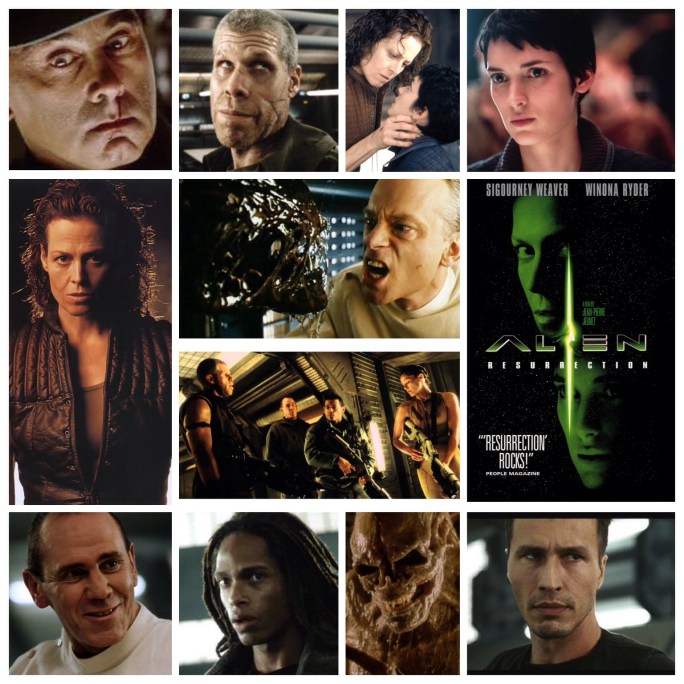
To this day it still amazes me how under appreciated and misunderstood Alien Resurrection is. The four films in the series are a quartet of vastly different stories, due to the fact that the torch was passed to four very diverse directors over the course of the legacy. Ridley Scott crafted a tense, claustrophobic catalyst. James Cameron made a rootin, tootin Wild Bunch set in a galaxy far far away where no one can hear you scream. David Fincher gave us an odd, inaccessibly disturbing thriller where the real monsters lurked inside the humans, literally. French Maestro Jean-Pierre Jeunet, best known for his own charmingly surreal quartet of distinctly European wonders Amelie, A Very Long Engagement, City Of Lost Children and Delicatessen, made the final film in the franchise. I once saw a post on IMDB which prompted users to describe each of the Alien films in one word. The one response that stuck with me was: Alien-suspense, Aliens-action, Alien3-unpleasant and Alien Resurrection-weird. Is this accurate? Depends on your opinion of the series. Resurrection is my second favourite, after Aliens. To some it was weird, to many a failure, but to me it’s a bona fide, rip roaring odyssey of gorgeous, gory design and offbeat ideas fleshed out by an absolutely legendary cast, headed up by Sigourney Weaver as Ripley. Two hundred years after she died, she is cloned using parts of the Xenomorph’s DNA, and kept sequestered on a titanic pseudo military ship run by whackos who have never heard of a certain expression involving curiosity and a cat. She awakens, the alien genes giving her a decidedly heightened awareness which Weaver plays with giddy, sinister glee. This ain’t the stalwart Ripley we are used to. Her eyes dance with an unearthly fire that pronounces ‘here be dragons’, in the spaces beyond science that humans foolishly venture into. The station is run by creepy, power hungry Dr. Mason Wren (underrated J.E. Freeman is almost ickier than the monsters themselves), and his sidekick Gediman, played by Brad Dourif in his final form, resembling a demented Pokemon who also raises more goosebumps than the aliens. The good doctor has commissioned a ragtag troupe of space pirates to bring him kidnapped humans in cryogenic sleep to be forcefully impregnated with alien fetuses. Lovely, right? This is where it gets interesting. Joss Whedon penned the script, and the crew of intergalactic badasses in this film are in fact the prototype for his endlessly successful TV series Firefly. Now, he claims that everything about the tone, delivery and execution of this film is wrong, and that the end result butchered his work. Here’s my take: I’ve seen Firefly. It’s good. But the team of space pirates in this movie are eternally more fascinating and worth spending time with. I feel that he really abandoned part of a great premise here, opting for a chipper, watered down version of a vision which presented itself to him and begged for further exploration. Firefly is fun, and it’s characters are a veritable Partridge Family of interplanetary characters to chill with, but it lacks the steel edged nastiness and grit that he began with here. Michael Wincott is a blast as the captain, Frank Elgyn, in a role that’s cut entirely too short but is aces while it lasts. Ron Perlman is a primate on earth and proves the same in space as Johner, the lovable lug of the crew. Gary Dourdan, the only black dude I know with blue eyes is Christie, with more than a few high powered tricks up his sleeves. Jeunet disciple Dominique Pinon plays wheelchair bound Riess, a tougher cookie than one might imagine. Lastly, Winona Ryder is Call, a doll with a pixie cut who takes an immediate shine to Ripley, leading them both to dark and dangerous places. Dan Hedaya makes lively work of Perez, the military honcho in charge, with Raymond Cruz, Kim Flowers and a shrieking Leland Orser rounding out the dream cast. As one might expect, all hell breaks loose in outer space as the creatures breed and hunt anything in their proximity. This provides loose cannon Jeunet with reason to fire off many a special effect that will give your gag reflex a workout and your pulse a solid pounding. There’s seriously gnarly stuff here, especially near the end with a certain fucking monster of an alien hybrid that acts as pure nightmare fuel while also being a bucket of fun at the same time. One of Whedon’s complaints was that his lighthearted script was given the heavy treatment, which obviously clashed with the vision he had. Fair enough. It was his baby after all. But for me though, it works bettering he ever planned. The characters maintain a sense of gallows humour laced with very real danger, garnished with cheeky levity in the face of unimaginable horror. That’s a good recipe to follow in any book I can think of. This one is ripe for redemption, certainly in the eyes of many who panned it upon release, and always ready for a revisit from myself.  

DUNCAN JONES’ MOON — A REVIEW BY NICK CLEMENT

1

Duncan Jones’ smashing directorial debut Moon, which he co-wrote with Nathan Parker, is exactly my type of science fiction film — thoughtful, stylish, mind-bending, narratively challenging, and totally consuming on both an emotional and aesthetic level. Sam Rockwell, easily one of our finest working actors, delivered what amounts to likely the top performance of his sterling career, portraying a worker-bee situated on the far side of the Moon, working to harvest a helium-based energy source which is being sent back to Earth to be used by its inhabitants as the planet is suffering from an oil crisis. But when something truly life-changing happens to Rockwell during his three-year stint all alone in space, the film takes on a sinister sense of misdirection, enveloping the audience in a story of a man losing his grip on his own sanity, with detours into cosmic introspection as well as the expected genre based thrills that have been slyly upended in most instances. Kevin Spacey’s creepy and dry voice work as Rockwell’s “trusted” robot companion GERTY was certainly indebted to the HAL character in 2001: A Space Odyssey, but Jones was too smart to attempt any sort of rip-off; his mechanical creation is certainly its own thing and the final act contains more than one surprise which I’d never reveal in a review. Following it’s premiere at the 2009 Sundance film festival, Moon received a very limited theatrical release before becoming an immediate cult item on DVD and Blu-ray, and it’s easy to see why — it’s the type of film that’s more interested in brainy ideas than empty, flashy action, with notions about identity and humanity and loneliness on full display, while fusing together an exciting, beat-the-clock scenario that plays out with escalating tension while never sacrificing anything in the intelligence department. The fact that this film only cost $5 million is staggering; massive kudos to production designer Tony Noble and cinematographer Gary Shaw for crafting a film that looks 10X bigger and fancier than its actual budget. Clint Mansell’s riveting score is also a major plus; he’s easily one of the finest film composers currently crafting music.

2

ZACK SNYDER’S WATCHMEN — A REVIEW BY NICK CLEMENT

1

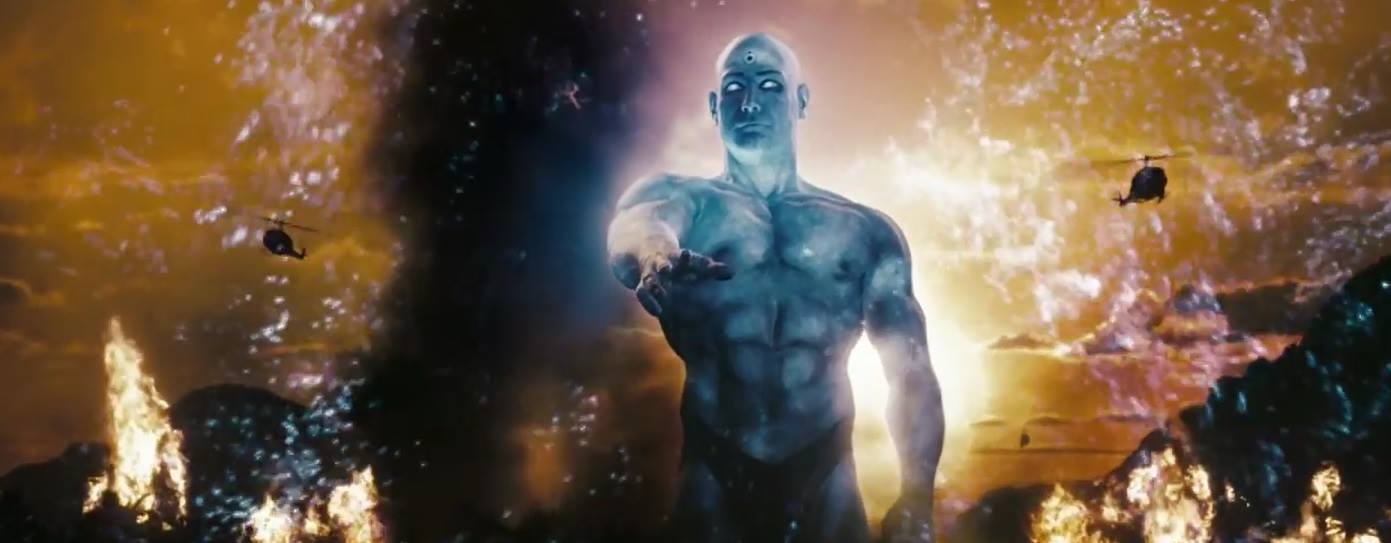
Watchmen is as bold, risk-taking, and ambitious as a major studio event movie starring actors in spandex suits is going to get. Without the runaway success that 300 became, divisive but undoubtedly gifted director Zack Snyder was never going to be allowed to make a $150 million hard-R comic book movie. Throughout the years, a diverse group of filmmakers including Joel Silver, Darren Aronofsky, Terry Gilliam, Paul Greengrass, and many others all tried – and failed – to bring Alan Moore’s wildly revered graphic novel to the big screen. The big-wigs calling the shots at Warner Brothers at the time of Watchmen’s production (the Alan Horn-era?) deserve some serious accolades, as this project could have been turned into a PG-13, watered-down version of its incredibly nihilistic source material. And it wasn’t. I’m not judging the film version against the graphic novel. They are two totally different mediums, and what works in one doesn’t necessarily translate to the other. The big changes were A-OK by me, and quietly frankly, made a lot of sense from a cinematic point of view. I’ve read the Watchmen source material, and I never thought for a moment that what Moore put on the page would be exactly copied and transferred to the screen; this was not going to be 300 all over again, with a film that literally feels TORN from the pages of its original inspiration. Back on opening weekend in 2009, I saw the film in the IMAX format and it was an overwhelmingly powerful visual experience. It was honestly too much to fully process on initial viewing, even with the benefit of having read the graphic novel beforehand. But over the course of multiple viewings and endless online discussions, I’ve been able to boil down all of the plot lines and key thematic discussions, with the visuals and action and special effects never losing their dynamic impact. Billy Crudup’s scenes as Dr. Manhattan are easily my favorite; the Mars interlude has an elegance to it that’s hard to describe.

I’m stunned by the overall sense of design and visual sophistication of the film, especially the opening credit sequence, which dispenses with backstory and motivation in such an economical and purely visual fashion that it’s nearly impossible not to become immediately engrossed. Set to Bob Dylan’s classic tune “The Times They Are A Changin’,” Watchmen opens up with a glimpse of our society that’s just a tad skewed from what we’re familiar with, all done in glorious Snyder-vision, showing the formation of the Minutemen, their eventual collapse, and the birth of the Watchmen, while providing a political timeline that expands upon this alternate universe – it’s visceral poetry in motion and one of the most startling openings to any film. Snyder seems to love the ability to literally turn a graphic novel into a living, breathing piece of moving celluloid, and Watchmen has a fantastic, surreal quality because much of it was done on practical sets and real locations, but also utilizing CGI environments and backdrops, giving the film a rough yet slick and totally heightened quality. With Watchmen, he took a supposedly “unfilmable” graphic novel and made it – at least to my eye – into one of the most uncompromising, demanding, and insanely brutal superhero films that’s ever been attempted. There’s so much to sift through – the alternate political timeline, the subversion of the superhero genre, the blending of film noir with science fiction – Watchmen feels like an uncanny amalgam of 2001, A Clockwork Orange, Blade Runner, Dark City, Sin City, The Dark Knight, and the works of Raymond Chandler. It’s a very heady brew, trippy and surreal at times, ironically campy in a few instances, always nasty, frequently kinky, and always interesting to experience. This is a one of a kind film that really stands alone within the space of the comic book film, and even though it’s not perfect, it’s so ambitious and at times downright hypnotic to watch that I find myself under its spell in no time whenever I put on the Blu-ray.

2

RIDLEY SCOTT’S THE MARTIAN — A REVIEW BY NICK CLEMENT

1

With the solidly entertaining The Martian, Ridley Scott has made a two and a half hour movie about science, and for that, he should be commended; he’s going to get some kiddies in love with NASA and the space program. I love the fact that three years in a row we’ve gotten a big-budget, original idea space epic from three master filmmakers, all made without the notion to sell toys or become franchises. The fact that Scott’s entry into the outer-space sweepstakes is my least favorite out of the bunch (Interstellar and Gravity being the other two) takes nothing away from how enjoyable a piece of entertainment it is; Scott has found that rare sweet spot between art and commerce with this exquisitely designed trip to the Red Planet. The film is going to be a MASSIVE worldwide hit, which Scott could use at this point. Dariusz Wolski’s stunning cinematography and Janty Yates’ stylish space-suit costumes were some of my favorite aspects to the film. It’s also surprisingly funny – maybe too light considering the life or death stakes presented by the narrative – and that was the one big surprise about the entire thing. Scott is typically a serious with a capital S filmmaker, with only rare ventures into outright comedy (A Good Year) and a stab at black, gallows humor (Hannibal). Matchstick Men has its comedic moments, but that’s a drama first and foremost.

And while The Martian certainly has the requisite action and special effects and big-time money-shots that you’d expect from a lavishly appointed Scott picture, the film seems to be more happy at home in the smaller, more character based moments, and sort of obsessed with subverting the potential heaviness of a story that could have been made in a variety of ways. Matt Damon is never less than excellent in this film, displaying a warmth and humanity that was relatable to observe, with a star-studded supporting cast doing colorful background work both up in space and on the ground. But other than the humor, there was nothing surprising about The Martian, with all of it playing out exactly as I predicted, and while I can’t find too much to be displeased with, I wasn’t sent out of the theater soaring in the same way that I did with Interstellar and Gravity, which The Martian sort of feels like a curious hybrid of. And also, this thing where people are saying: “Ridley Scott is back” and “Wow, what a comeback!” – that’s pure horse-shit. Other than the turgid and wholly unnecessary Exodus, he hasn’t gone anywhere; he’s been here for years making one great movie after another. The Counselor came out two years ago and the film is a diamond-cut masterpiece. But back to The Martian – it’s Ridley Scott doing a four-quadrant family movie with just enough edge to still feel Sir Ridley-ish, and I’m glad it’ll make a ton of money so that maybe he can get another film like The Counselor made.

2

RICHARD KELLY’S SOUTHLAND TALES — A REVIEW BY NICK CLEMENT

1

How can one accurately “review” Richard Kelly’s mind-bendingly crazy and divisive film Southland Tales? Kelly, whose debut was the incredibly enjoyable cult classic Donnie Darko, totally shot for the moon and back with his second directorial effort, which is filled with an insane amount of ambition and spontaneous sense of creativity. A sprawling, Los Angeles-based head-trip, Southland Tales feels like one of the most expensive experimental films ever made, bowing to zero concessions, devised by a mad scientist who often times feels like he’s making up new rules as he goes along. For some, Southland Tales will inevitably be a maddening viewing experience, especially upon first glance, but over the last few years, I’ve grown to absolutely love the movie, and I constantly feel compelled to revisit it. The film’s extra-packed midsection, at first, seemed purposefully meandering, but I’ve realized that it’s just extra dense, and requires some careful dissection. While some may feel that Kelly possibly bit off more than he could chew overall, it’s impossible to dismiss this film the way a majority of critics did, if for no other reason than it takes serious chances as a piece of storytelling, and because it’s a surreal, distinct vision that could only have come from a filmmaker with immense talent and a high level of chutzpah.

2

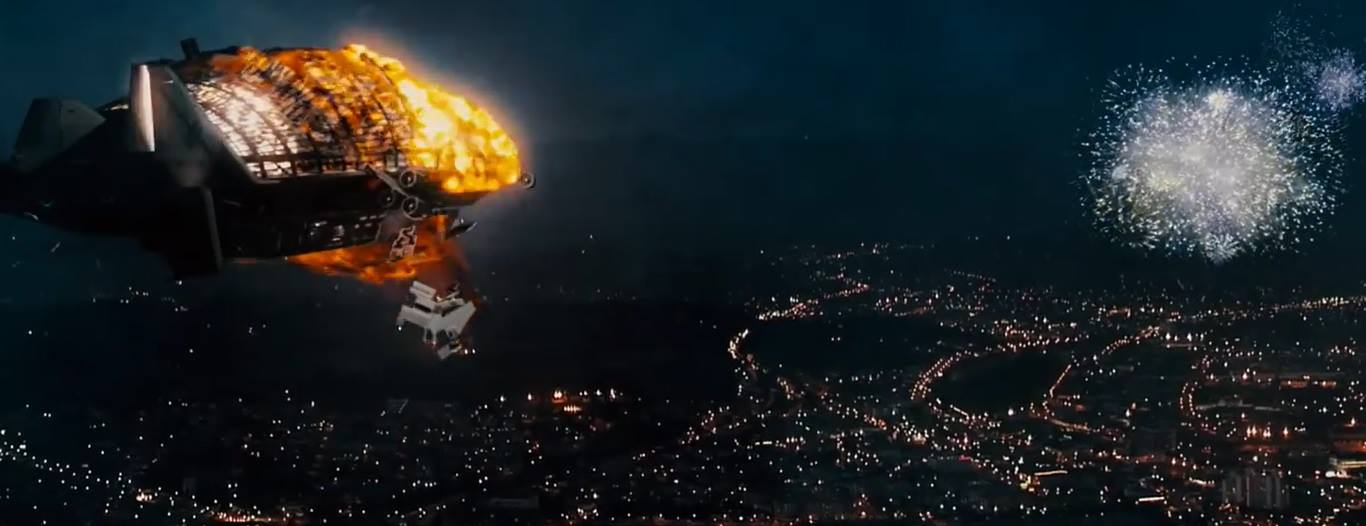
The film starts off in 2005, at a backyard, Fourth of July barbeque in Texas. Home video camera footage shows families playing with sparklers and eating hot dogs. Then, the unthinkable—a mushroom cloud can be seen in the horizon. An atomic bomb has been dropped in Abilene. The world is forever changed. We then jump three years into the future to Los Angeles; again, it’s July 4, but the world we knew is gone. Society stands on the brink of social, economic and environmental disaster. A fascist government is in control with big brother lurking everywhere. Boxer Santaros (Dwayne “The Rock” Johnson) is an action-movie star who’s stricken with amnesia. He crosses paths with a calculating porn star named Krysta Now (a sassy Sara Michelle Geller), who, among other things, is developing her own reality television project. The two of them concoct a movie idea that has Boxer set to play a cop. Meanwhile, good-guy police officer Ronald Taverner (an excellent Sean William Scott), agrees to allow Santaros to shadow him so he can get the feel for police life in an effort to turn in a convincing performance. But, it turns out that Taverner may hold the key to a vast conspiracy that nobody is ready to comprehend. There’s a lot more to Southland Tales than that. Radicals are stirring up a political uprising, using Venice beach and Santa Monica as their staging ground, while much of Los Angeles has been reduced to a DMZ. Armed soldiers monitor the beaches and streets with itchy trigger fingers. Then there’s the finale with two Roland Taverners, time-portals that open up into new dimensions, a floating ice cream truck, rocket launchers, and an exploding, futuristic zeppelin. There’s more…much more…but I’m at a loss to know how to summarize all of it. It’s a massive piece of filmmaking, going off on tangents and filling the frame with tons of visual detail (Kelly’s regular collaborator, the versatile Steven Poster, handled the aggressively stylish cinematography). This is a film that takes elements of political satire, post-apocalyptic nightmare, science-fiction fantasy, romantic drama, and movie-musical and throws them all into a blender and swirls them up into a wild smoothie of a movie.

3

Making all of these seemingly disparate threads add up to a cohesive whole had to have been a herculean task. This is a staggeringly original piece of work, filled with homages to classic films, while still operating as a unique vision all its own. While narratively stuffed at times, and with performances that veer this way one moment and the other way the next, Kelly’s film is never boring and is fascinating on many levels, mostly because Southland Tales is satirizing a world that doesn’t totally exist. Kelly created a frightening political and social landscape, one that in fact may not be too far away for all of us in reality. But by not basing his vision in any sort of fully realistic setting, the audience isn’t in on the joke as much as Kelly; he’s poking fun at a world that is removed from our own, and as such, the satire sometimes feels a bit esoteric. But that’s because Kelly truly KNOWS this world that he’s created. The performances are broad, and in many respects, over the top, but that was likely the directorial intention. The true acting surprise of the film was easily Sean William Scott, still best known at the time for his immortal role as “Stifler” in the American Pie franchise, and here, give the chance to be someone totally different from the lovable and immature clown that he so memorably portrayed. Granted, his character (much like the audience), spends most of the film in a fog of confusion, but the charm and ease that he brings to this zany movie is very effective and emotionally engaging. I always had the sneaking suspicion that there was more to him as an actor, and throughout much of Southland Tales, he makes good on that promise.

As Southland Tales moves towards its fiery climax, the film really ups the momentum and becomes something truly fantastic. The last 30 minutes are awesome in a deranged, Terry Gilliam-esque fashion, with bracing moments of chuck-it-all abandon, which makes for some delirious fun. Kelly and Poster conjure up one fantastical image after another, using the widescreen space as their ultimate surrealistic playground, riffing on commercialism, surveillance tactics, and filmmaking in general, all in effort to yield something as different as possible. Kelly re-edited his film extensively after the initial three hour cut was derided at the Cannes Film Festival, which in retrospect, as he mentioned in interviews, was likely the A-1 worst place for this film to debut, especially in an unfinished state.  He snipped about 30 minutes from the run time, got rid of entire characters (Janeane Garofalo was a cast-casualty), and added some special effects; I’d love to see his initial cut for the sake of comparison. A film this creative, unique, and brazen could only come from an individual with an enormous imagination, and in today’s cookie-cutter Hollywood landscape, Kelly deserves points for making a film as out there as this one, which easily ranks as one of the most ambitious if at times perplexing films I’ve ever come across, one that has aged extremely well over time as our social landscape continually changes.