Cutting on the Train: A Chat with Mick and Me by Kent Hill

csm_audsley_4_7ac800b436

Those learning the craft of film-making nowadays shall have little to no experience with cutting film the old fashioned way. True – it was timing consuming, sometimes messy and fraught with peril – depending on your mastery. It was, however, also romantic. The trims at your feet, the smell of celluloid, the tactile nature of editing a movie . . . one splice at a time.

My guest, the distinguished editor Mick Audsley, has indeed been on Podcasting Them Softly before (https://podcastingthemsoftly.com/2016/11/25/pts-presents-editors-suite-with-mick-audsley/), and the lads did a bang-up job covering the breadth of Mick’s storied career. But, the doesn’t mean I can’t have a chat with him about a film that was not out at the time (Murder on the Orient Express), as well as the changing nature of the editing process, the evolution of the way people are enjoying their movies away from the confines of the cinema, plus our mutual admiration for the cinema of Kenneth Branagh . . . and much, much more.

murder-on-orient-express-1200-1200-675-675-crop-000000

2679

Mick’s a gentleman, aside from being and exceptional craftsman, and please do check out all the great work he is doing over at his family owned and operated venture Sprocket Rocket Soho. Mick is continuing to contribute, educate and bring together all those with a passion for telling stories via the moving image.

…hope you enjoy.

JACK DETH IS BACK . . . AND HE’S NEVER BEEN HERE BEFORE: An Interview with Tim Thomerson by Kent Hill

Cherry-2000-31

I was mid-way through my interview with C. Courtney Joyner when Tim Thomerson’s name came up. Joyner of course, had directed Tim in Trancers 3, and cooler still, he had just had him round for breakfast earlier that day. You might call it an imposition, but I mentioned that if there was even a remote possibility that he could put me in touch with Tim, I would be forever grateful. Courtney told me he was seeing Tim again on the weekend and would put forward my proposition. Soon after, I received a message with a phone number.

Now, I’m usually in the habit of arranging an appropriate time and day to call, but Courtney had left it open. I remember for the first time, in a long time, being nervous to make the call. After all this was Tim Thomerson who was going to be picking up the phone; a guy, a legend that I had watched for years. So I summoned my moxy and dialled the number. The familiar international ring-cycle began and then . . . “Thomerson,” the voice on the other end of the line said.

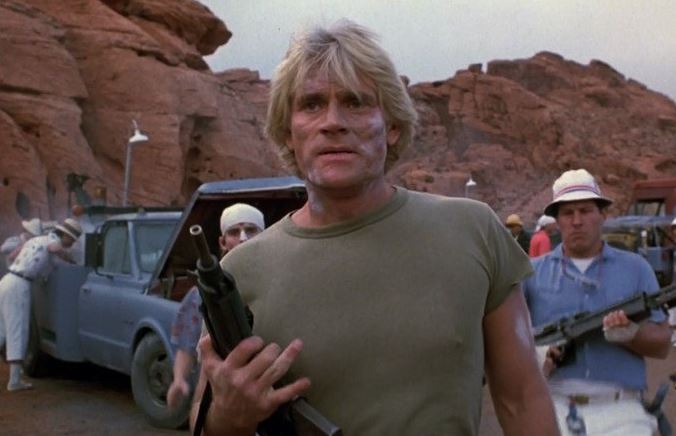
I’m going to come off as an idiot here, but I.D.G.A.R.A. “Damn,” I remember thinking. “He sounds exactly like he does in the movies.” Stupid, I’m well aware. But the moment was profound, and I was instantly transported to that time when I sat in the theatre watching Metalstorm, and that glorious afternoon I first sat down to watch Future Cop (aka Trancers). Here was Jack Deth now, on the end of the line and talking to me like we had been buddies since forever.

I did kinda wish we could have jumped into our chat right there. Tim was at once disarming, candid and as cool as i had expected him to be. He was off to his retreat in the desert to do “old man shit” as he put it, and, while I realize he is an aged gentleman now, that voice, the larger than life character that he is still packed all of the vitality, swagger and youthful exuberance that very much belies his years.

I didn’t have to wait long before we would talk again, and when we did, the conversation picked up right where it left off. I would take a significant amount of time to go through the length and breadth of his career, so I restricted myself to personal favourites among his credits. We talked about his beginnings, his great friendships, his bumping into Mel Gibson at the doctor’s office, him working with his idols, Australian Cinema and his meeting with the legend that was Sam Peckinpah.

For those of you who regularly check out my stuff here on the site (God bless you), I fear I might be starting to sound like a cracked record. A number of times in the past I have found myself gushing about the opportunities I have enjoyed whilst writing for PTS, and how humbled and indeed awe-struck I have been as a result of these encounters with the folks who make the movies. Sadly I’m now going to do it again. Tim Thomerson is a hero of mine and it was at once spellbinding and an indescribable treasure to have had the chance to shoot the breeze with an actor I have long held in high regard . . .

. . . and an equal pleasure it is, to now share it with you.

Enjoy.

20 years in the making: An Interview with Steve Alten by Kent Hill


Sometimes good things take time. Still, it is rare that Hollywood, being in possession of what it believes is such a ‘hot property’, would allow said property to languish in the depths of development hell. Especially for 20 years. But that is exactly where Steve Alten’s bestseller has been in residence. That, of course, is about to change.

Yes ladies and gentlemen (and in case you haven’t been following the story) next year Alten’s leviathan shall rise and finally arrive at a cinema near you. I have long been fascinated with the journeys  movies take on the road to the big screens on which we witness them. Some of these films never arrive, some appear in a confused and unfinished form. Others are the victims of too many cooks and most are a product of the machine.

For the films that don’t make it, (see great documentaries like Lost in La Mancha and Jodorowsky’s Dune (though Gilliam seems to have at last remedied this)) their journey is often as intriguing, if not more so, than what the final product might have been. But with MEG, the powers that be have what is a potentially massive franchise on their hands. So, why the wait?

The fates are strange and fickle. Steve Alten’s bestseller was optioned before it was complete, but it has taken the better part of two decades to arrive. I found this story intriguing, mainly because this was not some sort of artsy passion project or some grand tale of ridiculous hubris. No, what could have been, and what we may yet experience, might very well be the next JAWS? And while Spielberg’s film is by its nature a far more intimate piece; the shark menaces a small community and finally three men set out to kill the beast, MEG is something we are definitely going need a bigger boat for. A really BIG boat for!

Thus Steve Alten agreed to have a chat with me about the origins of his book’s long gestation toward its screen adaptation. What he relayed I found fascinating, and still believe it could become a great extra feature or a terrific stand-alone documentary of the ride this big shark movie as taken. But, like most fans, I am just grateful that with each passing day, we finally are at last drawing closer to the MEG movie’s premiere. Of course the real relief belongs to the creator. In many ways it has been worse for him, he having served on the front lines, he having been present for each false start and each heartbreaking hurdle. I have agreed to catch up with Steve before the film’s premiere next year. As the hype builds and teasers and trailers and all the ads  bombard our senses, what brings me pause and makes me smile is the thought of Steve Alten waking the red carpet, entering the theatre, taking his seat . . . and enjoying the movie…

…as I hope you will enjoy this.

unnamed (1)


Terry Gillian’s The Imaginarium Of Dr. Parnassus


Terry Gilliam films almost always feel a bit slapdash and chaotic, it’s just the guy’s calling card to have a modicum of organized mayhem filling the fringes of whatever project he delivers. With The Imaginarum Of Dr. Parnassus, that is probably the case more so than any other film he’s made, and despite letting the clutter run away with itself a bit too much, it’s still a dazzling piece. Of course, your movie will always have a disjointed undercurrent when your lead actor passes away halfway through production, but that’s just the way it goes, and Gilliam finds a fascinating solution to that issue here. Imaginarium is in many ways a companion piece, in spirit, to The Adventures Of Baron Munchausen, a film he made decades earlier, both containing a sort of baroque, Da Vinci-esque splendour and sense of fantastical wonder. Christopher Plummer hides behind a gigantic Dumbledore beard as Parnassus, a magician extraordinaire who travels the land with his daughter (Lily Cole, that bodacious Botticelli bimbo) and circus troupe, including Verne ‘Mini Me’ Troyer. Years earlier he made a pact with the devil (Tom Waits, an inspired choice) using his daughter as collateral, and now Old Nick has come to reap the debt, causing quite the situation. The story is a hot mess of phantasmagoria and kaleidoscope surrealism thanks to the Imaginarium itself, a multi layered dimension-in-a-box that accompanies them on their travels. Things get complicated when they rescue dying lad Tony (Heath Ledger) who somehow ties into the tale as well. Now, this was Ledger’s very last film, its future left uncertain after his passing, but help arrived in the form of Johnny Depp, Jude Law and Colin Farrell, swooping in to play doppelgänger versions of Tony as he bounced from one plane of the imaginarium to another with Cole in tow, always one step ahead of Waits, who is a rockin’ choice to play the devil, smarming and charming in equal doses. It’s kind of a huge melting pot of images and ideas hurled into creation, but it’s a lovable one, the fun you’ll have watching it reasonably eclipses lapses in logic, plotting and pacing. 

-Nate Hill

Terry Gilliam’s The Fisher King: A Review by Nate Hill 

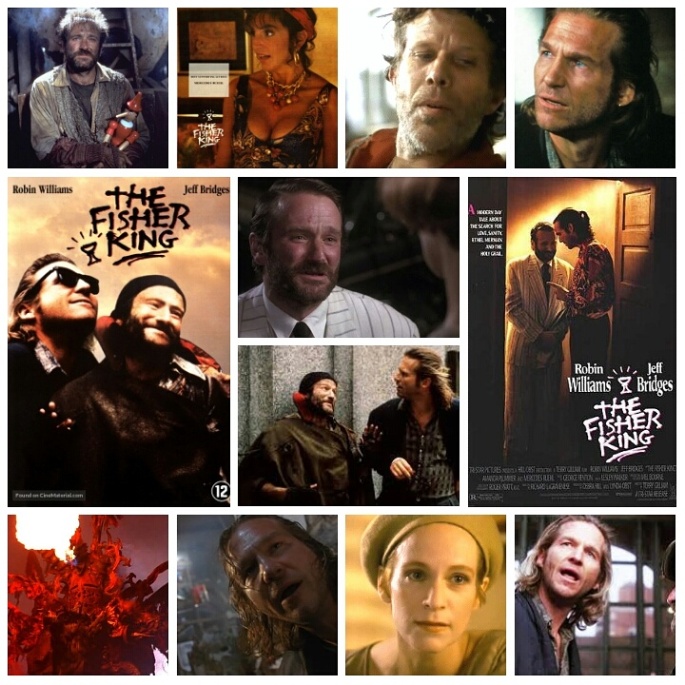
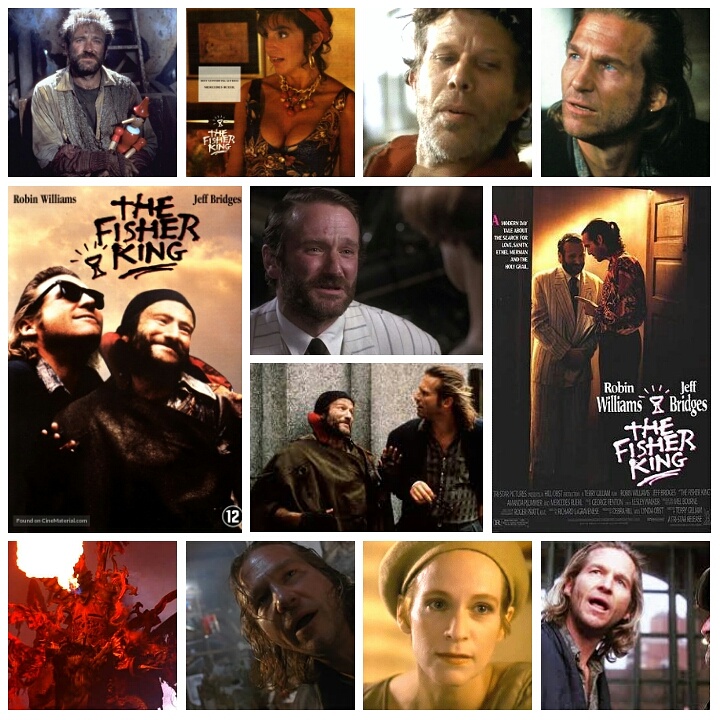
Tragic. Uplifting. Comical. Bittersweet. One of a kind. Terry Gilliam’s The Fisher King takes on mental illness by way of a fantastical approach, an odd mix on the surface, but totally fitting and really the only way to put the audience inside a psyche belonging to one of these beautiful, broken creatures. Sometimes an unlikely friendship springs from a tragedy, in this case between a scrappy ex radio DJ (Jeff Bridges) and a now homeless, mentally unstable ex professor of medieval history (Robin Williams). Bridges was partly responsible for an unfortunate incident that contributed to William’s condition, and feels kind of responsible, accompanying him on many a nocturnal odyssey and surreal journey through New York City, an unlikely duo brought together by the whimsical cogs of fate that seem to turn in every Gilliam film. Williams is a severely damaged man who sees a symbolic ‘Red Knight’ at every turn, and seeks a holy grail that seems to elude him at every turn. Bridges is down to earth, if a little aimless and untethered, brought back down from the clouds by his stern, peppy wife (Mercedes Ruehl in an Oscar nominated performance). They both strive to help one another in different ways, Williams to help Bridges find some redemption for the single careless act that led to violence, and Bridges assisting him on a dazed quest through the streets to find an object he believes to be the holy grail, and win over the eccentric woman of his dreams (Amanda Plummer). In any other director’s hands but Gilliam’s, this story just wouldn’t have the same fable-esque quality. Straight up drama. Sentimental buddy comedy. Interpersonal character study. There’s elements of all, but the one magic ingredient is Gilliam, who is just amazing at finding the way to truth and essential notes by way of the absurd and the abstract. Watch for fantastic work from Michael Jeter, David Hyde Pierce, Kathy Najimy, Harry Shearer, Dan Futterman and a quick, uncredited Tom Waits as well. The hectic back alleys and silhouetted trellises of NYC provide a sooty canvas for Gilliam and his troupe to paint a theatrical, psychological and very touching tale of minds lost, friendship found and the past reconciled. 

TWELVE MONKEYS – A REVIEW BY J.D. LAFRANCE

46

“It’s one thing to get lost in your own madness, but to become lost in somebody else’s madness is weirder.” – Terry Gilliam

How do you know when someone is crazy? This is a question that filmmaker Terry Gilliam tries to answer in many of his films, for he is obsessed by the notion of insanity – what makes someone insane and how do others view this person. Is someone really crazy or do they simply have a different view of the world than the rest of society? In the past, Gilliam’s films have presented characters that tend to blur the boundary between sanity and madness, but perhaps his most complex treatment of this subject is Twelve Monkeys (1995). It is with this project that the filmmaker combines his long standing obsession of breathtaking visuals with his knack for working closely with actors. This combination has resulted in more mature films for Gilliam who is normally associated with stylish overkill: films that tend to let the visuals overwhelm the story and characters. And make no mistake, Twelve Monkeys contains some of the most stunning images you are ever going to see but never at the expense of the story or its characters and herein lies one of the reasons why Gilliam remains one of the most interesting people working in film today.

Twelve Monkeys
is a film that constantly plays with, distorts, and more often than not, manipulates time. The film begins in the year 2035. A deadly virus has wiped out almost all of humanity, leaving the survivors to take refuge deep underground. Only the occasional foray up to the surface in protective gear by a select group of “volunteers” offers any clues as to what went wrong. James Cole (Bruce Willis) is one such volunteer who is particularly good at retrieving information. As a result, he soon finds himself being sent back in time to find out how the virus originated and who was responsible. Unfortunately, he goes back too far, arriving in 1990 and is promptly thrown into a rather nightmarish mental hospital in Baltimore where he meets Jeffrey Goines (Brad Pitt), a fellow inmate with a loopy sense of reality that feeds all sorts of paranoid delusions of grandeur. Cole also encounters Kathryn Railly (Madeleine Stowe) a beautiful doctor who feels sympathy for him and his plight.

As Cole travels back and forth in time he begins to realize that one of the most important clues to the source of the deadly virus may lie in the rather enigmatic underground organization known only as The Army of the 12 Monkeys. Soon, Railly and Goines begin to play integral roles in Cole’s search as he consistently crosses paths with them. But is this all taking place in Cole’s mind? Is he really humanity’s only hope at averting a catastrophic disaster or is he just insane? From the first shot to the film’s conclusion we are never quite sure of Cole’s sanity or lack thereof. It is just one of many questions that the audience must think about not only during the film but long after it ends.

The seeds of Twelve Monkeys lie in an obscure French New Wave film called La Jetee (1962) made by Chris Marker. The film was composed entirely of black and white photographs and set in Paris after World War III. It was an apocalyptic vision in reaction to the threat of nuclear annihilation that became prominent in the 1950s and 1960s. Writers David and Janet Peoples were approached by producer Robert Kosberg to do an adaptation of La Jetee. The screenwriting couple wasn’t that keen on the idea, however. “We couldn’t see the point. It’s a masterpiece and we didn’t see that there was anyway to translate that masterpiece,” David remarked in an interview. And he was no slouch to the art of screenwriting, having rewritten the screenplay for Blade Runner (1982) and penned the brilliant Clint Eastwood film, Unforgiven (1992).

Kosberg got the Peoples to watch La Jetee again and the couple began to see possibilities for a different, more detailed take on the material. “How would we react to people who showed up and said ‘Oh I’ve just popped up from the future’ and in turn how would that person deal with our reaction.” With this in mind, David and Janet set out to write a challenging piece of fiction that not only manipulated our conventional views of time but that also dealt with the notion of madness. Janet explained in an interview, “We were very interested in asking questions like ‘Is this man mad? And how about the prophets of the past, were they mad? Were they true prophets? Were they coming from another time? What are all the different possibilities?'” The film’s script argues that certain people who are classified insane by society at large may not really be crazy at all but are in actuality presenting ideas that are way ahead of our time. And perhaps the blame for this misunderstanding should be leveled at the psychiatric profession which, as one character in the film observes, has become the new religion of a society that has deserted traditional faith for modern technology.

After showing the finished screenplay to Marker and getting his blessings, the Peoples were faced with the daunting task of finding someone who would not only click with the material but also have the visual flair that the story needed. The couple figured that the only director to handle such tricky subject matter was somebody like Ridley Scott or Terry Gilliam. The theme of madness that plays such a prominent role in the script fit right in with Gilliam’s preoccupations and so he seemed the natural choice to direct. As luck would have it the filmmaker was between projects and looking for work after several years of seeing potential projects fall through for various reasons.

Gilliam was also eager to take a lot of Hollywood money (a $30 million budget) and create a strange art film that would fly in the face of the traditional mainstream movie. “The idea that someone’s writing a script like this in Hollywood and getting the studio to pay for it was pretty extraordinary. So I thought let’s continue to see how much money we can get the studio to spend.” Gilliam’s battles with Hollywood studios are the stuff of legend – most notably his struggle with Universal over the release of Brazil (1984). They wanted to revoke the director’s final cut privileges to insert a happier ending instead of Gilliam’s decidedly downbeat ending. Gilliam’s vision prevailed in the end, but the ordeal left him understandably wary of further studio involvement. He had reconciled somewhat with Hollywood by making The Fisher King (1991), which turned out to be a surprise commercial and critical success.

Architecture plays an important role in Gilliam’s films and Twelve Monkeys is no different. “I’ve always used architecture as if it was a character.” To this end, he found all sorts of intriguing architecture to populate his film. This included the transformation of an 1820s prison into a 1990s mental hospital where the film’s protagonist, James Cole first meets the Jeffrey Goines. The director found that the structure was designed like a wheel with spokes and hub. And so Gilliam used one section where three spoke-like parts headed off into nowhere. “It seemed to me [that] this trifurcated room was right for multiple personalities.” This feeling of madness is further amplified by the extensive use of skewed, off-kilter camera angles that are often shot at low angles to constantly distort and disorient the scene. “We started doing it and it got more and more fun to see how far we could push it because I wanted to create an atmosphere that you don’t know whether this guy is crazy or whether he actually does come back from the future.” The unusual camera angles not only mimic Cole’s confused state but also reflect Jeffrey’s manic, hyperactive worldview. By presenting the mindsets of these two characters in such a fashion, Gilliam is inviting us to see the world through their eyes and in the process offer a new, unique take on the world that we might not have been aware of before.

Gilliam was not just content to challenge mainstream audiences with unusual visuals and subject matter, but he also wanted to mess with people’s perception of certain movie stars by casting box office names like Brad Pitt and Bruce Willis against type. “One of the reasons [for doing Twelve Monkeys] was taking Bruce and putting him into situations and asking of him things I don’t think he’s ever done before or that people haven’t seen him do … and with Brad Pitt it’s the same thing. Brad is pretty laconic in some ways. Suddenly he’s a blabbermouth, jabbering away at high speed. I love doing that, playing with the public’s perception of that star; otherwise, it wouldn’t be fun.” As a result we get a very different Bruce Willis here than we have come to expect. Gone are the wisecracks and smart-aleck attitude and instead we see Willis impart a real wounded sensibility to the character of James Cole. The reluctant time traveler always seems to be flinching at every little thing, often appearing disoriented or distracted as he struggles to understand what is going on around him. Willis displays great skill in this role – perhaps the best of his career – as he creates a truly tragic figure that may or may not be losing his mind.

Brad Pitt’s character, Jeffrey Goines, resides at the exact opposite end of the spectrum. Where Cole is a sad, brooding figure, Goines is a frenetic psychotic oscillating wildly between paranoid ravings and calm interludes where his madness is kept in check but still resides behind wild eyes. It’s a daring performance for Pitt who lets it all hang out as he gladly chews up the scenery with his loony radical environmentalist cum revolutionary that all but steals every scene he’s in. It’s a performance that Pitt worked long and hard to achieve and it paid off in a Golden Globe Award that year for Best Supporting Actor and an Academy Award nomination in the same category.

It is easy to see what attracted Terry Gilliam to a project like Twelve Monkeys. In keeping with his past films, this one also played “with the same old things – time, reality, madness – so I was intrigued.” Even though it was one of the few projects he did not originate himself, Gilliam quickly made the film his own. In fact, it is Twelve Monkeys‘ unique look that prevents any easy categorization. As Gilliam observed in an interview, “I’m determined to make it indefinable.” It is this avoidance of any clear cut genre that makes the film a riddle waiting to be solved. The film is also structured somewhat like an onion. On the surface, the audience knows very little at the beginning, but gradually as it progresses and the layers are removed, more and more of the mystery is revealed. However, this is not readily apparent after an initial viewing. Only after subsequent screenings does the full impact and brilliance of what Gilliam and his cast and crew have created sink in. It is this great amount of care and detail that has clearly gone into this film that makes Twelve Monkeys worth watching.