Tim Burton’s Batman Begins

Batman Returns

1992. Directed by Tim Burton.

A landmark achievement and Burton’s masterpiece. Batman Returns marked the beginning of serious, adult themed superhero films with absolutely zero apologies.  There’s so many pieces at work in this tragic fairy tale that it’s difficult to stay focused. It delves into human despair; highlighting rejection, loss, and the life of a victim after traumatic abuse.


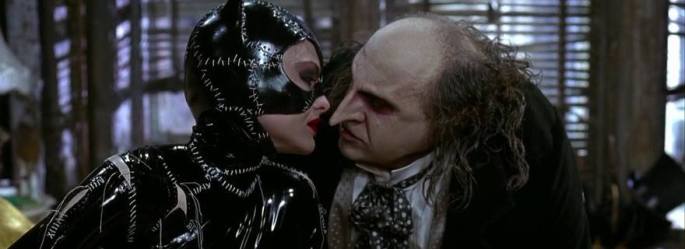
Danny Devito and Michelle Pfeiffer deliver the performances of their careers and were both criminally robbed of Oscar nominations. Devito’s Penguin, a menacing troglodyte from the sewers symbolizes the refuse of the American Dream, discarded by his socialite parents for his physical and emotional deformities. He chews up every scene with malicious heartbreak, a son scorned by denial.

Opposite him, is the Catwoman. Pfeiffer’s absolutely brilliant incarnation of Batman’s constant foil is unforgettable.  She forces the viewer to confront the inequalities in the boardroom and in the bedroom. On first glance, it’s easy to dismiss her as a leather clad dominatrix and I believe that is Burton’s intent. It is through this satire that she becomes the epitome of a victim’s rage and it’s simply delicious to watch her spar, both verbally and with claws.
 

Keaton brings the usual anchor as Batman, whose own demons take a backseat to the troubles of the rogue gallery that are an organic response to the costumed vigilante’s presence in Gotham.  Walken fills out the cast as a white-haired mogul, a modern day symbol of the wealth that rejected the Penguin in his youth, thus showing that ultimately, greed is a spirit as real as Gotham itself.

Stefan Czapsky’s cinematography shows a Christmas time Gotham in its death throws, with blacks, white, and grays flooding the visuals. The concept of death is in the very foundation of the city, brought to life with Cheryl Carasik’s breathtaking set pieces. The costumes are a marvel and transcend the superhero mores with a sense of desperation, due to Bob Ringwood and Mary Voight’s creative efforts.

Some could argue this is not really a Batman film, but more a Burton film and thus that is why it is such a masterwork. I contend the opposite. Batman is a story, at its core, about loss, searching for acceptance, and the inevitability of ones actions coming to fore. I think it is for these reasons that Burton chose Batman as the setting for his turbulent Shakespearean tragedy.

You can’t help but marvel at the spectacle, and the stench of Gotham’s sewers will follow you home, long after you’ve left the film behind.


 

Oz Perkin’s February, aka The Blackcoat’s Daughter

I like Emma Roberts, and really dig the career path she’s chosen for herself so far. Daughter of eccentric, legendary badass Eric Roberts and niece to Hollywood’s darling superstar Julia, she could have easily taken the oft trodden path of teen sensation, appearing only in stuff that appeals to a new generation that’s forgotten much of the odd, freaky stuff of former times. Instead she’s deliberately accepted best, off kilter genre scripts, using an ongoing stint on FX’s American Horror Story as a launching pad for some really interesting projects that duck the mainstream, just like her dad. Oz Perkin’s February is one such outing, a laconic, nightmarish mood piece that plays like a demon possession film without all of the tired hysterics, using pacing, atmosphere and glacially mounting dread to tell its story. Roberts plays a young runaway stranded outside a hospital on one cold night. Picked up by a kindly man (James Remar ditching the villain shtick) and his wife (Lauren Holly, who apparently is still in films after all!), she embarks on a tense road trip towards a county far away. In said county, two forgotten girls (Kiernan Shipka and Lucy Boynton) spend the holiday break at their catholic school. Gradually they start to feel some presence in the building, haunting them, and then shit gets crazy. This is textbook slow burn territory though, and anyone expecting a trove of jump scares need not apply. There are a few well earned moments of terror, but they’re fleeting, and all the more disturbing as a result. There’s a vagueness to the narrative too, with just enough left unexplained to spark some interesting Reddit discussions. A dark, moody flick that rewards those who give full attention with some scary secrets and a smothering atmosphere of danger on the horizon. You’ll find this titled as ‘The Blackcoat’s Daughter’ on demand and iTunes, but that title seems to not mean much except to quite an eerie song used throughout the film.

-Nate Hill

Lawrence Kasdan Autuer Series: The Big Chill

Image result for the big chill poster

Frank, Jason, and Patrick discuss one of Lawrence Kasdan’s most seminal films, THE BIG CHILL. They discuss the thematic elements, the all-star cast, and the iconic soundtrack from the film.

Brian Taylor’s Mom & Dad

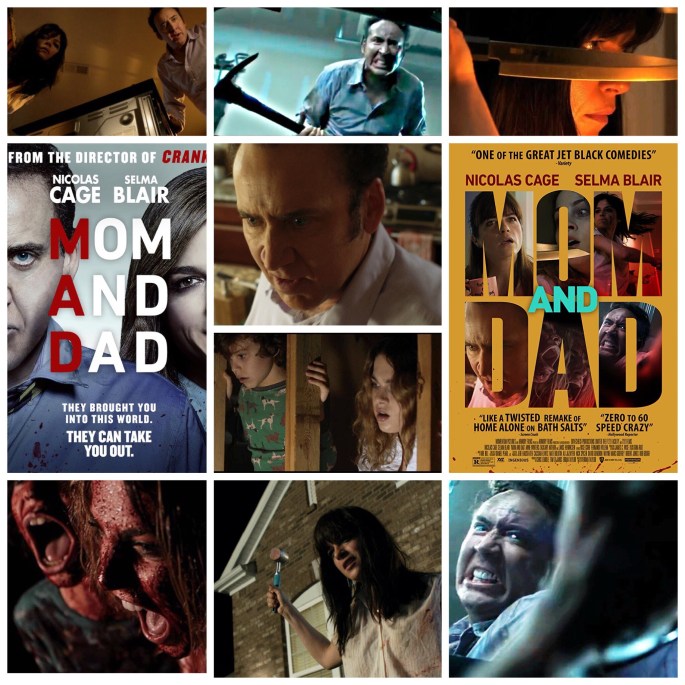
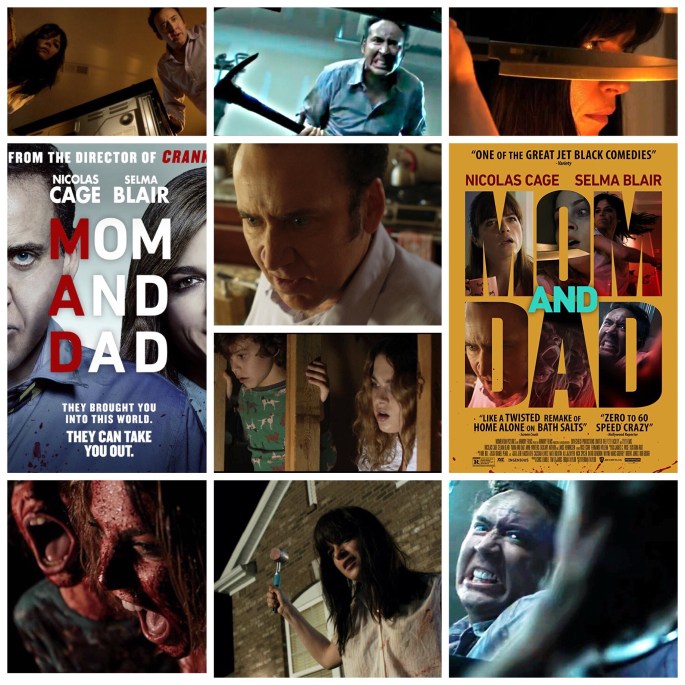
I read an article a while back saying that at the premiere of Brian Taylor’s Mom & Dad, the director attended the screening and prefaced it by saying that his film has “mental problems.” Well… he wasn’t wrong. Taylor is one half of the Neveldine/Taylor genre filmmaking team, a blitzkrieg duo responsible for both of the Crank movies, plus Gamer, and if you’ve seen any of those you’ll have an idea of the way their sense of humour slants towards the bizarre. With this one it kind of trundles headlong into willfully fucked up territory though, and before you know what’s happened, it’s scant 86 minute runtime is up and you’re left there in the dust, feeling somewhat violated. The concept is blunt and visceral: everywhere, all at once, the nurturing instinct in parents is savagely reversed and they immediately start to murder their own children. Only their children, mind you, and with a disturbing lucidity that I couldn’t decide whether to laugh at or get spine chills from. An amped up Nicolas Cage and Selma Blair play your average upper middle class parental unit, and the film mainly focuses on their eventual snap, and a subsequent tooth & nail fight to snuff out their poor son and daughter (Anne Winters and Zackary Arthur). That’s pretty much the film, although for such a seemingly simple concept within a short piece it somehow manages still clearly articulate its narrative amidst the ruckus and even comment on something deeper than it’s 70’s Midnite Movie veneer initially suggests. Cage treats this as the ultimate midlife crisis, and indeed his acting these days is more gonzo than ever. He’s got a mental breakdown midway through the film and before the killer epidemic even breaks out that is so over the top it reaches a kind of feverish harmony, not to mention appearing scarily un-faked on the actor’s part. Though quick and fierce, the film could have still tightened the pace a bit in the opener and extended the super violent, Home Alone-esque second act a smidge, but oh well. Watching Cage and Blair overact to the heavens as they try and kill their own kids with every household item they can grab including a meat tenderizing hammer (ouch) and a Sawzall (“Sawzall… saws…. all…”) hits some blissfully transcendent notes, if you have the twisted mind to stomach it. There’s a scene that will test boundaries though and walks a fine line between crazy and flat out uncalled for (one of my friends walked out of the room in disgust), but hey, that’s the kind of stuff this director is known for, so try and roll with it. Things get really bizarre when Cage’s own parents show up to add to the cluster-fuck, his demonic veteran daddy personified briefly and perfectly by a ferocious Lance Henriksen. Accompanied by a sketchy, warped and nerve-shredding score and some off kilter editing, this will either be your thing or it won’t, there’s just no middle-ground in an arena this fucked up. Good luck.

-Nate Hill

Danny Devito’s Duplex

I will never not love Duplex, Danny Devito’s jet-black ode to neighbours from hell, a ninety minute domestic squabble of epic proportions and one of the funniest films of the last few decades. Devito knows how to do comedy at it’s meanest, lowest and most shamelessly un-PC, whenever he’s in the director’s chair you know you’ll get something that will either land squarely with those who have a deranged sense of humour (moi) or drive of the prudes in droves. Ben Stiller and Drew Barrymore play a hapless NYC yupple (yuppie couple, just made that shit up) looking for their perfect little love nest to settle down in. They think they’ve found it in a gorgeous, spacious Brooklyn split-suite, but there’s just one problem: sweet, ninety year old Mrs. Connolly (Eileen Essell), who is the tenant equivalent of the plague. At first she’s a benign darling, but after a few weeks pass, she’s a harridan hellbent on making their lives into an extended nightmare of never ending chores, sleepless nights and maddening disruption. The solution? Well there’s many in the real world, but in Demented Devito realm it’s to kill her, of course, an eventual resolution they come to quicker than your average ruffled landlord. It’s all in good fun if you’ve got the wicked internal lens to angle at it, and I find it to be a consistent laugh riot with each repeated viewing. Essell is comic dynamite, pretty spry for an old gal and always game to make the dialogue sizzle, as the film sort of relies on her character to work. Stiller and Barrymore stir up a collective brew of exasperation and screeching hysterics, while the wicked good supporting cast includes Wallace Shawn, Robert Wisdom, Justin Theroux, Swoozie Kurtz, Maya Rudolph, Amber Valletta, Tracey Walter, Michelle Krusiec, James Remar as a shady hitman and Broadway’s beloved Harvey Fierstein as New York’s sleaziest real estate tycoon. Devito’s scripts almost always veer into a dark, bizarro cartoon style once the antics get feverishly out of hand, and bearing witness to the many varied and idiotic ways Stiller and Barrymore try to kill the old broad are a showcase of him at his nuttiest. Gross, unpleasant, cheerfully in bad taste, relentlessly raunchy and delightfully mean spirited, pretty much all the things a great comedy should be.

Clive Barker’s Nightbreed

Nightbreed (Director’s Cut)

1990.  Directed by Clive Barker.

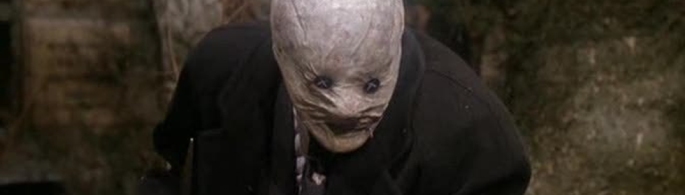
Clive Barker’s most ambitious film, Nightbreed was hacked to pieces by studio execs prior to release and then by critics after its lackluster debut.  Horrendously marketed as a slasher film, Barker’s misunderstood opus has thankfully gained a cult following over the years, and a recent Director’s Cut release by Scream Factory, allowing Barker’s incoherent monster-centric fable to be viewed in its intended form.

Boone is a drifter who thinks he may be killing people.  His dreams are filled with visions of a city called Midian, a place where monsters dwell.  He sets out in search of the city with his paramour, Lori.  Pursued by the authorities and his murderous therapist, Decker, Boone discovers that Midian is not only real, but that his coming has been foretold by dead gods, prophesying a war between the inhospitable forces of humanity and the savagely noble legions of outcast creatures known as the Nightbreed.

The biggest problem with this film is also its strongest attribute.  Barker throws so many balls into the air that it’s a foregone conclusion that not everything will hit the mark, and yet, Nightbreed comes off as wonderful combination of serial killer fodder, a Gothic fairy tale, and a hauntingly rich form of original mythology.  There are dozens of characters that inhabit Barker’s epic with the monsters eclipsing their human foils, save for David Cronenberg’s sadistic Decker, who is one of the more vital roles in the bloated ensemble.  Oliver Parker as Peloquin is the monstrous standout, with his flesh dreaded faux Rastafarian killer barking the film’s best lines.


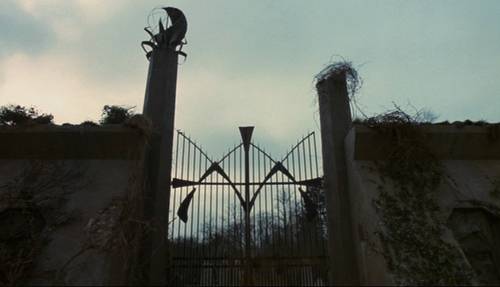
Mark Coulier’s freakish makeup designs are both elegant and obtuse, as some creatures appear as tangible nightmares and others come across half rendered, in part due to Robin Vidgeon’s stormy cinematography that bounces through lonely cemeteries and ancient catacombs without stopping to catch a breath.  The shame is that many of the creature designs are revealed as horrific intricacies,  whenever the viewer is allowed to glimpse their unspeakable splendor.  Danny Elfman’s amazing score enhances the mythic quality of the story, but it’s offset by the cardboard villainy of the humans and the wholesale familial slaughter that looms in the background throughout the narrative.

A feeling of too little, too fast is the mantra of Nightbreed.  What begins as a menacing serial killer story mutates into a quest for Midian, with Boone’s Christ-like ascension saturating the central act.  There’s also the race war between the monsters and humans and the various social dynamics of the underworld that come into play, but in regrettable portions.  The confusion is when all of these elements collide in an uneven stream of sexually charged violence during the final confrontation.  Despite the inconsistencies, the final battle is an amazing blend of CGI, practical effects, and gritty stunt choreography that is easily Nightbreed’s strongest aspect.


Available now on Netflix, or on an excellent blu ray transfer by Scream Factory,  Nightbreed is a unique horror saga that succeeds as much as it fails.  The director’s cut fills in many gaps, but also leaves the viewer wanting more, which while eternally frustrating, is also a testament to Barker’s meticulous world building.  This is a film that drives the viewer down a pot hole ridden dirt road into another world filled with esoteric mysteries and dark wonders, delivering an excellent horror fantasy unlike anything ever attempted in the genre.

Highly Recommend.


Black Panther

Black-Panther

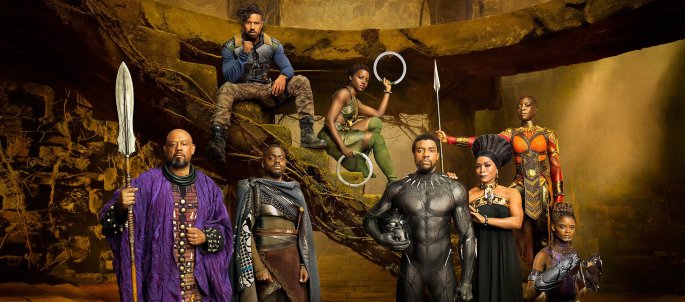
Shoehorned into an already well stuffed Marvel sequel (and…let’s do Giant Man!) in the successful Captain America franchise was a blink-and-you’ll-miss-it origin story for T’Challa, better known to fans as The Black Panther.  A marvelous mid 60s creation of Stan Lee and Jack Kirby, this hero defined aspirational black culture—a king from the fictional African country of Wakanda, rich enough in natural resources and groundbreaking technology that the influence of the white western world was not only unnecessary, but actively avoided.  Despite the rush job in Civil War, that film did a fairly good job of introducing Chadwick Boseman in the role, giving him a tragedy to rise above and an enemy to vanquish.  Considering the popular reaction to the character and an increasingly diverse Hollywood, it makes perfect sense that the Marvel Machine would give Black Panther his own film.  The biggest questions for the production probably revolve around how well such a film would balance action movie hijinks with themes of racial justice and history;  I’m glad to report that Boseman, director Ryan Coogler and an extremely talented cast of supporting characters storm through thrilling paces and deftly deal with a variety of elephants in the room using equal parts style, humor, character and heart.

Boseman, coming off an underappreciated turn in last year’s Marshall, has quickly joined his DNA with that of the Wakandan king and protector.  He strikes a perfect balance between heroic swagger and humble duty to his people, and as noted early and shown often, it’s a tough job that will take more than birthright to master.  He’s aided by a cadre of magnificent women, a sister, a lover and a lieutenant who exhibit mastery in their respective fields of science, spycraft and soldiering.  There’s an ongoing debate over what kind of role in the world a hyper advanced but secretive nation should play, which along with many nice touches including but not limited to some fun tech upgrades (this is Marvel, after all) to T’Challa’s classic costume end up serving as subtle but overarching metaphors on race and society, both from the past and very much today.  This leads to one of the best-conceived and executed villains of the MCU, Killmonger, played with anger and menace by Michael B. Jordan as the natural corollary to T’Challa’s thoughtful grace.  All heroes must pass a variety of trials by fire, and Killmonger brings both physical and spiritual obstacles to batter our protagonist with that truly lead to a transformative character arc while illustrating several complicated dichotomies between the foes.  The rest of the players involved soar—even Martin Freeman as the overwhelmed CIA operative Everett Ross gets some heroic notes—and by the time the dust has settled, we’re staring at what may become one of the most popular Marvel heroes to ever splash across the silver screen.  As names like Hemsworth, Downey Jr. and Evans age/expense out of their seemingly iconic roles, Boseman and a few other young upstarts appear to be more than ready to take on whatever challenges Marvel Studios cook up for their ever-expanding fictional universe.

black-panther-movie-10

Gore Verbinski’s Pirates Of The Caribbean: Dead Man’s Chest

Pirates Of The Caribbean: Dead Man’s Chest is so good it almost gives the first one a run for it’s money in terms of visual effects, imagination, swash and buckle. It does have it’s issues with letting some of the action set pieces run on literally forever (that rolling windmill sword fight tho) until you seriously start to question the limits of cardio in those involved, but director Gore Verbinski has always been an advocate for cheeky excess, so who can complain. In preparing a sequel to Black Pearl, they no doubt had a daunting task in equaling, and if possible outdoing the sheer bliss that came before, and they kind of succeeded and then some. Jack Sparrow, Will Turner, Elizabeth Swann and a whole circus sideshow of others are propelled on a dazzling adventure that spans past the isle of Tortuga, beyond the waters of Port Royal and to the far ends of the Caribbean, not to mention amping up the supernatural aspects of the first to dizzying heights. In Captain Barbossa’s absence (well, almost;), they also had to find a villain to match his adorable theatrics, and Bill Nighy’s moody Davy Jones, a hentai tentacled tyrant cursed by the ocean’s magic, doomed to sail the baroque galleon The Flying Dutchman forever, fits the bill. His crew are a gnarly, barnacled bunch of miscreants adorned in enough wicked cool marine biology and detailed special effects to get an Oscar nomination, which they did. Other new character additions include mopey Stellan Skarsgard’s bedraggled Bootstrap Bill, Naomie Harris’s spooky voodoo babe Tia Dalma, as well as familiar faces like Commodore Norrington (Jack Davenport), who gets a lot more to do here than twiddle the stick up his ass as he does in the first one, Governor Swann (Jonathan Pryce), Gibbs (Kevin R. McNally, deadpan as ever) and the whole motley crew. Depp takes what made Sparrow so charismatic and weird in Black Pearl and soars over the rainbow with it, he really and truly carries these films with his presence and it may just be the best characters created by him. A worthy sequel, kickass adventure and one for the books.

-Nate Hill

John Huston’s The Treasure of Sierra Madre

el_tesoro_de_sierra_madre

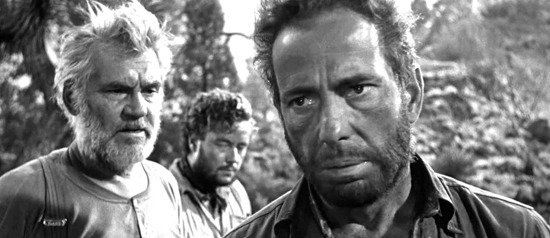
In this week’s Critics’ Corner, Kyle and Ben talk about John Huston’s classic, The Treasure of the Sierra Madre, the Warner Brothers classic which screened recently in theaters for its 50th anniversary.

BEN: I was glad I had the opportunity to see this film on the big screen. I loved the characters and their gritty settings, which lent a realism to their down and out status. I loved the fact that Humphrey Bogart wouldn’t let his character get swindled.

KYLE: Paul Thomas Anderson repeated watched this film while he was working on There Will Be Blood.  I think you can see a lot of both Huston’s influence and Bogart’s legendary performance in the DNA of PTA’s masterpiece.

treasure5

BEN: What makes John Huston’s adaptation of B. Traven’s novel is the struggle the characters went through to get to the treasure. The story treats their struggle as an adventure, something we don’t see much of today. But when you look at the amount of treasure they managed to get, the amounts don’t seem like much. That’s probably because we tend to think of gold in bars, not dustings like the film portrays.

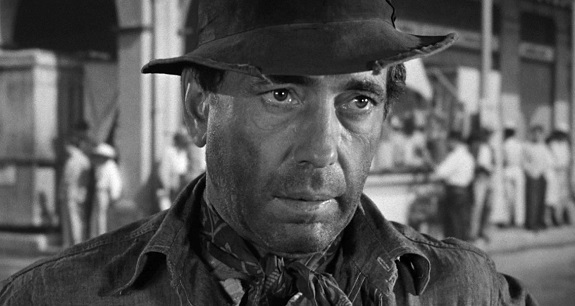
KYLE: Agreed, it is the Pyrrhic nature of the story that makes its such an important film.  This is an analysis of not only he debilitating effects of greed and paranoia, but also a fable-esque morality tale on the perils of self-centered apathy.  Dobbs’ entire arc is also intriguing, as he is easily the darkest of the central trio.  It’s difficult to root for him because he’s morally compromised from the jump, however as the final act begins, Bogart’s flawless performance subconsciously builds empathy with the audience.

Treasure_Of_SierraMadre_550x238-detail-main.jpg

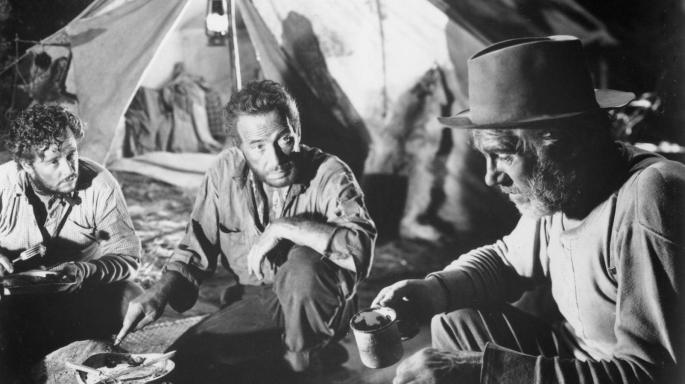
BEN: It was obvious that this was Humphrey Bogart’s film. As Dobbs’ he makes such a strong case for why he was a leading man. His look was always the same, but his eyes always sought out adventure, and friendships. Which is why Tim Holt as Curtin was a good match for him. They both carried off their respect for one another as partners, but they didn’t necessarily trust each other. And that’s where I felt Walter Huston as the old prospector, Howard was a good third party. He had been in the hills before, he knew where to find the treasure. And, technically he did so twice.

KYLE:  I’m glad you brought up the trust angle.  I think that is probably my favorite aspect of the film, outside of Ted McCord’s brilliant cinematography.  The setting of a lawless land, populated by rogues is then distilled through three personalities at the center, amplifying the feeling of uneasiness that runs through the heart of Treasure.  The dynamics of trust and betrayal that pervade the bulk of the narrative have quite simply, never been outdone without drifting into satire or melodrama.


the-treasure-of-the-sierra-madre.jpg

BEN: The last act truly represents the fulcrum of the triangle started by Dobbs. As a flawed “ideas man,” it was his initiative, and his business sense that allowed them to start the journey. Without Curtin, we wouldn’t have our conscience to guide us, and to keep our compass straight. And, without Howard, we would never have had a journey to go on.

KYLE: That’s a great observation.  In some ways, whenever I view No Country for Old Men, I’m reminded of this, mostly because of the trio of male actors at the center, with each of them representing different aspects of the narrative.

thetreasureofthesierramadre.png

BEN: It’s truly remarkable that John Huston directed his dad, Walter to an Academy Award nomination for Best Supporting Actor. The younger Huston won the Academy Award for Best Adapted Screenplay, and rightfully so.

KYLE: He also won for director.  Really a once in a lifetime situation.

BEN: They say flattery is the highest form of honor, especially when it comes from Mel Brooks.

Here is the original scene:

Here is the homage:


KYLE: That’s amazing!

BEN: I had a blast talking about this one, Kyle. 50 years later and the film is still so remarkably strong for its message and its characters. Until next time!

treasure-of-the-sierra-madre.jpg


Pirates Of The Caribbean: Dead Men Tell No Tales

The Pirates Of The Caribbean franchise has been a long and wild rollercoaster ride so far, with each new addition mining for fresh oceanic mythology to throw at Jack Sparrow & Co., as well as tossing in as much commotion, cameos and FX wizardry that Hollywood will cash out to a lucrative legacy like this. So the anthology arrives at it’s fifth excursion, titled Dead Men Tell No Tales, and it’s nice to know these films still have some wind in their sails, because this is actually a fairly fun and engaging entry, if a little more grey and somber than some of the livelier chapters. The characters have been through enough at this point it’s a wonder they still have their sanity and good looks, although a few have disappeared or fallen on hard times (Orlando Bloom’s Will Turner finds himself in a weird, prophetic predicament here). Jack Sparrow seems to soldier on undaunted though, perma-sloshed on The Caribbean’s finest rum, which is always in shortage, and as much a trouble magnet as ever, chased here by ghosts from his past, and I mean that quite literally. Jack himself is stuck in a bit of a drudge when we reconnect with him, cooling his heels in jail after a spectacularly botched bank robbery with his old crew (ever hilarious Gibbs present and accounted for). He’s shanghaied into another series of hijinks by a mysterious young lad (Brenton Thwaites) who’s searching for something, while the ghostly crew of a marooned Spaniard ship is searching for Jack. It’s captain, a spooky spectre called Salazar (Javier Bardem) has a personal bone to pick with out hero, dating back to the rascal’s teenage years. Played with sallow devilish glee by Bardem, Salazar is actually probably the scariest villain in the series so far, which isn’t saying much but it’s nice to get a little spine tingle from the combo of his work and the eerie special effects. Geoffrey Rush’s seemingly immortal Captain Barbossa returns again too, and sort of gets more and more garishly ridiculous with each incarnation, but Rush somehow manages to sell it, the champ. There’s a female heroine too (Kaya Scodelario) whose origins are also shrouded, the shrewd military prick that always shows up, played here by Lord Of The Ring’s David Wenham, and a sly cameo from Paul McCartney as another far flung relative of Jack’s. While nothing will ever top Curse Of The Black Pearl, this one both tones down the bloat of Dead Man’s Chest and reigns in the mania the nearly derailed At World’s End, as well as giving some life where blandness crept into On Stranger Tides. It’s not the best of the series, or even silver medal, but does the trick nicely and tries a few neat variations on the formula.

-Nate Hill