Walter Hill’s Trespass


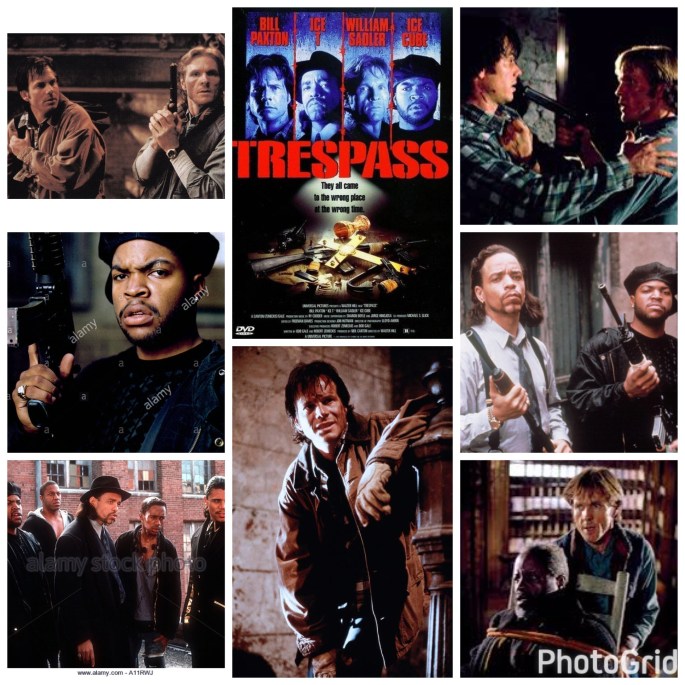
Walter Hill’s Trespass could raise a pulse in a quiet graveyard, it’s so relentless. It’s one of those single location, breathless siege thrillers where two unlucky dudes, this time Bill Paxton and William Sadler, are barricaded in some unfortunate building while hordes of inner city criminals try to smoke them out. Billy and Willy are two firemen in the wrongest of places at the wrongest of times, led to a dilapidated St. Louis warehouse in search of a hidden cache of stolen gold. When one of them stumbles into a gangland assassination, the two are immediately branded as witnesses and hinted like dogs by boss King James (a snarling Ice-T), his lieutenant Savon (Ice Cube) and armies of their men. That’s pretty much the premise, and simple as it is, action maestro Hill turns it into a ballistic bloodbath that barely slows down for a second once it gets going. Paxton and Sadler are soon at each other’s throats in a feverish haze of adrenaline, whilst the two Ices argue amongst themselves about tactical logistics. Yelling, shooting, running, borderline parkour, cat and mouse games, beloved 90’s action tropes and fight scenes that almost wind the audience as much as the characters. This is a lean cut of a film, concerned only with thrilling the pants off the viewer, hurtling by at a locomotive’s pace without rest until that final shell casing hits the pavement. 
-Nate Hill

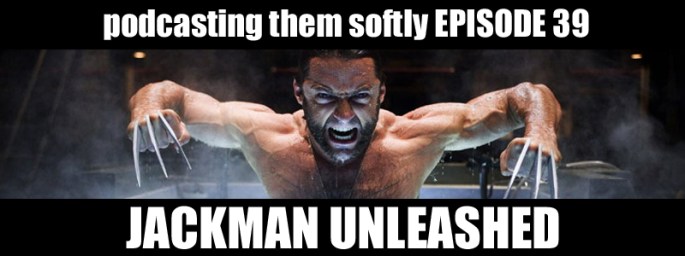
Episode 38: JACKMAN UNLEASHED

39

This is a big episode for a few reasons.  No, we didn’t get to talk to Hugh Jackman, but joining Frank is an array of PTS contributors: Joel Copling, Kyle Jonathan, and Ben Cahlamer.  We spend an hour discussing James Mangold’s LOGAN, Hugh Jackman’s seventeen year; seven-year span playing Wolverine, and an overall assessment of Hugh Jackman’s filmography!  We hope you enjoy!

DAVID CHASE’S NOT FADE AWAY

1

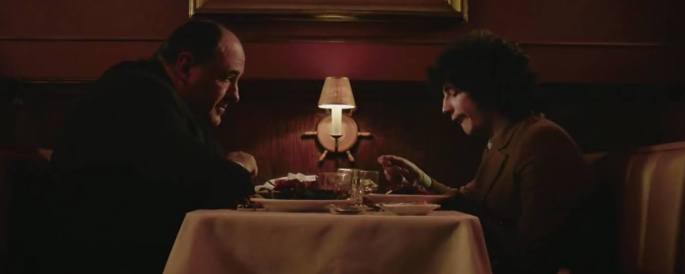
Totally buried by Paramount Vantage at the end of 2012, David Chase’s Not Fade Away is a funny and nostalgic time portal back to the 60’s, with a fantastic soundtrack, and a killer supporting performance from James Gandolfini. While the film possibly feels incomplete (I really would love to see a miniseries that picks up right after the events of the final scene), it’s yet another reminder of how well-observed Chase is as a storyteller, and how he really needs to be doing more work. The dialogue is sharp as a tack and I loved the freewheeling, almost rambling quality to Not Fade Away’s narrative. Bella Heathcote is positively alluring as Grace, the object of desire for eager musician Douglas, played with sensitivity by John Magaro, who with his buddies has dreams of making it big as a Beatles-inspired musical act. Gandolfini is Douglas’s extremely disapproving father who doesn’t understand the “noise” that his long haired son is creating in the garage.

2

There’s an excellent sense of time and place in Not Fade Away, and you get the feeling that Chase really knows these characters. If only he had been given a bit more time to tell the story (I wouldn’t be surprised to learn that stuff was left on the cutting room floor) because while what we’re left with is strong and enjoyable, there were times that I felt like it could have been even more expansive and thematically probing. Still, great music, solid performances, Heathcote and Gandolfini steal the show, and really nice cinematography from Eigil Bryld (House of Cards, In Bruges). After debuting at the NY Film Festival, this $20 million production would go on to gross less than $1 million in a shamefully small release, and while critics were mostly kind, people underrated this one a bit; it didn’t deserve to die on the vine without anyone even knowing that it was an option. Not Fade Away is available on Blu-ray and via various streaming providers.

3


Walter Hill’s Tomboy: A Revenger’s Tale


Walter Hill’s Tomboy: A Revenger’s tale went through a few different titles, first Tomboy, then (Re)assignment, and has been quietly released this week under the simple and bland ‘The Assignment’, which tells you nothing of how batshit crazy it is. It’s a film I’ve waited to see a long time, partly due to its controversial, bizarre premise (it’s been boycotted already), and partly because it marks the return of action guru of yesteryear, the great Walter Hill. I’m sad to say the final product is somewhat underwhelming, aside from a few key elements that shine through the dour mood, the best being star Michelle Rodriguez, in her first leading role since 2000’s Girlfight. Here she plays Frank Kitchen, a scumbag of an assassin who takes his orders from wiseguy mobster ‘Honest John’ (Anthony Lapaglia, quite fun in the film’s only other decent performance). Frank is a creature of brutal instinct, a street rat and cold blooded killer with a taste for bullets, booze and blonde bimbos, basically the finer things in life. So, Michelle Rodriguez as a man. This could have gone either way, and she herself, always having a somewhat masculine presence anyway, does fairly well. She can only do so much with the makeup and prosthetics she’s given though, and let me tell you, they are horrendous. Sporting a ponytail, goat’s pube beard and plastic looking Ken doll torso, she’s a shining beacon of amateur hour from the effects team, for the first third of the film, impossible to believe as a dude. Anywho, ‘Honest’ John proves to be anything but trustworthy, double-crossing our Frank and delivering him into the hands of a rogue plastic surgeon played laughably by Sigourney Weaver, who has quite the bone to pick with him. Here is where it gets nuts: Weaver forcibly performs a gender reassignment surgery on Frank, turning him into a woman to release him from his ‘macho prison’. Frank wakes up with brand new lady parts, the prosthetics all gone and Michelle in her final form, ready to dole out vengeance on both John and the surgeon. This is all told in retrospect of course, as Weaver sits in a padded cell and blathers on and on to a wormy psychiatrist (Tony Shaloub), about the philosophical nature, the lofty how’s and why’s that fuelled her actions, while the audience is sitting there going, “Nah bitch you just crazy.” It’s all the sleaziest fare, and doesn’t work as well as a premise like this should, but there’s something about the gritty sight of a post surgery Michelle wandering around in a hospital gown, tits loose and waving a gun around that has potential and may have done well in a better film. As far as the concept itself goes, anyone who arches their back or (lol) boycotts this film is expending unnecessary energy; it’s a down n’ dirty B movie throughout, never meant to be taken seriously one bit. It’s just a shame it wasn’t more fun. 
-Nate Hill

I Don’t Feel at Home in This World Anymore

I Don’t Feel at Home in This World Anymore

2017.  Directed by Macon Blair.

i-dont-feel-at-home-in-this-world-anymore-elijah-wood-melanie-lynksyd870f71_o-1200x520

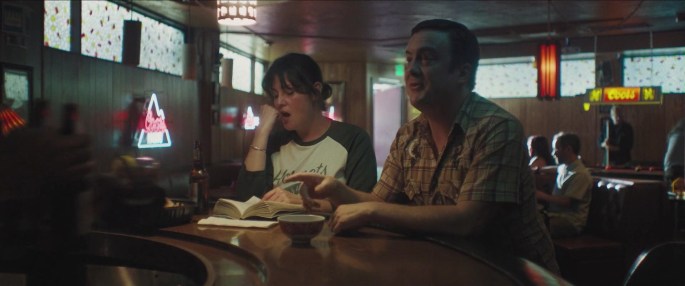
The casualty of self absorption is often common courtesy, with the hallmarks of charity being forsaken on the altar of fast paced living.  Macon Blair’s pugnacious directorial debut, I Don’t Feel at Home in This World Anymore frames the grand questions of existence in a bluesy package, filled with inept criminal mayhem, a twisting nosedive into violence, and an endearing pair of performances by its two leading actors.

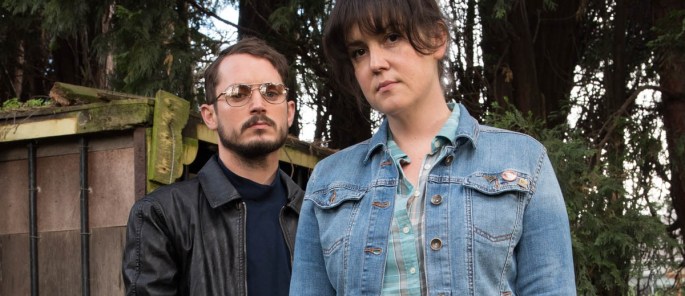
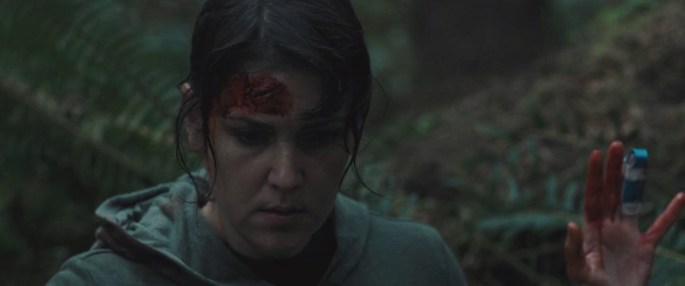
Melanie Lynskey’s central performance is both a totemic representation of the ignored and exploited and a cheer inducing portrayal of a woman who finally hits her limit.  The story revolves around a depressed nurse whose breaking point involves a peculiar robbery that leads her on a mission of revenge that rapidly spirals out of control.  Lumet’s Network is anchored by Peter Finch’s televised dissent in a post Watergate world, while Lynskey’s medicated ferocity is the perfect satirical remedy for the digital age.  Comparisons with the Coen Brothers are unavoidable, as the entire premise hinges upon normal people becoming involved in extraordinary circumstances, however Lynskey’s wry understanding of Blair’s surprisingly poignant script is sensational.  She is the person in the express lane who complains out loud when someone pulls out a checkbook.  She is the rage in your head when someone won’t pull forward enough to let you get into the turn lane.  She is the sum of every real and imagined sleight that we endure on a daily basis, and she is the viewer, a deeply flawed human who has the possibility for greatness.  Lynskey is a spinning wheel of emotional resonance blending the sadness of insatiable anger and the unmistakable satisfaction of doing the right thing, regardless of the cost.

22K2EQC

Elijah Wood supports as a quirky, Kung Fu wielding neighbor who balances the furnace of his personal anger with the calm of shared spirituality.  His chemistry with Lynskey is a platonic oddity, a potent ingredient for the bizarre microcosm on display,  Jane Levy (Don’t Breathe) has a dark turn as a trailer park disciple that keeps the roiling narrative grounded in the dangerous plausibility of a caper gone wrong.  This is the essence of I Don’t Feel at Home in This World Anymore.  The unfettered bliss of finally lashing out at the world always ends and reality has a nasty way of reminding you how important your normality is.  This concept is enhanced  by Brooke and Will Blair’s soundtrack that offsets the humor with deep, brooding tones which hold the promise of the violence to come.

Larkin Seiple’s cinematography has a dime store quality that is perfectly at home in the world Blair has created around his criminal miscreants and Samaritans gone awry.  Grungy blues and exhausted browns flood the screen, while shadowy, reverse shots in doorways put the impending malice on display.  The deep greens of the Oregonian wilderness are shot with interesting light combinations that enrich the mysterious idea of providence that hangs over the final act.  Everything is detached, with even the film’s most endearing moments framed at arm’s length.  On the surface this film says go away, but beyond the bellicose presentation lies a warm fable about loving oneself that is undeniably inviting.

64fc4a68efb9ea9c9241b75c44322dbe

Available on Netflix now, I Don’t Feel at Home in This World Anymore won the Grand Jury prize at the Sundance Film Festival.  This is a film that is not for everyone.  Its characters are extremely odd (making them even more human) and the plot borders on fantastical, turning the dials of the crime genre on their head, displaying the misfit backyard of Macon Blair’s mischievous subconscious, a place I am eager to return to.  If you’re looking for a film that will make you laugh and cringe in equal amounts, all the while reminding you of the importance of contentedness, this will not disappoint.

Highly Recommend.

athomemain

James Cameron’s Aliens 


Each of the four Alien films has their own distinct and noticeable personalities. Ridley Scott’s original creeping horror show is a tense, streamlined, gracefully vicious film that slinks along at its own pace, not unlike the resident feline Jonesy who wondered about on the spaceship Nostromo back then. If Alien has the qualities of a cat, James Cameron’s Aliens has those of a rambunctious puppy dog, a rip snortin, go get em action backyard barbecue knockout that runs up and gives the audience a big wet slimy kiss. All animal metaphors aside (I’m running out of oh-so-clever ways to open my reviews, ok? Been at this shit for two years now), Cameron’s film is an undisputed classic, still jaw dropping to this day, even after what feels like hundreds of viewings, nostalgic yet fresh in different ways every time, and simply one of the best films ever made. It’s the gold standard for creature feature sci fi too, and while many argue whether or not it in fact outdid Scott’s original white knuckler, I can’t bring myself to be petty and pick favourites out of the quadrilogy, I love them all for a whole bunch of reasons. Aliens picks up quite a while after the catastrophic events of the first, with Ripley floating around in that cryo-pod for way too long, until she happens to cruise past earth, crossing the vision of the Weyland/Yutani corporation once again. Because they always make astute, well thought out choices, they decide to send a research team, accompanied by a very reluctant Ripley and a group of hoo-rah, bull in a China shop colonial marines to far off industrial exomoon LV-426, where they have lost communication with the settlers. After a brief, clammy build up, all hell breaks loose, and we get to see the full impressive extent of Cameron’s skill as a visual storyteller, as well as the oh-so-gooey, inspire practical effects work that brings those gorgeous Xenomorph beauties to snarling life. The cast is the epitome of badass, as we are constantly reminded of by Bill Paxton’s Hudson, the film’s resident squirrel who gets hilariously skittish when things get dicey (“game over, man!” Will never not out a big, Paxton sized grin on my face), but who heroically holds his own once he gets his sillies out. The other side of that coin is Corporal Dwayne Hicks (Michael Biehn, never slicker), cool as ice, shaken by nothing, including an atmosphere entry landing that would make Alfonso Cuaron pee himself, but doesn’t come close to disturbing Hick’s afternoon nap. Every Alien team must have an artificial human, some of which are trustworthy, and some not. Lance Henriksen’s Bishop is as solid as they come, never losing his head (despite being reduced to a puddle of spilt dairy product) and sticking by Ripley’s side until the bitter, hectic end. Ripley herself is a little older, a little wiser and a lot tougher, her intensity calcified into grit after losing her daughter, and given somewhat of a surrogate in the form of Newt (Carrie Henn) an orphaned child who has survived months living like a rodent in the air ducts. “They mostly come at night… mostly” she eerily warns Ripley. Oh boy, do they ever. LV-426 is positively teeming with them, and they show up to provide speaker shattering, pixel scattering action like only Cameron can do. The facehugger in the room sequence is still one of the most terrifying sequences in any film, and serves to make you hate Weyland weasel Burke (Paul Reiser) with that deep loathing reserved for the scummiest traitors in film. The final thirty minutes of the film are a showcase of action cinema, and it’s amazing to think they pulled off the Queen fight without any cgi back then, a slam-bang marvel of a climax that fires on a thousand cylinders, and to this day has never been topped. That goes for the film too. It’s *the* action sci-fi film, and as close to perfection as you can get.  
-Nate Hill

Jackman Unleashed Week: Gavin Hood’s X-MEN ORIGINS: WOLVERINE

The idea behind this film was to franchise origin stories, including a Magneto film that turned into a soft reboot of the X-Men films with FIRST CLASS.  We were also supposed to get a solo Gambit film that is still currently in development limbo, and a Deadpool film with Ryan Reynolds that eventually took seven years to get off the ground.  What ended up happening was an unintentional Wolverine trilogy.

Related image

This film has some major flaws and is an imperfect picture.  The two sequels, THE WOLVERINE and LOGAN, remain superior films to this, yet Origins still remains my favorite Wolverine film warts and all.  The X-Men franchise has never taken continuity into consideration.  Actors were recast in important roles, most notably in this film Danny Huston as William Stryker and Liev Schreiber as Victor Creed/Sabertooth.  Timelines get blurred, especially after the hard franchise reboot of DAYS OF FUTURE PAST, and what ends up happening is reinvented origins for Wolverine.  Basically, the takeaway here is that the timeline continuity of the X-MEN films is almost as confusing as the TERMINATOR saga.

What saves this film for absolute failure are two important factors and why this remains my favorite Wolverine centered film.  Firstly, the opening credits sequence is phenomenal.   Spanning the course of every major American war from The Civil War to Vietnam we watch Jackman and Scheiber, brothers in arms, relentlessly fighting and almost single-handedly winning each war for America.  As the wars rage on, Logan observes and acknowledges Creed’s bloodlust and morality eroding.

Image result for liev schreiber victor creed

Secondly, which is encompassed in the opening credit sequence, the relationship between Logan and Creed.  They’re brothers, they share the same mutant powers.  Freakish regeneration and organic weapons from their hands.  What sets them apart is important.  Creed isn’t as strong as Logan when it comes to regeneration, he would not be able to survive the Adamantium process as Stryker tells him.  Most importantly, Creed lacks the morality that Logan attains.  Logan has empathy, Creed does not.

Violence is what both of them were born into, what their sole purpose became as they aged into warfare.  Creed’s bloodlust overtook him and what little compass of morality he had was disbanded, while Logan was more sensible – more in touch with humanity.  This comes full circle in the botched third act of the film that turns Wade Wilson into this super mutant Weapon X.  It is a silly ending that promises the future reconnection of Logan and Creed.  Regrettably, that never happened; which is a total and complete shame considering this year’s LOGAN was the perfect opportunity to do so.

Casting the dated CGI and third act aside, this film is still steeped with fertile X-Men lore.  We get a cool glimpse at Taylor Kitsh as Gambit, which leaves us wondering what could have been had he reprised his role in future films.  Taskforce X led by Stryker (who does Brian Cox’s original turn absolute justice) is a very fun aspect of the film yet is underutilized.  Aside from Logan and Creed, the team is made up with Reynolds as Wade Wilson (pre Deadpool), Daniel Henney as Agent Zero, Kevin Durand as Fred Dukes/Blob, Will.i.am as Wraith, and Dominic Monaghan as Bolt.

Image result for liev schreiber victor creed

This film could have been monumentally better, but if you take it for what it is, it remains an incredibly enjoyable picture.  Had the film focused more on Logan and Creed fighting their way through major wars, or made Taskforce X the focal point, this film would have been fantastic.  What we’re left with is an at times clunky vehicle with an easter egg packed third act that left most Wolverine diehards disappointed.  Regardless of keyboard warriors trolling of this film, it’s a lot of fun with colorful dialogue, heavy adult themes, and a once in a lifetime performance from Liev Scheiber as Victor Creed.  ORIGINS: WOLVERING rightfully earns its keep as the starter for one of the most beloved superhero trilogies in recent memory.

‘Logan’ Review: Hugh Jackman’s final Wolverine film is a bloody, heartfelt farewell to the last X-Man- by Josh Hains

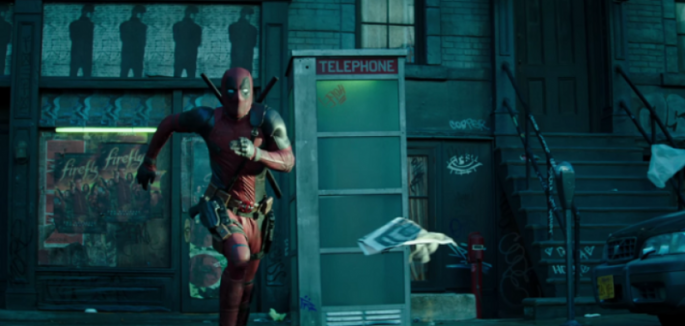
Before I break into the review portion of this piece, special mention must be made of the alleged cut scene from Deadpool 2 that serves as a preview or teaser of sorts for the upcoming sequel to the R rated smash hit. I greatly enjoyed experiencing the company of the darkly comical Merc With A Mouth once again, to the tune of John Williams’ epic Superman: The Movie score, and the song that closes out the late Tony Scott’s underrated True Romance. What a fun little riot, a pleasant albeit all too brief little tease of the pleasures to come. Cue the music!
deadpool-2-trailer-release-date-800x381

In 2029, the ageing James ‘Logan’ Howlett (Hugh Jackman) is a pale shadow of the once iconic mutant hero he used to be, Wolverine, popularized in comics that both exaggerate and sanitize the truth. Mutants are extinct save for Logan, Professor Charles Xavier (Sir Patrick Stewart), and the albino mutant Caliban (Stephen Merchant). A mutant birth hasn’t been recorded in 25 years either. Logan is an alcoholic, sporting a visible limp and a frequent cough, and a cynical, cantankerous, almost always pissed off demeanor. He’s kind of an asshole now. His body is slowly breaking down thanks to the cancerous adamantium that covers his entire bone structure and trademark claws, his wounds healing slower and leaving big ugly scars. He’s also plagued by nightmares if the brutal acts committed against and by him. At 200 years old, Logan has experienced multiple lifetimes of violence, tragedy, loss, heartbreak, and grief, the result of which coupled with his age, has broken the poor guy’s soul. He lacks the conviction and strength to get through each day, hence his worsening alcoholism and overbearing cynicism. Life has truly beat the hell out of Logan, yet he presses onward. If an adamantium bullet doesn’t kill him, time, our own worst enemy, surely will. Eventually. By this juncture in Logan’s life, violence isn’t just a way of dealing with other violent beings, it’s become a part of who he is, as if a genetic code for violence is coursing through his veins.

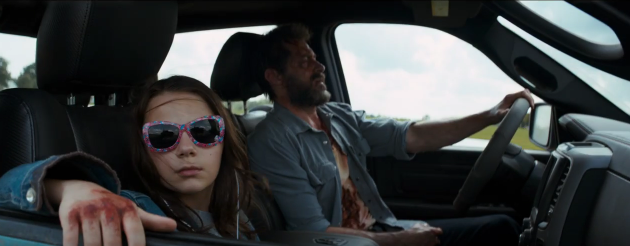
Logan works day and night as a limousine driver in Texas for the kind of drunken party girls who like to flash the driver, and foolhardy guys that dickishly chant jingoistic phrases. His work provides him with just enough cash to afford him the medicine he and Caliban require to help control a neurodegenerative disease that produces seizures Charles is suffering from, the result of which if left untreated renders anyone in the vicinity, save for Logan, temporarily paralyzed, or dead. They live in seclusion in a dingy private smelting plant in Mexico, until their relatively peaceful existence is shattered by the arrival of a merciless cybernetically enhanced assholes called the Reavers. They’re led by Wolverine fanboy and henchman Donald Pierce (Boyd Holbrook), and Zander Rice (Richard E. Grant), a bioengineer and Donald’s boss. They’re seeking the mute Laura aka X-23 (newcomer Dafne Keen), an 11 year old mutant who bears eerie resemblance to Logan. I think we all know why. A brutal encounter sends the trio on their way to Eden, a supposed place of salvation for young mutants in North Dakota, with the Reavers hot on their trail. Yes, this is a road movie but don’t worry, it’s a great one.

I’ve been an X-Men fan since I was a little kid, watching the ’90’s animated series on television, watching every live action movie adaptation, and collecting action figures and comic books along the way. I don’t have anything against PG-13 movies or comic book movies, with the sole exception that the rating limits on-screen violence. I’ll gladly watch jokey, fun superhero flicks any day of the week, a few of which even populate my own favourite films list. But Logan required an R rating to get across the precise tone director James Mangold and Hugh Jackman have been aiming for over the last few years. Just like many other fans, I’ve been waiting 17 years to see Wolverine finally cut loose and tear people to shreds the way I’ve always known he can, because foot-long metal claws from the strongest metal on the planet (in their reality), don’t just poke the bad guy – they dismember, disembowel, and decapitate. Rest assured, he finally does in Logan.
logan-wolverine-3-hugh-jackman

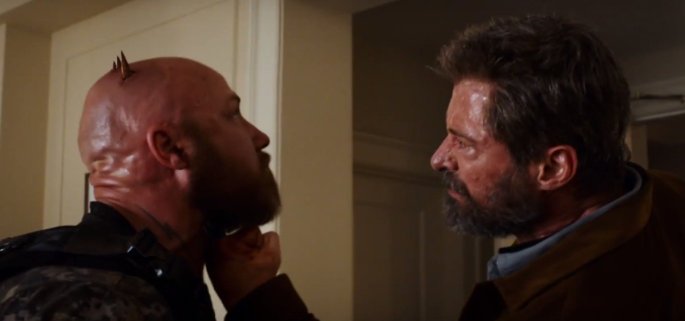
The rumours are true, Logan is packed with plenty of bloody violence, far from tame, and with enough blood soaked carnage to satisfy even the most bloodthirsty gore-hounds. Heads roll, limbs fly off, threats are ripped open wide, and buckets of blood are spilled as Logan finally delivers a whopping heap of berserker rage fuelled killings throughout its 135 minute runtime, especially in two scenes of 100% pure classic Wolverine berserker rage that will blow minds. Two fight scene in particular, one midway through the movie, and the other the bloodstained finale, offer up some of the most intense, brutal, and graphic comic book movie violence committed to film. These two scenes in  particular are stand-out action set pieces due to the physical and dramatic weight the R rating allows them to possess. When Logan becomes physically drained, weakened by multiple gunshots (*spoiler alert* or stabs wounds from an experimental clone of himself *end of spoiler*), we feel his exhaustion through his body language and facial expressions. When he or Laura are dispatching foes left and right, we feel the primal anger and blood lust. A PG-13 movie could never have that dramatic heft to it. Logan also bears a significant amount of profanity, enough to rival last year’s similarly R rated comic book movie hit Deadpool, but unlike that movie, profanity isn’t used like a comedic tool to up the wattage of vulgarity as was needed. Rather, the frequent uses of the f-bomb accentuate the anger and frustration the characters (Logan in particular), are experiencing at any given moment. Logan isn’t for the faint of heart, but there’s more to Logan than just gory violence.

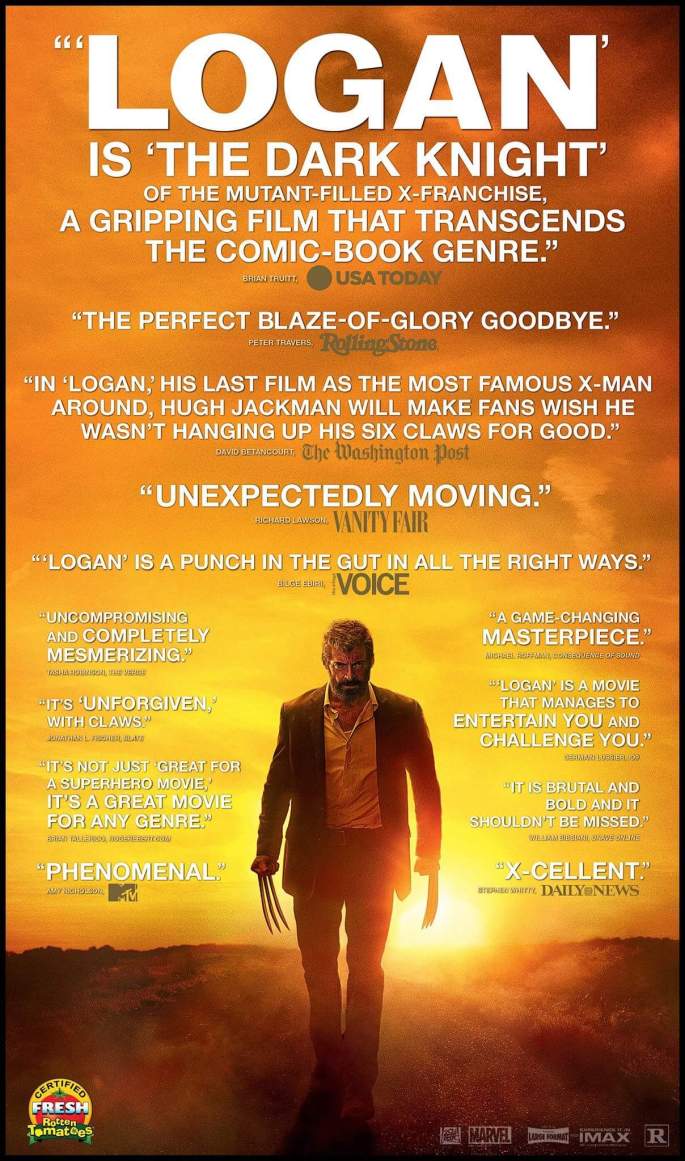
Hugh Jackman deserves an Oscar for his performance as Logan. I’m not just saying that for the sake of it. Hugh has never given a more layered, meaningful, naturalistic performance in the 17 years I’ve been watching his movies. If Logan is a truly his final outing as the iconic character, I don’t think he could have given a better performance than what you’ll see in Logan. The script by Mangold and co-writers Scott Frank and Michael Green, along with that R rating, affords Jackman the opportunity to work with dialogue and scenes that at ask for more of dramatic work than physical, allowing Hugh to go to places he wouldn’t otherwise be able to reach. It’s the work of an actor who knows this character better than anyone else outside of his creators, who isn’t simply playing a role, but living within the skin of him. He is our Logan, through and through in every way in this subtle, deeply human performance. Sir Patrick Stewart has never been better as Charles Xavier, and acting on the assumption that this is also his final turn as his iconic character, as reported in recent days, I couldn’t have asked for a more fitting end to his reign. Dafne Keen needs an X-23 movie pronto, she’s so good for such a young newcomer. Boyd Holbrook makes for a menacing villain, his smooth talking Texas accented Donald acting as quite the ice cold delight in a sea of CGI, oversized doomsday super villains, and Richard E. Grant gives multiple dimensions to his Zander, bringing a welcomed honesty, tenderness, and sheer cruelty to what could have otherwise been a thinly developed villain.
17097525_1294482667310470_5932397460279918760_o

At first glance, Logan is a comic book movie meant to bring a satisfactory yet heartbreaking end to a 17 year long career and story arc spent on the iconic hero. Peel back the layers and it’s a redemption through justice and revenge western tale, the kind kind of story carried through history books for centuries to come. Logan is right from the get-go, a classic western yarn, and the best kind too. The kind of western where a tired gunfighter has to take up their guns one last time in the name of frontier justice. The western frontier may be gone, but the idea of the stubborn hero who needs persuading still exists, right down to the classic Shane appearing on a hotel television.

That Logan uses a couple of the same tropes seen in westerns decades ago doesn’t mean the film is a slave to those tropes, as Logan firmly stands on its own two feet as a unique amalgamation of comic book fantasy, the classic western, and the modern family road trip drama. Remove the use of mutant powers and you have a modern day western about a tortured soul waiting for death to end his suffering, until his skills are called upon to assist those in need, one last time. Hollywood hasn’t run out of fresh ideas, rather they’ve just found creative ways of reinventing the wheel from time to time. Taking the fantastical world of the X-Men and grounding it in the themes of the classic American western is a brilliant manner of humanizing and personalizing Logan’s story. Logan has more in common with Clint Eastwood’s Unforgiven than any of the X-Men movies that precede it. The presence of X-Men comics in the film (real comic books with newly commissioned art by their original artist Dan Panosian), seems to suggest that the world in which the previous 9 X-Men movies occupied may also have been a sanitized embellishment of the grim world Logan inhabits. I quite enjoy the notion. 

Last year Deadpool proved an R rated comic book movie about a fourth wall breaking, profane, crudely humourous, violent mercenary out to rescue his lover and not look like an avocado had sex with an older more disgusting avocado, could out perform multiple other comic book movies released this past decade, if the correct amount of love and respect are applied to the material. This year, Logan has proven that Deadpool’s success wasn’t just beginner’s luck, but that lightning struck twice because just as much love, passion, and respect were applied in all the right places. That they had the balls to make a commercial comic book movie about a broken man learning to love one last time, proves they broke the mould when they made Logan. That we’ll likely never see another comic book movie that treads these waters again is fine by me. I wouldn’t want it any other way. This final ride was perfect.
logan-final-trailer-image-40


Man Down 


I’ll say this right off the bat: do not watch Man Down if you’re already in a mood, because it will emotionally lay you the fuck out. I learned that the hard way the other night. Billed as a war film, marketed as such and discreetly snuck onto iTunes without so much as a hint of theatrical release, its easy to see why they’ve tried to bury this one, it’s the bleakest film I’ve seen so far this year, and possibly the previous one. If there’s any doubt still surrounding Shia Labeouf’s acting talent (there shouldn’t be at this point), his work here should solidify greatness. All publicity antics and oddball muckery aside, he’s proven time and again that he’s one hell of a performer, and this is the best work he’s ever done, by a long shot. As Afghan war vet Gabriel Drummer, he’s put through an emotional wringer, sent back to an America ravaged by some vague pandemic, on a hopeless mission to locate his wife (Kate Mara) and young son (Charlie Shotwell). Joined by his best friend and fellow soldier Devin (Jai Courtney), Gabriel’s mission seems hazy and desperate, his family always just out of reach, tormented by the psychological wounds of combat but determined not to give up. This is interspersed with an extended dialogue scene between him and General Peyton (Gary Oldman, restrained, patient and careful), in which he heartbreakingly opens up about the horrors he has seen. This is where Labeouf shines, his tears uncannily genuine, his work visibly shaking up Oldman and tearing at the edges of the screen in it’s implosive intensity. Trust me, this is not the film you are expecting, not even close. By the time the third act rolls around and you see what’s really going on, you’re emotionally sucker punched when least expecting it, and the film’s quiet, devastating anti-war message is hit home with the force of a sledgehammer. I can’t say too much more without ruining it, but it’s one of the most thoughtful, understanding war films I’ve seen, one that gets the reality of what it’s like to have seen such atrocities, and come out of it a different person. Strong, stinging stuff that takes a while to shake off. 

-Nate Hill

Jackman Unleashed Week: Baz Luhrmann’s Australia

2008_australia_hugh_jackman

By J.D. Lafrance

After his debut film Strictly Ballroom (1992), writer/director Baz Luhrmann never looked back, creating lavish, ultra-stylish musicals William Shakespeare’s Romeo + Juliet (1996) and Moulin Rouge! (2001), and let’s not forget that $5 million Chanel commercial starring his cinematic muse, Nicole Kidman. With, Australia (2008), he decided to take national pride to a whole new level by creating a sweeping romantic epic about his home country that takes place between the World Wars and was made by and starring Australians. With a budget in the neighborhood of $130 million, the pressure was on Luhrmann now more than ever before to deliver at the box office and, while underperforming in North America, it went on to gross $200 million worldwide despite a lukewarm critical response.

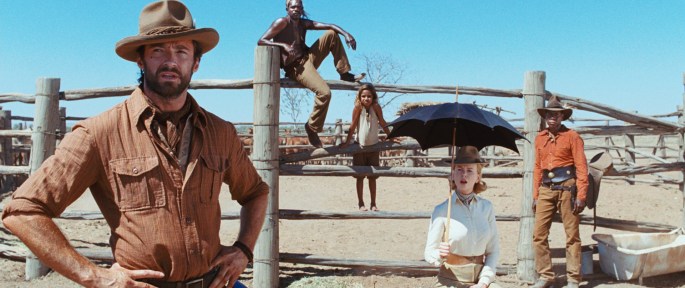
Lady Sarah Ashley (Kidman) is a headstrong English aristocrat who travels to Northern Australia in 1939 to meet her husband at their ranch Faraway Downs. Within a few minutes of arriving, she meets her guide to this strange new land, a man known as the Drover (Hugh Jackman), a hard-drinking, two-fisted Australian version of a cowboy. They take an instant dislike to each other: she thinks that he’s crude and uncultured and he thinks that she’s too prim and proper.

They arrive at Faraway Downs to find her husband dead (apparently at the hands of an Aboriginal) and the ranch in disarray and in danger of being foreclosed. Mr. Carney (Bryan Brown), the local tycoon with a monopoly on the local economy, has his right-hand man, Mr. Fletcher (David Wenham) try to sabotage Lady Ashley. In order to save Faraway Downs, she has to drive 1,500 head of cattle to Darwin and so she enlists the help of the Drover. Along the way, they befriend a young Aboriginal boy named Nullah (Brandon Walters) whom she protects from being taken away and forced to assimilate with white folks.

As with his previous films, Luhrmann populates Australia with broad, stereotypical characters and tells a classic story. The film revels in archetypes: Ashley is a pure, upstanding woman, the Drover is the rugged western hero, Fletcher is the dastardly villain, and Nullah is the adorable child who narrates the story. As he proved with is previous films, Luhrmann has an uncanny knack for casting. Who can forget the undeniable chemistry between Leonardo DiCaprio and Claire Danes in Romeo + Juliet and the sparks that flew between Ewan McGregor and Nicole Kidman in Moulin Rouge!? He’s at it again with this film with the casting of Hugh Jackman and Kidman as the romantic leads.

Jackman finally fulfills those early comparisons to Clint Eastwood, playing the Drover as a tough, dependable hero who’s not afraid to show his vulnerable side. He’s never been more charismatic as he proves to be equally adept at the physical demands and the emotional range that the role requires. No one knows how to photograph Kidman quite like Luhrmann. She looks stunning, even covered in a layer of dirt and dust from a cattle drive. At first, her stuffy English aristocrat comes off as a cartoonish stereotype but as her character becomes acclimatized to the country and she develops a bond with Nullah, she becomes warmer and more empathetic.

Beginning in 1939 and climaxing with the Japanese bombing of Darwin in 1942, Luhrmann’s Australia mixes the larger-than-life melodrama of Gone with the Wind (1939) with the exciting cattle drive in Red River (1948) and with a dash of The Wizard of Oz (1939). His film clearly harkens back to the kind of cinema that they just don’t make any more with very little CGI used and everything built from scratch and on location. Australia is the kind of ambitious Technicolor epic that might have been made by John Ford or George Stevens. It is a marvel of absolutely stunning cinematography – only Luhrmann could make the desolate outback look vibrant and alive. He alternates between sun-drenched day scenes and night scenes that appear to be impossibly illuminated by the stars.

One should not go into Australia expecting realism. Luhrmann presents a mythologized take on his country. Love him or hate him, you have to respect Luhrmann for not being afraid to wear his heart on his sleeve. He’s arguably the most romantic filmmaker working today with the possible exception of Wong Kar-Wai. And with Australia, he has made an unabashed love letter to his homeland on a grand scale.