F. GARY GRAY’S THE NEGOTIATOR — A REVIEW BY NICK CLEMENT

3

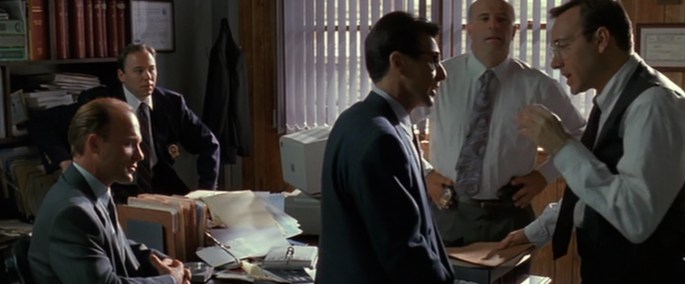
F. Gary Gray’s well above average late 90’s thriller The Negotiator remains a solid chop off the Dog Day Afternoon block, telling a riveting story of police corruption, mistaken motives, shadowy conspiracies, and high-pressure bits of action. Exciting and tense direction, smart writing from James DeMonaco and Kevin Fox, crisp editing by Christian Wager, and classically shot by the great cameraman Russell Carpenter – this film really was the total genre package back in the day, and it deserved a higher profile during the summer of 1998, where it was released to solid reviews and solid if unspectacular box office. It’s the sort of movie that I’d love to see get made these days; tough-guy cinema like this is always in short supply.

1

Yes – Samuel L. Jackson and Kevin Spacey delivered showy and terrific star turns, but this movie BELONGS to its AMAZING supporting cast, which is essentially a roll-call of the A-1 best character actors and “faces” that ever graced a policier potboiler of this sort. Hear me now: David Morse, Ron Rifkin, John Spencer, J.T. Walsh, baby-faced Paul Giamatti, Michael Cudlitz, Dean Norris, Nestor Serrano, Carlos Gomez, and Jack Shearer just to name a few. You have to wonder how Henry Czerny didn’t make it on the cast list as well. Seriously – these names may not all be familiar, but take a moment and do a Google image search and you’ll realize how incredible these guys were in SO MANY MOVIES throughout the 90’s.

negotiator

Gray has had a solid career directing slick and disposable Hollywood entertainment, but last year’s Straight Out of Compton and this juicy, exceedingly entertaining ensemble piece rank as his best. I should also revisit Set It Off, as I remember really enjoying that as well. And of course, Friday is an all-time stoner classic, a film that “gets it” in ways that few other films do; it’s as sly and subversive as it is in-your-face-funny. But with The Negotiator, he dared tread in the same waters as genre masters like Sidney Lumet did before him, and he ended up crafting a movie that has some nice edges to go along with its smooth sense of style. This is the definition of a Sunday afternoon matinee that could be joined at any point in the narrative.

2

Joe Dante’s Burying The Ex: A Review by Nate Hill 

Everyone has that one psycho ex. Well… not everyone. But a lot of folks. I do, many do, enough do for there to be a whole lot of movies on the subject. Joe Dante’s Burying The Ex takes that predicament one step farther, straight into the realm of the supernatural, as the director always does. We haven’t had a Dante flick in a while (he’s the genius behind Gremlins, Innerspace and Small Soldiers, for those who don’t know), and it amazes me the lack of marketing which led to me taking my sweet time in seeing this. Glad I did, because it’s a treat. Any headline that boasts Dante, Ashley Greene, Anton Yelchin and the luscious Alexandra Daddario in the same film is automatically a rental, before I’ve even read a synopsis. This one is a darkly comic zombie romantic comedy and subtle Hammer Studios homage, an irresistible flavour indeed. Yelchin is a lad who works at a halloween FX store, has an affinity for retro horror and all things macabre, and is dating prissy Ashley Greene, who couldn’t be more different than him. She’s an abrasive, vegan type A personality jealous manipulative control  freak banshee who is sinking their relationship quicker than the Titanic. Enter Alexandra Daddario, a hip, horror movie themed ice cream parlor owner, and sparks fly between her and Yelchin. Those sparks are shot down by a dagger glare from Greene, and it’s in that moment Yelchin realizes he has to dump her. Before he can do the deed, she’s fatally hit by a bus, dies and essentially solves his problem. Or does she? Cue gothic organ music. Before he can take Alexandra on one date, she rises from the grave, now a sex starved psycho zombie bitch hell bent on keeping him for her own, pretty much forever. Quite the situation eh? Dante is never one for metaphors and heady trickery (a refreshing trait), all of his premises are straight up, face value, 100% genre simplicity. She’s dead, he needs to somehow kill her… again. It’s charming and lighthearted, while still retaining the macabre, like Tim Burton by way of Stephen Sommers. Greene is disarmingly hilarious as everyone’s worst nightmare of an ex, Yelchin is earnest and exasperated in equal doses, and Daddario is a babe and a half, always winning me over with them eyes. They all frolic in Dante’s casually R rated inter zone where everything is purely rooted in movie-land, and nothing needs to be seriously thought out. The writing is sharp, heartfelt and riddled with easter eggs for fans of horror from back in a better day. Brilliant stuff. 

Bobcat Goldthwait’s World’s Greatest Dad: A Review by Nate Hill 

Worlds Greatest Dad is a true curiosity, a film I had to sit back and really think about right after I had watched it. It has such a strange arc, and wasn’t the pithy dark comedy I was expecting from the trailers. I mean, it is a pithy dark comedy, just not in the way you’d think at all. I still can’t even figure out if I liked the thing, but it wouldn’t leave my head for a while after, so it certainly has a kick to deliver, one that’s decidedly below the belt. Williams is Lance, a high school English teacher with traces of old world in his methods. He prefers to instruct his students in poetry, which makes him a bit unpopular, sadly. He also has an absolute snot nosed, shithead fuckwit douchebag of a son, played by Spy Kid’s own Daryl Sabara. Think my description of him is too harsh? Nah, son. This kid is a royal asshole of the highest degree, and one wonders what Lance did in a previous life to deserve such evil spawn. He’s a mean, spiteful, discouraging, porn addicted little piss stain, and ironically enough, it’s the spank material that results in his untimely death. I won’t say exactly how it happens, but for those who know what I’m talking about, he and David Carradine share an embarrassing fate. What’s curious is Lance’s reaction upon discovering the body: the kid treated him with nothing but disdain and disregard for years, but he’s still devastated. A father’s love, I suppose. He then writes a passionate suicide note and passes it off as his son’s, to hide the perverse truth. Everyone at the school, in town, even the local newspaper goes ballistic and praises the deceased boy’s work. Suddenly he’s a local hero, a beacon of hope for troubled youth everywhere, and a martyr to spur copies in flying off the shelves. There’s the joke, though. He was pretty much the worst person ever in the world, and now the writing Lance worked so hard on is being not only credited to, but hailed as that of his shitty dead kid. Even in death, one final jab of abuse bites back. Like I said, a very odd turn of events, and definitely like no other dark comedy, or other film, for that matter. When you consider this is a script by irreverent comedian Bobcat Goldthwait, who also directed, it’s easier to understand and appreciate the twisted nature of the story, and the places it goes. Williams is inspired, turning Lance from a sulky mess to a hero behind the curtain, finding his own life in Sabara’s demise, as wrong as that sounds. I guarantee you’ve never seen a film like this, and we probably will never get another just like it. 

WALTER HILL’S 48 HRS. — A REVIEW BY NICK CLEMENT

3

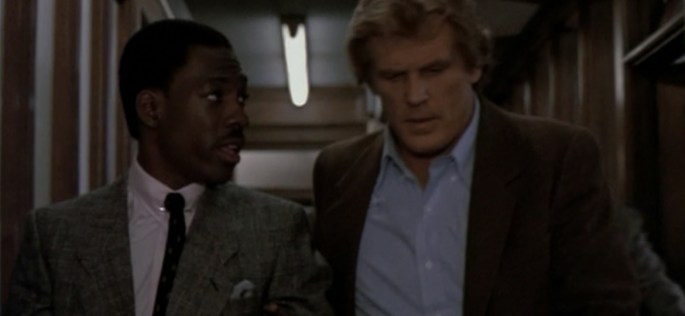
Truly great “buddy movies” are very hard to find these days, so I find myself often returning to the classics of the genre, with the totally terrific 1982 action-comedy 48 Hrs. continually leading the way. With dynamite chemistry between Nick Nolte and Eddie Murphy (in his big-screen debut), macho-man director Walter Hill was armed with a superb screenplay that he co-authored along with Roger Spottiswoode, Larry Gross, Steven E. de Souza, and Jeb Stuart, and he brought the same sense of hard-charging action to all of the set-pieces that he had become known for during the 70’s with his prolific output. Marking the producing debut for future genre overlord Joel Silver, the narrative was fast and loose, with big laughs running parallel to big stunts and shootouts, while the interplay between Nolte (as a crusty cop) and Murphy (as a convict) really helped to elevate the film beyond what it might have been with different actors in the lead roles. The great supporting cast includes an oily James Remar, Annette O’Toole, David Patrick Kelly, Sonny Landham, Brion James, and Jonathan Banks(!). James Horner’s score was big and magnificent, Ric Waite’s cinematography appropriately rugged and gritty, and the tight editing by Bill Weber, Mark Warner, and Freeman Davies kept the film moving at a fast clip.

2

Helping to revitalize the “buddy cop” genre after films like Busting, The Super Cops, and Freebie and the Bean exploded on the scene in the 70’s, the excellent work done by all of the creative parties on 48 Hrs. would go on to inspire future efforts like Lethal Weapon, Midnight Run, Beverly Hills Cop, and Rush Hour, with many imitators coming and going along the fringes. The film spent a while in development, with various writers and directors all taking shots at the material before Hill settled down to roll cameras; Clint Eastwood was attached to star for a while as well. This is a timeless film. Sure, it was made with an 80’s aesthetic, but because the script is genuinely witty and there are actual stakes to the plot, you become immediately invested, while truly liking the leads and wanting to see them succeed. Nolte and Murphy knew exactly how to play off of one another, resulting in an unlikely pairing that has now become something of cinematic legend. And for Hill, it’s yet another reminder of how sturdy a filmmaker he was in his heyday; his entire body of work is worthy of reconsideration. A critical success and box office hit, this is one of Hill’s most overtly entertaining films, and a true call-back to a different type of action blockbuster.

1

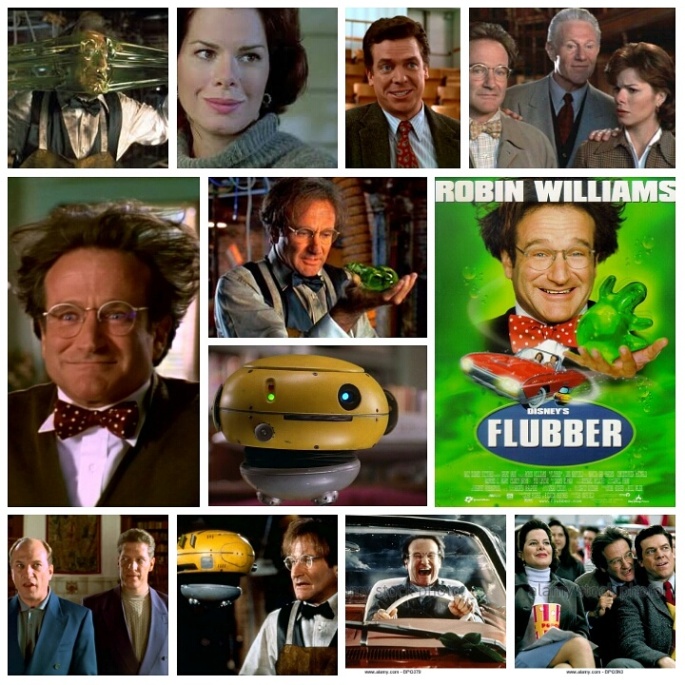
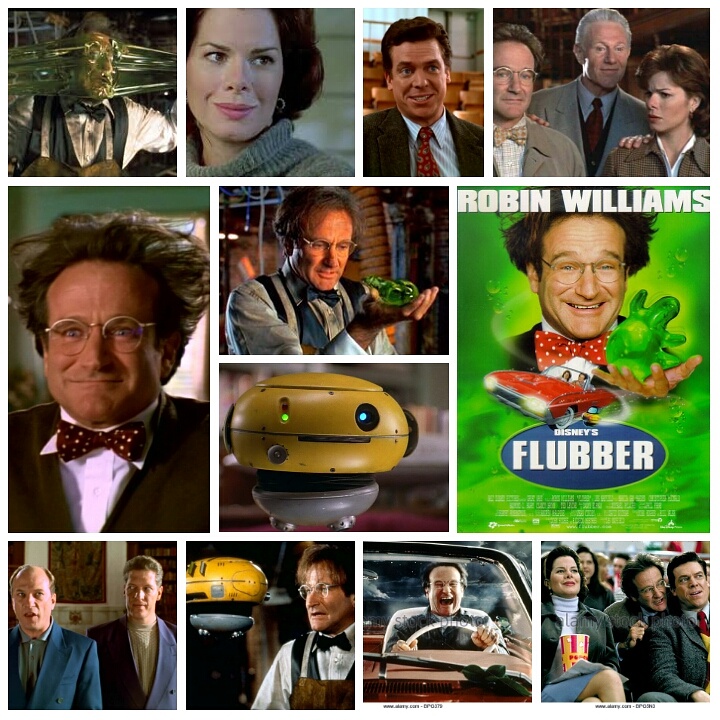
Disney’s Flubber: A Review by Nate Hill 

A remake of an old black and white Disney flick called The Absent Minded Professor that has long since gotten a bit stale, Flubber took all the best elements of that and breathed new 90’s life into the premise, most of the pep in its step coming from star Robin Williams. Keep in mind it was a critical bomb though, which just doesn’t make a shred of sense to me. It’s fun, lighthearted, hilarious and just a bit raunchy in places where it can pull it off. For whatever reason, it didn’t sit well with anyone other than fans like me who will furiously shove a copy in your face if we hear that you haven’t seen it. Williams is college professor Philip Brainard, who is so absent minded it borders on dementia.  He leaves his lovely fiance (Marcia Gay Harden) at the alter TWICE, prompting the advances of irksome college dean Shooter Mcgavi- I mean Christopher Mcdonald. He’s on a quest, you see, an obsessive quest to find the formula for… something. That something turns up after a destructive whirlwind of disasters in his basement lab, and in the form of Flubber, a lovable ball of green goo, infected with incurable ADHD and an inexhaustible sense of humour. While the utter the life of the party, Flubber does have its practical uses, such as making cars fly and turning the hopeless varsity basketball team into a bunch of flying Tasmanian devils who nail every dunk. This all gets the attention of insidious local philanthropist and lowlife Chester Hoenicker (Raymond J. Barry) who greedily wants the discovery for his own. He sends his two goons Smith (Ted Levine) and Wesson (Clancy Brown) to rob Brainard of his precious sentient mucous, which turns into one of the most hilarious displays of slapstick comedy since the Three Stooges. Oh, did I mention Williams has a little flying UFO sidekick named Weebo, who has a perfect GIF reaction to everything, before GIF’s were even a thing? So much to love about this little classic. Williams is his usual buoyant self, with some of his trademark razor focus diminished in favor of doe eyed, vacuous forgetfulness that would make Jason Bourne guilty for ever whining about his predicament. Special effects are top drawer too, Flubber would look dapper in Blu Ray if they ever felt so inclined as to release one, not to mention aforementioned airborne automobiles and dear little Weebo. Can’t give enough glowing praise to this little treasure, and hiss enough venom towards those sourpuss critics who assaulted it. Flubber for the win.   

B Movie Glory with Nate: Pawn

Pawn is another gift from the assembly line of slightly muddled second tier crime dramas, cobbled together with elements of greats from yesteryear, and barely held together at the seam by acting titans who have fallen on hard times chasing that almighty paycheque. That’s not to say it’s bad (although plenty of its breed are woeful), but simply inconsequential and forgettable. Starting off with a simple diner robbery that will inevitably spiral beyond control, we meet a band of clueless petty thieves lead by Michael Chiklis, doing his utter best with a silly cockney accent that has no reason to exist here. Little do these geniuses know, the diner they picked to lift happens to be a front for the Russian mob, setting off a chaotic chain of events that could end in all their deaths. The mob panics, and brings in everyone they can to clutter things up. Two corrupt cops show up, one inside the diner, played by Forest Whitaker, looking like he had some trouble understanding his portion of the script, and one outside, played by Marton Csokas who is underused a lot it seems. Common shows up as a hostage negotiator of all things, which made me chuckle. Stephen Lang is dangerously quiet as the restaurant owner and strong arm of the Russians. He hires a chatty Ray Liotta to hold one of the thieves wives (Nikki Reed) hostage and appear vaguely menacing until everything blows over. So we have scenes of him talking to her in cyclical metaphors interspersed with all the intrigue going down at the diner, and it all amounts to… what, exactly? Well, you’ll have to take a look for yourself, but the while thing seemed rather pointless to me. 

PTS Presents EDITOR’S SUITE with MARK GOLDBLATT Vol. 2

Goldblatt v2

goldblatt

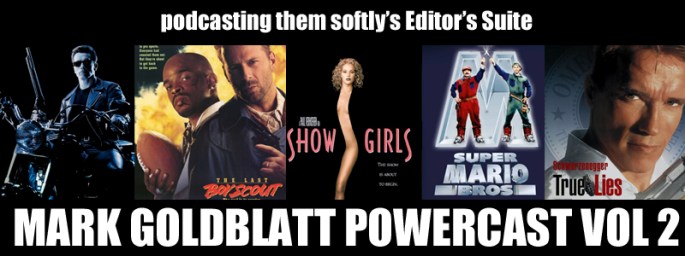
Podcasting Them Softly is incredibly excited to present PART 2 of our epic conversation with veteran film editor Mark Goldblatt! Up for discussion — his work on James Cameron’s Terminator 2: Judgement Day (aka one of the greatest movies ever made), Tony Scott’s The Last Boy Scout (one of our all-time favorites!), the off-the-wall big-screen video game adventure Super Mario Bros., Cameron’s spectacular action-comedy True Lies (try getting this one made today…!), Paul Verhoeven’s extreme cult classic Showgirls, and Verhoeven’s bold and bloody sci-fi satire Starship Troopers. This is yet another fabulous and informative chat with a true legend in the industry. And just wait – there’s still one more episode with Mark coming in the near future….! We hope you enjoy!

CONSTANTINE – A REVIEW BY J.D. LAFRANCE

constant

Constantine (2005) marked the feature film debut of music video director Francis Lawrence who, judging by the look of this movie, would like to follow in the footsteps of David Fincher. For his first time out, Lawrence takes on the daunting task of adapting the excellent comic book, Hellblazer. Its main character, John Constantine first appeared in the pages of Swamp Thing, during an illustrious run by Alan Moore. Eventually, Constantine got his own series with the launch of DC Comics’ Vertigo line. Jamie Delano was the primary writer and fleshed out the character’s backstory, his friends (like Chas the cabbie) and family. These stories typified late 1980s comic book horror and provided a bridge between Moore and the next creative heavyweight to tackle the character, Garth Ennis. His run on Hellblazer is where the movie gets most of its material from. Constantine is a chain-smoking, hard-drinking guy suffering from terminal lung cancer. He becomes embroiled in a complex war between Heaven and Hell with humanity caught in the middle.

The movie moves the comic’s setting from London to Los Angeles with John Constantine no longer being a blond-haired Englishman who looks like Sting to a very un-British-looking Keanu Reeves. The opening sequence introduces Constantine as an expert demon hunter trying to get back in with the good graces of God and the way he figures it, buy his way back into Heaven, but it isn’t that easy. We meet him as he exorcises a nasty demon from a young girl (a snazzy CGI updated riff on The Exorcist) while his twentysomething sidekick, Chas (Shia LeBeouf) waits in the car and perfects his Travis Bickle routine. Despite these cliches, this introduction is quite impressively shot and Lawrence successfully establishes this supernatural world and wisely limits Reeves’ dialogue, conveying most of what we need to know through the visuals.

Angela (Rachel Weisz) is a police detective whose twin sister has just died, committing suicide in a psychiatric hospital. Angela suspects foul play and this leads her to Constantine. They learn that demons are finding a way to crossover into our world and it has something to do with the Spear of Destiny (the weapon used to kill Jesus) being instrumental in summoning the son of Satan. To make matters worse, Constantine is rapidly dying from lung cancer and this gives his mission a certain sense of urgency.

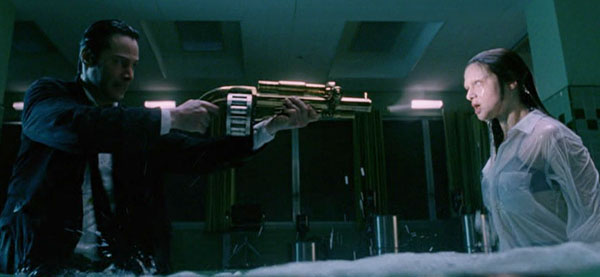
Fans of the comic book are probably not going to like this movie. Constantine is supposed to be world-weary, a sarcastic drunk and womanizer but Reeves doesn’t quite pull it off. He presents a more sanitized version of the comic book character and even that feels forced. Another major betrayal of the character is having him wield a gun (a cool-looking crucifix shotgun), something that the Constantine of the comic would never do. Guy Pearce or Clive Owen would have been a much better choice to play Constantine.

Rachel Weisz is also miscast as Constantine’s potential love interest. Her line delivery throughout the movie is flat and lacks passion. She has zero chemistry with Reeves (didn’t they learn anything from Chain Reaction?) and someone like Fairuza Balk or even Drea DeMatteo would have been much better in this pivotal role. On the plus side, alternative rocker Gavin Rossdale plays a very dapper Balthazar who looks like he stepped right out of a GQ photo shoot. He has a lot fun chewing up the scenery and his confrontation with Reeves is one of the highpoints of the movie.

Lawrence certainly knows how to establish atmosphere and does an excellent job of presenting a seedy, Los Angeles underworld populated by bars filled with demons, dilapidated apartments and grungy city streets slicked with rain. Thankfully, he doesn’t fall into the trap of shamelessly ripping off Blade Runner’s (1982) dystopic cityscape. If anything, his vision of Constantine’s world is like an episode of the television show Angel on big-budget CGI steroids. He also is able create an effectively creepy mood throughout. For example, there’s a nice, throwaway scene where Constantine and Angela are on a city street when all the lights systematically go out as a slew of nasty, winged demons swarm all over them.
constant2Despite the miscasting of Reeves and Weisz in the two main roles, Lawrence’s take on Constantine is actually quite entertaining, even more so if you haven’t read the comic book. However, fans of the series will have problems with the major liberties the filmmakers have taken with the characters – especially Constantine and Chas. Like most comic book adaptations, this film only sprinkles certain elements from the source material, just enough to vaguely resemble it while watering it down for mainstream consumption. It’s a shame because in the right hands, Constantine could have been more like Hellboy (2004) instead it’s closer to the flawed, missed opportunity of The Punisher (2004).

JAMES FOLEY’S GLENGARRY GLEN ROSS — A REVIEW BY NICK CLEMENT

3

Al Pacino. Jack Lemmon. Ed Harris. Alan Arkin. Kevin Spacey. Bruce Altman. Jonathan Pryce. Jude Ciccolella. Alec Baldwin. Glengarry Glen Ross. All director James Foley had to do was point his camera and shoot. David Mamet adapted his own blistering play for the screen with a tremendous sense of vulgar energy and edgy verve, so all that was required was someone to capture the words and do little else. But instead, because Foley has quietly fashioned himself into one of the most underrated filmmakers of my lifetime, he brought his own sense of macho style to this testosterone-fueled war of the words, and as a result, the film still feels every bit as incendiary now as it likely did upon first release as a Pulitzer winning play back in 1983. Showcasing the desperate and volatile lives of a group of Chicago-based real estate salesman, this is one of those special narratives that provides every single actor with a serious chance to shine on multiple occasions, while allowing for one of the most show-stopping single scenes of character interaction that’s ever been captured on film to take place (the bit with Baldwin and his hostile threats to the entire group). After the agents come under fire for lack of results, the story’s pace becomes even quicker, with each man doing their best to not be fired by the end of the week. Words are flung like extra-sharp daggers all throughout this whip-fast and supremely observed character study, with Mamet basing certain aspects of the office life depicted on screen on his own experiences working in a real estate office when he was just starting his writing career.

2

In working with the great cinematographer Juan Ruiz Anchia, Foley was able to craft a casually menacing visual atmosphere, shooting through glass with streaks of bold yet smeared color, and lots of rain drops, with an uncertain vibe thanks to the jazzy and cryptic score from James Newton Howard. Howard Smith’s judicious editing kept an extremely fast pace, which is all the more a challenge when a film is as dialogue heavy as this one. And what can one really say about Mamet’s perverse sense of humor and his caustic worldview? Each character in Glengarry Glen Ross is given their own distinct voice, despite everyone letting the F-bombs fly with gusto; few other writers have understood the value and meaningful nature of the word “fuck” the way Mamet does. What you end up hearing all throughout this movie amounts to a form of brutal, tough-guy poetry, and it’s the way that there’s always this sense of honesty and concrete logic to Mamet’s writing that keeps it solidified even when it becomes highly stylized. Despite not catching on at the box office, Foley’s magnetic piece of filmmaking has become a well deserved classic as a result of the VHS and DVD era, and has inspired any number of motion pictures moving forward. Lemmon won the Volpi Cup for Best Actor at the Venice Film Festival, while Pacino nabbed Oscar and Golden Globe nominations for Supporting Actor (while winning Best Actor for Scent of a Woman). Many consider Baldwin’s extended cameo to be his greatest screen achievement. This is a piece of work that simply gets better and better as the years progress.

1

Marcus Nispel’s Conan The Barbarian: A Review by Nate Hill 

I’ve never seen any of the original Conan films with Ahnuld (I know, get the torches and pitchforks), so I don’t really have anything to compare Marcus Nispel’s remake to, but on it’s own I found it to be a solid, servicable sword and sandal outing with a welcome hard R rating and some neat work from legendary actors. Jason Momoa was fresh of his Game Of Thrones stint, jumping right into a very similar role as iconic Conan, a musclebound soldier of fortune on a grisly quest to exact revenge against warlord who decimated his village when he was but a pup. Momoa exudes a different aura than I imagine Schwarzenegger must have, a stoic, silent tunnel vision style as opposed to posing theatrically. It works, but it’s a new Conan from the one I’ve seen in many a trailer and snippet on tv, that’s for sure. My favourite part of the film is the extended prologue, which just somehow feels like the most grounded part, whereas everything else is almost cartoonish, reminding me of stuff like The Mummy. The opening is terrific though, introducing us to a young Conan (Leo Howard) and his father Corin (Ron Perlman, who else?), living in their nomadic village on the edge of nowhere. Enter tyrannical villain Khalar Zym (Stephen Lang) and his super freaky daughter Marique (Ivana Staneva), played later down the line by Rose McGowan, before she got all lame on us. Laying waste to Conan’s home and killing countless people including Corin, he is left to breed fearsome vengeance for years, until he sets out into the wide world on a journey to find Zym and mess him up real good. The story is standard, the action is well staged by Nispel, who has a golden eye for spectacularly orchestrated displays of violence in his films, and pulls no punches here. He also casts roles on the nose, and has for years. Lang is in overdrive, practically frothing at the mouth and turning Zym into something scary indeed. McGowan is straight out of a Takahashi Miike film, all bone white hissing snarls and needle sharp appendages, a hellcat with supreme bloodlust that you just don’t want to encounter. Momoa has the brawn for Conan, but a few extra syllables of dialogue wouldn’t have hurt, if only to round the guy out some more and give Jason something to say, which he rarely gets to do in his work it seems. I think parts of the film, especially the finale, were somewhat ruined for me by the catastrophically bad 3D they used (when oh when will they learn with the damned 3D), so I feel like a Blu Ray revisit is nigh, in which I can fully appreciate some of the set pieces without being reminded of a popup book. It’s a good time at the movies, but like I said, I have nothing to compare it to as far as Conan goes.