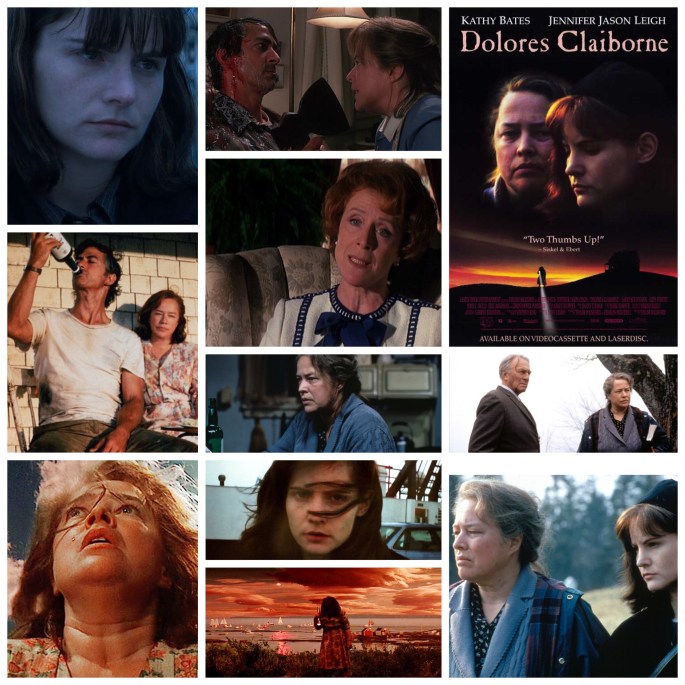
Stephen King’s Dolores Claiborne

Stephen King’s Dolores Claiborne is one of those ones I held off on watching for years, for whatever reason. It’s an absolute corker though, a well written horror story of the most human kind, finding the darkest corners of the psyche and blowing them up full scale for a morbid effect that’s altogether far more unsettling than any ghosts or supernatural stuff. Ominous grey clouds roll in over picturesque Maine (actually Nova Scotia, the sneaky bastards), as former housewife and in-home nurse Dolores (Kathy Bates in one show stopper) is accused of a heinous crime: murdering her sick and elderly employee, a rich old goat (Judy Parfitt) who’s put her through decades of hard labour. Dolores’s daughter Selena (Jennifer Jason Leigh) returns home from a high profile journalist gig in the big Apple just in time for old wounds to be seared open. As a highly biased Detective (devilish Christopher Plummer) grills her on every aspect of the case, the narrative arcs back to Selena’s childhood years with Dolores and her monster of a father (David Strathairn, well out of his comfort zone and loving it), a tyrannical alcoholic whose ‘accidental’ death casts a heavy shadow on Bates, a pattern to be deciphered deliciously by both Leigh and the viewer. Things are not only not what they seem, but just about as far away from what we’re presented as possible, and when the final curtain lifts, it’s a wicked series of revelations to look back upon. King is undeniably the master of all things horror under the sun, but what he really excels at is how the lines blur between external demonization, the forces that exist out there in the night and the simple fact that humans are capable of despicable acts, whether by design or influence. It’s not a pretty tale, especially during the lurid, violent third act, but what a masterfully told tale it is, with expert director Taylor Hackford pulling at the reins, Danny Elfman undoing his mischievous aesthetic for a score that’s deep and dark, cinematographer Gabriel Beristain probing the inlets and harbours of eastern Canada with a surefire lens that creates atmosphere to spare, and every actor firing on all cylinders, including nice sideline work from Eric Bogosian, Ellen Muth, Bob Gunton, Wayne Robson and John C. Reilly. It’s interesting to observe the contrasts in visual style as well: For the most part, this is a moody, misty locale played dead straight, with no touches of the surreal or ‘out there’. Then in the third act there’s this crazy sequence during an eclipse (which bares uncanny similarities to this year’s gem of King adaptation, Gerald’s Game, I might add) that goes full on horror mode, dials down the realism and reminds us that this is after all a Stephen King story, and at some point things are liable to get weird. This one aims to please and prickle the senses of even the most stoic fan of deranged thrillers, and is a terrific funhouse to get lost in.

-Nate Hill

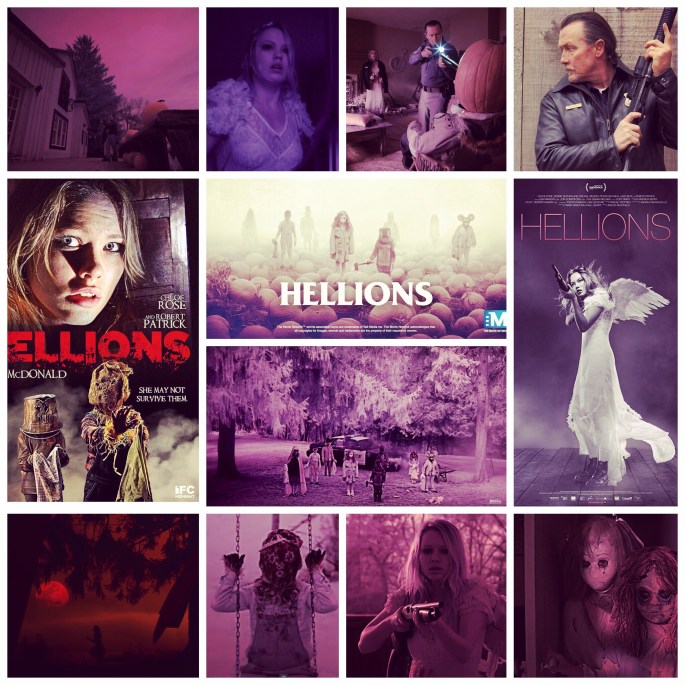
B Movie Glory: Hellions

It’s always frustrating when a horror flick ‘almost’ gets there, like it has a handful of real cool qualities that just sort of get buried by a heap of shitty cliches and and a middle section that drags like a chain. Hellions is such a film, a low budget, atmospheric shocker that I feel would have been better suited to a twenty minute short film format that the usual ninety minute time slot that feature horrors sit in. There’s just not enough of what’s there to go around and a lot of it ends up feeling thin and sort of stretched, like butter scraped over too much bread (seewhatididthere). The film focuses on a teenager (Chloe Rose) who is forced to fight through a Halloween night from hell when something takes over the town, something accompanied by a gauzy, unsettling mauve colour filter and an impressive original score filled with eerie hooting and wailing. Atmosphere is key here, there’s loads of it and they’ve done a fantastic job with it, to their credit. It’s just everything else that goes off the rails or doesn’t seem to fit: Chloe is hunted by weird little munchkins in Halloween costumes, there’s hellish intonations of a pregnancy gone wrong tied into the town’s plight, and a bunch of such mumbo jumbo, with a noisy climax that is only discernible as excessive commotion. Too much is too much, a pearl of wisdom these filmmakers could have heeded better. Grizzled veteran Robert Patrick helps her shoot her way out of the situation as the local Sheriff, a film always gets brownie points for simply having him there. It’s sad because what does work here, really works. The score is truly bone chilling, and the visual palette once dark forces show up is dreamy, unsettling and very creative. The opening shot of future Chloe walking up to the window of a maternity ward in a quiet panic, music on cue, is something incredible, and I wish the whole film could have followed suit. There just needed to be less running about, less chirping demonic midgets, less nonsensical hallucinatory gore, for as everyone knows, less is often more.

-Nate Hill

Ceyda Torun’s Kedi

There’s a ton of films out there that explore humanity’s symbiotic relationships with animals, from the innocuous sweetness of Beethoven to the whimsical fables of Babe. Ceyda Torun‘s Kedi is a brilliant Turkish documentary that focuses on the wild, independent street cats of Istanbul, lovable, curious creatures who have shared countless bonds with the city’s residents since the dawn of time. A handful of individual felines are shown in the spotlight, each with it’s own distinct personality, behaviour traits and each connected to their own human caretaker or friend. They roam free along the streets, alleys, bazaars and canals of picturesque Istanbul, a place where the hum of the old world still survives, only recently encroached upon by the inevitable advance of technology and progress, an aspect which the film comments on and one that has a big effect on these animals. The film is structured simply and wonderfully: each vignette tells the story of a cat, through the words of their human companion, the auditory component, and visually we see these people and this place through their eyes and interactions they have with all those around them. It’s a brilliant, hypnotic rhythm, accompanied by the soothing tones of traditional/electronic hybrid compositions from musician Kira Fontana, and effortlessly creates an immersive, unique atmosphere. You don’t have to be a cat lover to appreciate (but if you aren’t, you’re not cool in my books already) the bond these creatures share with their environment, as it’s fascinating in a scientific way as well, to observe the behaviours, each species intrinsically connected to each other through eons of shared existence. These aren’t docile house cats either, they’ve got the nomad gene through years of genetic memory, yet still function as creatures of habit, and as one girl remarks on camera, “when they’re confined in a house indefinitely, they lose their ‘catness’.” They are an integral, essential part of Istanbul’s soul though, as we see the healing power they have on those who are sad or broken, the therapeutic friendship they provide to all around them, and the way in which they rekindle people’s ‘slowly dying joy of life’, as another character observes, a thought which hit a bit close to home as I heard it. Some may consider this a small or inconsequential film, but make no mistake: this isn’t just ‘a cute cat documentary’, it’s a meditation on some of the core elements of our mindsets and action, relationships and perceptions that many have forgotten in the modern world, and a reminder that animals are more than just furry friends, rather they are an influential force of nature that shape and change our world, as well as us, every day. One of the very best of the year.

-Nate Hill

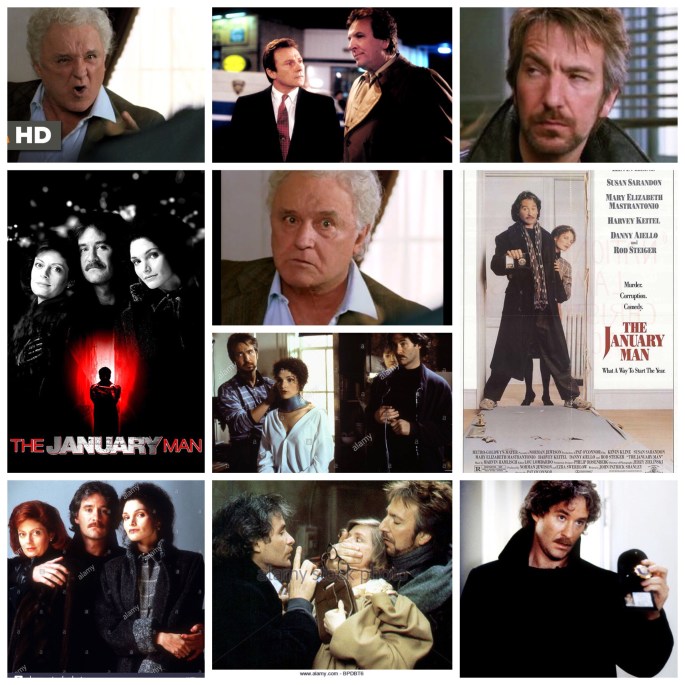
The January Man

If you ever feel the need to define ‘tonally fucked” in the cinematic dictionary (if there was such a thing), you’d find a one sheet of The January Man, a warped, malignantly silly crime/comedy/thriller… something. It dabbles in wannabe screwball farce, serial killer mystery, breezy romance, high profile police procedural and as a result of it’s genre flim-flamming, has no clue what kind of movie it wants to be, and ends up a raging, tone deaf dumpster fire. It’s so all over the place that marketing churned out a bi-polar publicity package that at times seems like it’s advertising two completely different films. I used to see it on the shelf at blockbuster leering out at me like an eerie gothic murder mystery, Kevin Kline and Alan Rickman glowering evocatively off the dark hued cover. In reality it’s something just south of Clouseau, as Kline plays a bumbling, overzealous guru detective who scarcely has time amongst the silliness to hunt down a shave or change of clothes, let alone a murderer. Rickman? His odd, awkward artist friend who vaguely helps with the case but really isn’t necessary to any of the plot threads, and certainly appears nothing like his freaky persona does on the cover, suggestive of a villain. There’s another poster floating around on IMDb that is more honest about what’s in store, Kline perched like a loon in a brightly lit doorway while love interest Mary Elizabeth Mastrantonio peers adorably around his shoulder in true benign comic fashion. The film wants to be both of those aesthetics and more though, wants to have it’s cake, eat it, regurgitate it against the wall and film that, which is at times what it seems like we’re looking at. The police force brings disgraced cop Kline back on the force to catch some killer, while everyone runs about tripping over their shoelaces. Harvey Keitel is Kline’s brother, now a police commissioner, Danny Aiello the precinct captain, Susan Sarandon Kline’s estranged wife, and so on. Rod Steiger causes a hubbub as the mayor, staging a terrifying meltdown in one scene that goes on for minutes, a curiously unedited, noisy tantrum that dismantles what little credibility and structure the film had to begin with and seems out of place, even by the barebones standards set here. This is a good one to watch if you yourself are making a film and want to see an example of what not to do in terms of deciding on and cementing a certain style, instead of carelessly chucking in every haphazard element on a whim like they did here. Equivalent to a grade school theatre play.

-Nate Hill

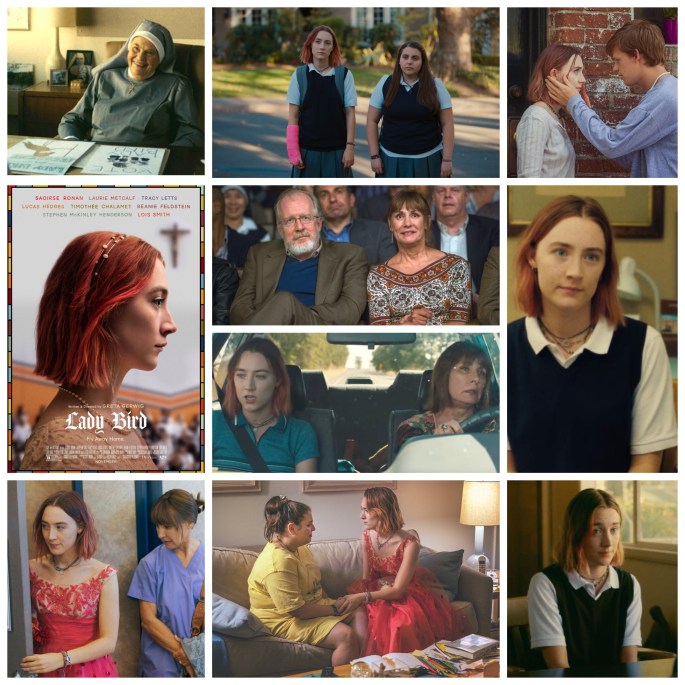
Greta Gerwig’s Lady Bird

Greta Gerwig’s Lady Bird soars on wings of beautifully blunt dialogue, a traditionalist comic of age story that just somehow feels endlessly fresh with each new scene, three miraculous central performances from Saoirse Ronan, Beanie Feldstein and Laurie Metcalf, plus an editing style that creates lovely organic momentum and never falters for a beat. Coming of age stories are usually structured fairly similar across the board, and although all the recognizable chips are in place here, Gerwig has just managed to spin it in a way that still seems fresh and surprising. When you see that a film stars Saoirse Ronan, you pretty much know that it’s going to be an interesting project, if not an instant classic, she just seems to be a magnet for great scripts. The actress is on a career high here as Christine, or ‘Lady Bird’, her self given name, a feisty high school girl navigating the slippery terrain of being a teenager in a Sacramento Catholic high school. Exploring sex and relationships for the first time, clashing with her hotheaded mother (Metcalf in a fiery, complex and compassionate turn that practically demands an Oscar) over what college she’ll go to after grad (she has her sights set on those lofty east coast boroughs where “writers live in the woods”). Her father (understated, excellent Tracy Letts) is more laid back than her mom’s fire and brimstone approach, but both love her more than anything in their own way. All the restless turmoil and transformative angst of being that age is captured spectacularly by the story, somewhat of an autobiographical take on Gerwig’s own life in the early 2000’s. Broadway actress Beanie Feldstein is especially great as Lady Bird’s best friend Julie, and the scenes between the two have an un-coached, ‘fly on the wall’ realism that’s an admirable feat of acting from both. The film is very episodic, employing a brisk ‘fade in, fade out’ tactic with the editing, but despite that never feels staccato or segmented, all of it’s modest ninety minute runtime a fluid, flowing, near free-form anti-structure, a choice which works wonders and one that Gerwig and team should be very proud of. These types of stories always need a good dose of biting humour, a pinch of sadness and something unique to set them apart, as well as simply being well crafted and authentic. This one blasts off the charts in every category, and is one of the sweetest, most endearing and terrific films all year.

-Nate Hill

Top 10 Performances of 2017

Here we are, the end of another year of amazing films and amazing performances. Even though the box office performance has continued its downward trend, movies in general haven’t satisfied movie goers and Movie Pass has made a huge splash in the lily pond, there are several noteworthy performances that appealed to our roving film critics, Ben Cahlamer and Kyle Jonathan. Here are their favorite 10 performances of 2017 along with honorable mentions.

BEN:

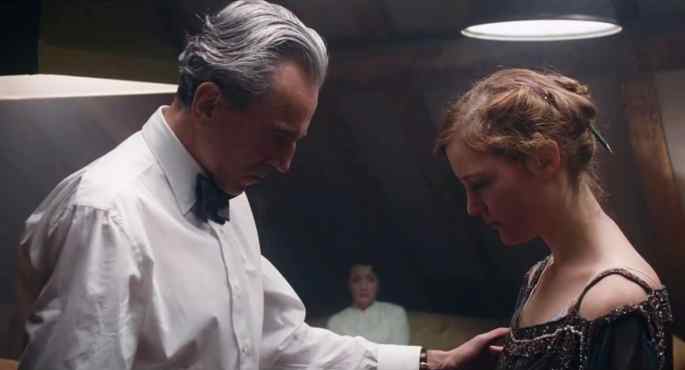
phantom-thread.jpg

  1. Daniel Day Lewis as Reynolds Woodcock in Phantom Thread Although the film is still in a limited release, plenty of critics and LA and New York filmgoers have raved about Daniel Day Lewis’s Golden Globe – nominated and storied turn as a dressmaker in this turn-of-the-century period piece.

Honorable Mention: Barry Keoghan as Martin in The Killing of a Sacred Deer.

Screenshot_2016-11-03_12.07.41.0.0.png

  1. Gal Gadot as Diana/Wonder Woman in Wonder Woman and Justice League. It’s very rare that filmgoers get two performances of the same character in one year from two separate movies, Ms. Gadot’s performance in her solo Wonder Woman film just leapt off the screen. More than her beauty is her intelligence and her empathy for the human race. The fact that she played a larger role in Justice League is just icing on the cake.

Honorable Mention: Bella Heathcoat as Olive Byrne in Professor Marston and the Wonder Women.

novitiate-trailer-watch-video-melissa-leo-film-news.png.644x583_q100.png

  1. Melissa Leo as the Reverend Mother Marie St. Clair in Novitiate. The convent featured in Melissa Betts’ film is a place where young Cathleen (Margaret Qualley) finds herself. Melissa Leo’s Reverend Mother St. Claire runs the convent on a very short leash, holding tradition sacred, despite the Vatican Papers directing her to follow the new order. Her stoicism in the face of adversity and her adherence to what she has practiced all her life is something to be admired.

Honorable Mention: Sally Hawkins as Maud Dowley in Maudie.

7885604.jpg

  1. Robert Pattinson as “Connie” Nikas in Good Time. In one of the most brilliant of independent films of 2017, Robert Pattinson breaks out of his Edward Cullen role from the Twilight film series into a more dramatic and adult role. As “Connie,” he is always looking for his next angle. Between trying to hide from the police, trying to get enough scratch to get his brother out of jail and just trying to keep himself sane, Pattinson’s tour de force performance is one for the ages.

Honorable Mention: Richard Jenkins as Giles in The Shape of Water.

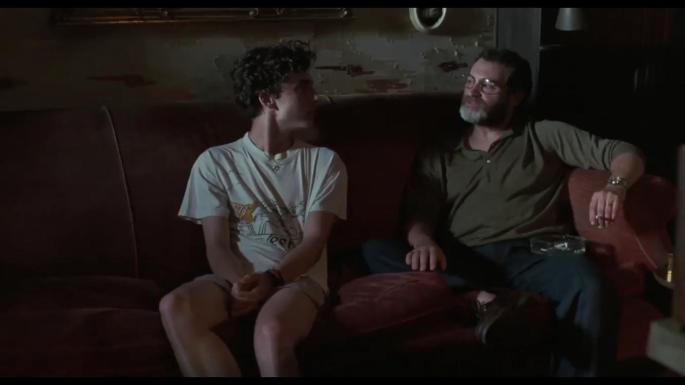
michael-stuhlbarg-and-timoth-e-chalamet-in-call-me-by-your-name-2017.jpg

  1. Michael Stuhlbarg as Sam Perlman in Call Me by Your Name. Let’s be clear that this is a film actors dream of being able to participate in. Timothée Chalamet and Armie Hammer are at the center of the film and both are worthy of the accolades they have already received. However, it is Michael Stuhlbarg’s widely praised performance as Sam Perlman that truly gels the film together. I suspect he will be among a very few select actors to be nominated by the Academy for one single scene.

Honorable Mention: Patrick Stewart as Professor Charles ‘X’ Xavier in Logan.

Finally, in the Year of the Mustache, I extend honorable mentions to Kenneth Branagh for his exquisite mustache as Hercule Poirot in Murder on the Orient Express and to Henry Cavill for his lack of a mustache, which was digitally removed for his reshoots as Superman in Justice League and the talk about it on social media. Well done, lads.

KYLE:

lady-macbeth-film

  1. Florence Pugh – Lady Macbeth

Pugh’s performance is one of the year’s best surprises.  Tackling complex themes of female empowerment, sexual freedom, and class entitlement, Pugh’s total commitment to the role is dangerous and entrancing.  This is a stunning turn that shows how much promise this young actress has and I can’t wait to see what she does next.

screen-shot-2017-08-29-at-2-47-51-pm.png

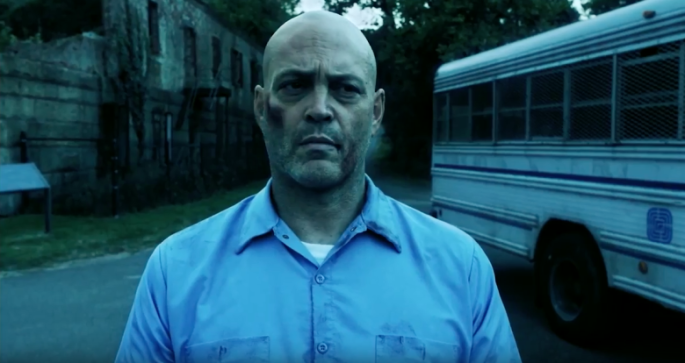
  1. Vince Vaughn – Brawl in Cell Block 99

Vaughn started in comedy and appeared to have pigeonholed himself into forgettable roles in which he plays the charismatic underdog.  True Detective season 2 showed exactly how much skill he has and I was eager to see him push his limits.  His quietly ferocious role in Brawl in Cell Block 99 is exactly what I was hoping for.  This is a landmark performance that will undoubtedly go overlooked by many viewers.  S. Craig Zahler’s furious grindhouse homage is an unrelentingly brutal time and Vaughn dominates every one of his scenes.  This is not to be missed, an almost mythological performance.

20f260f94be565e5ea1188b66d3d27754647e0ec.jpg

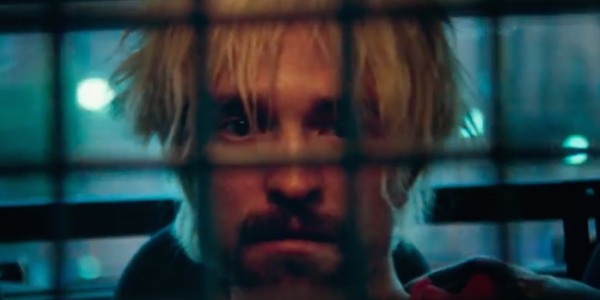
  1. Robert Pattinson – Good Time

Our first tie!  Pattinson has really developed into something special since his Twilight days.  Not only is Good Time one of the best films of the year, I am hoping that Pattinson is able to nab an Oscar nom for his performance.  Connie is a narcissist who is able to turn the world to his desires….yet unable to escape the darkness of his predicament.  Good Time is more of an experience, a neon soaked love note to Breathless and After Hours and it simply does not work without Pattinson’s bravura at the center.

0324carolebethuel01.jpg

  1. Kristen Stewart – Personal Shopper

Another Twilight veteran, Kristen Stewart has shown that she is one of the most talented actresses working today.  Pairing with auteur Olivier Assayas, her performance in Personal Shopper has been lauded by film critics across the globe.  A murder mystery, ghost story, and heart breaking meditation on loss, this is one of 2017’s best and Stewart’s endearing role as a medium searching for her brother’s spirit remains the epitome of acting prowess for the year.

Screen Shot 2017-09-06 at 3.35.32 PM.png

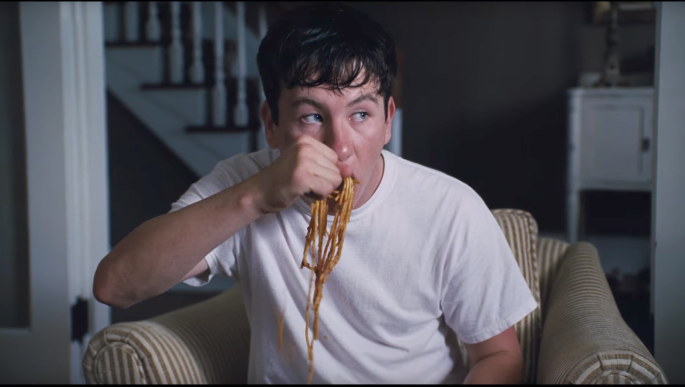
  1. Barry Keoghan – The Killing of a Sacred Deer

Yorgos Lanthimos’ latest continues his trend of divisive, darkly comical, and utterly terrifying storyteller.  Barry Keoghan’s supporting role as Martin is simply astounding.  He has two monologues that absolutely dominate the entire film, producing some of 2017’s most memorable cinematic moments.  Part myth, part morality tale, and always uncomfortable, The Killing of a Sacred Deer is my favorite film of the year and Keoghan gives my favorite performance.

Honorable Mentions – Pekka Strang – Tom of Finland, Michael Fassbender – Song to Song, Keanu Reeves/Jim Carry – The Bad Batch, Gil Birmingham – Wind River, Tiffany Haddish – Girl’s Trip

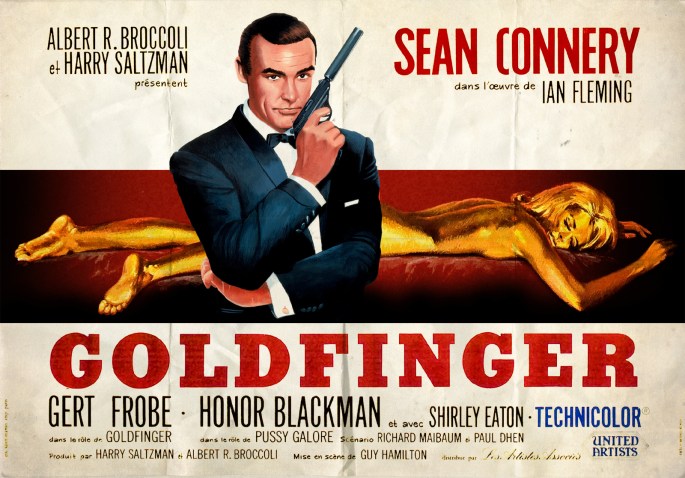
For Your Ears Only: GOLDFINGER

Image result for goldfinger poster

Frank and Tom are back with Podcasting Them Softly’s James Bond series, For Your Ears Only discussing Guy Hamilton’s GOLDFINGER and its impact on the franchise moving forward.

“It’s time for the Jedi… to end.” A spoiler review of Star Wars: The Last Jedi – by Josh Hains 

Thirty-seven years ago, The Empire Strikes Back subverted audience expectations by taking the story and characters in new directions that, for lack of better word, no one saw coming. Han Solo was frozen in carbonite late in the movie, and Luke Skywalker lost his right hand in the lightsaber duel with Darth Vader that revealed his biological connection to the man beneath the mask. Empire itself had a divided reaction, with some viewers angry that Darth Vader was Luke’s father, or that Han had been frozen, but thanks to the lack of internet in 1980, this division was nowhere near as caustic as it is now. Today, The Empire Strikes Back is lauded for the geoundbreaking risks it took in evolving the characters and story, and one would assume the risks involved in the storytelling of The Last Jedi would be received similarly. Oddly enough, it’s even more divisive than any if us could have expected, and thanks to the social media’s manner of letting every voice be heard no matter how asinine it may be, this division is infinitely more caustic. 

I know a lot of my fellow Star Wars fans went into The Last Jedi with their own fan theories and fictions bouncing around in their minds, and their expectations understandably high. This is Star Wars after all. It’s okay if you didn’t like the movie for a variety of reasons, from the performances to the CGI to the score. It’s also perfectly okay if you loved this movie for the same reasons other seem to hate it. However, calling a movie “bad”, or claiming it has ruined your childhood because your fan theories didn’t pan out, isn’t well thought out, rationally minded criticism, and it doesn’t make a movie bad. That’s not how cinema works. This hyperbole laced tantruming makes me appreciate the rational conversations I’ve had with others who don’t like the movie, or don’t like it as much as I do, all the more. Remember folks, it’s just a movie. 

I have seen The Last Jedi twice. Once for the experience of seeing the movie for the first time loud and writ large, the second to see if my reaction was strengthened or weakened by an additional viewing. After the second viewing, I came to the conclusion that most of the problems I had with the movie had dissappeared, and I was left with just one gaping problem that I simply can’t overlook. Thankfully, the rest of the movie built around that singular problem more than make up for the damages. I am happy to report that while it may not be my favourite entry in the series (I don’t know which one is, to be truthful), it is certainly beloved by me. Warts and all, I adore this motion picture. 

By now you should may know the basic plot of the eighth film in the Skywalker saga. Poe Dameron (Oscar Isaac), and General Leia Organa (the late Carrie Fisher) are battling the First Order in wide open space. Finn (John Boyega) and newcomer Rose Tico (Kelly Marie Tran) head to a gorgeous new locale known as Canto Bight to acquire assistance in fighting the First Order. And Rey (Daisy Ridley) is confined to Ahch-To, trying desperately to persuade a reluctant Luke Skywalker (Mark Hamill) to join the battle against The First Order and put an end to Supreme Leader Snoke (Andy Serkis) and Kylo Ren’s (Adam Driver) reign. That’s not saying too much, is it? 

The gaping problem I was referring to in an earlier paragraph comes in the form of the plot thread involving Finn and Rose and their adventure of sorts to Canto Bight. The events that unfold here are do not affect the main narrative of the movie, and only seem to affect the characters involved in this plot in the moment, or soonly. I appreciate being shown how rich war profiteers live, how their intense gambling and partying also seem second nature to them by the time we meet them. It’s a shame then that their modes of gambling are too Earth-like, lacking any real imagination or creativity. 

I also took issue with the character of Rose, who I didn’t find to be a compelling character, and whose portrayal by Kelly Marie Tran lacked chemistry between herself and John Boyega (Finn). Had Rose’s arc ended shortly after she stuns Finn into a brief slumber, I would have been okay with it, but because Rian Johnson instead pairs her up with Finn, I felt like I was forced to suffer through watching a vaguely interesting character without a worthwhile character arc, who is as out of place in this movie as a Deadpool cameo would have in this year’s Logan. The forced and otherwise jarring and completely unnecessary romantic desire Rose holds for Finn (but he doesnt seem to reciprocate in the slightest), conjured up on the salty grounds of Crait that causes her to crash her speeder into his while he’s attempting a suicide run against a powerful First Order weapon, is as asinine as saying this movie ruined your childhood. It’s all fine entertainment, but this sole portion of the movie is its greatest weakness. 

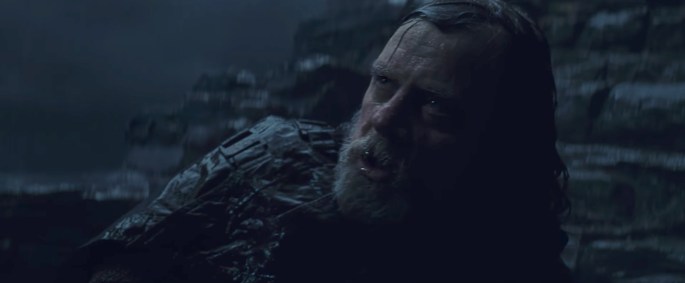
There’s plenty of greatness to be found elsewhere, but for my money’s worth, I found true greatness in three places. Firstly, the elongated opening scene, once the action kicks in after a couple of humourous gags, is a frontrunner for the best space battle in Star Wars film history, especially becausit contains a brilliant white knuckling sequence where Rose’s soon to be deceased sister Paige (Veronica Ngo) has to recover a device that will allow her to drop the enormous payload of bombs aboard the ship she’s on. Secondly, there is the popular throne room fight scene around three quarters of the way through the movie, wherein Rey and Kylo face off against Snoke’s well trained private guards. It’s a dazzling, inventive, and thrilling action scene, bound for iconic status in no time at all. And lastly, there’s the scene near the very end of the film in which Luke Force projects himself onto the battlefield of Crait to distract Kylo while the remaining Resistance fighters escape the clutches of the hell bent Sith, before Luke is revealed to still be on Ahch-To. He seemingly becomes one with the Force and peacefully vanishes into the air. That he does so to the tune of John Williams’ beautifully composed and iconic Binary Sunset track from Star Wars (Episode IV: A New Hope), made the moment all the more moving and powerful for this fan, whose favourite scene in Star Wars is in fact the original Binary Sunset, though this scene sure gives it a run for its money.  

In the opening line of his review for Star Wars Episode I: The Phantom Menace, the late movie critic Roger Ebert offered up the following sentiment: “If it were the first “Star Wars” movie, “The Phantom Menace” would be hailed as a visionary breakthrough. But this is the fourth movie of the famous series, and we think we know the territory; many of the early reviews have been blase, paying lip service to the visuals and wondering why the characters aren’t better developed. How quickly do we grow accustomed to wonders,”. That quote has stuck with me like dirt under my fingernails, and I can’t help but apply its unwavering logic to Star Wars: The Last Jedi. My mind wanders to the finale of my favourite movie of last year, La La Land, which posed a delightful what-could-have-been sequence, an alternate timeline if you will. Perhaps in another timeline of our human history, The Last Jedi was the first of the Star Wars movies, lauded by many for generations to come, and praised for the risks it took in creating something new and unique. Perhaps not. Who knows what could have been. 

“This is not going to go the way you think!” A spoiler free review of Star Wars: The Last Jedi – by Josh Hains  

Thirty-seven years ago, The Empire Strikes Back subverted audience expectations by taking the story and characters in new directions that, for lack of better word, no one saw coming. Han Solo was frozen in carbonite late in the movie, and Luke Skywalker lost his right hand in the lightsaber duel with Darth Vader that revealed his biological connection to the man beneath the mask. Empire itself had a divided reaction, with some viewers angry that Darth Vader was Luke’s father, or that Han had been frozen, but thanks to the lack of internet in 1980, this division was nowhere near as caustic as it is now. Today, The Empire Strikes Back is lauded for the geoundbreaking risks it took in evolving the characters and story, and one would assume the risks involved in the storytelling of The Last Jedi would be received similarly. Oddly enough, it’s even more divisive than any if us could have expected, and thanks to the social media’s manner of letting every voice be heard no matter how asinine it may be, this division is infinitely more caustic. 

I know a lot of my fellow Star Wars fans went into The Last Jedi with their own fan theories and fictions bouncing around in their minds, and their expectations understandably high. This is Star Wars after all. It’s okay if you didn’t like the movie for a variety of reasons, from the performances to the CGI to the score. It’s also perfectly okay if you loved this movie for the same reasons other seem to hate it. However, calling a movie “bad”, or claiming it has ruined your childhood because your fan theories didn’t pan out, isn’t well thought out, rationally minded criticism, and it doesn’t make a movie bad. That’s not how cinema works. This hyperbole laced tantruming makes me appreciate the rational conversations I’ve had with others who don’t like the movie, or don’t like it as much as I do, all the more. Remember folks, it’s just a movie. 

I have seen The Last Jedi twice. Once for the experience of seeing the movie for the first time loud and writ large, the second to see if my reaction was strengthened or weakened by an additional viewing. After the second viewing, I came to the conclusion that most of the problems I had with the movie had dissappeared, and I was left with just one gaping problem that I simply can’t overlook. Thankfully, the rest of the movie built around that singular problem more than make up for the damages. I am happy to report that while it may not be my favourite entry in the series (I don’t know which one is, to be truthful), it is certainly beloved by me. Warts and all, I adore this motion picture 
By now you should may know the basic plot of the eighth film in the Skywalker saga. Poe Dameron (Oscar Isaac), and General Leia Organa (the late Carrie Fisher) are battling the First Order in wide open space. Finn and newcomer Rose Tico (Kelly Marie Tran) head to a gorgeous new locale known as Canto Bight to acquire assistance in fighting the First Order. And Rey (Daisy Ridley) is confined to Ahch-To, trying desperately to persuade a reluctant Luke Skywalker (Mark Hamill) to join the battle against The First Order and put an end to Supreme Leader Snoke (Andy Serkis) and Kylo Ren’s (Adam Driver) reign. That’s not saying too much, is it? 

The gaping problem I was referring to in an earlier paragraph comes in the form of the plot thread involving Finn and Rose and their adventure of sorts to Canto Bight. The events that unfold here are do not affect the main narrative of the movie, and only seem to affect the characters involved in this plot in the moment, or soonly. I appreciate being shown how rich war profiteers live, how their intense gambling and partying also seem second nature to them by the time we meet them. It’s a shame then that their modes of gambling are too Earth-like, lacking any real imagination or creativity. I also took issue with the character of Rose, who I didn’t find to be a compelling character, and whose portrayal by Kelly Marie Tran lacked chemistry between herself and John Boyega (Finn). Had Rose’s arc ended shortly after she stuns Finn into a brief slumber, I would have been okay with it, but because Rian Johnson instead pairs her up with Finn, I felt like I was forced to suffer through watching a vaguely interesting character without a worthwhile character arc, who is as out of place in this movie as a Deadpool cameo would have in this year’s Logan.  It’s all fine entertainment, but this sole portion of the movie is its greatest weakness. 

In the opening line of his review for Star Wars Episode I: The Phantom Menace, the late movie critic Roger Ebert offered up the following sentiment: “If it were the first “Star Wars” movie, “The Phantom Menace” would be hailed as a visionary breakthrough. But this is the fourth movie of the famous series, and we think we know the territory; many of the early reviews have been blase, paying lip service to the visuals and wondering why the characters aren’t better developed. How quickly do we grow accustomed to wonders,”. That quote has stuck with me like dirt under my fingernails, and I can’t help but apply its unwavering logic to Star Wars: The Last Jedi. My mind wanders to the finale of my favourite movie of last year, La La Land, which posed a delightful what-could-have-been sequence, an alternate timeline if you will. Perhaps in another timeline of our human history, The Last Jedi was the first of the Star Wars movies, lauded by many for generations to come, and praised for the risks it took in creating something new and unique. Perhaps not. Who knows what could have been. 
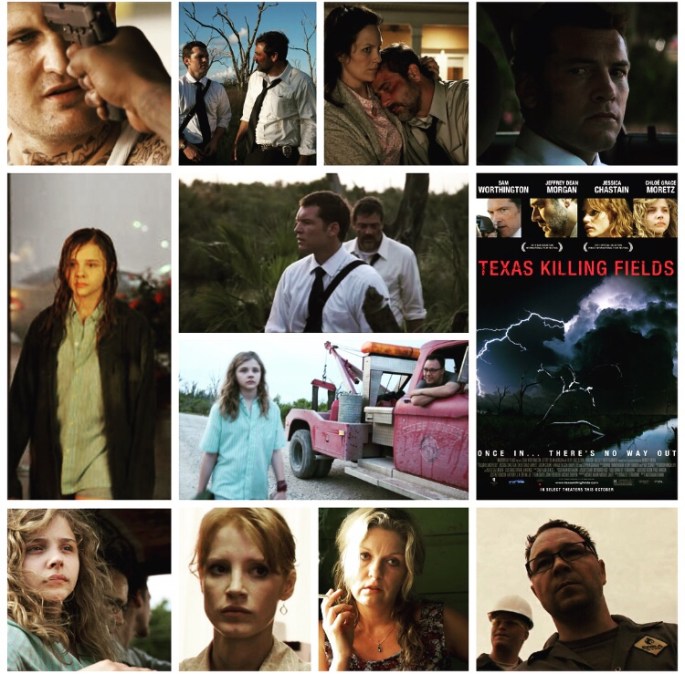
Amy Canaan Mann’s Texas Killing Fields

Whenever people say there isn’t enough gritty, messed up modern neo-noir (which there’s some truth to, but that’s another article) I like to dig up ones like Texas Killing Fields, an unforgivably overlooked crime drama from some years back that went by mostly unnoticed. Directed by Amy Canaan Mann, who is none other than Michael Mann’s daughter, and starring a talent trio of Jeffrey Dean Morgan, Sam Worthington and Chloe Grace Moretz, it’s a dark-boned, nihilistic murder mystery set in the deepest south and populated by the kind of folks you’d actively avoid entire sections of the barroom to get away from. There’s a killer loose in the low income doldrums of Texas, as if they didn’t have it bad enough in life, and two scarily mismatched cops are on the case. Intrepid idealist Morgan sees the light in darkest corners, while faithless misanthrope Worthington adopts a hopeless, devil may cry attitude. Caught between them is a wayward teen girl (Moretz), a homeless sitting duck who wanders the byways, a prime target and unfortunate default bait for this monster to come skulking out of the shadows. This is a downbeat, chilling flick with scant rays of humanity here and there, but bleakness takes over the screen like the portentous clouds in the storm-swept skies of the rural Americas, bringing danger and decay in their wake. The suspect list is a mile long because of how many wicked character actors there are in the supporting cast, but the culprit is oddly obvious from the get go. This isn’t to say the narrative is weak or they failed at a whodunit, as one can scarcely say that was there intention at all. It’s less of a whodunit and more of a ‘dunit’, as every character has some evil to hide or stain on their soul, and when the killer is revealed, they’re just another in a long line of wayward beings out there. Sheryl ‘Laura Palmer’ Lee is great as Moretz’s destitute, promiscuous mother, Jason Clarke roars in for a terrifying cameo as a violent pimp with an otherworldly blond dye job, Stephen Graham is dangerously quiet as a psychopathic local yokel, Annabeth Gosh has a brief role and Jessica Chastain gives an early star-making turn as an out of state cop who reluctantly aids Jeffrey and Sam. Dread is the word that seems to be on both Mann and her cinematographer Stuart Dryburgh’s mind, as every shot is composed primarily of darkness, shadows and claustrophobic grain, giving the fields and flatlands of Texas a hellish, oppressive lacquer. Darkness is explored both literally and thematically, and more fervently than most mainstream films care to get, which may be one reason the film wasn’t well received at all, or at least by most. It knowingly plunges headlong into the eye of the hurricane surrounding the hopeless heart of humanity, without much light on the other side or any to guide it, but there’s a bravery in that that I respect. One of the best crime dramas in recent history, a film that should be brought up more in discussion and a treatise on how to make a lasting impression in a genre that sees entries fall through the cracks on the daily. Brilliant, searing stuff.

-Nate Hill