Angelina Jolie Pitt’s BY THE SEA – A Review by Frank Mengarelli

A cinematic love story is rarely grounded in reality.  We see a projection of it, someone else’s idea of what love is.  The escapism of boy meets girl, boy loses girl, and then the boy triumphantly wins girl back – is a mundane and trite formula.  Angelina Jolie Pitt’s BY THE SEA is a love story that wages war with itself and takes place within the reality of life.

image

The film spans a few weeks at a villa in France.  Roland (Pitt) and Vanessa (Jolie) are married, waging a toxic and a fearless psychological war with one another.  Roland drinks all day, desperately seeking inspiration for his next novel while Vanessa bunkers herself within their room and lies comatose in bed on a self medicated mixture of pills and wine.

image

At this point in their marriage, all is lost, yet they continuously fight for and against one another.  Their passion still burns bright, but their hope flickers as each minute of the film passes.

Jolie has become an inspiring vision behind the camera, fluidly crafting her film; using the vulnerability and innocence of 1970’s France as a canvas to showcase such a painfully beautiful film.

image

BY THE SEA is a clear cut example of a critical and box office failure that eludes the self indulgence of critics and the current cinematic populous with its pulverizing and honest view of love.

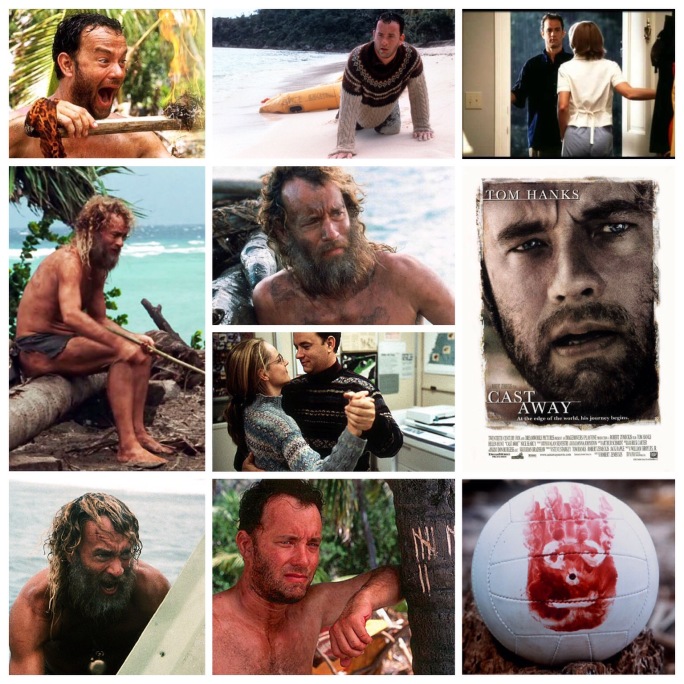
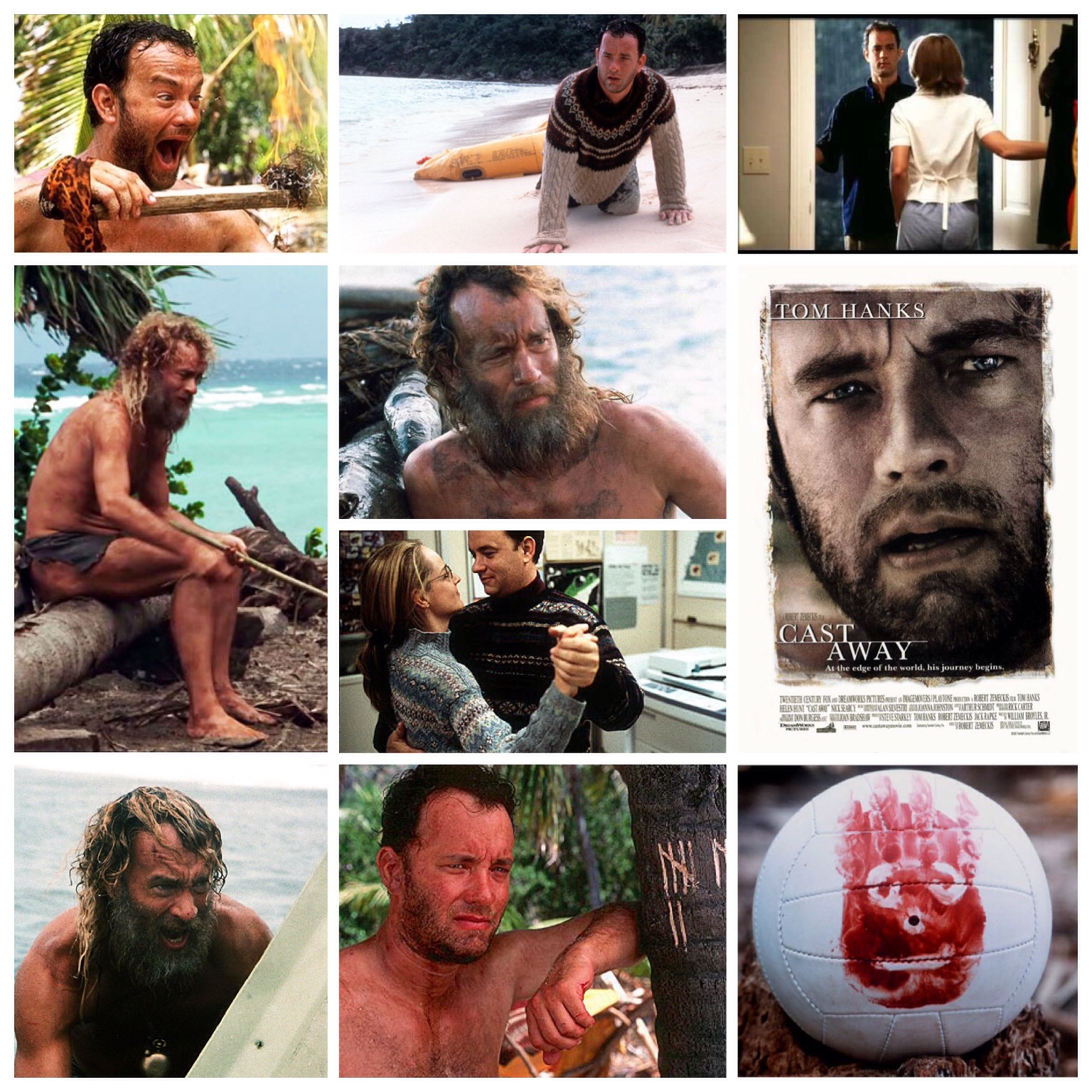
Cast Away: A Review By Nate Hill

  
Up until two days ago, I had never seen Cast Away. Not once in my life. I know, try not to have a heart attack. I knew the whole story, each and every beloved plot twist mapped out for me by eager friends, word of mouth, online fare and pop culture over the years. I just never sat down and actually watched the darned thing. Well I did two nights ago, and damn if I didn’t wish I’d done that sooner. It’s every bit as incredible as I’ve heard all this time, and more so. It’s one thing to know everything about a film just because of its notoriety, and quite another to see it, obviously. I experienced every scene, every landmark event in the film for the first time ever, and my foreknowledge of it did not dampen one wondrous second of the experience. Few films bring you as close to their protagonist as this does, for two and a half patient, spellbinding hours in the life of a man whose path has taken a turn for the extraordinary. Tom Hanks is the right guy for the job, and then some. He’s immediately likeable and exudes currents of good nature and humility. Perfect casting choice. He plays Chuck Noland, a FedEx honcho with a busy life that scarcely makes room for his doting girlfriend (Helen Hunt). One Christmas eve, he’s forced to run out on her for an overnight package flight. As we all know, his plane crashes somewhere in the South Pacific, and he’s forced to survive on a deserted island for almost half a decade. We feel every empty minute, every momentous triumph right alongside Chuck, from the first dazed stroll along the wave speckled beach of his new home, to the final, raging ditch effort to find his way back to civilization. Director Robert Zemeckis let’s this larger than life tale unfold with steady, earnest shots and a down to earth score, a very simplistic approach that let’s Hanks do most of the heavy lifting. And lift he does, in a performance of sheer courage and transformative qualities. We see Chuck go from suburban joe and real world businessman to a near feral being, forged into something more than himself by the same forces that govern and mold the geography which he now inhabits, while never losing his humanity in the wild chaos. The time spent stranded is sandwiched between two segments that bookend the film, in which we see his life in civilization before, and eventually after his experience. The impeccable pacing tricks the audience into feeling like we’ve been watching this play out for as many years as he’s been living it. I mean this as a profound compliment to the filmmakers and not to say the film ever drags, in fact, for a two plus hour running time it feels surprisinly slight. It all rests on Hank’s shoulders, and he carries it beautifully, selling this man’s plight with truth, humour and resilience. An experience for the ages, and one that you should see right out of the gate in your cinematic exploration, as opposed to waiting till your mid twenties like someone we know. Masterpiece.

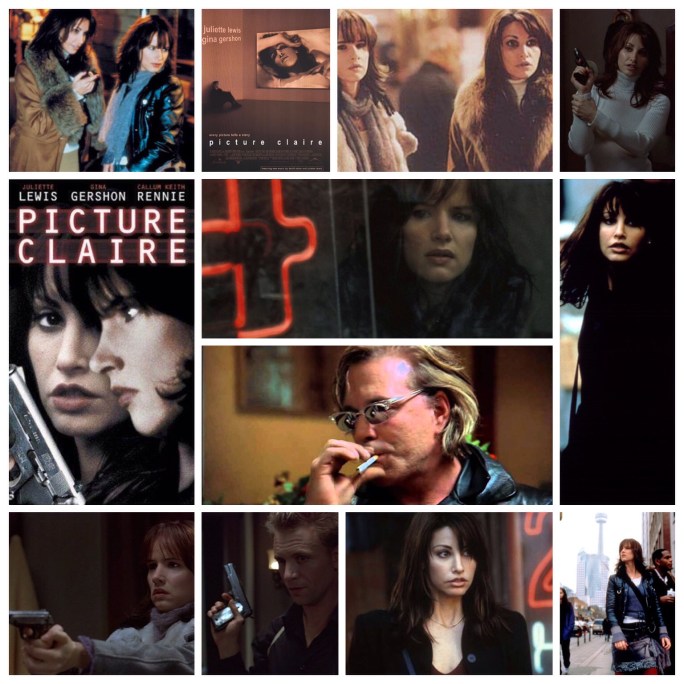
Picture Claire: A Review By Nate Hill


It figures that a decent Canadian film, which lets face it, is a rare commodity, would me mishandled, neglected and not properly promoted, resulting in its exile into the inter zone of obscurity. Picture Claire is an original, stylish little crime thriller with two solid female leads and a story to tell, a story that has regretfully made its way to far too few audiences. Juliette Lewis plays Claire Beaucage, a confused and awkward French Canadian girl who finds herself in way over her head with dangerous, sexy jewel thief Lily Warden (Gina Gershon, in yet another physically demanding role that adds to my wish that she got a crack at playing Catwoman). Lily is on the run from Laramie (Callum Keith Rennie, the king of charisma) a mobster who wants something she stole, which through circumstance is now in the unwitting hands of Claire. The chase then starts, through the unmistakable streets of Toronto and from one violent encounter to the next. The film is a thriller, and a chase flick at heart, but in that heart it’s got an almost old world, European flavour. Claire has quaint, almost Amelie esque inner monologues which give us insight into her character. She doesn’t speak English, and everyone around her does, which somewhat alienates her. These interludes give us something to latch onto with this strange girl who is more in the dark about what’s going on than even we are, watching from behind our screens. Watch for a profane cameo from Mickey Rourke as Gershon’s lowlife partner in crime, a scene stealer as always. Thoroughly overlooked, and a true delight. 

What’s The Worst That Could Happen? : A Review By Nate Hill

  
People rag on What’s The Worst That Could Happen all the time. Let em, and screw em while we’re at it. Implausible? Yes. Silly? Yup. Ridiculous? Oh yes. Funny? You bet your ass. It’s one of those lighthearted Martin Lawrence comedies like Blue Streak or National Security, tripping along an alleyway of lowbrow humour and bawdy antics that you just can’t stay mad at, like a friend who does something really dumb and follows up with something that cracks a grin on your face. Lawrence also has the luck to be paired with Danny Devito here, who is funny even when he isn’t trying to be. Lawrence plays Kevin, a cocky cat burglar who bungles the wrong dude when he breaks into the not so vacant summer home of sleazy billionaire Max Fairbanks (Devito). Max catches him red handed, holds him at gunpoint and convinces the cops that a family heirloom ring on Kevin’s finger is part of the stolen goods, adding insult to arrest. That dick move launches an ego fuelled battle of wills as these two morons find more and more elaborate ways to incite each other’s wrath. They each have a little armada who back them up when they aren’t questioning their every idiotic movie. Kevin has his gorgeous girlfriend (Carmen Ejogo has sadly made a career of being underused), his partner Berger (John Leguizamo plays around with accents like you ain’t never seen) who is the Dumber to his Dumb, and his sassy handler (Bernie Mac). Max is hounded by his witchy wife (Nora Dunn), shunned by his much abused attorney (a dry, delightful Richard Schiff), pawned over by his mistress (Glenne Headly) and secretly lusted for by his chief of security (you haven’t lived until you’ve seen Larry Miller do his thang here). Max and Kevin are engaging arch enemies, with Lawrence mugging for face time a tad too much, and Devito perfectly settled into his shtick as always. I must make note of probably the best performance of the film, from William Fichtner as a flamboyantly gay police detective who hounds all parties involved. He’s one part frightening with a side of classy charm, subverting his usual weirdo tough guy image for something even weirder and totally out there. Watch for Lenny Clarke and Siobhan Hogan as as pair of squabbling fellow burglars, and work from Cam Neely, Kevin Chapman and Garry Shandling as well. It’s a screwball caper. I love it. Many don’t. They can suck it. Check ‘er out and make up your own mind. 

MARK RYDELL’S CINDERELLA LIBERTY — A REVIEW BY NICK CLEMENT

1

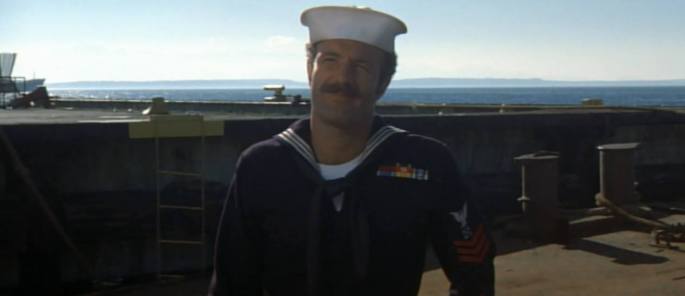
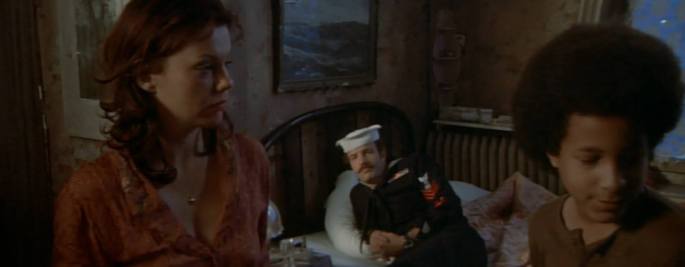
Cinderella Liberty is a potent 70’s drama with an outstanding performance from James Caan, displaying a warm and comforting side that was sort of rare to encounter consider all of the intense roles he gravitated towards. Marsha Mason, in her second big screen outing, was Oscar nominated for her emotionally complex role that might have been a total failure in the hands of a less attentive and attuned performer. Sensitively directed by Mark Rydell, the film was written by Darryl Ponicsan, who adapted his own novel, and centers upon a slightly shy sailor (Caan) on shore leave who meets and falls for the wrong woman (Mason), an unstable, pseudo-hooker who has a 10 year old bi-racial son at home, who is barely receiving any sort of traditional parenting. Caan feels something almost instantly for Mason and her son, despite both of their rough edges, and he works to better their lives in ways that may seem far- fetched to some, but to me, rang true because of how honest Caan’s performance was, and how powerful Mason delivered her big scenes, of which she has a few.

2

This being a product of the 1970’s, it doesn’t end tidy, there are off-color remarks galore in the funny and unpredictable screenplay, and there’s ample T&A on display considering the milieu (seedy Seattle, with bars and strip clubs being a major highlight). The final act has a plot point that will hit hard for some people, and at that point in the story, the narrative mildly shifts gears a bit and becomes an interesting portrait of people trying to put all of their pieces back together despite knowing it may be impossible to keep them in tact forever. Eli Wallach and Burt Young both delivered extremely memorable supporting turns. The score from John Williams is jaunty and pensive in equal measure. Netflix carries the DVD for rental-at-home customers, and the older transfer still does a fine job showing off Vilmos Zsigmond’s appropriately dark and grubby 2.35:1 cinematography, filled with glorious grain and period filmic look. I love when movies were shot on Eastman Kodak celluloid! Cinderella Liberty is also available as a streaming option via YouTube’s HD rental service, and is also available to stream via Amazon.

3

HealtH – A Review By Patrick Crain

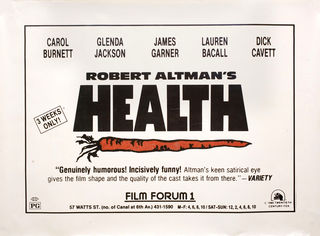
zoom_1418768851_HealtH@2xWhen you begin to consider the high-level talent that went into the formula that produced Robert Altman’s HealtH, it’s difficult to recall another movie in film history that was, and continues to be, treated as poorly. Coming directly after Altman’s twin failures of 1979, Quintet and a Perfect Couple, its production was relatively quick and on-the-fly; an attempt to get one in the can while things at 20th Century Fox were still being run by Alan Ladd, Jr., a staunch Altman proponent who once gave the maverick filmmaker a million and a half dollars to make 3 Women, a movie that came to Altman in a dream and had no real cohesive story.

Sure enough, things did change and Ladd was ousted. HealtH, which had an initial scheduled release date in late 1979, began to get slowly pushed back on the schedule. Early 1980 came and went and a series of test runs arranged by the new management proved to be less than promising. The master plan of having it released before the 1980 presidential election never materialized. It’s safe to assume that when Altman began shooting the lavishly budgeted, dual-studio event picture Popeye in 1980, he couldn’t dream that he would get it shot, edited, and in theaters before HealtH.

But Popeye was released in time for Christmas in 1980 and HealtH was eventually pushed off of the Fox release schedule entirely. It did manage to play a limited engagement at Film Forum in 1982 but, aside from its occasional, stealthy appearance on various television movie channels, HealtH has never seen a release on home video. It’s a depressing world in which we live that Robert Downey Sr.’s similarly-imprisoned the Gong Show Movie finally gets a Blu ray release and HealtH can’t even be bought on the sad, used VHS market. Every once in a while, a widescreen rip from one of those movie channel broadcasts makes its way onto YouTube, but its difficult to know if it’s been edited for time or whether the somewhat squeezed visual presentation is a representation of the film’s true aspect ratio.

Given its obscurity, the perceived notion is that HealtH must be some kind of otherworldly dog of a film; a real hubristic bonanza crafted amidst a barrage of likeminded projects by Altman. But the truth of the matter is that HealtH is a surprisingly strong look at the ridiculousness of the American political system as filtered through the world of the then-bourgeoning consumer health industry. A fine addition to the busier, wide-canvas ensemble pieces Altman could engineer with remarkable skill and dexterity, HealtH performs double duty as a sly comedy and a prescient warning of the toxic injection of empty personality and media-driven messaging into our electoral process.

In a way, the overtly political overtones of HealtH would go on to serve Altman well when it came time for him to produce his masterpiece of the 80’s, Tanner ’88; one specific element, the jaunty campaign theme “Exercise Your Right to Vote,” is heard in both films.  In its earlier incarnation, it’s delivered by The Steinettes, an a capella outfit who acts as a ridiculous but appropriate greek chorus to HealtH’s very odd portrait of 1979 America.

HealtH is, on the surface, about two days at a health convention in which two candidates are running for the title of “President of HealtH.” Present at this convention are product pitchmen, authors, political functionaries & fixers, glad-handing bureaucrats, dirty tricksters, aides, liaisons, and PR staff all centering around the two presidential hopefuls.

In one corner, Esther Brill (Lauren Bacall), 83 year-old virgin whose ubiquitous campaign slogan “Feel Yourself,” is delivered with an astounding cluelessness as Brill believes that each orgasm shaves 28 days off of your life. Her staff is made up of PR guru Harry Wolff (James Garner), oversexed campaign manager, Dr. Ruth Ann Jackie (Ann Ryerson) Brill’s undersexed personal physician who secretly lusts after Wolff, and a gaggle of nurses who are constantly drinking behind Brill’s back.

In the other corner is Isabella Garnell (Glenda Jackson) a pragmatic-yet-cold idealist whose speeches all seem swiped from Adlai Stevenson. Her entourage consists solely of Willow Wertz (Diane Stilwell), a sweet-natured aide whose ongoing sexual frustration is rooted in her inability to feel anything sexual for anything whatsoever.

Between the two candidates is Gloria Burbank (Carol Burnett), a representative from the White House and Wolff’s ex-wife; Dr. Gil Gainey (Paul Dooley), an independent candidate for president and shill for something called “Vita-Sea;” Colonel Cody (Donald Moffat), a bellowing political string-puller; Bobby Hammer (Henry Gibson), a slimy political operative sent to disrupt the Garnell campaign; Sally Benbow (Alfre Woodard), the convention hotel’s PR director; and, finally, Dick Cavett, as himself, who is there to cover the event for his talk show. Oh, yeah, and the Steinettes. 

In the film, we’re told that HealtH (which stands for “Happiness, Energy and Longevity through Health”) is an organization more than three times the size of the NRA and whose members can be similarly motivated to vote one way or the other. So the film certainly exists in an America that could also produce the cockeyed presidential campaign of Nashville’s Hal Phillip Walker. But Walker didn’t much have a real-life counterpart in 1975. The populist politics of Nashville reflected a hopelessness that washed through the post-Watergate, pre-Carter country like a rotten fever. The politics of HealtH were much more immediate. While sending up the then-current political climate, the film seems to anticipate the cultural shift that occurred in the presidential election in 1980. Even if the other candidates in the film could be composites of many other political figures, Esther Brill is a certain representation of the perceived image of Ronald Reagan, a man who counted on a network of advisors and aides to keep him informed and aware and who was about to enter the presidential race with a boatload of sunny optimism and slogans aplenty.

While HealtH is far from perfect due to its unfocused and rushed production and its occasional tendency to get lost in the weeds of its own mix of satire and reality (you never really feel like you should be investing in it as you really should), there is a great deal to admire. The script, by Altman regular Frank Barhydt, actor Dooley, and Altman does an admirable job keeping the film equally steeped in reality (through the characters of Woodard and Garner), television (Cavett and, eventually, Dinah Shore), and fantasy (basically everything else). The performances, too, are all top-notch. Burnett, Bacall, and Jackson are all terrific but the film is absolutely stolen at every turn by Woodard whose polite facade hilariously begins to give way to disdain as the convention rolls along. Among the men, Garner turns in a reliably easy-going performance, Paul Dooley is as energetic as I’ve ever seen him, and Dick Cavett, remarkably comfortable in a sizable role, has a great deal of fun.

As history marches on, HealtH’s chances of being anything other than a completely forgotten and mostly unseen film become slimmer and slimmer. Altman passed away ten years ago so it’s unlikely that any other event could be the catalyst for its release. Sometimes chuckling and sometimes wincing while watching it in the midst of our own current presidential election that certainly seems like it could play out in an Altman film, it’s a cinch that HealtH could still find an audience today.health-sm-web
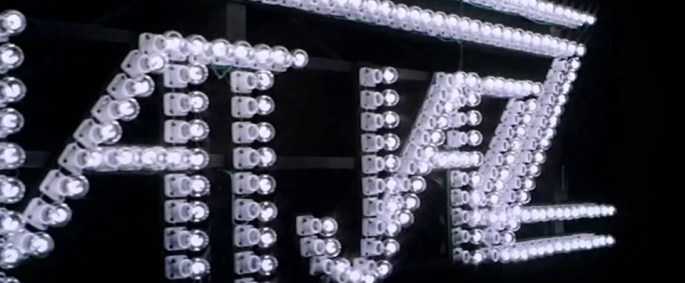
Bob Fosse’s ALL THAT JAZZ – A Review by Frank Mengarelli

ATJ2

Every once in a great while a film gets made that you hold so sacred to yourself, that you feel it was made specifically for your eyes only. Bob Fosse’s ALL THAT JAZZ is a full out tour de force MASTERPIECE. For me, it’s the finest film ever made, I completely and utterly adore this film. Like any great piece of art, it can affect its audience in a multitude of ways, and mean different things to different people. Over my decade long obsession with the film, I’ve come to see and apply many lessons the film teaches. The most important lesson this film preaches is simply, the heavy price one pays for narcissism.

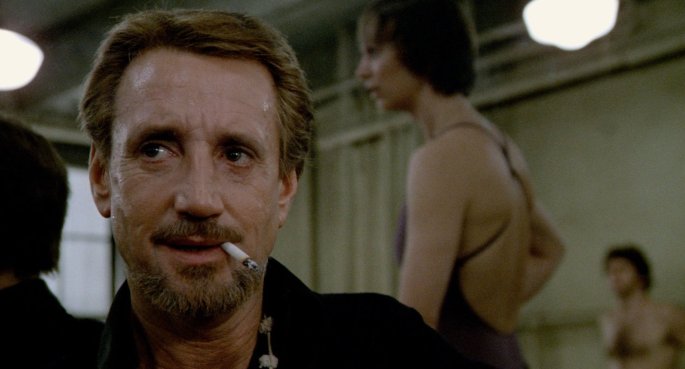
I cannot think of a film that displays more audacity and self-indulgence in such a showy and brilliant way. The casting of Roy Scheider is the most brilliant casting move in the history of cinema. Roy Scheider as Joe Gideon is Bob Fosse. From the facial hair, to the chain smoking, right down to the address on the bottle of his prescription pills in his bathroom. It’s all Fosse. The film follows Gideon navigating his professional life; editing his latest film THE COMEDIAN (LENNY) and reinventing a Broadway play (CHICAGO) under a tight deadline. All the while Gideon is co-raising his daughter (Erzsebet Foldi) with his muse and ex-wife (the remarkable Leland Palmer), and constantly cheating on his current muse and girlfriend (Ann Reinking, who was Fosse’s real life mistress and fierce champion of his legacy). Folded into all this, Gideon’s personal and professional life, he is having a sit down conversation that stretches the duration of the film with the painfully beautiful Angel of Death played by Jessica Lange.

ATJ

Gideon is the contemporary version of Sisyphus, constantly pushing that boulder up a hill, only for it to roll back down to the bottom again. He cannot, and will not compromise with anyone, even himself. He constantly pushes himself physically, mentally, and creatively. An entire dissertation could be written about this film, it is impossible to sum up the importance and greatness of this film in a few paragraphs. Everything in this film is phenomenally executed. All the performances in the film are landmark career highs, the production and costume design is perfect, and the editing in this film by Alan Heim showcases the best cut film ever made.

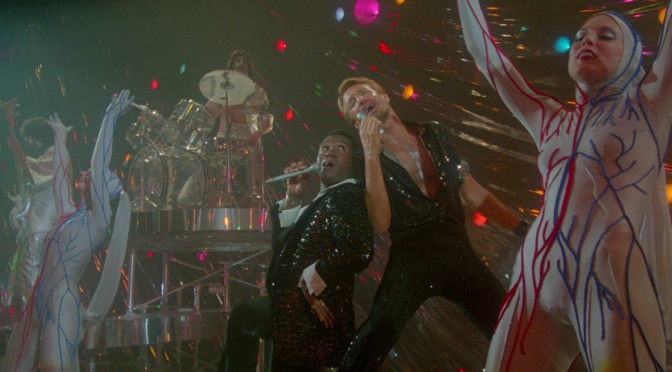
The entire film is perfect, but where my undying excitement and admiration for this film comes to a head is the final act, in particular the final scene. Gideon’s fever-dream send off to a musical performance of The Everly Brother’s BYE BYE LOVE sung by Ben Vereen and Roy Scheider in front of anyone of importance from Gideon’s life. This is cinema at its absolute finest.

There will never, ever be another Bob Fosse. There will certainly never be a film made that is so ingrained with its author like ALL THAT JAZZ. The film remains a cornerstone in not only the history of film, but in the history of art itself.

ALT3

William Friedkin’s Killer Joe: A Review by Nate Hill

image

William Friedkin’s Killer Joe. What, oh what can I say. Upon finishing it, my friend and I shared a single silent moment of heightened horror, looked at each other and chimed “What the fuck?!” in unison. Now, I don’t want our aghast reaction to deter you from seeing this wickedly funny black comedy, because it’s really something you’ve never seen before. Just bring a stomach strong enough to handle dark, depraved scenes and a whole lot of greasy fried chicken that’s put places where it definitely doesn’t belong. Matthew McConaughey is unhinged and off the hook as ‘Killer Joe’ Cooper, one of his best characters in years up until that point. Joe is a very, very bad dude, a Texas police detective who moonlights as a contract killer and is just a lunatic whenever he’s on either shift. Emile Hirsch plays an irresponsible young lad (a character trait that’s commonplace with the folks in this film, and something of an understatement) who is several thousand dollars in debt to a charmer of a loan shark (Marc Macauley). Joe offers to help when Hirsch comes up with the brilliant plan of murdering his skank of a mom (Gina Gershon in full on sleazy slut mode). The ‘plan’ backfires in so many different ways that it stalls what you think is the plot, becoming an increasingly perverted series of events that culminate in the single weirdest blow job I’ve ever seen put to film. Joe has eyes for Hirsch’s underage sister (Juno Temple, excellent as always), and worms his way into her life, as well as her bed. He claims her as collateral, and hovers over the family like some diseased arm of the law. Thomas Haden Church is hilarious as Hirsch’s ne’er do well country bumpkin of a father. Poor Gershon gets it the worst from Joe, in scenes that wander off the edges of the WTF map into John Waters territory. I was surprised to learn that this was a Friedkin film, but the man seems to be the king of genre hopping these days, and it’s always key to be adaptable in your work. A deep fried, thoroughly disgusting twilight zone episode of a flick that’ll give the gag reflex a good workout and keep your jaw rooted to the floor during its final sequence.

BRIAN DE PALMA’S SNAKE EYES — A REVIEW BY NICK CLEMENT

1
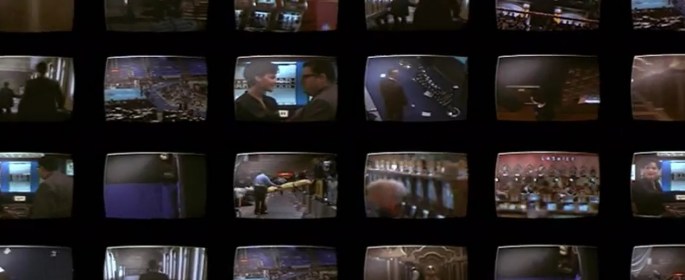
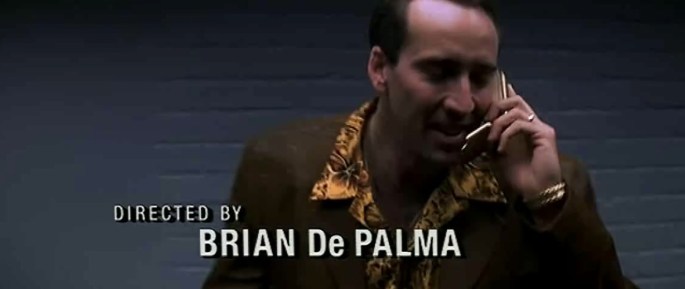
Snake Eyes is electrifying filmmaking from Brian De Palma, who at one point in his career was billed in voice-over during trailers for his films as the “modern master of suspense,” a title he totally earned. The opening 20 minutes of this film are so stunning that we could only hope to get sequences of pure filmmaking like this in every single movie in every single calendar year. And even if many people seem to find fault with the final act, I don’t, and never did; while the “Hand of God” tidal wave sequence would have been cool to see from a visual perspective, the climax works just fine as it is, and wraps everything up the way it should. Also – the absolute final scene between Nicolas Cage and Carla Gugino stings with moral complexity and ends on an untraditional note of uncertainty — shades of 70’s storytelling peeking through the cracks of a big-budget, late 90’s thriller.
4
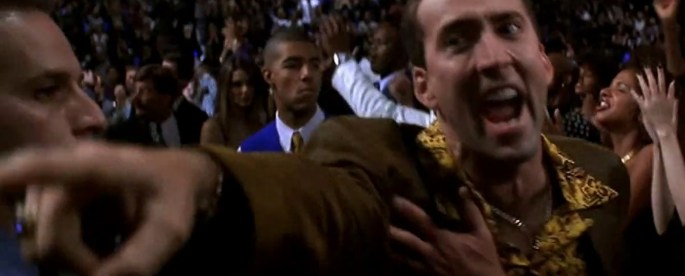
 A sleazy and chest-hair-proud Cage was completely on fire in this film, totally flamboyant and awesomely over the top as a morally bankrupt Atlantic City cop who gets in way over his head at a heavy weight title fight which is taking place at a casino during a hurricane. Oh, and the United States Secretary of Defense is on hand for the bout, and wouldn’t you know it, he’s about to get assassinated in the opening reel. What follows is a battle of wits between Cage, his sketchy military “friend” played by Gary Sinise, and various interactions with a rogue’s gallery of supporting actors including Michael Rispoli, Stan Shaw, Kevin Dunn, John Heard, Joel Fabiani, Luis Guzman, Mike Starr, David Anthony Higgins, Chip Zien, and Eric Hoziel. The alluring Gugino perfectly fit the prototypical De Palma heroine, delivering a sexy and crafty performance as Cage’s reluctant helper, and red-head Jayne Heitmeyer made a very memorable appearance during a crucial portion of the visually audacious protracted opener.
2
Ryuichi Sakamoto’s bravura score amplified every single sequence – it’s true sonic glory and one of my favorite soundtracks to any De Palma film. And don’t get me started on how much Stephen H. Burum POWER is contained in this film. This was the second to last film that the vastly underrated cameraman shot for De Palma, and in tandem with the legendary stedicam operator Larry McConkey, he crafted one of the most visually muscular and all-together exciting cinematic atmospheres I can think of. From the two or three extended takes that comprise the utterly gripping and fabulous opening sequences, including McConkey pulling off a Dutch angle while operating the rig, Snake Eyes contains passages of purely visual filmmaking that should serve as sequences worthy of study. From De Palma’s obsessive love for the split-screen and overhead photography to his undying fascination for femme fatales and the tropes of the Hitchcockian thriller, Snake Eyes played to the director’s unmatched strengths, while the script, which was concocted by De Palma and big-money-scribe David Koepp, had tons of fun with genre conventions and the upending of our expectations in key instances.
3
De Palma, like few other directors, really knew how to explore paranoia within the narratives to his films, and all of the actors in Snake Eyes brought a level of mystery to their performances. Bill Pankow’s razor-sharp editing knew precisely how long to hold on every single moment, keeping an intense edge present all throughout. And then there’s the film’s elegant and totally amazing theatrical trailer, which is cut and scored with the precision of a diamond. Released in August of 1998, the film was a modest success at the United States box office, a solid worldwide hit, and a massive audience favorite on VHS/DVD/cable. The Blu-ray absolutely pops off the screen. Even in a throwaway genre picture, De Palma brought a sense of pure cinema and consummate craftsmanship to the table.
6

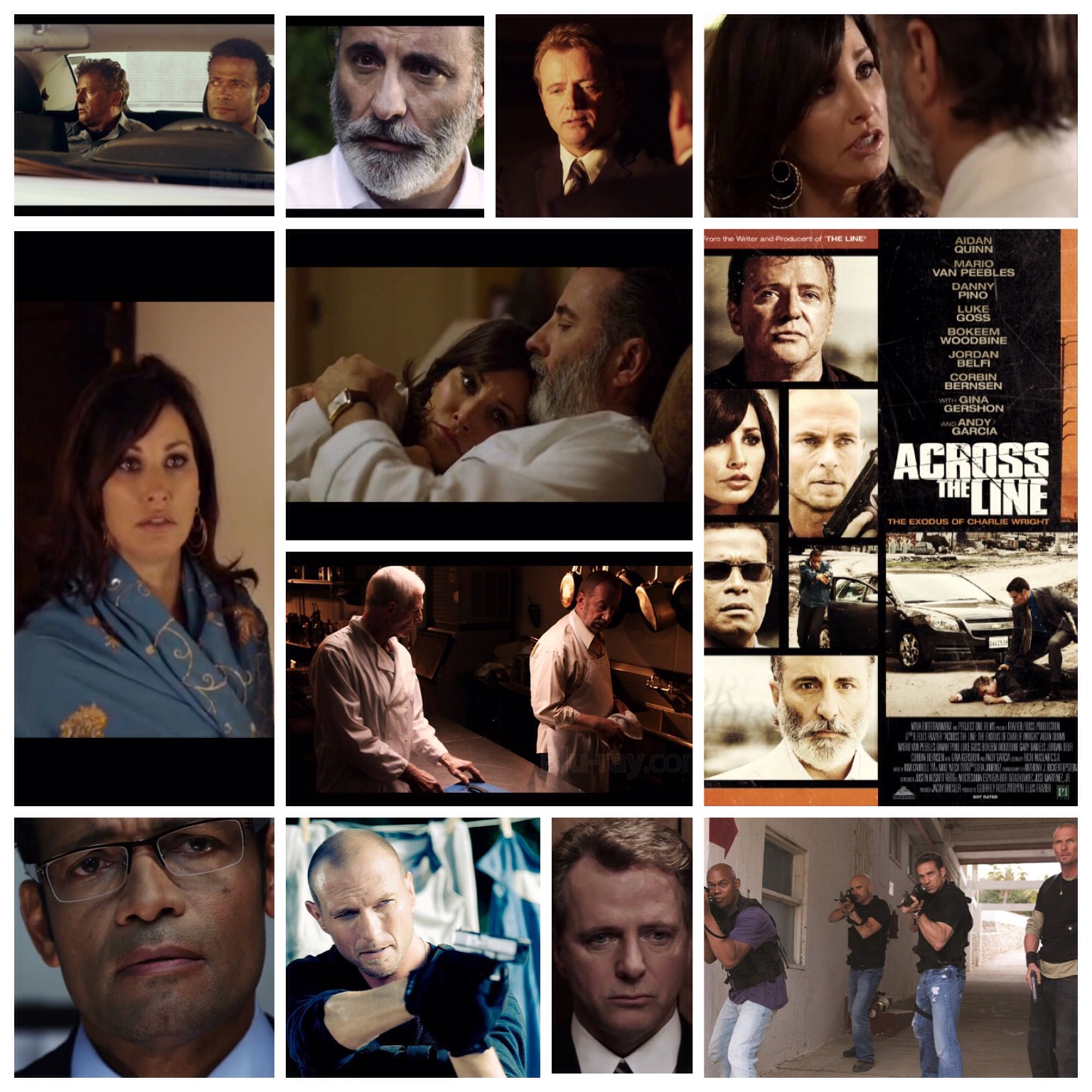
Across The Line: A Review By Nate Hill


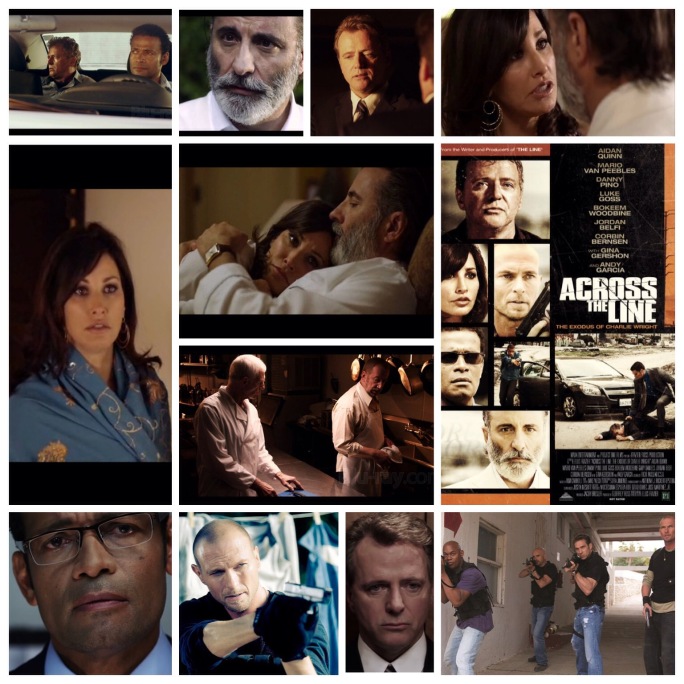
Across The Line: The Exodus Of Charlie Wright is the very definition of overlooked. It was probably underfunded and squeaked forth through meager marketing a few years ago, neither of which has prevented it from triumphing as a sharp little sleeper flick that of course nobody saw. The central theme is age and regret, each character finding themselves at some sad crossroads, placed there by the decisions they’ve made in the past and the ways in which they have conducted themselves up to the final act of their lives. To observe people at such a stage haunts you as much as it does them, and made for a film that took a while to get out of my head. Aiden Quinn plays Charlie Wright, a billionaire financial genius whose empire has been exposed as nothing more than a pitiful ponzi scheme, right under his unwitting nose. He is in self imposed exile in Mexico, and soon the consequences rain down on him in the form of several different pursuers. A Mexican gangster (Andy Garcia) wants him, as well as a Russian (Elya Baskin) and his dodgy American representitive (Raymond J. Barry). The FBI has their sights on him as well, in the form of a weary looking Mario Van Peebles, sanctioned by the Director (Corbin Bernson). There’s also a trio of merceneries headed up by a dogged Luke Goss, Bokeem Woodbine and Gary Daniels who have been deployed south of the border to hunt him. It sounds like a bunch of commotion, but I found it to be a very reserved meditation on just how far people are willing to stand by their life choices when they see what’s become of the goals they had in mind when they made said choices in the first place. Quinn is the most understated, yet speaks the loudest as a man on the run from the world. Gina Gershon makes an emotional impact as a woman involved with Garcia, who is also great. South of the border intrigue. Ponderous introspect. A winning recipe.