Triple 9 – A Review by Josh Hains

triple_nine_xxlg I think most of the criticism toward Triple 9 is misguided at best. I feel that most of the critics whose reviews I’ve read (and I’ve read dozens over the last week) weren’t expecting what Triple 9 delivers, they thought they were paying to see the next Heat or something, and upon being vastly disappointed, tore the film to shreds as they saw fit. I think a few critics jumped on the hateful bandwagon, and now moviegoers who were excited up until the reviews rolled out are unsure if they want to cough up their hard earned dough for the film or not. Some will have you believe the film is worth waiting for the Blu-Ray of. The joys of the internet age of film criticism and audience reception. This way of thinking is backwards. You have to see this film for yourself decide if it’s your cup of tea or not. Don’t even take my enthusiastically positive word for it. See it for yourself, and go from there.

When you see the trailers for Triple 9, it’s pretty easy to say it looks like a cross between Heat and Brooklyn’s Finest, or Street Kings or End Of Watch. It’s even easier to walk into the theatre expecting something akin to that. The surprise if Triple 9 is, that while there are minor similarities between the films I mentioned above, Triple 9 is its own unique film, a different monster entirely. I’ve never seen a crime film quite like it before and I doubt I will anytime soon given the lack of gritty crime films in theatres these days in preference of sanitized comic book and video game based movies.

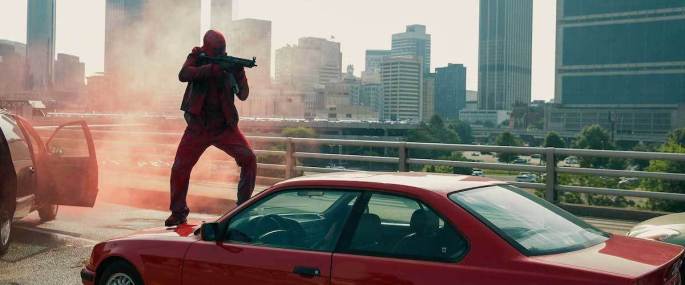
Triple 9 follows an ensemble of edgy characters strewn throughout Atlanta, Georgia, each one undergoing immense amounts of pressure, stress, and paranoia, and seemingly trying to keep their heads above the water. There’s Mike Atwood (Chiwetel Ejiofor), the hot headed leader of a 5-man group of thieves, and a former Navy Seal. His ex-wife Elena’s sister Irina,the wife of an imprisoned Russian mafia boss, is using his son as leverage over Mike so he’ll commit elaborate robberies. His team is comprised of Franco Rodriguez (Clifton Collins Jr.) and Marcus Belmont (Anthony Mackie); two corrupt Atlanta cops, and then there’s Russell Welch (Norman Reedus); a former Navy Seal and old war buddy to Mike, and Gabe Welch (Aaron Paul); Russell’s younger brother and a former Atlanta police officer who worked in the same precinct as Marcus and was a junkie until 6 months prior. The film opens with one such robbery, which goes horribly wrong when a hidden dye pack from the bank they just knocked off fills their escape vehicle with an impenetrable red mist, causing a multi vehicle collision on a packed highway. Then there’s Jeff Allen (Woody Harrelson), the Atlanta detective heading up the investigation into the robbery. He’s also the temperamental uncle of Chris Allen (Casey Affleck), a greenhorn cop with a wife and kid who conveniently becomes Marcus’ new partner. Irina wants the group of thieves to commit another heist, to continue to collect sensitive information that can set her husband free, but the guys need a new plan to pull of their next daring job. Franco and Marcus suggest killing a cop, which would incite a 999 or officer down call that sends every police offer to their fallen comrade’s position. Marcus nominates Chris as cop to kill…and that’s where I’ll leave you hanging. To say much more beyond this would ruin all hope for surprise.

Earlier today I would have told you I have two issues with the film, the first of which is the plot, which I would then explain is a little too reliant on convenience and is in some ways vaguely predictable and inevitable. I would then mention a sequence that occurs with around a half hour left in the film in which two characters enter an abandoned warehouse and only one of them has murder on their mind, we can assume what will occur next. I would point out that while this scene does play out exactly as we expect it to for a while, it takes us in a different direction after a couple minutes that is almost completely unexpected.

I’m not complaining about the plot now as I type away at this review because I’ve changed my mind since this morning. Triple 9 isn’t reliant on its plot so much as it is reliant on the unpredictable the actions of the characters, reactions that actually seem like the natural ones most of us would have. If you were a cop, and you were informed that your nephew’s life could be hanging by a thread, would you drive like a maniac to the scene of the crime, or take your sweet time? If you found out someone wants to kill you, would play it and wait for precisely the right moment to strike, or would you freak out and blow their head off right there? How you may react isn’t necessarily how someone else might, and that’s the key to the tension in Triple 9. You genuinely don’t know who is going to what and when, keeping you constantly trying to anticipate every character’s next move and in complete suspense. I swear my knuckles turned white during the last half hour of the film, the suspense was that gripping and overwhelming.

A review on rogerebert.com tries desperately to suggest that Michael’s sad predicament is a half assed attempt at inciting sympathy toward the character. This is false. I do not think I am meant to sympathize with Michael for one single second, rather I am meant to understand quite simply why he’s doing what he’s doing. His predicament is motivation for the character and an elaborate way of generating the beginnings of a gripping crime story, not a piss poor attempt at making him a three dimensional character.

On that note, do not walk into this film thinking you’ll like more than two of these characters. You won’t. The acting is so good here, so down to Earth, naturalistic, and nuanced. These aren’t showy Oscar bait performances, they’re subtle and realistic portrayals of plausible human beings, and not simply cardboard cut out archetypes. Take Harrelson for example, playing another oddball but with the edge he brought to Rampart, creating a fleshed out, dynamic, tangible human being. Which brings me to my second issue, which is the noticeably phony accents utilized by Kate Winslet and Gal Gadot that greatly affect their performances. These women don’t sound authentically Russian, in that Cate Blanchett in Indiana Jones And The Kingdom Of The Crystal Skull kind of way. I think if you changed Winslet’s character to someone of British ethnicity (and cast someone else from the UK in place of Gal Gadot, say Carey Mulligan), Winslet could have delivered a much icier, more vile performance. Sadly, due to the accent, she is so hindered she’s incapable of providing an enjoyable villainous performance. Thankfully, Gal Gadot has a fleeting presence in the film so one doesn’t have to endure yet another dreadful performance from her. One can only hope she has just as few minutes in Batman V. Superman.

John Hillcoat, whose previous films include The Proposition, The Road and Lawless, delivers yet another already sorely underrated motion picture, and directs the hell out of it. I recall a popular criticism of Lawless, that the film’s ending was too down and depressing for critics to grapple with, and that a happier ending would have made the film better for them. I’ve always found that to be a poor criticism. In today’s age of film criticism, over saturated and far too pretentiously picky, it doesn’t surprise me that so many critics would prefer a “Hollywood” ending for that film. I wonder how many of them realized that was the ending of the non-fiction book The Wettest County In The World, the source material for Lawless, based on facts and written by the grandson/grand nephew of the trio of brothers showcased in the film. Bear with me, there’s a point to this.

I don’t think too many of those same critics like the ending to Triple 9 either, which I won’t spoil. It’s partially the ending you expect, and partially an ending you don’t see coming. For this film it works and wonderfully. It suits the nature of the beast, the nature of this grimy, brutal crime saga. It’s not forced, inauthentic, or improbable. Watch Harrelson’s face at films end. He says everything his character is thinking with one action, and the look on his face and in his eyes. You not only understand him and what he’s thinking in that moment, you feel for him too. It’s damn near perfect.
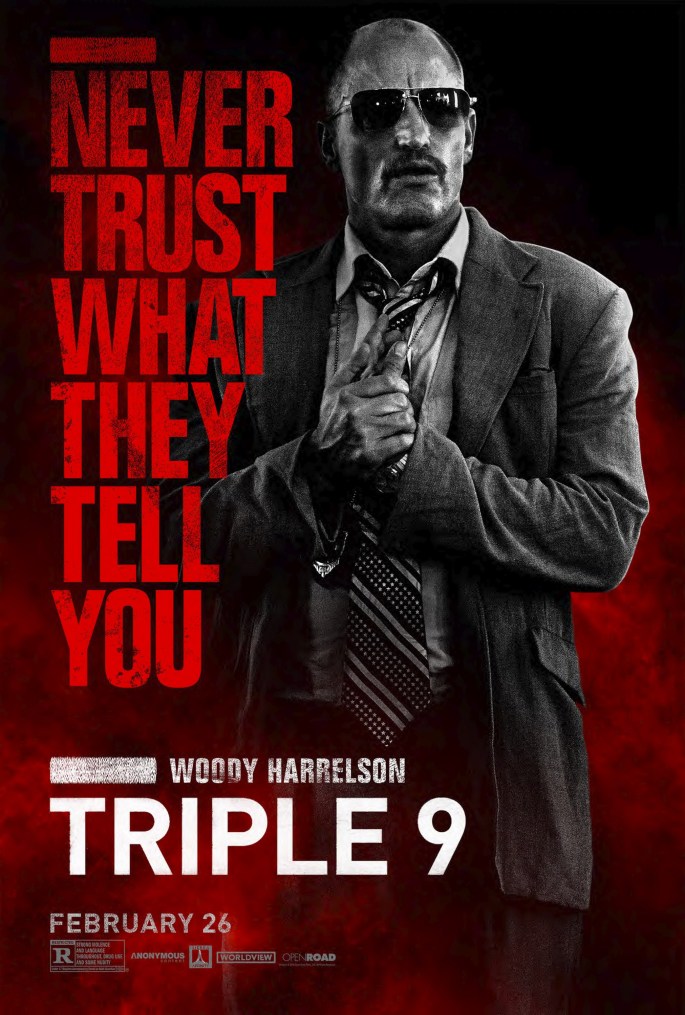
triple_nine_ver13_xxlg

Nicholas Winding Refn’s Fear X: A review by Nate Hill

image

Before Nicholas Winding Refn blew up into the big time with intense, stylish stuff like Bronson, Drive and Valhalla Rising, and after he made his bloody emergence into cinema with Pusher, he made another film that no one seems to remember or even even like all that much. It’s easy to see why Fear X wasn’t that well received or remembered: it’s choppy and confusing, even by Refn’s terms, and doesn’t pull it’s third act into a cohesive resolution, instead favoring a disconcertingly surreal descent into subconscious, abstract imagery, which we all know (the careers of Lynch and others are examples) is an aesthetic not always absorbed by the most open of minds when it comes to the masses. Now that we got that out of the way, here’s my take. I adore the film. It’s a skitchy Midwestern nightmare that starts of gently gnawing at the fringes of your perception with a sense of dread that’s intangible in its possibility, an outcome as vast and unknowable as the desolate prairie setting that calls to mind the fear and degradation of Fargo without an ounce of its good humour, black or otherwise. John Turturro inhabits this setting with a twitchy, anxious aura, suggesting a haunted mindscape beneath those famous curls. And well he should be haunted, considering his wife recently disappeared without a trace. For him, not knowing what happened is worse than any kind of grisly answer, for its a sick hollowness that chokes out any room for him to grieve. He works by day as a mall security guard, busting shoplifters and scanning snowy surveillance screens to distract himself. Then, his co-worker (Stephen Eric Mcintyre) hands him a videotape that may contain answers and be the first breadcrumb in a trail leading to his wife’s killer, and possibly his solace. In a lot of films and shows like these, the protagonist ventures to a small town with sordid secrets simmering just beneath the crust of the cheerful looking pie held by the pretty waitress at the local diner. Some artists find their own groove without riffing on other’s work too much, and some fall flat-footed into derivitive motions. Refn is bold yet subtle in his direction once Turturro arrives in the town, and casts a deceptively innocuous  yet insidiously creepy spell over the proceedings. It’s essentially where the film really exits utero and manifests, the danger before that was only glimpsed on the horizon now a very real possibility, like waking up from a bad dream into a worse reality. Turturro is met with cold stares and grim greetings, especially by a deputy who becomes predatory upon seeing part of the clues he has brought with him, vaguely tied to a local resident. From there he is led to a suspicious Sheriff (James Remar), and the sheriff’s wife (Deborah Kara Unger). Remar may have been involved in his wife’s death, and he plays with the curtain of his performance wonderfully, pulling it back ever so slightly in scenes with Unger (some of his best work) and stirring up confusion while menacing Turturro. It’s an unheralded best from him and a rare occasion where he gets to be subtle and eerie, as opposed to his usual brash, cocky characters. Unger is similar to Remar in the sense that she has made a point over the course of her career in picking obscure, challenging and unique roles to play. In playing a couple here they feel kind of star-crossed just by the nature of their careers, fed by their smoldering  chemistry. The film proceeds like any thriller would, with only intangible hints at the weirdness to come, until the last half of the third act, where it abandons logic completely and dives headlong into a dreamlike abyss of surreality, without a readily discernable warning or narrative signpost. Is Turturro unstable? Or is it Remar? Or are events just taking a turn fpr the supernatural as a result of the town messing with people’s psyches, a la The Shining? We will never know, and honestly I doubt Refn did, or ever will either. It’s him in the sandbox, free from logic or consequence, and hate it with all your might if you wish, but you can’t deny it’s a psychologically galvanizing experience that toys with your perception  and spooks to the core. The film deals with themes of not knowing, and open ended tragedy masked by confusion and spiraling ‘what ifs’. Perhaps Refn implemented all the metaphysical hoo-hah as an extreme metaphor for Turturro’s consciousness, fractured and torn by the absence of resolution to the point of madness. Or maybe Refn just likes making weird shit. That’s the eternal debate with artists like him and Lynch: do they have some plan, a secret marauders map to the strangeness that they present to us on screen which only they are privy too, or are they simply making it up as they go along, hurling paint at the canvas until they are satisfied with the result, regardless of comprehending it? We’ll never know, and that for me is the beauty of it. With Fear X Refn crafts a polarizing thriller that is the very proto – example of ‘love it or hate it’. It’s definitely not for everyone. But love it or hate it, there’s no escaping it’s power.

PTS Presents Writer’s Workshop with JOSH OLSON

olson POWERCAST

olsonPodcasting Them Softly is extremely excited to present a discussion with special guest Josh Olson. Josh is the Oscar, BAFTA, and WGA nominated writer of the David Cronenberg crime thriller A History of Violence, which we’re both huge fans of. Josh has also written an episode of Masters of Science Fiction with the legendary Harlan Ellison, was the last writer on Halo, working with Peter Jackson and Neil Blomkamp, and has worked on scripts with Slash, Willie Nelson and Mick Jagger, as well as writing one of the segments of the animated anthology series Batman: Gotham Nights. He’s currently developing a Western TV show with the great filmmaker Walter Hill. Josh is also a massive film buff, having provided numerous commentaries for the excellent web site Trailers From Hell, and on this episode, we chat about his career as a screenwriter, and also discuss our most favorite underrated movies stretching various genres. We hope you enjoy!
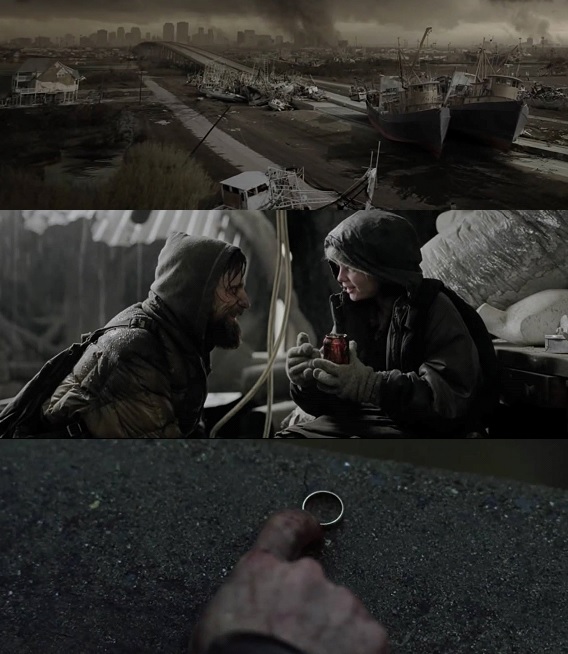
JOHN HILLCOAT’S THE ROAD — A REVIEW BY NICK CLEMENT

road

John Hillcoat’s nasty and chilling adaptation of Cormac McCarthy’s The Road was the best, most powerful film from 2009. Ever since I first viewed it I knew it would be impossible to forget. This is an emotionally riveting experience, a film that’s not likely to be embraced by all viewers, but I found it to be brilliant on pretty much every level. The snubbing that this film received, both by its distributors, and the Academy, was despicable. This is a masterful piece of post-apocalyptic fiction, a film that’s appropriately grim and bleak, but one that contains slivers of hope for humanity even during the darkest of moments. Viggo Mortensen’s quietly devastating performance as The Father was yet another incredible piece of work from this actor, who has strangely been missing from the screen for the last few years it seems. Kodi Smit-McPhee, making his debut performance, held his own quite admirably as Mortensen’s confused and scared son; the two of them hit some dramatic high notes of raw, honest, emotional intensity and their chemistry as father/son was palpable in every scene. Hillcoat (The Proposition, Lawless, the outstanding Triple 9 which is currently in theaters) and screenwriter Joe Penhall (the fantastic and deeply underrated Enduring Love) weaved a furiously dark tale of survival at the end of the world, smartly adapting Cormac McCarthy’s blistering novel, without ever resorting to cheap sentimentality as a buffer between all sorts of disturbing yet thought provoking narrative content.

Nick Cave and Warren Ellis’s moody score (they also did the brilliant music for The Assassination of Jesse James by the Coward Robert Ford) combined perfectly with the stunningly desolate cinematography by Javier Aguirresarobe, and Chris Kennedy’s intricately detailed and decrepit production design truly brought the viewer into this haunting, nightmarish world. I thought about the ending of this movie for days after I first witnessed it, and even after countless viewings, I’m still left shaken up by it. The film ends as it should, but it leaves you wondering so many things, but in a great, enriching way. This is the kind of introspective and sad piece of cinema that not a lot of people want to sit through, and I get that. But for me, films like The Road are why I love the power of the cinematic form. The Road is one of the best and most interesting films to deal with the idea of the apocalypse, and I just wish it had found a larger audience on the big screen and more support from the company that distributed it. When a film is as uncompromising with its vision in the way that The Road was, it becomes a challenge to market the story to a broad audience, hence the terribly misleading action-oriented trailer that pulled a major bait and switch. Whenever I watch The Road, I constantly ask myself how I would react in the situations that unfold during the story. What would I do if confronted with these odds? The Road doesn’t offer easy answers. It’s mysterious but accessible, and the way that Hillcoat and Penhall dispense with clues and signs as to the who/what/where/when/why of the desolation is subtle and eerie. I adore this strong and powerful piece of contemplative work, and it’s one that I’ll re-visit for many years to come.

***SERIOUSLY SPOILER FILLED SIDE-BAR INVOLVING MULTIPLE FILMS – PROCEED WITH CAUTION***

I love to ponder the idea of mixing movie worlds. After the events of David Michod’s astonishing The Rover, Guy Pearce, who would be out of reasons to stick around in the Australian outback, and given that The Rover features only a partial collapse of society, hitches a boat ride to the East Coast of America. He’s not there for more than a few months, when, BANG!, whatever happens to destroy society in The Road happens, and he’s now in a similar situation as he was in The Rover, just in a different part of the world. Viggo and his son traverse the coastline and make it to that beach, where, wouldn’t you know it, Guy Pearce from The Rover shows up, old and sloppy with some other people in tow (a family? Stragglers?), and he adopts Mortensen’s son. Boom. I love this.


CEMETERY OF SPLENDOR: A Review by Joel Copling

Rating in Stars: **** (out of ****)
Cast: Jenjira Pongpas Widner, Banlop Lomnoi, Jarinpattra Rueangram, Petcharat Chaiburi, Tawatchai Buawat
Director: Apichatpong Weersethakul
MPAA Rating: NR
Running Time: 2:02
Release Date: 03/04/16 (limited)

Upon first viewing, there is something distinctly odd (and entirely fascinating) about writer/director Apichatpong Weersethakul’s aesthetic approach to Cemetery of Splendor. Here is a story about soldiers in the modern day whose mysterious form of narcolepsy is caused, according to a pair of long-dead princesses, by the spirits of ancient kings still fighting a millennium-old war. The soldiers’ lack of wakefulness is not just physiological but spiritual. When the one to which our chief protagonist latches herself in a maternal fashion does wake, it is through two avenues: his own body, which eventually loses the ability to keep that kind of energy active, and that of a local mentalist.

This is not just spiritual silliness, as this strange and singular narrative is largely told within the present day. The princesses who visit Jenjira (Jenjira Pongpas Widner, in a very good performance that conveys world-weariness well) look like any other woman that populates the Isan province of Khon Kaen in Thailand. Jenjira and her oft-absent, American husband (Richard Abramson) had prayed at the foot of a shrine and given various items as offerings just hours earlier. It was an act done in tribute to those soldiers, specifically to Itt (Banlop Lomnoi), the soldier in whom Jenjira develops a parental sort of interest (Itt has little family of whom to speak, and certainly none of them has visited since his relegation to this small, makeshift hospital built out of an elementary school).

Even the hospital is on its way out, so to speak, soon to be replaced by a company that manufactures and sells fiber-optic cables. One has to wonder how the kings’ spirits would affect such a product when even children who attended the old elementary school complained of sleepiness for the years of its run. In any case, Jenjira and the head nurse at the hospital tend to several soldiers by a careful application of palliative medication, a healthy dose of meditation over the internal injuries that might have resulted from their days in combat, and the use of lengthy light bulbs whose hues shift color in particular striking moments within Diego García’s lush cinematography.

That last point brings me to the curious aesthetic choices made by Weersethakul and García. Almost every shot is a static one, simply observing the goings-on within and around Jenjira’s story. A waterwheel spins with great speed and determination. Bulldozers brutally renovate the land on which children play with soccer balls in order to pave the way for that cable company’s incoming location. The soldiers suffer the indignation of being in a coma and without the ability to control their bodily functions (An involuntary erection underneath bed covers is just one of a few things that might have earned the film an R rating if the MPAA had gotten their hands on it).

The film then enters a third act that fully embraces the hallucinatory qualities of Weersethakul’s intentions. The mentalist, Keng (Jarinpattra Rueangram), comes into the picture as Itt’s spirit, briefly trapped in a body that will perhaps never be cured, only treated, of its ailment, inhabits Keng, who leads Jenjira through a portion of the nearby wood, its metaphysical state now sharing that of the palace that accompanied an ancient graveyard holding the bodies of the soldiers from so many ages before. The allegory is afforded gravity by Weersethakul’s gentle hand, and as a result, Cemetery of Splendor resonates most heavily as a patient but devastating elegy.

THE LAST BOY SCOUT – A REVIEW BY J.D. LAFRANCE

3BRLjwxF2rmVFedrQkjNdPcd8UwShane Black’s career has had a fascinating, meteoric rise and fall (and rise again). The screenwriter hit the big time when his breakthrough screenplay for Lethal Weapon (1987) sold for $250,000. This kick-started a wildly popular action film franchise. He soon hit rock bottom with the heavily re-written (by others) modest hit, The Long Kiss Goodnight (1996), the script of his that sold for a staggering $4 million. And yet, even his weaker efforts still contain decent action sequences and playful banter between characters. What seemed to be missing in Black’s later films was depth and characterization – elements that made his screenplays distinctive. Perhaps this was as a result of meddling and script revisions at the hands of others. For Black, screenwriting came easy: “The fact that there were so few rules associated with it, so few actual structural maxims … you can just do what you want. So I played around and it was fun. I would just type to keep myself entertained. It turned out people liked that. They felt it represented an interesting way to go, but for me it was truly just typing to keep myself entertained.”
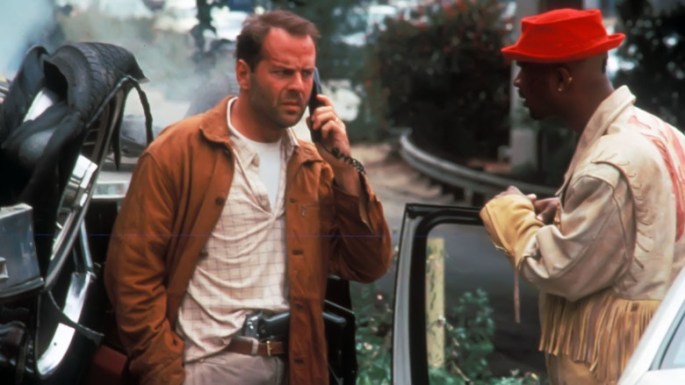
Studio executives were only interested in using Black to write formulaic drivel. Determined to make it, he wrote Lethal Weapon. The script was a blast of fresh air and ended up being made into a big budget action film starring Mel Gibson and Danny Glover. This kind of thing almost never happens in Hollywood and it’s a testimony to Black’s skill as a screenwriter that he achieved this kind of success so early on in his career. Lethal Weapon grossed over a $100 million. In the best tradition of Hollywood, money talks and so in 1990, Black was paid $1.75 million (an unheard of amount at the time) for The Last Boy Scout script. The next year it was made into a 1991 action movie starring Bruce Willis and Damon Wayans and directed by the late Tony Scott.

The film starts off literally with a bang as a pro-football player (a pre-infomerical Billy Blanks) pulls out a handgun right in the middle of a play and shoots three opposing players in his way to getting a touchdown before killing himself. Joe Hallenbeck (Bruce Willis) is a private detective hired by his best friend (Bruce McGill) to protect a stripper named Cory (Halle Berry in an early role). The best friend is subsequently blown up in a car and the stripper gunned down by thugs. Her washed-up, football-playing boyfriend Jimmy (Damon Wayans) hooks up with Joe to get some answers and some much needed payback.

“I had this period where I didn’t think I was any good at anything and fought desperately to stay afloat,” Black said in an interview with Creative Screenwriting magazine. And with that feeling in mind, Black wrote a movie that pushes the world-weary detective stereotype to then new, surreal levels. Willis’ performance and Black’s screenplay combine to produce a portrait of a guy who is so down and out that our first glimpse is a shot of him passed out in his own car while being harassed by snotty neighborhood kids with a dead squirrel. When we meet Joe he has a pretty simple outlook on life – a mantra, if you will, to start each day: “Nobody likes you. Everybody hates you. You’re gonna lose. Smile you fuck.” Willis, who has made a career out of playing world-weary tough guys, nails the defeated vibe that sticks to Joe like stink on dog poop. Joe’s actually a very disillusioned good guy, an ex-Secret Service agent who saved the President’s life once but got fired after he punched out a senator (Chelcie Ross) with a kinky streak. Throughout the movie, Willis delivers deadpanned one-liners while constantly getting the crap kicked out him. As a result, you can’t help but root for him as he and Wayans send the baddies to their well-deserved violent deaths.

Willis plays a classic burn-out, sporting the traditional slovenly appearance of a down-on-his-luck P.I. complete with unshaven look and rumpled clothes that he slept in. And that’s the best he looks, from that point on it’s all downhill as his face takes on cuts and lacerations accrued from fighting numerous bad guys. Joe actually uses his disheveled appearance to his advantage, like when a random baddie takes him into an alleyway to kill him. Joe buys time by cracking jokes about the flunkie’s wife and then, when the guy lets his guard down, stabs him in the throat with a broken bottle. The guy gurgles, “You bastard,” to which Joe curtly replies, “And then some.” Willis was born to spout Black’s dialogue. He’s the master of sarcastic comebacks and gets some real doozies in The Last Boy Scout. At one point, Jimmy chides him, “You read much?” Joe replies, “My subscription to Juggs magazine just ran out.”

Jimmy is also at an emotional cul-de-sac of sorts – popping pills to stave off chronic pain from football injuries he picked up as a player. Like Joe, he’s been disgraced from his former profession, kicked out of the league for gambling. He now spends time feeling sorry for himself by cultivating a drinking problem and nailing anything in a skirt despite having a super-hot stripper girlfriend played by Halle Berry (only in the movies!). Like Martin Riggs in Lethal Weapon, Jimmy lost his family to tragedy and it taints his entire worldview. Life means nothing and solving his girlfriend’s murder is the only thing he has left. Wayans shows that he’s more than just a goofy funnyman in a scene where he tells Joe how he got kicked out of football. It is an angry tirade tinged with hurt and bitter resentment as he was basically chewed up and spit out by an uncaring organization. His speech touches upon the harsh realities of professional sports.

Scott populates his movie with a fine collection of character actors, chief among them Noble Willingham as uber rich football team owner Sheldon Marcone and stand-up comedian Taylor Negron cast wonderfully against type as one of Black’s trademark polite, well-spoken sociopaths (see also Lethal Weapon’s Mr. Joshua and The Long Kiss Goodnight’s Timothy). Marcone is also a repeating motif in Black’s scripts. He’s an old, privileged white man who is greedy and corrupt. Think of the money-laundering retired general in Lethal Weapon and the war-mongering CIA boss in The Long Kiss Goodnight. Black clearly sees these men as the source of real evil in the world, pulling the strings that will result in death and destruction in the name of money. In all three films, the protagonists face insurmountable odds to do what is right regardless of the danger or risk to their own well-being.

Like most buddy action movies, the relationship between Joe and Jimmy starts off with plenty of friction as the quarterback resents the private investigator watching over his girlfriend because that’s his job. They trade a few insults and then decide to team up when she’s killed. Black has fun playing around with the dynamic between two guys who basically hate each other but are thrown together due to extraordinary circumstances. At one point, Jimmy cracks a joke to lighten the mood between them only to be rebuffed by Joe. Jimmy tells him, “I’m just trying to break the ice,” to which Joe replies, “I like ice. Leave it the fuck alone.” There are all kinds of snappy banter between them as Wayans tones down his trademark goofy shtick and more or less plays straight man to Willis’ deadpan humor.

Unlike a lot of buddy action movies, Black allows for the occasional lull, like the moment where Jimmy looks at a photograph of him and Cory and you can see on his face how upset he is by her death now that he has a moment to reflect on it. No words are said, Wayans’ face says it all. Joe and Jimmy represent the last bastion of decency in a world that is corrupt and morally bankrupt, where best friends double cross each other, wealthy businessmen are blackmailed, and wives cheat on their husbands. The deeper our two heroes go into investigating Cory’s murder the more corruption they uncover.

The aforementioned alleyway sequence and Cory’s death are vintage Tony Scott moments with his trademark look: smoke, neon and rainy streets at night. Think of it as the director’s version of a neo-noir. He is equally adept at action sequences as he is with showdown set pieces, like the scene where a henchman repeatedly offers Joe a cigarette only to punch it out of his mouth. Joe has been captured and is unarmed and outnumbered but he still has the balls to threaten to kill the guy if he hits him one more time. There is palpable tension as we wait for Joe to follow through on his threat (or be killed), which he does with brutal swiftness. It is reminiscent of the famous showdown between Christopher Walken and Dennis Hopper in True Romance (1993) where a tense scene could erupt in violence at any moment.

Successful screenwriter Shane Black made headlines in 1989 when he sold his spec screenplay (written without a contract from a studio or a producer) for The Last Boy Scout to the David Geffen Co. for an unprecedented $1.75 million. He had wisely taken advantage of the boom of independent production companies that sprouted up in the late 1980s looking for big budget action scripts. It must’ve come as validation of his abilities after what he had been through.

After his meteoric rise with the success of the script he had written for Lethal Weapon, a sequel was inevitable. The studio gave Black first crack at it. Something had happened to the writer after enjoying a taste of notoriety and his first draft was even darker than what he had written for the first movie. For starters, he proceeded to kill off Mel Gibson’s character. Not surprisingly, the studio didn’t want to go that route and Black quit the project. Then, he lost the desire to write. A family illness coupled with the break-up of a long-term relationship rocked his already shaky confidence. For the next two years he did no writing and instead lived in fear of the next project and failing. Out of this dark period in his life came the script for The Last Boy Scout, which he wrote in five months.

For the script, Black drew on such influences as hard-boiled crime fiction by the likes of Raymond Chandler and Ross McDonald because they wrote about “personal integrity, morality, conflict, dealing with insanity, dealing with pain and death.” He wanted to write a modern private investigator story set in Los Angeles. He decided to set his story with the sleazy side of professional football as the backdrop because it matched up well with his take on a Chandleresque private investigator story. For Black, football “combines the spirit of the American hero with the spirit of American greed.” After finishing the script, he didn’t think it would sell because “it was weird” and “too rough for most people. It’s not a commercial formula; it’s a very raunchy, down and dirty detective film.”

Originally, director Tony Scott had a war movie taking place in Afghanistan set up as his follow-up to the Tom Cruise racing car movie Days of Thunder (1990). However, the script didn’t come together and he was given The Last Boy Scout. He liked it so much that he agreed to do it. Not much has come out of what went down during filming but what little has suggests a contentious shoot. With titanic egos like producer Joel Silver, movie star Bruce Willis and Tony Scott, they were bound to clash and they did as Scott later admitted, “I got caught a little bit between Bruce and Joel Silver … I was pushed in terms of the cast and in terms of how I was shooting it.” He also felt that Black’s script “was better than the final movie.” Of the experience, all Silver would say was that it was “one of the three worst experiences in my life.”

The Last Boy Scout performed fairly well at the box office and has since enjoyed a second life on video and television (thank you, TBS). Black went on to get paid more than $1 million for his rewrites on The Last Action Hero (1993), a criminally underrated romp that is the granddaddy of self-reflexive action movies. This movie was crucified by critics and did not perform as well at the box office as expected but this did not tarnish Black’s reputation either. However, he disappeared from movies for a few years before coming back with a vengeance with the quirky private detective movie Kiss Kiss Bang Bang (2005) and Iron Man 3 (2013). The Last Boy Scout is a lean, mean guilty pleasure with a misanthropic streak that is uncompromisingly un-PC in attitude. This is further reinforced by its rather poor view of women. They are either liars and cheats (Joe’s wife), whores (Cory), or foul-mouthed brats (Joe’s daughter). Joe takes it all grimly in stride because hey, he’s already hit rock bottom. He doesn’t care about anyone or anything, including himself. Action films don’t get any nastier than this one.

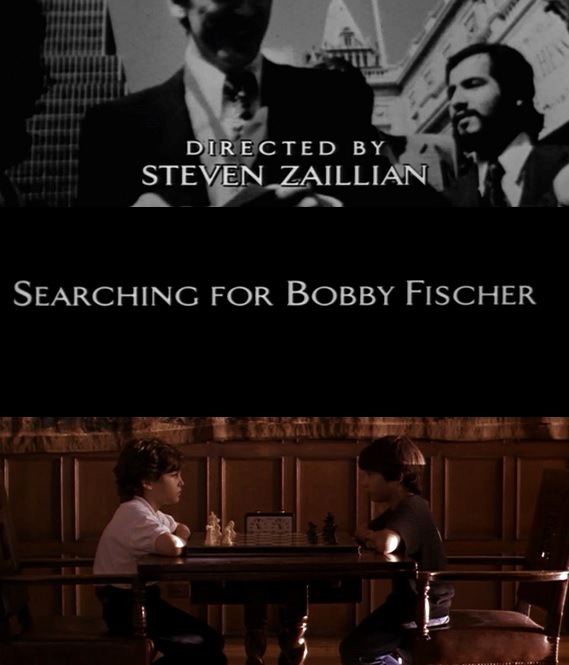
STEVEN ZAILLIAN’S SEARCHING FOR BOBBY FISHER — A REVIEW BY NICK CLEMENT

bobby fisher

I absolutely adore Steven Zaillian’s directorial debut Searching for Bobby Fischer. Zaillian has a nearly flawless track record as a big-gun Hollywood screenwriter, and his directorial efforts have also been excellent (A Civil Action and the underrated All the King’s Men), but his first film is a nearly perfect, humanistic piece that zeroes in on character in a way that few dramas ever dare, especially when considering that the film is told through the POV of a 10 year old chess prodigy, who likely has some developmental and social anxieties, if not outright disorders. I’ve been obsessed with this film for over 20 years. I viewed it in the theater at 13 years of age, it was a go-to film when it endlessly played on HBO back in the day, and throughout the years, I’ve turned to this great, unassuming, patient work at least once every 365 days on my well-worn DVD, because it reminds me of how effective a simple story can be when the acting is extra-precise and when the writing compliments the direction and vice versa. It also helps to have had Conrad Hall calling the shots behind the camera; this is yet another beautifully textured and composed piece of work from one of the most legendary of cinematographers ever to grace the medium. The plot centers around a kid named Josh who is discovered to be a chess whiz by his parents and family members. They encourage his passion and gift, which leads him to an extremely intense and strict instructor named Bruce (played with devilish charm by Ben Kingsley), who pushes young Josh both emotionally and psychologically to be the best chess talent he can be, along with never forgetting how to be a decent person along the way, without sacrificing a competitive edge.

Bruce continually hypes up and compares Josh to chess great Bobby Fischer, allowing the youth to develop the idea that one day, he might be as great as that iconic yet mysterious figure. There’s also an affecting subplot between Josh and a speed-chess hustler named Vinnie, perfectly captured with great spirit and flair by Laurence Fishburne. And let’s not forget about the incredibly moving family dynamics between Josh and his parents, played by the brilliant team of Joe Mantegna and Joan Allen, both of whom radiate warmth and respect and support for their son, even under the most trying of situations and circumstances. And over the course of the film, it’s remarkable to witness Josh become his own person, after so many others have projected what they want him to be or to become, without ever asking Josh what it is that he really wants to do. The lead performance from then eight year old Max Pomeranc is nothing short of sensational; there are adults who have been acting for years who don’t come close to the complexity that he delivered in this challenging piece of work. It’s also interesting to note that Pomeranc was an actual chess player before filming began (even appearing on a Top 100 list for his age group, according to Wikipedia), and that he never went on to act in another substantial film again. But he’ll always have his tremendous performance in this amazing film to hold close to his heart. Zaillian has long been a considerable talent, expertly balancing his artistic sensibilities with the demands of the studios who are always courting him for big adaptations or structural work on their blockbusters. It’s not hard to see why. This is a great film and Zaillian is a class act.


OUT OF SIGHT – A REVIEW BY J.D. LAFRANCE

“It’s like seeing someone for the first time. You can be passing on the street and you look at each other and for a few seconds there’s this kind of recognition. Like you both know something, and the next moment the person’s gone. And it’s too late to do anything about it. And you always remember it because it was there and you let it go. And you think to yourself, what if I stopped? What if I said something? What if?” – Jack Foley

This bit of dialogue from Out of Sight (1998) perfectly captures the essence of the relationships between the characters in this film. It is about the what ifs and the what could have beens. What the characters do and, more importantly, what they don’t do that directly determines their fate.

As the film begins, Jack Foley (George Clooney), a career bank robber, escapes from a Florida prison with the help of his loyal accomplice Buddy (Ving Rhames). In the heat of the moment they kidnap a beautiful Federal Marshall named Karen Sisco (Jennifer Lopez). She and Jack are stuffed in the trunk of her car as they make a hasty retreat. Trapped in such a small, confined space Jack and Karen have nothing to do but engage in idle chitchat. Even though they are on completely opposite sides of the law there’s a spark, an initial attraction that blossoms into something more as the film progresses and their paths inevitably cross again.

Out of Sight
is based on the book of the same name by Elmore Leonard. He had wanted to do a bank robber story for a long time. Several years ago, he saw “a picture in the Detroit News of an attractive young woman who was a Federal Marshal standing in front of the Federal Courthouse in Miami. She held a shotgun which was resting on her cocked hip and as soon as I saw that picture, I knew it was a book.” Danny DeVito bought the rights to a previous Leonard book Get Shorty for his production company Jersey Films. After the success of that film, he bought the rights to Out of Sight.

The film came to George Clooney and Steven Soderbergh at a time when both of their careers had reached a critical junction. Clooney was coming off the commercial and critical train wreck known as Batman and Robin (1997). Soderbergh had completely shunned the mainstream with the one-two punch of Gray’s Anatomy (1996) and Schizopolis (1996). Both men were looking for a hit that would put them back on the map. Soderbergh had already made two films for Universal and one of its executives, Casey Silver, offered him Out of Sight with Clooney attached. Soderbergh was close to making another project and was going to pass but Silver told him, “These things aren’t going to line up very often, you should pay attention.”

Soderbergh and screenwriter Scott Frank achieve a perfect mix with Out of Sight. The film’s pace moves with effortless ease and self-confidence. They know when to slow things down and savor the moment as well. As Frank proved with his excellent screenplay for Get Shorty (1995), he perfectly understands Leonard’s distinctive cadence and the speech patterns of his characters. Cinematic adaptations of books are almost always inferior because so much has to be cut out or changed to fit into a two-hour film. However, Leonard’s books are tailor-made for movie adaptations because they are very visual and almost entirely dialogue and character-driven — ideal for the screenplay format. Out of Sight is one of those rare movies that is actually better than the book.

Soderbergh and his cameraman, Elliot Davis (White Oleander), paint their film with a specific color code. The bright colors of the Florida scenes — especially the prison sequences with vibrant blue and the bright yellow prison uniforms worn by various characters — provide a nice contrast to the second half of the film, which consists mainly of a gun-metal blue color scheme. The Detroit scenes have a cold, metallic feel to them and this really comes out. David Holmes’ catchy R&B score comes in and instantly transports the viewer into this world. He mixes in his own brand of funky electronica with old school tunes from the likes of the Isley brothers and Willie Bobo. From the atmospheric noises in the background to Holmes’ superb trip hop beats, this is a great sounding film.

After a string of so-so films, George Clooney finally found the right project that suited his particular talents with Out of Sight. With his movie star good looks and suave charm, he is perfectly cast as the smooth talking criminal. This may be his finest performance to date. For Clooney what attracted him to this role was the chance to play a character that evoked his cinematic heroes of the past. “When I was growing up the heroes for me were the bankrobbers — you know, the Cagneys and the Bogarts, Steve McQueen and all those guys, the guys who were kind of bad and you still rooted for them. And when I read this, I thought, This guy is robbing a bank but you really want him to get away with it.” Clooney’s style of acting is perfect for this role as he plays Foley with the right amount of laid-back charm. This is typified by his character’s introduction — the most pleasant, non-violent bank robbery ever committed to film. Clooney has such a likable screen presence that you want to see his character succeed.

Conversely, Jennifer Lopez is his perfect foil as a smart, tough law enforcement officer who can’t help but fall in love with this charismatic criminal. She is a very attractive woman but not above wielding a shotgun to apprehend a fugitive. There is a genuine chemistry between the two actors that makes their romance work. And it is this relationship that gives Out of Sight its depth. There is more to this film than snappy banter and a hip soundtrack. Incredibly, Sandra Bullock was originally considered to play Karen Sisco opposite Clooney, however Soderbergh said, “What happened was I spent some time with [Clooney and Bullock] – and they actually did have a great chemistry. But it was for the wrong movie. They really should do a movie together, but it was not Elmore Leonard energy.” Someone must’ve listened as the two ended up acting opposite each other years later in Gravity (2013).

A killer cast supports the two lead actors. Steve Zahn, an underrated character actor, is perfect as Glen, a stoner screw-up who looks up to Jack but is a royal pain in the ass. Dennis Farina plays Karen’s laid-back dad who buys his daughter a handgun for her birthday and just wants to see her married to a lawyer or a doctor. Albert Brooks is Richard Ripley, a bumbling white-collar criminal type who is in way over his head and sports a truly awful toupee. Don Cheadle plays “Snoopy” Miller, a tough guy-wannabe that is a classic schoolyard bully. Rounding this cast out is Ving Rhames, Jack’s tough, God-fearing partner in crime who always has his friend’s back.

Despite its lackluster performance at the box office, Out of Sight received widespread critical praise. It was clearly a career turning point for both Clooney and Soderbergh. The actor said in an interview that “Out of Sight was the first time where I had a say, and it was the first good screenplay that I’d read where I just went, ‘That’s it.’ And even though it didn’t do really well box office-wise — we sort of tanked again — it was a really good film.” Clooney went on to success with O Brother, Where Art Thou? (2000) and Ocean’s Eleven (2001). Soderbergh saw Out of Sight as “a very conscious decision on my part to try and climb my way out of the arthouse ghetto which can be as much of a trap as making blockbuster films. And I was very aware that at that point in my career, half the business was off limits to me.” The film’s critical reaction gave Soderbergh a foothold in Hollywood that led to the commercial success of Erin Brockovich (1999) and Oscar gold with Traffic (2000).

Out of Sight
is a film about making choices and taking chances despite the sometimes inevitable, painful consequences. It is also an entertaining look at a collection of colorful characters and the exciting world they inhabit. This is a smart, sexy and wonderfully stylish crime thriller that was ignored by audiences (due to lousy advertising and an even worse release date) but garnered strong critical reaction (winding up on many Best Of lists that year). Fortunately, Out of Sight has been re-discovered on home video and recognized as one of the best Elmore Leonard adaptations ever put to film.

JOHN HILLCOAT’S TRIPLE 9 — A REVIEW BY NICK CLEMENT

1

Triple 9 is my kind of movie. But I expected that. This is a John Hillcoat film. Hillocat has only made movies that I have loved. The Proposition, The Road, Lawless, and now this nasty, 70’s-flavored cop film that has streaks of Lumet while possessing an aggressively stylish and modern aesthetic hand. Matt Cook’s hard boiled screenplay involving corrupt cops, heists gone awry, and shifting allegiances surprises all throughout, unexpectedly killing off characters with blunt force, made even more impactful by Hillcoat’s always incredible sense of grim fatalism. There’s zero fat on the narrative yet the story is still full bodied. The star studded cast all clearly had a blast playing in this scuzzy milieu, with Kate Winslet as a Russian-Jewish gangster stealing the entire picture from an appropirately glum and intense Casey Affleck and an extremely riled up Chiwetel Ejiofor. Aaron Paul does drugged-out despondency better than anyone, Anthony Mackie goes hardcore, and Clifton Collins Jr., yet again, delivers a robust and extremely memorable supporting performance, totally dominating the screen and adding yet another terrific character to his rogue’s gallery. Oh wait, and then there’s Woody Harrelson, completely OWNING the film every time he appears, bringing a sense of humor to the otherwise heavy subject matter. Theresa Palmer, it must be said, has a stunning backside. And Michael K. Williams gets the cameo of the year. Triple 9 is also brimming with fantastic car chases and ear-ringing shootouts that explode with dangerous intent. The throbbing muscial score by Atticus Ross is a perfect match for the purposefully ragged cinematography and editing, creating brilliant chaos that still remains coherent. And then there’s the last shot, which, for my money, is an instant classic for this type of material. If you love violent cop films with hardened, unrepentant characters who aren’t easy to root for, if you yearn for more R-rated genre entries like this that harken back to the old days, then go out and see Triple 9.

MICHAEL MANN’S THIEF — A REVIEW BY NICK CLEMENT

thief.jpg

A Jerry Bruckheimer production. A film by Michael Mann. Damn, does that sound pretty sweet. It’s interesting to note how very different these two creative forces would become over the years, but their 1981 collaboration cemented two very distinctive stylistic talents who would pave the way all throughout the decade for other filmmakers who would become obsessed by their explosive action elements and urban nocturnal elegance. James Caan delivered one of his greatest performances in this gritty yet slick neo-noir which Mann based on the 1975 novel The Home Invaders by Frank Hohimer, who in actuality was real-life criminal John Seybold. Tuesday Weld co-starred as Caan’s girlfriend, with an amazing supporting cast including Willie Nelson, James Belushi, Robert Prosky, Dennis Farina, and Tom Signorelli peppering the film with lively, extremely memorable moments. This was Mann’s auspicious feature film debut after time spent on docs and TV programs, displaying a sensationally strong grasp of filmmaking technique and intent, with some of his now-obsessive visual traits firmly in place from the start.

The scene in the coffee shop between Caan and Weld is an all-timer, one of the single best moments of acting in Caan’s career, and further serves to demonstrate just how forceful and commanding he was as a leading man, while being able to convey his own special brand of sympathy. And one gets the sense that, while totally acting as its own great piece of storytelling, Mann was warming up and setting the stage for bigger, more epic pieces of filmmaking, while establishing his love for hardened, morally ambiguous protagonists who straddle both sides of the law while displaying an intense concentration on their job by following a meticulous set of personal and professional codes. These have been the recurring themes in Mann’s work that has stretched from the near operatic (Heat) to the grounded docudrama (The Insider) to the quasi-experimental studio thriller (Collateral) to the expressive and impressionistic genre treatise (Miami Vice). William Peterson made his feature debut in a very small part. After debuting at the Cannes Film Festival, Thief would slip in and out of theaters mostly unnoticed, despite receiving strong reviews from critics. Tangerine Dream’s hypnotic score only amplifies Mann’s uncanny sense of atmosphere and mise-en-scene.