IVAN PASSER’S CUTTER’S WAY – A REVIEW BY NICK CLEMENT

2

Cutter’s Way is so underrated it’s almost a joke. Terrific script by Jeffrey Fiskin, who also adapted Jim Harrison’s Revenge for the late, great Tony Scott, gritty and propulsive direction by Ivan Passer, and boasting an absolutely ferocious performance by John Heard (probably his best work) as a disabled Vietnam vet and a fantastic Jeff Bridges as best friends who get mixed up in a murder mystery when one of them accidentally witnesses a guy disposing of a dead body. Heard’s emotionally fragile and physically beleaguered character then gets an idea that might push stuff over the edge; I’m really trying to avoid any spoilers or too much of a plot description because this movie is so consistently awesome and I’d want anyone unfamiliar with it to track it down and have as little of an idea as possible about what they’ll see. Based on the novel Cutter and Bone (and released at one point under that title), the film premiered in 1981, and went criminally under the radar at the box office due to lack of marketing and confusion/turmoil at the studio; the film’s Wikipedia page highlights what happened to this cinematic diamond in the rough. Happily, Cutter’s Way has picked up cult status over the years, and it’s easy to see why. The material is politically charged without being preachy, it’s tense and terrific when it comes to action and dramatics, and the performances all sting with authenticity and force. Jordan Cronenweth handled cinematography chores, and as usual, the results were wonderful, while the score by Jack Nitzsche hits all the proper notes. The film has a tone that feels more 60’s/70’s rather than the 80’s, and the ambiguous nature of the narrative is a key highlight to the film’s success. Honestly, make it a double bill with Karel Reisz’s phenomenal and equally underappreciated Who’ll Stop the Rain, and then come and thank me for telling you to do so!

Edward Zwick’s Legends Of The Fall: A Review By Nate Hill

Edward Zwick’s Legends Of The Fall is sweeping Hollywood grandeur at its finest. It’s a raging typhoon, one part family high drama, one part war film, wrapped in a nostalgic, old world romance that hearkens back to the golden age of cinema. It’s an epic as only the pictures can show us, blowing a gust of storytelling wind at us and depositing us on the endless plains of the 1900’s, in the monumental Rocky Mountains of Montana. The story focuses on Colonel William Ludlow (Anthony Hopkins, gnarled nobility incarnate), living with his three sons in the desolation of an old world making way for a new, as the four of them deal with love, loss, war, nature and interpersonal conflict in a story that plumbs the chasms of human nature and spits out characters that bleed raw feeling, reach out to one another in the clamour of a nation only just being formed (like the land itself), and clash in tragic harmony, spanning years in their lives and showing us desperation, grief and brotherhood. Brad Pitt, in the fiercest performance I’ve ever seen him muster, plays Tristan, Ludlow’s half Native son with a wild streak a mile long and a kinship with the tangled wilderness he calls home. Aiden Quinn plays the middle brother Alfred, a reserved, analytical type. When their younger brother Samuel (Henry Thomas), arrives home with his beautiful fiancé Susannah (Julia Ormond) sparks fly between her and Tristan, and an immediate rift is formed in the family that Ormond sees all too well, but cannot deny her love for Pitt. Samuel is a fragile, easily traumatized man, and when the boys are driven from their lands to fight in the war, it dampens his soul with a ruining force of horror that leaves him scarred forever. Tristan, being almost animalistic at heart, sinks into the carnage of combat with the keen resilience of a wolf, and is transformed in a different fashion. This to me is the penultimate sequence of the film, as it strays from the picturesque grandeur of their life before, removed from the world of conflict, into the sheer reality that befalls a country in formation, representing a loss of innocence so to speak. Neither of them are the same after that, and the cracks in their brotherhood only etch further after tragedy befalls Susannah, blackening their idealistic home life as well and tainting the memory with aching sadness. Tristan tries to move on, either to wrap the hurt in a cloak of new events, or because his instinctual nature spurs him on, but he almost seems to be cursed, and more hardships step into his path as well. I don’t want to deter you from seeing this by laying all this doom and gloom into my review, because it’s actually a very beautiful film to see unfolding, it just deals with incredibly tragic subject matter that will leave you breathless with tears, like Titanic, or Romeo & Juliet. Pitt.. What can I say. He’s outstanding, giving Tristan the fearsome gaze of a wounded animal, and the love struck longing that’s shot down by fate, turning him into a prisoner of his own ephemeral love for those who are taken from him. It’s my second favourite of his roles (it’s hard to top Twelve Monkeys) and he shines in it like a silver star over the Montana horizon. Montana itself basically screams to be pored over by a camera, and the cinematography will make you feel every gust of mountain air and gasp at the looming crags and sun dappled glades that leap out from your screen at you. It’s one of the last of a dying breed: the romantic epic. Like Titanic, or Gone With The Wind and Doctor Zhievago before it, it posses that untouchably bold quality that showcases emotion, tragic happenstance and deep longing all set in a breathtaking setting that is meant to move and astonish you. A classic.

Ted Demme’s The Ref: A Review By Nate Hill

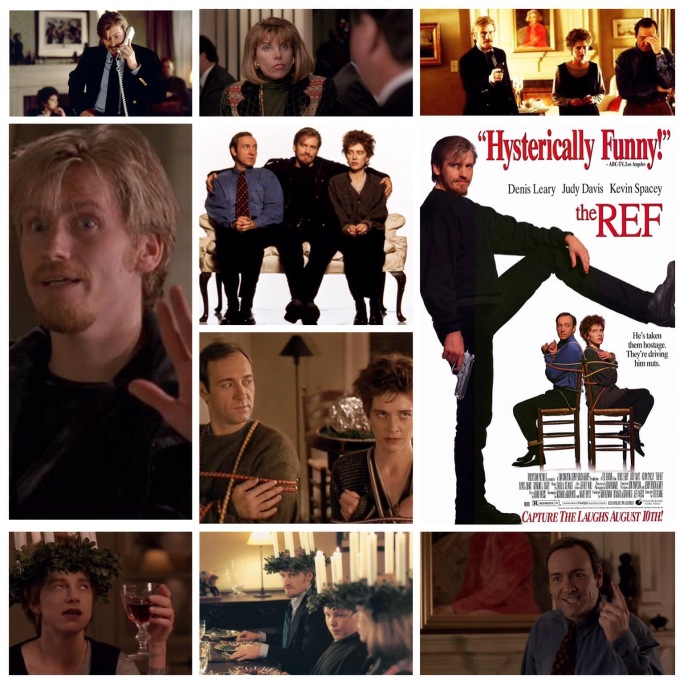
Ted Demme’s The Ref is one of my favourite holiday comedies of all time, one I re watch every and never tire of. It’s the most cheerful black comedy I can think of, while at the same time being one of the most cynical, acid tongued Christmas movies on record. In spite of this pissy tone, however, it still manages to elicit warm fuzzy feelings and make you care for its loveable, curmudgeonly characters. It’s also got a spitfire of a script, given wildly funny life by its star, the one and only Denis Leary. Leary, every the motor mouthed, nicotine fuelled teddy bear, is an actor who’s work is very dear to me. Many times when I was younger and wasn’t in the best place in my head, I’d watch various films of his, and his standup and he always put me in a better place. Here he plays short tempered cat burglar Gus, who is forced to lay low in a small town on Christmas Eve after being busted and nearly caught by a state of the art alarm system. He takes a middle aged couple hostage to hide out at their house, and goes from the proverbial frying pan into the fire. Kevin Spacey and Judy Davis play the couple, who bicker endlessly and drive Gus up the wall by constantly being at each other’s throats and never shutting up. Spacey never comes up short in intense performances, whether dramatic or funny, and he owns the role, meeting Leary and Davis’s manic energy with his own verve. Davis, an underrated actress, pulls out all the stops an delivers like she always does as well. The three of them are left in the house to hash out their issues, criticize each other, fight, make constant jabs at character and all that other lovely Christmas-y stuff. The hilarity peaks when Spacey’s insufferable brother and his family show up for the most awkward Christmas dinner in history, as the trio tries to disguise the fact that they’re harbouring a criminal from the dimwitted clan, and Spacey’s tyrannical bitch of a mother (Glynis Johns). There’s balance to the stressful vibe, though, as Leary’s presence elevates every emotion from the couple and eventually turns things around, all expertly played by the actors for laughs both obvious and subtle. The excellent Raymond J. Barry is crusty delight as the mean spirited Sheriff, and there’s great work from J.K. Simmons, Christine Baranski, Arthur Nascarella, Vincent Pastore, Richard Bright, Adam LeFevre and B.D. Wong. A Christmas classic for me, for a number of reasons, and one of the funniest, overlooked holiday flicks out there.

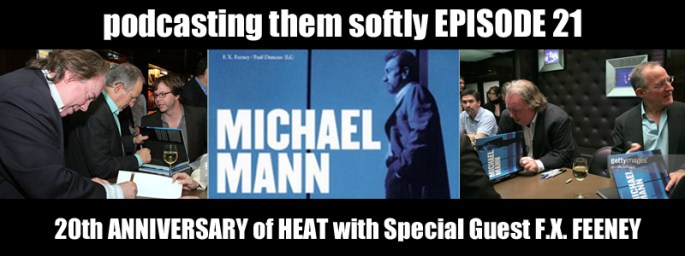
Episode 21: 20th Anniversary of HEAT with Special Guest F.X. FEENEY

EPISODE 21

F.X. Feeney, Moro Bay 2009 (1)It was an absolute honor to be joined by film critic, historian, screenwriter, and author F.X. Feeney to discuss the 20th Anniversary of Michael Mann’s masterpiece Heat. His latest book, Orson Welles: Power, Heart and Soul, is available from The Critical Press and through Amazon. Prior to dealing with Welles, F.X. contributed to the great filmmaker book series from Taschen with the definitive exploration of Michael Mann and his works. He’s written two screenplays, The Big Brass Ring which was directed by George Hickenlooper and was based on an unproduced script by Orson Welles, and the Roger Corman classic Frankenstein Unbound. He served as film critic and creative consultant for the now famous Z Channel back in the mid 80’s, and his articles have appeared in LA Weekly, Movieline, People Magazine, Variety, Vanity Fair, and the magazine for the Writers Guild of America West. He also wrote the Roman Polanski filmmaker book for Taschen which is an extraordinary resource on that filmmaker, and served as a co-producer on the fantastic documentary Z Channel: A Magnificent Obsession. This was a total thrill to discuss one of our favorite films with one of the true experts on Mann’s oeuvre, and we hope you enjoy this most passionate and informative chat!
ALEKSEI GERMAN’S HARD TO BE A GOD – A REVIEW BY NICK CLEMENT

3

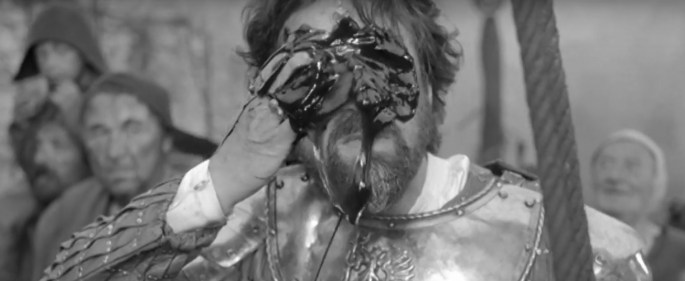
You’ll know within the first few minutes of the impossible to completely describe and classify film Hard To Be A God if you’re going to make it through all three hours of this carnival of cinematic madness. In production for 13 years with director Aleksei German passing away before the film could be fully completed (his wife and son finished the herculean job), this is a continuously staggering and all-together monumental piece of filmmaking, and it’ll likely prove to be a severe endurance test for even the most discerning, adventurous viewer. This is a Russian language medieval science-fiction film, shot in black and white, and offering nothing in the way of audience comfort; this hellish vision feels as uncompromising as anything I can think of, and it offers sights and sounds of such striking and odd depravity that people are likely to be disturbed and perplexed in equal measure. Based on the novel by the Strugatsky brothers, the story involves a group of scientists who journey to a planet that most resembles Earth, but the twist is that the society that inhabits the planet is culturally and technologically challenged to the point of almost ludicrous imagination. The people have violently suppressed any form of advancement (imagine if the Renaissance movement was skipped entirely), using murder and scare tactics against anyone demonstrating intelligence. One of the scientists decides to sneak his way into the Kingdom of Arkanar in an effort to offer help and progress to the people, but he’s met with all sorts of opposition, and his ideals continually prove to be shattered all the way until the end. This film is consistently disgusting, and I don’t think I’ve ever seen anything as dirty and grimy and all together vile. There are repeated shots of people puking, passing their bowels, yelling asinine noises, playing a variety of musical instruments for no apparent reason other than just making noise, and I swear, there are more than a few moments where the camera lingers on the grotesque face of a person to an almost awkward degree. Werner Herzog would do backflips for this movie. German and his various collaborators created one of the ultimate cinematic nightmares, and because the film operates in an oblique, circular fashion, there are times when you feel like the film is doubling back on itself; this is one of those pieces of work that’s interested more in atmosphere and minutiae than it does on massive plot developments. This film is fascinated by manure, pain, mud, filth, disease, water, and people spitting, and the themes of society’s inherent ability and propensity for self-destruction feel sharp and well observed and sadly relatable. It’s a travesty that German didn’t live long enough to see the completed version of this insane, instantly legendary piece of work. After only one viewing, I’ve only begun to scratch the surface.


CREED – A Review by Frank Mengarelli

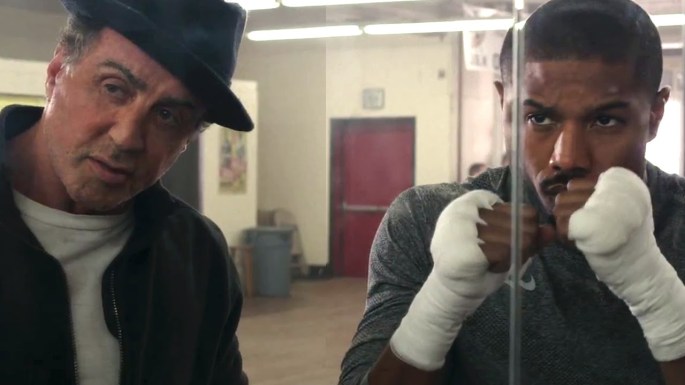
CREED excels on every level possible.  It’s a new story that is shored up by one of the most seminal film legacies of all time.  The story is rather simple; the bastard son of Apollo Creed wants to build and champion his father’s legacy. He travels from Los Angeles to Philadelphia to seek out the only man who can train him, Rocky Balboa.  Yes, the film is a template of the first ROCKY film, and it is predictable – yet this is an incredibly inspired film that fulfills the legacy of the sacred ROCKY franchise.

maxresdefault (1)

There are two things that make this film as phenomenal as it is.  Firstly, this film is the next collaboration between actor Michael B. Jordan and filmmaker Ryan Coogler who first worked together on the brilliant FRUITVALE STATION.  These two are a perfect team, ranking up amongst the team of Nicolas Winding Refn and Ryan Gosling and the early work between Martin Scorsese and Harvey Keitel/Robert De Niro.   There is a scene in this film, which is to be absolutely marveled at – the second fight featuring Michael B. Jordan is all in one shot.  There aren’t any fancy camera movements to slip in trick edits; it is one showboat of a camera movement.  Coogler brings a fresh look and feel to a franchise that was pretty much closed with Stallone’s final chapter, ROCKY BALBOA.

Regardless of how fantastic this film looks, how good of a performance Jordan gives as Creed, the be-all-end-all to this film is the resurrection of Sylvester Stallone as Rocky Balboa.  Stallone is not only one of the most talented people in Hollywood today, but maybe even ever.  The man has three fantastic franchises under his belt and a probable fourth if CREED gets its own series of films (which I hope happens, it more than deserves).  While Stallone is credited as an actor and producer on the film, he doesn’t get a WGA credit even though he did help polish the script.

Creed_77637

In CREED, Stallone gives not only his best performance as Rocky, but one of the very best of his career.  Rocky’s legacy is continued in the best possible way – he becomes Mick from the first film, and it is beautiful.  Stallone reaches a new emotion depth in his seventh turn as one of the most classic and beloved characters in film history.  This time, we see a more vulnerable and human Rocky.  He’s no longer the superman, he’s an old man fighting his biggest and most personal battle yet.

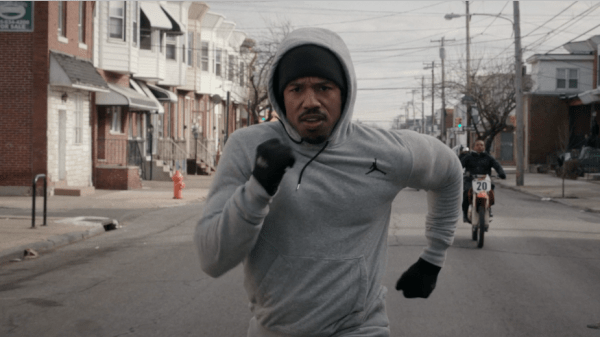
Michael B. Jordan, Ryan Coogler and Sylvester Stallone are wonderfully complimented by Maryse Alberti’s cinematography, Ritchie Coster’s turn as a skeevy trainer, and Ludwig Göransson’s score.  Possibly my favorite thing about the film is Rocky’s theme GONNA FLY NOW lingers throughout the film, it softly and slowly lurks in the ambient background until it is loudly unleashed while Michael B. Jordan runs down a Philadelphia street in a grey sweat suit.  CREED is a wonderful film on all accounts and is one of the very best of the year.

michael-b-jordan-2


PETER BOGDANOVICH’S PAPER MOON – A REVIEW BY NICK CLEMENT

12

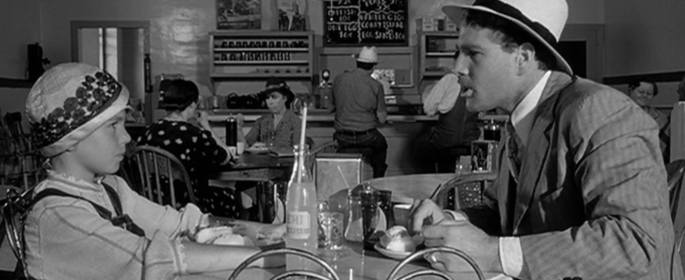
This is a wonderful movie, the sort that rarely gets made these days, and if it were to get made, nobody would go to see it. Two great and thoroughly engaging performances from Ryan O’Neal and Tatum O’Neal, some colorful support especially by Madeline Kahn, a terrific script by Alvin Sargent, spot-on direction from Peter Bogdanovich, all lovingly captured in silky-smooth black and white by master cinematographer Laszlo Kovacs. Set in Kansas and Missouri during the Great Depression and centering on the odd-couple pairing of a con man getting mixed up with a confident nine year old girl, this comedy/drama has a light touch all throughout, and can easily be seen as an inspiration for Ridley Scott’s Matchstick Men. Some of the shots in this film last for a long time, and the clarity of Kovacs’ images were at times startling to behold, with an emphasis on the flat and anonymous Midwest geography. Sargent’s screenplay was romantic, funny, clever, and from what I’ve read, a big departure from the novelistic source material; he would receive an Oscar nomination for his adaptation. Shot on a $2.5 million budget, the film would become a big hit, grossing $30 million domestically, and would net Tatum O’Neal an Oscar for Best Supporting Actress, making her the youngest winner in Academy history.

JACQUES AUDIARD’S A PROPHET – A REVIEW BY NICK CLEMENT

1.jpg

Jacques Audiard’s A Prophet is a searing, violent, and totally unforgettable cinematic experience. This has got to be one of the most epic, primal, exciting, and all together riveting crime pictures ever made, or, at the very least, that I’ve ever seen. Don’t let the fact that it’s a three hour French prison film scare you away from seeing it, as I can almost promise that you’ll be locked into this film from frame one, as Audiard’s vice-grip direction is inescapably forceful and commanding. There are performances here that will shake you to your core, with the film possessing a screenplay that’s brilliant in its fine details, while the intimate, raw-nerve cinematography pulses with life, visceral tension, and edginess. There’s a shoot-out in A Prophet that ranks as one of the all-time best, not because of a huge body count or excessive amounts of gore/blood, but because of the importance it has within the narrative, and the bold and scary way in which Audiard shot and cut the sequence. I could go on and on but I won’t. If you care about movies, and if you haven’t seen this gale-force knock-out, make it a top priority. Audiard’s work overall is supremely impressive (few films hit harder than Rust and Bone) but this one is his crowning achievement that I’ve seen thus far. I can’t wait to see Dheepan.


Tim Burton’s Batman Returns: A Review By Nate Hill

Tim Burton’s Batman Returns is my second favourite Batman movie thus far. It’s pretty underrated, stylishly cheeky and full of ornate, wonderfully oppressive, melancholic set design and drips with a gothic sensability that only Burton included in his versions, and seems to be missing from the franchise these days. It’s dark, comical and just a little bit campy, always a winning combination. Michael Keaton steps back into the batsuit for a second time, and he’s even more somber and downbeat than in Burton’s original 1989 film. Keaton is so talented, and one only needs to look at his zany work in Beetlejuice and compare it to the heft and restraint he shows as the caped crusader to see this. Here he’s faced with a snowy, blackened and endlessly corrupt Gotham City, this time under siege from three wildly different villains. Danny Devito plays Oswald Cobblepot, a.k.a. The Penguin, in what is probably the most outlandish character in the otherwise grim film. He’s a bad tempered, knobbly little gremlin, encased in sallow makeup and sporting disgusting, pasty little flippers. It’s hard to tell it’s even Devito at all until that little smart ass mouth opens up to hurl calculated obscenities at anyone and everyone. He aims to be mayor, and only in freaky deaky Gotham would a plan like that ever be taken seriously, from a sewer dwelling, animalistic mobster with an army of clowns following him. Christopher Walken plays evil, ghoulish Max Schreck, an amoral monster of a businessman with nefarious plans of his own, and a haircut that would make Andy Warhol run for cover. Last and most memorable is Michelle Pfeiffer as Selina Kyle, Schreck’s awkward, meek secretary who eventually becomes Catwoman. And what a Catwoman she is. Forget Anne Hathaway, Julie Newmar take a number, and we won’t even mention Halle Berry. No one played the pussy quite like Pfeiffer. She’s got a shiny, skin tight outfit with the body to match, a sassy, sexy attitude, a whip smart mouth on her and just a hint of psychosis, making her my favourite film incarnation of the character. “Meow” she purrs sensually as an incendiary bomb detonates behind her. Damn. They all get wrapped up in various schemes and scams. Penguin wants ultimate power, which apparantly involves kidnapping a bunch of infants. Schreck wants ruthless progress to tear Old Gotham up in worship of the almighty dollar, and Catwoman is content to slash and burn everyone’s plans, until she gets a bit of a smolder in her eye for Batman, providing some electric sexual tension between the two of them that’s a highlight of the film. Neither of them are sure whether they want to kiss or kill, fight or fuck the other, and it’s devilishly entertaining watching them hash out their hormones in naughty little action sequences and slow, slinky intimate scenes, involving both Bruce and Selina as well as their feral alter egos. Their chemistry revolves at the center of the piece, with all manner of circus sideshow madness happening around them. Pat Hingle and Michael Gough diligently put in work as Commissioner Gordon and Alfred Pennyworth, with Doug Jones, Michael Murphy, Andrew Bryarniarski and Paul Reubens rounding out the roster. Burton outdid himself with style on this one, his trademark eye for loving detail laboriously employed here to the point where it surpasses the artistry of a comic book and starts to look like some mad dream of Vincent Price. He dipped his toe in the water of the Batman universe with his first outing. Here he plunges headlong into it and fully commits to a style and tone that’s distilled to a satisfactory point that he wasn’t quite at with Batman 1989. A treasure in the franchise, and a wicked fun film at that.

DAVID WNENDT’S WETLANDS – A REVIEW BY NICK CLEMENT

1

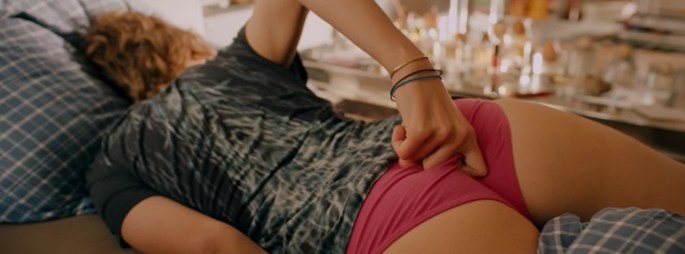
The insane German import Wetlands is singular, gross, nauseating, highly sexual, strange, lovely, smart, insane, icky, depraved, uber-graphic, and sort of monumental. It’s never, ever going to be remade for American audiences and it’s likely to appeal strictly to fans of “cinema-as-art.” I’ve never seen anything remotely like it. You get to see a POV shot from that of an STD-infected pubic hair, a woman uses a variety of vegetables as sexual pleasure devices, and the camera lovingly details a shaving accident that, let’s just say, will pucker up a certain part of your derriere. And that’s all in the first act! Directed with energy and snap by rising star David Wnendt with a constant attitude of “I’ve Got Something To Prove,” Wetlands, at times, feels like a hybrid of Enter the Void and Blue is the Warmest Color with a dash of sweetness from a Farrelly Bros. enterprise. Carla Juri gives an absolutely fearless, wholly committed performance as a young woman named Helen with any number of unique sexual and bodily fetishes. I can’t think of one major American actress who would ever dare take on the challenge of this role. Known in some circles as “the anal fissure movie,” Wetlands will prove to be an endurance test for many viewers, offering wildly graphic sights you’ll never be able to un-see. After the previously mentioned shaving accident, Helen winds up in the hospital and falls in love with a male nurse, but this being the type of movie that it is, their meet-cute is over discussions of bloody anal injuries and the benefits of frequent oral sex. After her surgery, Helen fakes the inability to pass her bowels, in an effort to remain in the hospital so that she can win the heart of the nurse she’s falling in love with. So it’s the classic girl meets boy story, filled with the requisite amount of heart and honesty that makes you care for the characters, but ups the gross-out elements way past what Apatow and Rogen could ever dream of creating. This is outlaw cinema to be sure, replete with constant full frontal female nudity, extraordinarily graphic sexual behavior, and a general air of chuck-it-all-unpredictability that is bracing to behold and keeps you on edge. And while there is a rather sweet and simple story that gets told, many viewers will be too caught up in the moment to make heads or tails of whether or not Wetlands has something interesting or valid to say. I think it does. It’s smart, it’s honest, it’s very mature despite the various idiocies, and at its heart, this is a film about acceptance, love, and about how one woman, no matter how different or odd her behavior may seem, is living the life that she wants to live, bloody orifices or not. Not for the faint of heart or weak of stomach, Wetlands is a romantic comedy that defies general description. In short, see it with the family!