B Movie Glory: iMurders

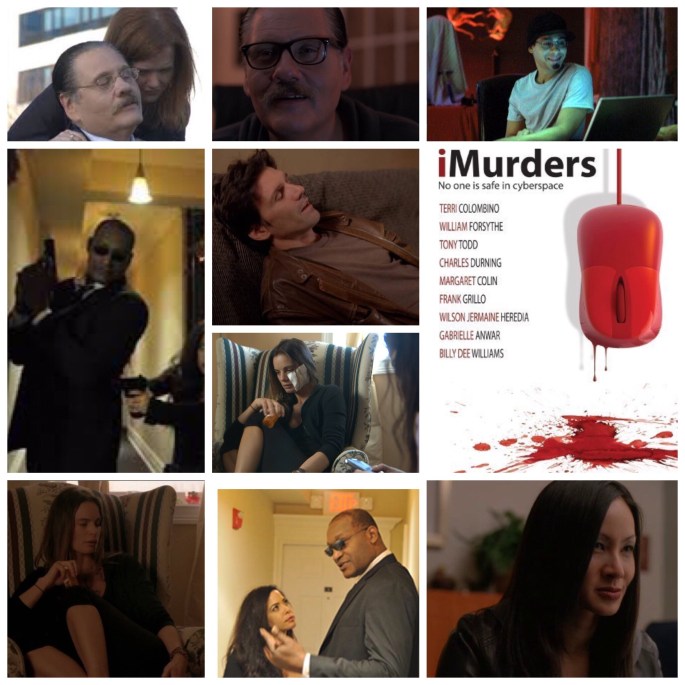
iMurders. Just let that title sink in. It’s worse than it sounds. A movie about a series of murders related to an online internet chat room should at least have the trashy decency of something like Pulse or One Missed Call, but this thing plays like a soap opera that got cancelled after the pilot. Cheap, lazy and ridiculous, the only saving grace is the comforting presence of a few character actors to brighten your day. It’s a roundtable whodunit with a series of characters, all who might be the killer stalking them via ‘cutting edge’ technology that resembles nothing Apple has actually ever put out. There’s a tragic shooting from years before that has somehow spurred this lunatic to torment a MySpace group like this, but honestly it’s all a bunch of narrative mud. There’s a scandalous college professor (the great William Forsythe), Gabrielle Anwar (who honestly deserves better than this) as a girl with a few skeletons in her closet, a detective (Frank Grillo) with some personal ties to the case, and more. The one decent strand sees a mysterious psychiatrist (Charles Durning) interviewing a girl (Miranda Kwok), and the two appear to be in some weird other dimension, probably one where the horror films are better than stuff like this. Tony ‘Candyman’ Todd shows up as a sarcastic FBI agent. The whole thing has a silly Fisher Price feel to it and we never buy anything as legit, and even on the standards set by B Movies this is shameless, and that’s all I have to say. Oh and Billy Dee Williams is apparently in it too, but I’ll be fucked if I remember who he is.

-Nate Hill

The Disappearance Of Eleanor Rigby: Him & Her

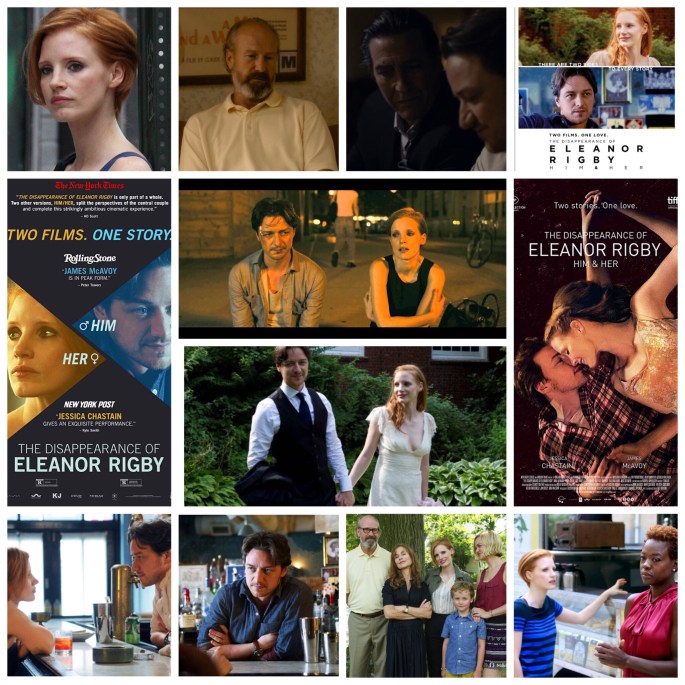
I’ve written about The Disappearance Of Eleanor Rigby before, but I feel like it’s still one of those diamonds that flew under the radar and no one really saw. This is one of the most important films out there if you are interested in studying grief, the effects of loss, the healing passage of time and enduring love as themes in cinema. Heavy stuff, I know, but the film patiently leads you along and never throws histrionics or melodrama right in your face like some would. James McAvoy and Jessica Chastain give perhaps the performances of their careers as Conor and Eleanor, a couple dealing with the traumatic after effects of a recent miscarriage. Eleanor distances herself from everyone after a suicide attempt that just alienates her further and tries to find a new path, Conor misses her like crazy, throws himself into his work and gets a tad self destructive. Everyone deals with this sort of thing in their own way, and the film uses a nonjudgmental lens to observe how these two cope, revolve around each other and try to salvage the love that seemed brighter and stronger before the incident. ****NOW READ THIS PART VERY CAREFULLY!!**** Now that I’ve got your attention, this is incredibly important: there are in facet three radically different cuts of this film, each with their own sub heading after the title. Her is a feature length cut that focuses primarily on Chastain, her side of the story, and what she goes through, with brief appearances from McAvoy. The other side of that coin is another edit called Him, which does the same for McAvoy, and his side of the whole situation. This is a brilliant, very thoughtful tactic on the filmmaker’s part as it brings us closer to both characters, makes us genuinely feel the time going by through realistic pacing and lets the story flourish in a free flowing way that few films ever achieve. Now the third cut, no doubt assembled under studio duress for the lazy among us, is simply a truncated edit of both of these aforementioned versions, and all it succeeds in doing is making the uniqueness of the other two diminish, dulling the experience and turning something special into a pedestrian telling that’s just like every other flick out there. This third cut is unnecessary, pointless and should be ignored. The vitality of the material lies in the way the two cuts run parallel, how these two souls that were once together are now separated, and the energies we feel between them both together and apart. Others revolve around them too; William Hurt gives a small powerhouse as Eleanor’s loving father, Ciaran Hinds is equally as implosive as Conor’s supportive father, Isabelle Huppert is Eleanor’s mother, Viola Davis is excellent as a stern college professor who helps her through some of the tough times, Bill Hader is Conor’s best friend and business partner, and so on. They’re all wonderful but the core of it lies with the two of them, and their process from hurt, to grief, to losing each other and finding each other again, and it’s a brilliantly told story that you won’t want to miss.

-Nate Hill

Rodrigo Garcia’s Nine Lives

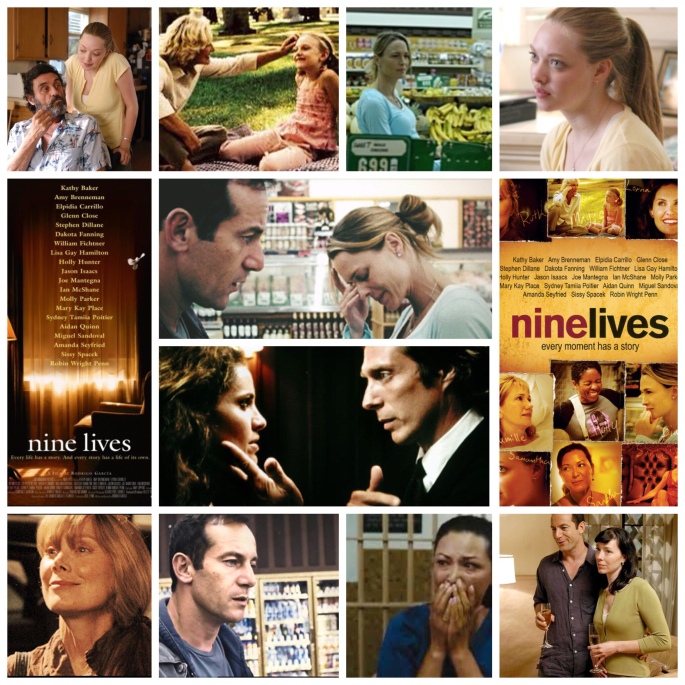
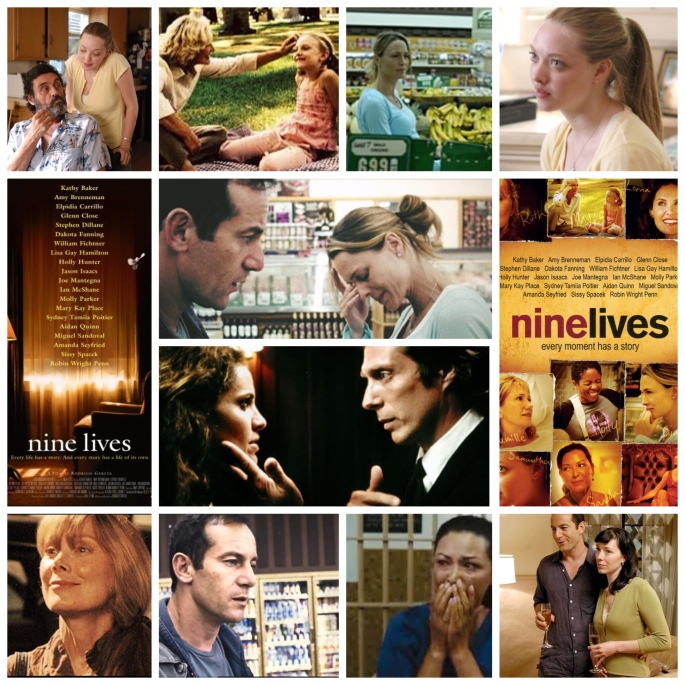
Rodrigo Garcia’s Nine Lives is a fascinating one, if a bit too cluttered with spare vignettes for a feature film. It’s one of those mosaic pieces where we see a string of unrelated episodes about various people here and there in the midst of some life changing moments, and as is usually the case with these, it is absolutely star studded. There’s two formats for these, the one where everyone’s story is interwoven and the vignettes collide and weave (ie Paul Haggis’s Crash) and the linear template where each story is a standalone piece, with no blurred lines or cross crossing. This film falls into the latter category, and themes itself on nine different women in various instances of their lives, be it tragic, joyful, passionate, penultimate or simply everyday life. The issue is, nine of these stories is just too much for a film that runs under two hours. Or perhaps it’s not and what I meant to say was that nine stories that are this thoughtful, complex and important shouldn’t have shared the same compacted narrative, for its too much to keep up with from scene to scene. Anyways there’s quality to be found, some actors cast brilliantly against type and any flick that rounds up a cast of this pedigree deserves a high five. My favourite by far of the bunch is a two person scene between Jason Isaacs and Robin Wright Penn as two former lovers who meet in a supermarket after being apart for many years and try to reconcile their feelings. Both actors are tender, attentive to one another and it’s some of the most affecting work I’ve seen from either. A more lurid one involving Amy Brenneman and William Fichtner lands more with a questionable thud, both are great as well but their scene needed some backstory. My second favourite stars a young Amanda Seyfried as a girl who alternates speaking with her father (the excellent Ian McShane) and mother (Sissy Spacek) who are in different rooms of the house. It’s intimate family drama through a prism of casualty and works quite well. Other sequences, including one that sees Glenn Close on a picnic with her granddaughter (Dakota Fanning), aren’t as memorable or striking. But the cast alone is enough to stick along for the ride, and includes Lisa Gay Hamilton, Mary Kay Place, Holly Hunter, Kathy Baker, Sydney Tamiia Poitier, Stephen Dillane, Molly Parker, Aiden Quinn, Joe Montegna and more. A worthwhile watch for the handful of stories that have some weight, but falters here and there and could have axed some of the commotion of too many solo narratives buzzing about.

-Nate Hill

Gone

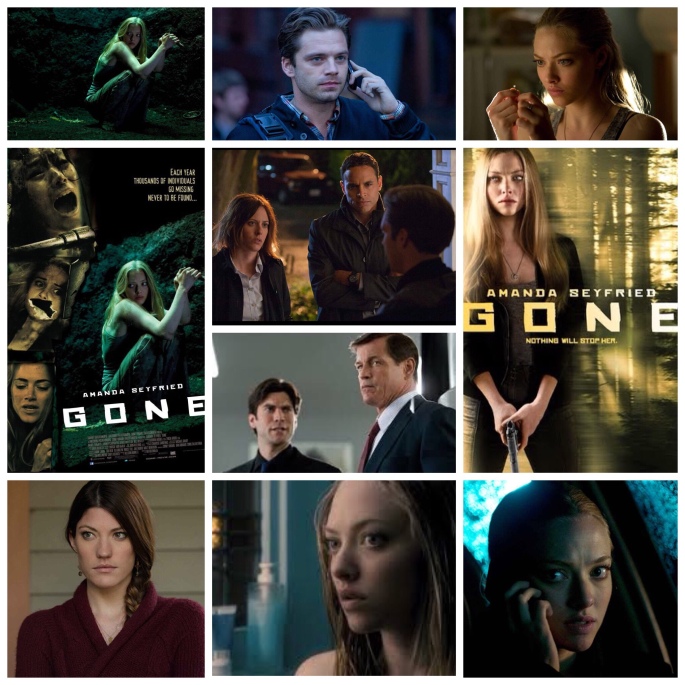
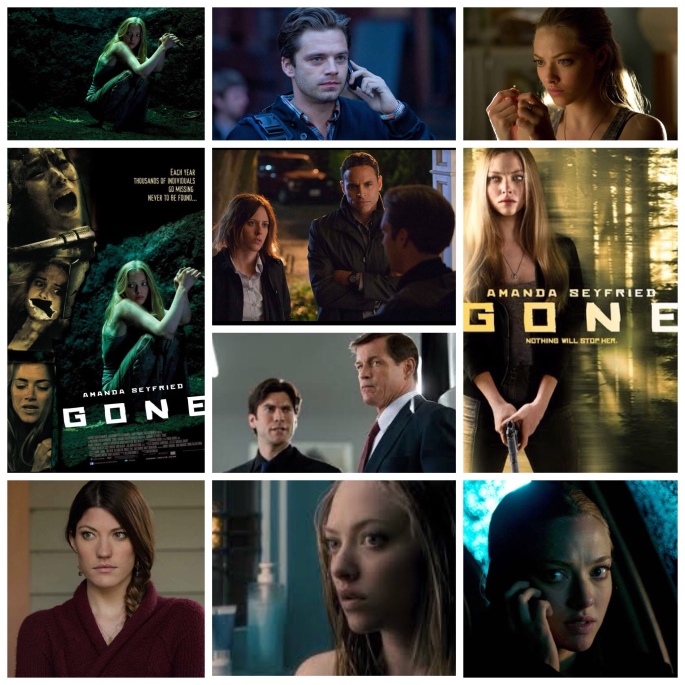
I’ve never understood the dislike or lacklustre reception for Gone, a moody, propulsive suspense thriller starring Amanda Seyfried. It’s not especially groundbreaking or crazy in any way but it’s a solid genre piece with a lead performance that proves once again what kind of pure star-power she has, enough to carry a film and then some. She plays a girl that allegedly escaped the clutches of a serial kidnapper/killer who tossed her down a hole somewhere way out in the wilderness. The cops never really believed her as there was no actual proof and their searches turned up fuck all, but she won’t be deterred, especially when her older sister (Emily Wickersham) seems to vanish into thin air one night and she’s convinced the guy has returned. Once again the lead detectives on her case (Daniel Sunjata and Ray Donovan’s Katherine Moennig) give her the skeptics eye and she has no choice but to launch her own solo investigation, a dangerous option but the girl has no shortage of bravery. Inherently creepy looking Wes Bentley plays another cop who is decidedly more helpful for his own reasons, but he exists mainly as a red herring and ultimately doesn’t do much of anything useful. This film is about her journey and not so much her destination, as it’s essentially a heightened Nancy Drew yarn fuelled by a constant vibe of suspense and blanketed in the thick atmosphere of the Pacific Northwest region where it was filmed. When her eventual confrontation with the killer does come, it seems a bit after the fact and even rushed, but it was never the point anyways, as the story’s effectiveness lies in her relentless search and resilient, charismatic tactics to discern each clue along the way. The cast here is full of gems, including Dexter’s Jennifer Carpenter as her waitress boss, Joel David Moore, a very young Sebastian ‘Bucky Barnes’ Stan, Nick Searcy, Socratis Otto and legendary tough guy Michael Paré as the Lieutenant of the local precinct who is helpful but stern and concerned about Seyfried’s seemingly drastic actions. Don’t let any negativity spoil a fun evening in with this one, there’s really nothing to hate about it. Tightly wound, nicely acted by everyone, and shot with the benefit of the Northern locale. Admittedly broad and farfetched in terms of plotting, but what thriller isn’t here and there anyways, get over it. Mainly it worked so well for me because Amanda is such a vivid, present actress who can hold a scene like nobody’s business and really commits to her craft. A diamond of a flick in my books.

-Nate Hill

B Movie Glory: Femme Fatale

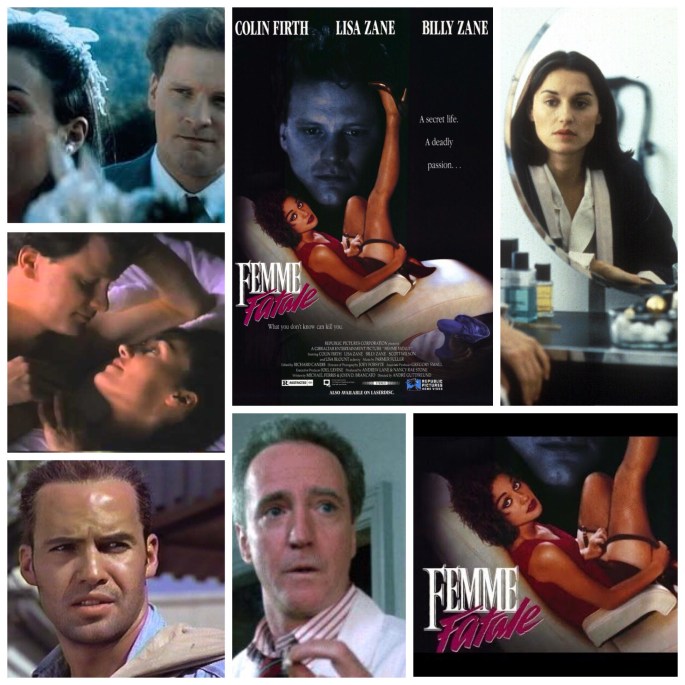
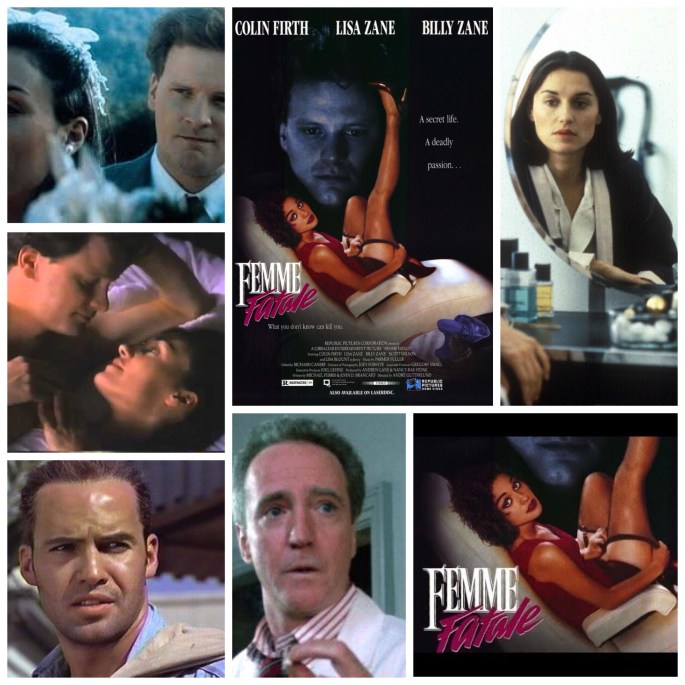
Femme Fatale is a gong show, and not in a good way. I’m not talking about the De Palma film of the same name, which is a gong show in a good way. This thing is a sad, no budget little tv flick from back in the day starring Colin Firth, who has seen better days than he has here. It’s a strange psycho sexual ‘mystery’ in which none of the plot points really make sense and each scenario gets a little more ridiculous than the last. Firth plays a fairly meek dude who’s recently married a mysterious girl (Lisa Zane) that he doesn’t know much about, and she turns out to be someone different entirely, leading him on a dull goose chase across the country to find out just who he tied the knot with. Zane is Billy Zane’s sister by the way, and speaking of him he’s on this too as Firth’s eccentric friend, which is a hoot because you get to hear him refer to his sister as a ‘diesel dyke.’ The central mystery involves several identities she takes up and more than a few multiple personalities brought by by unconventional therapy from a shady psychiatrist (the great Scott Wilson in a hammy extended cameo), but ultimately its hard to care about a story this loosely threaded, far fetched and just plain silly. Watch for some gem cameos though from the likes of Danny Trejo as a worldly tattoo artist, Catherine Coulson (the beloved Log Lady on Twin Peaks) as a nun who delivers some exposition and then peaces out and character actor Pat Skipper as a rowdy henchman who steals scenes like nobody’s business. Overall it’s a fairly useless piece of fluff though, painfully average and inconsequential.

-Nate Hill

Kevin Smith’s Dogma

No one has ever skewered the Catholic Church quite like Kevin Smith did with Dogma, a wholly original, densely verbose, punishingly funny stage play of monologues, satirical jabs, cynical skits and cheeky lampoons that showcase the kind of idiosyncratic, acid tipped penmanship that only The Smith can bring us. It’s my favourite of his films, mainly because of how original the humour is, based in reality but blasted off into a stylized fantasy realm that gives a galaxy of perky acting talent room to pontificate and sink their teeth into immense passages of rich dialogue that are any actor’s dream. Also, it’s just such a unique, surreal experience in terms of casting and characterization; where else can you see beloved thespian Alan Rickman get his sillies out as the sarcastic Metatron, an asexual being who serves as the voice of god and the spiritual tour guide to adorable protagonist Linda Fiorentino (whatever happened to her?), who’s the chosen one in a holy not so holy crusade of angels, demons and religious figures all given the Royal Smith twist. There’s Ben Affleck and Matt Damon as Loki and Bartleby, two hedonistic fallen angels who squabble at each other and rebel against heavenly management, causing quite the cosmic ruckus. Salma Hayek does a transfixing go-go dance to rival her slinky number in From Dusk Till Dawn as The Muse, a shapeshifter who helps them battle an excremental (that’s a demon made of poo, before you ask). It goes on with sterling work from everyone including Chris Rock, Jason Lee, Bud Cort, George Carlin, Janeane Garofalo, Gwyneth Paltrow and those two adorable slackers Jay & Silent Bob, who wouldn’t miss a Smith outing for the world. Oh, anyone who casts the already angelic Alanis Morisette as God should be given a hefty raise. It’s a tough film to summarize or even capture the spirit of with a written passage, as it defies description, shirks standards and makes no apologies. Anyone from the Clergy who took any offence clearly missed the point though, this is satire and lighthearted at that, with only a dash of the kind of jaded ill will a film like this could have had. This is Smith’s world, and the characters who populate it are larger than life yet still feel real, never boring and always have something to say, be it thoughtful rumination or effervescent silliness.

-Nate Hill

B Movie Glory: Streets Of Blood

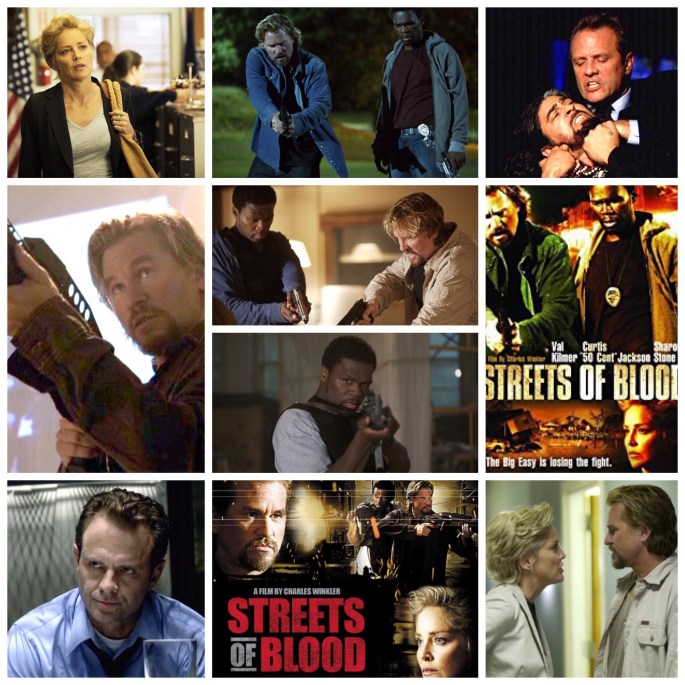
Streets Of Blood more like Streets Of Crud. Maybe I’m being a little harsh but from what I remember this thing is a huge, huge whack of disappointment when you look at the capable, wasted cast and the premise ripe with potential. Val Kilmer and Curtis 50 Cent Jackson are slick New Orleans cops investigating the corruption and death in their department following the aftermath of Hurricane Katrina. Sounds cool eh? Not so much. Most of it is noisy, incomprehensible shootouts in soggy, dilapidated warehouses and faux intense verbal standoffs in dank interrogation rooms that have no payoff because they had no discernible setup or pacing. It’s not the actors faults, they’re not even half bad. Kilmer does a flashy Orleans drawl that echoes his famous Tombstone accent. Sharon Stone even shows up as an ice queen DA,

looking like a forgotten First Lady. These fine talents just can’t rise above the muck of a half assed script that’s more hollow than the waterlogged buildings they chase suspects through. Not even the great Michael Biehn can save the day, showing up as a nasty, accusatory FBI agent that you just know will turn out to be part of the conspiracy later (I’d feel sorry spoiling that if it weren’t so blatantly obvious right off the bat). It’s a shame no one remakes B movies and gives what could have been a cool concept another shot, because they blew this one pretty bad, and produced a bigger mess than Katrina herself did.

-Nate Hill

The Director’s Chair with Dan Mirvish

Image result for bernard and huey poster

Joining Podcasting Them Softly once again is filmmaker, author, and Slamdance Film Festival co-founder Dan Mirvish. Dan’s most recent film, Bernard and Huey, is written by Jules Feiffer (Carnal Knowledge, Popeye) based upon his characters created in 1957 in the Village Voice magazine. The film stars Jim Rash, David Koechner, Mae Whitman, Nancy Travis, Bellamy Young, and Richard Kind. The film is currently in its theatrical and VOD run. Support your local filmmaker and go see the film!

John Woo’s Broken Arrow

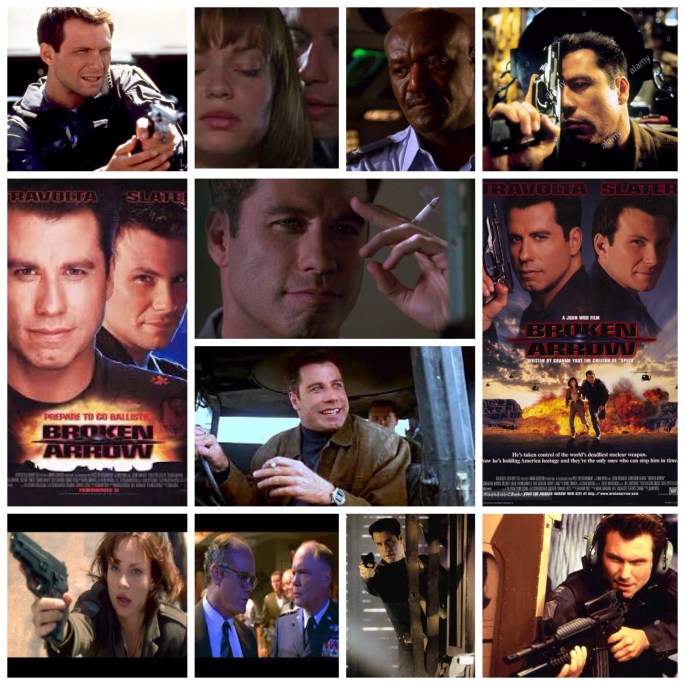
When Hong Kong action alchemist John Woo mixes up his gracefully brutal aesthetic with big budget Hollywood high gloss, the results are an irresistible flavour. While not quite the balls out, blitzkrieg masterpiece that Face/Off is, his military gong show Broken Arrow is still one walk on the wild side of stunts, explosions, overblown madness and maniacal behaviour from John Travolta, who seems to be amping up the histrionics in double time just to cover Nicolas Cage’s shift this time around. He’s a navy pilot psycho called Deakins here, an unstable traitor who hijacks a volatile nuclear warhead and holds congress hostage, giggling like a schoolgirl the whole time. It’s up to his trainee and former partner Hale (Christian Slater) to hunt him through Death Valley where they’ve crashed, causing as much pyrotechnic commotion as possible and prep for the inevitable one on one smackdown that’s neatly foreshadowed by an opening credits boxing sequence between the two that’s an appetizer for the adrenal glands in prep for the chaos to follow. The action is fast, fierce and extremely violent, as is the amped up macho banter between the two, but Travolta really takes the role and sails off the charts into the ‘here there be dragons’ realm of acting reserved for only the most memorably over the top performances in history. “You’re fucking insane”, Slater sneers at him; “Yeah! Ain’t it cool?” Travolta smirks back with a face that would be straight if not for the knowing glint in his eyes. Park ranger Samantha Mathis helps Slater in his quest to bring the lunatic down, and there’s an impressive laundry list of character actors rounding out the military faction including Howie Long, Delroy Lindo, Frank Whaley, Bob Gunton, Chris Mulkey, Daniel Von Bargen, Vondie Curtis Hall, Jack Thompson, French Stewart, Raymond Cruz and Kurtwood ‘Red Forman’ Smith. Hans Zimmer does the score here and it’s an undervalued composition in his canon, a chromed up tune that drips cool and hurtles alongside the action awesomely. Woo has had some dodgy luck in Hollywood since (Mission Impossible 2 and Paycheck are painful), but this is one of his best stabs at the Western style of action, brought to eccentric life by Travolta’s oddball psycho and full of crazy ass action spectacle.

-Nate Hill

Hereditary

hereditary-sundance-review

It’s fashionable to bemoan big studio budgets flowing only towards flying men in tights and spaceships zipping around long, long ago, but what about the little studio budgets?  Are they now beholden to a genre long cast aside by critics but a guilty to proud pleasure of many film fans worldwide, horror?  Writer/director Ari Aster seemed resigned to this as modern gospel in a post screening Q&A session this week, telling the audience he graduated from film school in 2010 loaded with ideas for serious R rated thrillers and family dramas, only to find little to no interest in such scripts until he went ahead and married them to the spookfest tropes which, at a fraction of the cost of the latest Marvel movie, reliably make small studios large profits.  I’ve always found horror to be one of the best ‘big tent’ film forms around, allowing for drama, romance, comedy and any number of fantastical examinations of otherwise land-locked subject matter.  Aster apparently has too with his relentlessly dark debut film, Hereditary, albeit with a hint of recalcitrance lurking like a sour spirit around a few corners.

One of the best gifts A24 gave to this movie is a marketing campaign that lays out the broad concept and vibe but tells the audience next to nothing about what actually happens in this film; it’s a gift most two minute trailers refuse to offer, instead hammering out the three acts of a story plus half of the big payoffs, fed to us by a clunky four quadrant spoon.  Trust me when I say you don’t know what you’re in for with Hereditary, and I won’t be spoiling the fun here.  A quick description might look something like Dario Argento’s Ordinary People.  We are introduced to a family grieving the loss of a mysterious, withholding grandmother, but quickly come to realize they’re grieving a normal, happy family life that never quite materialized for them, too.  Father Steve (Gabriel Byrne) quietly goes through the day to day motions of keeping house up and family together, but he’s often shown wistfully gazing into the distance over a glass of scotch, perhaps envisioning an escape that he knows will never come.  Mother Annie, played with bracing immediacy by Toni Collette, uneasily splits the difference between fierce matriarch and wanton disruptor.  Son Peter (Alex Wolff) pursues a semblance of teen normalcy through an increasingly sad set of eyes, and Milly Shapiro’s Charlie, the youngest child and only daughter, has an otherworldly presence that makes one question whether or not she arrived on the right planet at birth.

It’s not doing the film a disservice to leave this character summary as a plot description, because Hereditary really does read like a sad family drama above all else—Aster is clearly taken with the characters, their interactions and history, which does a fine job of investing the viewer so that we’ll care when things worsen—and worsen they do.  The transition into the supernatural horrors we all know are coming is fairly seamless, although the sheer breadth of well known cinematic nightmare tactics employed, not to mention scenes and concepts borrowed from earlier pillars of the genre, might ultimately be a little off putting to those who swim in these dark waters often.  It’s all very effectively woven together—Aster’s a talent to watch, for sure—yet by the end one almost feels the director has taken a kitchen sink approach to the scares in order to get something, anything approaching what he originally wanted to create into the multiplexes.  That said, what he’s gotten is a very well acted and shot thriller, deeply rooted in character and proud to swing its influences around like a well knotted noose.

hereditary-cover