Disney’s The Journey Of Natty Gann


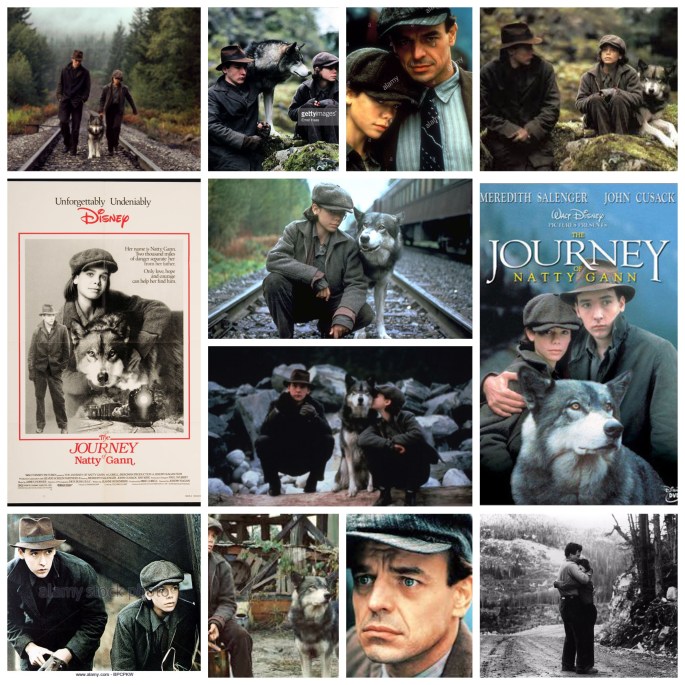
It’s neat to think that Disney would take a chance on something as grim and risky as The Journey Of Natty Gann, but they green-lit it and allowed a wonderful story to come alive. Set during the Great Depression and focusing on themes of abandonment and loss, it’s hardly the studio’s milieu, but they’ve proudly stamped their seal on it and I consider it to be one of the best amongst their live action output to date. Starring a terrific Meredith Salenger, it tells the tale of a young girl who’s separated from her father (Ray Wise, brilliant as ever) after he takes off to a logging job elsewhere in the country. Faced with life as an orphan or worse, Natty makes an epic trek across the dilapidated, economically gutted states to find him. It’s got all the trappings of a syrupy, run of the mill Disney outing: dog/wolf cross sidekick etc, but it really manages to find the danger, fear and loneliness she faces in a country that has gone to all hell everywhere she looks, and let the pathos come naturally out of how she fights her way through each new situation. John Cusack is great as a train hopping rambler who joins her here and there, his mopey doglike visage fitting right into the 30’s hobo shtick uncannily well. Salenger is a strong and fierce leading lady, the strife she sees around her echoed in her haunted face, emblazoned also with hope for the future. Filmed entirely in my home province of British Columbia, the film is beyond gorgeous to look at, the sooty grime of a looming industrial wave accented by the burnished greens and crystal waters of the region. This is sort of a forgotten Disney film, it wouldn’t be right up there on someone’s collection shelf or sitting near the front of the rental queue online, but it’s more than worth checking out, and considered a classic by me. 

-Nate Hill

In Memoriam: Tobe Hooper’s The Texas Chain Saw Massacre

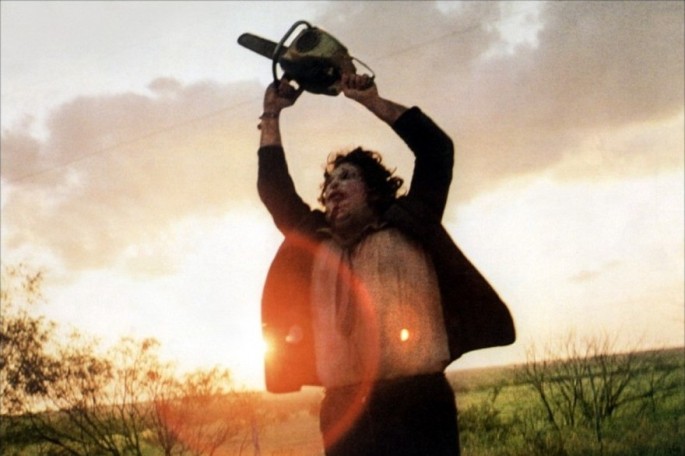
7779506870_leatherface-le-tueur-terrifiant-de-massacre-a-la-tronconneuse

The cinematic world was deeply saddened by the passing of Tobe Hooper in late August.  Responsible for some of the most iconic American films in the horror genre, Hooper’s legacy will always be remembered for pushing boundaries and using ours fears as a means of self-reflection.  This week, Ben and Kyle sat down to discuss Hooper’s masterpiece, The Texas Chain Saw Massacre.

BEN:  Like many classics, I’m sad to say that this is yet another film that I had not previously seen. Despite it being the father to so many other films, whether horror, sci-fi, thriller or a combination there of, Hooper’s film looks every bit his $300,000 budget and even more.

KYLE: Wait, you’d never seen it until now?  Why did you wait so long!?

Ben:  I can’t honestly answer that.  I really didn’t gravitate towards horror films when I was a kid.  Even as an adult, slicing people with knives or razors still creeps me out.  Which is why the sequence in the van when they pick up the hitchhiker works so very well.  Edwin Neal played ‘freaked out’ to the hilt, but it was the close quarters of the van and Daniel Pearl’s camerawork that really make the magic happen.  And that was Tobe Hooper’s gift. His film is shot and edited in such a way that it makes you think you’re seeing more than you actually are; the mind plays tricks on you.

KYLE: Absolutely.  It’s part of the film undeniable charm.  From the first shot, you know you’ve waded into a greasy pit of hell.  I love that you mentioned the close quarters.  Paranoia is an important part of this film, both from the experience the characters endure and in how America was feeling at the time.  The country was still reeling from Vietnam and I think that is why it was so popular.  That and the outstanding cinematography and editing.
la-matanza-de-texas-2

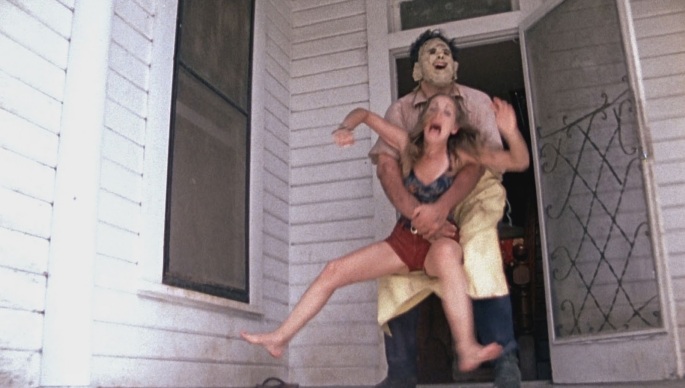
BEN: The technical achievements aside, this film is torture porn with bits of voyeurism if I’m not being too blunt. Sally’s screams uttered from Marilyn Burns were ear piercingly jarring, but they were effective.  Paul Partain probably had the more difficult roles as a paraplegic, but his acting got on my nerves towards the end of the film.

KYLE: I like how it switches between presumed violence and voyeurism depending on the situation.  It’s somewhat tame by today’s standards and yet, it’s unrelentingly bleak without being a complete downer.  A lot of modern horror comments on the darkness within everyone where Hooper was more interested in exploring a darkness that is almost inhuman.  Again, perhaps it is a comment on the place where the nation was at during filming?

BEN:  Oh, I very much liked the framing using the graphic news clips to place you in the middle of everyday life throughout the United States in the mid-1970’s.  More specifically, the use of a grave robber was creepy enough.  Young college-aged kids were more apt to be adventurous, which is why they picked up the hitchhiker with such ease.  And yet, they were skeptical.

KYLE: That is a great point.  It’s interesting how this is the proto-slasher and yet, it has a lot of qualities that are outside the niche genre, specifically with respect to the kids being skeptical.  I also enjoyed how sexuality was underplayed.  It is part of the world, but not the focus.  While the 80’s was filled with a lot films who used sexually charged victims as bait for the underage VHS generation, this is a smart film, both in its handling of violence and treatment of its subject matter.
TTCSM-2

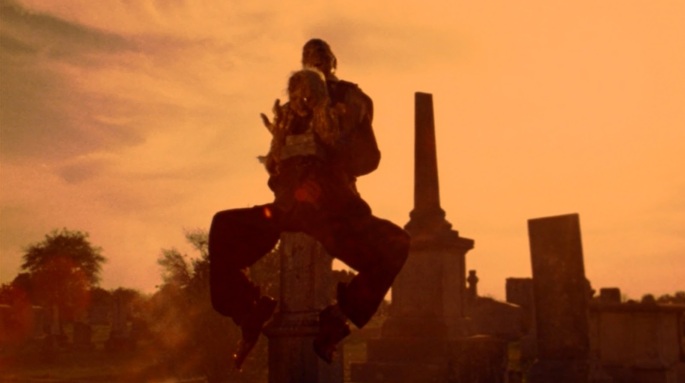
BEN: Alan Danzinger as Jerry, William Vail as Kirk and Teri McMinn as Pam were effective at helping to convey the free-spirited nature of the times; it was almost like looking at a time capsule.  It helped that Hooper and Kim Henkel’s script incorporated the news clips I mentioned earlier.

Despite the marketing and the opening monologue by John Larroquette, this was not a true story. Hooper admitted that his inspiration for the story elements reflected the distrust of the government including Watergate, the 1973 oil crisis, and Vietnam. The character of Leatherface and some of the plot details were based on serial killer Ed Gein.

KYLE: This is the heart of the film and the reason I think it retains its legendary status decades later.  The best films are often reflections of their time and TCM is a great example of one of the many things that can be birthed in the midst of a counterculture revolution.

BEN: Gunnar Hansen had the unenviable task of playing Leatherface, someone who had to thrash about the frame while trying to project his character’s intentions at the same time.  One might think it would be easy to use a chainsaw to point in a direction. Without motivation, there’s no pointing.

KYLE: And the chainsaw almost killed one of the cast members!  Almost every cast member was injured during production.  Marilyn Burn’s costume was so drenched with blood it had completely stiffened by the time they wrapped.  It’s details such as this only enhances the film’s notorious mystique.

Marilyn-Burns-texas-chain-saw

BEN: I found it interesting that Hansen took the time to get his inspiration from special needs children, learning their movements, which Hooper keyed in on.  The house in Round Rock, Texas plays as much as role in the film as the other characters.  Who ever thought that a farmhouse with a white picket fence could be so menacing?  Robert A. Burns’ art direction added the textures that bring the house to life.

KYLE: Absolutely. The film presents an idea of a hidden, haunted American backwoods filled with all manner of horrors, all of which are human.  Fear, when distilled through our own world is the most potent brand imaginable because the audience already knows the world is a dark place.  Hooper’s masterful understanding of this and using it as a weapon against the unsuspecting is just one more ingredient in a perfectly tainted recipe.

BEN: The local Alamo Drafthouse here in Phoenix screened it, in honor of the late Tobe Hooper.  They had a DCP, but it looked like I was watching a 35mm print, it looked that good. I was surprised to learn that Hooper used 16mm film, which explains the harsher look. Massacre is a stunning technical achievement for its budget. Between the editing by Larry Carroll and Sally Richardson, Burns’ use of real rotting carcasses, and Pearl’s stunning cinematography, Tobe Hooper’s film is a tribute to the cast and crew’s dedication.  I would definitely revisit this film again.

KYLE: It’s one of my favorite films of all time because it shows that a big budget isn’t required to make an influential film that continues to hold up.  Hooper’s guerilla tactics behind the camera congealed with a thrilling ensemble and unspeakable visuals to create one of the most important horror films ever made.

Ben and Kyle would like to thank you for continuing to follow their conversations.  Join them next week as they discuss their favorite Jennifer Lawrence performances in honor of the release of Mother!.
tcm-title

FRANCIS FORD COPPOLA’S TUCKER: THE MAN AND HIS DREAM — A REVIEW BY NICK CLEMENT

3

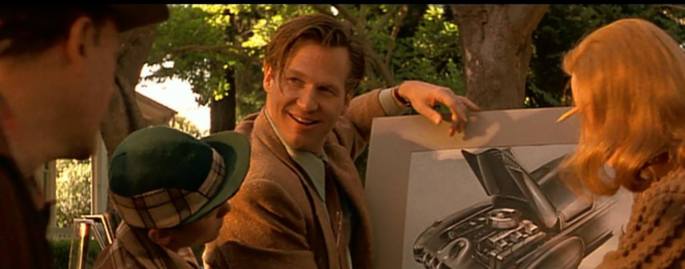
It’s true that Francis Ford Coppola had a rough time after the first two Godfather films and Apocalypse Now, but that’s not to say that the films that would follow would all be without merit or importance. 1988’s deeply underrated Tucker: The Man and His Dream deserved to do better than it did at the box office ($19 million on a $25 million budget), and despite solid critical response, it’s a late 80’s gem that not enough people seem to have seen, but once you’ve seen it, it’ll be hard not to be a fan. Jeff Bridges gives a warm, winning, and hugely sympathetic lead performance as Preston Tucker, a dreamer, schemer, and all together believer in his own mystique and passionate ideas. He wants to build a car, a special car for the people, but has to fight corrupt business partners, shady journalists, and government meddling all in effort to get his dreams realized for real and on a national stage. In a career filled with underappreciated performances before he finally got his Oscar, this is one of my favorites from Bridges.

2

Vittorio Storraro’s expansive cinematography is lush and vibrant (this film is screaming for a Blu-ray upgrade) and Joe Jackson’s uplifting score hits all the right notes of “feel good” inspiration without becoming overly cloying or cheaply sentimental. The Oscar nominated production design by the absolutely amazing Dean Tavoularis is stunning, and the film certainly bears the optimistic thematic imprint of long time Coppola buddy George Lucas, who served as producer, and ultimately rescuer, when Coppola was having problems getting the film financed.  The excellent supporting cast also includes Joan Allen, Mako, Martin Landau, Elias Koteas, Frederic Forest, and Dean Stockwell, while the strong script by Arnold Schulman (Funny Lady) and David Seidler (The King’s Speech) really keeps this one on firm narrative ground. A passion project since childhood, you can smell the love that Coppola brought to the entire, lavishly appointed production. Tucker: The Man and his Dream is available on DVD.

1

Werner Herzog’s My Son My Son What Have Ye Done


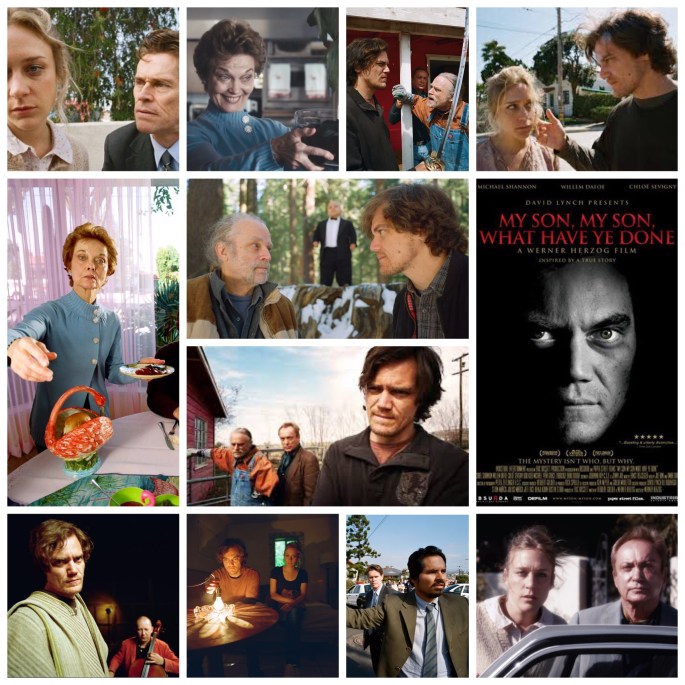
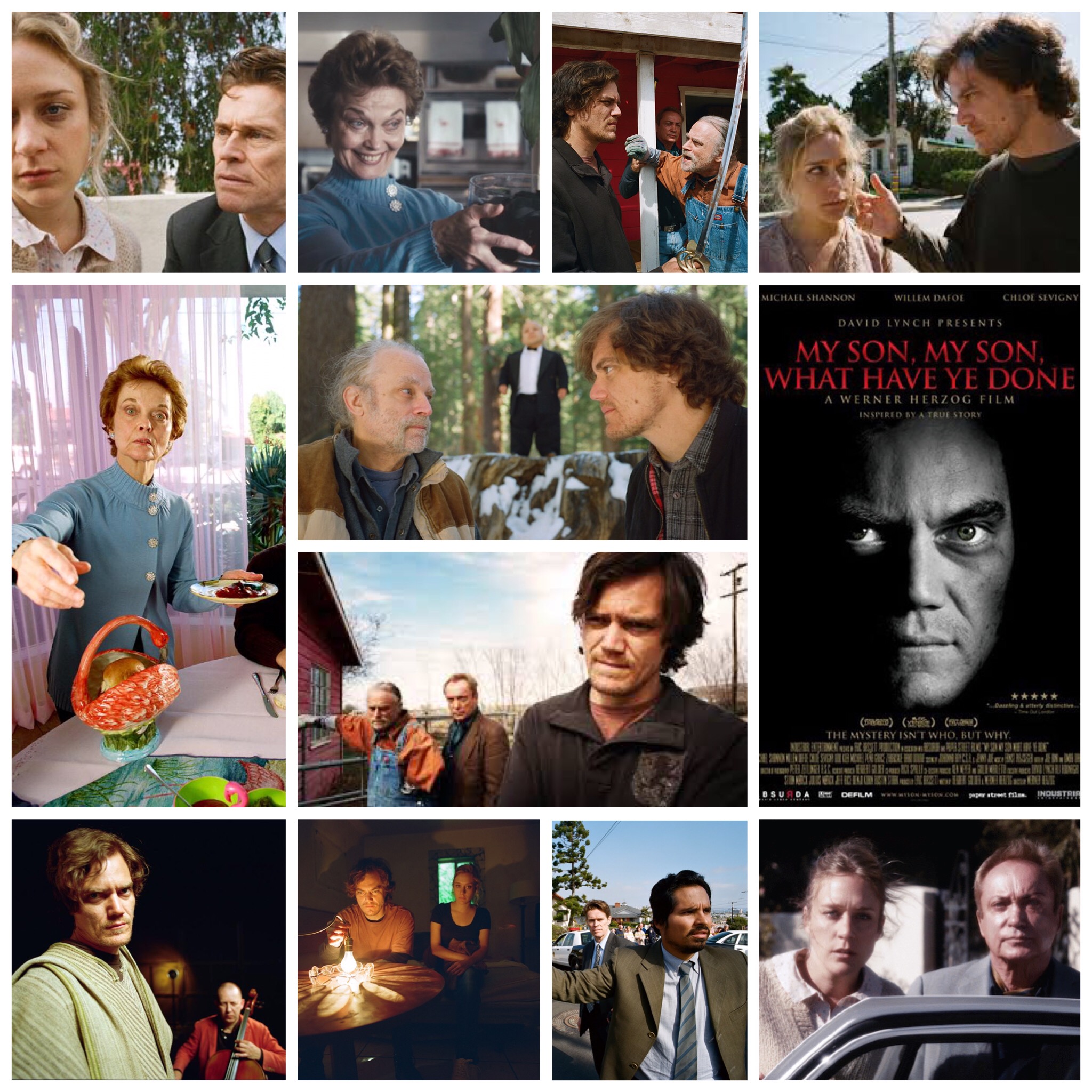
Werner Herzog’s My Son My Son What Have Ye Done, although not quite congruent with what you’d call my cup of tea, is an impressively bizarre little foray into… well, something. Michael Shannon plays a disturbed stage actor who, in an offscreen fit of violence, slays his mother (the great Grace Zabriskie) with a sword. Now, whether by mental illness, strange Peruvian spirits that piggy-backed on his psyche after a trip down there or reasons unknown, he slowly unravels throughout the rather short yet obstinately molasses paced film, until the final act solidifies his exodus into the realm of total bonkers lunacy. Shannon is an expert at all things in the circle of mental unrest in his work, and even when playing innocuous supporting characters or stalwart leads, there’s always a glint of menace in the whites of his eyes. It’s an impenetrable character study though, giving us not much to go on other than obtuse clues and the weird, wacky troupe of people in his life, portrayed by an appropriately zany bunch of cult actors. He has an uncle (Brad Dourif, a Herzog regular) with an ostrich farm and some, shall we say, interesting views on life. His quiet girlfriend (Chloe Sevigny) looks on in unsettlement, and his mellowed out drama instructor (Udo Kier) tries to make heads or tails of everyone else’s strange behaviour. You know you’re in the twilight zone when Udo Kier is the most well adjusted character in your film, but such is the territory. As Shannon descends into whatever internal eye of the storm privy only to him, he takes his mother and her two friends hostage, and the obligatory salty detective (Willem Dafoe) and his rookie partner (Michael Pena) show up to add to the clutter. David Lynch has an executive producer credit on this, and although the extent of his involvement is hazy to me, simply having his moniker post-title in the credits adds a whole dimension of bizarro to go along with Herzog’s already apparent eccentricities. It’s well filmed, acted and looks terrific onscreen, and I’m all for ambiguous, round the bush storytelling as a rule, but this just wasn’t a dose that sat well with me or tuned into my frequency as a viewer. Worth it in spades for that cast though, and their individual, episodic shenanigans. 

-Nate Hill

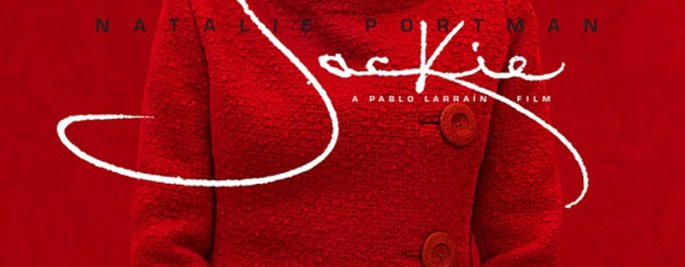
Jackie

Jackie

2016.  Directed by Pablo Larrain.

download

America consumes its legends.  The fuselage of politics and media exposure are the cutlery, while national tragedies are the main course, with the blood and camera lights dripping from the chin of insatiable public opinion  Pablo Larrain’s daring, borderline terrifying examination of Jackie Kennedy in the aftermath of her husband’s assassination is a fairy tale biopic that abandons any sense of tradition in favor of focusing on the concept of bereavement as an inconvenience to the patriotic machine and the unsung defiance of a woman forced to reinterpret her existence in the face of the unthinkable.

Natalie Portman becomes her subject, shredding the First Lady veneer to expose the ugliness of circumstance.  Her embodiment of Jackie, of a woman whose entire existence was undone with a bullet, is both brutal and demure, balancing the warm embrace of depression with the repressed rage of gender misappropriation.  Poise and conviction are her weapons, filling every sequence with subtle devastation and reluctant resilience.  Within instants of the fatal shot, Portman’s Jackie is relegated to an inconvenient specter, walking the halls of the future White House, with her ethereal presence carrying the film through the spectacle of the final act.  The deft manner in which Portman glides between cataclysmic psychological horror and rebellious self realization is unparalleled in this year’s lead actress performances.

download (1)

Stephane Fontaine’s cinematography captures the conflicting nature that flows through the veins of Jackie by using a variety of lighting and sharp angles to offset the personal torment with the grandeur seen by the public.  The moments of public knowledge, such as the exquisitely recreated funeral procession, use bright reds and warm blacks in combination to both respect the melancholy underpinnings and explore the inside of a national tragedy.  It is the moments in between, however, the quiet and eerie happenings within Jackie’s solitary hell, that are the most memorable.  Jean Rabase’s magnificent art direction turns the fabled White House into a haunted Camelot, with Jackie holding a lonely court amidst smoke filled chambers, adorned in immaculate costuming by Madelaine Fonataine.  Soft pinks highlight bloodstains and bruised skin, pulling the raw emotional upheaval into the focus, locking the viewer into Jackie’s tumultuous dirge.

Mica Levi’s score is a living entity, the shadow of history that is behind Jackie wherever she treads.  Filled with ominous crescendos and sharp tonal misdirection to signify the fleeting dream of America that has become a nightmare.  Noah Oppenheimer’s script has garnered some controversy for its treatment of the Johnson’s and Jackie’s reactions to them, but when taken in the context of the situation, the acts as displayed are organic companions to the film’s core mechanic of a woman being systemically undone and this is what elevates Jackie to being one of the best films of its year.  The free world will always need a leader, and the second JFK stopped breathing, Jackie’s entire universe, both her porcelain public persona and her briskly resigned private life began to evaporate.  The conflict over the funeral serves as a means for Jackie to commit a final act of patriotic maternity that ultimately became the nation’s first steps towards recovery.

download

Available now for digital rental, Jackie is ballad of pain.  A unique offering in the biopic genre that weaves threads of horror and hope into the Chanel armor of its champion, this is a one of kind of offering of poetic deconstruction.  Featuring one of the best performances of 2016, astounding technical craft, and an unforgettable score, if you’re looking for an unabashed examination of one of America’s greatest tragedies, this is the one.

Highly.  Highly Recommend.

jackie-poster

PTS Presents IT DOESN’T GET ANY BLUER Episode 1

Bluer Banner

We’re back to discuss the finale of TWIN PEAKS: THE RETURN. We’ve rebranded slightly, Tim and Frank are officially joined by Mya McBriar to assemble Podcasting Them Softly’s It Doesn’t Get Any Bluer Twin Peaks podcast! Today we’ll be discussing the last two episodes of the latest season, discuss what we all think it meant, how we felt about it, and will there be any more TWIN PEAKS?

Two Wolves, a snake eating its tail and a secret- A review of Twin Peaks: The Return by Nate Hill 


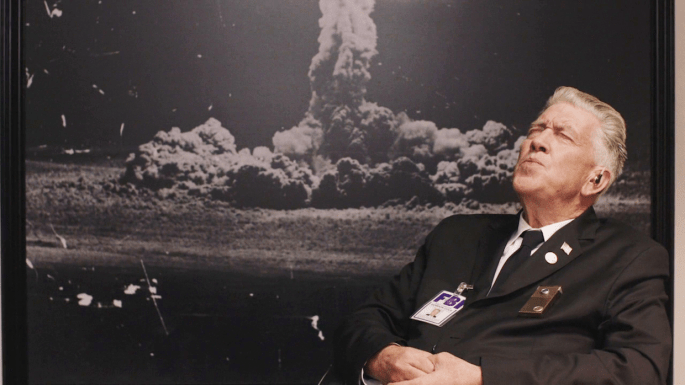
Twin Peaks: The Return has come full circle, and I mean that quite literally. Carefully, lovingly and maddeningly orchestrated by David Lynch, who has proven himself to be nothing short of a brilliant mad scientist of the cinematic arts, this is an endlessly deep, fiercely creative vision that refuses to compromise or meet anyone halfway, and it’s all the better for it. Showtime gave the man full and total control over every aspect, a decision they most likely didn’t fully understand at the time, but one which will have a beautiful ripple effect upon the landscape of serialized television and art itself in the decades to come, just as the original series did until now. 
  As the show unwinds in elliptical, rhythmic kaleidoscope fashion, it arrives at what can be called an ending only for the fact that there must be a last episode, but it’s not really an ending at all, there never was one in Twin Peaks, and likely never will be, a quality that has given it it’s vitality since day one. Many are having trouble accepting Lynch’s open ended, haunting finale, and that’s alright, considering human beings are simply wired to seek answers, and engineered to get frustrated, hostile even, when they aren’t provided. If one sits at a table with a jigsaw puzzle spread out, how would it be if the puzzle were quickly, neatly solved? The very quality that makes it a puzzle evaporates, the mystery gone, and one would simply lose interest, get up from the table and walk away. Now, if a handful of pieces are missing and never found, if the puzzle remains unsolved indefinitely, it feeds the observer with the fuel to pour thought, attention and care into continuously pondering how they might fit the pieces together, if ever at all. In short, the mystery lives on, and on. Lynch understands this, and it’s a wondrous gift to give fans, who no doubt will have Twin Peaks on the brain until the day they move on to the white lodge. It is quite literally the gift that keeps on giving. Like a snake eating it’s own tail, like the never ending, billowy curtains of the labyrinthine Red Room, like the portentous infinity symbol that the Philip Jeffries teapot warns Cooper with, this is a story that has ends, beginnings, middles, alternate timelines, repetition and, thanks to the intangible forces constantly at work, will never truly be at rest, at least not in any way that we can comprehend. 
  The themes which have fascinated Lynch his whole career are in full bloom here like never before, but one that takes centre stage after being deftly touched upon in the show and Fire Walk With Me is that of duality, light versus dark and the uneasy realization that the line between them isn’t as stark as we’d like it to be. Leland Palmer was always thought to be possessed by Bob, unbeknownst of his heinous atrocities, a babe in the very dark woods. Fire Walk With Me blew that comforting certainty right out of the water with some very dodgy scenes implicating Palmer himself, blurring the lines to show that although good and evil may indeed occupy opposite sides of the fence, they most certainly hop over and tread on each other’s lawn, a truth that has been shied away from in cinema quite often, but one which Lynch won’t let you tune out so easy. As we see a mullet adorned doppelgänger version of Cooper engage in a tirade of crime and violence across the states, the real Agent Cooper, or at least that part of his soul that’s trapped in the embryonic limbo of a pastel phantasmagoria Vegas, seems lost in a sea of characters we’ve never met before the Return. When it comes time for that inevitable showdown, it’s quick, and the surface level battle is skimmed over so Lynch can dive into a disorienting rabbit hole in which Cooper is stoic, uncharacteristically violent, a concentrated prism of all the qualities that were separate in the worlds that came before, his psyche in narrative nursery school until Lynch hurtles past that 430 mile marker into territories with ugly truths and revelations that are hard to swallow. Two wolves fight inside every one of us, one light and one dark, but they’re only two sides of the same coin, rival essences within a single beast, and although they run along side by side, tussle occasionally and appear to be separate entities, they’re one and the same when they look in each other’s eyes, as we see in the mirror, or when we come face to face with our doppelgänger against the backdrop of a shimmering red curtain. 
Twin Peaks has always been about secrets, from the very moment that Laura Palmer’s body washed up on those shores, wrapped in plastic (or did it?). Who killed her? That one secret lead to many, and as a story unfolds that’s scope vastly captures realms far beyond the sleepy little northwestern town it began in, we see a story at play that’s so much more, one that is very much filled with secrets, a motif we were warned about almost right off the bat. “She’s filled with secrets”, the Arm gleefully imparts to Cooper. That she is. The hollow screams of a shell shocked Sarah Palmer. The haunted, weary eyes of trailer park supervisor Carl (the beloved Harry Dean Stanton). Audrey Horne sharply awakening in the frightening unknown. Cooper and Laura being foiled yet again by the powers that be (those darn Chalfonts). An empty glass box that isn’t so empty. Coordinates that nestle between shrouded mountain glades. Heartbreakingly gorgeous melodies from the maestro Angelo Badalamenti. Pages from a secret diary that document horror, madness, joy, bravery, vulnerability and an odyssey through time, space, love, evil and of course good, the secrets that keep us coming back for more each time. Lynch has spun his magnum opus here, a tale where every piece is important, even the ones we may likely never find. A testament to the power of storytelling, a treatise on the mystery genre, everything I could have hoped for in a return to the town of coffee and cherry pie, and a full on bona-fide masterwork. See you in the trees, and whatever kingdoms lie beyond them in the glow of the red curtain, the purple seas, the hum of electricity in the dreams of a homecoming queen and a lone FBI Agent on a road trip to…

RIC ROMAN WAUGH’S SHOT CALLER — A REVIEW BY NICK CLEMENT

3

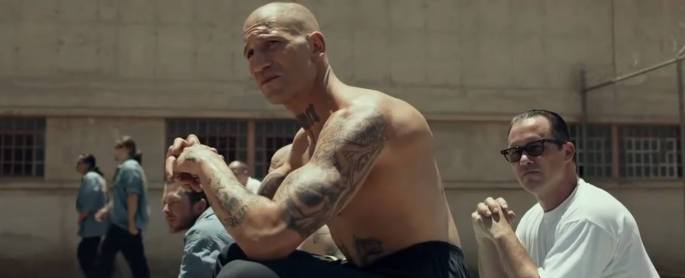
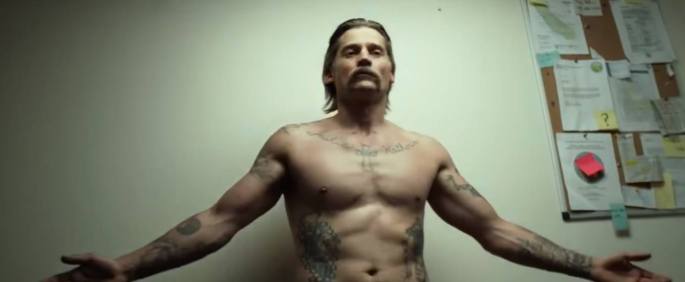
Damn. Shot Caller is a piece of hard-as-nails cinema. I’d love to see the expression on Walter Hill’s face after viewing this testosterone drenched display of movie machismo; the fact that it’s basically air-tight from a conceptual level only helps to make the film feel all the more spectacular overall. Written and directed by Ric Roman Waugh, a former stuntman turned indie filmmaker who apparently has a fetish for prison narratives (previous credits include the very good Felon; Snitch, which I’ve not seen; and the intriguing sounding In the Shadows, which sounds like a riff on Richard Rush’s The Stunt Man), and it’s abundantly clear he understands this milieu extremely well. Maybe too well, as Shot Caller made me quite afraid of spending any amount of time in jail, which I would have to imagine was Waugh’s intent. Circular in its construction and devised with a driving sense of forward momentum despite a non-linear presentation, Shot Caller is never unnecessarily gory or over-plotted, instead relying on smart and explosive moments of graphic violence to punctuate the gritty story. Waugh’s anxious and dangerous little B-movie transcends its trappings as a result of dynamic acting from everyone in the beefed-up cast, with Nikolaj Coster-Waldau turning in a transformative piece of acting that elevates the picture to an even higher plateau. The film pivots on a successful family man who causes a deadly traffic accident. He’s sent to prison, and when he gets there, he realizes that nothing will ever be the same, and must fight to stay alive by any means possible. And yet, there’s so much more, none of which I’ll hint at or spoil.

2

Add in Joe Bernthal (love this guy!), Jeffrey Donovan, Emory Cohen, Holt McCallany, Benjamin Bratt, Evan Jones, Omari Hardwick, and Lake Bell and you’ve got rock-solid support from a deep supporting cast. Everyone registers with authority, and Bernthal has definitely got the market-cornered in terms of playing hot-tempered alpha-males who love to get physical. The matter-of-fact cinematography by Dana Gonzales gets down and dirty with all of the bloody shankings and hand-to-hand killings, and there’s a prison yard brawl where nearly everyone is brandishing some sort of shiv that feels as visceral and fucked up as what was shown in a similar scene in The Raid 2. Michelle Tesoro’s strict editing keeps a fast pace and goes a long way in escalating the inherent tension in Waugh’s scenario, while the film belies its likely low budget with a terrific sense of verisimilitude in and out of lock-down, with some great nocturnal locations chosen for maximum atmosphere. Shot Caller is an R-rated actioner made for people who really appreciate this type of hard-nosed entertainment, and a total rebuke of the homogenized, PG-13, CGI-jizz-whiz culture that the major movie studios are so obsessed with. So naturally, that means that Shot Caller was entirely funded by independent sources of money, with Direct TV helping to pull it all together and showcasing the end product on their service a few weeks before anyone else. Whatever it takes is my motto. I’m so happy that these new outlets are catering to the people whose interests have been abandoned by the big-dollar suits.

1

Sebastian Silva’s Magic Magic


Sebastián Silva’s Magic Magic is a terminally bizarre little experimental film that simultaneously fascinates and prompts the viewer to wonder why it was ever made in the first place. Starring a posse of young, uber famous Hollywood talent that usually draw crowds in numbers, Magic somehow managed to slip under the limbo bar and avoid everyone’s radar undetected, no doubt a result of any marketing being smothered by a studio who wouldn’t have been able to sell the thing as it was presented to them. Jarring, aloof, persistently weird and frankly all over the place, it’s worth a look just for the sheer novelty, I suppose. A trip to Chile turns into some kind of nightmare for a group of youngsters played by Juno Temple, Catalina Sandino Morena, Emily Browning and an apparently mentally challenged Michael Cera, when one of them starts to display unpredictably odd behaviour, feverish delusions and violent outbursts that would give Father Lancaster Merrin the willies. Temple, an actress who admirably always takes risks, goes full on whackadoo here as the disturbed girl, plagued by restless mental instability caused by who knows what, subjecting her friends to her unsettling monkeyshines. Cera’s performance is so odd and tonally oblong it’s like he’s in a school play and his lines have been dubbed over by someone who’s first language is not English, I honestly don’t know what he was going for, while Browning does her pale and sultry thing dimly in the background. Is Juno just off her rocker? Are there invisible spirits at work that have latched onto her? Did the filmmakers even know when they made this? My guess is no, and sometimes that can work, but you have to present a final product that at least flows through it’s ambiguous arc naturally, and this one just feels off where it should draw us in. Neat camera work, Temple is engaging as she always is and makes a vivid, if ultimately perplexing impression, but overall it’s an unlit tunnel of a film that we emerge from and go “huh?”, and not in a good way.

-Nate Hill

Requiem for a Dreamer: The Twin Peaks Finale

LynchWhistle

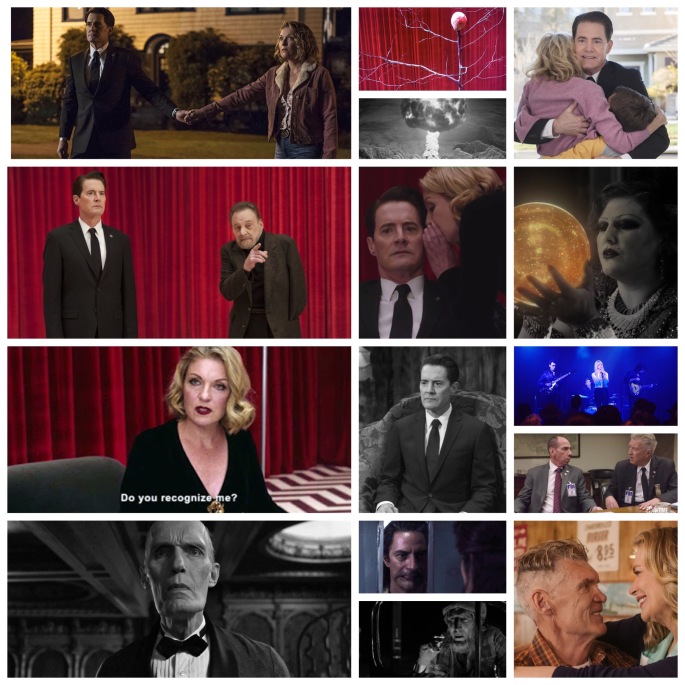
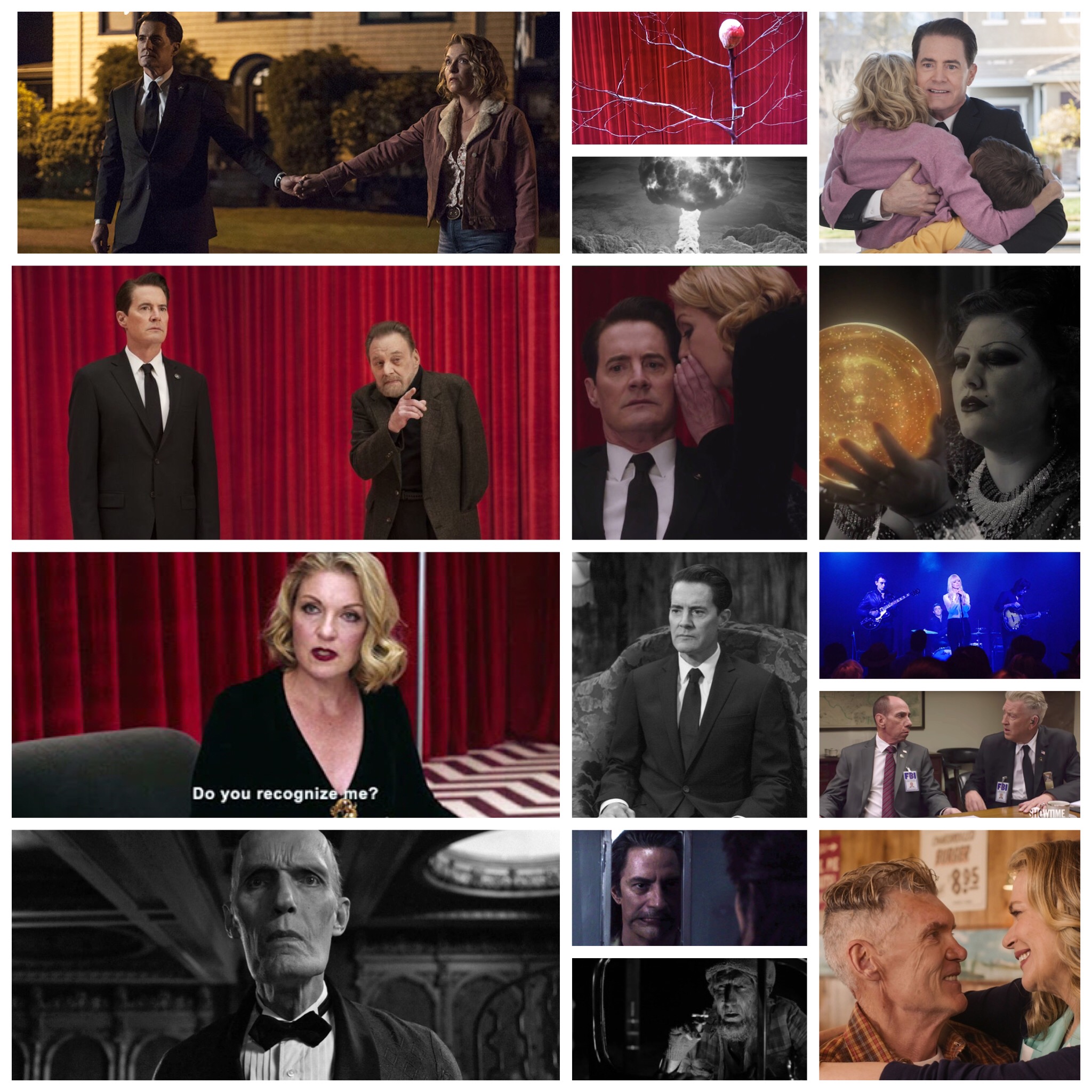
Stephen King once described the act of writing as telepathy; across time and space, the writer plants thoughts into readers and an unbreakable connection of minds is formed forever.  From a cinematic standpoint, David Lynch holds dreams in similar esteem.  His dreams become ours as we examine every frame of his output, lean in to hear what detail the sounds we’re hearing may offer, wrestle our left brain down so that our right brain might take flight and understand the dream on levels rarely captured by mere words.  It’s no mistake that the most ostensibly good realm we travel to in Twin Peaks: The Return is a theater, resplendent in nostalgic black and white, often showing its residents the ‘reality’ of a world more familiar to most of the characters, but cast upon a movie screen.  And what is that reality?  Much consternation has been stirred up over the course of the new Peaks’ 18 episode run about what parts of what we’re seeing are actually real.  The question itself probably gets a chuckle out of Lynch and co-creator Mark Frost, since if a fictional town populated by actors that’s always been on the verge of bleeding into the surreal and supernatural (and often ultimately does) is a baseline of reality, then we’re already starting far, far from home.  Dating back to Eraserhead, the auteur has seamlessly weaved dreams and nightmares together, perhaps reminding us of our day to day existence just enough that we’re consistently startled by the frequent additions of madmen, monsters, magic and mayhem.  This spurs many to attempt to ground his work in something more understandable to everyone who exists on terra firma, to sort and categorize and separate elements into their individual truths.  But to him, they’re all pieces of the same painting, different colors swirling together and apart to present a picture of a dream—not a picture of reality.

So, Twin Peaks: The Return has finished, our final visit to this place and its many levels of existence may well have happened this past Sunday night.  To complete one of many mirroring tricks used throughout the series and the invaluable film cohort Fire Walk With Me, once again we’re left with a downbeat cliffhanger of sorts, surrounded by loose ends, promised little by way of resolution.  The seemingly happy sendoff that an entity as fundamentally good and admirable as Special Agent Dale Cooper deserves is nowhere to be found, and it’s looking quite likely that he’ll continue searching for it forever anyway, turning up from time to time like his fellow missing Blue Rose cohorts only to disappear into the ethers to swing at windmills again and again.  In nods if not true deference to viewers who were sticking around more for the ‘quirky soap opera’ aspects of the original than the darker subtexts and storylines, Lynch and Frost tossed up a few small stories about old fictional friends of ours with happy endings:  Nadine lets Ed and Norma finally be together, Ben Horne continues his path to redemption by staying true to his wife in the face of temptation, Bobby Briggs lives up to his honorable family name as a sturdy lawman in the Twin Peaks Sheriff’s Department.  Then again, we may never know the fate of his daughter who, like mother Shelly, is prone to poor romantic choices and may have given her life for them.  Fan favorite Audrey Horne looks to be trapped in a level of nightmare well beyond a bad night’s sleep, but details are few and hardly forthcoming.  Even the series finale itself serves as two sides of a coin, with the first hour offering the satisfying takedown of the loathsome Evil Cooper the previous episodes appeared to be building towards and the second hour casting increasingly dark shadows on anything approaching a positive outcome.  Indeed, before the first hour’s up we’re already seeing that much if not all of Cooper’s journey back to lucidity was most likely his own dream; the immediately gratifying but increasingly silly battle and assembly of many of this season’s heroes in one room, resplendent in Wizard Of Oz style pluck and smiles, doesn’t hold up very well as we see his face superimposed over the proceedings.  Cooper’s always been an extremely smart character with great intuition, but in many respects, he usually comes up short.  He’s barely allowed to enjoy this victory before going off to attempt another, while any boundaries between what’s perceived as real and dream are shattering before his eyes and ours.

Twin Peaks Swirl

Anyone who feels like a mean trick is being pulled hasn’t been paying attention.  Talk of dreams, questioning whose dream we’re a part of or witness to, these are discussed early and often throughout Twin Peaks, not to mention Lynch’s overall filmography.  The surprisingly large influence of missing agent Phillip Jeffries (played originally by the dearly departed David Bowie, now ably substituted for with a cosmic coffee pot) on the new series comes into play here as well—we’re warned as far back as Fire Walk With Me that “we live inside a dream.”  Lynch clearly loves playing in the dream factory that is cinema, but there’s also an odd, almost masochistic adherence to the truth that he forces his characters to accept.  In Lost Highway, Fred creates a fantasy world of fast cars and faster women to escape into when the reality of his crimes becomes too much, but the illusion breaks down and he’s violently shoved back into the darkness of his true self.  Similarly, Diane Selwyn crafts a beautiful dream of mysterious adventure in Hollywood as Betty in Mulholland Drive, yet an hour and a half of respite from reality is all Lynch allows her before her murderous acts draw her to despair and, ultimately, suicide.  In Twin Peaks, characters such as Dale Cooper and Laura Palmer are clearly on the right side of the good/evil dichotomy, but they’re not spared the truth either.  Cooper, a victim of his own hubris, clearly states “the past dictates the future,” then promptly runs off into another dream dimension or two to try and change that past.  Does he in fact save Laura Palmer from that fateful night in the woods on February 23, 1989?  We’re shown a reality where that appears to be the case, yes.  On the ever present flip side, though, we’re also shown another reality, wherein faces don’t match identities, lovers become leavers, Cooper himself is unsettled, uncharacteristically violent and attempting to complete his mission of saving Laura Palmer and bringing her home in an increasing fog.  Harkening back to the Hard R Hardy Boys hero of Blue Velvet, he barks “Leave her alone!” at some cowboy thugs, then dispatches them with only a shred more restraint than his evil doppleganger would have. This, the final incarnation of Cooper that we’re left with, is an amalgam of all the Coopers we’ve come to know throughout Twin Peaks, good and bad, thoughtful and simple, observant and confused.  Laura hasn’t skipped merrily out of the Black Lodge into a cushy life/afterlife herself; when Cooper finds her, she’s been oddly absent from her waitressing job a Theresa Banks-style 3 days, has no knowledge of her former identity, and is entangled in yet another mystery we won’t get to the bottom of involving a corpse in her living room.  They journey together on lonely highways seemingly more appropriate to Evil Coop’s travels until they arrive at the Palmer home, which of course is not the Palmer home.  The Chalfont/Tremond story, heard before, offers little by way of a road map to sanity, and we’re left with an utterly confused Cooper, stumbling around in the street next to a horrified Laura, screaming in terror—the antithesis of the seeming relief and release seen in the closing moments of Fire Walk With Me.

Usually this part of an essay is dedicated to tying the loose threads together into explanations, conclusions, answers.  Unfortunately for those in need of such things, Lynch has increasingly moved away from these as his career has worn on; unsurprisingly, leaving pat resolutions behind has led to his most striking and lasting work.  Breadcrumb trails of numbers, visual clues, notable repetitions and more will keep internet sleuths and theories afloat for decades to come, no doubt.  Yet the perplexing, mesmerizing finale stands as a tribute to this American maverick’s complex and intuitive take on life itself.  Cooper may well be on an endless fool’s errand to try and fix the unfixable, to erase the history of incest and murder that came to roost on the shoulders of Laura Palmer many moons ago.  Laura, an avatar for goodness in a harsh, unforgiving world, doesn’t get to escape to a new reality or settle back into her old one.  These truths are as close to closure as we’ll be offered.  Lynch and Frost stated early and often that solving Laura Palmer’s murder was something they never wanted to do.  Given the opportunity to return to her story and the town of Twin Peaks, it should be no surprise that leaving Laura’s mystery wide open is the final gift we’re given.

twin-peaks-the-return-part-8-laura-palmer