Little Nicky


I’ve never been one to actively nab the Adam Sandler flicks off the rental shelf, but even he has made the occasional winner, one of the best being Little Nicky. For some reason it’s panned over other far worse ones he’s churned out of the gumball machine (ever re-watch Billy Madison? What the fuck were we/they thinking back then?), but when you part the curtains of Sandler Stigma™ and really just look at what the movie is in itself, it’s a hoot. What other film can boast Rodney Dangerfield playing Harvey Keitel’s dad in hell? That’s right, Keitel is the red beast himself, coming down off a ten thousand year unholy monarchy, with no plans to retire. This infuriates his two wicked sons, played by Tiny Lister (must have been a different devil-mom) and a slick Rhys Ifans. They depart the inferno and set up their own devilish franchise up in New York City, raising all kinds of hell, the most amusing of which is lowering the drinking age to ten (where were these guys when I was that age?) and forcing Regis Philbin to say naughty things on live primetime. Their younger, slightly retarded brother Nicky (Sandler) must pursue them on their haunts and trap them in a magic flask before it’s too late. Dumb concept, right? Sure it is, but try and tell me it’s not hilarious m, especially with the amount of inane visual gags and trippy production design these folks have dreamed up. Between Hitler dressed as a slutty maid getting a pineapple repeatedly rammed up his rectum to a giant gorilla massaging mammaries that have sprouted on a dude’s head like fleshy succulent pigtails, there’s no shortage of wtf moments. Sander picks an odd character mask as usual, sporting a metal-head swoosh of a haircut and lisping his way through his lines sounding like he had a stroke from watching Billy Madison dailies one too many times. Patricia Arquette is in it, as a sweet, shy girl he meets topside and the closest thing to a sane person you’ll find in this madhouse. Cameos abound, from usual Sandler cronies like Jon Lovitz, Rob Schneider, Kevin Nealon, Dana Carvey, Peter Dante and Allen Covert, to randoms like Michael McKean, Clint Howard, Laura Harring, Henry Winkler, Ozzy Osborne, Reese Witherspoon as Nicky’s angelic mom and Quentin Tarantino as a blind preacher. I don’t really know what else to say about the thing, because its it’s own thing and you either rock out with it, or you don’t. Visually it’s never boring, the script was conceived in the toilet and jumped straight to the gutter, the performances are all garishly obnoxious and the overall tone is that of an sixth grade birthday party gone rogue. 

-Nate Hill

ROBERT MULLIGAN’S THE NICKEL RIDE — A REVIEW BY NICK CLEMENT

3

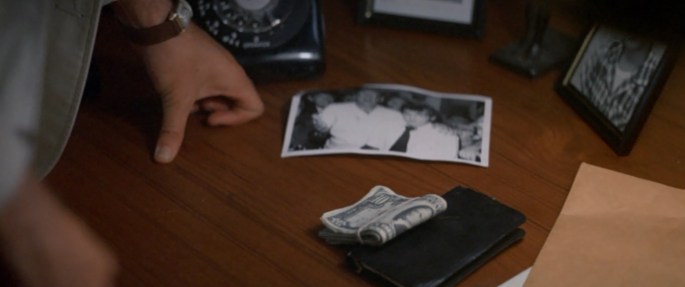
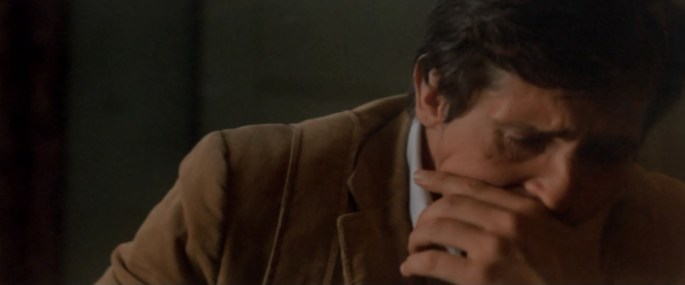
The Nickel Ride is a cool as a cucumber crime film from 1974, patiently directed by Robert Mulligan (Summer of ’42, The Stalking Moon, To Kill A Mockingbird) from a sly, morally ambiguous screenplay by then-newbie Eric Roth (Munich, Forrest Gump, The Curious Case of Benjamin Button, The Insider). The plot centers on a “key-man” named Cooper (Jason Miller), who works for a local crime syndicate, and always carries his ubiquitous key chain at all times. His job is to run a group of Los Angeles-based warehouses that house stolen goods, but things get complicated when a real estate deal turns south and local gangsters led by an evil John Hillerman who feel threatened by Cooper’s knowledge of the ins and outs of the various illegal activities. Before he knows it, someone has been sent to kill him. But who? And why? Roth’s script is clever and shifty, never giving up its full hand until the final moments, and it must be said that Miller’s ability to convey pensive, sullen, broken-down alpha males was truly signature.

2

The film is more about its tense atmosphere and the anxiety that Miller projects as an actor than it is about anything else; his underplayed performance rests in his eyes and body language and the way his sullen face is captured within the frame. The Nickel Ride was shot in 2.35:1 widescreen with a love for shadows and darkness by legendary cinematography Jordan Cronenweth (Blade Runner, Cutter’s Way, Altered States, Rolling Thunder) and features a low-key musical score from Dave Grusin (The Friends of Eddie Coyle, Three Days of the Condor, Oscar-winner for The Milagro Beanfield War). The Nickel Ride screened at the 1974 Cannes Film Festival and was nominated for the Palme d’Or before getting lost in the theatrical market with less than a $2 million domestic gross. The film is available on DVD as a double feature with the outlandishly entertaining John Frankenheimer oddity 99 and 44/100% Dead from Shout! Factory, and would easily fit the bill for a great night of 70’s crime cinema where you never can truly guess how things will end up.

1

Indie Gems: American Perfekt


American Perfekt is a disjointed yet darkly compelling little nightmare of a road movie, a dusty ode to bowers of the American southwest left unchecked and decayed, populated by wayward souls with perpetual heat delirium, vixens, psychopaths and hustlers alike, who saunter through lurid storylines that often end in bloodshed and madness. In the vein of stuff like Oliver Stone’s U-Turn and Kalifornia, we once again pair up with some extremely off colour characters as they navigate both the tangled web of highways that lace the States as well as the human capacity for greed, lust and heinous physical violence. The characters, and actors for that matter, who populate this stretch of highway are an especially bizarre bunch, starting with Robert Forster’s vacationing criminal psychologist Jake Nyman. Forster is quite the unpredictable guy, usually found in calmly benign protagonist roles, yet just as capable of stirring the pot with evil antics. Here’s he’s opaqueness incarnate, driving from one place to another until he runs into two sisters played by another couple of acting hellcats, Amanda Plummer and Fairuza Balk. Jake is basing each decision of his trip upon the flip of a coin a-lá Harvey Dent, a tactic which simultaneously causes trouble and indicates how unhinged he might really be.

Plummer is weird and Balk is weirder, but neither as weird as David ‘Professor Lupin’ Thewlis as an awkwardly placed character who seems to exist just to jump into a scene and throw the mood off kilter. There’s others running amok too, including Geoffrey Lewis, as well as Paul Sorvino and Chris Sarandon as a pair of state troopers who serve as comic relief. Forster is scary here, playing a guy who is psychologically hard to pin down or get a read on, and he’s got some dynamite scenes with Balk in the third act, the two talents lighting up the frame. It’s pretty far south of coherent though, mostly just these freaks terrorizing each other and engaging in puzzling romantic flings that only make sense to them, I suppose. If feverish, borderline abstract, sun-stroked neo noir is your thing, go for it. You can certainly do worse than spend a certifiably bonkers ninety minutes with this terrific bunch of actors. 

-Nate Hill

THE FOX & THE HOUND — A REVIEW BY FILMMAKER AND GUEST CRITIC DAMIAN K. LAHEY

FoxAndTheHoundPoster

“The Fox and the Hound” (1981) dir. Ted Berman, Richard Rich, Art Stevens

One of Disney’s more adult efforts, ‘The Fox and the Hound’ is an endearing morality tale depicting the negative long term effects of tribalism. Todd, a fox and Cooper, a hound become childhood best friends only to realize as they grow older that they must adhere to the roles of their respective cultures and cannot be the friends they once were.

The filmmakers do a remarkable job at the outset of developing the friendship between the young hound and the young fox. It is extremely genuine. A tad hammy but not false. This foundation holds the film together. Cooper is derided by his peers for befriending a fox but is given the benefit of the doubt because of his youth. The older hunting dog Chief and the master, Mr. Slade, are metaphorically unabashed racists as the film brazenly makes its case that bigotry is not inherent in the young but is instead learned by one’s elders and their culture. This film is also astute enough to point out that even the seemingly enlightened woodland creatures who befriend Todd are just as responsible for the general state of things. While they may acknowledge that societal prejudice is wrong, their refusal to do anything about it makes them benign accomplices all the same.

It should be noted that ‘The Fox and the Hound’ features to-die-for voice work by Mickey Rooney, Kurt Russell, Corey Feldman, Sandy Duncan, Pat Buttram and Pearl Bailey. Hard to imagine what this film would have been like without them.

Much has been made about whether or not Chief should have been killed. The new blood at Disney working on the project argued vehemently the Chief should be killed but the old guard voted them down. I certainly agree that the film would have had more narrative bite (ha!) if Chief had been killed. As it stands the retribution seems a little wonky even for Disney logic but it doesn’t raise much of an eyebrow. In my opinion it was a small price to pay in order to get the film’s message across.

Life is unfair, people. And as this film shows us, most of life is spent within the grey areas as opposed to the blacks and whites. Even the most dramatic moments in our lives end in neither clear victory nor defeat. When Cooper stands up to Mr. Slade at the end of the film, refusing to betray Todd – it is merely a truce of sorts. It is no victory for multiculturalism nor defeat for isolationism. There is merely a mournful acceptance that the fox and the hound cannot coexist for many frustrating reasons. But for a brief period of time, Todd and Cooper proved that they could. Society, my friends, can be a very oppressive force. One that influences people far too often to betray their more noble instincts for the ‘good’ of the pack. We could all be more mindful of this.

TheFoxandTheHoundStill

STANLEY KRAMER’S INHERIT THE WIND — A MINI-REVIEW BY NICK CLEMENT

2

Stanley Kramer’s timeless drama Inherit the Wind still has the capacity to rouse and startle, and remains scarily relevant in today’s increasingly Idiocracy-leaning society. Co-written by blacklisted screenwriter Nedrick Young and Harold Jacob Smith, the film was based on the play by Jerome Lawrence and Robert Edwin Lee and inspired by the famous “Scopes Monkey Trial” in 1925, where creationism vs. evolution was up for debate. Starring Spencer Tracy, Fredric Marsh, Gene Kelly, Dick York, Donna Anderson, Claude Akins, Harry Morgan, and Elliot Reed, there’s not a bad performance in the entire bunch, and the film’s black and white photography by Ernest Laszlo is consistently dynamic, which was no small feat considering that much of the action takes place in a courtroom. I was introduced to this film by my father early in my formative movie-buff years, and I’ve revisited it numerous times as it always provides an intellectual punch, and serves as a potent reminder of how mixing religion with law is a terrible idea.

3

B Movie Glory: Cat Run 


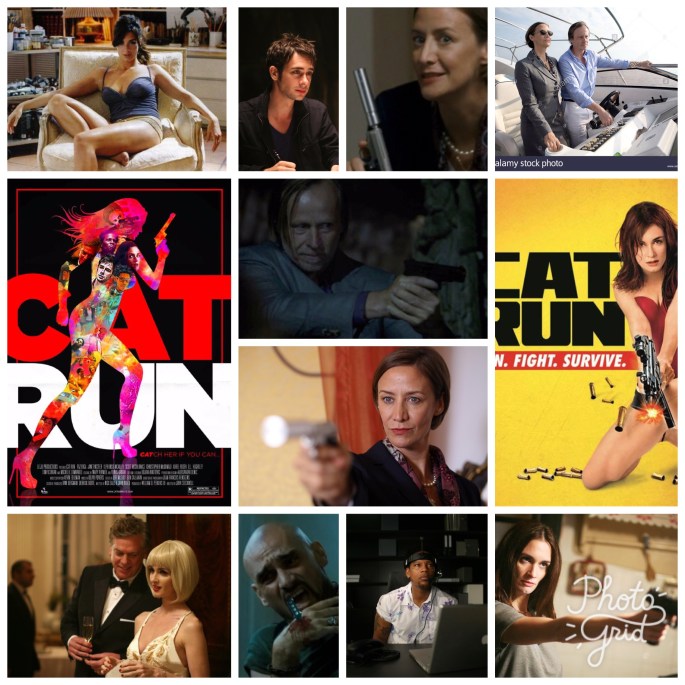
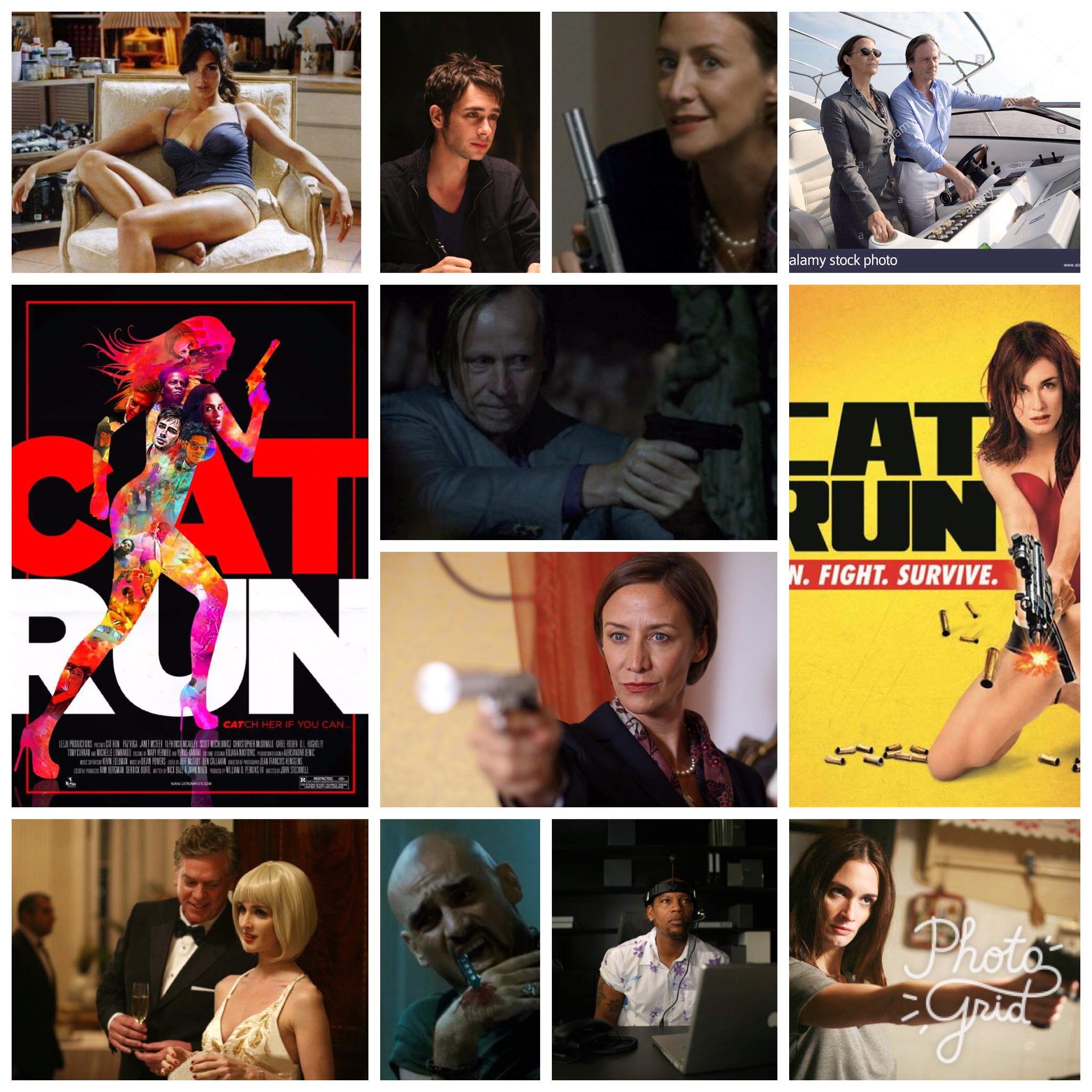
Cat Run is a useless, needlessly crass and unpleasant piece of pseudo euro-pulp garbage with not a redeeming factor in sight. It tries its best to do the whole assassin mad dash a-lá Smokin Aces and such, but there’s no heart, no discernible frequency to jive with and it ends up so thoroughly dead on arrival that you can feel the lack of pulse simply by watching a hastily cut trailer. The story is a glossy parade of silenced pistols, broad characterizations and graphic genre prototypes that offers nothing fresh, beginning with a murder scandal involving a scumbag politician (Christopher ‘Shooter McGavin’ McDonald) and a high class escort (Paz Vega). This causes subsequent fallout and bloodshed as all kinds of freaks and lowlifes come crawling out of the woodwork. They include two moronic would-be businessmen (Eurotrip’s Scott Mechlowicz and Alphonso McCauley), a mysterious oddball (DJ Hughley) an Eastern European mobster nutjob (always cool to see Karel Rosen) and Helen Bingham, a ferocious assassin played by British thesp Janet McTeer. They’ve made her character excessively, ridiculously arch and violent, hovering so far over the top she flies into orbit. The thing about these low rent, hard boiled, high octane ensemble capers is that you have to have a balance, a flow of all energies involved that stays streamlined and congruent. Smokin Aces had that (its sequel ran on an empty tank, but that’s another story), as a good example of the recipe done right. This one just feels aloof and awkward, nothing to say and no amount of high style to distract us from the lack of proper story. It amazes me that they churned out a sequel this year, which I’ll be avoiding, I think. 

-Nate Hill

Guardians of the Galaxy Vol. 2

Guardians of the Galaxy Vol. 2

2017.  Directed by James Gunn.
Guardians-of-the-Galaxy-Vol.-2-Rocket-and-Yondu-e1476895483196

Guardians of the Galaxy is often described as one of the best films in the Marvel Cinematic Universe.  As a result, expectations for James Gunn’s follow up, Guardians of the Galaxy Vol. 2 were incredibly high and the final result, while not perfect, is one of the best made superhero films thus far.  Featuring a scene stealing performance from Michael Rooker, uncharacteristically beautiful visuals, and an unexpectedly mature story, this is a film that showcases the limitless potential of superhero films as allegories to the struggles of reality as well as reveals the innate ability of comic book films to mirror the depth and artistic breath of their source material.

Peter “Starlord” Quill is found by his wayward father, Ego after a disastrous job that leaves the Guardians fractured and pursued by a ruthless alien civilization.  As Peter explores his relationship with father, terrible truths are revealed that test the bonds of friendship and family as each Guardian confronts the horrors of the past for hope at a better future.  Gunn’s script stumbles to achieve the same level of humor of the first film while presenting an action film almost devoid of action that almost entirely mimics The Empire Strikes Back.  However, as the story begins to unfold, dark sequences of mass executions, torture, and murderous narcissism are interwoven with one of the most sophisticated stories to be featured in a Marvel film.  Building on the first movie’s core of broken outsiders forming a ragtag tribe among the stars, Gunn’s second effort expands on the theme of family by examining fraternal conflicts and surrogate fathers. While the heart wrenching conclusion is telegraphed from one of the first frames, the emotional payoff works due to the chemistry of the cast.

download

Michael Rooker’s performance as Yondu is a tarnished, broken, and perfect super nova.  His vulnerable delivery of dialogue combines with moments of genuine menace and paternal empathy to form the foundation around which everything else orbits.  This is a story about love and its consequences distilled through a cosmic interpretation of Cat’s in the Cradle and none of it works without Rooker’s panache. Dave Bautista continues to impress, despite the clunky script, and his scenes with newcomer Pom Klementieff are comically awkward in one instant and then tear inducing in the next. Zoe Saldana and Karen Gillan continue to have weaker arcs, but this is more from the material than their performances.  Bradley Cooper’s Rocket continues to impress, with Cooper’s verbal torment unexpectedly overcoming continually stale jokes about his origins.  Kurt Russell is the perfect choice for his role, but to expound would spoil the pure joy of his introduction.  The Baby Groot-centric credits are outstanding, focusing on the childlike wonder of the character while ignoring a repetitive action scene that suggests a heightened awareness of the formulaic constraints of its colleagues.  Unfortunately, there are continuous efforts to double down on the character’s cute factor that are underwhelming.

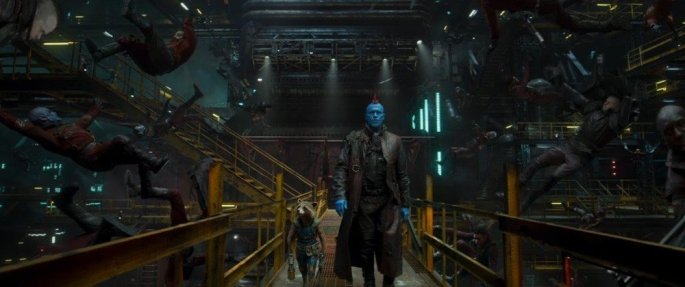
Henry Braham’s ambitious cinematography is the savior.  There’s a remarkable shot of Yondu looking out onto a shantytown while red and green neon lights reflect against a dingy window that underscore the character’s inner turmoil and immediately sets the tone.  Another jaw dropping composition features Gamora sitting on an alien planet’s surface, surrounded by a psychedelic miasma of colors while the film’s centerpiece involves a beautifully shot sequence of musical mayhem aboard a pirate ship.  The poetic finale is a color infused sequence of reverence that is both a sublime capstone on a transitional story and a sensational homage to the era in which Guardians is forever submerged.  The soundtrack diverts from the first film’s grab bag of chart toppers to feature intimate songs whose symbolism (while blatant) mixes perfectly with the serious tonal shifts and will have even non-believers humming for days after.

download (1)

Ramsey Avery’s art direction is yet another unexpected surprise.   The Sovereign are an alien race that are introduced during the first act and with just a handful of precious scenes, the sheer scope of their home world is communicated through dazzling Art Deco throne rooms and Black Mirror-esque combat stations.  The planet on which the bulk of the story transpires is a LSD soaked sanctuary, mirroring the arrival of a child’s errant father who brings wondrous new toys as compensation for unreliability.  Dreams, impressions, and preconceptions are all at play both in the physical environments on display and the heady metaphysical conflicts within the characters’ hearts.

In theaters now, Guardians of the Galaxy Vol. 2 is not perfect, but it excels in areas that other Marvel films have just begun to explore.  Michael Rooker’s outstanding supporting performance anchors a film that could have easily gotten carried away into a vortex of CGI and Vol. 2 almost does.  It is brought back from the brink of forgettable action sequels by breathtaking visuals and adult oriented themes that combine to create the perfect remedy for the spandex fatigue that has gripped the box office.  If you enjoyed the first film, there is plenty here that will work, albeit with some rough patches of dialogue and crude humor, but underneath the expected mediocrity lies a passionate story about the definitions of family, traumatic abuse and its consequences, and most surprisingly a well-defined villain with a purpose, something that has been severely lacking in the bulk of the Marvel Cinematic Universe films.  Candy cane aesthetics and pure heart are what elevates James Gunn’s second pop-pulp space opera to front of Marvel’s cinematic stable.

Highly Recommend.
download (2)


BARRY LEVINSON’S TIN MEN — A REVIEW BY NICK CLEMENT

2.5

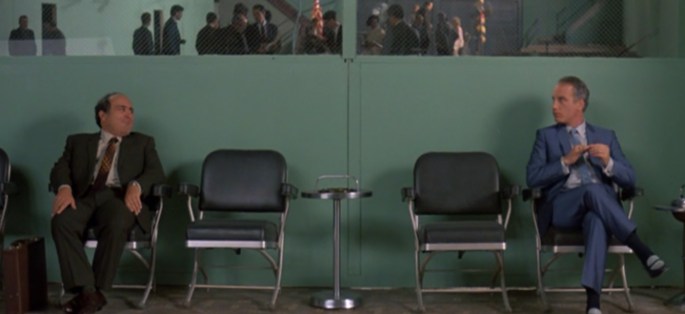
I’ve been a big fan of director Barry Levinson (Wag the Dog, The Natural, Rain Main, Bandits, Bugsy) over the years, and one of my favorites from him is his 1987 dramedy Tin Men, which features a trio of fantastic performances from Danny DeVito and Richard Dreyfuss as competing aluminum siding salesman who cross paths with each other, and Barbara Hershey as the woman who they compete for. Levinson wrote the humorous and fond-memories screenplay (it’s the second of his four “Baltimore Films”, with the others being 1982’s Diner, Avalon in 1990, and the very underrated Liberty Heights in 1999) and it’s abundantly clear that he’s always had a great ear for dialogue, especially in the films that he’s set in his home state of Maryland. Peter Sova’s unfussy cinematography is stylish without calling attention to itself, Stu Linder’s crisp editing keeps the comedic timing sharp and on-point from all the actors, and the wonderful supporting cast includes J.T. Walsh, Bruno Kirby, Seymour Cassel, John Mahoney, and Jackie Gayle. The Fine Young Cannibals contributed to the soundtrack and made an appearance during a nightclub sequence, and the film ended up grossing $25 million in theaters off of strong critical notices. Tin Men is currently available on DVD and via Amazon streaming and feels like the sort of film that a present day studio executive would laugh you out of their office for pitching to them.

3

Dark Cities, Dark Futures, Dark Caves: An Interview with Bruce Hunt by Kent Hill

Young Bruce Hunt loved movies and blowing things up. This love, and learning the basics of the craft from film magazines of the period, would firmly cement in his mind the path on which he would travel. As it was said in a film that Bruce would later work on, “Fate it seems, is not without a sense of irony,” a teenage Bruce would encounter Academy Award winning special-effects artist Dennis Muren in a cafe in London.

1475781640944

It was Muren that would advise the dreamer to seek out an effects house in his native Australia for possible future employment and, after art school, that is what the talented Mr. Hunt would do. Working with small production houses on commercials his work would soon catch the eye of the founder of one of these companies, a man named Andrew Mason. It would be Mason, producing a film directed by Alex Proyas called Dark City, that would call on Hunt to bring his passion, and by then, professional eye for effects photography to his first big screen gig.

Work on another big flick would follow, as Mason would again tap Bruce and bring him to work on the Wachowski’s cinematic masterpiece The Matrix. There would be work on the film’s sequels before, at last, Bruce would sit in the director’s chair for The Cave, an adventure in deep terror. He would emerge from the darkness to work on Baz Luhrmann’s Australia only to descend again soon after for Guillermo del Toro’s Don’t be afraid of the Dark.

Through it all his love of the movies continues to drive him and, as you will hear, he has plans to get his visions back on that big screen, just as soon as he can. It was great to sit down with Bruce. Not only is he a filmmaker I admire, but it was great to just talk about movies with him.

If you don’t know his work then now is the time to check it out. But, if you already have and you’re a fan like me – then kick back and enjoy.

Ladies and gentlemen, I give you my good mate . . . Bruce Hunt