Triangle: A Review by Nate Hill 

  
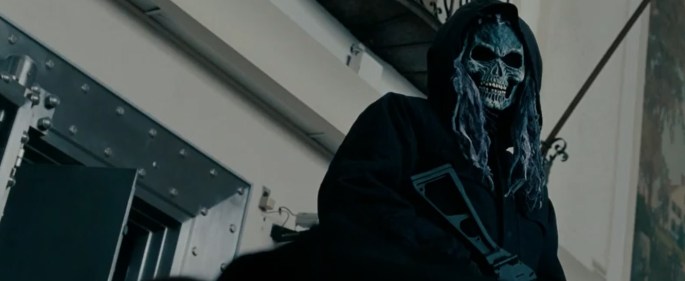
Structured like a labyrinthine video game. Packed with loads of paranoid suspense and style. Tuned with the hazy thick atmosphere of a bad dream. A diabolical guessing game from scene to scene. Triangle is one of the most enjoyable mind benders out there, a funhouse of a thriller that sails into murky metaphysical water and doesn’t let either it’s protagonist or its audience off with a cheap resolution. Imagine Dead Calm crossed with Memento and you’ll begin to have some notion as to where this film will take you. It’s a freaky voyage, as star Melissa George finds out after a yachting expedition with friends hits a nasty patch of storm weather. Soon a massive, deserted ocean liner crosses their path, and they are forced to board it after the typhoon wreaks their smaller craft. The rest of her crew just seemed puzzled by the derelict vessel, but Melissa has an eerie, gnawing feeling that she’s been on this boat before, a feeling that something is very wrong. Suddenly there’s a mystery person hunting and killing them, and if I just made it sound like a run of the mill slasher flick, please be assured that it’s anything but. What I’ve described happens in what is maybe the first quarter of the film, and everything after that point is a trip into a dizzy, seafaring twilight zone of psychological mystery and reality warping uncertainty that makes George unsure if anything, including her own perception of reality, can be trusted. Events repeat themselves, characters dart in and out of the wormhole of a narrative arbitrarily yet with a hidden purpouse that managed to scarily elude me for much of the film. It’s scary in the way that ducks usual horror trends. There’s violence and even some ghastly gore, but the real fear here lies in the unknown, the idea that forces beyond what we perceive as reality are messing around with us, and indeed they do mess around with her and then some, right up until the last frame of an ending that’s commendable, haunting and difficult to process. George makes great work of the confusion that morphs into terror and then outright existential panic, keeping us on our toes with the way she handles her character arc. Keep an eye out for a young Liam Hemsworth too. For psychological thrillers, it don’t get much better than this, and it’s off the radar enough that you’ll be able to recommend it to your friends who chances are, haven’t even heard of it.

Titan AE: A Review by Nate Hill 

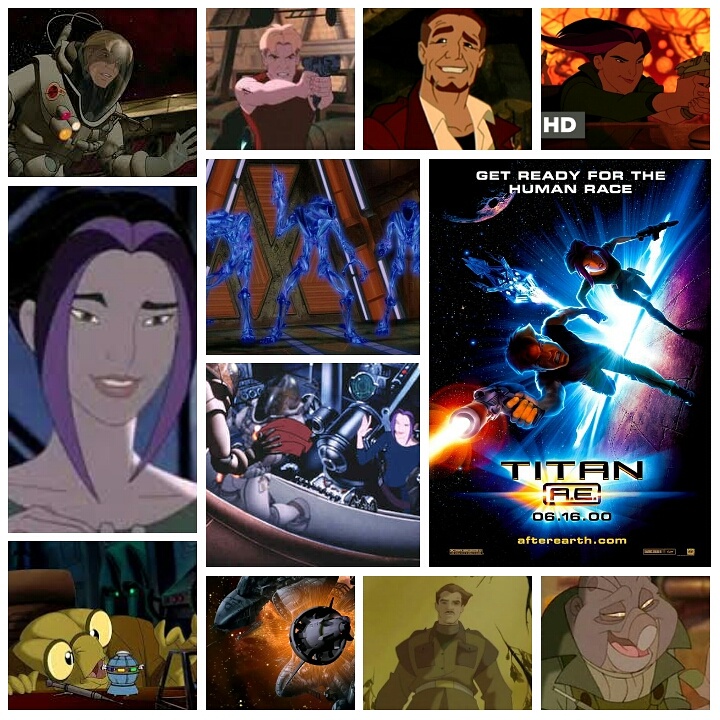
Titan AE is one of the best 2D animation ventures out there that isn’t Disney. Science Fiction and animation just seem to inherently go hand in hand (affirming my belief that Treasure Planet is the best one that Disney ever churned out, but that’s another story), perhaps because of the dazzling possibilities in a form of creation like that, tools which make the visual patterns of the artist’s dreams and beautiful renditions of the cosmos a reality. This one nails the visual aspect, but it was story that hooked me ultimately. Along with the artwork there is a boundless creative surge, a very human plotline that’s relatable to anyone who’s ever felt lost or like they don’t fit in. In the year 3028 A.D., a marauding race of aliens called the Drej decide that us humans are a threat, and obliterate earth, leaving few survivors. Dark way to kick off an animated movie, amirite? That’s another great thing about it, it’s not exactly for kids and reaches for themes that are a little more than your standard animated flick, getting fairly intense in the process. One of the few human survivors is young Cale (later played by Matt Damon), whose scientist father (Ron Perlman) was working on an idea that could have greatly advanced our civilization. In the years following the destruction, Cale has been left to wander the galaxy with the sparse, impoverished remains of the human race, now looked down upon by other alien tribes for essentially being homeless. When human Captain Joseph Korso (Bill Pullman) comes to him telling of a mysterious device created by his father long ago, Cale is reluctant, resenting his him for disappearing on the Titan ship so many years before. Soon it becomes clear that Perlman’s device is the key to creating a new earth, and reuniting humanity. Thus begins an epic race across the universe to find it before the Drej do. Drew Barrymore lends her sassy voice talents to Akima, Korso’s tough lieutenant, and there’s also work from John Leguizamo, Nathan Lane, Janeane Garofalo, Charles Rocket, Alex D. Linz and rapper Tone Loc who has a perfect voice for this kind of thing, playing a kindly alien mentor named Tek. This one is timeless, feeling fresh and vital with each passing decade it’s allowed to age through. A celebration of imagination and the creative force of will that lies inside each and every one of us humans, no matter how dire our situation. Classic stuff. 

LUIS LLOSA’S THE SPECIALIST — A REVIEW BY NICK CLEMENT

specialist

Hollywood has seemingly abandoned the slick and disreputable big budget actioner, and I’m slowly realizing how the 90’s were essentially the last decade that really took full advantage of the big spec-script sale which would then lead into the over-inflated star vehicle. I love The Specialist. It’s obviously not a great movie, but it’s massively entertaining, featuring a trio of bad guy performances from a maniacal James Woods, an extra-sleazy Eric Roberts, and a hysterical and way over the top Rod Steiger. Stallone was rather quiet in this one, as an explosives expert who is drawn into considerable danger by his lusting for a super-hot Sharon Stone, playing Roberts’ trophy girlfriend, while his ties to Woods which stem for their CIA operative days have left them mortal enemies. Stallone and Woods go at each other’s throats all throughout the cliche and predictable narrative, while the epic and gratuitous sex scene between Sly and Stone is one for the books, featuring action in an out of the shower, and more than one moment of laugh-out-loud corniness. The cheese-ball yet extremely plot-heavy script by Alexandra Seros, who also wrote the tepid La Femme Nikita remake Point of No Return for director John Badham, was based on the novel by John Shirley, and has all sorts of terrific howler lines as well as some really nasty tough-guy talk, while the entire production was overseen by legendary producer Jerry Weintraub.

The action, all well staged by famous B-movie filmmaker Luis Llosa (Sniper, Anaconda, various Roger Corman titles), is slick and violent and explosion-happy, with the entire film given a phenomenally luxurious yet still gritty visual veneer by the tremendous cinematographer Jeffrey Kimball, who shot Top Gun and True Romance for the late, great Tony Scott. Every single shot in this film is gorgeous, with Kimball lighting the radiant and ultra-sexy Stone like a true cinematic Goddess, while the Miami setting at least allowed for the excuse to lather all the stars in faux-sweat and body oil, all in an effort for maximum gloss. Jack Hofstra’s tight editing kept a fast pace and the entire picture was bolstered by John Barry’s exciting score. A decent hit at the domestic box office but totally trashed by critics who couldn’t be bothered to see the film for what it is — a good old stupid-fun time at the movies — this is one of those mid-90’s efforts that signaled the downturn in American interest in Stallone’s output, but would become a massive financial success overseas, just as almost all of his films have been. While certainly not revolutionary on any level, this is a solid and undemanding time waster that I’ve watched repeatedly throughout the years, and it’s a reminder of how tame and prudish the studios have become with their inclusion of violence and sex in pop-corn action fare.

Batman Forever: A Review by Nate Hill 

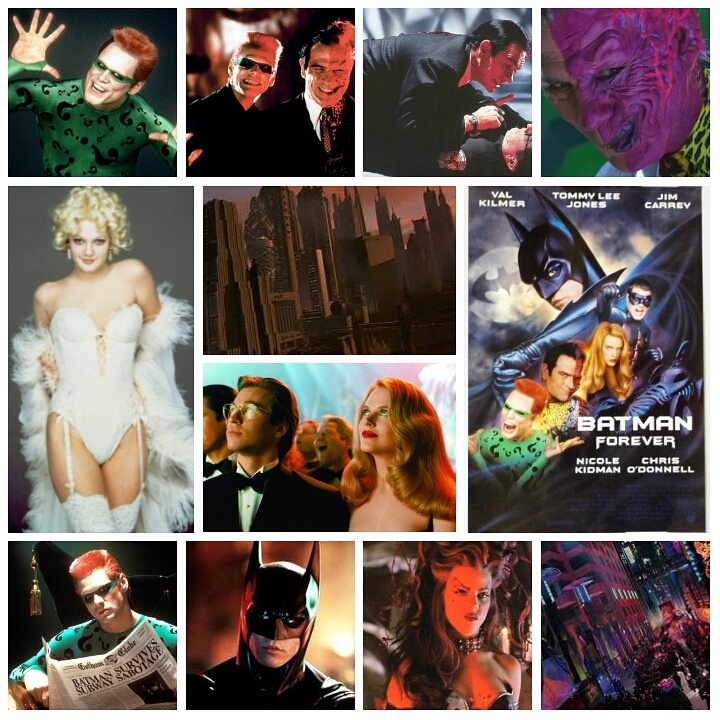
It’s true, Batman Forever is a silly, overblown, cartoonish riot of buffoonry.  But so what? It’s also awesome in it’s own way, and inhabits a certain corner of the Batman culture, the side of things that is rooted in camp and unhinged wonderment. Now, there’s an important and discernable difference between taking things far and taking things too far. That difference is delineated on one side by a willingness to be goofy, colorful and not take this superhero stuff too seriously. The other side of that of course is a disregard for limits, throwing every ridiculous line, costume and awkward scene into it you can imagine. I’m referring to Joel Schumacher’s followup to this, Batman & Robin. Everything that is weird, wonderful and extravagant about Forever just revved up to much in Robin, resulting in a piss poor typhoon of mania and over acting. Not to say that Forever doesn’t have over acting. Ohhhh boy is there over acting. Between Tommy Lee Jones and Jim Carrey, the thing is liable to give you epilipsy. But it somehow works despite its madness, a lucky stroke that Robin couldn’t have cared less about adhering to. Val Kilmer is the sedating antidote to Jones and Carrey, a remakably laid back Bats and a pretty solid casting choice, both as Brooding Bruce and Buttkicking Bats. Eternally broken up about the death of his patents, Bruce fights off Harvey Two Face Dent (Jones) in a garish, disarming Gotham City that resembles Mardi Gras in Dr. Seuss land. Jones’s Two Face is so far over the top, so rabid that it’s a wonder he didn’t give himself a bloody heart attack in the first take. Anyone who’s interested can read up on his performance, and how he pushed himself right to the heights of bombast in order to try and out-Carrey the Jim. Carrey, playing the Riddler, is a ball of twisted nerves himself, set loose on the wacky sets and basically given free reign to.. well.. go fucking nuts. It’s one of his most physical performances too, prancing around like a loon in green spandex that leaves nothing to the imagination. Aaron Eckhart’s Two Face may have had the edge for grit, but Jones has the rollicking clown version, and runs away to kookoo land with mannerisms that even call to mind The Joker in some scenes. The only thing I’ve seen him more hopped up in is Natural Born Killers, but shit man its hard to top his work in that. The story is all over the place, involving a nonsensical subplot with a mind control device, multiple elaborate set pieces, endless scenery chewing and the eventual arrival of Robin, played by Chris O’Donnell who is like the cinematic Buzz Killington. Michael Gough and Pat Hingle dutifully tag along as Alfred and Commissioner Gordon, both looking tired at this point. Debi Mazar and Drew Barrymore have amusing dual cameos as Two Face’s twin vixens, and Nicole Kidman does the slinky love interest shtick for Bruce as a sexy psychologist. Watch for an uncredited Ed Begley Jr. Too. There’s no denying the silliness, but one has to admit that the achievment in costume, production design and artistry are clear off the charts with this one, and visually it should be a legend in the franchise. Say what you will about it, I love the thing. 

ROBERT ALTMAN’S BREWSTER MCCLOUD — A REVIEW BY NICK CLEMENT

1

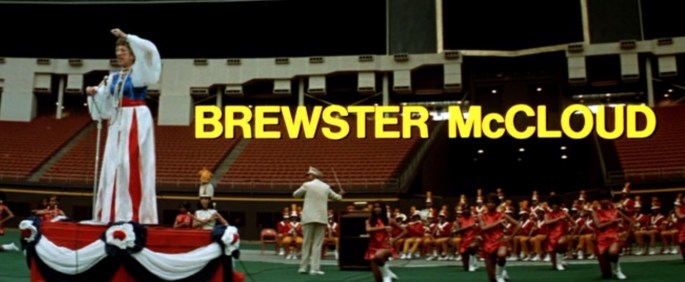
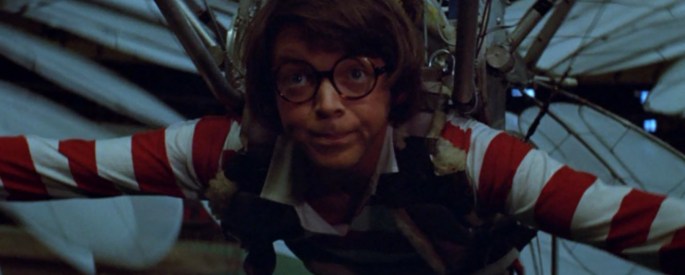
Absolutely one of the more peculiar and beguiling films that I can think of and absolutely the product of the 1970’s, and in particular, the fertile and restless mind of filmmaker Robert Altman, the strange and silly and all-together funky Brewster McCloud feels like a movie that was willed into existence by a group of very stoned people all looking to make one of the ultimate “How Did This Get Made” feature films. Released in 1970 and starring a pre-Harold and Maude Bud Cort as the bizarre titular character, the plot revolves around a possible lunatic living in the Houston Metrodome who is building a pair of mechanical wings in the hopes of taking flight. Right from the beginning when the MGM lion roar is replaced by René Auberjonois’ voice saying “I forgot the opening line,” you know you’re in for something weird and wacky.

2

And because Altman had just had a massive hit with M*A*S*H (his next film would be McCabe and Mrs. Miller), he was essentially allowed to make whatever film he wanted, and thankfully, his eccentric sense of humor and overall oddball leanings helped to birth Brewster McCloud with screenwriter Doran William Cannon and dual cinematographers Jordan Cronenweth and Lamar Boren. Mix in a serial killer plot, Michael Murphy as an obsessed cop, kooky Shelley Duvall as Cort’s possible love interest, sexy-strange Sally Kellerman, a crazy car chase, and one of the more surreal endings to a movie that I can think of, and you have the genuinely whacked-out Brewster McCloud, a film that could never get made today, or really, at any other point than when it was. Also, take special note of the various Wizard of Oz references scattered all throughout the picture.

3

TOKYO DRIFTER – A REVIEW BY J.D. LAFRANCE

641022096879472221-tokyo-drifter-neon-banner.full

Seijun Suzuki made his name in Japan with hard-boiled B-crime films during the 1950s. By the 1960s, he took traditional Yakuza stories and juxtaposed them with an extreme Andy Warhol-esque pop art look that gleefully pushed genre conventions. He started to break away from convention with Youth of the Beast (1963) and then fused the sensibilities of Samuel Fuller with the aesthetics of Douglas Sirk with Story of a Prostitute (1965). Tokyo Drifter (1966) is a film that eschews narrative logic for playful abstraction and the results are quite unlike anything at the time or since.

Tetsuya Hondo (Tetsuya Watari) is a Japanese gangster trying to lead an honest life as the syndicate he belonged to dissolved itself and went legit. The only problem is that they borrowed money from their rival – Yoshii – and now they’ve come to collect. In the film’s striking washed out black and white prologue, Tetsu is beaten up by the Yoshii syndicate when he refuses to work for them, which, as it turns out, is a test to see if he’s actually gone legit. Out of loyalty to his former bosses, Tetsu decides to help him pay off the debt that is owed. However, complications arise when yet another rival syndicate kills Yoshii and takes over collecting the debt.

Tokyo Drifter has a striking ‘60s pop art look with a nightclub’s walls saturated in purple; a scene with a singer accompanied by a piano in a yellow room and is visited by a man in a red suit, while phones in various rooms in various places are primary colors. These vivid contrasts in color, coupled with the hep jazz soundtrack, make for a very unusual gangster film. Suzuki uses color and composition of the widescreen frame masterfully, like how he places his actors in a given frame.

Tetsuya Watari’s Tetsu is the epitome of ‘60s mod culture cool with his stylish suits, good looks and fashionable existential angst. It also doesn’t hurt that he’s pretty good with a gun. The pop art style that influenced Tokyo Drifter can also be seen in films like Modesty Blaise (1966) and In Like Flint (1967) but Suzuki’s film fearlessly pushes genre conventions further than either of these examples as he experimented with color and composition to a fascinating degree.

Stephen King’s Firestarter: A Review by Nate Hill 

Film versions of Stephen King novels can be a tricky thing. Often they’re half assed,  clunky miniseries (ever tried to sit down and watch The Langoliers??), and when they’re given the lofty cinema treatment, he has famously turned his nose in the face of Kubrick’s might. I feel like Firestarter escaped unscathed, and still holds to this day, if a bit achingly retro now. It’s a thriller perceived in a childlike manner by its young protagonist, Charlie Mcgee (Drew Barrymore). Charlie can start fires with her mind, and certain shadowy agencies just can’t wait to get their hands on her. Her father (David Keith) once participated in some scary drug testing related to telekinesis back in the day, and some of whatever altered his DNA has been passed on to her. He will do anything to protect her, as the two frantically race across the country to safety, pursued by forces working for Hollister (Martin Sheen), a spook with too much power and nasty ideas about what to do with it. Also on their trail is pseudo spiritual whacko John Rainbird, who wants to absorb Charlie’s abilities, man what a freak. Rainbird is a native American in King’s novel, so white haired yankee boy Scott is an odd choice, but he does a fine job all the same. Two things are what makes this one really stand out in a special way. Tangerine Dream provides yet another ultrasonic, elemental synth score that has since become legendary. It accents the story in an almost fairy tale like way, gilding the danger with a fable style sound, but never stamping out the real menace. Barrymore is the other leg of the table, giving one hell of a fierce and vulnerable performance for such a young girl, her childlike honesty a prism for the audience to see the evil around her through innocent eyes. It’s great stuff, and one of the most solid King adaptations out there. Now there is a sequel (not sure if the man wrote a second book?) called Firestarter 2: Rekindled, which pales in comparison and runs about 45 minutes too long (!), but it’s worth a look for the casting of Marguerite Moreau as a grown up Charlie, Malcolm McDowell taking over from Scott as Rainbird, and Dennis Hopper as well. 

PTS Presents DIRECTOR’S CHAIR with DAVID MICKEY EVANS

DME POWERCAST

DMEPodcasting Them Softly is extremely excited to present a chat with special guest David Mickey Evans, the writer, director and the narrator’s voice of the heartwarming classic baseball movie THE SANDLOT, and writer/producer of the cult family classic RADIO FLYER.  He has contributed to the BEETHOVEN family movie series, and also wrote, directed and narrated THE SANDLOT 2.  His recent novel, THE KING OF PACOIMA, is a fascinating expansion on the RADIO FLYER universe he created, and really hits a lot of intense notes of emotional and personal reflection. His work has skillfully combined childhood magic with real world trauma, something that had been largely missing on screen since 1960’s era cinema, and he helped to break the mold of cliched cuteness that was inherent in family fare all throughout the 1980’s. He’s also a prolific script doctor on a wide variety of films, which is always an area of great fascination for us.  A true movie lover, Evans is a major baseball fan, so it was a lot of fun to pick his brain over his favorite big screen tales from the diamond. It was an honor to have David on the show, and we hope you all enjoy!
BEN AFFLECK’S THE TOWN — A REVIEW BY NICK CLEMENT

1

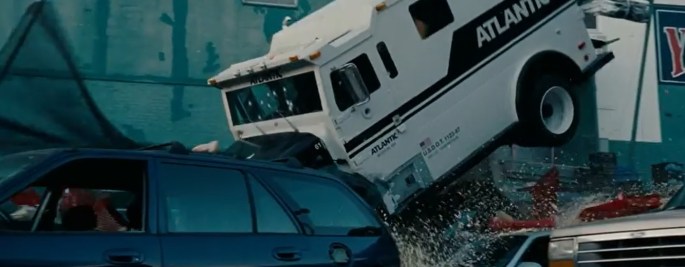
I am a huge fan of hot-blooded crime cinema, and one of the better recent genre entries is most definitely Ben Affleck’s high-voltage cops and robbers drama The Town, which proved that his extra-sharp directorial debut Gone Baby Gone was no fluke. Adapted with foul mouthed gusto and extra atmospheric flavor by screenwriters Peter Craig, Aaron Stockard, and Affleck from the Chuck Hogan novel Prince of Thieves, and directed by Affleck in minor-Michael Mann mode, this film became a big audience favorite in the fall of 2010, paving the way for Affleck’s Oscar-winning Argo a couple of years later. The action pivots on a group of dangerous but disciplined bank robbers led by Affleck, in what’s likely a career best performance, who operates a mostly solitary life, until he falls in love with one of his hostages that he takes during a daring mid-morning heist. Will he be able to call it quits with his criminal life, and is it possible for a good woman to love a bad man? It’s also got terrific action sequences and a dynamite car chase through the narrow streets of Boston that is genuinely hair-raising, furthering underscoring how truly rare it is to get a piece of R-rated, cracker-jack entertainment like this one that never insults intelligence levels at any point.

2

The deep supporting cast was absolutely incredible, with Jeremy Renner receiving an Oscar nomination for his pugnacious yet sympathetic work as Affleck’s volatile #1 buddy and partner in crime, Jon Hamm as a dogged FBI agent hot on their tail, and the sexy and sweet Rebecca Hall as Affleck’s somewhat reluctant love interest (what an amazing run of films she had with The Prestige, Frost Nixon, Vicky Christina Barcelona, Please Give, Red Riding 1974, Iron Man III, Closed Circuit, Everything Must Go, Transcendence, and most recently, The Gift). Filling the edges of the pulpy narrative are Blake Lively doing her best white-trash-hot routine as Affleck’s townie plaything, Chris Cooper, Titus Welliver, Victor Garber, and a scene-stealing Pete Postlethwaite as a local crime boss with a penchant for flowers. Affleck has released two different director’s cuts which are even more expansive with the character beats and various arcs and which feature darker endings, while all versions of the film showcase Robert Elswit’s ground-level yet totally electrifying camerawork, especially during the extra-loud and intense shoot-outs, which certainly tip their hat to Mann’s benchmark masterpiece Heat. Originally developed as a directing project for Adrian Lyne, the film was shot on location in Boston, and became a sizable box office hit around the world. This is a very satisfying piece of work in all respects.

3

Best Men: A Review by Nate Hill 


Best Men is the most charming, dainty and innocuous movie about bank robbing that you’ll ever see. It’s premise revolves around a wedding party that unwittingly gets roped into a heist, but they’re all solid folks, including the perpetrator, and all just want the best for the happy couple they are celebrating for. Therein lies both the comedic and the touching moments, of which there are many, supplied by a diverse and very capable cast. A troupe of best men accompany a groom (Luke Wilson) on the way to his matrimonial bliss. One among them is a hotheaded adrenaline junkie named Billy (Sean Patrick Flanery, never more adorable). Billy has knack for robbing banks whilst reciting Shakespeare. Demands, commands, profanities. All in the Bard’s tongue. He brazenly holds up a rural branch and drags his friends in, including two others, an ex military stud (Dean Cain) and a squirrelly, pussy whipped Andy Dick. They soon find themselves trapped in the bank with law enforcement prepping a siege outside their front door and Wilson’s determined Bridezilla (a feisty Drew Barrymore) marching straight into the crime scene to furiously give her fiancé what for. Billy also has severe daddy issues, which probably led to him lashing out in such a theatrical fashion in the first place. Coincidentally, the local sheriff (Fred Ward) happens to be his Poppa, and the two face off in scenes which undermine the lighter tone and dig for pathos that’s worth pausing for. They’re threatened by a gung ho FBI agent (Raymond J. Barry) who wants to blow them to kingdom come so he can go to lunch. They also find themselves sequestered in the bank with a sketchy Viet nam vet played by a wicked funny Brad Dourif in quite the commanding little supporting turn. Amid the screwball roughhousing, him and Cain find a few aching moments of truth relating to Cain’s sexual orientation, and his shame regarding it. I love a light, harebrained comedy, but I love em even more when they take deep breaths between fits of lunacy to gift their characters with some gravity that makes you feel something besides your sides splitting. This ones sadly forgotten, and you should all give it a go, it’s a gem.