“I am very sure that’s the man who shot me.”: Zodiac 10 years later – by Josh Hains

The idea of offering up a defence for David Fincher’s Zodiac seems rather silly given that ten years later it’s widely regarded as perhaps Fincher’s greatest film, often revered as one of the finer films released over the past decade. We all know it’s great, though admittedly, I didn’t know that for several years.

I avoided Zodiac like it was coated in radioactive slime until 2014. I had heard a great deal of positive things about the movie, and had been greatly intrigued by the marketing behind it, but the knowledge that not only was it was a long, slow paced movie, but also a rather unsettling one too kept me away for so long. When I did finally give it a chance late September 2014, my mind immediately gravitated toward Google, scouring through page after page of information about the investigation in an attempt to better understand the finer details of the case, and come to my own conclusions about who the Zodiac killer may have been. My gut however, felt like I’d eaten a bad take out meal, disturbed, shaken, and stupidly hungry for more. I felt like how I imagined Robert Graysmith felt all those years ago, minus the fear, paranoia, and impending danger of course.

That David Fincher populated Zodiac with such a great cast is a marking of a great director who knows how to compile actors who will treat the characters as individuals and not just caricatures. I find it intriguing and perhaps even ironic, or merely coincidental, that Jake Gyllenhaal starred in last year’s underrated thriller Nocturnal Animals, given that in Zodiac he is essentially one. His Robert Graysmith is a nocturnal animal, an increasingly gaunt, wide eyed mouse sniffing around for a piece of cheese, in this case the next tangible clue or lead worth obsessively investigating. And it’s all thanks to his unshakeable love for puzzles, a factor that helps decode the first Zodiac letter. As he digs deeper into the case, we come to fear for his safety, in particular during a genuinely white knuckling scene in which the unarmed and unimposing Graysmith ventures into the basement of someone we begin to assume might put an abrupt end to Graysmith’s life.

Before the blockbuster splash that was Iron Man in 2008 thundered into the film scene, one could have argued that Robert Downey Jr.’s performance as the San Francisco Chronicle reporter Paul Avery was the best he’d ever given. An argument can be made that while he was seemingly born to play the billionaire tycoon and saviour of the planet Tony Stark, his best work still resides in the fractured Avery. The deeper the investigation gets the further Avery seems to slip from cool as a cucumber journalist to a paranoid, spineless slob.

Prior to his self induced exile on a houseboat, I got a kick out of the scene where he joins Graysmith (Jake Gyllenhaal) for drinks at a populated watering hole, chugging back those luminous bright blue Aqua Velvas while rambling about the case and their personal lives. There’s a great sense of both humour and humanity in that scene, as Avery lets his guard down and actually engages with someone beyond a superficial relationship, while Graysmith sheds his mouse-like internalized mannerisms in favour of energetic, loud behaviour, though briefly. From this point forward however, Graysmith has a spine, albeit a rather loosely fitting one, and Avery has seemingly lost his, donning “I am not Paul Avery” buttons in the hopes of fending off potential threats. He’d have made a wonderful Doc Sportello.

And of course, there’s San Francisco detective Dave Toschi played with a real sense of respectable authority by Mark Ruffalo. Toschi, an Animal Cracker snacking family man, and the inspiration behind both Steve McQueen’s preferred method of wearing his service revolver in Bullitt, and Dirty Harry’s iconic law breaking detective Harry Callahan, can’t seem to figure out how to put the pieces together in the Zodiac case, understandable in light of the overwhelming amount of contradictory information at hand. Under Fincher’s direction, Ruffalo portrays Toschi as a driven yet logically minded detective. He remains dedicated for years to catching the Zodiac, but lacks the desperation and paranoia Graysmith possesses. Instead, Toschi approaches every aspect of the case with the kind of logical thinking and reasoning every detective should be in possession of, following procedure by the book, and generally doing everything he can to crack the case until the psychological burden becomes far to heavy to bear. You can see how heavy sits in his mind by Ruffalo’s subtle body language in later parts of the movie, and you soon feel sorry for the guy.

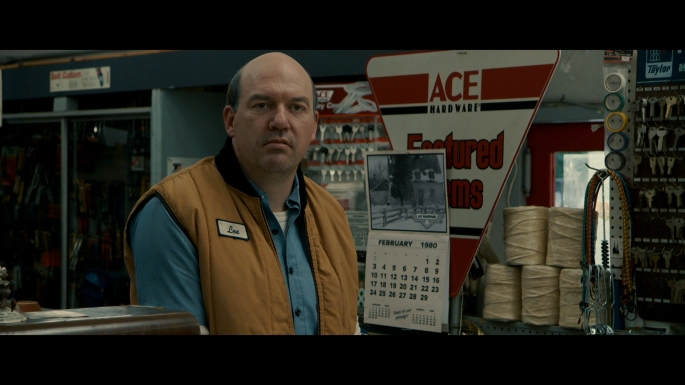
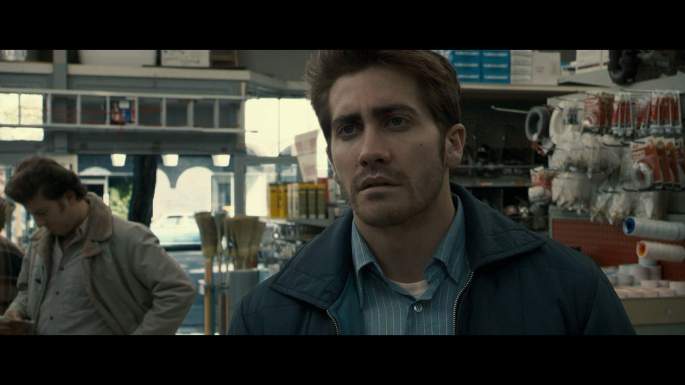
Near the end of the film, Graysmith declares “I need to stand there, I need to look him in the eye and I need to know that it’s him.”, desperate to prove that Arthur Leigh Allen (John Carroll Lynch; perfectly unnerving and subtle) is indeed the cold blooded killer. He gets his wish a short time later when he encounters Allen at an Ace Hardware store in Vallejo where Allen works as a clerk. Allen offers his assistance to Graysmith with a polite “Can I help you?”, Graysmith responds with a “No.”, the two men simply staring at one another until Graysmith leaves, Allen thrown off by Graysmith, and Graysmith appearing much more certain that Allens is the man they’re after. The movie moves forward eight years to when Mike Mageau, survivor of the Zodiac killer at the start of the film, meets with authorities to potentially identify the Zodiac killer, positively identifying Arthur Leigh Allen as the man who shot him and killed Darlene Ferrin. While many had their suspicions and some evidence pointed in his direction, Allen died in 1992 before he could be questioned. Not that he would have confessed anyway.

Admittedly, I have intentionally left out many details and characters, with no disrespect intended, and it should be said that every actor involved in this film, from the leading performances to the smallest of cameos (for exmaple, Ione Skye of Say Anything as Kathleen Johns, a woman who was threatened in her car by the Zodiac killer), give world class performances, some even the best of their careers to date. And the script by James Vanderbilt, based on books by Robert Graysmith, is an achievement of impeccable research and respect for the case. And the cinematography  by the late Harris Savides is bar none the greatest work the man had ever crafted, richly capturing everything with immaculate detail, from the lush valleys of California and its busy, inviting cities and streets, to the Aqua Vera drinks, to beams of red light emanating from police cars. He painted a gorgeous picture for us to gawk at for years to come.

Ten years later, I find it astonishing that Zodiac never truly ends like other movies do. Most movies tie up every loose thread with a ribbon to go with it, others leave room for potential sequels. You can’t end a movie when their is no resolution in reality, forcing a tacked on Hollywood ending wouldn’t sit right with anyone in possession of a brain. You can only leave the audience with the next best thing, the assurance of a living Zodiac victim that the man in the picture they’re pointing to is indeed the man who shot him. That Fincher was bold enough to choose this manner of ending his film shows us he’s a director capable of unsettling viewers long after the film ends, without needing to manipulate his audience or present alternative facts. Zodiac is a bona fide masterpiece, the crime film equivalent to All The President’s Men, and just as good too.
11415612_862880327137375_6688093266983067936_o

Morgan: A Review by Nate Hill


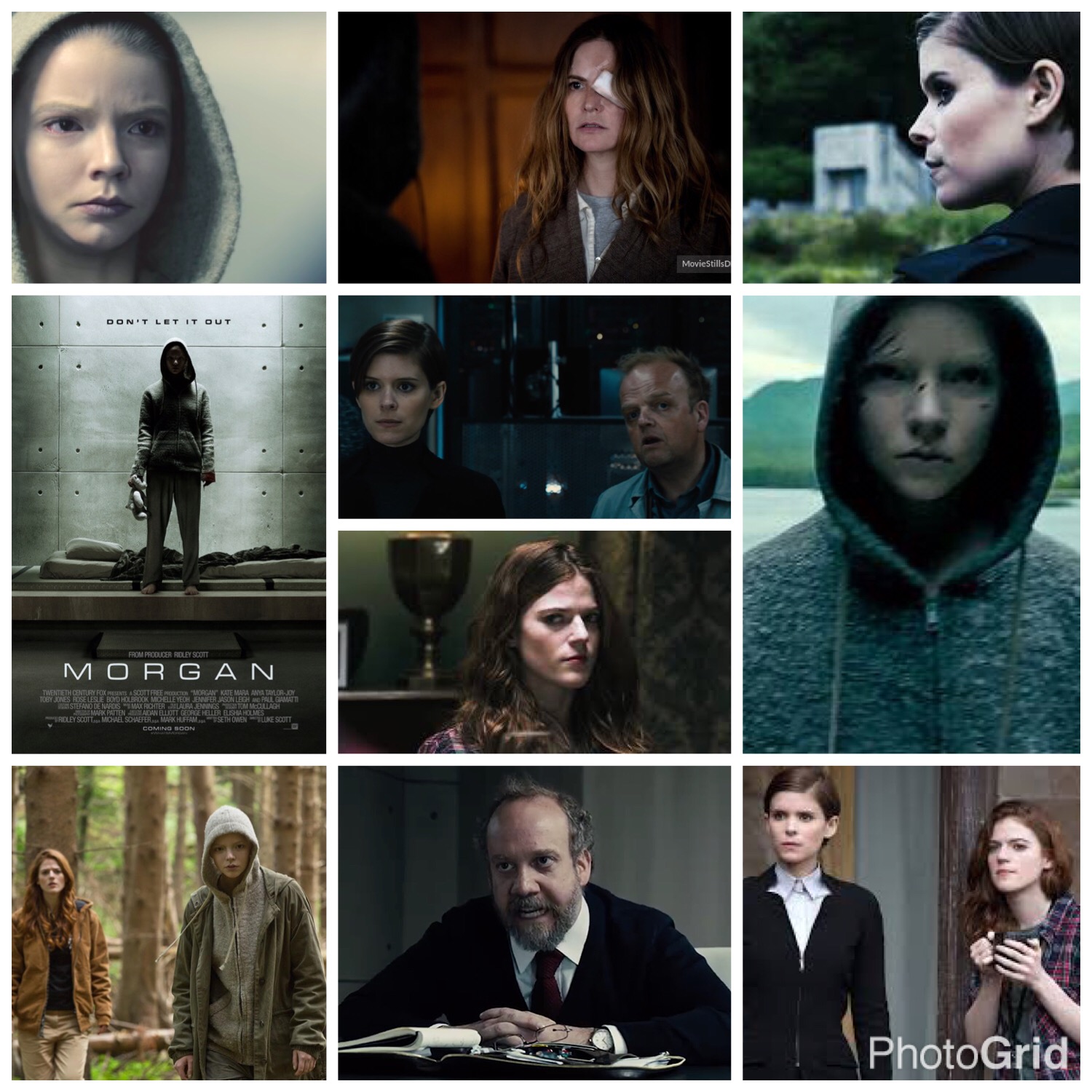
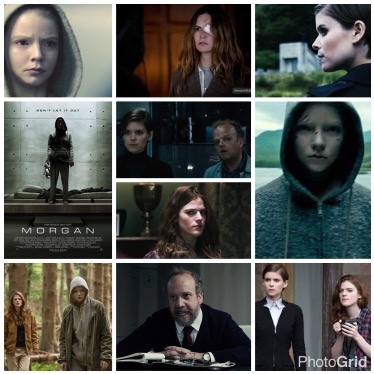
Morgan is one of the slickest genre flicks I’ve seen in recent years, finely tuned like a barbed wire tightrope, full of nasty surprises, throat ripping action and that ever present ethical turmoil that hangs about in any films that deal with artificial humanoid beings. It’s only weakness is exactly that stylistic strength: it’s so tight and streamlined that one occasionally feels like the scales tip in the favour of style over substance, but it’s a minor quibble when you take a step back and look at just how entertaining and fired up this piece is. The filmmakers are minimally concerned with the moral grey areas that cloning wades into, and subsequent philosophical pondering, but more than anything they just want to pull the ripcord and blast full throttle into an adrenaline soaked, R-rated sci-if tale with vague aspects of a character study. The title refers to Morgan (The Witch’s Anya Taylor-Joy in a performance both terrifying and heartbreaking), a genetically engineered humanoid girl held at a secluded facility alongside researchers, one of which she has just had a violent incident with. The corporate honcho (Brian Cox in a sly, all too brief honcho) dispatches a cold, clinical asset in the form of Kate Mara, sent to assess the situation and implement any measures necessary. She is an outsider, a callous bicep who flexes at the whims of the company. The researchers and handlers, however, are not. They have grown up around Morgan, invested time and, somewhat unwisely, emotion into her and will stop at nothing to ensure her survival. Paternal Toby Jones, opinionated Jennifer Jason Leigh and compassionate Rose Leslie prove to be a formidable armada against Mara’s evaluation, and tensions arise. Morgan has her own cloudy agenda though, and whether by flawed design, ghost in the shell syndrome or pure survival instinct, proves to be the greatest danger of all. She experiences people at their best, worst and most enigmatic, and her startling behaviour is a reflection of all of it, and a sobering example of humanity’s pitiful inability to perfect the creation of artificial life, at least in this film’s universe anyway. From Mara’s threatening presence, to an intense evaluation from a particularly nasty psychiatrist (Paul Giamatti overacting so hard he almost sucks the set dec up into his orbit), it’s no wonder Morgan snaps. Now when she snaps, the film more or less whips all its chips on the table, flips said table and hulk slams it two floors down. All subtlety and thought provocation kind of get left in the dust as everything careens towards an especially visceral climax, and that’s okay, as long as it doesn’t leave you feeling underwhelmed. I kind of had the intuition it was going to take the rambunctious root overall, and took comfort in the fact that it at least somewhat focused on the delicate aspects earlier on. It’s a well oiled machine, impeccably casted, given just enough pathos to keep our sentimental sides invested, and more than enough visceral hullabaloo to get our pulses dancing, all set to a score both thundering and graceful. Great stuff. 

“What happened to you?”A review of The Autopsy of Jane Doe by Josh Hains

The R rating description for the Autopsy of Jane Doe reads “bloody horror violence, unsettling grisly images, graphic nudity, and language”, a misleading description that may give future viewers the impression they’re in for a hearty gore fest. I thought I might be in for a suspenseful slasher, something akin to a cross between Don’t Breathe (another great horror entry from 2016) and The Ring, but with a greater focus on gory splatter. I wasn’t disappointed per se, but the graphic qualities of this movie don’t unfold the way you might expect them to, which admittedly caught me off guard yet pleasantly surprised me.

Without giving anything away (as this is a spoiler free review), I can tell you that this particular horror movie actually shows barely any on-screen violence. In fact, the bulk of the “bloody horror violence” actually comes in the form of the autopsy itself, which doesn’t shy away from giving viewers prolonged sequences of dissection, which plays directly into the “unsettling grisly images” of the rating description. Think of any CSI: Crime Scene Investigation autopsy scene, but make it run for an hour and twenty six minutes. The graphic nudity doesn’t come from an impromptu sex sequence, but from Jane Doe’s seemingly lifeless corpse laying nude on the cold steel table. It’s nothing exploitive or fetishized, just protocol when examining a dead person for cause of death. And as far as the language portion of the description is concerned, you might find more profanity in one scene in Planes, Trains, and Automobiles than in the entirety of this film, not that it’s a bad thing.

The movie introduces us to a gruesome multiple murder scene where a nameless nude young woman is found buried in the sands of the house’s basement floor and whisked off to the mortuary run by Tommy (Brian Cox) and Austin Tilden (Emile Hirsch), a father-son coroner duo, given until the early morning hours to find Jane Doe’s cause of death for the sheriff. Austin has plans with his girlfriend for the night, but once Jane Doe shows up, he feels compelled to stick around and assist Tommy, despite his girlfriend’s immediate unhappiness with being ditched yet again. Jane Doe’s is an extremely odd case for the duo, her entire outer body in perfect condition but her insides boasting a series of horrifying injuries including broken ankles and wrists. With how she died becoming a more frightening answer with every new internal injury discovered, the autopsy draws on, and as an unseen storm outside increases in its catastrophic potential (as heard via a radio that provides comfort music) several unexplainable supernatural occurrences begin to manifest, eventually trapping the duo in the mortuary and threatening to terrorize them all through the cliche dark and stormy night.

Early exchanges of dialogue between father and son, both personal and professional, as well as the blatant chemistry between the two actors, illustrate a believable history and relationship between the characters. You could change Hirsch’s last name to Cox and never doubt for a second that he is indeed Cox’s son, and it’s that believability that elevates the material from standard issue to fare to something special and unique. Both actors bring their A-game, and are not just convincing as family but also as coroners, the technical jargon adding another layer of authenticity and believability to the film. Your eyes and ears might be drawn to Cox more than Hirsch, as Cox has so often been a magnetic scene stealer everything from Manhunter to Braveheart to Red, but don’t underestimate Hirsch’s nuanced work here; this is his finest hour since Into The Wild.

For his first foray into American cinema, director André Øvredal (Trollhunters) does a splendid job of crafting a movie that contains characters we believe in and come to care for, all the while gradually among up the suspense as the movie unfolds. It’s always a delight when a movie sets up an intriguing premise while simultaneously providing characters worth watching, and not just the usual dumb victims.

The first hour of The Autopsy of Jane Doe is both interesting and totally suspenseful, but sadly the movie becomes a less interesting (yet still suspenseful) endeavour as more information about the titular Jane Doe is revealed. You’ll stick around to find out the fates of the characters, but after a third act exposition dumping of information about Jane Doe that lacks the subtlety of the scenes that precede it, the plot stops dead in its tracks: there is no plot left to tell. Once that information comes to light, the focus of the movie shifts to the survival of the characters against the overwhelmingly horrifying odds and lacks the surprise and intrigue of earlier scenes. I still found myself deeply involved, but not necessarily surprised or shocked by the revelations. This misstep by no means makes Jane Doe a bad movie, just underwhelming. 

Regardless of how I might feel about the third act reveals, I have to admit I still really enjoyed watching the movie right up until the final frames snapped to black. I especially enjoyed the relationship between Tommy and Austin, and even appreciated the brief but effective appearances of the girlfriend Emma (Ophelia Lovibond) who thankfully didn’t feel like a cliche and more like a real breathing human. I also appreciated the technical jargon and the extensive look at the practice of being a coroner and conducting an autopsy. It’s grisly stuff, sure to make even some of the most hardcore gore hounds’ stomachs churn, but in the context of the movie and its unique premise, makes complete sense and doesn’t feel like shoehorned gratuitous gore. The Autopsy of Jane Doe isn’t a perfect horror movie, a tall order these days, but it’s still a great and unique entry into a genre in need of a little spicing up. Somehow, despite the underwhelming feeling I got from the third act, I found the ending oddly satisfactory albeit predictable and not at all surprising. It works, like a knife through butter. If you’re in the mood for a good horror movie, open up your heart to The Autopsy of Jane Doe. You just might thank me after the sun shines in.

Episode 32: 30th Anniversary of Michael Mann’s MANHUNTER with Special Guest Charles de Lauzirika

episode-32

charlie
Photo by Carlee Baker.
This year marks the 30th anniversary of Frank’s all time favorite film, Michael Mann’s MANHUNTER.  Frank is joined with returning guest, Charles de Lauzirika who produced Ridley Scott’s home video releases of everything from BLADE RUNNER to THE COUNSELOR to THE MARTIAN and the ALIEN QUADRILOGY.  Everyone who owns the ALIEN QUADRILOGY and the silver BLADE RUNNER briefcase, thank Charlie he was a producer and consultant on it, from the packaging to the menu navigation, supplements.  Anyway, Frank and Charlie gush about their love for MANHUNTER, and speak about the other films, novels, the HANNIBAL TV show, and the Shout Factory MANHUNTER release.  Please check out our previous chat with Charlie here.


Red 2: A Review by Nate Hill 

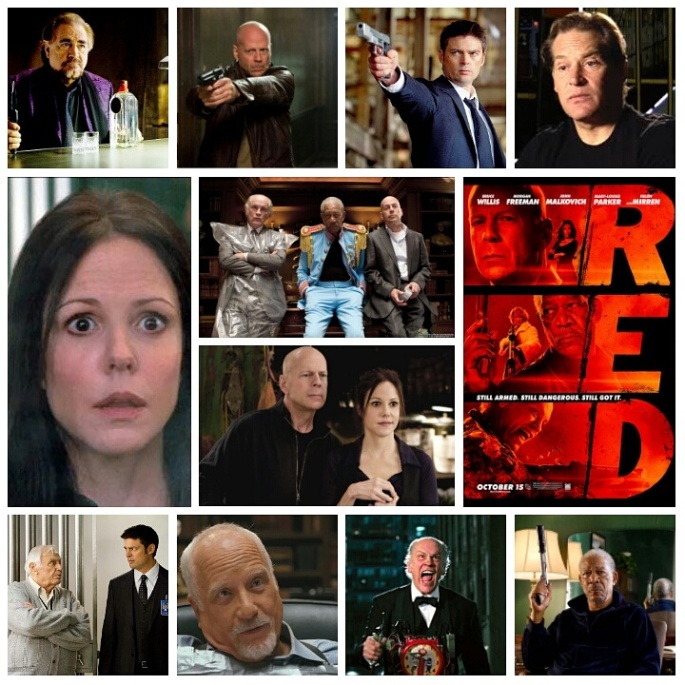
More of the same, baby. That’s a good thing in this case as we rejoin ex assassin Frank Moses (Bruce Willis) and his merry band of morons for another set of high caliber swashbuckling, this one even sillier than their first picnic. The key is in the deadpan humour, which is served up with all the relish needed to make something so fluffy work. Most of the eclectic cast is back for second helpings, and the ones who caught bullets are replaced by even more bankable names and familiar faces here. Moses, his girlfriend (Mary Louise Parker, finally aquiring her sea legs when it comes to warming up to the carnage) and loony old friend Marvin (John Malkovich) find themselves thrown headlong into an arms race to find a deadly super weapon before it’s either detonated or aquired by very dangerous people. Leading them along is a frazzled ex MI6 spook and mathematical genius (Anthony Hopkins in silly mode) who has seriously lost his marbles. On their tail is scary CIA psychopath Jack Horton (Neal McDonough nails yet another heinous villain role) who brandishes his silenced pistol with the same verve he uses to flash that icy grin, the last thing you see before the shooting starts. Helen Mirren returns, as does her beau, played again by Brian Cox and his teddy bear worthy russian accent. Other newcomers include Korean superstar Byung-Hun Lee as an agile and pissed off assassin out to get Moses, Catherine Zeta Jones as a foxy russian femme fatale and Professor Lupin himself David Thewlis as a snooty arms dealer called The Frog, but not for te reasons you might think. When actors of such skill and notoriety show up in these, it really makes everything else worth it, even if the plot is somewhat up in the clouds, and the mad das, rat race tone can get a bit too loopy. These pros always keep it grounded when they need to, both with shooting and acting prowess. This one can’t quite keep up with how much fun it’s predecessor was, but it’s certainly more than adequate, especially to see Hopkins, a man of trademark gravitas, give an out of left field (and his mind, really) turn worthy of Jim Carrey and not without a few disarming third act surprises.

Red: A Review by Nate Hill 

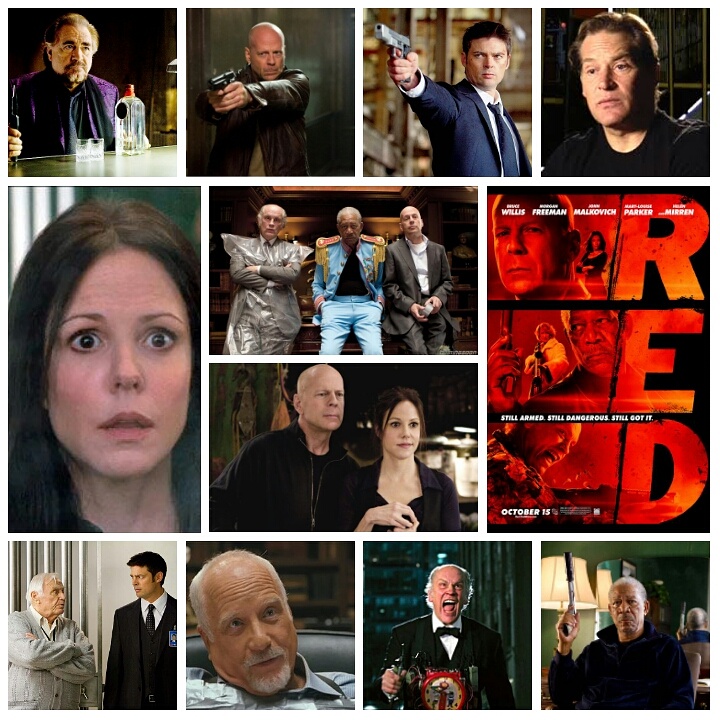
Despite being somewhat neutered by the ever present annoyance of the PG-13 rating, Red is some of the most fun you can have with in the glib assassin subgenre of action comedy. Bold, hilarious and just a little bit demented, it jumps right off the pages of the graphic novel it was based on for just under two hours of wiseass popcorn movie nirvana, hosted by a cast that’s almost too good to be true. ‘RED’ stands for ‘Retired Extremely Dangerous’, a moniker given to aging ex contract killers who have laid down the guns, but are still closely watched by the CIA. Frank Moses (Bruce Willis) is one such person, languishing in the doldrums of forced retirement, bored out of his mind and chatting endlessly with a cutey call center girl (Mary Louise Parker). Things get freaky when deranged former associate Marvin Boggs (John Malkovich) pays him a visit, belting out wild theories about the CIA sending operatives to terminate him. Before he knows it, Frank is swept up in espionage and intrigue once again, pursued by a slick, ruthless agency man (a deadly Karl Urban doing the anti-007 shtick nicely), with Parker in tow, whose terrified reactions to the escalating violence and deadpan sociopaths around her get funnier and funnier as the film progresses. Helen Mirren is regal gold as a well spoken ex MI6 spook who dissolves corpses in bathtubs full of acid, right before afternoon tea, I presume. Watching this dainty waif rock a Barrett 50 caliber and make red mist out of her enemies is one of the many mental pleasures one can get from this flick. Morgan Freeman takes it easy as another former buddy of theirs from the older, and I imagine, more agile days. As for the supporting cast, hell, take your pick. Richard Dreyfuss is a slimy Trump-esque politician lowlife, an underused James Remar shows up for a very brief cameo, as does that old toad Ernest Borgnine, Julian McMahon once again shows that no one wears a suit like Julian McMahan, and that lovable imp Brian Cox almost walks away with the film as a sly devil of a Russian agent who woos Mirren with the silver tongued virility of a fox. What works so well the dynamic between the three leads; Malkovich is mad as as hatter, Willis plays exasperated babysitter and Parker looks on in horror that starts to turn into amusement with every outlandish scenario. Action comedies are tricky recipes, and it’s easy to let too much of one ingredient slip into the pot. This one keeps a steady trigger finger that’s locked onto the funny bone and positively sails. 

The Bourne Supremacy: A Review by Nate Hill


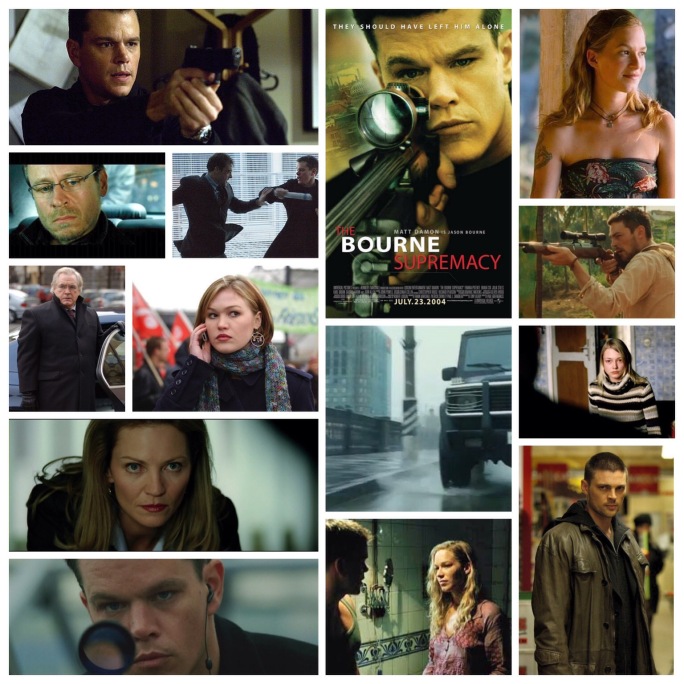
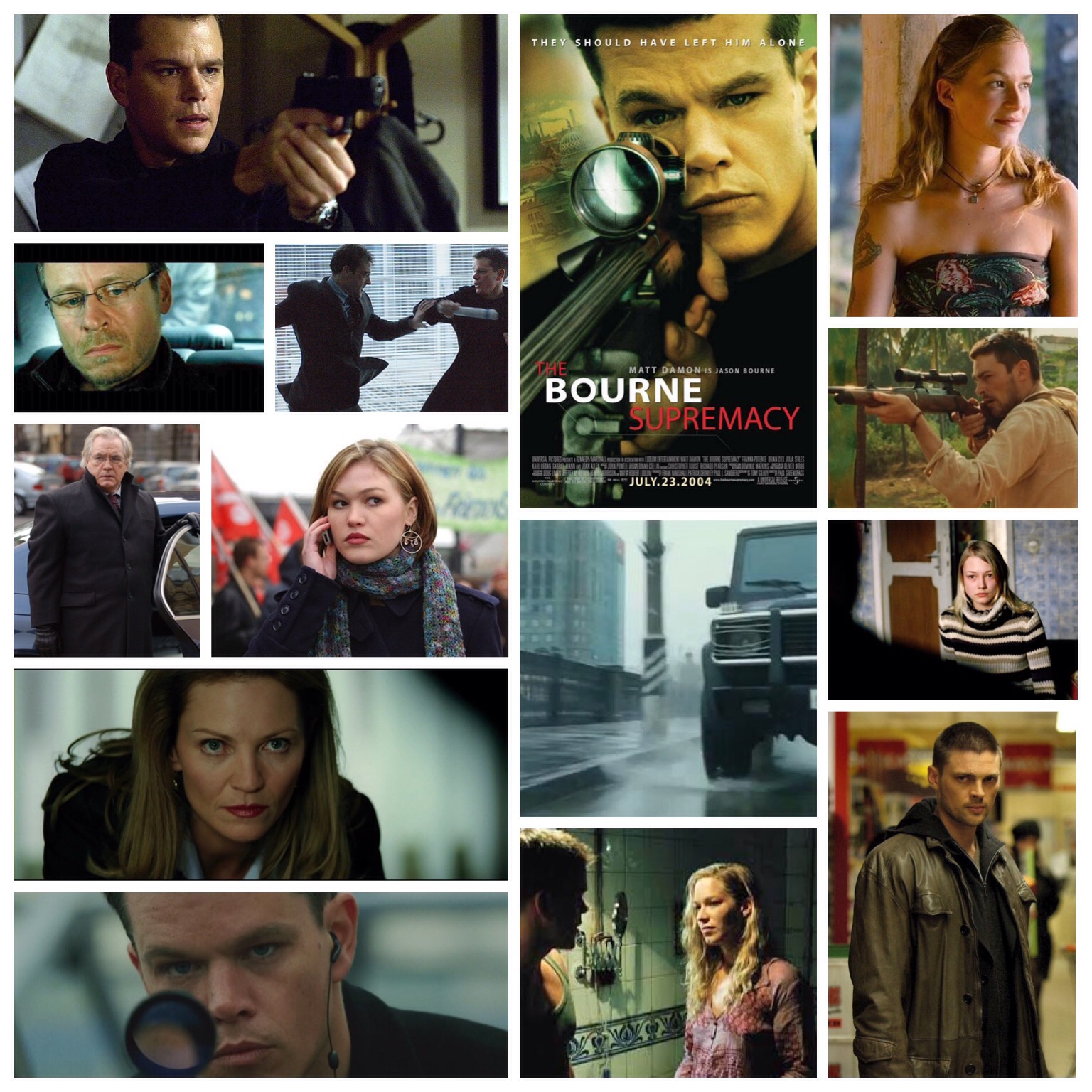
It’s nearly impossible for me to pick a favourite from the original Bourne trilogy, but I suppose if you held a gun to my head I would have to go for the breathless, breakneck Bourne Supremacy. It’s the first one I ever saw and one of the very first big summer movie experiences of my youth, so I have a burning nostalgia. I wouldn’t base my decision solely on that, though. No, I’ve thought a lot about it, and Supremacy just has every element in pitch perfect place, every second of pacing hurtling by on full throttle and Matt Damon taking names like he never did before. I love the fact that Bourne has something driving him other than a need to know who and what he is this time around. He has revenge for the death of someone he loved, which is never something you want to provoke when you have someone like him gunning for you. Life is quiet for Jason and Marie (Franka Potente 😍) for about five seconds at the beginning of the film, until a highly skilled assassin (a capable, relentless Karl Urban) explodes into their lives, sends their jeep careening off a bridge, resulting in Marie’s death. This pisses Jason off and then some, prompting a global excursion to find out who Urban works for and take them down. Also on his trail is CIA bigwig Pamela Landy (Joan Allen, excellent) and the severely morally misguided Ward Abbott (Brian Cox takes slimy to a whole new level in this outing). There’s also scheming Russian oil magnate Gretkov (a relaxed Karel Roden) with his own reasons for wanting Bourne. As is always the case, Jason is the smartest guy in the room, more so even than those that trained him, and he out thinks, out shoots and outruns them all every step of the way that takes him nearer to his goal. He isn’t simply running scared and confused with no outlet or idea how to use his talents anymore. He’s a lethal asset with emotion and forethought on his side, and he takes no prisoners. Damon is just ridiculously badass, especially in the several furious hand to hand combat scenes he dances through, doling out the smackdown faster than anyone’s reflexes can react. There’s also a humanity to him, burgeoning regret when he learns what Treadstone made him do, and the yearning to set it right, or at least make himself known to the daughter (Oksana Akinshina) of a Russian couple he once murdered. People complain about all the shaky cam, but whatever man, it sure fires up an action sequence and places you right there amid the mayhem of a rattling jeep chase through a Berlin tunnel, a bone splintering man to man with an ex Treadstone operative (Marton Csokas) and more. Julia Stiles is terrifically intense as a girl who used to do the psych evaluations for agents, Chris Cooper briefly returns as Conklin, the devious founder of the program, and watch for Tomas Arana, Corey Johnson, Gabriel Mann and Michelle Monaghan too. Like I said it’s a tricky task to pick a favourite, and on any given day I’d just say I love all three equally. This one just has a bit of an edge on the others in certain spots, and never feels like it bears the curse of the middle chapter. It’s a tightly wound coil of a film that springs into kinetic motion with the force of a piston. I’m curious to see how the new Bourne flick does, but I doubt it’ll come close to the first three, let alone this platinum classic. Cue Moby’s Extreme Ways to play out my review. 

THE BOURNE SUPREMACY – A REVIEW BY J.D. LAFRANCE

bourne1

After the grueling experience that was making The Bourne Identity (2002), Matt Damon was understandably wary about reprising the role of Jason Bourne. However, the film’s substantial box office success meant that the studio was eager to crank out a sequel and brought their leading man back into the fold with the promise of a new director after Doug Liman managed to alienate almost everyone on the first film. Paul Greengrass, director of the critically-acclaimed Bloody Sunday (2002) came on board, taking up where Liman left off by adopting the same loose, hand-held camerawork and cranking up the intensity, especially with the action sequences, to the detriment of some that felt the herky-jerky movements resulted in motion sickness. Regardless, The Bourne Supremacy (2004) was a hit both critically and commercially, outperforming Identity.

Bourne (Damon) and Marie (Franka Potente) have gone off the grid by taking refuge in India and this gives him time to sort through his fragmented memories and feverish nightmares. But, as is always the case with these kinds of films, our hero can’t stay hidden for long and trouble finds him. Meanwhile, a top-secret government deal in Berlin goes bad. Two agents are assassinated by Russian bad guys who steal $3 million and files that pertain to the whereabouts of Bourne. Greengrass ups the stakes right from the get-go as he has Bourne framed for the agents’ deaths and the stolen money and has an assassin (Karl Urban) track him and Marie down. An exciting car chase ensues that leaves Bourne alone and putting on him on the run again. This makes him dangerous as he has nothing holding him back so he can focus entirely on finding out who wants him dead and sift through the remnants of Operation Treadstone from the first film.

One of the first things that becomes obvious while watching this film is how its look harkens back to 1970s American cinema. Director Paul Greengrass utilizes the gritty, realistic look of his previous film, the powerful Bloody Sunday, with a lot of hand-held camerawork and snap zooms to give a you-are-there rush of adrenaline and urgency to the action sequences. In the car chases, Greengrass often places the camera right in the vehicle so that it is almost like we are riding along with Bourne, trying to piece together his fragmented past. In particular, the first chase in India is like The French Connection (1971) by way of Calcutta. Tony Gilroy’s screenplay wastes no time getting into it. We’re not 15 minutes into the film and Bourne is being chased by a mysterious and ruthless Russian assassin. It is this intense, no-nonsense pacing that propels this film so that one barely notices the two-hour running time.

Matt Damon plays Bourne with a quiet determination and intensity. It’s a surprisingly minimalist performance devoid of self-conscious tics and proves that his performance in the first Bourne film was no fluke. Bourne is not some invincible, super-soldier, but a tortured man trying to rebuild his past and his identity. He doesn’t kill unless absolutely forced to. And yet, he is certainly a man of action, capable of going from an inert, passive figure to one full of explosive action in a heartbeat. Supremacy sheds more light on his past as he’s haunted by a job where he killed a Russian politician and his wife. Damon does a nice job of portraying a man coming to terms with the fact that he is a killer. Bourne also comes to terms with the notion that what was just another mission for him forever changed the life of a young woman who was made an orphan because he killed her parents. It is an important part of the humanizing of Bourne as he sheds his past of being a detached assassin to someone trying to redeem himself. He tracks down people like Nicky Parsons (Julia Stiles), introduced in Identity as a handler to the Treadstone assassins, that can provide him with pieces of his past so that he confronts it and understand what he was in order to change who he is in the present.

The primary bone of contention that critics had with The Bourne Supremacy was how Greengrass films the action sequences. There is an impressively staged fight scene between Bourne and another Operation Treadstone survivor in Munich that is dizzyingly claustrophobic thanks to extensive hand-held camerawork that dives right into the chaos. It is memorable not only for its jarring brutality but also for Bourne’s skill with a rolled-up magazine that he uses to defend himself against a rather large knife. Greengrass’ camera flies around the tight confines of this room, dragging us along for this visceral, almost primal sequence. He treads a fine line between being edgy and incoherent, but knows just how far to push it – something that the countless imitators didn’t always achieve. This approach drew criticism for being too fragmented and disorienting, making it difficult to see what was happening but I think it was Greengrass’ attempt to put the audience right in the middle of the action and to experience the sudden and brutal nature of how quickly these guys fight.

bourne2Joan Allen’s Pamela Landy is an interesting character in that initially it appears as if she will be an antagonist like Conklin in The Bourne Identity, but when she’s assigned to investigate the Berlin job she uncovers the existence of Treadstone and this brings her up against Ward Abbott (Brian Cox), the operation’s caretaker and the man who also mothballed it. She’s no dummy and quickly figures out its nature, what Conklin was up to and Bourne’s role, which, in a nicely executed scene, quickly recaps the events of Identity for those who haven’t seen it. Over the course of Supremacy, she shows indications of sympathy towards Bourne’s plight that are developed further in The Bourne Ultimatum (2007). Allen’s scenes with Cox are interesting as they are often fused with tension as Landy uncovers the secrets of Treadstone while Abbott, clearly uncomfortable with his dirty laundry being aired, tries to cover his ass, which makes for some heated exchanges between the two as they butt heads.

The Bourne Supremacy gives more screen-time to the character of Nicky Parsons. Landy brings her along because of what she knows, but Nicky ends up playing a crucial role when Bourne confronts her, asking questions about the operation. Stiles was an up and coming movie star in the late 1990s with films like 10 Things I Hate About You (1999), but had dropped off the mainstream radar by the mid-2000s. It is nice to see her pop up in the Bourne films even if she isn’t give much to do initially.

The Bourne Supremacy was based loosely on the 1986 best-selling novel of the same name by Robert Ludlum. Universal Pictures offered screenwriter Tony Gilroy $3 million to write the screenplay and he agreed, but only if it wasn’t a repeat of The Bourne Identity. Gilroy used a plot point from the novel – Marie is kidnapped and held ransom, forcing Bourne out of hiding – as the impetus for the sequel. The screenwriter came up with the idea of taking Bourne on “what amounts to the samurai’s journey, this journey of atonement,” said producer Frank Marshall. Gilroy didn’t want to make a revenge movie because “Bourne killed people and he doesn’t start the movie with a clean slate. There’s a lot of blood on his hands.” He decided to make Bourne a reluctant murderer and that he should suffer for his crimes. To this end, Gilroy envisioned Supremacy as “The Searchers of action films,” but was upset that Greengrass came in and placed an emphasis on action and not Bourne’s atonement.

Next, the producers had to find a new director that would have an affinity for the subject matter. Gilroy recommended that Marshall watch Bloody Sunday, directed by Paul Greengrass. It was a gritty recreation of the 1972 peaceful civil rights march in Derry, Northern Ireland that ended in violence. The producers were impressed with the film’s immediacy and sense of realism. Greengrass liked The Bourne Identity and how it “married an independent sort of feel with a mainstream Hollywood sensibility.” He flew to Prague and met with actor Matt Damon and they talked about the character of Bourne. Greengrass said of the character: “I think this film is not so much about a man who’s lost his memory, although that is part of it – but it’s more about what happens when you’ve recovered your memory and realized that you’re actually a bad man.”

Damon spent months doing personal and combat training including special firearm instruction in order to portray a trained assassin. The actor worked with a SWAT expert in Los Angeles so that when Bourne first picks up a gun in the film “it needs to look like an extension of his arm,” Damon said. He and Greengrass got along right away with the actor happy to have a director “who was putting you first and saying, ‘Be as natural and real and honest as you can and it’s our job to capture it rather than yours to adjust for the sake of my shot.’ That’s the thing an actor wants to hear.” The actor had no problem doing most of his own stunts, but was apprehensive doing an underwater scene where Bourne’s car goes crashing into a river. “I didn’t want to do that at all,” Damon said and so he worked with a diving instructor a couple times a week for a month in order learn how to relax underwater without an oxygen mask and eventually be able to do simple tasks like tying a shoe. Still, after one day of shooting under water, he “woke up probably four times gasping for breath, thinking I was drowning. It was terrible.”

Principal photography began on the streets of Moscow then moved to Berlin with the city’s former eastern sector doubling for the streets of the Russian capital and finally ending in Goa, India. Producer Patrick Crowley wanted the transition from locations to mirror Bourne’s arc “from lush, tropical and warm to more progressively cool, steely, blue, then finally to grays.” To depict the visceral car chases, the production utilized a high-speed, low center of gravity, chassis replacement stunt driving camera platform that was piloted by a stunt driver from a moveable cockpit, which allowed all kinds of camera placement around the vehicle.

bourne3The people behind the Bourne franchise are smart and willing to take chances. They cast an atypical action hero with Matt Damon, surrounded him with an eclectic cast that mixed Hollywood and internationally known stars (with the likes of Julia Stiles, Brian Cox and Karl Urban) and hired independent filmmakers like Doug Liman and Paul Greengrass against type to direct, letting them put their own unique stamp on their respective films. Ultimately, The Bourne Supremacy is all about the title character making amends for his past. There is a scene where he confronts the woman, whose parents he killed, that is rich in understated emotion as Bourne takes responsibility for his actions and tells her what really happened. It’s a great way to end the film as Greengrass eschews the cliché of a climactic action sequence (which happens before this scene) in favor of a more poignant one as Bourne atones for one of his many sins while also setting things up for the next installment.
B Movie Glory with Nate: Sin


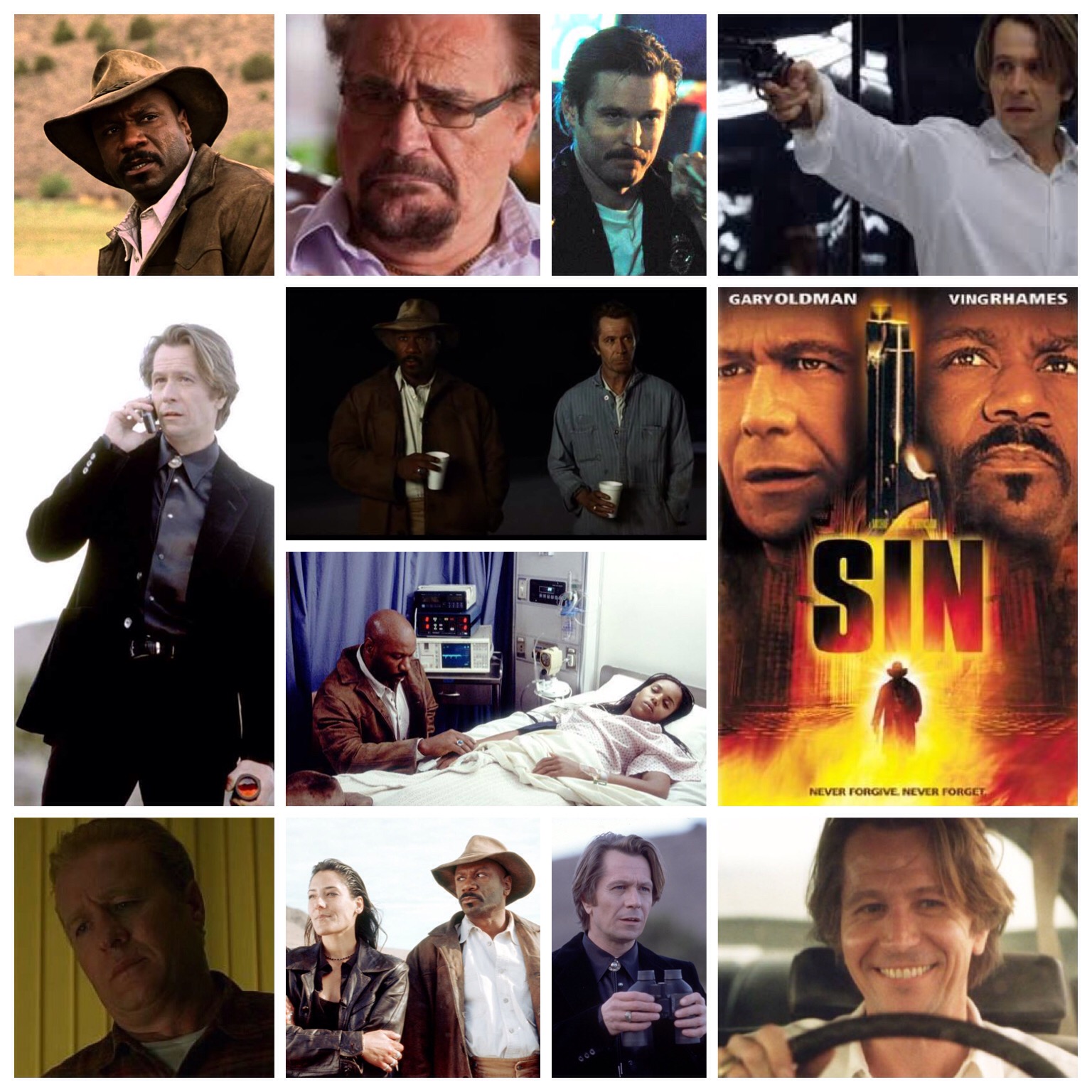
Sin is known as the B movie that Gary Oldman did, and he himself has bad mouthed it on occasion. Back then though, this was the only kind of movie like that he had to explain away. These days he has quite a few more of this type in his filmography, so he can’t really talk. It really isn’t the best movie, and functions as well as its limited budget and mediocre script will allow, but I must say there are a few moments, ones with stars Oldman and Rhames, that are just killer, and one in fact that borders on greatness. Rhames plays Eddie Burns, an ex cop or military man who lives estranged in the country, until the organized gang rape of his sister (Kerry Washington) coaxes him back into Reno Nevada. This heinous crime (a scene which borders on exploitation, to be honest) is orchestrated by Charlie Strom (Oldman), a nasty pornographer and drug kingpin who has a decades old bone to pick with Eddie. The film has some lonely atmospherics to it, the eventual confrontation between the two playing out in a poetic, if contrived fashion. For all the two bit moments in the script (and there are a lot), there’s one showstopper of a scene between Rhames and Oldman, that is reminiscent of Michael Mann’s Heat, and is quietly but surely affecting in its sadness. Brian Cox blusters through as Eddie’s former police boss, Bill Sage hangs out for a bit as a detective, and the one, the only Gregg Henry appears as a sleazy informant who feeds Rhames Intel. He also gets the best line of the film, exclaiming “I haven’t even had my morning fattie” after being rudely awakened Rhames. Watch for Alicia Coppola, Daniel Dae Kim and Arie Verveen as well. There’s some genuine ambition in the script, delving into the complex moral conundrum that exists between protagonist and antagonist, and how the two archetypes aren’t always so clear cut. Conscience and lack thereof is explored as well, with surprising results. I won’t lie and say it isn’t just a trashy b movie, but I won’t pretend there wasn’t some moments and aspects which I greatly enjoyed. It’s somewhere right in the middle. 

Battle For Terra: A Review by Nate Hill

  
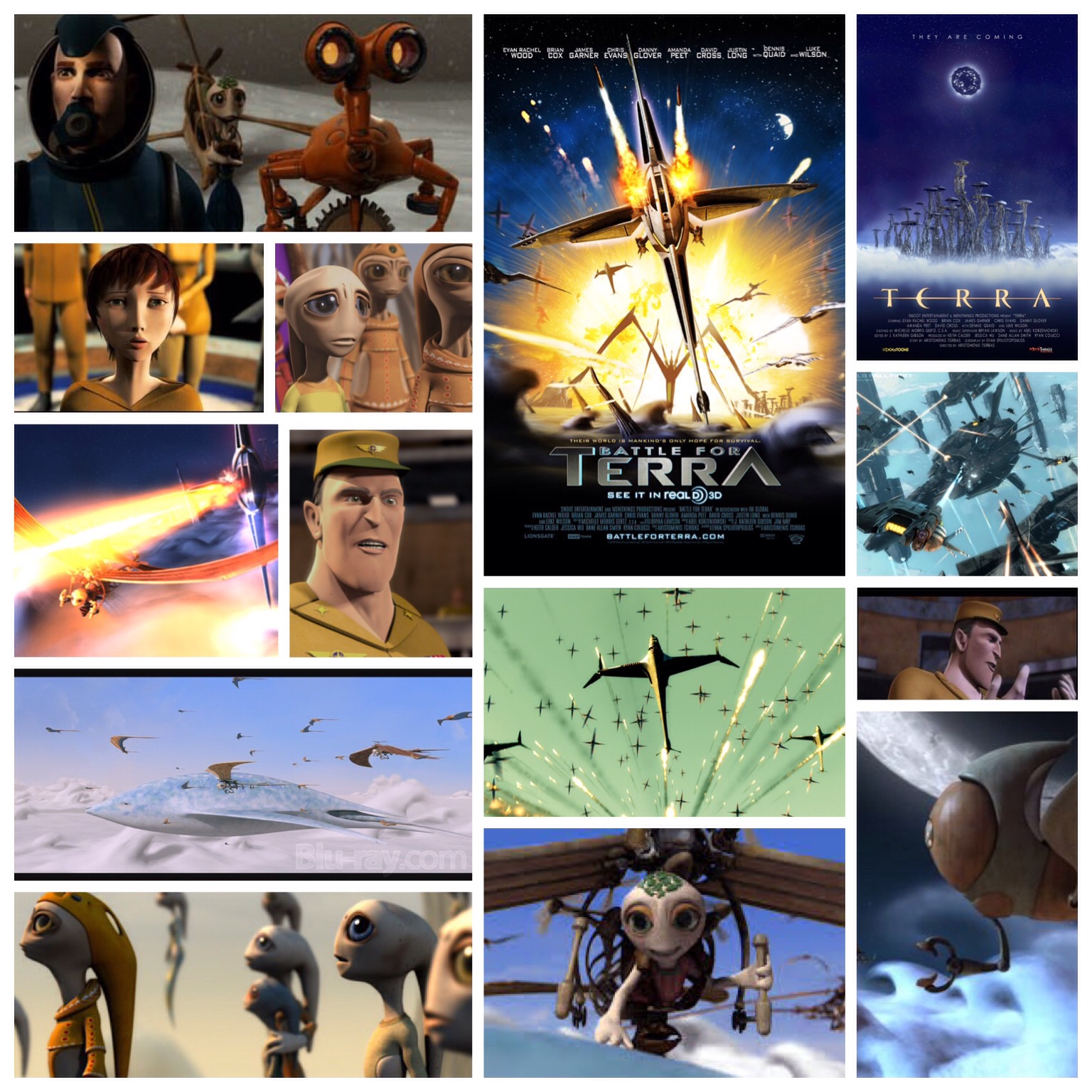
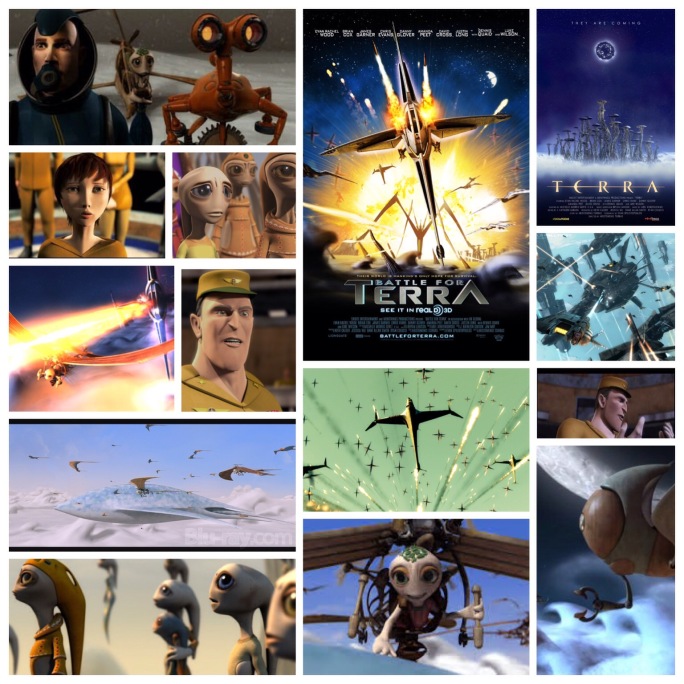
Battle For Terra is right up there with Titan AE as one of the most underrated animated films out there. It was shunted to the area off the beaten path of the genre, released quietly and inconspicuously back in 2009, sneaking just past people’s radar. Not mine. I waited eagerly for a theatrical release, which never came, and grabbed the dvd as soon as it hit shelves. It’s a dazzling science fiction parable not unlike Avatar, but a little softer, reverent and easy on the pyrotechnics. The story takes place some years after the remainder of the human race has been left to wander the stars in a giant spaceship called The Ark, left homeless after devastating the resources of earth, and three subsequent planets after. Soon they set their sights on a newfound world they dub Terra. Terra is populated by a peaceful alien race who spend most of their time in harmony, studying their heritage and bettering their existence. They now face annihilation, however, as the humans wish to settle, mine resources and deeply unbalance their way of life. One young Terran girl named Nala (Evan Rachel Wood) is a plucky young inventress and wonderer who finds one of the human astronauts (Luke Wilson) crash landed and stranded in her neck of the woods. They form a bond which may turn out to be the only way to find peace between humanity and the population of Terra. The story is wonderful, universal and carried out in a childlike manner full of earnestness that anyone can relate too. The Terrans resemble something like upright tadpoles crossed with sock puppets, and are fascinating to look upon. More interesting still is the natural world they inhabit; they sort of swim/glide through their thick atmosphere, and coexist with the many strange creatures and bioluminescence around them, including gigantic blue whale type things that fly around with them. I’m describing this to try and impart to you the level of thought and detail which went into creating this world, so you can see how high the filmmakers have jacked up the stakes in attempt to let you see the length humans will blindly go to further their survival, without voluntary compromise. The world the Terrans live on is a lush paradise in perfect balance, and the humans aboard The Ark, no matter how desperate, threaten it. They are led by stern General Hammer (Brian Cox), who is an antagonist, but not a villain in the least, a determind leader who will go to extremes to protect his people if his lack of empathy is allowed to go unchecked. The supporting cast is stacked high with incredible talent, and one can practice ones skill for identifying voices by listening for Danny Glover, Ron Perlman, Danny Trejo, Justin Long, Rosanna Arquette, David Cross, Beverly D’Angelo, Chris Evans, James Garner, Mark Hamill, Amanda Peet and Dennis Quaid. What a lineup. Imagination, storytelling ambition and visual genius govern this overlooked piece, and anyone who is a fan of animation (which is brilliant here, I might add) or science fiction needs to take a look.