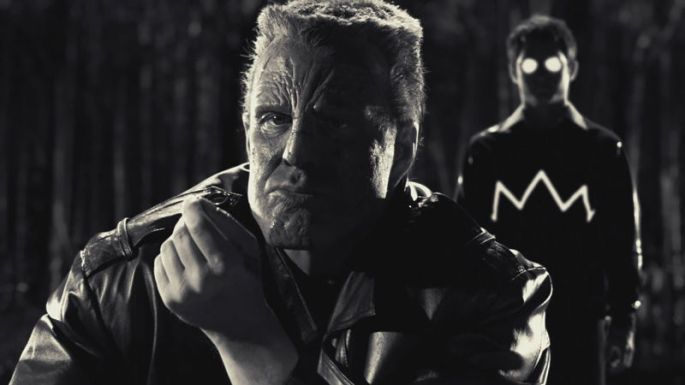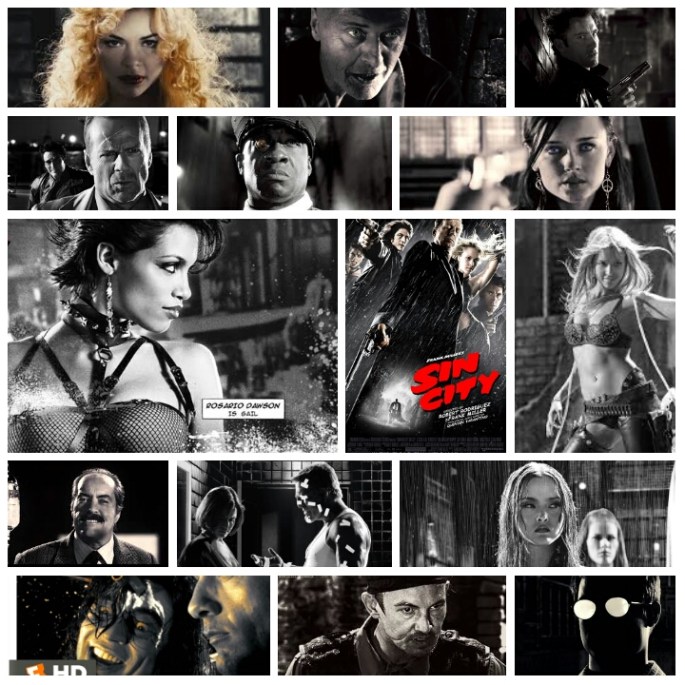
I remember seeing the edgy character posters for Robert Rodriguez’s Sin City hanging on the movie theatre wall when I was younger, having no idea what Sin City was or any knowledge of the books, but thinking they looked incredibly cool and enticing. Then the trailer came out, and it was all I could think, talk or breathe about for months leading up to its release. I was obsessed. When opening weekend arrived I got my dad to take me, and spent two unforgettable hours of cinematic nirvana in a dark auditorium that was packed to the gills with fans old and young alike, each basking in the delectable black, white and colour speckled glow of the piece unfolding in front of us. I had never seen anything like it, and it blew my system into sensory orbit like nothing had before. Around this time I was just discovering a lot of Rodriguez’s and Tarantino’s career, poring over pulp and crime thrillers from all across the decades as my love for cinema expanded, and this was something I just knew would be special as soon as I saw that first provocative teaser poster. The innovation and artistic ambition used by the ever resourceful Rodriguez and his team led to gleaming critical reception, a massive box office hit and one of the most gorgeous pieces of art in the motion picture realm. His decision to simply lift the still frames out of Frank Miller’s graphic novels was something that not every director would be able to go along with, let alone wrap their minds around (director’s are a finicky lot who always have thir own bright ideas, even when the source material is already gold). Rodriguez was so in love with the books that he envisioned them onscreen just the way they were drawn, and that’s pretty much what you get in the film. The pre-credit sequence sets the dark, vibrant, moody and impossibly lurid setting of Basin City, a rotting heap of corruption where almost everyone is either corrupt, sleazy or just outright evil, and even the ones that aren’t deal out some pretty heinous bouts of violence themselves. The prologue involves girl in in a red dress (Marley Shelton) conversing with a mysterious, well dressed man (Josh Hartnett). The scene takes a turn for the dark and tragic, we zoom out as Rodriguez’s self composed gutter lullaby of a score grinds into motion, and the glowering opening credits trundle by, a moment of a pure joy for anyone watching. The film is separated into three central vignettes, each from a different volume of the comics. The first, and strongest, features a sensational Mickey Rourke as Marv, a hulking bruiser built like six linebackers and basically impervious to anything that could kill a human being. After a heavenly night with hooker Goldie (Jaime King), he wakes up to find her lying dead next to him, not a mark on her. This gives his set of talents a purpouse beyond bar fights and roughing up abusive frat boys, and he wages a war of ultraviolence in her name, to his grave if he must. There are some villains in these stories that seem to be dredged up from the very bottom of the last pit of hell, just the worst of humanity’s many deplorable qualities. Marv eventually runs into evil arch bishop Cardinal Roark (a devious Rutger Hauer) and insane cannibal ninja sicko Kevin (Elijah Wood will haunt your nightmares)., on his bloody quest. Rourke’s genius even shines out through 12 pounds of prosthetic makeup slapped all over his mug, and he captures the wayward warrior soul in Marv, a restless anger and old school, Charles Bronson esque charm by way of Frankenstein’s monster. His work is a great way to kick off the first third of the film, and the gravelly narration hits you right in the film noir nostalgia. The second segment is a lot more lively, with far more people running around, sans the melancholy of Rourke’s bit, and instead emblazoned with a war cry of a story starring Clive Owen as Dwight, a hotshot tough guy who gets on the wrong side of seriously scummy dirty cop Jackie Boy (a growling Benicio Del Toro having a ball) who likes to beat up on waitress Shelley (Brittany Murphy). Dwight pursues him to Old Town, a district run by lethal militant prostitutes lead by no nonsense Gail (Rosario Dawson can use that whip and chain on me anytime). Then everything goes haywire (I won’t say why), and Michael Clarke Duncan gets involved as a weirdly articulate, golden eye sporting otherworldly mercenary named Manute. This middle section is the one that feels most like a comic book, where as the other too have more of a noir flavor, like their old Hollywood roots. The third and most depraved chapter (which is no light statement in this town), sees aging Detective John Hartigan (Bruce Willis) lay his life down in order to protect young Nancy Callahan from a terrifying pedophile child killer (Nick Stahl) who is the spawn of despicable US Senator Roark (Powers Boothe sets up a cameo of the pure evil he would go on to exude with his much larger role in the sequel). Jessica Alba plays the adult version of Nancy, now an exotic dancer and once again in danger from Stahl, who now has some… interesting changes to bis appearance, courtesy of genital mutilation from Hartigan years before. It’s one demented set of stories that would be almost too much to take in the real world, but this is Sin City, a realm that exists in the darkest dreams of Raymond Chandler and his ilk, a seething netherworld of stunningly beautiful women, ghastly corruption and terror, and good deeds that go unheralded in the night, bloody retribution perpetrated by antiheros and tragic scapegoats who know damn well what a pit of hell their town is, and that nobility is but a drop in the bucket of injustice they wade through on their way to violent exodus. The cast list goes on for miles longer than I’ve mentioned so far, but look out for Alexis Bledel, Carla Gugino, Michael Madsen, Jude Ciccollela, Nicky Katt, Nick Offerman, Tommy Flanagan and Devon Aoki as Miho, a deadly little hooker assassin who can turn you into a pez dispenser with her razor sharp katana. The level of violence on display throughout the film is so far over the top that after a while it seems almost Looney Toons in nature. Throats are slashed, heads are removed, testicles are ripped off, skulls are crushed and all manner of maiming and murder inflicted. What made it acceptable with the ever gay MPAA though is the fact that mic of it exists in the black and white mode of visual storytelling, and only a few instances of actual red blood seen. That goes for more than just the violence though in terms of color. Amid the sea of stark black and white there are beautiful hidden gems of colour that you have to train your eye to find. A pair of green eyes, a crimson convertible cadillac, the sickly yellow pallor of Stahl’s mutated skin. That’s but a taste of the patchwork quilt of visual artistry you are treated to here, and has constantly been emulated in either work since, but never quite effectively as here. That’s the idea of it though, a heavily stylized piece of hard boiled neo noir that exists simply to plumb the very depths of darkest genre territory, do justice to Miller’s books with a laundry list of wicked actors, a bonus scene directed by Quentin Tarantino and a story that’s pure noir to its bloodstained bones.
Tag: bruce willis
B Movie Glory with Nate: Fire With Fire
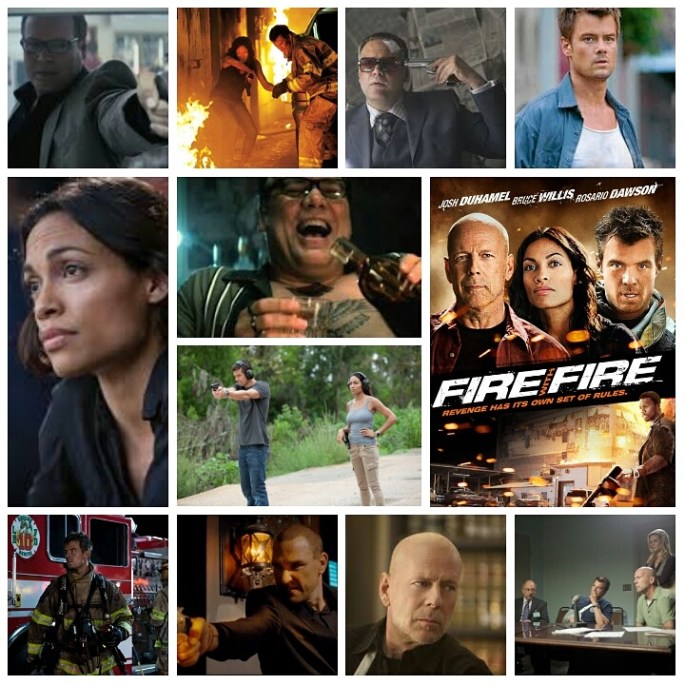
Fire With Fire is one in a long string of recent direct to video flicks that Bruce Wilis seems oddly intent on appearing in. Some are cool (Catch 44), some are halfassed (The Prince) and some are just plain poo (Set Up). This one falls in the first category. It’s an overblown and unbelievable little thriller but it has a great cast on it’s side, and when you score Vincent Donofrio for your villain role, you’ll always at least have some merit. The story is pure B movie: a studly firefighter (Josh Dumahel) ends up seeing something he shouldn’t and gets on the wrong side of a vicious neo nazi psychopath (Donofrio) and his crew. Just his luck though, as his foxy girlfriend (Rosario Dawson) happens to be an FBI agent working on a task force headed up by a gruff senior operative (Bruce Willis). Willis has been trying to nail Donofrio and his gang for years, and he finally has a handy little firefighter witness to testify. Donofrio won’t stop though, making their lives hell as he shakes their shit up right left and center. He’s a hell of an actor, especially when playing the baddie (his turns in The Cell, Daredevil, The Salton Sea and Men In Black are legendary), and this loose cannon weirdo white supremacist nut job is one more to add to the canon. Duhamel does his classic laid back pretty boy thing, Dawson is tough and oh so attractive as always, and Willis dials up the grumpy metre for a nice little jaded turn that i actually really enjoyed. Vinnie Jones lends his mug to the role of second in command, 50 Cent shows up (wherever Willis and Deniro go in B movie land, he unnervingly seems to tag along), and watch for more work from Quinton ‘Rampage’ Jackson, Julian McMahon, Richard Schiff, Arie Verveen and Kevin Dunn. I like the chaotic formula employed here: a bunch of characters running around, large cast, flashy violent spectacle, flamboyant villain. It almost seems like a 70’s genre piece, and I’d love to have seen a hand drawn, retro style poster with a bunch of stuff sprawled together in a mural like those old school flicks used to do. It sure would beat the generic, vanilla design they went with and I feel like the film deserves more. Great stuff.
The Fifth Element: A Review by Nate Hill
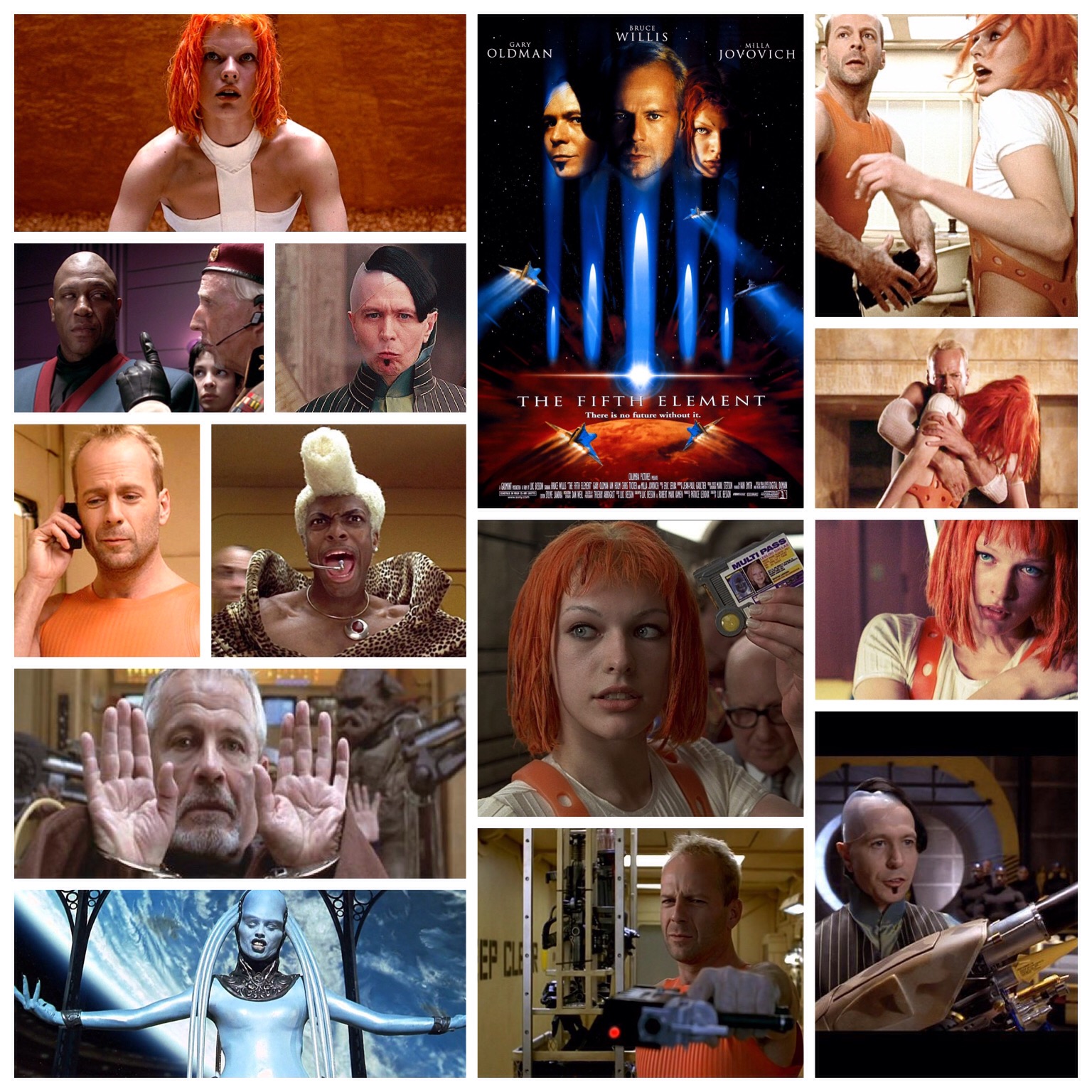
Luc Besson’s The Fifth Element is what you get when you give a massive budget to a director who has an otherworldly flair for imagination and a creative pulse that doesn’t subside for one single second. It’s one of the best sci fi films ever made, a pure intergalactic rush of absurdist qualities anchored by a solid blueprint that’s both akin to and far removed from countless space movies out there. The surprise, and what works so well, comes from Besson and his team crafting a warped and almost Dr. Seussical world that dabbles in cartoonish territory, boggles the eyes endlessly and continually assures you that anything goes in terms of style and tone. It’s an all timer for me, a blast of zany ideas, lovable characters (even the villains are teddy bears to me), a celebration of off the cuff production design and a goddamn certified barrel of fun. Most who read this will know the plot inside out and up and down, but we all know how much I love babbling on about actors and events, so bear with moi. There’s an adorable prologue (“Aziz, light!!!!”) In which an alien race called the Mondosheewans arrive on earth to remove a sacred and very powerful item from an Egyptian pyramid. They resemble shambling steam punk Volkswagen beetles, and are a force of good. This takes place in the 1800’s, and before you can say Luke Perry, we’ve flashed forward to a dazzling futuristic New York City where the events that came before come full circle. Self depracating cabbie Corben Dallas (Bruce Willis) has a day of unending bad luck, until a gorgeous humanoid being named Leeloo (Milla Jovovich was my first cinematic crush in this role ♡) literally falls into his lap, or rather, crashes through the roof of his cab and incites a high speed chase in hover cars, a fantastic sequence, I might add. It turns out this slender, orange deadlocked babe is the human manifestation of the coveted artifact that the Mondosheewans took into their possession. Willis and Jovovich have an immediate exasperated chemistry that practically leaps off the screen as giddily as your heart does whenever they’re seen together. They’re one of the cutest couples in history, and soon embark on a wild adventure to prevent mass destruction at the hands of a giant ball of pure evil that threatens earth (and no I didn’t make that up). Also threatening them is Jean Baptiste Emanuel Zorg (wish that was my name), played by Gary Oldman in a preening, gaudy display of theatrical evil that must be seen to be believed. Zorg is an arrogent megalomaniac who basically runs the city, out to find the ancient stones that are the key to stopping that malevolent force that hangs out just outside of earth’s atmosphere. This is the only film that can claim it has a scene where pure evil itself calls up Gary Oldman on the phone for a chat, which has to be some kind of achievment. There’s a gaggle of incredible actors running around as well, including Bilbo Ba-, I mean Ian Holm as Father Cornelius, a priest of an ancient order sworn to protect Leeloo, the president of the united states (Tiny Lister, once again I’m not making this up), a hapless general (John Neville), a tweaked out petty thief (Mathieu Kassovitz in a scene of pure WTF), Brion James, Lee Evans, and Chris Tucker. Oh good lord Chris Tucker. I don’t know how the guy has the energy, but he keeps it in mania mode as Ruby Rod, a flagrantly horny loudmouth prima donna radio DJ that tags along with Corben for a few gunfights and explosions and shrieks like a banshee all the while. Willis has never been as amiable as he is here, it’s as if John McClane wandered into an episode of Mystery Science Theater 3000 and decided to have some fun. Truly a great protagonist. You will fall deeply in love with Milla as Leeloo. Her lithe physicality, unearthly dialect that she actually learned in full for the film, striking naivete and burgeoning compassion all make her one of the most unique and mesmerizing heroines to ever exist in a film. Oldman mugs, chews scenery like a bulldog, prances about like he’s in a grade school play, and is a sheer diabolical delight. The scene where he demonstrates the ‘swiss army gun’ for his dimwitted extraterrestrial cohorts is time capsule worthy, as is the entire film. Besson directs and stages his world with a reckless abandon that plays like a watercolor painting of pure expression. If there’s an idea someone had, it ended up in this film no matter how outlandish and random it is. That’s the kind of carefree artistic qualities that all movies should have; a willingness to be silly, to be crazy, to step outside the box and then trample on it whilst hurling confetti all about the place. This film is a shining example of that, and stands out as not only one of my favourite films of all time, but one of the best ever made. Big BADABOOM.
Antoine Fuqua’s Tears Of The Sun: A Review by Nate Hill
Antoine Fuqua’s Tears Of The Sun is a brutal, tough war machine of a flick in the tradition of the old 70’s war films, kind of like a brooding Dirty Dozen. Bruce Willis stoically heads up a team of special ops soldiers who are sent into a war torn region of Africa to rescue a doctor (Monica Belucci) from a missionary camp. Genocidal maniacs are encroaching into the area and it’s no longer safe for locals or relief workers. His orders are simple: locate and extract the doctor, and no one else. However, when he comes face to face with the refugees, and their situation, he simply can’t find it in himself to turn his back on them when he can do something to help. He then disobeys his orders, collects both his team, Bellucci and the Africans and makes a run through the jungle for diplomatic protected soil. His team are a grizzled band of warriors, each with their own unique qualities and opinion on his decision. Kelly (a badass, mohawk adorned Johnny Messner) believes it’s too much of a risk, and not their concern). Michael ‘Slo’ Slowenski (Nick Chinlund, excellent and understated) takes a compasionate standpoint. Second in command Red Atkins (Cole Hauser) trusts Willis is making the right call. Soon they are pursued by the extremists, led by a hulking Peter Mensah, before King Leonidas kicked him into the Sarlak pit. The combat scenes are hard hitting, seemingly very well rehearsed and researched. The only problem for me was the overbearing and extended sequences of genocide, which are harrowing and quite tough to watch. When it’s combat based it’s a damn fine piece, with a rugged, thoughtful band of heroes who are an absolute joy to see in action. Rounding out the team are Eamonn Walker, Charles Ingram, Paul Francis, Chad Smith and a briefly seen Tom Skerritt as Willis’s commanding officer. Tough, muscular and no nonsense, with burgeoning compassion that gives that soldiers purpouse beyond the cold lethality of the mission. Fuqua has a terrific collection of lean and mean action flicks under his belt, and this is one of the best.
Barry Levinson’s What Just Happened: A Review by Nate Hill
Barry Levinson’s What Just Happened is an unfairly overlooked little Hollywood satire, a little less bombastic than his excellent Wag The Dog, but no less biting. It’s like Entourage on Zanax, a surprisingly laid back entry into an oeuvre that is usually foaming at the mouth with frenzy. Robert De Niro plays Ben, a very stressed out movie producer who is dealing with a zillion different things at once, most of which are going wrong. The character is based partly on real life Hollywood producer Art Linson, and his book. Ben has a lead actor (Bruce Willis playing Bruce Willis) who refuses to shave his bushy beard for a film. Anyone who remembers the film The Edge with Alec Baldwin and how big his beard was in that, well, that’s where the idea came from. That’s just a taste of how many weird things that both Hollywood and his personal life toss at Ben. He’s also in post production on a Sean Penn film (Penn also plays himself) with a very stubborn and flamboyant director named Jeremy (Michael Wincott) who refuses to cut the film in accordance with the studio’s wishes (here manifested by an icy Catherine Keener). Ben’s daughter (a weepy Kristen Stewart) is going through personal crisis, he’s also got a bitter rivalry with an obnoxious writer (Stanley Tucci) and has to babysit an anxiety ridden agent (John Turturro). It’s all a lot for him to handle and we begin to see the turmoil start to boil under Ben’s cool exterior. The cast is beyond ridiculous, with additional work from Moon Bloodgood, Peter Jacobson, Lily Rabe and Robin Wright as Ben’s estranged wife. Standouts include Michael Wincott who is a comic gem and gives the film it’s life with his pissy, enraged and altogether charming performance. Willis is also priceless as he ruthlessly parodies himself to the hilt. It’s slight, it’s never too much and is probably a bit too laid back for its own good, but I had a lot of fun with it, and it’s always cool to see meta movies about the inner workings of Hollywood.
SIN CITY: A DAME TO KILL FOR – A REVIEW BY J.D. LAFRANCE

In 2005, Robert Rodriguez adapted the comic book Sin City into a film with help from its creator Frank Miller who co-directed it. Convincing the veteran comic book writer/artist to come on board was a smart move on the filmmaker’s part as it assured that Miller’s luridly violent noir tales would be faithfully translated. This was achieved through a then-groundbreaking green screen environment that allowed Rodriguez to place his actors in Miller’s stylish world with a striking look comprised of black and white with strategic splashes of color. This innovative approach attracted a star-studded cast that included Bruce Willis, Mickey Rourke, Clive Owen and Benicio Del Toro among others. The final result dazzled audiences and was a commercial success.
A sequel seemed inevitable, but instead Rodriguez went on to team up with Quentin Tarantino on the box office misfire that was the Grindhouse double bill (2007) while Miller applied the Sin City aesthetic to a disastrous adaptation of Will Eisner’s comic book The Spirit (2008). Over the years, talk of a sequel surfaced occasionally with the likes of Johnny Depp and Angelina Jolie being mentioned in potential leading roles. Nine long years later and the stars (and money) aligned for Rodriguez and Miller to reunite with Sin City: A Dame to Kill For (2014). The film promptly tanked at the box office and received mixed to negative reviews. What happened? Did Miller and Rodriguez wait too long? A green screen-heavy film is no longer a novelty. Two cast members with characters in the film had passed away and some roles have been recast. The general consensus seems to be that they waited too long to make a sequel and interest in the film had waned.
Some might complain that A Dame to Kill For is just more of the same. As a big fan of the first film this is not necessarily a bad thing. After seeing Sin City, I wanted to see more of Miller’s stories brought to life. In addition to adapting A Dame to Kill For and the short story “Just Another Saturday Night” from the Booze, Broads, & Bullets collection, Miller created two new stories specifically for the film – “The Long Bad Night” and “Nancy’s Last Dance.” By doing this, he has given the fans a real treat by offering two stories where the outcome is not known and introducing new characters into this universe.
In “Just Another Saturday Night,” Marv (Rourke) wakes up amidst a car accident unable to remember how he got there. He proceeds to recall what happened via flashback on a snowy Saturday night. This segment is a nice way to reacquaint us to the brutal yet darkly humorous world of Sin City. “The Long Bad Night” introduces us to Johnny (Joseph Gordon-Levitt), a confident gambler who decides to take on Senator Roark (Powers Boothe), the most powerful man in the city, in a high-stakes poker game and gets more than he bargained for. It’s a lot of fun to see Joseph Gordon-Levitt square off against Powers Boothe, the former playing a young upstart and the latter an evil, influential man.
The centerpiece of the film is “A Dame to Kill For,” which features Dwight McCarthy (Josh Brolin) as a private investigator taking photographs of a businessman (Ray Liotta) cheating on his wife with a hooker (Juno Temple). When the man tries to kill her, Dwight intervenes. He has a tortured past, which involves keeping his homicidal impulses in check. Afterwards, Dwight gets a call from an ex-lover by the name of Ava Lord (Eva Green), a beautiful woman married to a very rich man. She’s in some kind of trouble and he finds himself drawn into her tangled web yet again. He soon runs afoul of her imposing bodyguard Manute (Dennis Haysbert) who proceeds to work him over. Realizing that he’s out of his depth and bent on rescuing Ava, Dwight enlists Marv’s help, which only complicates things in typical noir fashion.
In “Nancy’s Last Dance,” Nancy Callahan (Jessica Alba) is an exotic dancer still haunted by the death of her lover John Hartigan (Bruce Willis) and is obsessed with avenging his death by killing Roark, the man responsible for it. Over time, she’s counseled/haunted by Hartigan’s ghost, which drives her increasingly crazy.
Actors Josh Brolin, Joseph Gordon-Levitt and Eva Green slip seamlessly into the Sin City world. It helps that they have that old school noir look, especially Brolin with his chiseled tough guy features and gravelly voice – perfect for his character’s voiceover narration. In no time, the actor makes you forget that he plays a character once portrayed by Clive Owen. Gordon-Levitt is excellent as the young newcomer with a secret and manages to elicit sympathy for his ultimately doomed character. Green plays Sin City’s reigning femme fatale. The stunning actress has an alluring, exotic look and can turn a vulnerability on and off at will all the while playing a cold-hearted manipulator of men. Green gives key line deliveries the right venomous spin that makes Ava Lord a fearsome figure in this world.
It’s great to see Mickey Rourke return to the role of Marv, a character he inhabits so well. He brings a world-weary charm and a much-needed dose of dark humor to the film. Powers Boothe, who only had a minor role in the first film, gets a much meatier part in A Dame to Kill For and it’s a lot of fun to see him sink his teeth into such a deliciously evil character. Unfortunately, Jessica Alba is once again miscast as Nancy, the stripper with a heart of gold. While she looks the part, the actress doesn’t have the chops to pull off the tricky evolution of character that goes from sweet girl traumatized by the death of loved one to a revenge-obsessed vigilante. Miller’s stylized dialogue needs to be delivered a certain way. Some actors can pull it off and others can’t. Alba falls into the latter category and it becomes painfully obvious in her segment. Even her dancing is unconvincing.
While it no longer has the technological novelty factor as an incentive (shooting it in 3D really didn’t help either), there is certainly no other film out there that looks like Sin City. There have been a few imitators since, most notably The Spirit and Max Payne (2008), but the look of the film is so specific to its universe that few have dared to emulate it. Rodriguez has said that with the first Sin City he held back somewhat stylistically for fear that it would be too much for audiences. Emboldened by its commercial success, he took the look further and made it even more faithful to Miller’s comic book. So, there are things like Ava being rendered in black and white accentuated with red lips and green eyes, and visual flourishes like Marv recounting past exploits while a tiny car chase revolves around him, or the moody storm clouds that hang heavy in the cemetery where Nancy visits Hartigan’s grave. And why not? It’s not like the characters or the world they inhabit are based on any kind of reality. They exist in a hyper-stylized neo-noir universe drenched in atmosphere.
The dialogue in A Dame to Kill For is riddled with clichés and the characters are drawn from archaic stereotypes, but that’s the point. Miller is paying homage to the Mickey Spillane crimes stories he clearly idolizes. The film immerses itself in noir clichés and wears them proudly like a badge of honor, refusing to make any excuses for trading in them. There’s really nothing more to it than that, which may make the film seem instantly forgettable, but Rodriguez’s film never aspires to be art as it is unrepentedly sexual and violent with very few if any redeeming characters. The first Sin City film came out at the right time and tapped into popular culture zeitgeist. A Dame to Kill For is not so lucky, but you have to give Miller and Rodriguez credit for sticking to their guns and delivering another faithful adaptation of the comic book, which may only appeal to fans and probably won’t convert the uninitiated.
SIN CITY – A REVIEW BY J.D. LAFRANCE

Until recently, most adaptations of independent comic books were far more successful (and by successful I mean faithful to their source material) than long-running mainstream ones from the two largest comic book companies, Marvel and DC. One only has to look at examples, such as Ghost World (2001), American Splendor (2003) and Hellboy (2004) against the failures of Catwoman (2004), Elektra (2004) and Constantine (2005). So, why are the first three films more satisfying triumphs and the last three empty exercises in style? The answer is simple. In the case of the first three movies, the filmmakers wisely allowed the comic book creators direct involvement in the filmmaking process, whether it was working on the screenplay (as with Ghost World and Hellboy) or actually appearing in the movie (American Splendor).
In the past, the comic book creator was, at best, a peripheral presence in the filmmaking process, or not even included at all. With bigger, longer running series, like Spider-Man or Superman, it is much harder to include the creator because there is not just one but many who have worked on the comic book over the years. Where does the filmmaker even start in these cases? To be fair, with Iron Man (2008) began a great run of adaptations of Marvel Comics being successfully translated to the big screen but before it the examples were few and far between.
It only makes sense that if one is going to adapt a comic book into a film that it be faithful in look and tone to its source material. Otherwise, why adapt it in the first place? Of course, there is always the danger of being too faithful to the look of the comic and not being faithful to its content (characterization, story, dialogue, etc.) like Warren Beatty’s take on Dick Tracy (1990) — all style and no substance. It goes without saying that the next logical step would be to include its creator, if possible, in the process so as to achieve the authenticity and integrity of the source material. Filmmaker Robert Rodriguez took this notion to the next level with Sin City (2005) by having its creator Frank Miller co-direct the movie with him. In fact, Rodriguez is so respectful of Miller’s work that he not only has the artist’s name listed first in the directorial credit but also displays his name prominently above the film’s title.
Sin City began as a series of graphic novels created by Miller. They are loving homages to the gritty pulp novels Dashiell Hammett, Raymond Chandler and Mickey Spillane and classic film noirs from the 1940s and 1950s. Miller’s world — the dangerous, crime-infested Basin City — is populated by tough, down-on-their-luck losers who risk it all to save impossibly voluptuous women from corrupt cops and venal men in positions of power through extremely violently means in the hopes of ultimately redeeming themselves. The movie ambitiously consists of three Sin City stories: That Yellow Bastard, The Hard Goodbye, and The Big Fat Kill with the short story, “The Customer is Always Right” acting as a prologue.
In the first story, Hartigan (Bruce Willis), a burnt-out cop with a bum-ticker and on the eve of retirement, is betrayed by his partner (Michael Madsen) after maiming a vicious serial killer (Nick Stahl) of young girls who also happens to be the son of the very power Senator Roark (Powers Boothe). The next tale features a monstrous lug named Marv (Mickey Rourke) who wakes up in bed with a dead prostitute named Goldie (Jaime King) and decides to get revenge on those responsible for killing the only thing that mattered in his miserable life. The final segment focuses on Dwight’s (Clive Owen) attempt to keep the peace in Old City when the prostitutes who run the area unknowingly kill a high profile (and also a sleaze bag) cop named Jack Rafferty (Benicio del Toro) and in the process risk destroying the precarious truce between the cops and the hookers that currently exists.
The three main protagonists are all well cast. Bruce Willis is just the right age to play Hartigan. With the age lines and the graying stubble on his face, he looks the part of a grizzled, world-weary cop with nothing left to lose. Willis has played this role often but never to such an extreme as in this film. Quite simply, Mickey Rourke was born to play Marv. With his own now legendary real life troubles and self-destructive behavior well documented, the veteran actor slips effortlessly into his role as the not-too-bright but with a big heart hero. British thespian Clive Owen is a pleasant surprise as Dwight and is more than capable of convincingly delivering the comic’s tough guy dialogue. As he proved with the underrated I’ll Sleep When I’m Dead (2003), Owen is able to project an intense, fearsome presence.
The larger-than-life villains are also perfectly cast. Nick Stahl exudes deranged sleaze as Roark, Jr. and cranks it up an even scarier notch or two once he undergoes his “transformation” as the Yellow Bastard of his story. Perhaps one of the biggest revelations is the casting of Elijah Wood as the mute cannibal Kevin. Nothing he has done previously will prepare you for the absolutely unsettling creepiness of his character. Finally, Benicio del Toro delivers just the right amount reptilian charm as Jackie-Boy. Not even death stops him from tormenting Dwight and it is obvious that Del Toro is having a blast with this grotesque character.
Miller’s pulp-noir dialogue may seem archaic and silly but it is actually simultaneously paying homage and poking fun at the terse, purple prose of classic noirs and crime novels of the ‘40s and ‘50s. Rourke, Willis and Owen fair the best with this stylized dialogue as they manage to sell it with absolute conviction. It helps that both Rourke and Willis have voices perfectly suited for this kind of material: weathered and worn like they have smoked millions of cigarettes and downed gallons of alcohol over the years.
Of the women in the cast, Jessica Alba is the only real miscast actress. Not only does she not look like her character, Nancy Callahan (who was much more curvy, full-bodied and naked most of the time in the comic) but she does not go all the way with the role and her line readings feel forced and unnatural. Fortunately, Rosario Dawson more than makes up for Alba as Gail, an S&M-clad, heavily-armed prostitute who helps Dwight dispose of Rafferty’s body. She looks the part and inhabits her role with the kind of conviction that Alba lacks.
Finally, somebody has realized that the panels of a comic book are perfect storyboards for a movie adaptation. With Miller’s guidance, Robert Rodriguez has uncannily recreated, in some cases, panel-for-panel, Sin City onto film. He has not only preserved the stylized black and white world with the occasional splash of color from Miller’s comic, but also the gritty, dime-novel love stories that beat at its heart. Fans of the comic will be happy to know that virtually all of the film’s dialogue (including the hard-boiled voiceovers) has been lifted verbatim from the stories and the sometimes gruesome ultraviolence has survived the MPAA intact.
If you think about it, Rodriguez’s career has led him up to this point. With the stylized, over-the-top action of Desperado (1995), the pulp-horror pastiche of From Dusk Till Dawn (1996) and the mock-epic Once Upon a Time in Mexico (2003), he has been making comic book-esque movies throughout his career. It was only a matter of time before he adapted an existing one. Cutting his teeth on these action movies has allowed him to perfectly capture the kinetic action of Miller’s comic. Seeing hapless thugs fly through the air at the hands of El Mariachi’s deadly weapons in Desperado foreshadows the cops being propelled through the air when Marv makes his escape in Sin City.
What Sky Captain and the World of Tomorrow (2004) did for the pulp serials of the 1930s and ‘40s, Sin City does for film noir. There is no question that Sin City resides at the opposite end of the spectrum from Sky Captain. While both feature retro-obsessed CGI-generated worlds, the former looks grungy and lived-in and the latter is pristine and perfect-looking. Sin City is absolutely drenched in the genre’s iconography: hired killers, femme fatales that populate dirty, dangerous city streets on rainy nights. It is the pulp-noir offspring of James Ellroy and Sam Fuller with a splash EC Comics gore. Ultimately, Sin City is a silly and cool ride and one has to admire a studio for having the balls to release a major motion picture done predominantly in black and white with the kind of eccentric characters, crazed violence and specifically-stylized world that screams instant-cult film.
TWELVE MONKEYS – A REVIEW BY J.D. LAFRANCE

“It’s one thing to get lost in your own madness, but to become lost in somebody else’s madness is weirder.” – Terry Gilliam
How do you know when someone is crazy? This is a question that filmmaker Terry Gilliam tries to answer in many of his films, for he is obsessed by the notion of insanity – what makes someone insane and how do others view this person. Is someone really crazy or do they simply have a different view of the world than the rest of society? In the past, Gilliam’s films have presented characters that tend to blur the boundary between sanity and madness, but perhaps his most complex treatment of this subject is Twelve Monkeys (1995). It is with this project that the filmmaker combines his long standing obsession of breathtaking visuals with his knack for working closely with actors. This combination has resulted in more mature films for Gilliam who is normally associated with stylish overkill: films that tend to let the visuals overwhelm the story and characters. And make no mistake, Twelve Monkeys contains some of the most stunning images you are ever going to see but never at the expense of the story or its characters and herein lies one of the reasons why Gilliam remains one of the most interesting people working in film today.
Twelve Monkeys is a film that constantly plays with, distorts, and more often than not, manipulates time. The film begins in the year 2035. A deadly virus has wiped out almost all of humanity, leaving the survivors to take refuge deep underground. Only the occasional foray up to the surface in protective gear by a select group of “volunteers” offers any clues as to what went wrong. James Cole (Bruce Willis) is one such volunteer who is particularly good at retrieving information. As a result, he soon finds himself being sent back in time to find out how the virus originated and who was responsible. Unfortunately, he goes back too far, arriving in 1990 and is promptly thrown into a rather nightmarish mental hospital in Baltimore where he meets Jeffrey Goines (Brad Pitt), a fellow inmate with a loopy sense of reality that feeds all sorts of paranoid delusions of grandeur. Cole also encounters Kathryn Railly (Madeleine Stowe) a beautiful doctor who feels sympathy for him and his plight.
As Cole travels back and forth in time he begins to realize that one of the most important clues to the source of the deadly virus may lie in the rather enigmatic underground organization known only as The Army of the 12 Monkeys. Soon, Railly and Goines begin to play integral roles in Cole’s search as he consistently crosses paths with them. But is this all taking place in Cole’s mind? Is he really humanity’s only hope at averting a catastrophic disaster or is he just insane? From the first shot to the film’s conclusion we are never quite sure of Cole’s sanity or lack thereof. It is just one of many questions that the audience must think about not only during the film but long after it ends.
The seeds of Twelve Monkeys lie in an obscure French New Wave film called La Jetee (1962) made by Chris Marker. The film was composed entirely of black and white photographs and set in Paris after World War III. It was an apocalyptic vision in reaction to the threat of nuclear annihilation that became prominent in the 1950s and 1960s. Writers David and Janet Peoples were approached by producer Robert Kosberg to do an adaptation of La Jetee. The screenwriting couple wasn’t that keen on the idea, however. “We couldn’t see the point. It’s a masterpiece and we didn’t see that there was anyway to translate that masterpiece,” David remarked in an interview. And he was no slouch to the art of screenwriting, having rewritten the screenplay for Blade Runner (1982) and penned the brilliant Clint Eastwood film, Unforgiven (1992).
Kosberg got the Peoples to watch La Jetee again and the couple began to see possibilities for a different, more detailed take on the material. “How would we react to people who showed up and said ‘Oh I’ve just popped up from the future’ and in turn how would that person deal with our reaction.” With this in mind, David and Janet set out to write a challenging piece of fiction that not only manipulated our conventional views of time but that also dealt with the notion of madness. Janet explained in an interview, “We were very interested in asking questions like ‘Is this man mad? And how about the prophets of the past, were they mad? Were they true prophets? Were they coming from another time? What are all the different possibilities?'” The film’s script argues that certain people who are classified insane by society at large may not really be crazy at all but are in actuality presenting ideas that are way ahead of our time. And perhaps the blame for this misunderstanding should be leveled at the psychiatric profession which, as one character in the film observes, has become the new religion of a society that has deserted traditional faith for modern technology.
After showing the finished screenplay to Marker and getting his blessings, the Peoples were faced with the daunting task of finding someone who would not only click with the material but also have the visual flair that the story needed. The couple figured that the only director to handle such tricky subject matter was somebody like Ridley Scott or Terry Gilliam. The theme of madness that plays such a prominent role in the script fit right in with Gilliam’s preoccupations and so he seemed the natural choice to direct. As luck would have it the filmmaker was between projects and looking for work after several years of seeing potential projects fall through for various reasons.
Gilliam was also eager to take a lot of Hollywood money (a $30 million budget) and create a strange art film that would fly in the face of the traditional mainstream movie. “The idea that someone’s writing a script like this in Hollywood and getting the studio to pay for it was pretty extraordinary. So I thought let’s continue to see how much money we can get the studio to spend.” Gilliam’s battles with Hollywood studios are the stuff of legend – most notably his struggle with Universal over the release of Brazil (1984). They wanted to revoke the director’s final cut privileges to insert a happier ending instead of Gilliam’s decidedly downbeat ending. Gilliam’s vision prevailed in the end, but the ordeal left him understandably wary of further studio involvement. He had reconciled somewhat with Hollywood by making The Fisher King (1991), which turned out to be a surprise commercial and critical success.
Architecture plays an important role in Gilliam’s films and Twelve Monkeys is no different. “I’ve always used architecture as if it was a character.” To this end, he found all sorts of intriguing architecture to populate his film. This included the transformation of an 1820s prison into a 1990s mental hospital where the film’s protagonist, James Cole first meets the Jeffrey Goines. The director found that the structure was designed like a wheel with spokes and hub. And so Gilliam used one section where three spoke-like parts headed off into nowhere. “It seemed to me [that] this trifurcated room was right for multiple personalities.” This feeling of madness is further amplified by the extensive use of skewed, off-kilter camera angles that are often shot at low angles to constantly distort and disorient the scene. “We started doing it and it got more and more fun to see how far we could push it because I wanted to create an atmosphere that you don’t know whether this guy is crazy or whether he actually does come back from the future.” The unusual camera angles not only mimic Cole’s confused state but also reflect Jeffrey’s manic, hyperactive worldview. By presenting the mindsets of these two characters in such a fashion, Gilliam is inviting us to see the world through their eyes and in the process offer a new, unique take on the world that we might not have been aware of before.
Gilliam was not just content to challenge mainstream audiences with unusual visuals and subject matter, but he also wanted to mess with people’s perception of certain movie stars by casting box office names like Brad Pitt and Bruce Willis against type. “One of the reasons [for doing Twelve Monkeys] was taking Bruce and putting him into situations and asking of him things I don’t think he’s ever done before or that people haven’t seen him do … and with Brad Pitt it’s the same thing. Brad is pretty laconic in some ways. Suddenly he’s a blabbermouth, jabbering away at high speed. I love doing that, playing with the public’s perception of that star; otherwise, it wouldn’t be fun.” As a result we get a very different Bruce Willis here than we have come to expect. Gone are the wisecracks and smart-aleck attitude and instead we see Willis impart a real wounded sensibility to the character of James Cole. The reluctant time traveler always seems to be flinching at every little thing, often appearing disoriented or distracted as he struggles to understand what is going on around him. Willis displays great skill in this role – perhaps the best of his career – as he creates a truly tragic figure that may or may not be losing his mind.
Brad Pitt’s character, Jeffrey Goines, resides at the exact opposite end of the spectrum. Where Cole is a sad, brooding figure, Goines is a frenetic psychotic oscillating wildly between paranoid ravings and calm interludes where his madness is kept in check but still resides behind wild eyes. It’s a daring performance for Pitt who lets it all hang out as he gladly chews up the scenery with his loony radical environmentalist cum revolutionary that all but steals every scene he’s in. It’s a performance that Pitt worked long and hard to achieve and it paid off in a Golden Globe Award that year for Best Supporting Actor and an Academy Award nomination in the same category.
It is easy to see what attracted Terry Gilliam to a project like Twelve Monkeys. In keeping with his past films, this one also played “with the same old things – time, reality, madness – so I was intrigued.” Even though it was one of the few projects he did not originate himself, Gilliam quickly made the film his own. In fact, it is Twelve Monkeys‘ unique look that prevents any easy categorization. As Gilliam observed in an interview, “I’m determined to make it indefinable.” It is this avoidance of any clear cut genre that makes the film a riddle waiting to be solved. The film is also structured somewhat like an onion. On the surface, the audience knows very little at the beginning, but gradually as it progresses and the layers are removed, more and more of the mystery is revealed. However, this is not readily apparent after an initial viewing. Only after subsequent screenings does the full impact and brilliance of what Gilliam and his cast and crew have created sink in. It is this great amount of care and detail that has clearly gone into this film that makes Twelve Monkeys worth watching.
Tony Scott’s The Last Boy Scout: A Review by Nate Hill
Tony Scott’s The Last Boy Scout is pure stylistic grime, an exercise in early 90’s action with the blackest of humour. The tone is set with a square jaw early on: a star quarterback for a hotshot NFL team is under a lot of underground pressure to make that perfect play and in turn please the loan sharks. He buckles under the heat, ends up pulling a gun on the field and murdering a score of opponents before turning the gun on himself. Now horrifying as that is, if you have a sick sense of humor like me it conjures a dark chuckle of the most guilty variety, because.. well, it’s funny! Albeit in the darkest way possible, which is the arena this one skates in, love it or leave it. Upon closer examination of the script we discover it’s penned by that wonderful man Shane Black, who gave us Kiss Kiss Bang Bang and the upcoming The Nice Guys. No one can produce such heinous mayhem with a cavalier attitude and actually get away with it as well as Black does. The guy is a prodigy of dark humour, and who better to embody his protagonist here than a sheepish Bruce Willis as Joe Hallenbeck, a jaded ex detective who is so sullen and cynical he’s almost comatose. He’s paired with equally slummy former quarterback Jimmy Six (Damon Wayons), lazily trying g to solve a case involving the murderous quarterback and some shady politicians. Along the way that’s paved with many a sarcastic, beleaguered exchange they cross seedy paths with shady villains (Taylor Negron, RIP, and a youthful Kim Coates), a beautiful working girl with ties to the case (Halle Berry) and Willis’s spitfire of a dysfunctional daughter (Danielle Harris). There’s a wonderfully bloated supporting cast including Noble Willingham, Chelsea Field, Joe Santos, Bruce McGill and more. It’s got a bite that stings, mainly thanks to Black’s frighteningly stinging screenplay which give the film it’s sardonic, put – upon aesthetic. This meshes together nicely with Scott’s trademark sun soaked, pulpy, picturesque tone and provides one hell of an action movie rode. Nasty in all the right places, funny when the story begs for it, and build to last.
B Movie Glory with Nate: Catch 44
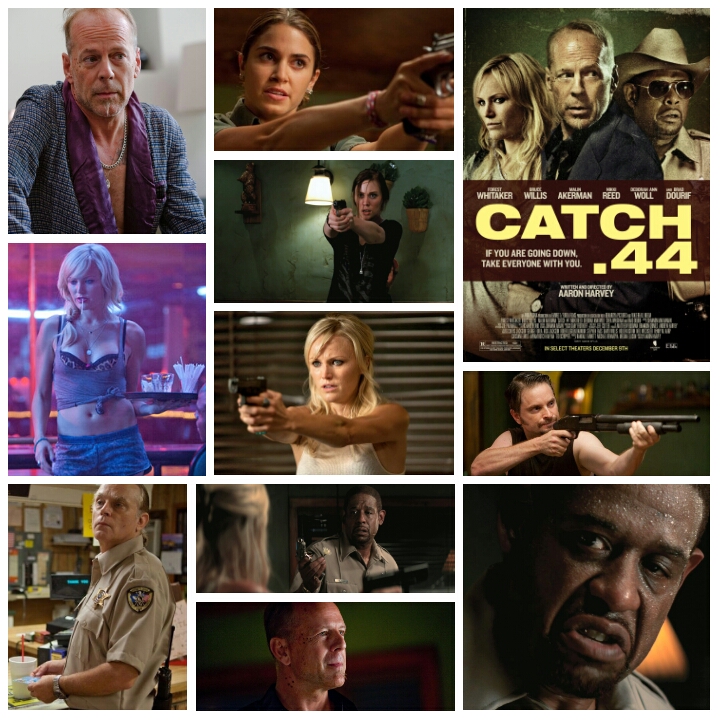
Catch 44 lives in that lurid interzone of direct to video crime thrillers that have the budget for the bare boned minumum: guns, a few big name actors stopping by for a paycheck, and a hard boiled, often ludicrous tale of criminals, cops and sexy chicks knocking each other off for some unnatainable trinket of wealth. Here we meet three lively femmmes fatale: Malin Ackerman, Nikki Reed and Daredevil’s Deborah Ann Woll, the angel’s to Bruce Willis’s Charlie, in this case a sleazy criminal kingpin named Mel. He tasks them with intercepting a mysterious package that passes through a lonesome truckstop diner. All hell breaks loose when the shotgun toting owner (Shea Wigham) takes them off guard, and blood is shed. From there it all spirals into a mess of chases, strange pseudo artsy setups and the entire cast hamming it up royally as they essentially go nowhere fast. There’s Forest Whitaker who seems to have wandered in from the loony bin, playing a psychotic Sheriff who switches up his accent from scene to scene until we realize we are sitting there watching an Oscar winner warble out a choppy Tony Soprano impression and have to chuckle at the absurdity of it all. Willis has fun doing his nonchalant smirk to kingdom come and sporting a soul patch that steals his scenes before he gets a chance. There’s also an underused Brad Dourif as a confused highway patrolman who wanders in and out of the story. A lot of pulpy outings like this get accused of aping Quentin Tarantino’s style, and while that is often a lazy, bullshit critic’s cliche, here the claim is understandable and not necessarily a bad thing. The soundtrack is appropriately offbeat, the trio of girls have a Death Proof type cameraderie and Willis ambles through his scenes with a verbosity reminiscent of Pulp Fiction. The story is a little haywire and one wonders what the ultimate outcome even means, but it sure has a ball getting there in violent, kooky fashion.