Harlan County War is a rare little TV movie that takes a partly fictional look at the union wars in rural Kentucky during the 1970’s, when a plucky band of coal miners and their wives took to the picket line in attempt to establish better working and living conditions. The story and title of the film have roots in the union wars of the 1930’s, which set the stage for this tale. Holly Hunter plays Ruby Kincaid, wife of Silas (Ted Levine) a miner who suffers through the harsh labor everyday. The townspeople are tired of the injuries, the deaths and the deadly black lung infections, and are given reluctant hope when compassionate union official Warren Jakopovich (Stellen Skarsgard) arrives to their county, promising change. Many locals are skeptical due to past corruption and disloyalty, but soon the company gets nasty and they realize that Jakopovich may be their only chance. Hunter is as fired up as she always is, her accent thicker than the moonshine everyone swills. I tracked this film down for Levine (Skarsgard too), and this is one of the best roles he’s ever gotten. He’s usually in character parts like the violent thug, stern general, gruff cowboy or yes, the skin stealing serial killer. Here he’s just a plain rural family man, a good hearted fellow who wants the best for his kin and county. Levine works wonders playing it straight here and I wish he’d get thrown more meaty and down to earth roles like this. Skarsgard can jump between being the most terrifying psychopath to the most comforting, sympathetic characters, and plays Jakopovich with compassion and dogged determination. The character building scenes between the three actors is brilliant. I feel like there’s a longer edit out there somewhere, because it jumps a bit and forgets to address one plot turn entirely, but alas it’s a tough one to affordably track down and this is the only version I could get. It’s made for TV and that shows at the seams sometimes, but it’s still solid drama about something important, and crafted very well.
Tag: film review
The Fifth Patient: A Review by Nate Hill
The Fifth Patient is a super awesome amnesia thriller, in the tradition of The Bourne Identity. It stars Nick Chinlund (in one of his rare lead roles) as John Reilly, an american who awakens in a remote rural hospital somewhere in Africa, with no memory of who he is, how he got there or what’s going on. A local military official (Isaach De Bankolé) interrogates him, believing that he works for the CIA. He has several visitors including a woman who claims to be his wife (Marley Shelton) and a former colleague (Henry Czerny). Gradually he pieces together the fragments of his damaged mind and suddenly has memories of being involved in a terrorism plot, planting seeds of doubt and causing him to suspect he isn’t who they think he is at all. Now all he can trust are his instincts, wary of everyone around him and unsure of his own past. It’s a serpentine story with hefty work from Chinlund who handles all facets of the character superbly, including some third act surprises. Sometimes these type of thrillers fall apart at the seams in the conclusion, tripping over the rug they’re trying to pull out from the audience in terms of plot points. Not this one. It’s well constructed and makes concise sense of its story right up to the last frame. Also watch for work from Brendan Fehr, Olek Krupa as a mysterious russian prisoner and the great Peter Bogdanovitch in a nearly unrecognizable turn. Now, I’m fairly certain that this one was never officially released back in 2007, because you literally cannot find it anywhere, it doesn’t have a legit poster and even seems nonexistent in some databases. Years ago it popped up on Netflix canada for about a month, thus ending my tedious quest to see it. You’d think that such a solid film with the prolific actors in it would have been treated better, but for one reason or another, it’s been forgotten. Hopefully one day a distributor will pick it up, because it’s quite the well made, entertaining thriller with a crackling lead performance.
Undertaking Betty: A Review by Nate Hill
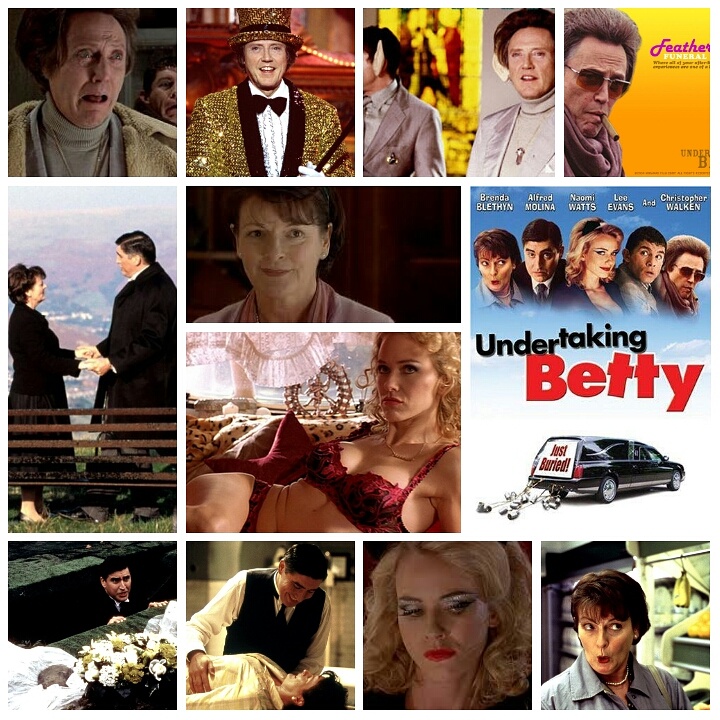
Undertaking Betty (or Plots With A View, as it’s called in the UK) is British black humour at its most brilliant, hilarious and surprisingly touching, in the tradition of stuff like Waking Ned Devine and Monty Python. It’s carefree and harmless but not without a raunchy sting that can’t help but be met with loving reception due to its charm and top drawer silliness. Brenda Blethyn plays a woman who has spent thirty years of her life in a small Welsh town, married to an absolute pig of a man (Robert Pugh). He’s a sleazeball who is shagging his slut of a secretary (Naomi Watts in full gumball sickening skank mode). Blethyn is secretly in love with the local undertaker and mortuary owner (Alfred Molina), the romance sparking up as the two try to find a way to get her away from Mr. Awful husband. Molina has the brilliant idea to fake her own death, letting her off the hook and allowing them to elope. She’s willing but reluctant, and so they proceed. Only one problem: Molina isn’t the only funeral outfit in town. Garish eccentric Frank Featherbed (Christopher Walken) and his peevy associate (Lee Evans) owns his own business and plans to steal Blethyn’s funeral for his own. Walken dials up the kook factor to the maximum and is pure genius, an entertainer at heart who believes that every funeral should have the showmanship and dazzle of a broadway show, leading to some amusingly awkward scenes. Just the fact that an american Chris Walken is working as a funeral home director way out in rural Wales is enough to bust a gut, let alone his off the wall performance. The resolution reaches comic heights that made me truly query why this film’s praises weren’t sung to high heaven upon release, but such is life, and death. The romance between Blethyn and Molina is sweet, endearing and balances out the larger than life sense of humour that the film keeps tossing around like confetti. Walken fans, dark comedy fans, film fans alike…please check this out.
David Twohy’s Below: A Review by Nate Hill
David Twohy’s Below cleverly combines two genres which seem to be made for each other, yet had never met up until this film. The atmospheric ghost thriller goes on an underwater ride with the submarine film for quite the unique and eerie experience. Strange occurances happen aboard a US army submarine during a routine WWII patrol mission, starting with the rescue of several stranded British castaways from a decimated ship, including Olivia Williams and Dexter Fletcher. The Captain (Bruce Greenwood) attempts to keep his crew calm, but apparantly it’s bad luck to have a woman onboard and soon uneasiness creeps in amongst them. There’s a mystery about their quarters as well, involving the supernatural, and pretty soon crewmembers are seeing, hearing and reporting eerie stuff, which adds to the tension. The crew is rounded out by an eclectic bunch of actors including Nick Chinlund, Holt McCallany, Matthew Davis, Christopher Fairbank, and Zach Galifianakis as a guy named Weird Wally who really lives up to the name. There’s some spooky moments, high drama between the cast which they pull off well, and a twist ending that explains the ghostly elements. Underrated stuff.
The Hunger Games: A Review by Nate Hill
I have never read the Hunger Games books, and didn’t rush out to see this first installment when it was released. I have this thing where I sometimes resist a largely popular project simply because it’s buxzingwith so much hype. There’s a word for that that I resist even more, which starts with H, but good luck getting me to admit to that. Anywho, I did watch it one day on netflix, loved the hell out of it, and have seen every subsequent entry, up til last year’s final one. It’s damn great storytelling that soars on a brilliant extended performance by Jennifer Lawrence, who is the actress of her generation and a genius of the craft no matter what anyone says. People called this a slick version of Battle Royale, and while that may be true, it’s certainly not a bad thing, and not the sole extent of what the franchise achieves. There’s stinging social commentary which both condemns and makes satirical light of modern North American culture. It examines the power of propoganda for both good and bad ends. It looks at the abuse of power, and the potent rise of fascism and fear tactics, and how quickly they can become commonplace. And this is all in a young adult orientated film that stars a strong, unhindered female protagonist. Gives you hope for the world. Lawrence is powerful as Katniss Everdeen, a young woman chosen from her district to compete in the much celebrated and very violent Hunger Games, a death tournament which serves as a purge and reminder to the citizens what it cost them to rebel against their oppressors years before. This is all at the behest of mega villain President Snow (Donald Sutherland oozes quiet malice with every articulate and icy syllable), who lives in the wealthy and decadent capitol city of Panem, a dystopian version of North America. Along with Katniss there’s also Peeta (but no hummus) a local baker’s boy played by Josh Hutcherson, who really struggles to match the skill level of almost everyone around him, especially Lawrence. They are thrust into the posh and stylized razzle dazzle of Capitol life as they train for the ruthless games, watched over by previous Victor and proud alcoholic Haymitch Abernathy (Woody Harrelson), as well as preening diva Effie Trinket (Elizabeth Banks channellig Marie Antoinette crossed with a poodle). The film takes some time to ramp up to the games, but as soon as it does the events unfold in breathless fashion set against a lush wilderness background, each and every member fighting tooth and nail to stay alive against both each other and the obstacles which gamesmasters have placed in their way. Anyone with an intense fear of wasps will want to be warned. A clever riff on the talk shows of our climate is shown, as the competitors are quizzed by Ceasar Flickerman (Stanley Tucci) a manically hopped up pop personality with a hairstyle that would make a samurai jealous and teeth so white they get accused of stealing oscar nominations. Tucci is truly a well of energy and the proceedings go electric whenever he’s around. Watch for Paula Malcolmson, Liam Hemsworth, Wes Bentley, Toby Jones and Lenny Kravitz as Cinna, a kindly fashion guru who takes a shine to Katniss and designs her a dress to end all dresses. Lawrence carries the entire thing on her mockingjay wings, making Katniss a spirit of unrest, a true symbol of hope and above all, a scared girl tossed into events she can’t possibly imagine navigating. Her performance is most of what makes these films so solid, and they couldn’t have made a better casting choice. Be sure to stay fpr the credits to hear ‘Abraham’s Daughter’, a fittingly grandiose original song by Arcade Fire.
Spotlight: A Review by Nate Hill
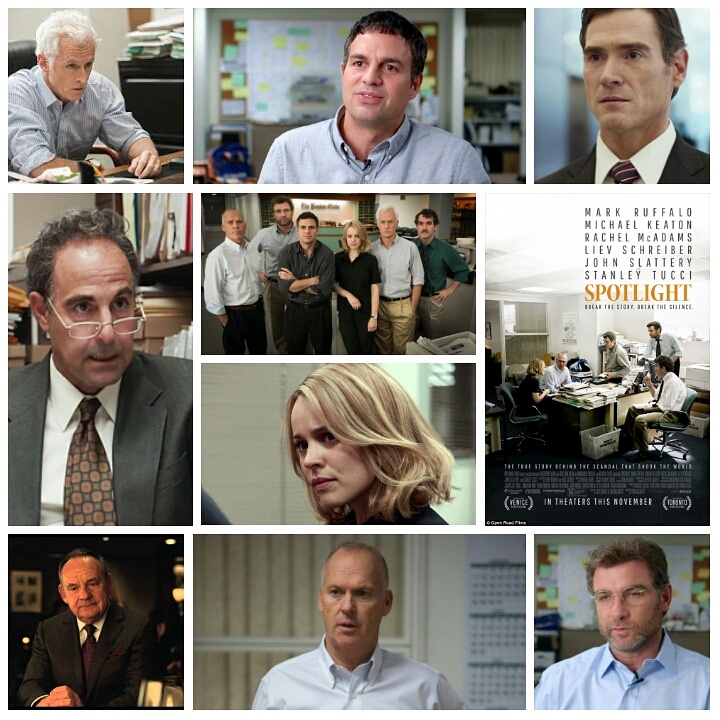
Spotlight focuses on a devastating turn of events which were ripe for melodrama, and instead turns out to be a spare, minimalistic entry that knows how to keep things close to the chest and still be deeply affecting. Director Tom McCarthy takes a fly-on-the-wall approach to his technique, showing us an intimate glimpse at what it no doubt must have been like for these Boston reporters as they brought to light one of the most sickening and heinous atrocities of our time, the sexual abuse scandal of the Catholic Church, which rotted through many a priest, parish and law firm who insidiously kept their mouths shut about the whole deal. For the reporters, ignorance was just not on the table, no matter what the consequences. Rachel McAdams is tender and fearless as Sacha Pfeiffer, a keen operative who is first to smoke out a lead, bringing it to her boss, the legendary Walter ‘Robby’ Robinson, (Michael Keaton), and the executive in charge of the paper, Ben Bradlee Jr. (John Slattery). The matter is brought to further attention by Marty Baron (Liev Schreiber), who arrives from out of state. It’s Mike Rezendes though, played by a stunning Mark Ruffalo, who drives the point home, refusing to give up and shoving loads of empathy down the throats of those who would look the other way. Ruffalo is note perfect, his determind sentiment delivered with compassion and impact that lingers. He hounds diamond in the rough lawyer Mitchell Garabedian (Stanley Tucci hides the sympathy behind the sass) to allow him access to the victims, giving him something concrete to go on. The bitter side of the lawyer coin comes in the form of Eric McLeish (underrated Billy Crudup), a passively belligerent guy who is anything but cooperative until the hammer comes down. Richard Jenkins proves that he can turn in excellent work with nothing but his voice, playing a source who is heard only via phone calls. Keaton is brilliant, bringing the laid back nature and giving the character an easy listening style Boston accent. McAdams mirrors the hurt in those she interviews with eyes that echo years of suffering. Tucci comes the closest the film gets to comic relief, and then veers into dead serious mode as he realizes his character is in control of lives with the info he has, snapping to rigid attention. Watch for work from Jamey Sheridan, Len Cariou, Brian D’Arcy James and Paul Guilfoyle as well. The film arrives at its destination free from obvious emotional fireworks, on screen text or sensationalism, elements which often permeate true life stories. It’s simple, to the point, grounded and diligent to story, character and truth. That approach makes it all the more shattering.
Robert Redford’s The Company You Keep: A Review by Nate Hill
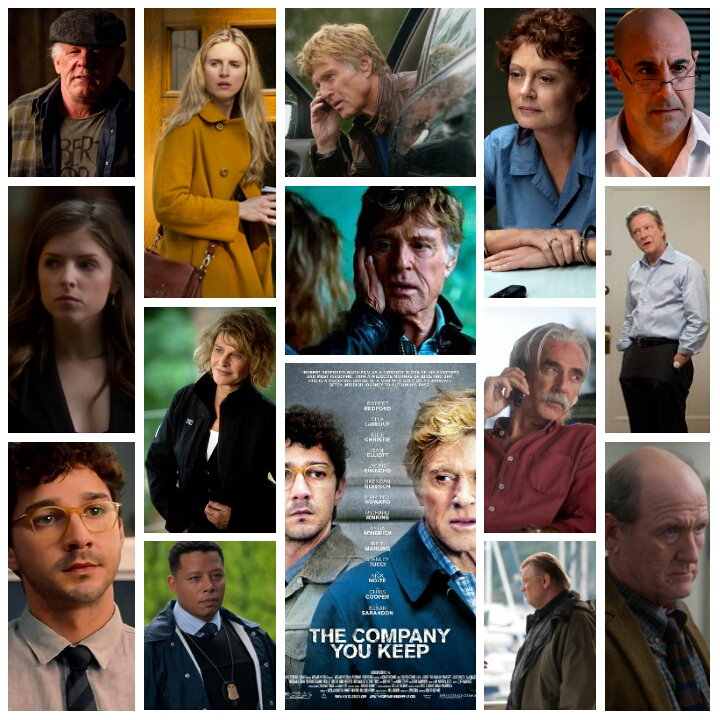
Robert Redford’s The Company You Keep is a powerful, smart, grounded drama revolving around the seriousness of one’s actions, the consequences they may make even decades down the road, and the lengths that some people will go to put things right. Redford has shown only improvement throughout his career, and has been really awesome as of late (All Is Lost was a favourite for me) and he directs here with as much confidence and empathy as he puts into his performance. He plays Nick Sloan, a former underground activist who was involved in a tragic accident as a result of his protesting, and branded a domestic terrorist. He went into hiding for nearly 30 years, until an intrepid journalist (Shia Lebeouf) uncovers traces of his tracks, and he’s forced to go on the run, leaving his young daughter with his brother (Chris Cooper). Lebeouf suspects his agenda is to do more than just hide, and indefinitely stay on the run. A federal agent (Terrence Howard) makes it his tunnel vision mission to find him. Sloan’s agenda only gradually becomes clear to us, as he navigates a tricky, treacherous web of former acquaintances, trying to locate his former lover and fellow activist (Julie Christie, phenomenal in a comeback of sorts). Old wounds are slashed open, the law closes in, and Nick wrestles with the notion that despite the good he tried to do in his idealistic youth, he is indirectly responsible for bloodshed. It’s enthralling to watch Redford play this man in his twilight years trying to put things right, waist deep in decades of acting experience, supported by an amazing script and a supporting cast that you couldn’t dream up . There’s memorable appearances from Stanley Tucci, Richard Jenkins, Brit Marling, Stephen Root, Susan Sarandon, Anna Kendrick, Brendan Gleeson, Sam Elliott, Susan Hogan and Nick Nolte, all in top form. For a thriller that takes itself seriously, takes its time building character and suspense, and sets itself in a realistic, believable tale that completely engrosses you, look no furthe
Easy A: A Review by Nate Hill
The best way to describe Easy A is calling it a wiseass high school retelling of The Scarlet Letter. That can also be a temperature gauge for someone to tell ahead of time if it’ll be there thing, or not. I enjoyed it a lot, thanks to a funny as hell Emma Stone who doesn’t leave out the vulnerability peeking through her guise as strong young woman. It’s a little more relaxed in the content department than some of the bawdier stuff that she got her start in, but still contains sufficient amounts of raunch to please the comedy hounds. Stone also has a veritable army of seasoned pros backing her up, an element which helps her, however she’s quite capable of carrying a film and does so as well. She plays Olive, a spitfire high school girl who finds herself in a funny yet unfortunate situation after her dunce of a friend starts a wildfire sexual rumor about her. Soon the whole school is talking about it, and she takes action in a bizarre move to fight fire with fire…of a certain kind. She boldly takes up the mantle of the school harlot, forever changing things in her quiet serengetti of suburban youth. It all spins wildly out of control, a common characteristic of adolescence, with poor Olive stuck right in the middle of the debacle, which sucks for her but is too funny not to enjoy. Stanley Tucci (“The Bucket List”) and Patricia Clarkson are darlings as her parents, Thomas Haden Church scores points as a deliberately hip and sympathetic literature teacher, and Lisa Kudrow that old flamingo, has fun as a dour guidance counselor. There’s also work from Amanda Bynes as an unhinged religious nut, the perpetually wooden Cam Gigandet, Penn Badgley and a brief cameo from Malcolm McDowell as the world’s most cynical high school principal. As a riff on The Scarlett letter it keeps theme alive, and as a teen comedy with a gaggle of adults trying to keep up with the youngsters, it’s a charmer. Stone holds the proceedings together very well.
The 6th Day: A Review by Nate Hill
The 6th Day is a brash, in your face sci fi actioner with some deft scientific notions that it plays around with in near satirical fashion. It chooses to shoot most of its scenes in my hometown of Vancouver, including a set piece atop the spiral shaped Vancouver Public Library tat sends sparks raining down into the streets and choppers spinning wildly to their demise. I love when films shoot here, because it gives my city an exciting chance to be a part of escapism, and it’s amusing to watch them digitally maim all sorts of landmarks and then chuckle as I see them intact on my way to work the next day. Schwarzenegger, in one of his last great flicks before his deliberate hiatus (we shall not speak of the abomination that is Collateral Damage), plays Adam Gibson, a helicopter tour guide who has a strange blackout in mid flight while transporting the CEO of a swanky scientific corporation (slick Tony Goldwyn). He arrives back home to find a clone of himself living with his family, and things only get weirder from there. He has stumbled into the inner workings of extremely illegal experiments involving human replication, and Goldwyn & Co. are none too pleased about it. Goldwyn has secretly made human cloning an everyday thing for the company, hidden from the aging eyes of the moral upright doctor who founded the company (Robert Duvall). This is all enforced by a ruthless corporate thug for hire (Michael Rooker) and his foxy assistant (Sarah Wynter). Schwarzenegger is faced with the daunting task of taking down this un-sanctioned empire, reclaiming his family and blowing up some stuff along the way. It’s a terrific flick, and Arnie gets to say the best line he’s ever spoken, directed at Goldwyn, which I won’t spoil here but it’s pure gold. Goldwyn is hateable and malicious, the horrific third act prosthetics fitting him like a slimy glove. Duvall strikes a noble chord and almost seems to have wandered in from a more serious film. Rooker is intense, evil and scene stealing as always. Watch for Wendy Crewson, Michael Rapaport and Terry Crews as well. In a movie so committed to the trademark Ahnuld fireworks, it’s cool to get a whiff of actual thought provoking, Asimov-esque intrigue with the cloning, a concept which is fully utilized and really a lot of fun here.
BRIGHT LIGHTS, BIG CITY – A REVIEW BY J.D. LAFRANCE

In the late 1980s, Michael J. Fox attempted to break out of the typecasted roles he found himself stuck in – light, breezy comedies like Teen Wolf (1985) and The Secret of My Success (1987). He also didn’t want to be known just for his role as the ultra-conservative Alex P. Keaton on the hit television sitcom Family Ties. To this end, he tried his hand at three dramatic departures: the gritty, blue collar Paul Schrader film Light of Day (1987), playing a musician in a bar band; a naive American foot soldier faced with a tough moral dilemma in Brian De Palma’s Casualties of War (1989); and a cocaine-addicted fact checker whose life is falling apart in Bright Lights, Big City (1988). You can argue the merits of each film but clearly the mainstream movie-going public was not interested in seeing Fox’s serious side and all three films failed to set the box office on fire. The critics were just as unforgiving and the films received mixed reactions at best, or outright savaging at worst.
Out of these three films, I find Bright Lights, Big City to be the most interesting one, especially in terms of Fox’s acting. The film is an adaptation of Jay McInerney’s best-selling novel of the same name and the production was plagued by all kinds of problems, which makes the fact that the finished product is as coherent as it is that much more impressive. For all of its flaws, the constant is Fox’s excellent performance as a struggling New York writer trying to figure out why his wife Amanda (Phoebe Cates) left him and why his life is a mess.
“You are not the kind of guy who would be at a place like this at this time of the morning, but here you are…”
And with these words both the book and the film begin with Jamie Conway (Fox) drunk and coked to the gills on what he calls “Bolivian Marching Powder.” With McInerney adapting his own book, he is able to preserve its distinctive second person narrative, which only reinforces Jamie’s self-absorbed state of mind. For example, there are several shots of Jamie looking at himself in various mirrors as he recognizes less and less of the person staring back at him. He works as a fact checker for Gotham magazine, a fictionalized version of The New Yorker. What he really wants is to be working in the fiction department. It’s interesting to see all the grunt work Jamie has to do at his job in the days before the proliferation of computers and the omnipresence of the Internet. At home, he works on his novel on a clunky old typewriter. It is these things that date Bright Lights, Big City in a wonderful way, especially for those of us who can remember these things.
The film’s most glaring flaws include an ill-conceived dream sequence involving “the coma baby,” the story of an unborn child trapped in a woman in a coma as documented on a daily basis by The New York Post. In the dream, Jamie sees the baby through the mother’s transparent belly. Not only does the baby look obviously fake, Fox does its voice as well. I guess the selfish child is supposed to be him or something like that. This sequence always takes me out of the film temporarily. Then, there’s the scene where Jamie and his best friend Tad Allagash (Kiefer Sutherland) break into the Gotham offices to plant a live ferret in his ex-boss’ office. Naturally, all hell breaks loose and the film’s tone veers dangerously close to slapstick as the understandably freaked out animal bites Jamie’s hand and almost tears off Allagash’s balls. They are caught in the act by Alex (Jason Robards), the veteran staff member who spends most of his time drunk, rambling on about working with the likes of William Faulkner and Dorothy Parker. Alex is almost taken out by a suit of armor in a kind of goofy moment. This scene isn’t quite as bad as the coma baby dream sequence but both could easily be removed from the film and no one would miss them. Interestingly, both of these scenes are in the novel but some stuff just doesn’t translate as well on the big screen as it does on the page where your imagination can create its own images.
Michael J. Fox does a really good job showing the gradual spiraling of his character, like when Jamie shows up to a fashion show featuring his wife (Phoebe Cates) as one of the runway models. He arrives a sweaty, disheveled mess, bribes the bartender (a then-unknown David Hyde Pierce) to pour him a couple of drinks even though the bar is closed, and then tops it all off by trying to get his wife’s attention by attempting to climb up onto the catwalk only to get ejected for his troubles. During this scene, Fox has a glazed look in his eyes of someone clearly not fully in control of their faculties. If that wasn’t bad enough, when spotted on the street by his brother (Charlie Schlatter), Jamie runs away, sprinting through the streets like a madman until he loses his sibling on the subway. The end of this perfect day comes when Jamie has dinner with a kind, former co-worker (Swoosie Kurtz) and proceeds to get drunk and make a clumsy advance towards her that is intentionally awkward and uncomfortable to watch. What a shock these three sequences must’ve been for fans of Fox’s squeaky clean roles on T.V. and in film.
Fox is excellent playing someone in denial that their life is falling apart. He just keeps piling on more alcohol and drugs in an attempt to deaden the pain or to forget about the reality of his situation. As the film progresses, you keep wondering when is Jamie going to hit rock bottom? It’s hard to say if he ever does but there is a scene late in the film where he finally acknowledges the reality of his situation. Whether he will finally be able to straighten out his life is left rather open-ended but there is a suggestion that he has come out on the other side of a pretty dark place and lived to tell the tale, just like the coma baby.
I’ve always admired Kiefer Sutherland’s courage to play unlikable characters that are interesting to watch. With his leading man good looks it would’ve been so easy for him to play one-dimensional romantic leads or flawless heroes but he has stubbornly refused to do so time and time again. Just think of some of his signature roles. In Stand By Me (1986), he played a vicious bully that terrorizes the film’s three teenage protagonists; in The Lost Boys (1987), he played the leader of a pack of vampires that delight in feeding off the riff raff at a California beach community; and in Flatliners (1990), he played a gloryhound medical student willing to kill and then resuscitate his classmates in order to prove life after death. In two of these three films he plays out and out villains and in the other one he plays a deeply flawed protagonist and yet we kinda like all of these characters because of Sutherland’s natural charisma. As an actor, he’s just so damn interesting to watch.
In Bright Lights, Big City, he plays Fox’s best friend Tad Allagash, the kind of Yuppie slimeball character that James Spader perfected during the ‘80s (I guess he was busy doing another film when this one was cast). On the surface, Allagash seems like a good friend to Jamie. After work, Allagash takes Jamie out clubbing and introduces him to several beautiful women in an attempt to help his friend forget about his disintegrating marriage and thankless day job. However, they really have a toxic relationship. He only pretends to listen to Jamie’s problems and always seems to be hitting him up for drugs. With the exception of a clandestine visit to Jamie’s workplace after hours, Allagash only seems interested in taking Jamie to nightclubs and parties. Sutherland uses his natural charisma to show why someone like Jamie would hang out with a guy like Allagash. He’s the kind of guy that is hard to say no to, especially when he’s offering you drugs, alcohol and women.
In 1984, Jay McInerney’s semi-autobiographical novel Bright Lights, Big City became a hot commodity. Brat packer Emilio Estevez wanted to option it and adapt it into a film. He met with the author who was working on his own screenplay version. However, it was Robert Lawrence, vice president at Columbia Pictures, who ponied up the money for the option and championed the novel despite resistance from older executives who saw it as “subversive and unconventional.” Lawrence saw it as his generation’s The Graduate (1967) with “a little bit of Lost Weekend in there.” Columbia agreed to make it with Jerry Weintraub producing and Joel Schumacher, hot off St. Elmo’s Fire (1985), directing. Soon after McInerney started writing the screenplay, Schumacher started rewriting it. Considered for the role of Allagash were the likes of Judd Nelson, Estevez and Rob Lowe. Tom Cruise was all set to play Jamie Conway and even took a tour of the New York City night life with McInerney and Schumacher.
A year later, when Weintraub became the chief executive at United Artists, he took the project with him. Now Bright Lights, Big City needed a new producer and so Sydney Pollack and his partner Mark Rosenberg agreed to come on board. They hired Julie Hickson to write the script. Schumacher lost interest and Cruise got tired of waiting. They left and Weintraub also exited, leaving the studio. The project was tied up in a complicated settlement until late 1986 when the studio decided to start from scratch with the notion of casting a relative unknown like Charlie Sheen (pre-Platoon) as Jamie. Tom Cole, who adapted a Joyce Carol Oates story into the screenplay for Smooth Talk (1985), was hired to adapt McInerney’s novel. His wife Joyce Chopra had directed that film and her high-powered agent not only got her involved in Bright Lights but also sent the novel to another of his clients, Michael J. Fox.
Initially, Pollack and Rosenberg weren’t too crazy about the idea of Fox starring in Bright Lights but then they got worried that mainstream audiences wouldn’t relate to a selfish Yuppie like Jamie. Pollack reasoned, “There is something in the persona of Michael that makes you care what happens to him, no matter how bad the character is.” However, with the casting of Fox, Bright Lights changed from a modestly budgeted film to a major commercial feature shot on location in New York City with a top box-office movie star. Fox used his clout to request Kiefer Sutherland play the part of Tad Allagash.
The producers surrounded Chopra with a crew that had worked with Pollack and were loyal to him. To make matters even more interesting, she brought James Glennon, her cinematographer on Smooth Talk, on board, thereby drawing sides with her, Glennon and Cole against the rest of the Pollack-loyal crew. To complicate matters, a Directors Guild of America strike was predicted to start early in July 1987 (that ended up never happening). Fox had to resume work in Los Angeles on Family Ties by mid-July giving Chopra ten weeks to finish her film.
Principal photography barely started and already studio executives were not happy with Chopra’s working methods. Some felt that she relied too much on Cole and Glennon and took too much time setting up shots. The director claimed that she “kept insisting that we take time each day to give the actors a chance to find their way,” and worked “collaboratively” with Glennon. Clearly, this slow, methodical approach was not going to work for the time crunch that the production was working under and something had to give. Executives did not like the footage Chopra was getting and a week into principal photography the chairman of United Artists and the president of production flew in from L.A. to New York. They had rushed the film into production without reading Cole’s script which diverged significantly from the novel. McInerney felt that Cole “was writing out all the drugs.” In his defense, Cole claimed that Pollack instructed him to do that because the producer was worried about tarnishing Fox’s squeaky clean public image.
Officially, Chopra was fired over creative differences with the studio. Fox cheekily referred to the month that Chopra was in charge as “a rehearsal period, though it wasn’t meant to be.” On the short list of replacements were Ulu Grosbard, Bruce Beresford and James Bridges. On a Friday, Bridges received a phone call from his agent telling him that Bright Lights, Big City was in trouble. He read the novel that night, flew to New York on Sunday and saw the footage Chopra shot. He agreed to take over only if he could start from scratch. Bridges was known for box office hits like The China Syndrome (1979) and Urban Cowboy (1980) but was coming into Bright Lights with back-to-back flops of Mike’s Murder (1984) and Perfect (1985).
On Monday, Bridges contacted legendary cinematographer Gordon Willis who agreed to sign on to the production. In a week, Bridges wrote a new draft of the script that had Jamie’s mother’s death as the emotional core of the film. He brought McInerney back into the fold and fired six actors, replacing them with Jason Robards, John Houseman, Swoosie Kurtz, Frances Sternhagen, Tracy Pollan, and Charlie Schlatter. They all read the novel because the script wasn’t ready. Bridges wisely kept Kiefer Sutherland and Dianne Wiest as Allagash and Jamie’s mother respectively. Before each day of shooting, Bridges worked on rewrites of his script and on weekends worked on it with McInerney. Bridges brought a much needed stability to the production and the film was shot in six weeks.
Shooting on location in New York City gives Bright Lights, Big City a real authenticity and serves as a snapshot of a city that looks and feels quite different now. In the ‘80s, it was quite a hedonistic time with materialistic Yuppies snorting cocaine in nightclub bathrooms while holding down jobs in the publishing industry or on Wall Street. I always felt that Bright Lights was the east coast answer to Less Than Zero (1987), also a flawed adaptation of a best-selling novel about affluent twentysomethings mired in drug addiction. Bright Lights is more successful because it doesn’t soften the edges of its protagonist as much as in Less Than Zero, which feels more compromised and less faithful to its source material. It’s really a shame that audiences and critics didn’t respond more favorably to Bright Lights. I would’ve liked to have seen Fox take more chances like he did with this film. Instead, he retreated back to safe comedies like Doc Hollywood (1991). It’s a rather unfortunate case of what could have been.