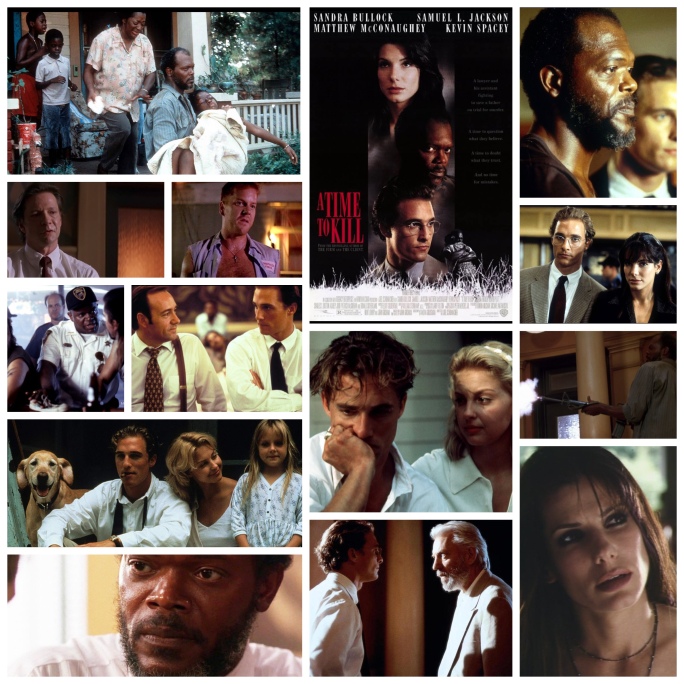
Joel Schumacher’s A Time To Kill

Many adaptations of John Grisham’s work have shown up in Hollywood, some great and others not so much, but for my money it doesn’t get any better than Joel Schumacher’s A Time To Kill. There’s something fired up about this story, a heartfelt and desperate aura to the high stakes moral maelstrom that Samuel L. Jackson and Matthew McConaughey find themselves in here. Jackson is Carl Lee Hailey, husband and father in America’s Deep South who opens up an AK-47 on the two redneck crackers who raped his eight year old daughter and left her for dead on the side of the road. McConaughey is Jake Brigance, the slick attorney hired to defend him who first seeks the limelight, then wishes he didn’t and finally becomes so morally invested in Carl’s case that it begins to unravel both his own life, not to mention stir up racial tensions all over the county.

Was Carl justified in these murders, given the situation? Should he be set free? Will the trial be a fair, civilized event given the fact that he’s a black man from the south in a time where they were not treated justly or as equals? The answer to that third question is definitely not because soon the Klan gets involved, the entire judiciary system itself gets put on trial and the whole state erupts in hot blooded anger over the situation. Jackson is fierce and vulnerable in the role, Never defaulting to the trademark detached, noisy brimstone that has become his thing but letting the hurt and righteous fury emanate from within organically, it’s probably his best work. McConaughey gets the sweaty desperation right and you begin to feel the uncomfortable nature of the situation creeping up on him until before he knows it there’s a burning cross on his lawn and his wife (Ashley Judd) is ready to leave him. Sandra Bullock does fine work as his legal assistants who, being an idealist, works for free because she believes in the cause rather than money or notoriety, the latter of which she receives whether she likes it or not. Kevin Spacey lays on the sleazy attitude as the loudmouth prosecuting lawyer who, naturally, hits below the belt in his tactics. An unbelievable roster of supporting talent shows up including Chris Cooper, Kiefer Sutherland, Brenda Fricker, Oliver Platt, Kurtwood Smith, M. Emmett Walsh, Anthony Heald, Charles Dutton, Raéven Kelly, Patrick McGoohan, Nicky Katt, Doug Hutchison, Beth Grant, Octavia Spencer and Donald Sutherland as a charismatic old alcoholic lawyer who serves as Jake’s mentor and voice of reason.

This film can sort of be used as a barometer to measure moral dilemmas and see through the weak spots of the justice system, of which there are many. Were Carl’s murders justified? I think so, given the heinous nature of the crimes against his daughter. But the ensuing racial turmoil, petty battle of legal wills and outside-the-courtroom power struggle sort of clouds that until the film reaches a barbaric fever pitch of violence and terror, until Jake calmly and directly cuts through all of that and turns the mirror on a whole community with his heartbreaking final address to the jury, after which it’s so dead silent you could hear a pin drop. It’s a bold, fantastic piece of acting from McConaughey and some of his best work also, in a brilliant film.

-Nate Hill
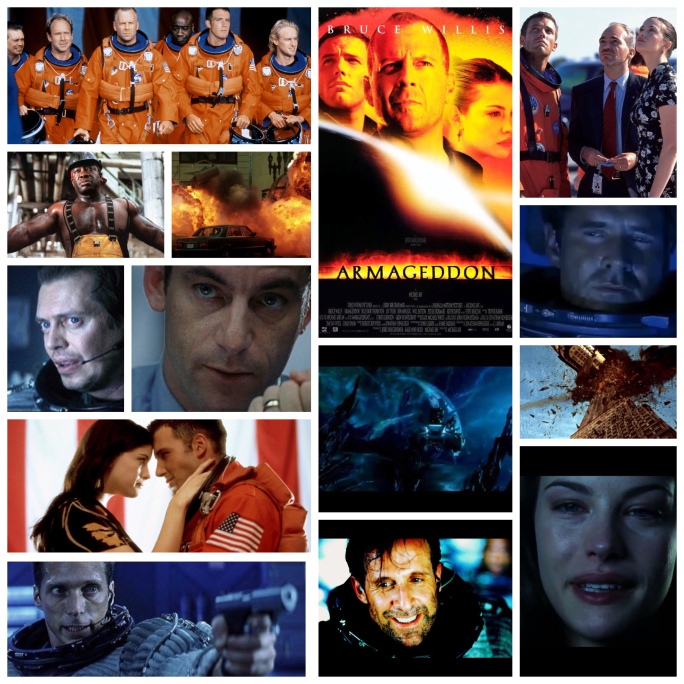
Michael Bay’s Armageddon

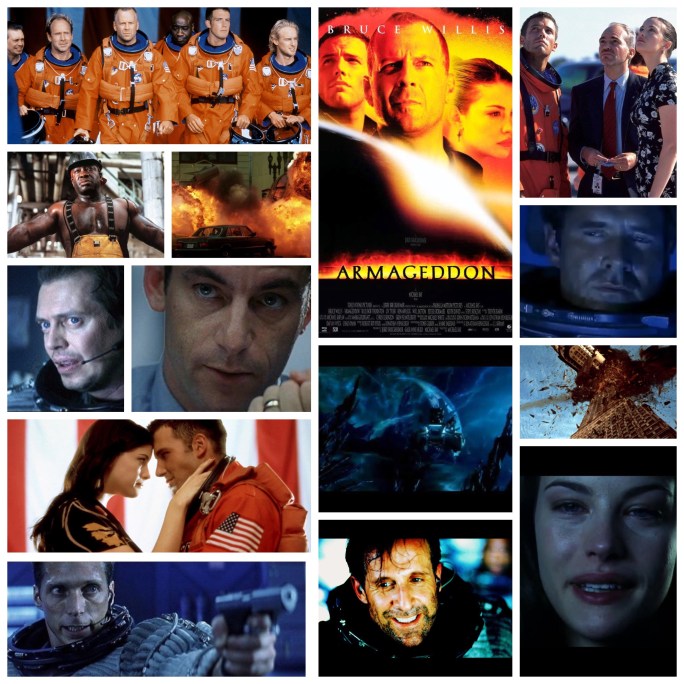
As Michael Bay’s Armageddon opens, a stern, well spoken Charlton Heston informs us that once upon a time a great big asteroid slammed into our planet and killed all the dinosaurs. He also makes mention that it’s only a matter of time before it happens again. Well, Michael Bay takes that and runs with it for nearly three furious hours of jump cuts, character actors, explosions, music montages and delirious extended Americana fanfare, and I love the resulting film to bits with no apologies or hesitation. Bay haters (Bay-ters to us cool kids) can whine and rip on the guy all he wants but fuck em, Armageddon is one kick ass film and an all time favourite for me. I feel like people just latch onto the glossy, runaway excess of the Transformers films and are blind to the fact that the guy has several classics under his belt, this being chief among them.

Never mind that the plot defies logical scrutiny or science, it’s an excuse to see Bruce Willis and his merry band of oil drillers train for NASA’s space program, climb aboard the space shuttle that might as well be a party bus, blast around the moon and hang out on the surface of a freaky looking meteor that Steve Buscemi’s loopy Rockhound literally refers to as ‘Dr. Seuss’s worst nightmare.’ If there’s one thing you can count on in a Bay film it’s no expense spared on spectacle and set pieces, even the ones that aren’t necessarily central to the plot. Before Willis and his team are even briefed on the situation there’s a mini-asteroid demolition derby that shreds NYC and a busted valve on his oil rig that sends equipment flying everywhere and goes on for a good ten minutes as he’s somehow chasing Ben Affleck around with a shotgun as an aside to the main event. Willis and Affleck spar with each other over his daughter (Liv Tyler) and call me an old school sap but I’ve always fallen hook line and sinker for their romance, put to the test by the potential end of the world and accented by the now infamous Aerosmith song belted out by her dad in the background. The cast is stacked too, as per Bay. Scenery chewing occurs thanks to Michael Clarke Duncan, Owen Wilson, Keith David, Jason Isaacs, Udo Kier, Eddie Griffin, Grace Zabriskie, Keri Russell, Chris Ellis, John Mahon, Shawnee Smith and Peter Stormare in probably the craziest Eastern European characterization he’s ever pulled off as the caretaker of the Russian space station who has more than a few screws loose.

As wild and crazy as much of the film gets, there’s a few characters who provide dramatic depth and weight that I’ve never seen mentioned in reviews, as most of them seem to be just focused on bashing Bay and his tactics instead. Billy Bob Thornton Is uncharacteristically grounded and dignified as the head of NASA, ditching his usual cocky prick attitude for a much more down to earth turn. Will Patton always makes me tear up as Chick, compulsive gambler who just wants to do right by his wife and kid, as well as make it home to see them. William Fichtner gives powerful work as an Air Force hotshot who also fears for his family’s lives and gets the most affecting scene of the film in a tense, emotional confrontation with Willis. Sure there’s the inherent silliness of the ‘Leavin On. A Jet Plane’ scene (it’s actually kind of sweet) and the overall maniacal attitude plus the constant stream of deafening pyrotechnics and special effects. But there’s also key dramatic moments and a host of excellent performances, and it would do many well to remember that. It’s an all timer for me, and a childhood classic that I fondly remember watching on VHS with my dad countless times. Oh, and fun fact; the guy who plays the US President here is Stanley Anderson, who also got the role in Bay’s The Rock, which pretty much suggests they exist in the same universe. I like the thought of a Bay multiverse, heh.

-Nate Hill

Mrs. Doubtfire

Ever watch Mrs. Doubtfire lately? Some 90’s films haven’t aged all that well in the years since, but if anything this one has improved, and endured as a sterling classic. What was it about Robin Williams that made him such a dynamic, magnetic and beloved artist? The list is long but for me it was his uncanny, intuitive ability to feel his way around a scene using both dramatic tenderness and that wildly energetic comedic mania that was his trademark. There’s this childlike earnestness when he’s expressing himself in a serious or sorrowful scene that is so damn genuine, and the unbridled mayhem in comic sequences interplays in a delicate balancing act that no one has ever replicated.

Here as voiceover actor and loving father Daniel Hillard he proves that he’ll go to any lengths for his three children (Lisa Jakub, Matthew Lawrence and Mara ‘Matilda’ Wilson) including elaborately disguising himself as a late middle aged British nanny just so he can spend more time with them. This is thanks to his makeup whiz of a brother (The lovable Harvey Fierstein) and ends up fooling everyone including the kids, his ex wife (Sally Field) and even her swanky new suitor (Pierce Brosnan, clearly having fun). The thing is, in the hands of almost any other actor this would be some creepy ass shit. I’ve even seen some spoof trailers on YouTube that recut this to look like a horror flick. But Williams was so talented and put his heart into it to the point that the concept just sells, and feels real despite being completely nuts on paper.

There’s two scenes that sort of cement both his character here and the kind of magic he was capable of on camera as an actor.

In a drab divorce hearing he pleads with the stone faced judge to let him have equal custody, lamenting that he can’t exist without being near his children and the emotion clouding his face feels immediate and organic. Later he has to rapidly switch in and out between the Mrs. Doubtfire disguise to fool a cantankerous social worker (Ann Haney) into believing he’s got his shot together. It involves slam dunking his face into a cake to mask the fact that he accidentally whipped his real mask out the window, and it’s absolutely hilariously inspired work that really illustrates his gift for delirious comedy. He had a long and varied career in film, but this has to be one of the showcase ventures. Aside from his work there’s a breezy, laidback San Francisco vibe and lovely work from a supporting cast including Polly Holiday, Rick Overton, Paul Guillfoye, William Newman and jolly old Robert Prosky as a scotch swilling network TV kingpin.

There’s also a surprising maturity in a narrative that could have easily patronized and pandered to the younger audience. There are core lessons to be learned that are never preached but written in seamlessly and the ending doesn’t cop out or cave in like many films would and do, but remains steadfastly rooted in this bittersweet situation, feeling all the more genuine for it. Williams is the rock, heart and soul of it but it’s a classic all across the board.

-Nate Hill

The Jackal

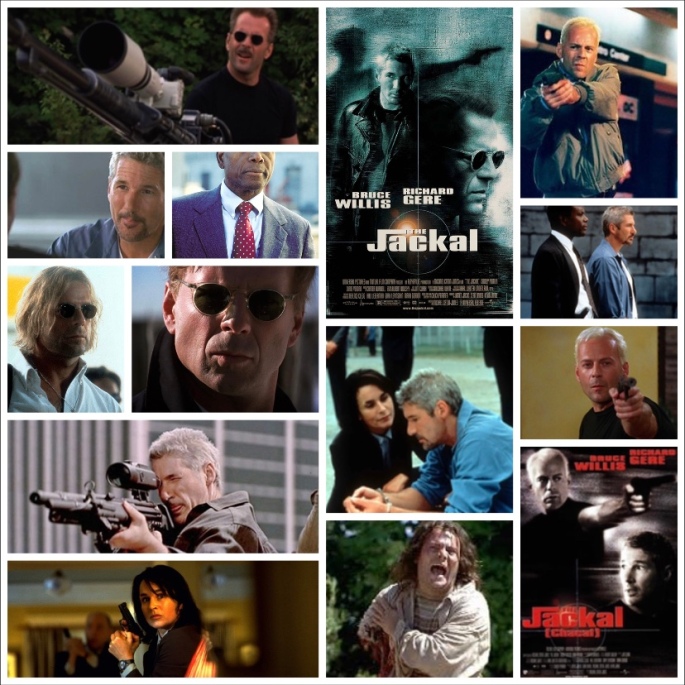
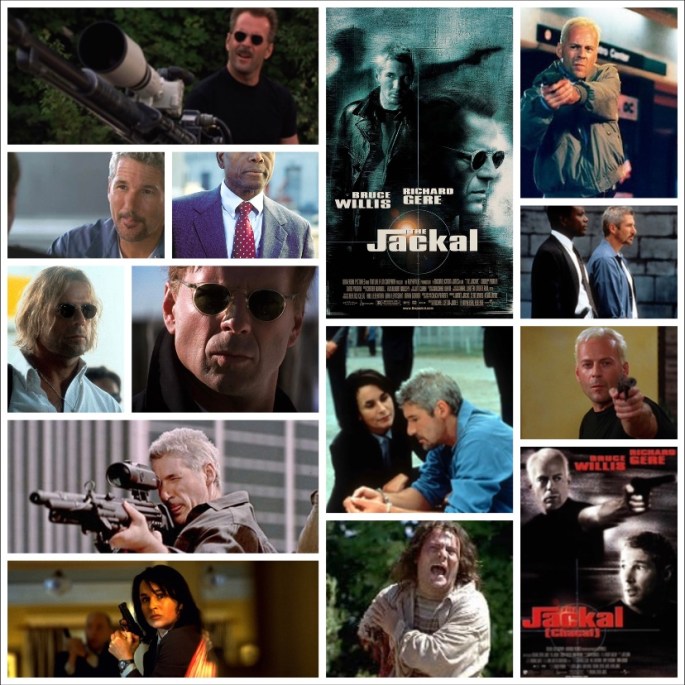
If you ever want to see Bruce Willis being a nasty bastard check out The Jackal, a pulpy remake of a 70’s spy flick that ramps up the intrigue, ultra-violence and takes a decidedly silly turn with its set pieces. Despite the fact that he and Richard Gere are kind of miscast, they both somehow get the intensity right and bring the heat even though we never really believe them in the roles. Willis is the titular Jackal, a sadistic international assassin whose methods get so elaborate you wonder where he gets the energy from. Gere is the imprisoned IRA radical who is sprung by super agent Sidney Poitier to bring him down. Willis’s next job is supposedly one that will put the delicate forces of international diplomacy off their axis and therefore the powers that be have allowed dangerous Gere to come into play as a ‘fight fire with fire’ mentality, which as any student of action movie narratives knows, never really ends well. Gere seems out of place as both an Irishman and an antihero but is fun to watch nonetheless, while Willis hams it up royally with a stoic grimace and enough high powered weaponry to bring down a building. Poitier always seems dignified no matter the material and such is the case here. The real scene stealer though is underrated character actress Diane Venora as Poitier’s partner, a scary badass of a Russian agent who displays more grit and grizzle than both Willis and Gere combined. Other work is observed from JK Simmons, Tess Harper, Stephen Spinella, Mathilda May, Sophie Okonodo and others. One scene always stood out though for years, and for awhile I didn’t even know what film it was from as a watched it with my dad when I was very young. Jack Black plays a shady arms dealer who hooks up Willis with product, but he gets a bit greedy with his paycheque. Willis, not impressed, loads up a giant 50 caliber cannon, tells him to start running and blows his fucking arm off from a few hundred yards out. Needless to say that scene made a spectacular impression on me and for years I just knew it as ‘that movie where Bruce Willis fucks up Jack Black with a 50cal’ until I eventually went for a rewatch. Not a great film but worth it for that scene alone, and the production value.

-Nate Hill

Mike Judge’s Idiocracy

I finally got around to watching Mike Judge’s Idiocracy (I know, shame me) and I couldn’t believe how hilarious and scarily on point this fucker is. Luke Wilson plays the most painfully average dude (life imitates art in terms of his onscreen charisma) who is frozen by the military along with a hooker (Maya Rudolph) and following one hell of a clerical error, wakes up five centuries into the future where it seems that stupid people have been breeding like rabbits and humanity has become a lot… stupider.

This is obviously a satire with a heightened sense of reality, but the themes, jokes and visual representation of dumbed down culture are just somehow so terrifyingly prescient that one has to squirm in equal doses as chuckle. The future has become a polyester soaked, energy drink saturated, lowbrow humour wasteland of mammoth Costcos, gladiator level monster truck rallies that serve to ‘rehabilitate’ dissidents and all intellectualism has been deemed too ‘faggy’ by the general population. The highest rated television show is called ‘Ow My Balls’, the film to sweep the Oscars is ‘Ass’ and it’s just that for two hours although in the golden age of indie surrealism that may be close to the mark in a way that Judge didn’t intend lol. People have names like Beef Supreme, Frito and, in the President’s case, ‘Dwayne Elizondo Mountain Dew Herbert Comacho’, and if I for any reason ever need a formal name change, it’s going to be that. He’s played by Terry Crews by the way, who actually would be a decent choice to run for real.

I keep describing the future here because the world building and lampoonery that Judge traffics in is so goddamn fucking funny and engaging that that’s really all you need to keep the momentum of this thing going, and plot be damned. There is a plot though, as soon as everyone figures out that Wilson is pretty much the smartest dude on the planet, and they rely on him to fix a world run amok. Wilson is in a sense the perfect actor to headline this story; there’s this wide eyed, childlike incredulity he exudes in every situation that is almost funnier than anything he’s gawking at, plus he’s just this side of likeable. Rudolph is hysterical as the braindead hoe who takes advantage of their situation and eventually learns a thing or two as well, but not how to paint. Dax Shepard does a comedic turn for the ages as Frito, a ‘lawyer’ who tags along with Wilson & Co. and acts as guide to this underworld of asininity, giggling at toilet humour and scarcely uttering anything past a few blunt syllables. Watch for cameos from Justin Long, Patrick Fischler, Thomas Haden Church and Judge regular Stephen Root.

So, *is* this film a documentary? Lol not quite, but I can see the angle from which that lament comes from. But you know, one time I was staying with friends in the Fraser Valley, which for those who don’t know is the more rural regions outside the big city where much of the ‘monster truck’ crowd have settled. I was in the kitchen asking my friend’s mom where I could find a glass for water, to which she laughed, opened the fridge that was stocked only with pop and said “we’re not really a water drinking household.” I feel like it’s that mentality that Judge skewers here and maybe what feels so close to home, as well as the overall collective forces of dumb that pervade our world every day, from the news to pop culture to entertainment media and everything in between. I’m not sure why this got so buried on release, I remember noticing it in Blockbuster way back when and noting that it went straight to video. That sort of relegated it to being a cult classic instead of an outright classic but that’s okay too. In any case this is a detailed, brilliant, hysterical farce on humanity at its most extreme and pitiable, laced with Judge’s trademark droll deadpan, a dazzling visual mood-scape and lively performances from all. Great film.

-Nate Hill

Michael Bay’s The Rock

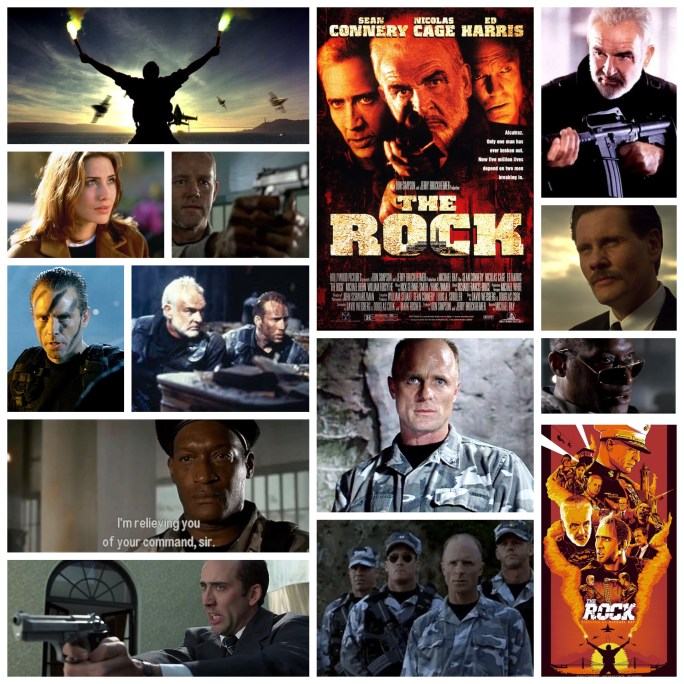
Who loves Michael Bay’s The Rock? I think a better question is who doesn’t. It was one of my first introductions to the action genre as a kid and I sat there in Saturday morning disbelief at just what was possible in the realms of cinema. Alcatraz Island, nuclear warheads filled with horrific poison gas, Nicolas Cage in charismatic goofball mode, Sean Connery basically reprising his 007 role one last time, a rogues gallery of gnarly character actors all hamming it up to high heaven, a score from Hans Zimmer that soars and invoked both emotion and adrenaline, what’s there not to fall in love with.

The plot here is besides the point: angry rogue military general Ed Harris takes Alcatraz hostage, threatens to launch warheads across harbour into crowded San Fran. Chemistry guru Nic Cage, ex MI6 super-spy Sean Connery and a team of Navy Seals covertly lead a siege on the rock to stop him. Many guns are fired, a lot of shit blows up and endless one liners are uttered. That’s the nutshell version though, the actual experience is something blissful and perfectly pitched in terms of the recipe for a great action film. Connery is intense yet somehow laid back and steals the show as the pissed off, blacklisted agent who really doesn’t care about the threat towards the city, or at least pretends not to. Cage, whether strumming his guitar, banging his super hot Italian American wife (Vanessa Marcel) or referencing Elton John right before killing a bad guy, is comic dynamite and a source of desperate, scenery chewing energy that somehow works despite how ridiculous his performance is (it’s like the antithesis of his work in Con Air, the sister film to this). What I love about Harris’s villain here is that, unlike many huge budget action flicks, you actually care about this guy and what he wants, despite the extreme measures he’s gone to get them. He’s calm, resolute and sorrowful and not much about his performance suggests an antagonist except for the situation the character is written into and it’s an interesting, thoughtful choice for the film’s baddie. The real nasty characters are the mercenaries he hires to carry out his mission, who include the more subdued likes of David Morse and John C. McGinley, the less subdued Bokeem Woodbine and Gregory Sorlader and the positively psychotic Tony Todd as Captain Darrow, the last guy you’d want on either side of the moral fence as his seems to be absent. On the other side of the action we get John Spencer as a cranky FBI bigwig, legendary Michael Biehn as the Seal commando, always awesome William Forsythe as the one FBI agent with a brain in his head and cameos from Pat Skipper, Claire Forlani, Danny Nucci, Tom Towles, Jim Caviesel, Stanley Anderson, Raymond Cruz, Xander Berkeley, Philip Baker Hall and Stuart Wilson.

From the moment Harris’s team steals the rockets to the explosive sequence where Cage flags down the military in a sly Platoon reference, this thing fires with everything it’s got. Connery’s escape and car chase through the streets of San Fran goes on needlessly long and exists only for the purpose of an action sequence, making it all the more awesome. Harris and Biehn’s utterly badass stare down and frantic chicken fight over who will order a stand-down first always gets me. It’s such a well made action film that even the Bay haters sound like ignoramuses when they bash it. Roger Ebert, who has routinely torn Bay new assholes over the years in his reviews, loved it. Zimmer’s theme is the perfect symphony for fighter jets, commandos, yellow hummers’ (“You shtole my humvee!”), trolley cars, assault weapons and high powered rockets to thunder across the harbour in spectacular fashion. The Rock rocks.

-Nate Hill

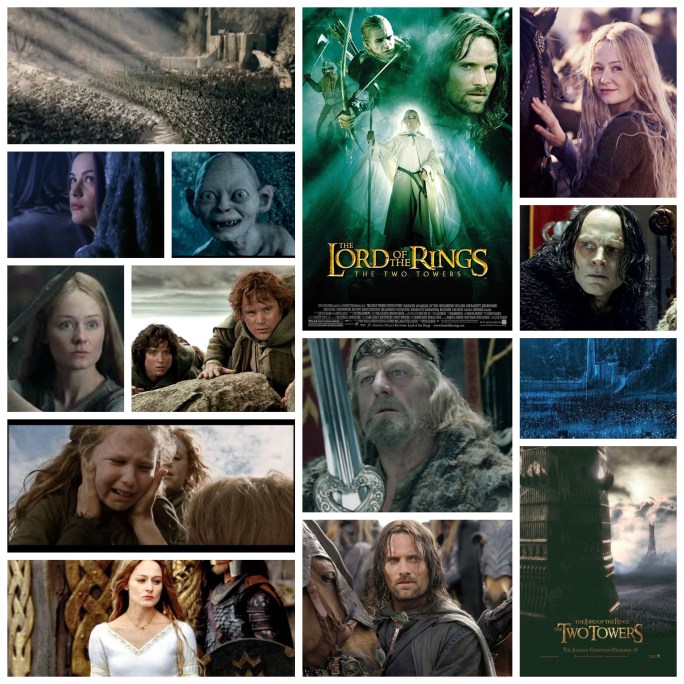
Peter Jackson’s The Lord Of The Rings: The Two Towers

The middle chapter in any trilogy has the unfortunate luck of being an oasis interlude that by definition can’t have an opening or a conclusion, because a hunk of story came before it and, naturally, there’s more to come after. However in the case of Peter Jackson’s The Lord Of The Rings: The Two Towers, it adapts and adjusts that malady by finding it’s own groove with a surging forward momentum that is removed from the episodic nature of both Fellowship and Return Of The King. It’s not my personal favourite of the three (Fellowship holds that trophy on sheer potent nostalgia alone) but to me it’s the most unique in the sense that *because* it has no bookend on either side of its narrative, it ironically feels like the most independent chapter.

There’s a restless surge of movement from every side of the action here; Frodo and Sam are uneasily led by Gollum through a haunted, labyrinthine marsh ever closer to the acrid peaks of Mordor. Aragorn, Legolas and Gimli furiously race to save the entire population of Rohan from devastation at the hands of Saruman, the good wizard who went about as bad as you can go, and his manipulative lackey Wormtongue. Merry and Pippin are whisked away on the shoulders of Ent elder Treebeard on an endless hike through Fangorn Forest, and eventually Isengard itself. Even Gandalf doesn’t get a sit-down or a smoke break, propelled on a dizzying battle with the Balrog and thrown right back into the struggle for Middle Earth with Tim for nought but a wardrobe update and hair dye. It’s that movement, the ever forward rhythm that sets this one apart and emphasizes what a truly massive journey this whole story is. Fellowship had dreamy interludes in Rivendell, whimsical leisure time spent in The Shire and near constant time to reflect and sit down for these characters, and Return had… six different endings that broke the pace. Two Towers begins with fiery chaos in Moria, holds that note throughout and finishes literal moments after the thunderclap battle of Helms Deep, which is still just an incredible piece of large scale filmmaking.

This one also introduced two of my absolute favourite characters in the whole trilogy, Theoden king of Rohan and his warrior niece Eowyn. Played by Bernard Hill and Miranda Otto, these two performances just sing through the whole film, drawing sympathies not just for Rohan but the entire human race, it’s struggle and earning every cheer out loud moment. The whole conflict with Rohan, despite again not being the inciting event in the war for Middle Earth or even the final battle, feels very immediate and important thanks to Hill, Otto, everyone involved and the monumental special effects involved in bringing the terrifying Uruk Hai army to life. There’s a tactile use of CGI that’s almost subtle enough to blend in with the real world elements, and despite being made like almost two decades ago, they still hold up and eclipse other similar efforts in more recent years, especially with the battle, Treebeard and poor Gollum who still looks fantastic. The stuff with Frodo is less compelling, or at least to me, I’ve always found in the latter two films that his trajectory gets increasingly dark, horrific and suffocating and find myself counting down the seconds until we rejoin the others. I suppose that’s the point as he is carrying that terrible Ring, but nevertheless, always tough to make palatable.

The climactic battle that goes on for nearly fifteen minutes, the incredibly cathartic siege of the trees on Isengard, the hair raising Warg attack, Gandalf’s final boss battle with the Balrog, Eomer (Karl Urban, a study in badassery) and his company massacring the Uruk war party, all are standout moments and fantastic pieces of cinema. But there are a few moments that are always present and important in my mind when watching this film: As a small village in Rohan is plundered by marauding orcs, a desperate mother sends her two (Robyn Malcolm) sends her two children ahead of her on horseback, and nothing is more heartbreaking or immediate than this parting. Later on, Theoden stands by the grace of his son and weeps against a twilit sky while Gandalf looks on in sorrow and utters words of comfort. Elsewhere, Frodo, despite being under the malicious influence of the Ring, takes pity on Gollum and treats him with compassion even though the creature has a track record of nasty behaviour. It’s the little moments like these that ground the story in emotion, create a stirring palette for the characters to interact in and make the battle scenes count for something.

-Nate Hill

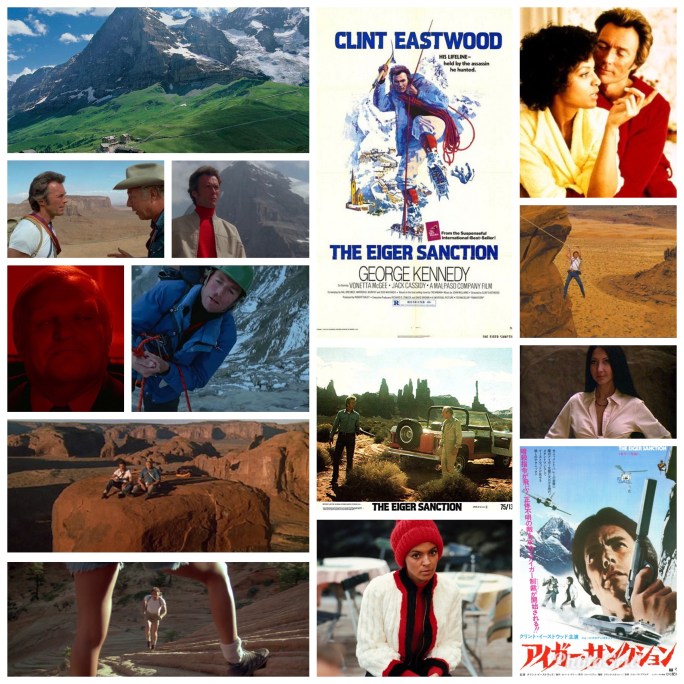
Clint Eastwood’s The Eiger Sanction

Clint Eastwood tries to do both Indiana Jones and 007 in The Eiger Sanction, a gorgeous production with incredible photography and stunt work that unfortunately is about half an hour two long, and would have greatly benefited from being a sleek ninety minute thing instead of being drawn out over a full two hours to the point where we wonder if some of the extended scenes of dialogue will end and if we’ll ever get to actually see the Eiger. Eastwood is Hemlock, a soft spoken liberal arts professor who just happens to also be a retired assassin super spy in hiding. His old organization, spearheaded by a creepy albino pseudo-bond villain (Thayer David), tracks him down and blackmails him into getting back to work, in particular climbing the infamous mountain in Switzerland to kill a target that ran up there… or something. This involves a long interlude in Monument Valley where an old buddy (George Kennedy, a study in gregarious exuberance) trains him up and an old enemy (Jack Cassidy, a study in the kind of characterization that would get a film boycotted these days lol) stirs up trouble. Then it’s off to Switzerland for an extended climbing sequence and an eventual showdown high atop snowy peaks. If this all sounds terrifically exciting… it isn’t. Eastwood shows a sure hand in directing elsewhere in his career but here the fight scenes are clumsy, cartoonish affairs, the dialogue is oddly conceived (Cassidy’s character has a dog whose name I won’t repeat here because I’m sure some lame brain would report my post) and the editing is loose and unrestrained, creating pacing that has you looking around the room for more interesting things to focus on. Still, the stunts (all done by Eastwood for real) are breathtaking, especially an ascent of one of those huge rock pillars that stand so formidably in the desert. The cinematography once the action switches to Switzerland is unbelievable but the place is so beautiful anyone could point a camera around and get gold. The climbing is all incredibly staged stuff and often suspenseful, but in terms of plot, character and cohesion it just falls apart though, sadly. I’ll always love it because my dad did, he was in the same Swiss town during filming and always talked about meeting the cast and crew. But yeah, from an objective critical standpoint, not the best Eastwood flick out there.

-Nate Hill

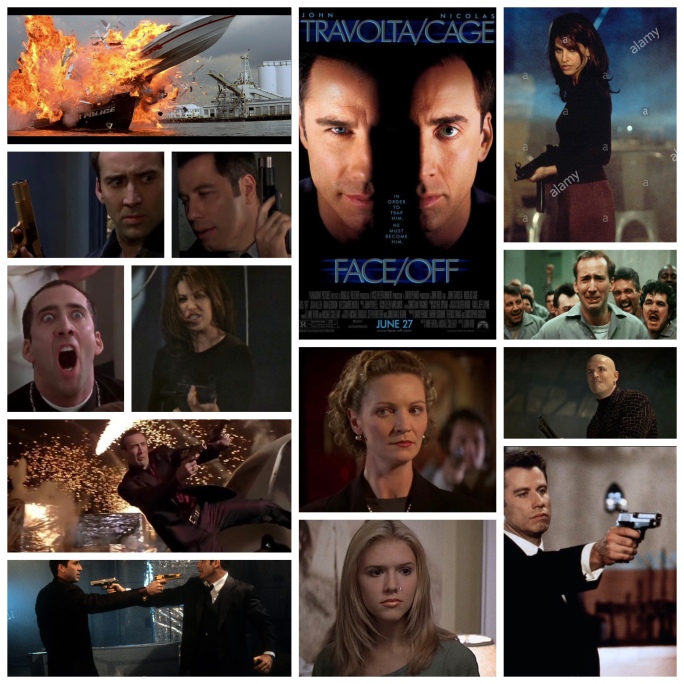
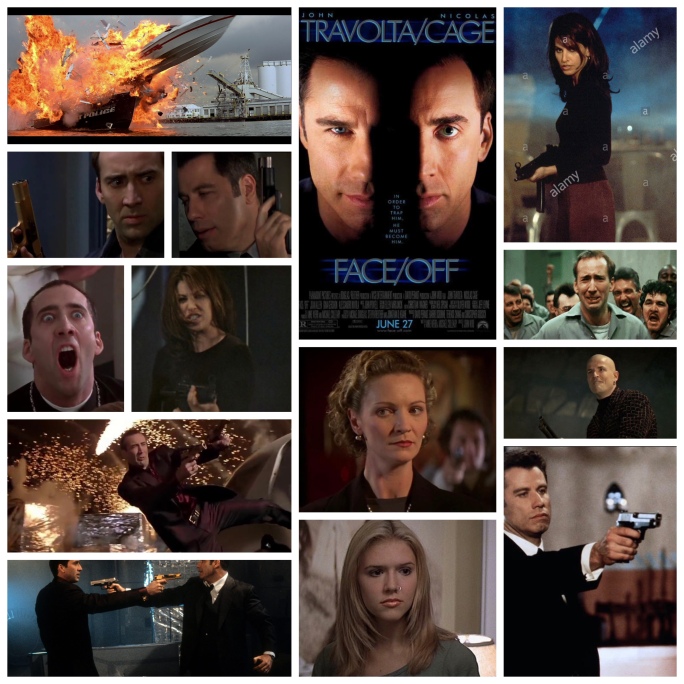
John Woo’s Face Off

John Woo’s Face/Off was originally conceived as a Schwarzenegger/Stallone vehicle and was to exist in a far more futuristic setting. I’m glad that the eventual execution was more down to earth because I get cold sweat visions of the 90’s Judge Dredd flick with Arnie swapped in for Armand Assante. Jokes aside, the performances, production design finished product turned out to be pretty much as amazing as anything you’ll find in Hollywood throughout the years, and has become a classic for me.

John Travolta and Nicolas Cage are perfectly paired as grizzled FBI super-agent Sean Archer and eccentric, psychopathic rock star terrorist Caster Troy, two star crossed arch enemies who find themselves battling on a whole new plane when their faces literally get swapped by the bureau’s fanciest clandestine nip tuck procedure. This gives the film not a only a high concept boost but the opportunity for each actor to really break free from the bonds of playing just one character and overlap into the realms of their counterpart, not to mention parody the absolute fuck out of their respective acting styles, which we as moviegoers know is never short on eccentricity for the both of them. Others revolve around them, specifically two very different women in their lives who are caught up in the in the titanic clash of will, ego and guns upon guns. Joan Allen is angelic poetry as Eve, Archer’s wife, and Gina Gershon adds a feline sexiness in Sasha, Troy’s old concubine. They both share a wounded nature in different ways, both having been drawn into the conflict and taking charge of their trajectory in different, equally compelling ways. Nick Cassevetes and his bald dome steal scenes as Dietrich, Troy’s trigger happy lieutenant, Dominique Swain shows early what talent she has as Archer’s strong willed daughter and there’s a galaxy of supporting talent including Harve Presnell, Colm Feore, CCH Pounder, Matt Ross, Margaret Cho, Thomas Jane, John Carroll Lynch, Alessandro Nivola, Chris Bauer, Robert Wisdom, Kirk Baltz, Paul Hipp, Danny Masterson, David Warshofsky, Thomas Rosales and Scottish badass Tommy Flanagan, early on before Hollywood gave him lines and those leering Joker scars did the talking.

This is the Cage/Travolta show most of the way though and they positively rock the house as two dysfunctional would-be siblings who could probably sit down and have a few beers together if they weren’t so busy trying to kill each other. Woo outdoes himself in a production that includes all of his hallmarks: white doves breaking formation in languid slo-mo, dual wielded berettas barking out clip after clip, symphonies of smashing glass, looming pillars of fireball pyrotechnics and the always classy tradition of characters having firefights clad in snappy suits. There’s a plane chase, a boat chase (my favourite sequence of the film), a breathless aquatic prison break, a church shootout of biblical proportions, a thundering FBI raid on a dockside stronghold, a vicious beatdown of Hyde from That 70’s Show (art eerily imitates life here) and the most inventive use of a harpoon gun I’ve ever cringed at.

Obviously the content of my favourite films is fluid and changes over time but in terms of a top action film, this is likely the constant. It’s like the whole genre went to sleep, had a dream and this was the resulting output. I gotta mention the original score because it’s a doozy, but I’ve always been a bit confused who to thank for it. IMDb has John Powell credited, whose work I love on the Bourne films. But other research turns up evidence of stuff from Hans Zimmer and James Newton Howard as well, so I’m not sure who did what or if it was a collaboratively lateral thing, but in any case it’s fantastic work, particularly in the boat chase where the composition reaches that near celestial height where it has the power to raise the hairs on your arms. What else is there to say? “Gonna take his face…. off…!”

-Nate Hill

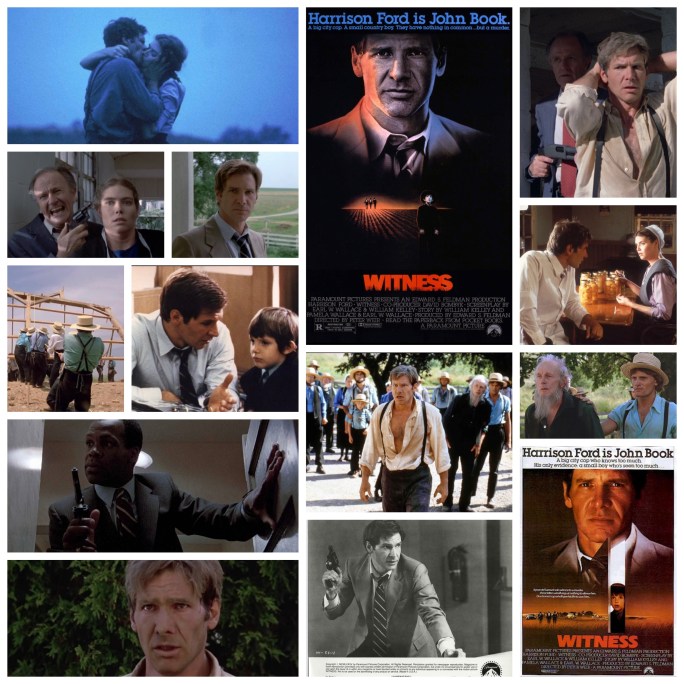
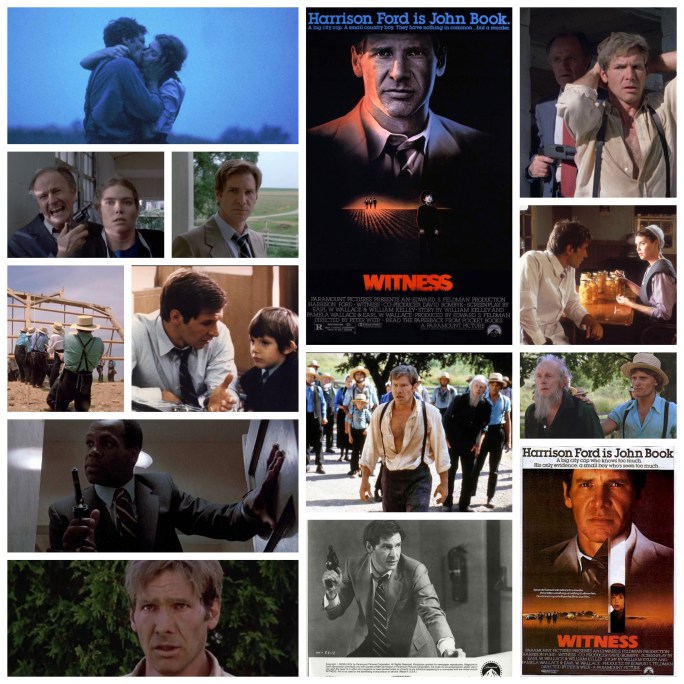
Peter Weir’s Witness

Witness is one of those films that in the hands of a less inspired director could have turned out to be pretty run of the mill thriller stuff, but they gave the script to Peter Weir, and he’s made a career out of films that could be called just about anything but run of the mill. This is essentially a fairly grounded tale of big city detective Harrison Ford undercover in Amish country to protect a young boy (Lukas Haas) who accidentally saw a cabal of corrupt cops murder someone in cold blood. It’s a fish out of water tale, it’s got budding romance, hot blooded action and even some comedy here and there. But there’s also this lyrical, esoteric atmosphere Weir brings to every project that really makes it something special. There’s a danger present in the Amish community, or rather the threat of such as seen in the long grass of the fields or sensed on the fringes of their village where the tree line looms. There’s a blessed calm as Ford learns the ways and customs of these folk and gets close with the daughter (Kelly McGillis) of one of their elders (Jan Rubes, a scene stealer) but alongside that there’s this restless, inexorable foreboding that these evil officers of the law could turn up at anytime and turn the calmness into a storm to follow. They eventually do, of course, and are played by the fearsome likes of Josef Sommer and Danny Glover, arriving like phantoms to herald a showdown of stealth and gun violence that is Western to its core but still stings with the grit of an urban cop flick. I love this film not so much for the story or script (both of which are just fine) but for the *feeling* it evokes, the ambience spun onscreen by Weir and composer Maurice Jarre, whose work here is ecstatically beautiful. There’s an extended sequence where we see the Amish folk building a barn and it’s a simple enough task, but something about the dutiful way Weir films it coupled with an almost grandiose passage of Jarre’s music makes it come alive in a way that not many scenes of its nature do in film. And always, lurking in the background, is the fear that danger is on its way, a sustained distillation of unease that helps to make this a gorgeous, effective thriller and all round great film.

-Nate Hill