Alan Parker’s Come See The Paradise


Alan Parker’s Come See The Paradise tackles a little spoken of, tragic period of American history: the internment of thousands of Japanese families in prison camps following the attack on Pearl Harbour, which sparked World War II. After the incident, a wave of frenzy and paranoia roiled across the states, and many of these people were separated from their loved ones for years, an event that altered thousands of lives, but not one you hear too much about in film. Parker is a born storyteller, whether it’s historical lore or gothic genre brilliance (insert obligatory Angel Heart reference), and here he approaches the subject matter with little to nothing in the way of melodrama, classic orchestral swells or tissue box bait, letting the story happen naturally and neutrally, the drama organically rising scene to scene as they happen. Dennis Quaid plays an Irish American man who falls in love with a Japanese girl (Tamlyn Tomita), and over a few years begins a life with her. He is a fiercely independent union man, passionately fighting for the working class, while she comes from a very tight knit family who rely on each other to make ends meet. Somehow the two of them make it work amidst the early stages of the American working machine, the love they have for each other keeping them afloat. Then the attacks occur. Quaid is separated from her and their daughter for over a decade, and the film’s pacing makes you feel every lost, broken moment of it. When their reunion does happen, it’s nothing like the romantic, tear jerking catharsis you’d expect, but a testament to Parker’s commitment to realism. The sadness comes from the hollow, unceremonious way in which these people are affected by such things, and how they simply go on, adapt and adjust, the pain an intrinsic part of everyday life. The movies show a different picture of that usually, an idealistic bubble where things always somehow end up alright, and every last thread is tied off somehow. Not with this one, which is why it may have been forgotten. In any case, it’s a beautifully tragic, eye opening piece that stays true to its narrative and follows it’s characters throughout bittersweet, minimalistic and believable arcs. 

-Nate Hill

B Movie Glory: Fist Of The North Star


If you ever want to see an entire film production embarrass themselves royally, check out Fist Of The North Star, a misguided, thoroughly awkward live action version of some obscure Japanese manga series. It’s one of those ones that painfully doesn’t translate into the realm of live action though, like that bizarre Super Mario movie they made. Full of notable character actors, packed with steampunk-esque special effects, it could have worked with a different story, but the theatrical intensity and specific vibe of oriental pop culture just doesn’t come to life well on the North American big screen. It’s also at war with itself tonally: there’s a light, PG Power Rangers feel in some places, but many scenes have graphic violence that pushes a hard R rating into the deep end, which makes for a jarring experience. Gary Daniels stars as Kenshiro, a lone warrior out to get Lord Shin (Costas Mandylor under one mess of a mullet), a brutal warlord who murdered his father, briefly played by Malcolm McDowell. McDowell pulls a classic McDowell move, showing up in the flesh for about thirty seconds before disappearing and lazily lending his iconic voice to a talking skeleton version of his character later in the movie. Don’t ask me to remember more of the plot than that because it would involve a rewatch, and ain’t nobody got time for that. Chris Penn is fun as Jackal, an angry vagabond with a giant potato head and the psychotic temper to match. Watch for Dante ‘Rufio’ Basco, Downtown Julie Brown, Clint Howard, Mario Van Peebles and more in equally ridiculous getups. The sole thing I can recommend here is the production design, lifted straight from some striking post apocalyptic video game, it makes somewhat of an impression. The rest lands with a colossal thud and just sits there, doing not much of anything. 

-Nate Hill

Mindscape: Anna 


Mindscape, given the less tantalizing title ‘Anna’ upon release, is a thinking person’s thriller, and perhaps a little bit too much so. In the near future, or perhaps some alternate reality, some humans have evolved into pseudo clairvoyants who can enter the memories of other people and interact with their subjects within them. This talent has been trademarked by law enforcement, who employ ‘memory detectives’ to psychologically resolve conflict or retrieve otherwise out of reach information. Mark Strong is one such man, but his talents have dimmed a bit following the deaths of his family and a crippling stroke. Hauled out of retirement by his former boss (Brian Cox, sly as ever), he finds himself tasked with navigating the labyrinthine mind of Anna (Taissa Farmiga) a girl accused of murder and deemed a potential sociopath pending diagnosis. The film is deliberately dense and elliptical, not standard Hollywood fare at all, which is nice to see, but it also trips just a little bit on its own cognitive aspirations, especially in the third act. It’s one of those pieces that’s less like The Cell, and more like Vanilla Sky or Danny Boyle’s Trance (two absolute favourites of mine) where so much of the story wades through muddy mindgames that at a certain point we think to ourselves ‘well who’s to say if any of this is actually real if it’s gotten so complex’, and indeed it’s very difficult to piece together what has transpired here, especially with a conclusion that would require multiple viewings to even get an inkling. It’s stylish as all hell though, given a clinical, steely grey palette punctuated by flourishes of startling red to show the capacity for violence lurking just out of sight within the opaque and enigmatic human psyche. The acting is top tier as well; Strong is reliably committed and intense, Farmiga is deeply disconcerting as the most fascinating and ambiguous character, showing blossoming talent that I look forward to seeing more of, while Cox steals his scenes as per usual. The film trips over itself a few times and like I said, overly convoluted, but it’s one mesmerizing effort for the most part, albeit after a second or third viewing. 

-Nate Hill

Ariel Vroman’s Criminal 


Ariel Vroman’s Criminal does its best to pay homage to beloved pseudo science fiction genre films of the nineties like Face/Off or Eraser, and for the most part it succeeds. All the elements are in place: padded, eclectic cast, implausibly sketchy high concept brain tampering, slick anti-terrorist war games, a brash arch-villain and adorably clunky emotional interludes. When a deep cover agent (Ryan Reynolds, weirdly uncredited) is killed in London, his FBI handler (Gary Oldman), has a shit fit at the lost secrets he knew and commissions Dr. Tommy Lee Jones to use sketchy cutting edge science and transfer Reynold’s memories into another man’s cerebrum. Of course they choose some violent, irreparably damaged convict, namely Jericho Stuart, played with growling, feral panache by Kevin Costner. “You hurt me, I hurt you back worse”, is this deeply sociopathic dude’s mantra, and it’s expectedly hilarious that the bureau shoots themselves in the foot by picking such a wild card for the program, but there you have it. With new memories, Jericho’s basic primal instinct is diluted with emotional scar tissue from Reynolds, haunted by his former wife (Gal Gadot, terrific), as well as a host of clandestine secrets from Ryan’s noggin that propel him on a globetrotting (well, London trotting, really) excursion to bring down a radical cyber criminal (Jordi Molla, the Spanish Gary Oldman, coincidentally sharing the screen with his counterpart). This is the Kevin Costner show all the way, it’s really the best work I’ve seen from him in years. He would have been way better taking the antagonist route with his career, as showcased here. Jericho is a bitter, psychotic outsider and Kevin plays it up royally, dishing out bone smashing beatdowns on random pedestrians and calling anyone he sees a ‘fucker’. Oldman yells at everything, and I mean everything. It’s like there were cue notes next to his lines that said ‘just scream your lines the whole way through’, but he’s fun too, that early career intensity showing through his weathered gaze. Michael Pitt also shows up with a hysterical Dutch accent, doing the boy with the dragon tattoo hacker shtick, looking pale and sullen. The cloak and dagger stuff is uproariously silly, as it should be, the emotional core appropriately sappy too. Smart move in keeping the hard R action movie alive, unlike some movies we know (I’m casting a disgusted look over at Expendable 3), and indeed Kevin gets some overly bloody kills in that fulfill the carnage quota and then some. He kicks ass, Oldman hollers, Reynolds cameos, Gadot cries, Jones looks weary, and so it goes. Not a total slam dunk, but it will make you feel nostalgic for those good old Sly/Armie/Van Damme blitzkriegs of yore. 

-Nate Hill

B Movie Glory: Slow Burn


Slow Burn is.. odd, to say the least. Living up to its title, it pretty much goes nowhere, tagging along with James Spader and Josh Brolin as they stumble around in the desert, both hitting on treasure hunter Minnie Driver, who constantly outwits them. This kind of lower budget, steamy stuff just seems to have a licence to languish, in the sense that story is of little concern, it’s more about mood and episodic character interaction than anything else. Spader and Brolin are doing the ‘Of Mice & Men’ shtick here, playing two hapless escaped convicts, one a sharp tongued weasel (Spader) and the other a dimwitted lug (Brolin). They’re kind of lost, in both perpetual arguments and the vast Mojave around them, when they run into Driver, whose presence, and the idea that there’s a whole whack of diamonds buried out there somewhere, inevitably stirs things up. The diamonds belonged to her parents, and there’s hazy scenes relating back to a tragedy involving her gypsy father (Chris Mulkey, briefly) and a mysterious character played by Stuart Wilson who serves as pseudo-narrator as he wanders around out there too. Got that? It’s ok, they barely explain it better than I just did, I’ve seen the thing twice and I’m still not sure how it all adds up either. Sweat, sand, sensual looks snuck between Brolin and Driver, dreamy atmosphere, threats of violence from Spader’s overacted, crazy eyed moron, a treasure hunt and general lack of cohesion is all you’ll find out here in this desert. Good for an absent minded watch or for background noise, not much else though. 

-Nate Hill

HBO’s Witness Protection 


The sad thing about HBO original films is that they air pretty quick and without notice, then are scarcely heard from again, despite having really good stories and production design to boast, with no theatrical crowd to ever share them with. Witness Protection is one among many of these, a brilliant, surprisingly thoughtful mobster melodrama starring Tom Sizemore in a rare and commanding lead role. He plays Boston area gangster Bobby ‘Bats’ Batton here, a wiseguy who gets a rude awakening one night when a violent attempt is made on his life by rival crime factions, striking at home while his family are there. His lifestyle has inadvertently put those he loves in danger and now there are consequences, as grimly outlined by Forest Whitaker’s sympathetic FBI agent. Bobby, his wife (Mary Elizabeth Mastrantonio is so great, why isn’t she in stuff anymore?), son (Shawn Hatosy) and young daughter (Sky McCole Bartusiak, who famously died young a few years ago) are relocated into the witness protection program run by the Feds, given new identities, their lives uprooted and their future uncertain. Now, I searched for this film for years (it’s near impossible to find) thinking there’d be some kind of actuon intrigue angle, a few gunfights as his enemies tracked him down, but such is not the case. This is a mature film, a meditation on what it takes to change who we are when our choices endanger the lives of those we are supposed to protect. Bobby is a man of violence who grew up in a certain way, and he has transformed that into his livelihood. But it’s also a risky creed to cling to, and eventually a line is crossed, the line between balancing a chaotic life, or letting it run away from you. He’s forced to change, to show honesty and the will power to go straight, and this causes intense strain on the relationships with each of his family members, both individually and as a group. It’s equal parts fascinating, heartbreaking and hopeful to see a family go from one extreme to the other, and every facet of the situation is explored in a script that feels authentic and unforced. Sizemore and Mastrantonio deliver powerhouse work that stuns and stings, inhabiting uncomfortable moments of personal anguish with gravity to spare. This one isn’t your typical crime drama, and is all the better for it. 

-Nate Hill

B Movie Glory: Night Trap


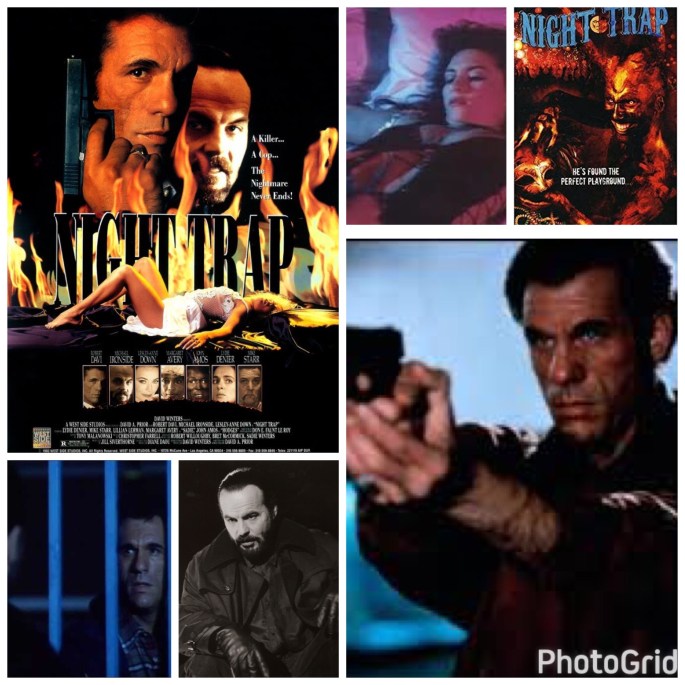
Night Trap is so old, obscure and out of print that I had to order an Amazon copy just to make sure it was even real, and not some dream I had as a kid. It’s real enough, and a glorious helping of low budget supernatural tomfoolery at that, with two charismatic character actors headlining. Robert Davi, in a rare lead role, plays a headstrong New Orleans cop who is hunting down a serial killer (Michael Ironside) that appears to have sold his soul to the devil in exchange for invincibility and a host of freaky deaky evil superpowers. Davi’s father was also a cop who pursued Ironside, and the monster likes to taunt both of them, leaving a trail of bodies in the hectic celebration of Mardi Gras. There’s a million of these type of movies, and they’re all across the board in terms of quality. It comes down to script and actors, really, as there’s never enough money to make any real visual magic. This one has a mile wide mean streak though, Ironside’s villain is a full on moustache twirling, nightmarish fiend and the veteran tough guy plays him as such. Matched against Davi, another notorious badass, it’s a B movie royal rumble that hits high notes of intensity, schlock and pulpy, violent delirium in all the right cues. Fun stuff if you’re a fan of these actors, and can actually locate a copy. 

-Nate Hill

James Gunn’s Guardians Of The Galaxy Volume 2


James Gunn’s Guardians Of The Galaxy Volume 2, I’m happy to report, blows the first film right out of the water. There’s a subversive, wonderfully sarcastic sense of humour running through both films, as well as a boundlessly creative and colourful canvas of ideas both big and small, coalescing into something just this side of chaos. Picture a stick of dynamite; Volume one is the fuse, fizzling terrifically as it gets off to a great start. In many franchises, by the time the first film uses up the wick and reaches the stick, it’s sequel, the energy is lost and we end up with a dud of a follow-up. Not this baby. Volume two is the stick of dynamite, exploding gloriously across our screens in fits of dazzling imagination, humour that doesn’t quit for a nanosecond and the heart to back it up. Volume one dipped its toe in the water and showed us the roots of what a great space opera might look like, and volume two plunges in to give us just that. We rejoin with the merry band of misfits who now know each other a little better, are more comfortable working as a unit, and blast off into a tale of space battles, living planets and perpetual banter. Chris Pratt’s Star Lord, equipped with a brand new eight track collection of vintage pop songs, is still searching for his real dad when he kind of finds him by accident in the form of Ego, a powerful celestial being slyly played by Kurt Russell. Joining him are the gang we know and love, broccoli hued babe Gamora (Zoe Saldana), deadpan Drax (Dave Bautista outdoes himself in the comic relief department, a true highlight) Rocket (Bradley Cooper, excellent), scowling smurfette Nebula (Karen Gillian), adorable Baby Groot (Vin Diesel, collecting a mortgage-eclipsing paycheque for literally doing nothing) and antihero Yondu (Michael Rooker). Rooker gets far, far more to do here than he did the second time around, becoming a fleshed out character with a terrific arc and a whole pile of scenes, a strong asset to the film. The villain here is way more compelling than Lee Pace’s silly space vampire in Volume One, and I won’t spoil anything but there’s more than a few surprises. Kurt Russell’s living planet is pure delicious eye candy, a vista to rival anything in Star Wars, Mass Effect or similar worlds, detailed and lovingly rendered. As per usual there are cameos, but surprisingly it’s more than the obligatory laundry list of Where’s Waldo fellow Marvel appearances. There are truly inspired name drops here and a few genre titans who show up, none of whom I’ll give away except Sylvester Stallone. He’s given an unassuming supporting role that he plays solidly without tongue in cheek or any hint of a gimmick, just an enjoyable little addition to the cast. James Gunn is a cinematic punk, cracking prudence right in the jaw, throwing caution to the wind and tirelessly churning out the kind of fresh, funny and irreverent films we want to see, scrappy crowd pleasers that people will actually remember, which lord knows is what Marvel needs to shake up their sometimes complacent, too comfortable aesthetic. The soundtrack is obviously a winner, and any film that uses Fleetwood Mac’s The Chain as its main cue has pretty much already won me over. This will probably be the cornerstone of summer blockbuster season, it’s just too much fun and has everything you’d want, with the dial cranked just past what we got the first time around in the best way possible. I am Groot. 

-Nate Hill

Ballistic: Ecks Vs. Sever


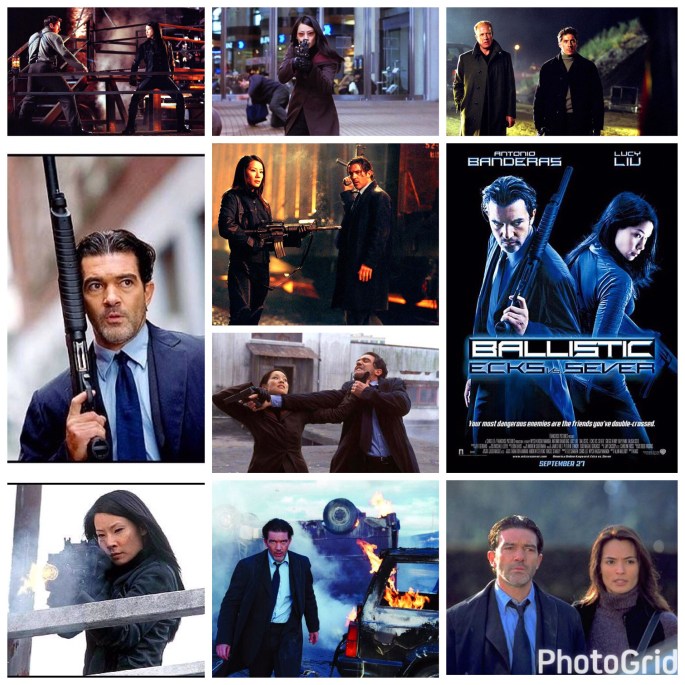
Big. Loud. Dumb. Hollow. Notorious train wreck and box office failure. Ballistic: Ecks Vs. Sever is all of these things, and yet somehow I still got a kick out of it, albeit in the shallow end of the speedometer. I know what you’re thinking.. “wow, another turd that Nate is polishing up with multiple syllable words to make it seem like less of a piece of shit.” Well, you’re not wrong. I fully concede that this is one huge glorious, post Mexican food pile of shit, but there’s something about it that pulls me in every time it shows up on SyFy or some such channel. Maybe it’s the fact that it’s one of those rare films that not only is shot in my hometown of Vancouver, but actually set here too. Mostly Vancity just doubles for Chicago, New York or any other Yankee metropolis, but director Kaos (yes that’s his name) chose to tell the story right here in my little burg. Speaking of story, or lack thereof, it’s one big shredded mess of a plot involving Ecks (Antonio Banderas) and Sever (Lucy Liu) two former federal agents out to get each other, eventually working together and then both becoming chumps in some ludicrous government conspiracy involving arch villain Gant (Gregg Henry, hammy as ever). It makes little to no sense, it’s so convoluted it prompts the viewer to throw their hands up in exhausted defeat and give up hope on any cohesion, instead letting a wave of shitty early 2000’s special effects and over elaborate, unwarranted stunt work to wash over them like a tidal wave of rejected video game cutscenes. And poor Vancouver, looking like a ghost town, just gets blown to fucking smithereens by these trigger happy, matrix wardrobed, scowling lunatics. I’d probably stay off the streets too if Lucy Liu massacring hordes of VPD officers was in the forecast, or on second thought maybe not, that sounds kind of hot. I’m rambling, but any review of this film has the right to get sidetracked and ramble as much as this pile of wanton sound and fury does for the entirety of its scant runtime. It’s disastrous to be sure, but does that stop me picking up the remote and switching over to something else when it’s on? Not really. Plus, despite the actual film, this has to have one of the coolest looking DVD cover posters ever designed. I mean, look at it. 

-Nate Hill

The Art Of War


Everyone loves a Wesley Snipes flick. If it’s decent, that is, and these days he’s been churning out some sewer muck. Back in the day, however, he had some bangers, which includes The Art Of War. Wesley heads up an elite tactical team here, secretly employed by the United Nations, hired to do all kinds of cloak and dagger stuff, including securing trade deals, eliminating potential threats and maintaining cooperation from all sides. Run by a well spoken Donald Sutherland and Anne Archer, it’s a low key ‘fight fire with fire’ situation, until it all goes tits up and Snipes is framed for the murder of some bigwig Chinese dirtbag. Forced to contend with Triads, government factions and his own former partner gone rogue (Michael Biehn steals every scene, as usual), it’s a nice set up for a serviceable, above average action yarn. That Oriental influence always seems to make these thrillers seem cooler (ever seen Black Rain or Rising Sun?) which helps as well. Snipes and Biehn are livewires though and have a fantastic silenced pistol duel late in the third act, which is one slick showcase of a sequence. Not a whole lot to this one, but as an entertaining garden variety actioner, it holds up just fine. 

-Nate Hill