B Movie Glory With Nate: Oblivion

  
“It’s high noon at the far end of the universe”, the dvd poster of Oblivion states. Years before the underrated Cowboys & Aliens came out, Oblivion came along, and it’s definitely gives the concept a better, and quirkier run for its money. Granted it’s essentially a B movie, and it’s meagre budget shows to the point where it looks like a grade school play. But therein lies it’s charm. It’s got a cast of supremely wacky old west stereotypes played by some surprising, familiar genre faces who you’d never thought to be seen rough housing together in the same flick. It also has some lovingly crafted, creaky stop motion animation that calls Harryhausen to mind and brings to life some super weird alien hybrid thingies that look almost Henson-esque as well. When a lone spaceship lands on the outskirts of an intergalactic desert town, it’s occupant brings trouble along with him. He’s a nasty, one eyed reptilian alien gunslinger named RedEye, played by the inimitable Andrew Divoff. He growling, bad tempered son of a bitch, and his first order of business is to ruthlessly slay the town’s sheriff, and claim it for himself. What he doesn’t count on is the Sheriff’s son (Richard Joseph Paul), a prospector who soon returns to Oblivion looking for answers, along with his Native friend Buteo (the late great Jimmie F. Skaggs). All kinds of townsfolk end up in the crossfire, including drunken Doc Valentine (a priceless George Takei), slinky brothel owner Miss Kitty (Julie Newmar), a cyborg police deputy (Meg Foster), a pawnbroker (Isaac Hayes) and the town’s elegant undertaker, played by Carol Struckyen who some may remember as the giant from Twin Peaks. RedEye has a smoking hot henchwoman and girlfriend named Lash, played by B movie scream queen Musetta Vander, who gets the vibe they’re going for here and sinks her teeth into the material with admirable abandon. The film sticks to its guns despite being obviously silly and somewhat falling apart in a climax that oddly is too darkly shot to make out properly. What it lacks in resources it makes up for in imagination, which it has in spades. Alien scorpions, cyborg deputies, leather clad babes are but a few of the genre mashing treats to be found here. Great stuff. Oh and check out the sequel as well, called Oblivion 2: Backlash, it’s a nice companion piece. 

Denis Villeneuve’s Enemy: A Review By Nate Hill

  
Denis Villeneuve’s Enemy is one of the most unsettling film experiences you will ever sit through, and the damn thing is only 90 minutes. It’s disconcerting, ambiguous and seems to exist simply to spin the viewer’s anxiety reflex into a storm and make our stomach turn loops. It’s a trim entry into the psychological upset sub genre, and puts a frazzled looking Jake Gyllenhaal through a wringer as he pursues a mysterious doppelgänger through the streets of Toronto, a bustling city that feels oddly desolate as glanced upon by Villeneuve’s camera, adding to the themes of paranoia and mental unrest. Gyllenhaal plays a twitchy college professor who is stuck in a closed loop routine: he gives lectures at the local university, drives home to his emotionally inaccessible girlfriend (Melanie Laurant), rinse and repeat. A chink appears in the chain when he becomes aware of another man in the city who appears to be his identical twin. The other man is a small time actor with a pregnant wife (Sarah Gadon) and a decidedly more nasty approach to the situation than the professor. The two of the, circle each other in a disturbing game of not so much cat and mouse, but Jake and Jake, both of them having not a clue as to what is going on, the edges of madness inching closer to both of their perception. Are they twins? Are there even two? Is it just one of them, losing their mind? There’s very freaky dream sequences with the constant imagery of spiders, both large and small, and what do they mean? Who’s to tell? Denis has stated in interviews that there is both rhyme and reason to his creation here, but whether he will ever divulge them remains to be seen. Perhaps it’s better left illusory, a formula for entrancing audiences that has already proved to work well for David Lynch. The moment that the man behind the curtain reveals the conscious meaning of his very subconscious efforts, the spell is no doubt broken. In any case, it’s a very hard film to process or focus on, our nerves jittering constantly and sabotaging any modicum of rational though that we might employ in deciphering the piece. This may be called style and atmosphere over substance by some, but even in not comprehending what’s going on, we feel deeply that there is some sort of cryptic cohesion if we are able to feel between the lines, maybe coming up empty handed ultimately, but knowing within us that we’ve attained wealth to our soul simply by bearing witness. I can’t say it’s a film that I love, or that I would watch again, but it’s certainly one that won’t leave my memories any time soon, and that is an achievement no matter how you look at it. It’s also got one of the scariest and most unexpected endings to any film I’ve ever seen, taking you so off guard that you feel like you’re going to have a coronary. It’s filmed in sickening piss yellow saturation which adds to the overall disconcerting nature, and quite the striking colour choice as well. I can see why this one was released with little fanfare or marketing, despite the presence of heavyweights Villeneuve and Gylenhaal. It’s difficult stuff, a movie that frustratingly soars above your head, onward towards its intensely personal and psychological destination. It’s up to us to jump, grasp and attempt to reach as high as the piece in order to get what we will out of it. Good luck. 

Victor Nunoz’s Coastlines: A Review by Nate Hill


Victor Nunoz’s Coastlines is a nice small town drama with some top players all giving fine work, causing me to wonder why more people haven’t heard of it, and how come it didn’t get a wider release. In any case, it’s low key and really captures the quaint rural vibe of less densely populated areas in the states. The cast is absolutely to die for, consisting mainly of very distinct, frequently garish actors who all play it dead straight and relaxed, which is a huge switch up for most of them. Timothy Olyphant plays Sonny Mann, an ex convict recently released from prison, quietly arriving back to his Florida hometown, and the dregs of the life he left behind. His Pa (the ever awesome Scott Wilson) is conflicted by long simmering resentment, and the love for his son buried just beneath. Sonny reconnects with his best friend Dave Lockhart (Josh Brolin), who has become the town’s sheriff in the years gone by. Sparks fly between Dave’s wife (Sarah Wynter) and Sonny, creating a rift between the two and illustrating Sonny’s unavoidable knack for creating trouble for himself, and those around him. Further tension comes along when the town’s local crime lord Fred Vance (William Forsythe at his most genial and sedated) tries to strong-arm Sonny into assisting with nefarious deeds, using his younger brother Eddie (Josh Lucas) to convince him. Even when tragedy strikes and these characters go head to head, it’s in the most relaxed, laconic way that permeates southern life. Robert Wisdom has a nice bit, Angela Bettis shows up as a girl with a thing for bad boys, and watch for the late great Daniel Von Bargen as the local Sheriff. This one fits nicely into a niche that leans heavily on small town drama, dips its toes ever so slightly into thriller territory, and is a charming little piece that’s worth a look to see these actors on an acting sabbatical.  

Girl, Interrupted: A Review by Nate Hill

image

James Mangold is a director who takes nothing but top shelf scripts and spins them into gold, and Girl Interrupted is a shining example of this. It’s based on a book by Susannah Kayson in which she outlines an 18 month stay at a mental ward sometime during the 60’s. Mangold adapts her book for the screen, gathers an excellent cast of talented gals and a couple guys, and makes a film that holds up today like it was still it’s release week in 1999. Winona Ryder plays Susanna, a reckless girl who is labeled wayward and unstable by her parents, committed to a facility by her stern psychiatrist (Red Forman himself, Kurtwood Smith). She’s a little rough around the edges, but one senses the innate sensibility to her that perhaps has been buried under turbulent behaviour not by anything within her, but by the constricting nature of the time period she has been born into. In any case, she finds herself thrown into an environment she didn’t expect, with many other girls, some of which she clashes with, some of which she ends up befriending, and one that.. well, defies classification, really. The girl in question is Lisa, played by a fantastically fired up Angelina Jolie who nearly combusts upon herself in her furious performance. Lisa has been dubbed nearly unable to treat, yet simply has the kind of soul that doesn’t fit into a box, let alone lend itself to scholarly dissection. Ice cool one moment, a raging typhoon the next, and holding a dense riot shield over any trace of her true emotions every second, she’s an enigmatic, elemental wild card. It’s the best work I’ve ever seen from Jolie, getting her a well earned oscar nod. She teaches Susanna some lessons that only people on that side of the glass can comprehend, confounding the facility’s head doctor (Vanessa Redgrave) and puzzling a kind orderly (Whoopi Goldberg), two rational people who simply can’t understand the kind resolution and companionship that often comes out of irrational, unconventional interaction that almost always is seen as ‘unstable’. Ryder is pitch perfect and carries her share of the load, but despite being the protagonist, it’s Jolie’s show all the way. She’s unbelievably good and will break the heart of both first time viewers and veterans who put the dvd in every so often for a tearful revisit. The late Brittany Murphy is great as Daisy, another complicated girl, and Clea Duvall scores points as Georgina, the shy and reserved one. There’s also work from Jared Leto Elizabeth Moss, Angela Bettis, Bruce Altman, Mary Kay Place, Kadee Strickland, Misha Collins and Jeffrey Tambor. Tender, patient and non judgmental are qualities which are essential in films of this subject matter, as well as empathy from both viewer and filmmaker, to take a look at these girls and even though we may not understand what is going on with them or their beaviour, to simply bear witness, and be there for them. Mangold knows this and acts accordingly, leading to a beautiful film of the highest order. Viewers are sure to do the same, completing the artistic ring full circle.

Conviction: A Review By Nate Hill


Tony Goldwyn’s Conviction is a searing dramatic tale that’s heavily based on true events, and is essentially the underdog story boiled down to its most effective elements, with inspiration running throughout its truly remarkable storyline. Hilary Swank can be a force of nature in her work, and she’s dynamite here as Betty Anne Waters, a small town girl who is very close with her rambunctious sibling Kenny (Sam Rockwell), who grows up as the troublemaker of the two, running afoul of a nasty local police officer (Melissa Leo). When his next door neighbour is found stabbed to death, Leo sees it as her opportunity to get rid him for good, and tampers with evidence, until he is convicted. Guilty until proven innocent is the mantra with this difficult tale, and because it’s based on a true story that happened in real life, it unfolds at a snails pace of tragic events in which a satisfying outcome sometimes just seems out of reach. With Kenny in wrongfully convicted and rotting in prison while his wife and daughters edge towards moving on, Betty does the unthinkable: with no previous experience in college, let alone law, she decides to study for the bar exam, in order to eventually represent Kenny in court, and prove his innocence. It seems like something from a movie, and here we see it, but this is something that really, really happened, which to me is extraordinary and essential to make known. She persists through many obstacles both great and small, and with the help of a dapper senior colleague (Peter Gallagher), and a perky fellow law student (Minnie Driver) she passes the exam and sets out to defend her brother. It’s a rocky road, beset with the decayed and deliberately lost memories of years before, and the police officer’s longstanding belligerence. Unreliable witnesses, uncooperative testimonials and all sorts of stuff get in her way, but Betty ain’t a girl to quit or back down, a character trait which Swank seems to have been born to play, and is the lighthouse which guides this fantastic film along its track. Rockwell exudes burrowing frustration as a man in a position of incomprehensible sadness, hopeful yet resigned to his fate which has been orchestrated by evil, targeting him in wanton cruelty. Painful is the word for him here, and when Rockwell sets out for a mood in his work, you damn well feel it. Juliette Lewis briefly rears her head as a dimbulb witness who plays a part in Betty’s quest, as does Clea Duvall very briefly as another witness who seems to have no idea what she actually saw. Melissa Leo is an actress who is utterly and totally convincing whether she’s on the good or the evil side of the coin, holding the audience in rapturous awe with seemingly little effort. Here she’s so nasty it radiates off the screen, providing a core incentive for Betty’s struggle, whether or not the events actually played out like that. Director Tony Goldwyn is an actor himself and uses that experience to forge a film with respect and sympathy for its two leads. One of the more underrated films of 2010.

The Jungle Book: A Review by Nate Hill

image

Prepare your eyes for maximum bogglement, work out your abs so you don’t bust a gut laughing, and most importantly, dust off that childlike sense of wonder before going to see Rudyard Kipling’s The Jungle Book, boldly and lovingly retold by Jon Favreau in what is the most flat out exciting, adventurous film of the year thus far. The director pulls  off a balancing act between palpable tension, character interactions that come straight from the heart and land squarely in ours, and some of the most believable, jaw dropping CGI I have ever seen on screen. The animals look so impressive and lifelike that after seeing them I shelved away some of my inherent reservations about computer generated effects as a dominant force in a piece, and simply gave in. The atmosphere is lush, intoxicating and deeply detailed, with a naturalistic feel and tone. Young Neel Sethi is tasked with being the only fully human component, and is perfect. His interactions seem real and rehearsed, immersing the viewer further into the visuals. Mowgli is a young man cub, found on the edge of the jungle by the panther Bagheera (stately, compassionate Ben Kingsley) and given to a wolf pack to be raised by alpha Akela (Giancarlo Esposito) and Raksha (Lupita Nyong’o). Not all in the animal kingdom are receiving of this man cub, especially a terrifying Bengal tiger called Shere Khan, given the rumbling tones of Idris Elba, inspiring fear in animals and audience alike. He has a rocky relationship with man, and wants Mowgli dead. Bagheera takes him far into the jungle, where they are separated and Mowgli’s adventure truly begins. He wanders into the path of Kaa (a slithery Scarlett Johansson) a monstrous, seductive python, and is taken under the wing of Baloo, an adult Winnie the poo voiced by Bill Murray. Murray is one of the film’s great delights, and as soon as he shows up we forget about all the menace and threat which preceded his arrival, and are swept up into his affable, lounging lifestyle and brightly colored neck of the woods. Murray clearly ad libbed a lot of Baloo’s dialogue, and anything he didn’t he still gives that unmistakable, winking ‘Murray’ twinge that I so love. Mowgli’s adventure continues, as he stays one step ahead of Shere Khan and is visited by the king of the monkeys, a twenty foot tall, lumbering orangutan named Louie, voiced with demented, pithy glee by Christopher Walken. As soon as he showed up the laughs erupted from within me, and reached a manic peak as he belts out the ‘Oobie Doo’ song in priceless Walken fashion, his monkey mannerisms uncannily starting to resemble Walken’s own distinct visage. Many of the animals serve as differing parental figures to Mowgli, representing elemental factions of raising one’s young. Bagheera is cautious, doubting and skeptical. Baloo is the fun loving, lenient one. Even Shere Khan has a curdled paternal feel to him, like the brutal stepfather who is damaging to his offspring. Raksha is the unconditional mother, and that devotion comes out wonderfully in Nyong’o’s souful performance. The vocal performances are aided by the stunning effects; the CGI of facial features allow the actors work to truly extend into the realm of what’s visible, with real emotions displayed by the creatures, and not a single rendering that’s anything short of lifelike. The film evokes true wonder and primal excitement, escapism that takes itself seriously yet knows when and how to play, a dazzling technical marvel, a timeless story well told, all in one cinematic package that is not to be missed. Oh, and stick around for the credits, instead of Walken out of the theatre and missing a final musical treat.

Passengers: A Review by Nate Hill

image

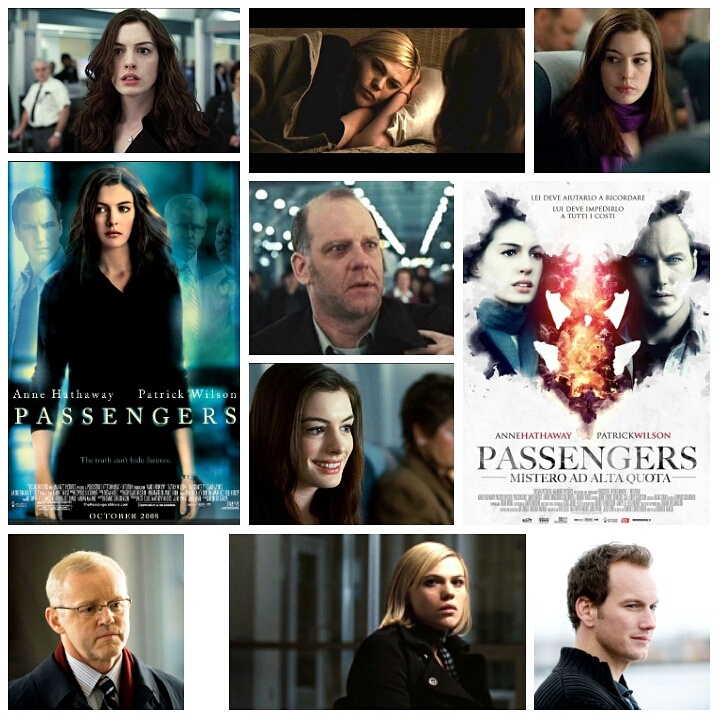
Passengers is a low key supernatural drama that came and went with little fanfare or attention back in 2008. Part of the reason for that could have been that it was marketed as a thriller, which is not so much the case. There is an eerie vibe to it, and certainly a paranormal component, but it’s quieter and much closer to the chest than advertising might suggest. It wasn’t reviewed very well, branded as predictable and derivitive. Some of its plot devices have been used before in the past, to be sure, but I greatly enjoyed the film and loved the way in which it’s story unfolds, told very well by its sturdy cast. Like Mark Pellington says, fuck the people, that’s why there’s 31 flavors. Anne Hathaway is excellent as Claire, a grief counselor who is tasked with looking out for a handful of people who have survived a catastrophic plane crash. She’s new to her profession, her eagerness laced with self doubt, yet she remains hopeful. All of a sudden, the patients in her cate begin to disappear mysteriously, and she starts to question the situation, as well as her own reality. The survivors are damaged and not fully willing to open up to her, collectively scared of some unseen threat. Claire has repeated run ins with a unknown and very distressed man (Andrew Wheeler, local vancouver actor and former teacher of mine) who has ties to the accident. It’s all hush hush and quietly unsettling, until we slowly begin to realize what’s actually happening, and the it changes gears and becomes very touching and thoughtful. Clea Duvall is great as one of the skeptical survivors, Patrick Wilson solid as always, and there’s work from Dianne Wiest, William B. Davis, Andre Braugher and briefly David Morse. Sure, this type of story has been done to death time and time again, draining new efforts of some of their effect, but if one comes along that gets it right, tells it’s story in a way that holds both my emotion and interest in its spell, I’m all ears. This one did just that.

B Movie Glory With Nate: The Last Stop

  
Agatha Christie takes a trip to the Pacific Northwest in The Last Stop, a chilly little indie B movie in which we have the pleasure of watching Adam Beach and Rose McGowan try to smoke out a killer amidst a group of people stranded in a remote motel during a blinding snowstorm. A welcome setup for intrigue indeed, if you’re into cozying up to these actors for a tense little 90 minute guessing game packed with just the right amounts of cheesiness and tension. Beach plays a local Sheriff who is stuck at the establishment while its Proprietor (the great Jurgen Prochnow, refreshingly cast against type) struggles with a guest overload as the storm gathers steam. Beach’s old flame (the ever alluring McGowan) has resurfaced in his life with little explanation. There’s also an obnoxious hustler (Callum Keith Rennie) a sleazy would be cowboy (Winston Reckert) and other disconcerting weirdos lurking about. Some are red herrings, some simply filler for the narrative, and all are entertaining, whether intentionally or not. The plot meanders in snowy, typically nonsensical b-movie form until it pulls itself together for a very grounded finale that seems misplaced given what came before, but welcome all the same. McGowan could dub a Korean pop song and still be riveting, and it kills me she isn’t in more stuff, but she’s made it clear that acting was never her first love. Nevertheless she’s great as both the most mysterious and fascinating character. Shades of The Hateful Eight, Eye See You with Stallone, and many a snowbound mystery. Fun stuff. 

Anamorph: A Mini Review by Nate Hill


Anamorph is a loving ode to the wilfully nasty serial killer flicks of the 90’s, obviously borrowing heavily from a few specific ones, the clearest example being Fincher’s Sev7n. It’s got the same dank, dispirited tone of that one, a restless urban nightmare wherein one lone detective searches for a heinous murderer that seems to elude him every step of the way, leaving increasingly grisly crimes in his wake. The detective here is Stan Aubrey (Willem Dafoe), a troubled fellow suffering from OCD, as if he didn’t have enough to handle, with a killer on the loose. Dusky New York streets are the predator’s playground, and he kills using some very elaborate, and very u settling techniques. Anamorphosis is a method used during times such as the Renaissance, where a painter would create a seemingly nonsensical sprawl with neither shape nor form, but when looked at through a tiny window of exposure (camera obscure), or from a painstakingly meticulous angle, a new image comes to light, in this case providing Dafoe with clues. Now this isn’t any Renaissance painter we’re dealing with, and he doesn’t use oil base, if you catch my drift. The crime scenes in this film are very, very horrifying and hard to watch, almost on the level of Sev7n. Dafoe gets help from his art fanatic buddy Blair (Peter Stormare), and tries to look after the troubled Sandy (a moody Clea Duvall), the relative of a deceased friend. There’s also work from Yul Vasquez, Scott Speedman, Don Harvey and the late James Rebhorn. Nasty stuff, this one, but stylish and well worth a late night watch with the lights low and your nerves on edge. 

Lee Tamahori’s Mulholland Falls: A Review by Nate Hill

image

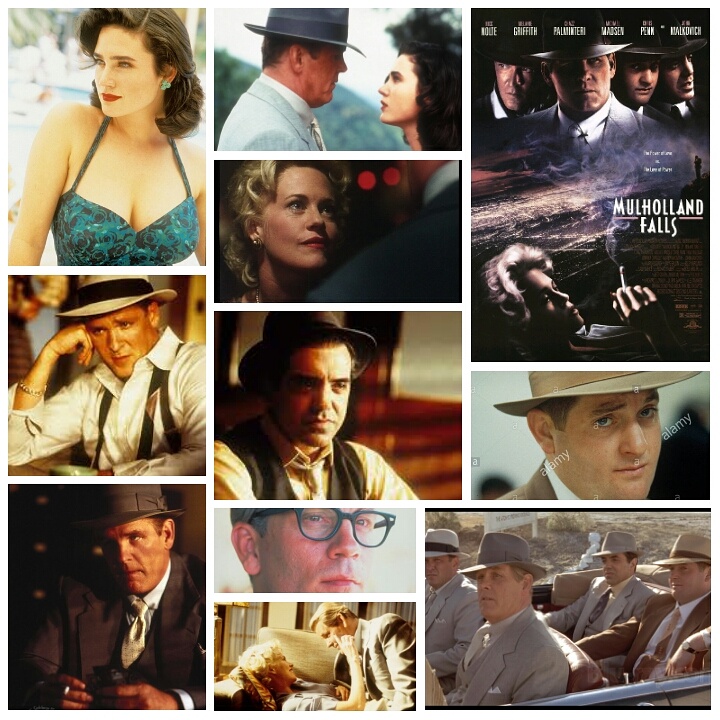
Lee Tamahori’s Mulholland Falls gets a bad rap in some circles for being boring and uneventful despite its charismatic cast and opulent setting that’s ripe for peppy action sequences. I think they are confusing boring with the concept of a paced and very slow burn, yet one with all the texture and richness of an action film, one that admirably decides to take the route of the old school noir, with loving care put into story and character, two elements which the action and violence live simply to serve, and not to take the driver’s seat against. Or it’s simply not some people’s cup of tea, which is totally okay too. Personally though, I love a good L.A. cop yarn that has a story to go with the toughness. This one bears striking similarity to 2013’s Gangster Squad, which also had Nick Nolte playing a 1940’s Los Angeles cop in charge of a squad that operates outside of the law. That film is pure cheese, all razzle dazzle and no plot. Mulholland Falls falls somewhere between Gangster Squad and L.A. Confidential; not quite up to delving into the serpentine intrigue of the latter, yet infinitely more interested in telling a worthwhile story than the former. And tell it does, in high flying style that only a crime film set in that time period can do. Nick Nolte plays Hoover, a whiskey voiced, take no prisoners LAPD badass who heads up an elite anti corruption task force that operates far outside the red tape and pretty much do what they want to stomp out corruption. His squad consists of Michael Madsen, Chris Penn and a scene stealing Chazz Palminteri as the oddball of the bunch, with serious impulse control issues. A straight up dream cast of tough guys, and although I’ll admit that Penn and Madsen are a tad underused, their presence alone boosts the film’s credentials into an epic pantheon. The film revs up with a kicker of an opening sequence in which the squad severely roughs up a troublesome mobster (an uncredited William L. Petersen). “This isn’t America, it’s Los Angeles” Nolte growls to him, stating the tone of perverse lawlessness which permeated the city back then. Soon he’s drawn into a tawdry scandal involving the murder of a young prostitute (Jennifer Connelly) who he previously had encounters with. The search leads him far and wide, crossing paths a sleazy photographer (Andrew Mcarthy), a dying air force tycoon (John Malkovich manages to ham it up even at his most laid back) and his stern lieutenant (Treat Williams). Nolte also has a poor jilted wife played nicely by Melanie Griffith in limited but effective screen time. The plot is hard boiled to the bone, with Nolte in one his most gruff mid career roles and loving every stressed out, rage fuelled second of it. The conclusion is his show, with a whacked out Palminteri in tow for a spectacular sequence set aboard a doomed military aircraft. The cast gets deeper, believe it or not, with Daniel Baldwin, Ed Lauter, Kyle Chandler, Titus Welliver, Louise Fletcher, Rob Lowe and Bruce Dern contributing gamely. This one’s got style on it’s side and then some, replicating a sense of time and place with the torque ramped up to near Sin City levels. Admittedly not perfect, but a pure and simple blast of a flick, in my opinion.