Dario Argento’s Phenomena

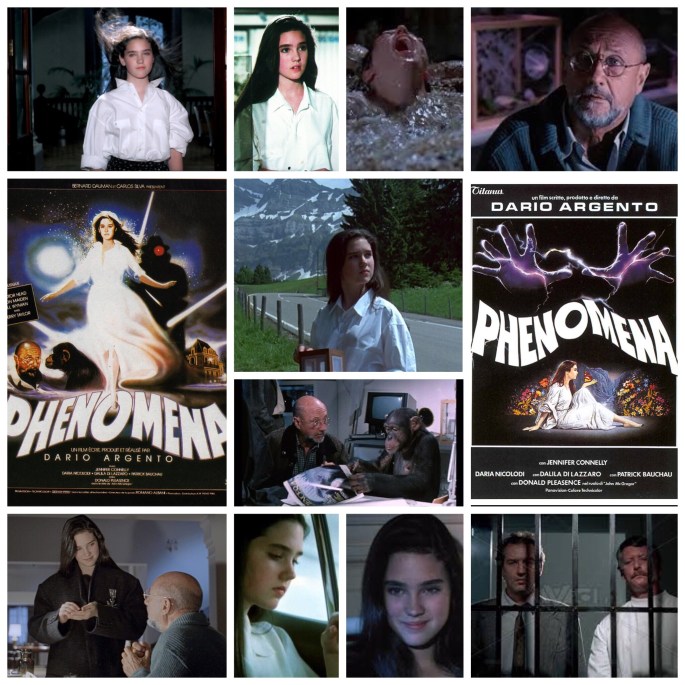
Dario Argento’s Phenomena isn’t one you usually see in a greatest hits list offhand from the oddball Italian horror-meister, but it ranks number two for me in his filmography. Set in the already spooky, airy Swiss Alps, this one sees a very young Jennifer Connelly and her classmates at a boarding school terrorized by an unseen killer who, like in most Argento films, just loves to stab people with super sharp objects in excessive closeup. Connelly has a special power and affinity for insects, which comes in handy when she meets entomologist McGregor (the lovely Donald Pleasance), his pet chimpanzee and they try to snare the killer using their own keen instincts and that of the vast collection of bugs in his care. It’s a unique, eclectic setup for a horror flick, but what’s interesting here is the outright horror and nastiness doesn’t even show up until the hectic, gross out final act. Most of the film is like an atmospheric, eerie fairy tale. Connelly is a darkly radiant beauty and you can practically see the effortless star-power percolating even at the age of fifteen. This film is unique in Argento’s career for several reasons; he takes full enjoyment and advantage of the setting here, the cavernous, looming alps and vast, flower speckled fields of Switzerland provide a more nature themed, organic palette here than his usually urban choice of old European cities and historic edifices, it’s a switch up that works quite well. Mostly though this one is notable for a sense of compassion that isn’t there in any of his other films, brought in by kind eyed Pleasence and his friendship with Connelly. As per usual, some of the acting, pacing and continuity is really off balance here, but that has become an Argento trademark and you kind of have to just roll with it at this point, the guy’s forte has always been atmosphere, music and the feeling behind what’s onscreen, not so much the logic of plot or realism in performance. Speaking of music, this also has to have the coolest soundtrack he’s ever amassed. Not only is there an electrifying, thunderous synth score by Goblin and Claudio Simonetti with a very lyrical, dreamlike vibe, we’re also treated to original rock compositions by the likes of Motörhead and Iron Maiden, making it one of the most collectively memorable soundtracks out there. There’s another cut of this film called ‘Creepers’, but it’s awkwardly edited down by chunks and loses all the magic, so don’t even go near it. The Anchor Bay DVD is the way to go. One of Argento’s best, and a gem amongst horror films.

-Nate Hill

Steve Beck’s Ghost Ship

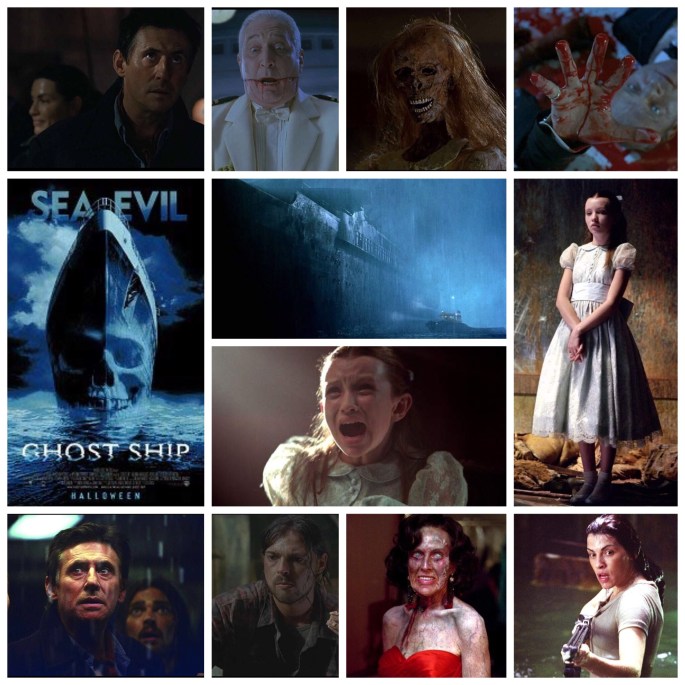
The only claim to greatness that Ghost Ship can make lies in its first five minutes, a frightening horror set piece that starts the film off with a bang, or should I say a slice. After that it’s a dank, rusty B movie with hilarious musical choices, routine scares and campy acting, but I kind of like the film in spite of all that. After the now famous Emily Browning witnesses a horrific ‘accident’ aboard a giant ocean liner back in the 60’s, we flash forward to a rowdy salvage crew and their attempts to find the lost ship somewhere in the Bering Straight. Captained by salty Gabriel Byrne, crewed by the likes of Julianna Margulies, Desmond Harrington, Ron Eldard, Isaiah Washington and Karl Urban, the thing has a capable cast that does well enough but at the end of the day they’re mired in a creaky, cheerfully silly flick that doesn’t make aspirations to take itself seriously. If you’re ok with that it makes cool background noise at a Halloween party, and even features a plot thread that is fascinating, if somewhat under-explored. That opening scene of collective, instantaneous carnage though, holy fuck man. I saw it on tv when I was younger and both the incident and young Browning’s reaction to it chilled me to the core. Too bad the rest of the film couldn’t keep up, but at least it’s better than 2001’s Lost Voyage starring Lance Henriksen, also I’m kinda just pulling one out of my hat that has no chance of comparison with anything because I enjoy Ghost Ship and want to make it seem better than it is.

-Nate Hill

Jeremy Saulnier’s Hold The Dark

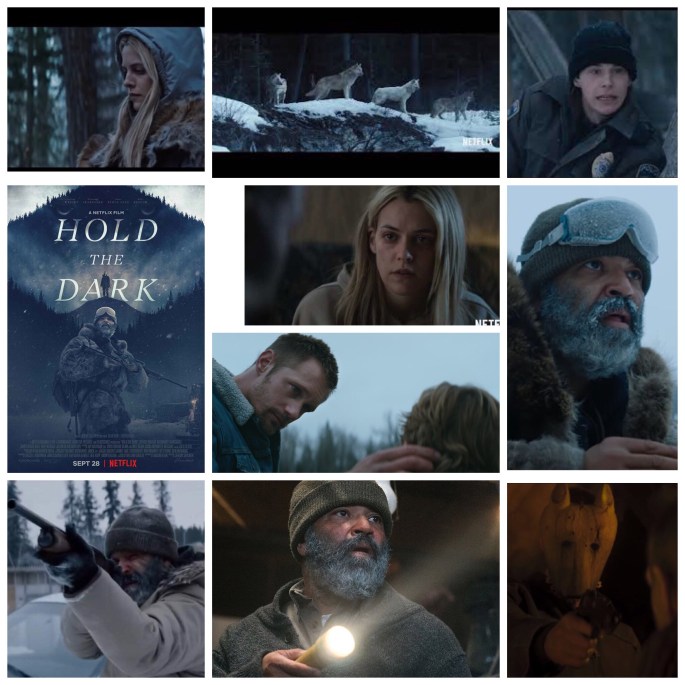
It’s easy to see why audiences are having sort of an icy reaction to Jeremy Saulnier’s Hold The Dark, an oblique, austere Alaska set thriller with esoteric undertones. On a platform as diverse yet decidedly commercial as Netflix, it will take some time for the riskier, more artistic and less accessible projects to gain traction, and for the casual viewers to warm up to varied aesthetics that they often lazily dismiss in a lump sum as ‘weird.’ They’ll come around. For us who are tuned in, however, we can appreciate that these risks are being taken and that money is being spent on challenging, anti Hollywood stuff. Although not as tightly wound or succinct as Saulnier’s first two efforts (Blue Ruin and Green Room), Hold The Dark is definitely my favourite as I have an affinity for snowy settings and dark, ambiguous mysteries. Jeffrey Wright is great here as as an outdoorsman and wolf expert hired by the mother (Riley Keogh) of a child supposedly snatched by wolves to find the beasts and kill them. I won’t say much more except that things are so far from what they seem at first that you’ll truly have no inkling of where the plot is going to take you next, which is a sign of great, inspired scriptwriting. There’s an eerie edge to the whole thing, but the film’s secrets aren’t divulged willingly or at all half the time. Alexander Skarsgard is implosive and lupine himself as the boy’s haunted father, on his own freaky quest for a goal shrouded in enigma like fog swells throughout the Alaskan mountains, actually Alberta here. James Badge Dale is great as the intense local sheriff, Julian Black Antelope is a standout talent as a shady local villager involved in the central mystery, and the cast includes fine work from Savonna Spracklin, Peter McRobbie, Macon Blair, Jonathan Whitesell and Tantoo Cardinal. Playing around with genre and tone, Saulnier and cinematographer Magnus Nordendorf Jønck deserve huge props for staging a fucking volcanic firefight scene that has to be up there with the best shootout scenes of all time, it goes on for something like ten minutes, more bullets are fired than in a Rambo movie and there’s some gnarly violence. There are some spooky, intangible ideas at play here and almost none of it is made obvious.. it may leave some in WTF mode, but clearly a stylistic language is being spoken here, with some deep, disturbing things to say about nature, humanity and the dark symbiosis held over them, particularly in lonely, desolate places such as this. This won’t be everyone’s thing, but it’s stayed with me all day since I saw it last night, I’m on board with it.

-Nate Hill

Rob Zombie’s The Lords Of Salem

Rob Zombie’s output has been hallmarked by a series of grungy, profane exploitation throwbacks with in your face violence and a loud, mean grind-house aesthetic. As much as I love *that* sensibility (I’m a hardcore fan of his films), what makes The Lords Of Salem so special is that he tries something different than he’s used to, ditches the comfort blanket of Manson-esque killers and brash, lewd dialogue in favour of mood, atmosphere and the kind of pacing you’d find in early 70’s fright flicks that valued aura over gore. This shows that although pretty much married to his trademark style (the third Firefly Family film is in production as we speak), he knows how to branch out successfully and has made a fantastic piece of slow burn horror with Salem. Set both during the infamous witch trials and in the present day, it focuses on quiet, introverted radio DJ Heidi Hawthorne (Sheri Moon Zombie). Now, if you’ve seen Sheri in the Firefly films you’ll know that the words ‘quiet’ and ‘introverted’ are a far cry from what she’s used to, but she’s brilliant here as a damaged recovering addict haunted by devilish forces. Plagued by sinister neighbours (Patricia Quinn, Dee Wallace and a freaky Judy Geeson), hallucinatory visions of evil and a mysterious music album mailed right to her radio station, it soon becomes clear that the demons of the past have come back to haunt Salem and have chosen her as a dark avatar. Zombie lovingly casts his films with carefully chosen icons of 60’s and 70’s genre cinema, and as such we get the likes of Ken Foree, Richard Lynch, Richard Fancy, Udo Kier, Maria Conchita Alonso, Michael Berryman, Sid Haig and more. Stealing the show is electric blue eyed Meg Foster in a blood freezing turn as Margaret Morgan, leader of the original Salem coven generations before. Foster hails from stuff like John Carpenter’s They Live, The live action Masters Of The Universe and recently Showtime’s Twin Peaks: The Return, but she’s absolutely terrifying and almost unrecognizable here as a freaky old hell hag with a raspy voice and gruesome saggy tits, truly a memorable villain. This is a film that takes its time building up to outright horror, alternating between dimly lit, spooky scenes from the original trials and the mounting tension of present day, including a subplot where an investigative scholar (Bruce Davison) tries to unearth evil and warn Heidi before it’s too late. Jarringly surreal visuals abound here, from neon palettes to a grandiose nightmare sequence involving a demon baby and some seriously strange architecture. It all builds to a searing finale that some may find to over the top or garish, but fits the story and ends the tale on a feverish note of hellish commotion, colour saturation and horrific spectacle that plays like Ken Russell by way of Dario Argento with a dash of David Lynch at his craziest. This is my favourite film in Zombie’s career so far, for its mood, unique visual language and rhythmic pacing, but also for his willingness to blast through the cobwebs of uncharted stylistic territory and bring forth well wrought, fresh artistic style and a damn great horror film too.

-Nate Hill

David S. Goyer’s Blade: Trinity

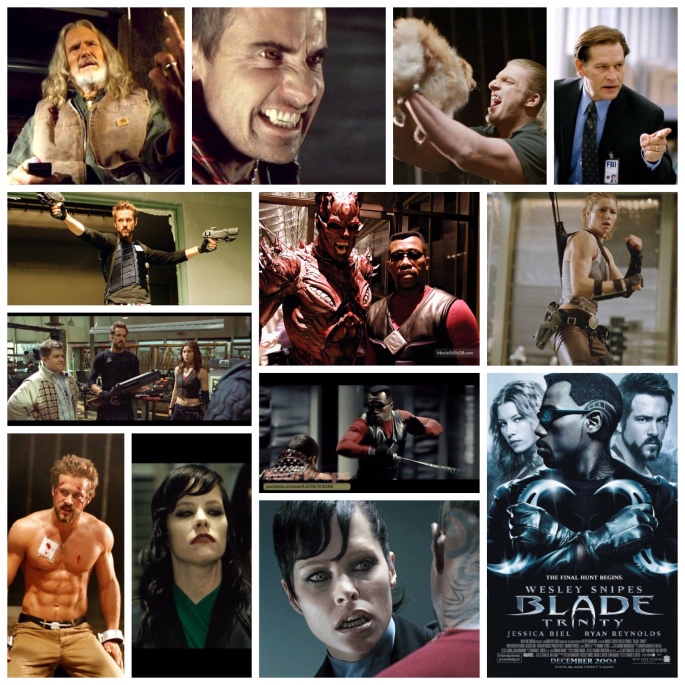
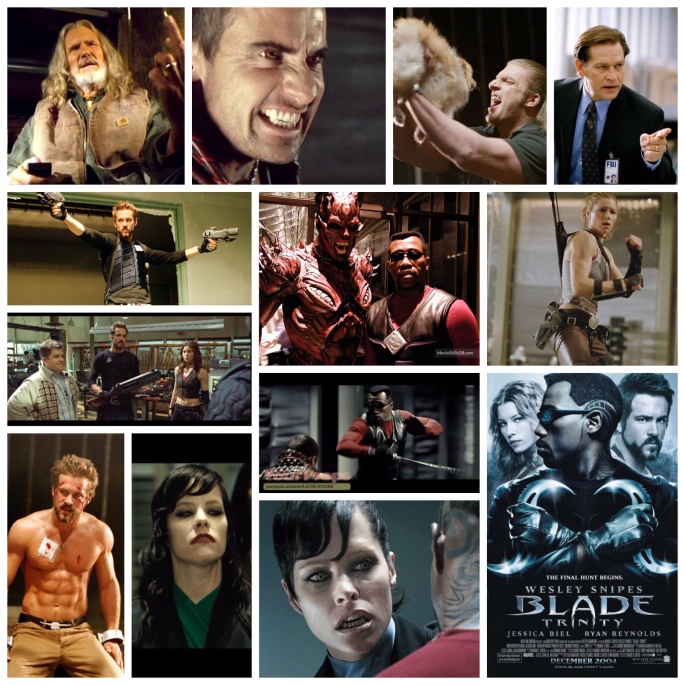
I think that Patton Oswalt’s stories about Wesley Snipes’s hilarious behaviour on the set of Blade: Trinity are more entertaining than the actual resulting film, to be honest. Having said that, I also don’t think it’s as terrible as its reputation. Worst of the trilogy? For sure. Silly as hell? Definitely, but it’s not entirely terrible. Blade has apparently relocated his operation to Vancouver, because regardless of where this is actually supposed to be set, I’ve never seen my city so thinly disguised as I have here, one wonders why they bothered at all. So why is it any good? Well, Ryan Reynolds for one in arguably his first turn as Deadpool. As snarky vampire slayer Hannibal King, Reynolds has stated on record that he was basically just playing Wade Wilson, and he’s a lot of fun, a torrential fountain of creative insults (“You cock juggling thundercunt!”) and sassy attitude. Jessica Biel is less memorable as the daughter of crusty weapons guru Whistler (Kris Kristofferson shows up again briefly). The three of them begrudgingly team up to do battle with the king of all vampires, Dracula himself (Dominic Purcell), but spend most of their time in skirmishes with nasty vampiress Danica Talos (Parker Posey), her minion brother (Callum Keith Rennie) and their hired muscle, played by wrestler Triple-H for fucks sake. Posey actually gives the best performance of the film, her moody brat villainess is an underrated Blade antagonist and she almost steals the movie, with cameos from Eric Bogosian as a talk show host and James Remar as a bumbling, overzealous FBI Agent. This is for sure a WTF entry in comparison to two excellent predecessors. I mean, you have Triple H setting vampire Pomeranians on Blade & Co. and more shattered plate glass windows than the entire Die Hard franchise combined, they’ve thrown a bunch of elements at the wall hoping they’ll stick without any real formula or reason, so a lot of it is misplaced and dumb, but I had fun here and there, particularly when Reynolds and Posey were around to chew scenery. Snipes is pretty much a walking two by four for most of it, but you can tell he’s not having much fun and isn’t firing up the dark charisma he brought to the first two. Rumours about him on set include locking himself in his trailer for hours and hotboxing it, threatening poor David S. Goyer and refusing to communicate with him using anything other than post-it notes and fiercely disliking Reynolds. Whether it’s all true or not who knows, but it’s pretty fuckin’ funny and I hope we get to see a behind the scenes documentary about these shenanigans one day called Blade 4: Snipes Rising.

-Nate Hill

David S. Goyer’s The Unborn

There’s a lot of ideas running around in David S. Goyer’s The Unborn, ideas that a terrific cast do their best with but ultimately this was one big WTF of a letdown, a boring waste of time that deserved better execution than it got. It’s essentially another Exorcist retread, given a twist, with Odette Yustman (whatever happened to her? She was sort of like Megan Fox Lite) playing a girl who is tormented by something called a Dybbuk, some sort of mythological Jewish entity but also just a fancy way of saying demon. It has something to do with her unborn twin who never made it past utero, her institutionalized mother (Carla Cugino, wasted in a heavily cut role) as well as history dating back to Joseph ‘Angel of Death’ Mengele, the infamous Nazi surgeon who had an obsession with twins, a theme that also plays on here. This thing haunts and eventually possesses her, until she finds help from two priests played by Gary Oldman and Idris Elba, in roles beneath their talent. There’s one nicely written scene where she and her boyfriend (Cam Gigandet, who can’t act to save his life) ponder the universe and all its terrors while in bed that would have been better brought to life by different actors. Various scenes show her interaction with her loving father (James Remar), but they’re underdeveloped and feel edited. Mostly it’s just her running from freaky scuttling apparitions, loose plot threads hanging about like wires in an abandoned warehouse and just.. bleh. There’s definitely something there in terms of brainstorming script ideas, but they screwed it up big time by making a haphazard, boring, generically glossy PG-13 dud instead of putting some actual style, personality and genuinely frightening elements in. Big ol’ missed opportunity. It’s a shame, because there’s some neat, spooky special effects thrown at the wall here that deserve a better film, and I’d expect better from Goyer too. Oh well.

-Nate Hill

Shane Black’s The Predator

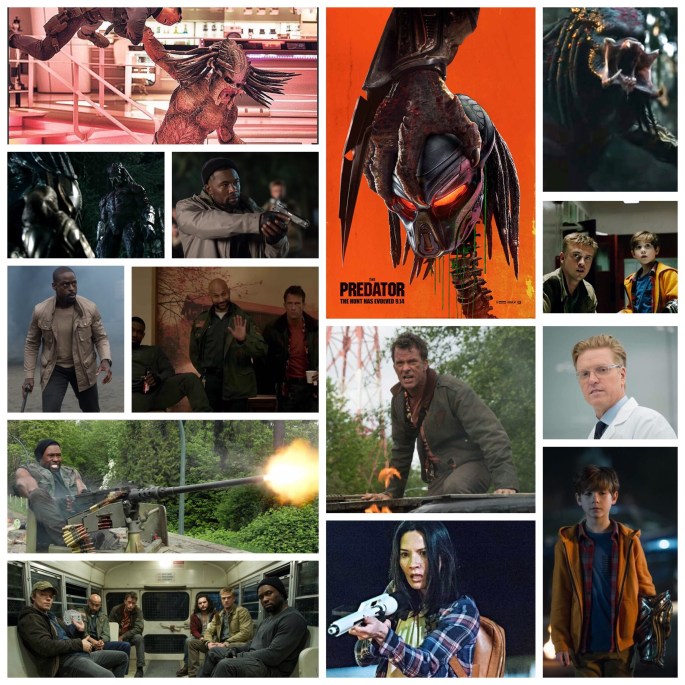
So.. Shane Black’s The Predator. Haters gonna hate I suppose, but I really don’t get the negativity thrown this one’s way, it’s a shit ton of fun. Admittedly a stark departure from any other film in the franchise, Black’s signature is to brand things with an irreverent comedic stamp, and they should have realized that when they handed over the torch to him. This is Predator in American suburbia, a much smaller film than those before, but no less gory, imaginative or propulsive, and certainly nowhere close to as disappointing as I’ve read in some of these hilarious reviews. After a jungle set opening that mirrors John McTiernan’s original classic both visually and musically, a device worn by one of the Predators gets accidentally mailed to the young son (Room’s Jacob Tremblay) of the military sniper (Boyd Holbrook, channeling 80’s Michael Biehn nicely) who managed to kill one of them, all hell breaks loose when the rest of the creatures come looking for it, and intergalactic war hits the home front. Holbrook is placed on a prison bus populated by the Loonies, disgraced ex soldiers with PTSD who serve as the perfect rogue unit to abscond with the bus and take on the aliens using guns, bad jokes, a constant stream of profanity and eccentric personalities. Elsewhere, Olivia Munn’s super scientist makes educated guesses about both the intentions and biology of the Predators, eventually joining forces with the Loonies. It’s madcap and almost has an adult Amblin vibe which actually works quite well. Scene stealer Sterling K. Brown makes an oddball villain as a snarky Fed with his own agenda, while Jake Busey slyly plays the son of his dad’s Uber Predator hunter from the 1990 sequel. Now, the Loonies are as off colour a bunch as you’d expect to see in a Shane Black flick, but for me their weird chemistry and crudeness worked. Keegan Michael Key is the coked up comic relief, a guy who punctuates every awkward silence with a severely raunchy joke, Alfie Allen is underwritten but present, Trevente Rhodes scores big as Nebraska Williams, a chain smoking ex CO who is the brains of the bunch. My favourite performance of the film is Thomas Jane cast way against type as Baxley, who suffers from Tourette’s except when the plot requires him to steadily hold a firearm. I’ve read a lot of people call his character insensitive and I’m not sure what they’re drawing from, I have a family member who has Tourette’s and Jane’s work here is one of the most realistic depictions I’ve seen on film, it’s probably just all the other comedic commotion around him that accents it. Alongside Jane, I really like Munn, who obviously doesn’t look the part of a brainy scientist but fully gets the vibe here and has a lot of fun with her role. The Predators themselves seem bigger, louder and more vicious than before, often seen in broad daylight, with nastier attitudes and, at one point, speaking in plain English albeit via translator. Their part of the story is definitely far fetched but has imagination and thought put into it. They’re less the hunters here (except for that eleven foot tall motherfucker) and more like space spies with their own private feud going on. This has obviously been a divisive film so far.. I’ve heard a buddy say that it’s ‘one of the worst movies he’s ever seen.’ I can’t imagine that’s anything but overzealous overkill, it’s not an instant classic or anything but it was bloody fun, entertaining stuff. Honestly, my only complaint? It wasn’t long enough. There are areas that feel patchy and I imagine that’s where this studio interference I keep hearing about took place, and although it doesn’t come close to ruining the movie, I’d really love to see a director’s cut from Black at some point. But what we got was a solid blast of a film from where I’m sat. I mean, you get a guy like Shane Black to make a Predator film, it’s not like this is some gun for hire, he’s his own specific artist and is going to make the thing his way. Studio cuts aside, he’s done a slam bang job here, an action horror comedy sci-fi hybrid that feels as retro as it should while injecting new life and flavour into the mythos. Call me crazy, I guess.

-Nate Hill

Paul W.S. Anderson’s AVP: Alien Vs. Predator

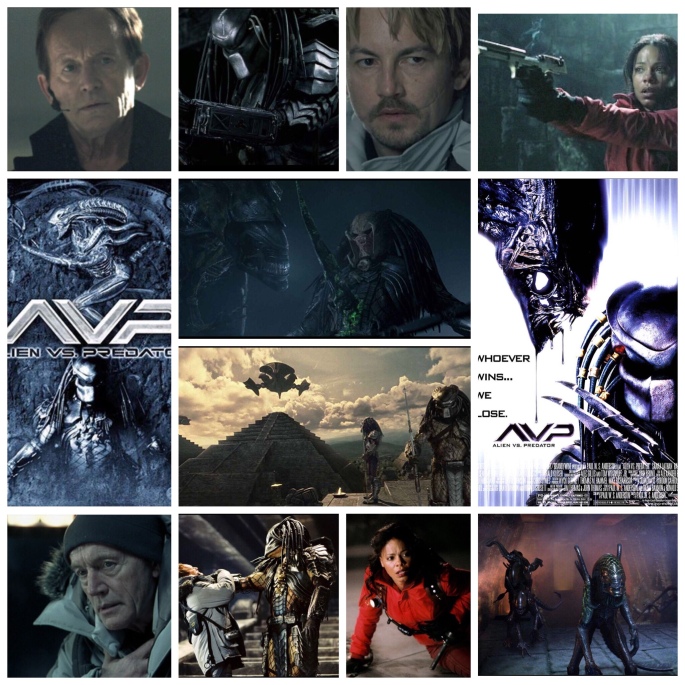
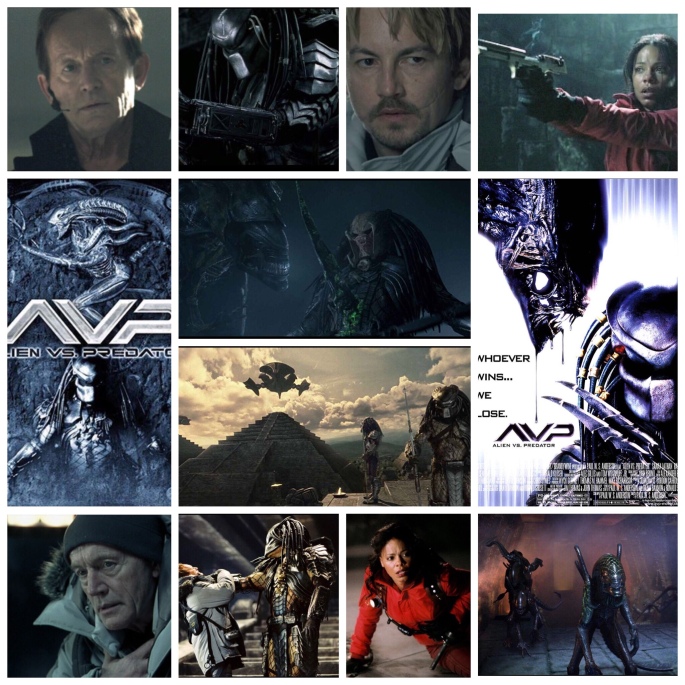
Here’s the thing: much of what is needed was in place to make an epic, badass Alien/Predator crossover flick. They had a solid premise, a director with a sure footing and visible background in horror, an able cast with a genre/franchise titan as a callback to earlier entries, and all the special effects they could want at their disposal. So how did AVP: Alien Vs. Predator end up being an oven roasted, inexcusable slice of shit? Well, script and execution I suppose, the whole thing just has a murky, suspiciously rushed feel to it and no trace of memorable pedigree at all. However, to me their first mistake and cardinal sin was to rate the thing PG-13. These are two intense, extremely graphic and gruesomely violent horror franchises, and as such any amalgamation should, of anything, step up the carnage, so whoever had final say as far as that goes should have a face-hugger attached to every orifice of their body. So what does work? Well, Lance Henriksen for one, but he has a history of being the best thing about many films he’s been in and it’s hard for him not to shine through any amount of muck. He plays the dying CEO of infamous Weyland Yutani corporation and gives all the grit and gravity he can amongst a flurry of inconsequential CGI. Recruiting a team of scientists and mercenaries, he plans to descend into an Antarctic pyramid where centuries ago, the mythic Yautjas and the primal Xenomorphs had a Royal Rumble. Star Sanaa Lathan is actually great as the ‘final girl’ of sorts in this slasher game, other team members include Ewan Bremmer, Raoul Bova and Tommy Flanagan, but most are lost in the confusion, poorly written or forgotten entirely. The battle scenes are haphazard and sloppy, the dialogue barely there and the colour scheme is this kind of shitty, subdued blue-hue nonsense with no personality it’s own, like an icy deodorant commercial that just happens to have monsters in it. Many people blame director Anderson, but who really knows. People forget that he’s responsible for the first Resident Evil film which is solid, gutsy horror and has the type of energy meant to be found here, as well as Event Horizon, one of the scariest, well wrought sci-fi/horror flicks of the century, so he was a reasonable candidate to helm this. In any case, it’s a big ol’ mess, a titanic wasted opportunity and a dark stain on both respective legacies. There’s a sequel which I haven’t seen, but it’s probably just as wretched.

-Nate Hill

Robert Rodriguez’s Predators

I like to call it Robert Rodriguez’s Predators despite the fact that he only has a producer’s credit, but his influence is all over it, plus the presence of Danny Trejo. This is one solid flick though, and definitely holds up against the first two films. The premise could even be said is more innovative than before, because as with any sequel or update, the story must evolve and break new ground, a feat they’ve outdone themselves with here. The Predators have taken it upon themselves to kidnap the roughest, toughest individuals of the human race and set them loose on a giant planet designed to be a game preserve, and have their fun. Adrien Brody does tense vulnerability to a T as a special ops badass, joined by an Israeli soldier (Alice Braga), a Russian spetznaz operative (Oleg Taktarov), an ex cartel enforcer (Danny Trejo), a psychotic maximum security inmate (Walton Goggins), an African rebel (Mahershala Ali), a disgraced Yakuza (Louis Ozawa Changchien) and… Topher Grace, whose involvement gradually becomes clearer. They’re forced to band together against a squadron of specialized hunters who pursue them, complete with the vicious wildlife native to this planet. It’s incredibly cinematic, brutally entertaining stuff, and the actors give it their all, including Laurence Fishburne as a crazy dude who’s been alone on this world a few too many years. Standout scenes include the chilling moment these poor folks reach the crest of a hill, spot two giant suns in the alien sky and realize they’re not in Kansas anymore, as well as a knockout showdown between the Yakuza and a giant predator that eerily mirrors Sonny Landham’s Billy making a final stand in the original film. Atmospheric, well casted, acted and shot, a solid action horror funhouse that lives up to the Predator legacy.

-Nate Hill

“I’m not fallin’ all over myself to talk about much anywhere, Jack.” Manhunter Revisited – by Josh Hains

“He who fights with monsters should be careful lest he thereby become a monster. And if thou gaze long into an abyss, the abyss will also gaze into thee.”
– Friedrich Neitzsche

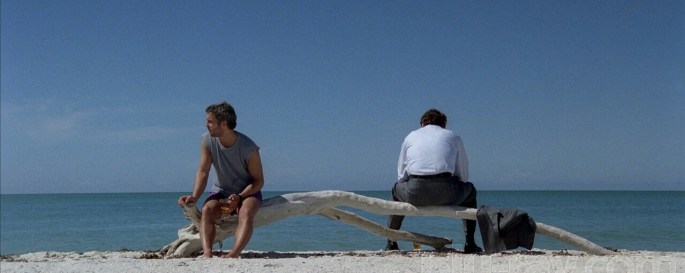
Will Graham doesn’t want to take the job Jack Crawford is offering, and we can hardly blame him. We are able to infer that whatever happened to him was of such a horrific nature that it caused his retirement from the FBI as a criminal profiler. We later learn in little bits and pieces (and not in an unnecessary prologue; I’m looking at you, Red Dragon) that a confrontation with the cannibalistic serial killer Dr. Hannibal Lecktor left him physically scarred from presumably gruesome injuries, and mentally broken. Through his body language and the stern, almost melancholic tone of his voice, we discern his reluctance, his unpreparedness, and we can sense the deep pain broiling beneath his calm surface. His peaceful existence in Marathon, Florida with his wife Molly (Kim Griest) and son Kevin is now on the brink of being shattered, all thanks to Jack’s perseverance. All it takes for him to crawl back into darkness is one look at a photograph of the deceased Leeds family, and the knowledge that he can help track down this one last psychopath, as if catching the killer will somehow put to rest his own inner demons from his years as a profiler. Easier said than done.

I revisited Manhunter on September 4th, over two years since the last time I’d seen it in March of 2016, and have given myself these last twelve days to absorb the film all over again. I had forgotten that for all of the darkness, despair, and violence, Manhunter is a beautifully photographed film, particularly during the opening scenes that establish Will’s moral quandary, and the serene dream sequence that occurs when Will falls asleep on a plane later in the picture. Even if Manhunter was somehow a genuinely awful movie, I believe I’d still remember those jaw droppingly gorgeous images conjured up by director Michael Mann and the director of photography Dante Spinotti. It certainly helps that I was watching it in high definition.

We later see that Will Graham (William Petersen) was indeed unprepared for this final job when he comes face to face with Dr. Lecktor in his cell, and experiences some manner of anxiety attack that sends him rushing out of the colossal building he’s incarcerated in. I recognized as with previous viewings, that unlike other interpretations of Lecter (spelled “Lecktor” only here in Manhunter, and spelled “Lecter” in the books by author Thomas Harris, and the other films and television shows) that reach for grandiose heights with the kind of theatricality one might expect from a Broadway production, Dr. Lecktor as played by the great Brian Cox, is a mild mannered, relaxed, everyman take on the character. He’s undoubtedly a psychopath, but his menace doesn’t come though in how he speaks but rather in what is spoken. This approach makes him all the more chilling than later versions because we know from human history that many of the most vile beings who have ever walked this earth, walked upon it in a manner as calmly, politely, and “normally” as Lecktor presents himself to be. What’s more frightening to you, reader: the Lecter you know is crazy before he’s ever opened his mouth because he practically smells of insanity, or the Lecktor you never suspect is insane until you’ve awoken under his knife?

Of course, no serial killer thriller is complete without the law enforcement affiliated lead, here personified with a palpable depth and a grounded everyman quality by William Petersen, in a performance as subdued and internalized as Cox’s Lecktor. Petersen never once strays into any kind of territory that would evoke feeling of his performance appearing fake or forced. He’s as natural as they come, and were it not for the knowledge that he is in fact, merely behaving for the screen, one might assume from his naturalism in Manhunter, To Live And Die In L.A., and CSI: Crime Scene Investigation, that maybe he’s the real deal, a cop turned actor like his co-star in Manhunter, the late Dennis Farina. Farina, who was a police officer in the Chicago Police Department’s burglary division for 18 years before Michael Mann used him as a consultant on his feature film debut, Thief (for which Farina also had a small role as an enforcer), turns in an equally as grounded, and entirely believable and authentic performance as Jack Crawford.

And then there’s the cause of Will’s return to profiling, the serial killer dubbed “The Tooth Fairy” for the bite marks he leaves on the bodies of his victims post mortem, better known to us as Francis Dollarhyde (Tom Noonan, who also has a small role in Mann’s Heat). His height and implied strength make him an imposing figure, though he’s also a shy little boy tucked away inside this monstrous shell, afraid to show his cleft palate, and obsessed with William Blake’s painting “The Great Red Dragon and the Woman Clothed in Sun”, later witnessed in a horrific scene with one of Dollarhyde’s victims, the sleazy reporter Freddy Lounds (the great Stephen Lang). That same painting has inspired an alternate personality borne out of his psychopathy he calls “Great Red Dragon”, which comes to life when he seemingly can’t control urges of both violent and sexual natures. Thanks in large part to Noonan’s eerie performance, and the subtle writing of Dollarhyde by Mann himself, the thin line between compassion and love, witnessed in intimate moments between Dollarhyde and blind co-worker Reba McClane (Joan Allen) with whom he starts a relationship with, and uncontrollable murderous rage, is narrower than the edge of a piece of paper, creating a figure all the more real and subtly terrifying.

It wouldn’t be a Michael Mann film without a memorable score or the use of a popular song, and Manhunter is no exception, complete with a thrilling, pulsating score from Michael Rubini, and The Reds, and the incredibly effective, memorable use of Iron Butterfly’s “In-A-Godda-Da-Vida” during the climactic confrontation between Dollarhyde and law enforcement led by Graham and Crawford. The use of Red 7’s “Heartbeat” over the credits offers up a welcomed upbeat conclusion to an otherwise dark picture.

In my revisitation of Manhunter, I took note of something that I had noticed the very first time I saw Manhunter in my teens (at the very least 11 years ago), and that has stuck with me ever since: the scene when Will visits the Leeds family home to scour the crime scene for clues to their murders, which is also where I came intonthe movie all those years ago when I caught it on television. This interpretation of Will Graham doesn’t just stand in the bedroom of the deceased Mr. and Mrs. Leeds and state into a tape recorder what he thinks occurred, like later versions. He scans the room before he ever says a word, his eyes circling the room from left to right, his mind at work taking in all of this visual information and formulating his idea of what happened simultaneously. When he’s done absorbing the scene, he speaks, low and taking his time, telling us how he thinks they died, and more, in full graphic detail. While we thankfully never bear witness to the events that actually occurred, we move onto the next scene with a clear understanding of what more than likely happened, without the sensation that we just listened to an unnecessarily long exposition dump. It’s a bone chilling scene, given the terrible subject matter, but an effective one we might not soon forget.

I’ve also come to recognize as I’ve grown older, that this same scene also conveys what it is about Will’s brilliant skillset as an FBI criminal profiler that compelled Jack Crawford to ask Will to step out of retirement to help him capture this one last criminal in the first place; to knowingly pull him out of paradise only to thrust him into a personal hell that endangers his family and himself. And why Will Graham said okay.