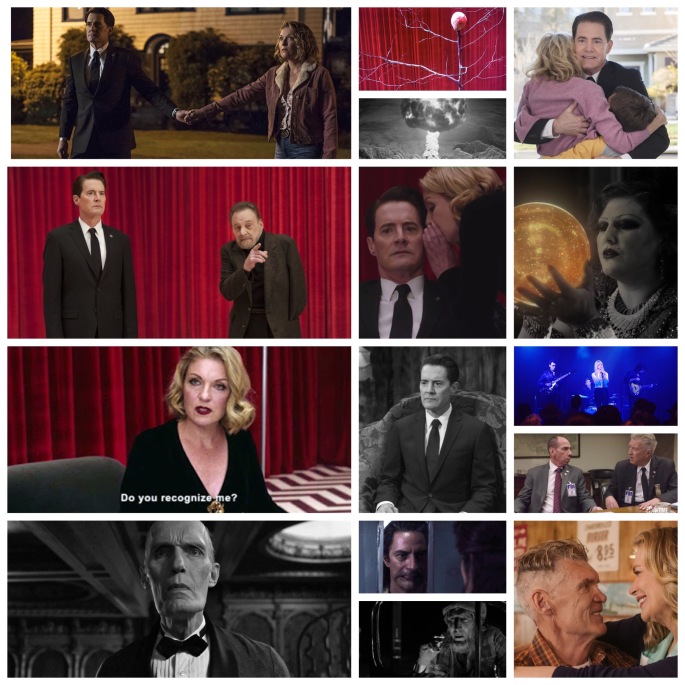
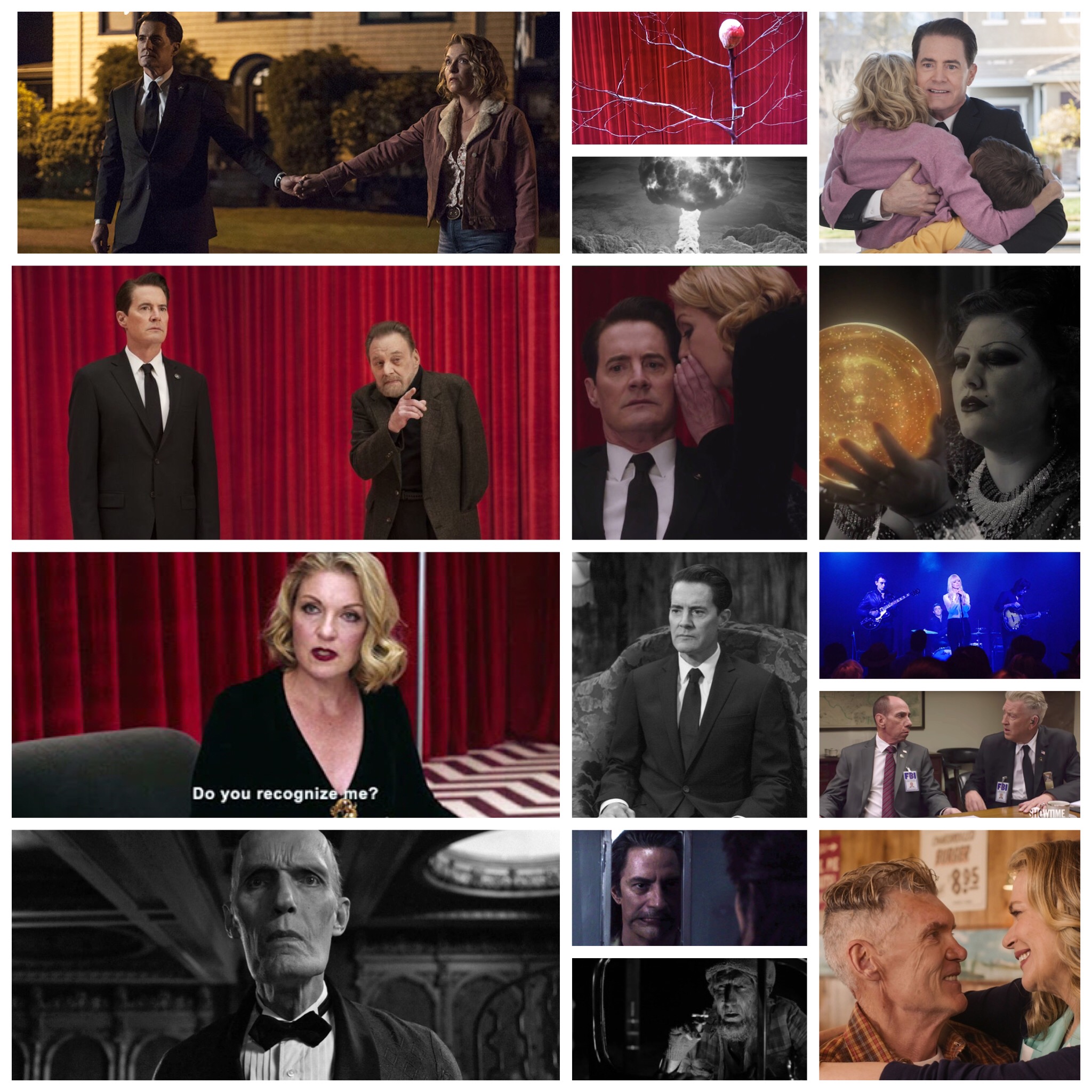
Twin Peaks: The Return has come full circle, and I mean that quite literally. Carefully, lovingly and maddeningly orchestrated by David Lynch, who has proven himself to be nothing short of a brilliant mad scientist of the cinematic arts, this is an endlessly deep, fiercely creative vision that refuses to compromise or meet anyone halfway, and it’s all the better for it. Showtime gave the man full and total control over every aspect, a decision they most likely didn’t fully understand at the time, but one which will have a beautiful ripple effect upon the landscape of serialized television and art itself in the decades to come, just as the original series did until now.
As the show unwinds in elliptical, rhythmic kaleidoscope fashion, it arrives at what can be called an ending only for the fact that there must be a last episode, but it’s not really an ending at all, there never was one in Twin Peaks, and likely never will be, a quality that has given it it’s vitality since day one. Many are having trouble accepting Lynch’s open ended, haunting finale, and that’s alright, considering human beings are simply wired to seek answers, and engineered to get frustrated, hostile even, when they aren’t provided. If one sits at a table with a jigsaw puzzle spread out, how would it be if the puzzle were quickly, neatly solved? The very quality that makes it a puzzle evaporates, the mystery gone, and one would simply lose interest, get up from the table and walk away. Now, if a handful of pieces are missing and never found, if the puzzle remains unsolved indefinitely, it feeds the observer with the fuel to pour thought, attention and care into continuously pondering how they might fit the pieces together, if ever at all. In short, the mystery lives on, and on. Lynch understands this, and it’s a wondrous gift to give fans, who no doubt will have Twin Peaks on the brain until the day they move on to the white lodge. It is quite literally the gift that keeps on giving. Like a snake eating it’s own tail, like the never ending, billowy curtains of the labyrinthine Red Room, like the portentous infinity symbol that the Philip Jeffries teapot warns Cooper with, this is a story that has ends, beginnings, middles, alternate timelines, repetition and, thanks to the intangible forces constantly at work, will never truly be at rest, at least not in any way that we can comprehend.
The themes which have fascinated Lynch his whole career are in full bloom here like never before, but one that takes centre stage after being deftly touched upon in the show and Fire Walk With Me is that of duality, light versus dark and the uneasy realization that the line between them isn’t as stark as we’d like it to be. Leland Palmer was always thought to be possessed by Bob, unbeknownst of his heinous atrocities, a babe in the very dark woods. Fire Walk With Me blew that comforting certainty right out of the water with some very dodgy scenes implicating Palmer himself, blurring the lines to show that although good and evil may indeed occupy opposite sides of the fence, they most certainly hop over and tread on each other’s lawn, a truth that has been shied away from in cinema quite often, but one which Lynch won’t let you tune out so easy. As we see a mullet adorned doppelgänger version of Cooper engage in a tirade of crime and violence across the states, the real Agent Cooper, or at least that part of his soul that’s trapped in the embryonic limbo of a pastel phantasmagoria Vegas, seems lost in a sea of characters we’ve never met before the Return. When it comes time for that inevitable showdown, it’s quick, and the surface level battle is skimmed over so Lynch can dive into a disorienting rabbit hole in which Cooper is stoic, uncharacteristically violent, a concentrated prism of all the qualities that were separate in the worlds that came before, his psyche in narrative nursery school until Lynch hurtles past that 430 mile marker into territories with ugly truths and revelations that are hard to swallow. Two wolves fight inside every one of us, one light and one dark, but they’re only two sides of the same coin, rival essences within a single beast, and although they run along side by side, tussle occasionally and appear to be separate entities, they’re one and the same when they look in each other’s eyes, as we see in the mirror, or when we come face to face with our doppelgänger against the backdrop of a shimmering red curtain.
Twin Peaks has always been about secrets, from the very moment that Laura Palmer’s body washed up on those shores, wrapped in plastic (or did it?). Who killed her? That one secret lead to many, and as a story unfolds that’s scope vastly captures realms far beyond the sleepy little northwestern town it began in, we see a story at play that’s so much more, one that is very much filled with secrets, a motif we were warned about almost right off the bat. “She’s filled with secrets”, the Arm gleefully imparts to Cooper. That she is. The hollow screams of a shell shocked Sarah Palmer. The haunted, weary eyes of trailer park supervisor Carl (the beloved Harry Dean Stanton). Audrey Horne sharply awakening in the frightening unknown. Cooper and Laura being foiled yet again by the powers that be (those darn Chalfonts). An empty glass box that isn’t so empty. Coordinates that nestle between shrouded mountain glades. Heartbreakingly gorgeous melodies from the maestro Angelo Badalamenti. Pages from a secret diary that document horror, madness, joy, bravery, vulnerability and an odyssey through time, space, love, evil and of course good, the secrets that keep us coming back for more each time. Lynch has spun his magnum opus here, a tale where every piece is important, even the ones we may likely never find. A testament to the power of storytelling, a treatise on the mystery genre, everything I could have hoped for in a return to the town of coffee and cherry pie, and a full on bona-fide masterwork. See you in the trees, and whatever kingdoms lie beyond them in the glow of the red curtain, the purple seas, the hum of electricity in the dreams of a homecoming queen and a lone FBI Agent on a road trip to…
Tag: Laura Dern
David Lynch’s BLUE VELVET

BLUE VELVET may just be one of the most depraved and transgressive love stories ever put on film. It’s a complex narrative that ushers the audience past their comfort zone into a dark and dangerous world of obsession and perversion. Not only do we enter this world through our innocent protagonist, Jeffery Beaumont, but we see and experience what he is exposed to. As his innocence erodes, as does ours.
Like anything David Lynch, the film is richly layered. The color scheme can be overanalyzed, as can the vague shadow world crime story, and especially the shifting timeline. When we’re in Jeffery’s world, we are in this overly nostalgic “good old days” of Americana and once we enter into Frank Boothe’s life in the fast lane all of a sudden we are thrown into this overly stinging and lightspeed paced contemporary (the 1980s) world of drugs, violence, and sexual perversion.

Lynch constructs a deeply layered world by his own aesthetic and his brilliant casting strokes. Kyle MacLachlan and Laura Dern’s star-making performances zigzag back and forth between the two worlds that Lynch creates, showcasing their brilliant range as actors as they carefully hold the audience’s hands during the build up of the story only to rip away once they enter the world of Frank Boothe.
Dennis Hopper is incredible in this film. His embodiment of Frank Boothe is not only one of the finest performances on film ever, but it is such a bold and daring performance. Frank Boothe is nearly irredeemable. He’s disgusting, he’s dangerous, he’s insane – yet he has a very empathetical trait. Everything he is doing, he’s doing because he is so very much in love with Dorothy Vallens played by Isabella Rossellini who matches and outdoes Hopper when it comes to giving a deeply brave performance.
With Lynch’s casting of Priscilla Pointer, Frances Bay, and George Dickerson he builds his pure vision of the idea of America, only to tear it down with the Hopper and more specifically former Golden Age of Hollywood child star Dean Stockwell in one of the most unique and scene-stealing performances ever. Stockwell’s overly caked on makeup, 70’s powder suit, and lip syncing Roy Orbison’s IN DREAMS using a work light as a microphone is one of the most memorably haunting scenes in Lynch’s canon, and that’s saying a lot.
Once the rip cord is pulled in the film, it is an incredibly exhilarating ride. How this film got made, or better yet distributed to the degree it did upon its initial release is gobsmacking. It’s a piece of cinema that will never be outdone. It propelled Lynch into a stratosphere of auteurs that not many can even approach.
Top Ten David Lynch Characters: A list by Nate Hill
The cinematic universe in which legendary director David Lynch has chosen to tell his stories is a yellow brick road which leads the way to a rabbit hole, wherein can be found dreams, nightmares, horror, love, spirits, small towns, psychological torment, offbeat humour, danger and endless gallons of hot black coffee. Within this mesmerizing realm lives a whole armada of strange and wonderful human beings, often with antennas extended out into both the metaphysical, the supernatural and the just plain undefinable. This makes them some of the most richly fascinating, deeply felt individuals to ever dance across our screens. If you have clicked on this post, you will see below a list of my personal top ten characters to have ever wandered out of the one of a kind mind of Mr. Lynch and been brought to life by the intuition, grace and startling gut instinct of many fine actors. Enjoy!
10. Marietta Fortune, played by Diane Ladd in Wild At Heart
Diane Ladd plays the ultimate mommy from hell in Lynch’s wacky, colourful romance road trip flick and livens the proceedings up no end with her mental instability, overprotective mania and frequent banshee screams that echo the terrifying melodrama of an exaggerated and psychotic Joan Crawford. Ladd rightly earned an Oscar nomination for her feral work, and one only needs to witness the unnerving sight of her sprawled across the bathroom floor with a liver full of martinis and a face smeared with crimson lipstick to appreciate the work funnelled into both the performance and direction to give us this horrific harpy.
9. The Man From Another Place, played by Michael J. Anderson in Twin Peaks
No other character solidifies Lynch’s pipeline to the collective subconscious like the red suited, inter-dimensional man of limited stature, a haunting presence who dances, speaks backwards and is always one step ahead of every fellow character and watching audience member who lays eyes on him. He serves as an image of what lays beyond, and no doubt an experimental choice for Lynch, one that would go on to become a token image of the television series, and his career as well.
8. Bobby Peru, played by Willem Dafoe in Wild At Heart
The uniting forces of Willem Dafoe’s brand of creepiness morphed together with Lynch’s intuition for everything weird resulted in Bobby Peru, a disgusting psychotic whacko who only shows up in the last quarter of the film, yet dominates every frothy frame. Peru is a scary son of a bitch, and Dafoe lends every Joker grin, sallow grimace and harsh syllable he can muster in a very discomforting scene in which he abuses Laura Dern’s character to squirm inducing effect. This heinous outburst only makes the explosive end he meets all the more satisfying. A true Lynch monster, a Dafoe creation to remember and spin yarns about in years to come beside the cinematic campfire.
7. Nikki Grace/Susan Blue, played by Laura Dern in Inland Empire
Dern turns the performance of her career in what is perhaps Lynch’s most peculiar film to date, a purposefully meta, altogether perplexing soul bender of a tale that revolves around two incredibly strong female characters, both played by her. There’s a galvanizing monologue buried within the heart of this dense saga that’s at once both a savage outcry and a self reflective summary to the character, Dern nailing every sharp turn of both that passage, and her work in the film as a whole. Lynch sat on Hollywood Boulevard with a cow and a sign advocating an Oscar nomination for her powerful work here, and upon viewing it it’s easy to see why. ‘A woman in trouble’ cries the DVD cover. Dern cries out into the dark and lets us know this character is exactly in that place, but her and Lynch lay out the breadcrumb trail in an ambiguous fashion that never really lets us in on the how and the why of said trouble. Such an achievement is pure collaboration, and worth every penny spent on the cow rental.
6. Margaret Lanterman, aka The Log Lady, played by Catherine E. Coulson in Twin Peaks
The Log Lady is the symbolic lynchpin of Twin Peaks, a woman who lost her husband in a fire long ago, and quite literally carries a log around in memorial, speaking to it as if it were a person. Such a concept could be seen as silly, but in Lynch’s hands it simply is compelling. Coulson too treats it with reverence, giving her the undefined gravity that is a key ingredient in the Twin Peaks mystery and will be remembered by fans, loved by veterans and discovered by newcomers for eons.
5. Frank Booth, played by Dennis Hopper in Blue Velvet
The third scariest person on this list comes in the form of Booth, an oxygen loving, volatile kinkster played with primordial menace by a wild eyed Dennis Hopper. Booth took audiences by storm when Blue Velvet was released, showcasing a villain’s ability to completely shatter the idealistic and womblike notions of small town, old world bliss that came before him. He barges into the film and immediately flips the table as far as tone goes, catching everyone off guard with his criminal and very twisted antics. A true Pabst Blue villain and force of perverted nature that we won’t soon forget.
4. BOB, played by Frank Silva in Twin Peaks
No demon has shivered the timbers of viewers quite like Killer Bob. He was a fluke, a lightning bolt of creative energy that Lynch channeled into what would become the scariest and strangest villain in his stable. A nightmarish and all too real apparition who feeds on rape, murder, fear, abuse and all the tools which reside within the darkest corners of humanity’s toolkit. Silva is a salivating horror, feeling his way through a performance that is rooted directly within the forces of undiscovered nature and firmly committed to scaring the pants off of us.
3. Mystery Man, played by Robert Blake in Lost Highway
Blake unsettles big time as a pasty faced, hollow laughed denizen who torments the protagonist at the most unexpected of moments and can’t help but utter a grinding giggle every time he can harvest an iota of confusion from his quarry. Whether the accusations against Blake in real life are true or not, the guy just has a corrosive vibe to his work and it kills me that he never got a chance to live out more years in cinema. This was one of his last two roles, and he’s the acrid soul of the piece, a snarling symbol of mental instability and otherworldly nastiness within the main character’s psyche.
2. Special Agent Dale Cooper, played by Kyle Maclachlan in Twin Peaks
Ahh, Dale Cooper. No one puts a big old smile on my face like him. In a career that has a whole bunch of lunatics and weirdos running amok, Lynch has given us the ultimate good guy, a comforting, likeable lawman with a keen sense of character and a deep love for both coffee and copious amounts of cherry pie. Maclachlan soars into pop culture legend with his winning smile, delightful idiosyncrasies and unyielding dedication to the law.
1. Laura Palmer, played by Sheryl Lee in Twin Peaks
The battered angel, the homecoming queen, the beauty wrapped in plastic. No one represents both the decaying, corrupted human spirit and the same purity that wages war upon the sickness as well as Laura. When Twin Peaks was cancelled and Lynch launched plans for a big screen follow up, he stuck with the one element that made the show so special: Laura. Through hell, high water and every horror in between he stuck with Laura, turning the film into a final loving ode to her that would be seen by many as too much, and a stark deviation from the show. He was simply following through with the uneasy themes which mean so much to him, represented by the ultimate girl in trouble, whereby spiritual forces or simply the malfunction within humanity. Lee has never been better, serving as the rose within the centre of the dark bouquet of characters which Lynch draws forth from his dreams.
WILD AT HEART – A REVIEW BY J.D. LAFRANCE
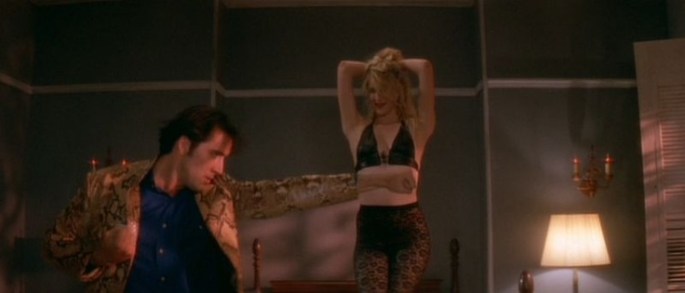
By 1990, David Lynch was at the peak of his popularity and enjoying the most productive period of his career. His television show Twin Peaks had captivated American audiences and he was directing a number of commercials and performance art pieces (Industrial Symphony No. 1). This all culminated with Wild at Heart (1990), an adaptation of Barry Gifford’s novel, which went on to win the coveted Palme d’Or at that year’s Cannes Film Festival. It also helped establish Lynch as America’s premier cinematic surrealist. At its core, the film is a touching love story between two people whose love for each other remains constant despite all of the obstacles that life throws at them, including an overly-protective mother, a dentally-challenged psychopath, and a grizzled rocket scientist. This film is, oddly enough, Lynch at his most romantic, a rock ‘n’ roll opera with vibrant, fiery imagery.
Sailor Ripley (Nicolas Cage) and Lula Pace Fortune (Laura Dern) are young lovers on the run from her crazed and over-protective mother, Marietta (Diane Ladd). Sailor has jumped parole after serving time for manslaughter and takes off with Lula for sunny California. This doesn’t sit too well with Lula’s mom who sends her boyfriend and private investigator Johnny Farragut (Harry Dean Stanton), and, unbeknownst to him, her lover and ruthless gangster Marcellos Santos (J.E. Freeman) on the trail of the young lovers.
As he would do with the opening scene in Twin Peaks: Fire Walk With Me (1992), Lynch kicks things off with a shockingly brutal act of violence that establishes a confrontational tone – this is a violent world where Sailor is prepared to kill a man with his bare hands in order to protect the woman he loves. The first image is the striking of a match followed by images of flames announcing the color scheme that would be prevalent throughout the film. This is continued in the love scenes between Sailor and Lula that are bathed in red, yellow and orange – all representing their burning love for each other. During the course of the film there are countless shots of cigarettes being lit, matches being struck, an exploding car, and a house on fire. This film is vibrantly alive and energized more than anything Lynch had done before or has done since.
In the summer of 1989, Lynch had finished up the pilot for Twin Peaks and tried to rescue two of his projects – Ronnie Rocket and One Saliva Bubble – that were owned by Dino de Laurentiis when his company went bankrupt. Independent production company Propaganda Films commissioned Lynch to develop an updated noir screenplay based on a 1940s crime novel while a filmmaking friend of his by the name of Monty Montgomery optioned Barry Gifford’s book, Wild at Heart: The Story of Sailor and Lula in pre-published galley form. Montgomery gave him Gifford’s book and asked Lynch if he would executive produce a film adaptation that he would direct. Lynch remembers telling him, “That’s great Monty, but what if I read it and fall in love with it and want to do it myself?” And this is exactly what happened as Lynch recalls, “It was just exactly the right thing at the right time. The book and the violence in America merged in my mind and many different things happened.” Lynch was drawn to what he saw as “a really modern romance in a violent world – a picture about finding love in hell.” He was also attracted to “a certain amount of fear in the picture, as well as things to dream about. So it seems truthful in some way.”
Once Lynch got the okay from Propaganda to switch projects, he wrote a draft in a week. Within four months, he began filming with a budget of $10 million. Lynch did not like the ending in Gifford’s book where Sailor and Lula split up for good. For Lynch, “it honestly didn’t seem real, considering the way they felt about each other. It didn’t seem one bit real! It had a certain coolness, but I couldn’t see it.” Samuel Goldwyn, who ended up distributing the film, read an early draft of the screenplay and didn’t like Gifford’s ending either so Lynch changed it. However, the director was worried that this change made the film too commercial, “much more commercial to make a happy ending yet, if I had not changed it, so that people wouldn’t say I was trying to be commercial, I would have been untrue to what the material was saying.”
When Lynch read Gifford’s novel, he immediately wanted Nicolas Cage to play Sailor and Laura Dern to play Lula. The actor said that he was “always attracted to those passionate, almost unbridled romantic characters, and Sailor had that more than any other role I’d played.” In Dern’s case, this was the first opportunity she had “to play not only a very sexual person, but also someone who also was, in her own way, incredibly comfortable with herself.” During rehearsals, Lynch talked about Elvis Presley and Marilyn Monroe with Cage and Dern. Around this time, Lynch bought a copy of Elvis’ Golden Hits and, after listening to it, called Cage and told him that he had to sing two songs, “Love Me” and “Love Me Tender.” The actor, a big Elvis fan, agreed and recorded each song so that he could lip-sync to them on the set.
Before filming started, Lynch suggested that Dern and Cage go on a weekend road trip to Las Vegas in order to bond. Dern remembers, “We agreed that Sailor and Lula needed to be one person, one character, and we would each share it. I got the sexual, wild, Marilyn, gum-chewing fantasy, female side; Nick’s got the snakeskin, Elvis, raw, combustible, masculine side.”
Lynch’s two leads are also on the same page in this respect, especially Cage who affects an Elvis Presley-like drawl and sings two songs made famous by the King. Sailor, like many of the characters in this film, is larger than life with his snakeskin jacket credo, his unorthodox style of dancing (involving martial arts kicks and punches) and his habit of singing Elvis songs to Lula in public. There is a show-stopping moment where he instructs Powermad, a speed metal band, to back him on a note perfect rendition of “Love Me” while the women in the audience scream in adoration in surreal slow motion like something out of a dream. Cage plays Sailor as an instantly iconic figure, where pointing an accusing finger at Marietta is akin to a declaration of war.
Dern plays Lula to gum-chewing perfection, delivering a completely uninhibited performance as Lula. She exudes a captivating sensuality in the way she carries herself and makes a line like, “You got me hotter’n Georgia asphalt,” sound like an enticing come-on. Lula is a young woman full of energy and vitality as is evident in the scene where she and Sailor dance to the music of Powermad. There is genuine chemistry and heat between her and Cage — rather appropriate for a film dominated by images of fire. However, as the film progresses and the tone becomes darker, Lula’s optimism is chipped away and this culminates in a terrifying scene where Bobby Peru (Willem Dafoe) verbally rapes her in a way that echoes a similar scene in Blue Velvet (1986).
Amidst all of this madness and brutality is a touching tenderness between Sailor and Lula, like the way he softly kisses her after a passionate bout of sex, or a moment where he places her hand over his heart without a word. Nothing needs to be said between them because they understand each other intimately. As she tells him at one point, “You mark me the deepest.” And Lynch takes the time to show a series of conversations between Sailor and Lula where they talk about their respective childhoods (“I didn’t have much parental guidance.” Sailor tells her, not surprisingly.), their dreams, random thoughts, and past relationships. This allows us to get to know and care about them while also taking the occasional breather from all of the weirdness that Lynch throws our way.
Diane Ladd is fantastic as the wicked witch cum mother-from-hell, gleefully chewing up the scenery as evident even in the way she vigorously drinks from her martini glass and the way she delivers threats to Sailor with venomous gusto. Also prevalent is Lynch’s trademark fascination with the dark underbelly of America as personified by the character of Bobby Peru, one of Lynch’s most disturbing psychopaths (right behind Blue Velvet’s Frank Booth). With his horrible teeth and all-black attire (to match his pitch black heart), Peru sets his sights on Sailor and Lula with the intention of killing the former and seducing the latter.
Lynch juxtaposes this darkness with his trademark absurdist humor in the guise of the various oddballs Sailor and Lula meet along the way, like the man at a bar (Freddie Jones) who talks about “pigeon-spread diseases” in a goofy, high-pitched, sped-up voice. Or, Lula’s wildly eccentric cousin, Jingle Dell (Crispin Glover in a memorably bizarre cameo), who believes aliens are after him, enjoys placing cockroaches in his underwear and exhibits odd, nocturnal behavior (“I’m making my lunch!”). There is also a memorable scene that introduces Bobby Peru and his friends, including Lynch regular, Jack Nance in a scene-stealing role as Boozy Spool, a dazed and confused rocket scientist who may have been sampling his own rocket fuel. He delivers a brilliantly surreal monologue that is amongst some of the best moments in any Lynch film and reminiscent of the joyride interlude at Ben’s in Blue Velvet.
Wild at Heart also features stunning cinematography by Frederick Elmes (who also worked with Lynch on Eraserhead and Blue Velvet). In particular, there is a scene where Lula and Sailor pull over to the side of the road as she is upset and disgusted with all of the terrible news that she’s heard on the radio. He finds Powermad on a station and they get out of the car and dance before embracing passionately. Lynch cuts to a long shot and pans away to a gorgeous shot of a sunset that captures the poetic beauty of this moment perfectly.
Wild at Heart is a film rich in emotion and feeling as everything is heightened to an operatic level. Surreal is an adjective always used to describe Lynch but he is also a very romantic filmmaker. There is the Douglas Sirkian melodrama of Blue Velvet, the emotional journey Alvin Straight takes in order to reconnect with his brother in The Straight Story (1999), and the town of Twin Peaks dealing with the grief over the death of Laura Palmer. Perhaps the most emotional scene in Wild at Heart is when Sailor and Lula drive along a deserted stretch of highway late and night and while an instrumental version of “Wicked Game” by Chris Isaak plays on the soundtrack, he tells her about how he knew her dead father. The reaction she gives is so heartbreaking, like a daughter who realizes that her father isn’t perfect.
Sailor, in some ways, is a father figure to her. He makes her feel protected and she even comments on how some of his physical features resemble her dad’s. This scene represents the first seed of doubt in their relationship. It is the first step off the yellow brick road and this is reinforced by Lula’s nightmarish vision of her mother as the Wicked Witch. And then they come across a horrible car accident and find one person still alive – a woman (Sherilyn Fenn) walking around in shock from a head wound. She eventually dies in Sailor and Lula’s arms. It is a tragic moment accentuated beautifully by Angelo Badalamenti’s moving score. This scene is a crucial turning point in the film as it descends into much darker territory as Sailor and Lula make a series of bad decisions, most notably getting involved with Bobby Peru.
Lynch loved The Wizard of Oz and put a lot of references to it in his own film. Boozy Spool talks about his dog, comparing it to Dorothy’s pooch Toto; Marietta’s picture disappears at the end of the film just like the Wicked Witch; there’s Lula’s vision of her mother as the Wicked Witch of the East; Sailor has a vision of the Good Witch (Sheryl Lee) at the end of the film, who convinces him not give up on love; and Lula clicking the heels of her shoes together after the terrifying encounter with Bobby Peru.
Early test screenings for the film did not go well with the intense violence in some scenes being too much. Lynch estimated that between 100-120 people walked out. The scene in question was the torture and killing of Johnny Farragut. “I didn’t think I’d pushed it to the point where people would turn on the picture. But, looking back, I think it was pretty close. But that was part of what Wild at Heart was about: really insane and sick and twisted stuff going on.” Lynch decided not to edit anything from the film and at the second screening another one hundred people walked out during the same scene. Lynch remembers, “By then, I knew the scene was killing the film. So I cut it to the degree that it was powerful but didn´t send people running from the theatre.”
The film was completed one day before its premiere at the 1990 Cannes Film Festival. Its first screening was in the 2,400-seat Grand Auditorium and afterwards it received “wild cheering” from the audience. Barry Gifford remembers that there was a prevailing mood among the media that hoped Lynch would fail. “All kinds of journalists were trying to cause controversy and have me say something like ‘This is nothing like the book’ or ‘He ruined my book.’ I think everybody from Time magazine to What’s On In London was disappointed when I said ‘This is fantastic. This is wonderful. It’s like a big, dark, musical comedy.’” When Jury President Bernardo Bertolucci announced Wild at Heart as the Palme d’Or winner at the awards ceremony, the boos almost drowned out the cheers with film critic Roger Ebert leading the vocal detractors.
Wild at Heart perfectly illustrates Lynch’s love-hate relationship with America. The film is filled with beautifully shot iconography of Americana, like big convertible automobiles from the ‘50s and rock ‘n’ roll music from the period. Sailor and Lula are loving (albeit tweaked) homages to Elvis Presley and Marilyn Monroe. It is also something of an underrated film that is often ignored in favor of Lynch’s more well-known work, like Blue Velvet or Mulholland Drive (2001). One can see the film’s influence in a film like True Romance (1993), with its Elvis-obsessed protagonist and his gum-chewing white trash girlfriend as they are pursued by psychotic gangsters, or Natural Born Killers (1994) with its white trash lovers on the run, or even U-Turn (1997) with its town full of eccentric weirdoes. But no one can pull this stuff off quite like Lynch and his film is a true original that deserves to be re-discovered and re-evaluated.
A PERFECT WORLD – A FILM REVIEW BY J.D. LAFRANCE
In 1993, Clint Eastwood was enjoying a resurgence in popularity. His revisionist western Unforgiven (1992) won three Academy Awards and he received critical and commercial acclaim for his performance in the action-thriller, In the Line of Fire (1993). When he was approached with the screenplay for A Perfect World (1993), he was still making Line of Fire and doing promotion for the Academy Award nominations for Unforgiven. As a result, Eastwood anticipated only directing A Perfect World. However, when Kevin Costner came on board, he felt that Eastwood would be perfect for a smaller role in the film. Eastwood agreed because it wouldn’t require him to spend a lot of time in front of the camera.
A Perfect World is essentially a road movie set in Texas, 1963, three weeks before the John F. Kennedy assassination (an event that subtly hangs over the film with ominous foreshadowing) that recalls a simpler, even more innocent time. Thematically there is much more going on as the film wrestles with father/son relationships, child abuse and religion. The film begins with two convicts making a daring escape from prison only to take refuge in the neighboring suburbs. Terry Pugh (Keith Szarabajka) is the more amoral one as he wants to kill the driver of the vehicle they commandeer to leave the prison. He then later tries to rape a woman whose house he breaks into. The other convict, Butch Hayes (Kevin Costner), steps in before things go too far with Pugh and the woman. Butch even convinces her little boy, Phillip (T.J. Lowther), to give him the handgun that was dropped during the ensuing scuffle.
This is a crucial moment because it establishes early on the instant bond between Butch and Phillip. Despite the circumstances, there is something about Butch that Phillip intrinsically trusts. What this is will become more apparent later on in the film. When a neighbor intervenes unexpectedly, Butch and Pugh kidnap Phillip and take off in a stolen car. Texas Ranger Red Garnett (Clint Eastwood) is called in to track down and bring in the fugitives. However, the Governor (Dennis Letts) assigns him a criminologist by the name of Sally Gerber (Laura Dern). He immediately resents her intellectual approach to the situation as opposed to her being a woman, which would have been the norm at the time. He tells her, “This is not a penal escape situation, this happens to be a manhunt. And no talking around in circles is gonna fix all that.” Eastwood immediately establishes an antagonistic relationship between Red and Sally, which parallels the antagonistic relationship between Butch and Pugh. In no time at all, both conflicts will be resolved – one amicably, the other violently.
Like many of Eastwood’s characters, Red works on instinct and common sense. He resents authority figures and bureaucracy. He likes to be left alone and do things his own way. He sees Sally as an annoyance and a possible obstacle in his path. However, she clears the air pretty quickly, letting him know that she’s no pushover when she tells him, “But the one thing I won’t do is be your straight man so you can play hero to a bunch of morons who think you’re some kind of hillbilly Sherlock Holmes.” These lines deflate Eastwood’s traditional stoic lawman façade and Red even offers a compromise of sorts. He encourages Sally to speak up and even though he might not agree with her theories, he’s willing to listen. A Perfect World proceeds to cut back and forth between Butch and Phillip’s developing friendship and the partnership between Red and Sally with the two storylines dovetailing finally at the film’s conclusion.
One of the hallmarks of Eastwood’s directorial efforts is an emphasis on character and the relationships that are created between them. This film is no different with John Lee Hancock’s superbly written screenplay. He would go on to adapt Midnight in the Garden of Good and Evil for the film of the same name that Eastwood also directed in 1997. Sadly, they haven’t teamed up since but these two efforts are proof that they were a good match for each other. Hancock’s screenplay is filled with clever dialogue, like when Butch tells Phillip his theory about how a car is a time machine. Everything behind them is the past, everything in front is the future and inside the car is the present. “We’re time traveling through Texas,” Butch proudly proclaims. And in a way that’s what the film is doing – taking us back to a time that doesn’t exist anymore, to a time before President Kennedy was killed and when people were more hopeful and optimistic. His assassination (and that of other key figures of the 1960s) changed all that and we watch these events transpiring with the knowledge of how radically history will change in a few short months.
Hancock’s screenplay should also be noted for how well it develops the relationship between Butch and Phillip. Early on, Butch puts his trust in the boy by leaving him and Pugh in the car with the gun while he goes into a store for supplies. Pugh is able to get the drop on Phillip and take the gun away from him only to find out that there are no bullets in it. Butch assumed that this would happen and did not want to see Phillip get hurt. He may be a convict but he is not as heartless as Pugh. In turn, Phillip trusts Butch and stays with him even when he has the option, on a couple of occasions, to escape. Butch makes Phillip feel important and needed. Once they are on the road, having ditched Pugh, Butch refers to the boy as the navigator of the car. Later on, he asks Phillip to scout a car that he is interested in stealing. Butch doesn’t make Phillip feel like a passive observer but encourages him to become involved in their adventures.
Another significant factor in their friendship is Phillip’s lack of a father figure – something that Butch can also relate to and this provides common ground between them. Butch also speaks honestly to the boy. In one scene, when Phillip says that his mother told him his father would return, Butch replies that she lied and that he is never coming back. He doesn’t come out and say it but we sense that Butch knows this from his own personal experience. He also broadens the boy’s horizons by allowing him to experience things that his Jehovah’s Witness practicing mother would never condone, like drinking soda or wearing a Halloween costume and going trick or treating.
The relationship between these two characters works so well not just because of the excellent script but also because of the strong performances from Costner and T.J. Lowther. On the surface, Butch seems like one of Costner’s cocky, cool characters that he is often known for (i.e. Fandango, Silverado or Bull Durham), yet underneath lurks a dark, dangerous streak that surfaces when he sees a child being abused (the sure sign that Butch was probably abused when he was a child as well). Eastwood never lets us forget that Butch is a criminal. Costner is able to balance this element of danger with his trademark charm, like when he helps Pugh differentiate between a fact and a threat in a scene that is slightly threatening because violence is involved but is also funny as well because of the absurd tone. If Costner had any doubts about his character going into this film, Eastwood assured him that movie stars like Humphrey Bogart and James Cagney weren’t afraid to play convicts and “have a bad side,” the director said, “and I had Kevin play a much harder edge than he has played.”
Lowther matches Costner’s performance with his superb take on a shy, young boy who develops a strong bond with his captor. He has such an expressive face, which he uses to great effect during emotional scenes, like the internal conflict that becomes apparent when Phillip is given the chance to escape or stay with Butch. He has been cut off from everything and everyone he knows. He has little choice but to stay with the convict. Lowther doesn’t have too much dialogue but he is able to convey so much with a look and with his expressive eyes. He is more than capable of holding his own with Costner and their scenes together are well-played as we see their friendship develop over time. Eastwood was never interested in playing the sympathy angle with this friendship. He said, “You can’t have him treat the kid as if he’s paternal. I didn’t want it to come off like he’s cuddling the kid.” Above all, the director did not want the boy to “become precious. I wanted an un-Disneyesque kid.”
The script also provides motivation for Red’s personal interest in this case. We learn that the lawman put Butch in juvenile hall when he was young in an attempt to save him from his abusive father but it turned him into a career criminal. Red even paid off a judge so that Butch would stay in longer and so he feels guilty and responsible for what happened to him. Even though he never comes out and says it, one feels that Red wants to be the person to find Butch and try set things right. This backstory also explains the convict’s hatred for any kind of child abuse (Pugh hitting Phillip or a mother physically scolding her two children) and this manifests itself in a particularly strong way towards the end of the film when he and Phillip take refuge in a poor family’s house in what is surely the darkest scene in the film. After witnessing the father repeatedly abusing his little boy, Butch hits and threatens the father, his own rage threatening to boil over. A scene that started off warm and inviting turns into one that is uncomfortable and filled with tension as Phillip sees just how dangerous Butch can be. He ties up the entire family and we see how this affects Phillip as he observes the fear in the eyes of the mother and her child as Butch threatens the father repeatedly.
Phillip stops Butch before anything fatal happens to the family but the question lingers, was he going to kill them or just tie them up so that they couldn’t get away? Regardless, Phillip shoots Butch and runs away, setting the stage for the film’s climactic showdown between Red and Butch. Even here, Eastwood defies our expectations by drawing out the stand-off. The relationship between Butch and the boy continue to play out as he apologizes for shooting him. They have one last emotional conversation and because we have gotten to know these characters, we care about what happens to them. Their final moments are very touching, even moving. Costner and Eastwood finally have a scene together and this is what we’ve been waiting for the entire film. Not much is said between them and this is because we already know their motivations, Eastwood has been building to this moment. Visually, A Perfect World begins and ends the same with a slow motion shot of Butch lying in a field with money floating around him in the wind but by the film’s conclusion we know how and why he got there.
These sequences feel like something out of a dream and coupled with the leisurely pace probably didn’t endear it to mainstream audiences who were expecting another crowd-pleasing popcorn movie like In the Line of Fire. A Perfect World is closer to Unforgiven thematically as both films explore how the sins of the past affect the present with Eastwood playing tortured characters that try to fix old mistakes that had life-altering consequences but end up resolving things violently. In the case of Unforgiven, Eastwood’s character takes an active part in this resolution but with A Perfect World events spiral out of his control. This film is one of his most underrated efforts to date with its almost lyrical approach making it ripe for rediscovery by another generation of filmgoers receptive to an Eastwood film with complex relationships and a tragic conclusion reminiscent of more recent efforts like Mystic River (2003) and Million Dollar Baby (2004).
RAMIN BAHRANI’S 99 HOMES — A REVIEW BY NICK CLEMENT
Ramin Bahrani has made five feature films thus far in his fascinating career, and all of them have been some of the best films of their respective years, with the trio of Man Push Cart, Chop Shop, and Goodbye Solo forming some sort of personal trifecta of small, less-is-more-inspired filmmaking, almost the American answer to the Dardenne brothers. His latest, the viciously angry social drama 99 Homes hits some of the same keys of maximized melodrama that his previous film did, the underrated At Any Price with Dennis Quaid and Zac Efron, while telling a topical, important, and thoroughly engrossing story that will likely be too intense and too real for some viewers. Concentrating on the financial and housing collapse of 2008 and centering the action in Orlando, arguably the epicenter of the sub-prime mortgage disaster zone, Bahrani and co-writer Amir Naderi have fashioned a compelling and provocative narrative that finds a struggling young man named Dennis Nash (an impassioned and excellent Andrew Garfield) learning just how far he’s willing to go to put food on the table for his son and mother, let alone a home over the heads. Michael Shannon is the real estate shark named Rick who has figured out how to take advantage of an already corrupt system, exploiting the failures and misery of others for his own financial gain; he sits at the same table as Gordon Gekko and Blake from Glengarry Glen Ross. The image of Shannon incessantly ripping his E-cigarette is one of the more searing visuals I’ve seen in any movie this year, and the effectively restless and propulsive music was scored by Antony Partos and Matteo Zingales, giving the film a level of anxiety that Bahrani ratchets up through his controlled and vigorous direction. Tackling topical themes and plotlines in works of Hollywood-based fiction can sometimes be a tricky proposition, but here, Bahrani and his skilled team knew precisely how to calibrate all of the elements.
The film kicks into high gear after Nash, his son, and his mother (the reliably fantastic Laura Dern) are evicted from their life-long home by Rick and two police offers, in an emotionally harrowing scene which is repeated throughout the story to underscore just how many people were affected by the greed and duplicity of financial managers, bankers, the federal government, and themselves. The superb cinematographer Bobby Bukowski can lay claim to having shot two of the most socially relevant and topical films of the year, with groundbreaking work done on Oren Moverman’s homeless drama Time Out of Mind, and incredibly intense lensing on 99 Homes. The film pulses with an immediacy, heightened by Bukowski’s smart widescreen framing, with the hazy Orlando sunlight offering the false promise of a happy day. The opening steadicam shot is nothing short of bravura, introducing the audience to the reprehensible but magnetic character of Rick, with Shannon shredding the screen with predator-like energy and endless answers to the various situations he’s found himself in. And while Garfield is undoubtedly convincing as a man pushed to his moral and ethical limits, all throughout, we’re constantly reminded that this is the Michael Shannon show, with this tremendous actor delivering an utterly ferocious performance that feels all too possible and realistic – you know there are plenty of people out there just like Rick, ready to swoop in and grab any and all of the pieces that they can line their pockets with; the agitated screenplay constantly stings and reminds us of how vulnerable many of us truly are at any given moment in life. This is the REAL horror movie for the month of October, and one of the best strengths of the film is its ending, which feels logical, understandable, and rational, as it takes into account everything that has come before it, with the final, mildly ambiguous beats suggesting nothing simple or happy for anyone. 99 Homes is tough but vital cinematic medicine that goes down smooth while leaving an appropriately bitter aftertaste. It’s one of the best films of the year.