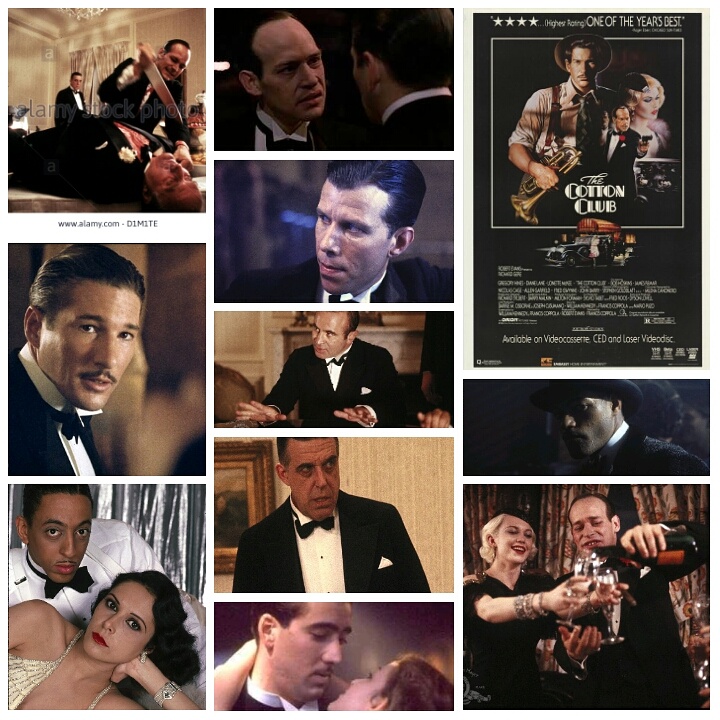
Francis Ford Coppola’s The Cotton Club is every bit as dazzling, chaotic and decadent as one might imagine the roaring twenties would have been. it’s set in and revolves around the titular jazz club, conducting a boisterous, kaleidoscope study of the various dames, dapper gents, hoodlums, harlots and musicians who called it home. Among them are would be gangster Dixie Dwyer (a slick Richard Gere), Sandman Williams (Gregory Hines), a young Bumpy Johnson (Laurence Fishburne) and renowned psychopathic mobster Dutch Schultz (a ferocious James Remar). Coppola wisely ducks a routine plot line in favor of a helter skelter, raucous cascade of delirious partying, violence and steamy romance, a stylistic choice almost reminiscent of Robert Altman. Characters come and go, fight and feud, drink and dance and generally keep up the kind of manic energy and pizazz that only the 20’s could sustain. The cast is positively stacked, so watch for appearances from Nicolas Case, Bob Hoskins, Diane Lane, John P. Ryan, James Russo, Fred Gwynne, Allen Garfield, Ed O Ross, Diane Venora, Woody Strode, Giancarlo Esposito, Bill Cobbs, Sofia Coppola and singer Tom Waits as Irving Stark, the club’s owner. It’s a messily woven tapestry of crime and excess held together by brief encounters, hot blooded conflict and that ever present jazz music which fuels the characters along with the perpetual haze of booze and cigarette smoke. Good times.
Tag: movie review
Hearts In Atlantis: A Review by Nate Hill
The one great benefit that any film based on a Stephen King story has is just that: it’s based on a Stephen King story. The guy is just such a prodigy of fiction that even if the film version of one of his books doesn’t deliver, one can still see the brilliant blueprint lurking beneath the frames. When the filmmakers are successful, however, we get a visually stimulating project founded on the tale he has weaved to support all the other elements. Hearts In Atlantis is based on an anthology volume of his, and in fact the story the film follows isn’t even called that, it’s actually ‘Low Men In Yellow Coats’. I can see why the director went with Hearts In Atlantis though, as it’s much more akin to the ethereal, sentimental tone he was going for, and less of an ominous hook. The story itself follows a mysterious man named Ted Brautigan (Anthony Hopkins), a recent tenant in the home of young Bobby Garfield (Anton Yelchin) and his wayward mother (a miscast Hope Davis). The setting is Midwestern America, in the dead heat of a 1950’s summer. Bobby spends his days cavorting in the local woodlands with his fastest of friends, Carole (Mika Boorem) and Sully (Will Rothhaar). He takes a shine to Ted though, who pays him a dollar a week to read to him, and warns him of shadowy ‘low men’, threatening figures who doggedly pursue him for nasty reasons. Ted becomes a father figure for young Bobby, whose mother has questionable ideas about not only raising a son, but taking care of her own affairs. Now the film may seem a bit thinly plotted to some, and there’s a reason for that. This story is actually a tiny fragment in a much larger tale, King’s magnum opus The Dark Tower. Ted and Bobby have important parts to play in that saga, in which the events of this film are but a sentence long. Some viewers may feel slighted by a lack of context, but the filmmakers here still find a way to make this its own story, crafting a touching coming of age story melded with whispers of otherworldly intrigue. The fusion of beguiling nostalgia and the vague menace that advances on Bobby and Ted makes for a unique tone, something just south of a thriller which can’t quite be pinned down by genre labels. Hopkins can be both terrifying and tender depending on the role. Here he is kindness incarnate as a man whose worldly intuition goes beyond telekinesis into the kind of qualities reserved for the best and brightest. Yelchin and Boorem, who would star alongside each other again a few years later in the lacklustre Along Came A Spider, are the superb heart of the film. Yelchin has shown a constant progression of strongly realized, believable work and the quality of his craft can be traced back to this stunning genesis role. Boorem is highly underused these days, and one need only watch her light up the screen with emotional sincerity in this to see why she should be working far more. There’s neat supporting work from Tom Bower, Celia Weston, Alan Tudyuk and David Morse as an older version of Bobby who yearns for days gone by. I found myself deeply enjoying this one whilst constantly drawing back to the knowledge and context I have for it via The Dark Tower, but the film on it’s own is enough to provide a rewarding experience for anyone who isn’t familiar with the multiverse. Amid King’s favourite topics and settings are Midwest adolescence, idiosyncratic nooks of Americana and the ever present supernatural aspect, dynamics which Hearts In Atlantis gives us aplenty, along with an open invitation to explore the universe farther, should one want to venture along the path to the Tower. I’d recommend it.
B Movie Glory with Nate: Wedlock
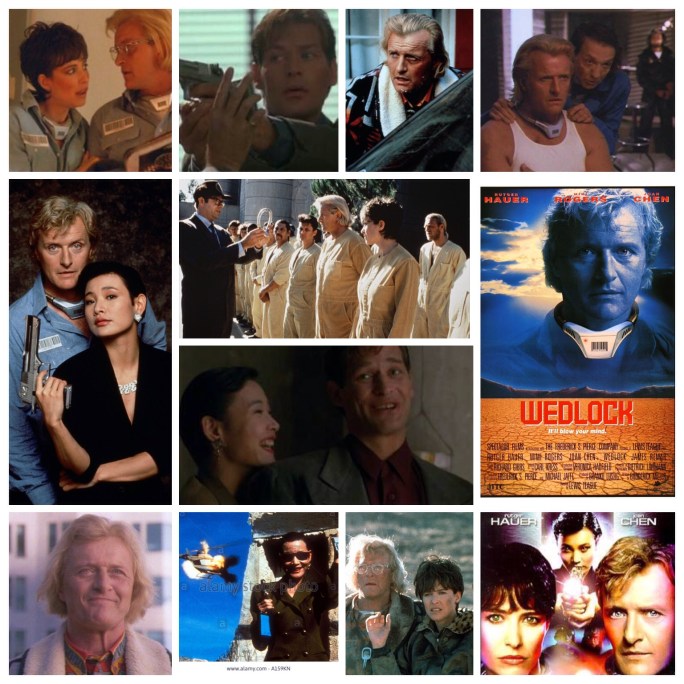
Wedlock is one of those shamelessly trashy B-movie romps that the 80’s proudly churned out in droves for our viewing pleasure. Some are shitty and enjoyable, some are just shitty, and some are solid gems, provided you’ve been schooled a bit in this particular, acquired taste of an arena. I spent a lot of my teenage years being a scholar in this sort of lovable junk, so I have plenty of ancient data in my mental hard drive to dust off for the old blog-ski. Rutger made quite a few ventures into this field (come to think of it most of my favourite actors have. Wonder what that says about my taste lol). He’s got genre written all over his acting style, and loves to play broad characters in stylized fare. Here he plays Frank Warren, an amiable jewel thief who is betrayed in an opening sequence heist by his dodgy partner Sam (James Remar), and rowdy girlfriend Noelle (Josie Packard- I mean Joan Chen). He’s sent to an amusingly ‘futuristic’ penitentiary where they implement prisoners with a unique system: each prisoner is fitted with a collar, each collar has a twin collar, and if the two get several miles apart, both detonate rigged explosives and messily decapitate the pair of unlucky inmates. They are not aware who has their twin collar, making escape a risky notion indeed. It’s exactly the type of high concept buffoonery that trademarks these type of outings, and it’s played for both suspense and laughs very nicely. Frank escapes, dragging along the woman who wears the twin collar (Mimi Rogers), pursued hotly by Sam and Noelle who want to find the diamonds that he hid shortly before his arrest. It’s a prison flick, it’s a chase flick, with its own kooky, offbeat sense of style. Hauer is usually so intense he looks like he’s gonna implode in on himself, but here he gives a very laid back, slight and funny performance, which gives the film it’s refreshingly upbeat feel. Remar and Chen are bouncing balls of energy as the dastardly couple out to ice Frank, riffing off each other and cheerfully chewing scenery. Watch out for an early career appearance from Danny Trejo, as well as work from Glenn Plummer and Stepehn Tobolowsky as a hard ass warden who gets the best line of the film: “You non-conformists are all the same”. That alone encapsulates the irreverent, tongue in cheek tone that’s a nice switch from the usually dank, oppressive atmosphere that second tier action flicks often get saddled with. Oh, and I want the number of Hauer’s wardrobe outfitter; those fluffy, technicolor wool sweaters are a sideshow unto themselves.
Nicholas Winding Refn’s Fear X: A review by Nate Hill
Before Nicholas Winding Refn blew up into the big time with intense, stylish stuff like Bronson, Drive and Valhalla Rising, and after he made his bloody emergence into cinema with Pusher, he made another film that no one seems to remember or even even like all that much. It’s easy to see why Fear X wasn’t that well received or remembered: it’s choppy and confusing, even by Refn’s terms, and doesn’t pull it’s third act into a cohesive resolution, instead favoring a disconcertingly surreal descent into subconscious, abstract imagery, which we all know (the careers of Lynch and others are examples) is an aesthetic not always absorbed by the most open of minds when it comes to the masses. Now that we got that out of the way, here’s my take. I adore the film. It’s a skitchy Midwestern nightmare that starts of gently gnawing at the fringes of your perception with a sense of dread that’s intangible in its possibility, an outcome as vast and unknowable as the desolate prairie setting that calls to mind the fear and degradation of Fargo without an ounce of its good humour, black or otherwise. John Turturro inhabits this setting with a twitchy, anxious aura, suggesting a haunted mindscape beneath those famous curls. And well he should be haunted, considering his wife recently disappeared without a trace. For him, not knowing what happened is worse than any kind of grisly answer, for its a sick hollowness that chokes out any room for him to grieve. He works by day as a mall security guard, busting shoplifters and scanning snowy surveillance screens to distract himself. Then, his co-worker (Stephen Eric Mcintyre) hands him a videotape that may contain answers and be the first breadcrumb in a trail leading to his wife’s killer, and possibly his solace. In a lot of films and shows like these, the protagonist ventures to a small town with sordid secrets simmering just beneath the crust of the cheerful looking pie held by the pretty waitress at the local diner. Some artists find their own groove without riffing on other’s work too much, and some fall flat-footed into derivitive motions. Refn is bold yet subtle in his direction once Turturro arrives in the town, and casts a deceptively innocuous yet insidiously creepy spell over the proceedings. It’s essentially where the film really exits utero and manifests, the danger before that was only glimpsed on the horizon now a very real possibility, like waking up from a bad dream into a worse reality. Turturro is met with cold stares and grim greetings, especially by a deputy who becomes predatory upon seeing part of the clues he has brought with him, vaguely tied to a local resident. From there he is led to a suspicious Sheriff (James Remar), and the sheriff’s wife (Deborah Kara Unger). Remar may have been involved in his wife’s death, and he plays with the curtain of his performance wonderfully, pulling it back ever so slightly in scenes with Unger (some of his best work) and stirring up confusion while menacing Turturro. It’s an unheralded best from him and a rare occasion where he gets to be subtle and eerie, as opposed to his usual brash, cocky characters. Unger is similar to Remar in the sense that she has made a point over the course of her career in picking obscure, challenging and unique roles to play. In playing a couple here they feel kind of star-crossed just by the nature of their careers, fed by their smoldering chemistry. The film proceeds like any thriller would, with only intangible hints at the weirdness to come, until the last half of the third act, where it abandons logic completely and dives headlong into a dreamlike abyss of surreality, without a readily discernable warning or narrative signpost. Is Turturro unstable? Or is it Remar? Or are events just taking a turn fpr the supernatural as a result of the town messing with people’s psyches, a la The Shining? We will never know, and honestly I doubt Refn did, or ever will either. It’s him in the sandbox, free from logic or consequence, and hate it with all your might if you wish, but you can’t deny it’s a psychologically galvanizing experience that toys with your perception and spooks to the core. The film deals with themes of not knowing, and open ended tragedy masked by confusion and spiraling ‘what ifs’. Perhaps Refn implemented all the metaphysical hoo-hah as an extreme metaphor for Turturro’s consciousness, fractured and torn by the absence of resolution to the point of madness. Or maybe Refn just likes making weird shit. That’s the eternal debate with artists like him and Lynch: do they have some plan, a secret marauders map to the strangeness that they present to us on screen which only they are privy too, or are they simply making it up as they go along, hurling paint at the canvas until they are satisfied with the result, regardless of comprehending it? We’ll never know, and that for me is the beauty of it. With Fear X Refn crafts a polarizing thriller that is the very proto – example of ‘love it or hate it’. It’s definitely not for everyone. But love it or hate it, there’s no escaping it’s power.
THE LAST BOY SCOUT – A REVIEW BY J.D. LAFRANCE
Shane Black’s career has had a fascinating, meteoric rise and fall (and rise again). The screenwriter hit the big time when his breakthrough screenplay for Lethal Weapon (1987) sold for $250,000. This kick-started a wildly popular action film franchise. He soon hit rock bottom with the heavily re-written (by others) modest hit, The Long Kiss Goodnight (1996), the script of his that sold for a staggering $4 million. And yet, even his weaker efforts still contain decent action sequences and playful banter between characters. What seemed to be missing in Black’s later films was depth and characterization – elements that made his screenplays distinctive. Perhaps this was as a result of meddling and script revisions at the hands of others. For Black, screenwriting came easy: “The fact that there were so few rules associated with it, so few actual structural maxims … you can just do what you want. So I played around and it was fun. I would just type to keep myself entertained. It turned out people liked that. They felt it represented an interesting way to go, but for me it was truly just typing to keep myself entertained.”
Studio executives were only interested in using Black to write formulaic drivel. Determined to make it, he wrote Lethal Weapon. The script was a blast of fresh air and ended up being made into a big budget action film starring Mel Gibson and Danny Glover. This kind of thing almost never happens in Hollywood and it’s a testimony to Black’s skill as a screenwriter that he achieved this kind of success so early on in his career. Lethal Weapon grossed over a $100 million. In the best tradition of Hollywood, money talks and so in 1990, Black was paid $1.75 million (an unheard of amount at the time) for The Last Boy Scout script. The next year it was made into a 1991 action movie starring Bruce Willis and Damon Wayans and directed by the late Tony Scott.
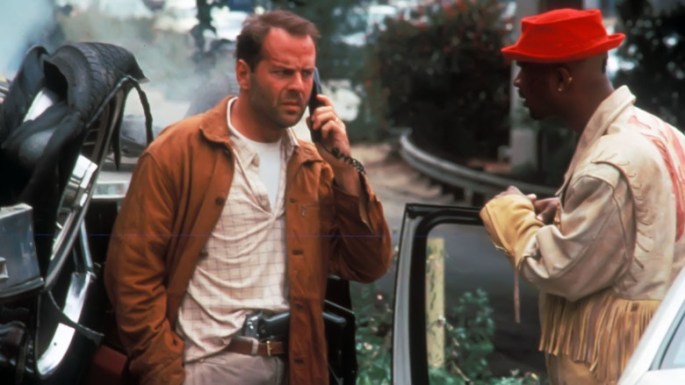
The film starts off literally with a bang as a pro-football player (a pre-infomerical Billy Blanks) pulls out a handgun right in the middle of a play and shoots three opposing players in his way to getting a touchdown before killing himself. Joe Hallenbeck (Bruce Willis) is a private detective hired by his best friend (Bruce McGill) to protect a stripper named Cory (Halle Berry in an early role). The best friend is subsequently blown up in a car and the stripper gunned down by thugs. Her washed-up, football-playing boyfriend Jimmy (Damon Wayans) hooks up with Joe to get some answers and some much needed payback.
“I had this period where I didn’t think I was any good at anything and fought desperately to stay afloat,” Black said in an interview with Creative Screenwriting magazine. And with that feeling in mind, Black wrote a movie that pushes the world-weary detective stereotype to then new, surreal levels. Willis’ performance and Black’s screenplay combine to produce a portrait of a guy who is so down and out that our first glimpse is a shot of him passed out in his own car while being harassed by snotty neighborhood kids with a dead squirrel. When we meet Joe he has a pretty simple outlook on life – a mantra, if you will, to start each day: “Nobody likes you. Everybody hates you. You’re gonna lose. Smile you fuck.” Willis, who has made a career out of playing world-weary tough guys, nails the defeated vibe that sticks to Joe like stink on dog poop. Joe’s actually a very disillusioned good guy, an ex-Secret Service agent who saved the President’s life once but got fired after he punched out a senator (Chelcie Ross) with a kinky streak. Throughout the movie, Willis delivers deadpanned one-liners while constantly getting the crap kicked out him. As a result, you can’t help but root for him as he and Wayans send the baddies to their well-deserved violent deaths.
Willis plays a classic burn-out, sporting the traditional slovenly appearance of a down-on-his-luck P.I. complete with unshaven look and rumpled clothes that he slept in. And that’s the best he looks, from that point on it’s all downhill as his face takes on cuts and lacerations accrued from fighting numerous bad guys. Joe actually uses his disheveled appearance to his advantage, like when a random baddie takes him into an alleyway to kill him. Joe buys time by cracking jokes about the flunkie’s wife and then, when the guy lets his guard down, stabs him in the throat with a broken bottle. The guy gurgles, “You bastard,” to which Joe curtly replies, “And then some.” Willis was born to spout Black’s dialogue. He’s the master of sarcastic comebacks and gets some real doozies in The Last Boy Scout. At one point, Jimmy chides him, “You read much?” Joe replies, “My subscription to Juggs magazine just ran out.”
Jimmy is also at an emotional cul-de-sac of sorts – popping pills to stave off chronic pain from football injuries he picked up as a player. Like Joe, he’s been disgraced from his former profession, kicked out of the league for gambling. He now spends time feeling sorry for himself by cultivating a drinking problem and nailing anything in a skirt despite having a super-hot stripper girlfriend played by Halle Berry (only in the movies!). Like Martin Riggs in Lethal Weapon, Jimmy lost his family to tragedy and it taints his entire worldview. Life means nothing and solving his girlfriend’s murder is the only thing he has left. Wayans shows that he’s more than just a goofy funnyman in a scene where he tells Joe how he got kicked out of football. It is an angry tirade tinged with hurt and bitter resentment as he was basically chewed up and spit out by an uncaring organization. His speech touches upon the harsh realities of professional sports.
Scott populates his movie with a fine collection of character actors, chief among them Noble Willingham as uber rich football team owner Sheldon Marcone and stand-up comedian Taylor Negron cast wonderfully against type as one of Black’s trademark polite, well-spoken sociopaths (see also Lethal Weapon’s Mr. Joshua and The Long Kiss Goodnight’s Timothy). Marcone is also a repeating motif in Black’s scripts. He’s an old, privileged white man who is greedy and corrupt. Think of the money-laundering retired general in Lethal Weapon and the war-mongering CIA boss in The Long Kiss Goodnight. Black clearly sees these men as the source of real evil in the world, pulling the strings that will result in death and destruction in the name of money. In all three films, the protagonists face insurmountable odds to do what is right regardless of the danger or risk to their own well-being.
Like most buddy action movies, the relationship between Joe and Jimmy starts off with plenty of friction as the quarterback resents the private investigator watching over his girlfriend because that’s his job. They trade a few insults and then decide to team up when she’s killed. Black has fun playing around with the dynamic between two guys who basically hate each other but are thrown together due to extraordinary circumstances. At one point, Jimmy cracks a joke to lighten the mood between them only to be rebuffed by Joe. Jimmy tells him, “I’m just trying to break the ice,” to which Joe replies, “I like ice. Leave it the fuck alone.” There are all kinds of snappy banter between them as Wayans tones down his trademark goofy shtick and more or less plays straight man to Willis’ deadpan humor.
Unlike a lot of buddy action movies, Black allows for the occasional lull, like the moment where Jimmy looks at a photograph of him and Cory and you can see on his face how upset he is by her death now that he has a moment to reflect on it. No words are said, Wayans’ face says it all. Joe and Jimmy represent the last bastion of decency in a world that is corrupt and morally bankrupt, where best friends double cross each other, wealthy businessmen are blackmailed, and wives cheat on their husbands. The deeper our two heroes go into investigating Cory’s murder the more corruption they uncover.
The aforementioned alleyway sequence and Cory’s death are vintage Tony Scott moments with his trademark look: smoke, neon and rainy streets at night. Think of it as the director’s version of a neo-noir. He is equally adept at action sequences as he is with showdown set pieces, like the scene where a henchman repeatedly offers Joe a cigarette only to punch it out of his mouth. Joe has been captured and is unarmed and outnumbered but he still has the balls to threaten to kill the guy if he hits him one more time. There is palpable tension as we wait for Joe to follow through on his threat (or be killed), which he does with brutal swiftness. It is reminiscent of the famous showdown between Christopher Walken and Dennis Hopper in True Romance (1993) where a tense scene could erupt in violence at any moment.
Successful screenwriter Shane Black made headlines in 1989 when he sold his spec screenplay (written without a contract from a studio or a producer) for The Last Boy Scout to the David Geffen Co. for an unprecedented $1.75 million. He had wisely taken advantage of the boom of independent production companies that sprouted up in the late 1980s looking for big budget action scripts. It must’ve come as validation of his abilities after what he had been through.
After his meteoric rise with the success of the script he had written for Lethal Weapon, a sequel was inevitable. The studio gave Black first crack at it. Something had happened to the writer after enjoying a taste of notoriety and his first draft was even darker than what he had written for the first movie. For starters, he proceeded to kill off Mel Gibson’s character. Not surprisingly, the studio didn’t want to go that route and Black quit the project. Then, he lost the desire to write. A family illness coupled with the break-up of a long-term relationship rocked his already shaky confidence. For the next two years he did no writing and instead lived in fear of the next project and failing. Out of this dark period in his life came the script for The Last Boy Scout, which he wrote in five months.
For the script, Black drew on such influences as hard-boiled crime fiction by the likes of Raymond Chandler and Ross McDonald because they wrote about “personal integrity, morality, conflict, dealing with insanity, dealing with pain and death.” He wanted to write a modern private investigator story set in Los Angeles. He decided to set his story with the sleazy side of professional football as the backdrop because it matched up well with his take on a Chandleresque private investigator story. For Black, football “combines the spirit of the American hero with the spirit of American greed.” After finishing the script, he didn’t think it would sell because “it was weird” and “too rough for most people. It’s not a commercial formula; it’s a very raunchy, down and dirty detective film.”
Originally, director Tony Scott had a war movie taking place in Afghanistan set up as his follow-up to the Tom Cruise racing car movie Days of Thunder (1990). However, the script didn’t come together and he was given The Last Boy Scout. He liked it so much that he agreed to do it. Not much has come out of what went down during filming but what little has suggests a contentious shoot. With titanic egos like producer Joel Silver, movie star Bruce Willis and Tony Scott, they were bound to clash and they did as Scott later admitted, “I got caught a little bit between Bruce and Joel Silver … I was pushed in terms of the cast and in terms of how I was shooting it.” He also felt that Black’s script “was better than the final movie.” Of the experience, all Silver would say was that it was “one of the three worst experiences in my life.”
The Last Boy Scout performed fairly well at the box office and has since enjoyed a second life on video and television (thank you, TBS). Black went on to get paid more than $1 million for his rewrites on The Last Action Hero (1993), a criminally underrated romp that is the granddaddy of self-reflexive action movies. This movie was crucified by critics and did not perform as well at the box office as expected but this did not tarnish Black’s reputation either. However, he disappeared from movies for a few years before coming back with a vengeance with the quirky private detective movie Kiss Kiss Bang Bang (2005) and Iron Man 3 (2013). The Last Boy Scout is a lean, mean guilty pleasure with a misanthropic streak that is uncompromisingly un-PC in attitude. This is further reinforced by its rather poor view of women. They are either liars and cheats (Joe’s wife), whores (Cory), or foul-mouthed brats (Joe’s daughter). Joe takes it all grimly in stride because hey, he’s already hit rock bottom. He doesn’t care about anyone or anything, including himself. Action films don’t get any nastier than this one.
OUT OF SIGHT – A REVIEW BY J.D. LAFRANCE
“It’s like seeing someone for the first time. You can be passing on the street and you look at each other and for a few seconds there’s this kind of recognition. Like you both know something, and the next moment the person’s gone. And it’s too late to do anything about it. And you always remember it because it was there and you let it go. And you think to yourself, what if I stopped? What if I said something? What if?” – Jack Foley
This bit of dialogue from Out of Sight (1998) perfectly captures the essence of the relationships between the characters in this film. It is about the what ifs and the what could have beens. What the characters do and, more importantly, what they don’t do that directly determines their fate.
As the film begins, Jack Foley (George Clooney), a career bank robber, escapes from a Florida prison with the help of his loyal accomplice Buddy (Ving Rhames). In the heat of the moment they kidnap a beautiful Federal Marshall named Karen Sisco (Jennifer Lopez). She and Jack are stuffed in the trunk of her car as they make a hasty retreat. Trapped in such a small, confined space Jack and Karen have nothing to do but engage in idle chitchat. Even though they are on completely opposite sides of the law there’s a spark, an initial attraction that blossoms into something more as the film progresses and their paths inevitably cross again.
Out of Sight is based on the book of the same name by Elmore Leonard. He had wanted to do a bank robber story for a long time. Several years ago, he saw “a picture in the Detroit News of an attractive young woman who was a Federal Marshal standing in front of the Federal Courthouse in Miami. She held a shotgun which was resting on her cocked hip and as soon as I saw that picture, I knew it was a book.” Danny DeVito bought the rights to a previous Leonard book Get Shorty for his production company Jersey Films. After the success of that film, he bought the rights to Out of Sight.
The film came to George Clooney and Steven Soderbergh at a time when both of their careers had reached a critical junction. Clooney was coming off the commercial and critical train wreck known as Batman and Robin (1997). Soderbergh had completely shunned the mainstream with the one-two punch of Gray’s Anatomy (1996) and Schizopolis (1996). Both men were looking for a hit that would put them back on the map. Soderbergh had already made two films for Universal and one of its executives, Casey Silver, offered him Out of Sight with Clooney attached. Soderbergh was close to making another project and was going to pass but Silver told him, “These things aren’t going to line up very often, you should pay attention.”
Soderbergh and screenwriter Scott Frank achieve a perfect mix with Out of Sight. The film’s pace moves with effortless ease and self-confidence. They know when to slow things down and savor the moment as well. As Frank proved with his excellent screenplay for Get Shorty (1995), he perfectly understands Leonard’s distinctive cadence and the speech patterns of his characters. Cinematic adaptations of books are almost always inferior because so much has to be cut out or changed to fit into a two-hour film. However, Leonard’s books are tailor-made for movie adaptations because they are very visual and almost entirely dialogue and character-driven — ideal for the screenplay format. Out of Sight is one of those rare movies that is actually better than the book.
Soderbergh and his cameraman, Elliot Davis (White Oleander), paint their film with a specific color code. The bright colors of the Florida scenes — especially the prison sequences with vibrant blue and the bright yellow prison uniforms worn by various characters — provide a nice contrast to the second half of the film, which consists mainly of a gun-metal blue color scheme. The Detroit scenes have a cold, metallic feel to them and this really comes out. David Holmes’ catchy R&B score comes in and instantly transports the viewer into this world. He mixes in his own brand of funky electronica with old school tunes from the likes of the Isley brothers and Willie Bobo. From the atmospheric noises in the background to Holmes’ superb trip hop beats, this is a great sounding film.
After a string of so-so films, George Clooney finally found the right project that suited his particular talents with Out of Sight. With his movie star good looks and suave charm, he is perfectly cast as the smooth talking criminal. This may be his finest performance to date. For Clooney what attracted him to this role was the chance to play a character that evoked his cinematic heroes of the past. “When I was growing up the heroes for me were the bankrobbers — you know, the Cagneys and the Bogarts, Steve McQueen and all those guys, the guys who were kind of bad and you still rooted for them. And when I read this, I thought, This guy is robbing a bank but you really want him to get away with it.” Clooney’s style of acting is perfect for this role as he plays Foley with the right amount of laid-back charm. This is typified by his character’s introduction — the most pleasant, non-violent bank robbery ever committed to film. Clooney has such a likable screen presence that you want to see his character succeed.
Conversely, Jennifer Lopez is his perfect foil as a smart, tough law enforcement officer who can’t help but fall in love with this charismatic criminal. She is a very attractive woman but not above wielding a shotgun to apprehend a fugitive. There is a genuine chemistry between the two actors that makes their romance work. And it is this relationship that gives Out of Sight its depth. There is more to this film than snappy banter and a hip soundtrack. Incredibly, Sandra Bullock was originally considered to play Karen Sisco opposite Clooney, however Soderbergh said, “What happened was I spent some time with [Clooney and Bullock] – and they actually did have a great chemistry. But it was for the wrong movie. They really should do a movie together, but it was not Elmore Leonard energy.” Someone must’ve listened as the two ended up acting opposite each other years later in Gravity (2013).
A killer cast supports the two lead actors. Steve Zahn, an underrated character actor, is perfect as Glen, a stoner screw-up who looks up to Jack but is a royal pain in the ass. Dennis Farina plays Karen’s laid-back dad who buys his daughter a handgun for her birthday and just wants to see her married to a lawyer or a doctor. Albert Brooks is Richard Ripley, a bumbling white-collar criminal type who is in way over his head and sports a truly awful toupee. Don Cheadle plays “Snoopy” Miller, a tough guy-wannabe that is a classic schoolyard bully. Rounding this cast out is Ving Rhames, Jack’s tough, God-fearing partner in crime who always has his friend’s back.
Despite its lackluster performance at the box office, Out of Sight received widespread critical praise. It was clearly a career turning point for both Clooney and Soderbergh. The actor said in an interview that “Out of Sight was the first time where I had a say, and it was the first good screenplay that I’d read where I just went, ‘That’s it.’ And even though it didn’t do really well box office-wise — we sort of tanked again — it was a really good film.” Clooney went on to success with O Brother, Where Art Thou? (2000) and Ocean’s Eleven (2001). Soderbergh saw Out of Sight as “a very conscious decision on my part to try and climb my way out of the arthouse ghetto which can be as much of a trap as making blockbuster films. And I was very aware that at that point in my career, half the business was off limits to me.” The film’s critical reaction gave Soderbergh a foothold in Hollywood that led to the commercial success of Erin Brockovich (1999) and Oscar gold with Traffic (2000).
Out of Sight is a film about making choices and taking chances despite the sometimes inevitable, painful consequences. It is also an entertaining look at a collection of colorful characters and the exciting world they inhabit. This is a smart, sexy and wonderfully stylish crime thriller that was ignored by audiences (due to lousy advertising and an even worse release date) but garnered strong critical reaction (winding up on many Best Of lists that year). Fortunately, Out of Sight has been re-discovered on home video and recognized as one of the best Elmore Leonard adaptations ever put to film.
Penthouse North: A Review by Nate Hill
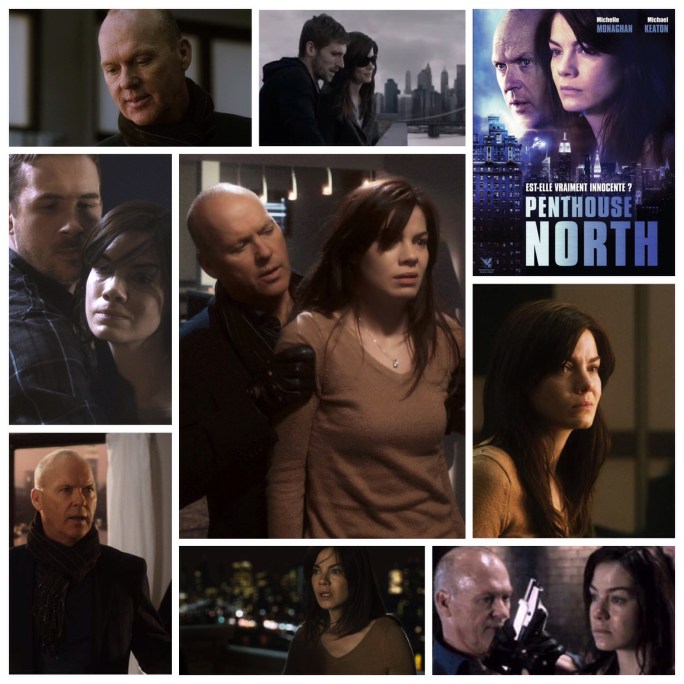
Penthouse North is a vicious little 90’s inspired slice of thriller fun, which sadly seems to have gained zero marketing and promotion, so unless it catches your eye on US Netflix or Shaw On Demand (which is where I watched it), you’ll prolly never even know you missed it. It’s nothing groundbreaking, and sometimes is very predictable, but as I found myself calling plot twists on the dime, and figuring out story beats before they happened, I didn’t find myself frustrated or feeling cheated out. I got a burst of nostalgia for the 80’s/90’s time period when these type of thrillers were in full bloom. Michelle Monaghan throws herself into the role of Sara, an ex-war photojournalist who was blinded in an incident. She lives in an ornate NYC penthouse with her boyfriend now, only just beginning to adjust to her new condition and emerge from reclusiveness. On New Year’s Eve, that auspicious time of year that buzzes with possibility, trouble comes knocking in the form of homicidal criminals in search of something hidden within the apartment. We are then treated to the archetypal game of cat and mouse as she fights tooth and nail for her survival. The film benefits greatly from a frenzied performance from Michael Keaton as Hollander, the lead criminal and a real piece of work. Keaton rarely plays in the bad guy arena (check out Pacific Heights for a more restrained yet equally dastardly turn), but he’s got a reptilian ferocity that’s equally scary and amusing, sometimes both at once. His Hollander is a royal prick, and oodles of fun to watch. Mark Mancini composes a solid score of jangly apprehension, and the film makes great use of its setting, with several clammy moments that didn’t sit well with my fear of heights. Good stuff.
John Hillcoat’s Triple 9: A review by Nate Hill
John Hillcoat’s Triple 9. Bloody. Nasty. Blistering. Nihilistic. And surprisingly deft in its presentation of character. The only clear cut, out and out protagonist is Casey Affleck’s Marcus Allen, a young detective with a wife and kid, brutally unaware that he’s been targeted by a group of stunningly dirty cops and a few ex special forces hardcases to bite the dust in a planned homicide, sparking an ‘officer down’ over the airwaves to distract the force from what’s really going down. With the exception of his straight arrow heroics, the entire rest of the cast is a snake pit of depraved, slimy, reprehensible degenerates, populating a decayed, gang infested Atlanta where the cops are just as likely to empty a clip into your skull as the cholos. Chiwetel Efjor plays Atwood, leader of a most unfortunate crew of misfits who are forced to perform near suicidal heists for tyrannical Israeli-Russian mafia bitch Irena (a bleach blond, terrifying Kate Winslet). Their newest venture is so impossible that they’re attempting to use a slain officer as a ditch effort to get their stake. Of course it all goes to high hell, as we’ve come to expect and love in these type of films, with bullets, profanity, self destructive behaviour and wanton violence languishing all over the screen in glorious excess. Efjor is crackling good, showing brief glimpses of humanity in a dude who has lost his soul down a deep dark well, a caged animal fighting tooth and nail to no avail. The rest of his crew spend the film savagely trying to out – sleaze each other, and I mean that in the best way possible. They are really a bunch of snot rags, and this is a group of outstanding actors having bushels of fun being irredeemable bad boys. Anthony Mackie is walking C-4 as Efjor’s right hand, a guy rotten to the marrow with moral conflict. Norman Reedus leaks grease as an ex special ops prick and their getaway driver. I didn’t think Aaron Paul could be anymore despicable than in breaking bad, but somehow manages it here, playing a dude so grungy you’ll squirm. It’s Clifton Collins Jr. who scores the points though. He hasn’t had a great role in years and he comes out blazing as the icy sociopath of the group. Then there’s Woody Harrelson. Oh, Woody. He’s clearly having a ball as Affleck’s stoner uncle and high ranking cop. He spends the entire film ripped off his gourd on joint after joint, and take it from me, he knows how to play stoned impeccably. Despite the laconic bumbling, he shows that fire and ferocity we’ve come to know from him in brief unmistakable flashes, especially where it matters. Throw in Teresa Palmer as Affleck’s loving wife and Gal Gadot in full slut mode and you’ve got a cast for the time capsule. Hillcoat wastes not a second in propelling his narrative forward with the force of a bulldozer, giving us minute moments of respite amongst the surging monsoon of bloodshed and dirty deeds. Composer Atticus Ross whips up a foreboding, hair raising war cry of a score that kicks in from the first frame and doesn’t quit till the last shell casing has hit the ground. The only misstep the film makes is killing off its best actor way too early on, vut its not enough to be an actual concern or hurt it overall. If sickeningly satisfying ballets of blood, broken limbs and morally bankrupt people engaging in all kinds of giddily fun criminal activities are your thing, this is a great way to kick off the year, cinematically speaking. Hell even if it’s not your thing go check it out. It’ll shake your shit up and then some.
The Big Easy: A review by Nate Hill
For a film about violence, crime and police corruption, The Big Easy sure is easy going and colorful. The characters are the liveliest bunch of rascals and it’s a pleasure to spend every minute with them. Dennis Quaid plays cocky New Orleans detective Remy McSwain, a swaggering smooth talker who’s gotten wealthy taking payoffs, a dude whose silky charm matches his swanky suits. He’s gotten used to the easy life in the police department, with a captain who looks the other way (Ned Beatty brings a jovial, rotund presence), and colleagues (John Goodman is perfectly cast as the witty loudmouth of the bunch) who are just as happily willing to bend the rules as him. Trouble arrives in the sultry form of D.A. corruption task force specialist Anne Osborne (a swelteringly hot Ellen Barkin) who leans on Quaid as heavily as he hits on her. There’s immediate and electric chemistry between them, which she adamantly fights, and he chases like a horn dog pursuing the bumper of a speeding Buick. Quaid and Barkin have the same spitfire sheen to their work, their careers dotted with performances that are flashy yet brave, pulpy yet laced with depth. Here they’re having oodles of fun and carry the entire film on their crackling star power and romantic spark alone. There’s also a subplot involving a rash of gang killings, as well as family matters involving Quaid’s vivacious Cajun clan, including his Momma (monumentally talented Grace Zabriskie). It’s a lively hodge-podge of plot elements we’ve seen a zillion times, but given such flippant style and good natured southern hospitality that we can’t help but be won over. There’s some lovely live performed Cajun music as well to add extra spice.
Joe Wright’s Hanna: A review by Nate Hill
Joe Wright’s Hanna started as a Vancouver Film School script, funded through grants that would make it the catalyst for the positively unique, incendiary action fairy tale that it is today. It’s crowd pleasing without any superficiality, straight to the point without being over serious, and is made with a slick, vibrant aesthetic that will have your pulse dancing a jig in time with the thumping score by The Chemical Brothers. I held off on seeing this one for years after its initial release, jaded by the prospect of another ‘killer genetically altered female assassin’ flick. One night I finally caved and took a peek on Netflix. I then kicked myself hard for not taking notice sooner, purely on the notion that I wouldn’t dig it based on its formula. I suppose I learnt a little ‘book by its cover’ lesson there, as I was completely enamoured with the film and have seen it at least ten times since then. The tired ingredients of any old formula can be whipped up into a tantalizing new recipe, providing all those involved have the commitment and passion. The filmmakers of Hanna go for broke with one of the best thrillers in years. Saoirse Ronan is an explosive, feral waif as the titular hero, raised in isolation by her badass ex CIA father Erik Heller (underrated Aussie Eric Bana nails the German accent to a T). They reside in the frozen tundras of Lapland, where Erik trains her in the ways of a warrior, instilling survivalism in both physical and intellectual measures, preparing her for their inevitable separation. An enemy from Erik’s past surfaces in the form of evil CIA witch Marissa Wiegler (Cate Blanchett practically breathes fire with a naughty southern accent and a red hairdo that looks acidic to the touch), and both Hanna and him are forced to run, separated from each other. She escapes from a remote facility and begins her journey across Europe, befriended by a lovable squabbling family of travellers, igniting a yearning for companionship in her that Ronan expertly shows the camera. Wiegler enlists the slimy help of a euro trash club owner who moonlights as some sort of freelance über villain (Tom Hollander almost walks away with the movie as the psychopathic, bleached blonde pervo Deutsch-bag) who relentlessly pursues Hanna along with his neo nazi skinhead henchman. The thing about this film is that it’s all been done before, but they find a way to make it fresh, exciting and strike chords which simply haven’t been hit in this sub genre before, providing a film experience that really sticks. Ronan has never been more virile and effective, also proving a mastery of the German accent and embodying Hanna with intense physicality that’s achingly punctuated by a gradual awakening as a person as well. Impressive balance is shown in her character arc, through writing and stunt work alike. This is the first movie to be scored by The Chemical Brothers, and damn I hope we get more. They belt out a technicolor rhapsody of electric music that flows beautifully with the story, hitting every beat, ramping up suspense when needed, being surprisingly weird at times and kicking around your head long after the credits roll. The actors are all easy listening with the dialogue, never feeling forced or making us doubt for a minute that these aren’t real people engaged in genuine interaction. The film neither drags nor rushes, arriving at its often grisly, sometimes touching and always entertaining conclusions exactly when it needs to. It shows uncanny intuition with its pacing, an absence of the need to show off with unnecessary fights or effects which don’t serve the story, and above all a keen desire to entertain us. Terrific stuff.