Ryan Gosling’s Lost River

I think that sometimes there may be a certain expectation set when an already minted Hollywood superstar branches off from the acting game and tries their hand at writing/directing, a vague conjecture that their foray into filmmaking will be more of the same stuff that fans are used to. Well, Ryan Gosling has no use for any of that in his stunning, surreal, masterful and wonderfully otherworldly directorial debut Lost River, a haunting, dreamlike slice of Detroit Gothic wrapped in a dark fairytale that casted a spell on me like no other film has. This is arthouse stuff through and through, Gosling has no interest pandering to the masses or sculpting his work into something wieldy or palatable, he courageously dives headfirst off the map into uncharted territory where there be monsters and visions the likes of which your screen has never seen. In a crumbling, decrepit borough of old Detroit, single mother Billy (Christina Hendricks) struggles to keep her family home from being seized by the bank and demolished, so she takes up employment from oily loan officer Dave (Ben Mendelsohn) working at the club he owns as a moonlight gig, where dancers like the beautiful Cat (Eva Mendes in a wonderfully playful turn, her last acting gig to date) pantomime being murdered on stage for a rapt audience. Meanwhile Billy’s son Bones (Iain de Caestecker) runs wild in the overgrown, labyrinthine basilicas, ragged chain-link fence desolation and jungled ruins of their Lost River county, collecting copper piping for cash, evading a very strange and violent bully named, uh, ‘Bully’ (a feral Matt Smith) and forming an ethereal bond with a lonely wandering waif called Rat, played by Saoirse Ronan in a lovely study of calculated, underplayed wonderment. Many have complained that this film is style over substance and that there isn’t really a plot to speak of supporting all the visual and auditory splendour but they’re kind of missing the point here; this is an abstract parable that refracts aspects and elements of our waking material world through a very primal, subconscious and childlike prism of images, impressions and emotions, I don’t think Gosling ever meant to tell a constructed story with delineated edges and beats, he strives for the fluid, the intangible, the kind of film you feel your way through as opposed to think. There is a strong undercurrent of deep, essential meaning here that can be very, very finely tuned into as a sort of subconscious frequency and in that sense what the film imparts to you could be called a ‘plot,’ but if you’re not tuned into it well… that’s your problem, really, and to say there’s no story or meaning just because you can’t quantify it with your waking consciousness is simply narrow, lazy criticism. Gosling employs the talents of musician Jonny Jewel to compose a suitably synth soaked, absolutely gorgeous score that is accented by several cast members doing singing of their own including Ronan and Mendelsohn, who belts out a transfixing, unforgettable rendition of Marty Robbins’ Cool Water in his eerie nightclub. The cinematography is bliss, from said club to it’s austere archway entrance that can be seen on the film’s poster to a ghostly underwater town long flooded to develop neighbourhoods that are swiftly falling beautiful ruin and the spectral, vegetative barrens of their environment around them, speckled with broken architectural curios and slowly being reclaimed by nature. I try not to use the ‘M’ word too much in my writing (that’s a big fat lie) but there are some films that I just vibe with so deeply and care for so much as immersive experiences that one can scarcely put into words (I hope I’ve made out alright here) that there’s just no way around it: to me, Lost River is a masterpiece, Gosling and everyone involved should be immensely proud of what they’ve made and how it will affect many like me who were powerfully moved by it.

-Nate Hill

John Erick Dowdle’s No Escape

There may not be much of a, shall we say, culturally tactful or sociopolitically subtle premise behind No Escape, but I’d be lying if I said that this isn’t an almost unbearably suspenseful, purely nightmarishly effective thriller. Owen Wilson and Lake Bell play a wealthy American couple on a business trip to some unnamed southeast Asian country that is going through kind of a rough patch, politically and economically. When the hotel they are staying in is stormed by a citizen’s army of ruthless, barbaric rebels staging an infrastructure-shattering coup, they are forced to flee through the dangerous streets of the city with no law enforcement or anyone to help them, save for one British intelligence agent played by Pierce Brosnan, an undercover operative who does his best to help them amidst the chaos of a country turning itself inside out. Now, I see from this director’s filmography that his work is almost all in the horror genre so far, which makes sense because this film is so punishingly, exhaustively suspenseful and tense that it could almost be classified as horror itself. The rebels are a terrifying, almost inhuman threat around every corner and are both willing and capable of inflicting frightening atrocities, as this family dodges them at every turn. If I were this director though I would have mayhaps lent my talents to a better, more tasteful script though, and here’s why: Wilson and his kin barely register as characters of their own, but rather blank, terrified chess pieces being frantically shunted across the board of pre-constructed dangers with no real agency or unpredictability of their own. The rebels are a faceless army of homicidal, rape inclined psychos and we get zero grasp on their cause or agenda beyond hunting this family down at al costs. The city they’re in doesn’t even have a name, and that’s how much this script cares for specificity or nuance. The only believable, well rounded character is Brosnan’s guilt ridden agent, he brings an obligatory Bond-esque charisma to the role while retaining this sort of haggard, world weary resolve too and is actually quite good. But his character and the unbelievable talents of the director in generating horrific suspense could have been put to use in a much better setting, premise and story beyond ‘white American family is brutalized by savage Asians in a crumbling third world.’

-Nate Hill

White Noise 2: The Light

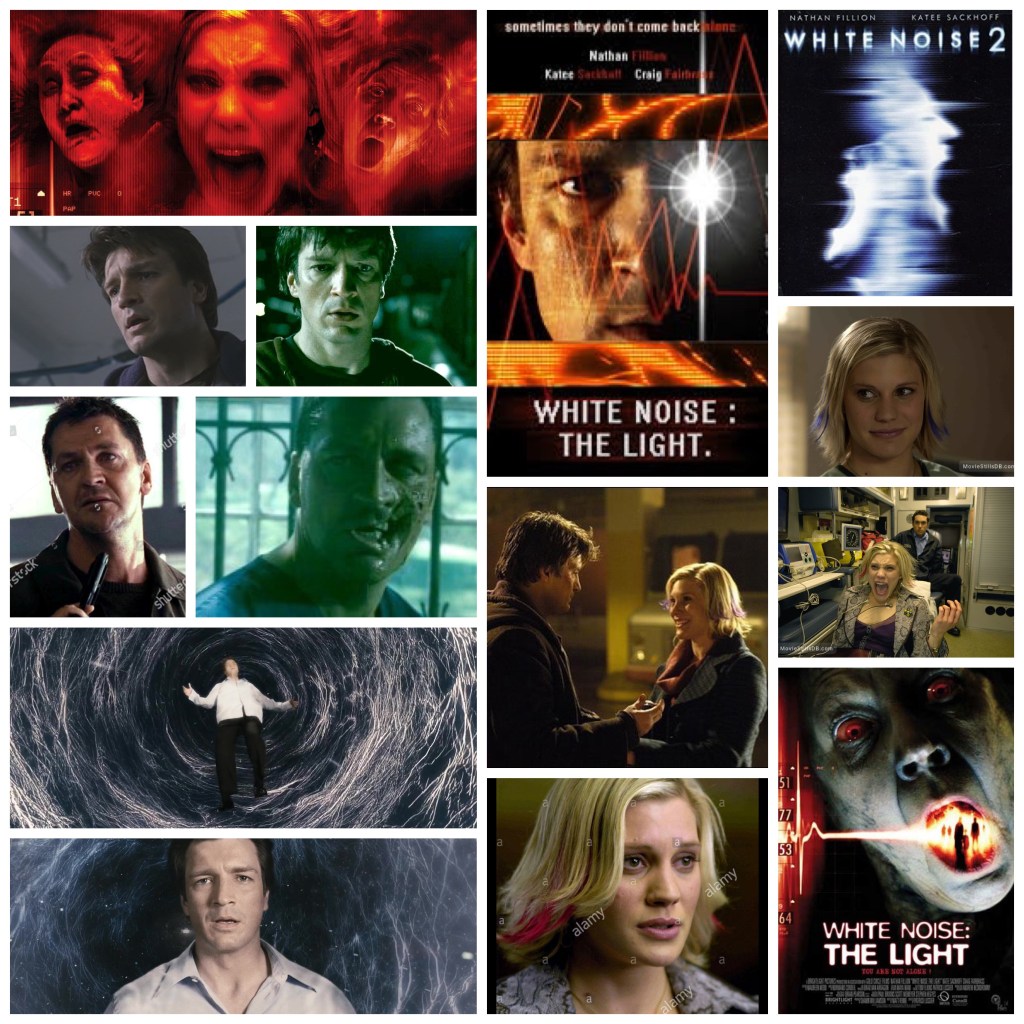
It can be jarring when horror sequels do something almost entirely different with their concept but still use that same franchise name as the first one, it either means bravely pioneering new ground or gravely deviating from an already solid blueprint into a morass of sideshow muck. In the case of White Noise 2: The Light I couldn’t tell you which of those two categories it fits into because it was such a confounding, nonsensical story I really didn’t make too much sense of any of it, so I suppose the second one if I had to say. Following the exploits of the excellent first film in which we saw Michael Keaton communicate with the dead, including his wife, via spooky VHS tape static, this one goes in a drastically different direction. Nathan Fillion plays a guy whose wife and child are murdered in the opening scene of the film by a disturbed, gun wielding maniac (perennial UK tough guy Craig Fairbrass) before the man blows his own head off. Lost in a pit of despair, Fillion attempts suicide himself and has a brief trip to the afterlife (cue the XBox 360 cutscene effects) before returning to make it a near death experience and discovering he has certain… abilities. Premonition, foresight, the power to sense impending catastrophes and save those in their path and the clairvoyance to know when certain seemingly benign people are going to perpetrate horrible acts of their own, kinda like the guy… well you can see where this going. He meets a friendly nurse played by the wonderful Katee Sackhoff and I must admit that their pairing is pretty much a casting match made in Heaven and the best thing the film has going for it, even if the script doesn’t do all that much with them together. The cast beyond them aren’t people I recognized except for a hilarious early career cameo from Jared Keeso, who Letterkenny fans will be just tickled to see here and may even do a double take. The film is set in Vancouver again and as always it adds a lot of atmosphere, but you can only do so much for a story that’s told as loosely and unconvincingly as this. There’s no real reference to the first film or it’s premise, this for sure didn’t even need to be called White Noise at all, it’s more a sequel to that Sandra Bullock flick Premonition than anything resembling a tie-in to the Keaton one, and it’s just not gripping, interesting, scary or affecting enough to recommend whatsoever. If you must give it a look to see Fillion and Sackhoff gently flirting for a few scenes then go for it, I don’t blame you, but just don’t expect anything close to an involving thriller here.

-Nate Hill

Rick Alverson’s Entertainment

There are some films that just aren’t for everybody, and seem to have even been fashioned to deliberately repel a certain demographic, as if to weed out those unwilling to take a trip down the weird end of the street and serve as a litmus test to determine who will stand-fast. Folks like John Waters, Todd Solondz and Lars Von Trier are prime examples of artists who traffic in such cheerfully provocative, knowingly inflammatory ventures and now Rick Alverson is well on his way with an eerie, uncomfortably abstract mood piece called Entertainment that I saw a long time ago and recently caught up with, and let me tell you it’s just as fucking bizarre as I remember. Alverson wrote this alongside Tim Heidecker himself and their buddy actor Gregg Turkington, who graduated with honours from the proverbial Tim & Eric Theatre Of Shock & Awe and works frequently with the two, so his badge of bizarre was squarely pinned to his chest before churning out this relentlessly off-putting curio of dust-bowl doldrums, against type cameos, agonizing awkwardness, surreal dreamscapes and nightmarish atmosphere. The film follows pitiful nebbish ‘The Comedian’ (Turkington), a would be standup comic with no audience on a tour to nowhere somewhere in the desolate American southwest. His jokes are excruciatingly cringe, his onstage personality is a grating head-scratcher, his doubting manager (John C. Reilly in a hilariously deadpan cameo) subtly begs him to tone the weirdness down, and just overall this guy’s life seems like a dead end that’s swiftly leading to a deader end. His one respite and glimmer of hope is infrequent phones calls where he leaves forlorn voicemails to an estranged daughter that we never see, perhaps because she never existed at all and it’s his last ounce of conviction to cry for help into an abysmal void. He runs into many characters along the way played by the likes of Heidecker himself, Dean Stockwell, Tye Sheridan, Amy Seimetz and Michael Cera as an impossibly creepy dude that he has an icky run-in with in a men’s bathroom. Many will find this to be a frustrating, confounding, empty, disquieting experience and that’s fine, I would be worried if *everyone* liked it. I admit that this particular flavour of weird isn’t typically my bag and that chunks of it were lost on me, like his interminable bouts of caustic and repulsive verbal digression on the standup stage. However, when the perception and focus shifts over to his ponderous meanderings in the Mojave desert and the incredibly effective, soul shaking original score by Robert Donne I got a real sense of this character’s waywardness, disconnect from everything around him and complete, utter loneliness, and on that front I was able to connect with the film. It’s unique, it’s weird, it’s darkly funny in a sort of brittle, curdled way and uses illogical, jagged sensibilities to explore an artist whose work alienates and humiliates him. You will either vibe with this intensely or be wholly turned off, there’s no real middle-ground.

-Nate Hill

House Of Wax (2005)

It amazes me what a dismal critical reception that House Of wax got because to me it’s a treasured horror film and one of the most disturbing, freaky ass experiences my stoned 14 year old ass ever had as an introduction to the genre. Just to prove that I’m not wistfully beefing up a mediocre horror flick through the treacherous prism of teenage nostalgia, I recently revisited it and it *still* just absolutely slaps, so I’m not sure what bone the critics had to pick with it other than it being a horror remake and having to face the unfair bias and hostility of being saddled with that yoke right out of the gate. So it’s the classic scenario where a bunch of reckless, impossibly sexy teens end up in some godforsaken county with a dried up town full of spooky abandoned buildings, menacing inbreds and a dark history. They’re played by people like Chad Michael Murray, Jared Padalecki, Elisha Cuthbert and Paris freakin Hilton, which is more pedigree than these horror flicks usually get to boast. They discover that a creepy old wax museum isn’t as derelict as outward appearances may suggest and that it’s demented curators never really retired, and have taken up a, shall we say, disconcerting brand of human ‘Wax-idermy’ as extracurricular activities in their spare time. They now find themselves on the run from these whack jobs and fighting for their lives to not be turned into living human wax dolls, or simply hacked to pieces by these crazies. This is one fucked up, super gruesome flick and the refreshingly practical effects are truly some brain melting, squirm inducing eye candy. They must have had to hire a ‘wax wrangler’ just to keep all of their production design materials in line because once they get deeper into this museum and the narrative overall, there are some genuinely nauseating, profoundly disquieting and altogether impressive visual gags and set creations on display. Don’t let anyone ever tell you this movie sucks or is anything other than an absolute banger, because they have no idea what they’re talking about. It’s sweaty, greasy, spooky, waxy, sleazy, trashy, shameless and wonderful in all the best ways a slasher can be. And for the record, I have seen the original, it’s cool, but for a kid my age it’s dated and creaky and something as balls out and energetic as this is just always going to take top spot. Great film.

-Nate Hill

Carl Strathie’s Dark Encounter

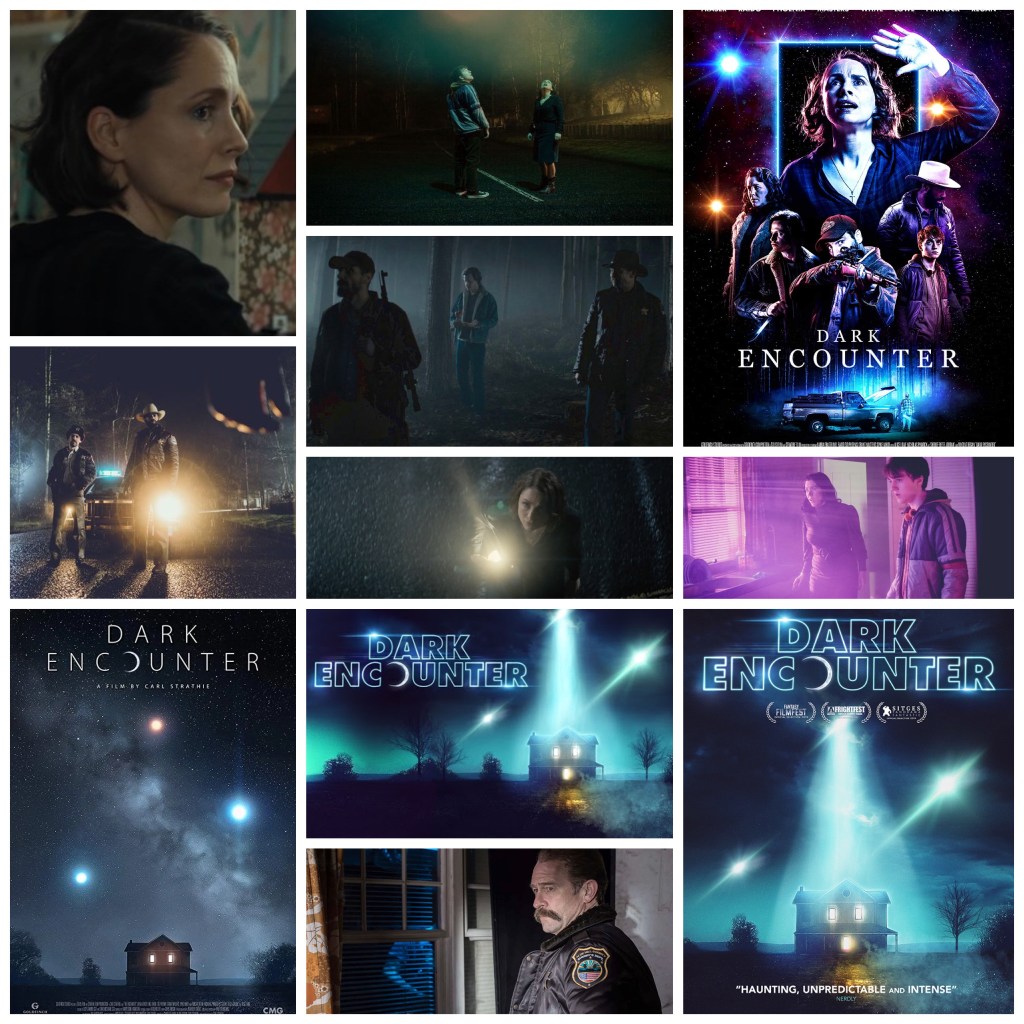
You can do pretty amazing things with lower budgets if your heart, storytelling technique and ambitions are in the right place and Carl Strathie’s Dark Encounter is a glowing example of that. This is a wonderful, emotionally devastating amalgamation of classic alien abduction/UFO stylistics and deeply heartfelt interpersonal family drama that wears its influences (everything from Nolan’s Interstellar to Spielberg’s Close Encounters) lovingly on its sleeve. It tells the story of a large family sometime in the 60’s or so who get home one night to find their young daughter missing. Flash forward one year later, they are still grieving her loss and trying to deal with the lack of closure, and as they all gather at her parent’s place to try and heal, strange things begin to happen. Lights in the sky and in the forests around their property, massive flocks of birds vacating the area en-massé, and mysterious spacecrafts hovering over their abode. Was their daughter abducted by aliens, who have now returned to torment the rest of her kin? I won’t say another word about the story beyond that except to say that at this point things get *really* interesting and completely unexpected. This is a beautifully made film full of unbelievably innovative special effects when you consider the budget, everything from iridescent strobe lights emanating from the floorboards to haunting points of light dancing on the edge of the forest’s horizon to a jaw dropping immersive sequence where our POV zooms out for a breathtaking visual voyage into the far reaches of the cosmos, a journey both inwards and outwards that reminded me, in spirit, of both Kubrick’s 2001 and Malick’s The Tree Of Life. I have to warn any viewer that this is a gut punch of a story that deals in subjects matter both tragic, disturbing and is tough to watch, but the process, execution and artistic forces at work are remarkable. The film’s score might be the best I’ve heard in a long time, an expansive auditory soundscape that encapsulates everything from the eerie to the experimental to the emotionally orchestral that digs your heartstrings right out of your chest. The cast are all perfect, with Laura Fraser and Mel Raido giving soulful work as the girl’s tormented parents, and an appearance by the always awesome Vincent Reagan, this role being perhaps the first time I’ve ever seen him in cinema without a sword in his hand. This is a fantastic film for anyone who appreciates spooky, atmospheric UFO themed storytelling, very well acted family drama and an unexpected, highly affecting narrative that I promise you will not guess ahead of time. Great film.

-Nate Hill

Brea Grant’s Lucky

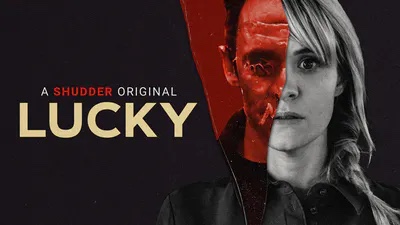
I struggled with Lucky, a new horror film billed as innovative and groundbreaking and yes it’s well made, yes it’s themes are incredibly important but you have to fashion a story that makes sense and draws you in around said themes or all you’re left with is abstraction without any proper narrative tissue to cling to. This is written by and stars Brea Grant, an actress whose work I loved in Rob Zombie’s Halloween II and some of the later seasons of NBC’s Heroes, where she played the Quicksilver proxy. Here she plays a suburban woman who is attacked one night in her own home by a masked man. She wounds the guy and he runs off, but the next night he shows up again. And the next night again. And again, and so on. When she tells her husband he more or less shrugs it off with a non-reaction. Her friends and the police seems to have the same lukewarm indifference so she’s stuck in this surreal twilight zone where she’s the only person who finds it concerning that the same intruder comes back night after night to torment her, no one in her life properly believes, listens or takes her seriously and she feels alienated and outmatched by both her attacker as well as the people and support systems in her life that are supposed to care. See where this is going? It’s a fabulous concept for a film and the fear, panic and paranoia is well executed on top of a terrific performance from Grant… however… the script does absolutely *nothing* to explain this concept from a story/script point of view beyond “she’s attacked every night by the same dude, no one really believes her and she’s basically on her own in fighting back.” Then, it starts happening on a mass scale all throughout the city like some kind of violent epidemic and everyone who is not the attacker or the victim seems to just carry on like nothing much of anything’s happening. The film makes absolutely zero effort to explain this beyond simply showing it happening, and as a result it completely tanks itself, and doesn’t work whatsoever as anything close to a coherent narrative. Now, this is a tricky one to review because of the subject matter itself so let me spell it out clearly: there is no doubt in my mind whatsoever that these themes are incredibly important, that violence/assault towards women is a very serious matter that needs to be addressed both in art or society, and so too the endemic indifference and non-believing nature of others in their lives who either turn a blind eye or don’t care. It’s so important. However: these filmmakers made their story *purely* from an abstract, allegorical point of view and didn’t mesh in a storytelling device or proper narrative to support it, and that to me felt lazy, incomplete and incoherent, and I disliked the film. Anyone out there hollering “you just didn’t get it because you’re a man and this film wasn’t made *for* you” into the echo chamber can stop right there. I succinctly and pristinely understood these themes, and understand how important they are, but that doesn’t change the fact that the film itself, as a piece of art, was not a successful endeavour and my saying so in a review doesn’t immediately imply that I’m discrediting anyone’s experiences or these social issues overall. I shouldn’t have to explain this so in depth but some people out there really seem to struggle with it, so there it is. Well made film from a technical standpoint, an absolute knockout of an original score by Jeremy Zuckerman, fantastic performance by Brea Grant and very important themes… but ultimately it falls flat on its face.

-Nate Hill

The VHS Files: Two Small Bodies

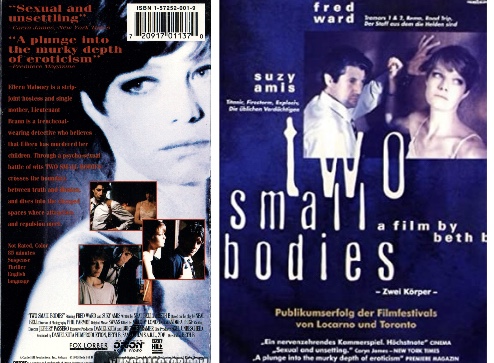
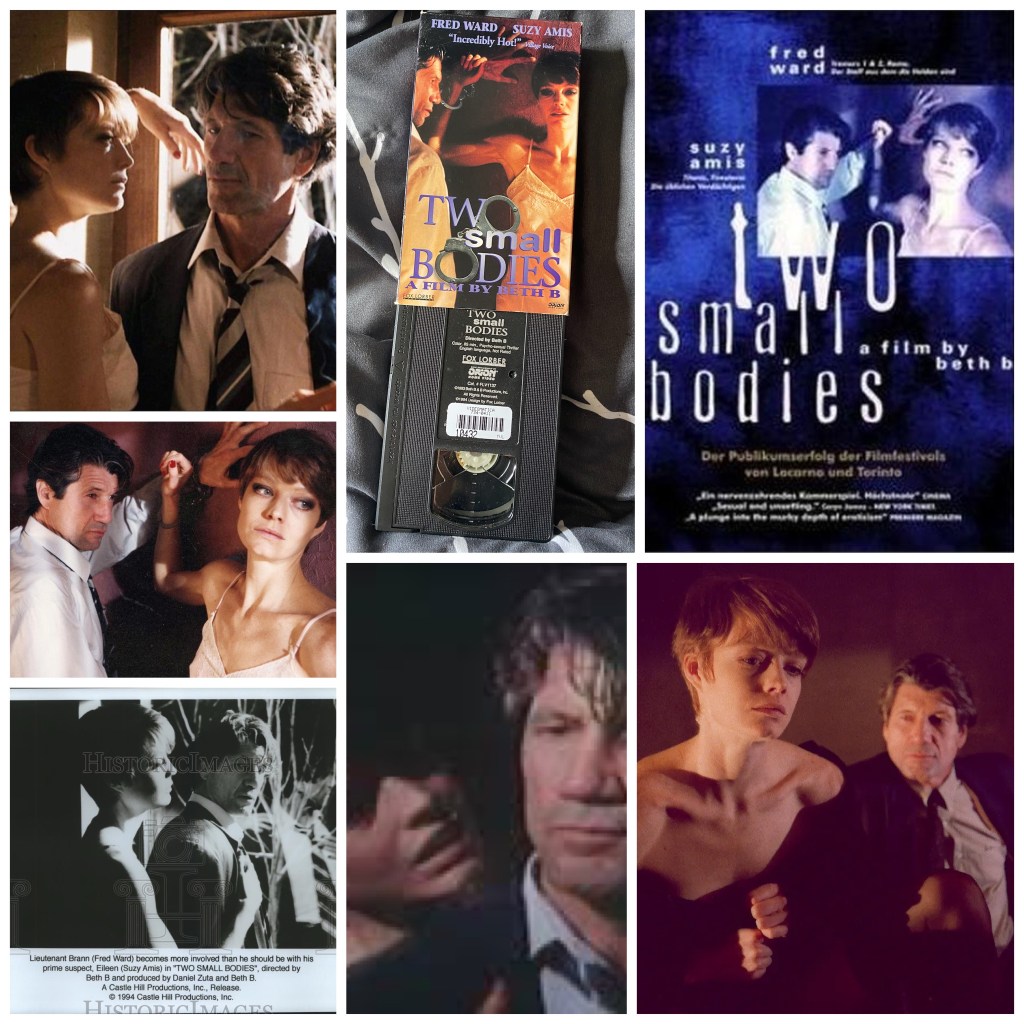
Today’s VHS File is an odd one called Two Small Bodies, essentially a grim two person drama that sees a police lieutenant (Fred Ward) relentlessly interrogate a single mother (Suzy Amis) who has reported her children as missing. They hang about her house as he goads, manipulates, probes and generally just drives a wedge into her life in an attempt to find out what happened to her kids, and he cultivates a growing suspicion that she’s the guilty party herself. This is based on a stage play, so we just have this one location, two actor story without anything else in the way of dynamics. Thankfully our two leads are both excellent, particularly Ward who is at his most… manic, Jim Carrey style acting I’ve ever seen him in a career full of mostly straight shooter authoritarian/cop roles. His cop (I began to wonder if he even was a real cop) here is a piece of work, and takes full advantage of the fact that Amis’s character is a stripper in his tirade of investigative fury towards her. The film is directed by cult filmmaker Beth B so the kinky underground vibe is there, but she struggles somehow in getting this story successfully across. You can only go so far with a constant back and forth barrage between two characters before you need narrative innovation and for your story to, you know… go somewhere! Unfortunately this doesn’t go anyplace concise beyond having the two leads engage in bizarre, borderline surreal roundtable dialogue and questionable behaviour and then just sort of leaves the ending open for us to figure out. I had a vague idea myself of who these two really were, what happened to the kids and what their situation was really about but the film (not sure how the play goes) does little to solidify any concreteness and let’s the final frames billow out in ambiguity like the perpetually windswept curtains in this woman’s nocturnal abode. That’s not to say it’s inherently a bad choice, ambiguity can be an especially *strong* choice if implemented correctly, but you just never know how each viewer will respond to that, and I was left a little lost. A fascinating exercise, if an incomplete one.

-Nate Hill

April Mullen’s Wander

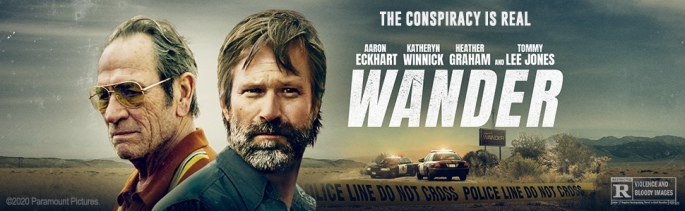
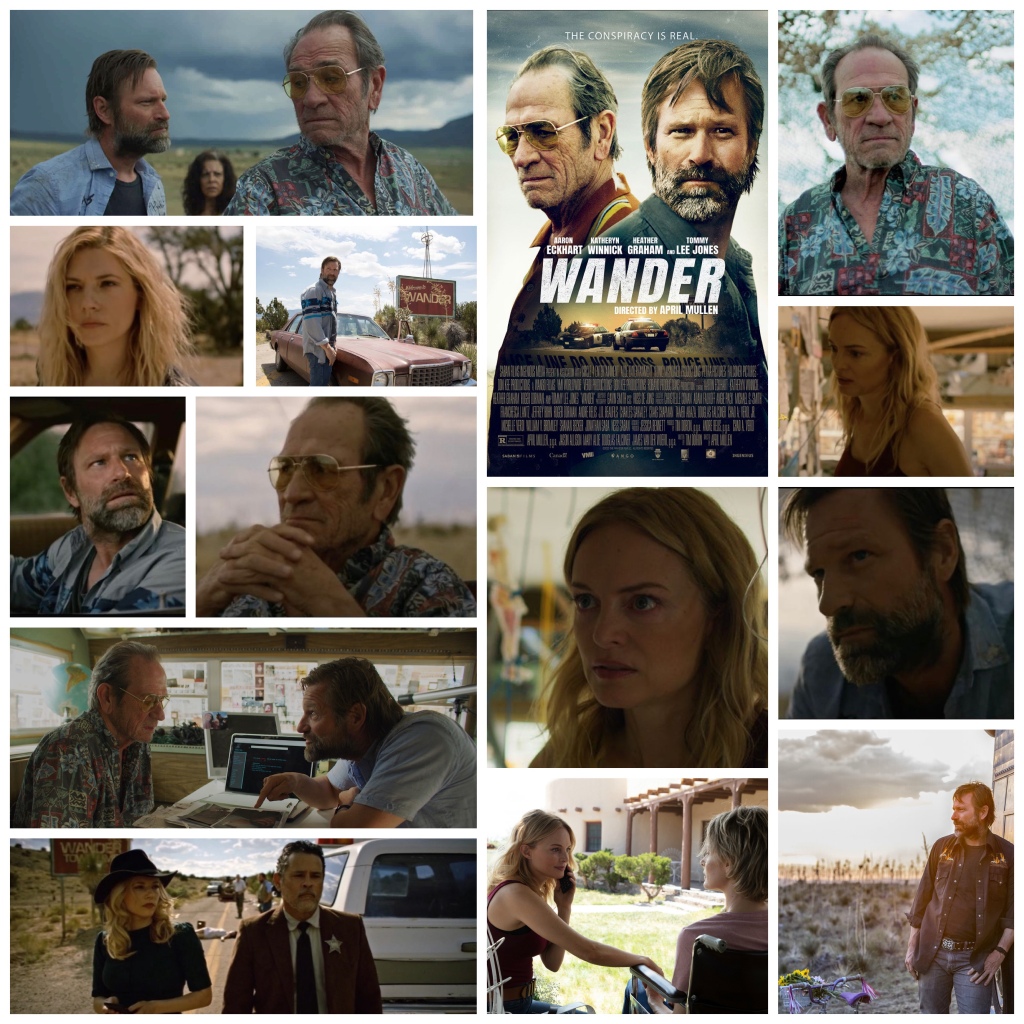
I wasn’t quite sure what to expect with April Mullen’s Wander and my hopes may have not been that high just based on reviews but I honestly loved this wild, scrappy, unconventional, ‘pulp arthouse’, sociopolitically conscious bauble of a film so much. Many won’t vibe with it and that’s okay because it’s supremely weird, visually stylish and kinetic in the fashion that filmmakers like Tony Scott and Oliver Stone traffic in and, quite frankly, all over the place in terms of tone, editing and plot to the point that many viewers will feel assaulted by commotion. I love it for all the reasons mentioned because my tastes always gravitate towards the wild, wooly, artsy and just plain strange. Aaron Eckart and Tommy Lee Jones give perhaps the two performances of their career that are most… ‘unlike their essence’, playing a couple of crusty, paranoid conspiracy theorists who run a tinfoil hat podcast from their dusty trailer. One night a distraught mother calls into their show claiming her daughter was kidnapped by shadowy government factions and corrupt law enforcement and enlists their help, so they pack up and venture out to Wander, NM, a literal one horse town with a nervous sheriff (Raymond Cruz) who knows more than he lets on and a mysterious cowgirl (Kathryn Winnick) who lurks about the place. Eckhart’s character has a lot to contend with beyond the task at hand, he’s ridden with PTSD from a former accident that killed his daughter and left his wife in brain damaged catatonia. Their investigation leads them to some pretty disturbing revelations that I won’t spoil here but there’s an interesting psychological juxtaposition between what’s really going on and what’s a facet of their already fractured collective mental states. Eckhart is wonderfully intense, barking and growling out his lines with the ferocity set on low burn and looking frantic as a wild animal, while Jones is the cunning old dog who is marginally more put together and tries to steady his pal but is still completely out of it himself. Heather Graham gives a wonderfully soulful supporting performance as a good friend of Eckhart’s who does her best to help him through what’s going on. What I really loved about this film is how many tones and styles tributary together for an often raucous but incredibly singular experience. The film opens with a preface paying respect to indigenous and all peoples of colour who have been displaced and mistreated along many borders and immediately begins with a jarring prologue as a Native woman flees unseen forces in a speeding car. Director April Mullens uses elaborate, tricky, swooping, unbelievably dynamic camera movements and chopper/drone shots to bring the story to life in an immersive and breathtaking way, and the musical talent of Canadian indigenous artist Jeremy Dutcher adds haunting atmospherics to the soundscape. This film is a lot of things, and it will no doubt be too much, or too ‘out there’ for many but it’s right up my dusty backcountry alley. Bizarre, confounding, melodic, emotional, frightening, it’s altogether like nothing I’ve seen and truly one for the books.

-Nate Hill

The VHS Files: John Irvin’s Freefall

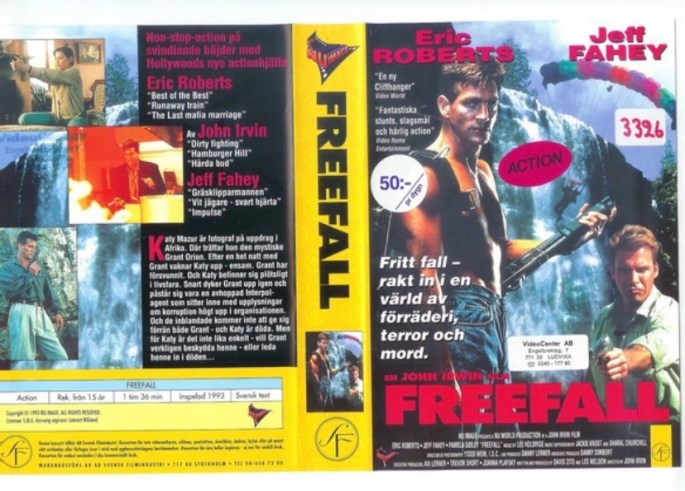
Today on the VHS Files is a super sexy Cliffhanger knockoff called Freefall starring an impossibly sweaty Eric Roberts, a super smarmy Jeff Fahey and a very foxy Pamela Gidley, who actually passed away last year and many of us fondly remember as Teresa Banks from Twin Peaks. This is actually a really solid action flick set in an exotic location and featuring these three B icons at the peak of their physical attractiveness. Pam plays wildlife photographer Katy, sent by her boss and fiancé Dex (Jeff) to get pictures of a rare bird of prey somewhere in deepest Africa. There she meets Eric’s Grant Orion, a daredevil adrenaline junkie who parachutes off waterfalls when he’s not sipping brandy on the hotel veranda, and she falls for him hard, hard enough for us to get to see them bang way up atop a waterfall with a gorgeous view. The plot goes bananas when it’s revealed that Grant is some sort of disgraced former Hollywood stuntman turned double agent for Interpol, all kinds of baddies are introduced including a freaky ass albino assassin and Dex himself who turns out it to not be the perfect fiancé she thought, and a globetrotting cat and mouse game gets underway. Roberts is terrific here, all lithe physicality and southern charm, Fahey himself tries an odd southern accent and comes across as a bit hammy but such is the arena here anyways, while Gidley fills out the action heroine role nicely. The film is directed by a dude named John Irvin who also did stuff like the Patrick Swayze western Next Of Kin, the rough crime pic City Of Industry, the cult Chris Walken curio Dogs Of War, the war film Hamburger Hill and the Schwarzenegger flick Raw Deal so he just knows his way around a good solid action sequence and how to handle tough guy actors. This is good fun with gorgeous locations, three knowingly arch lead performances and a relaxed vibe.

-Nate Hill