Francis Ford Coppola’s Twixt

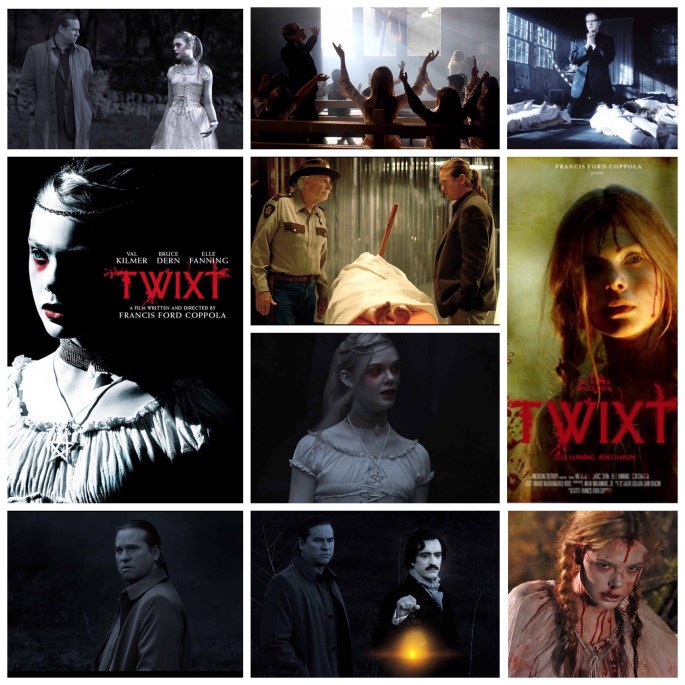
How to even approach Francis Ford Coppola’s Twixt. For a guy whose career has spanned decades from golden age Hollywood to contemporary and etched out a few mile markers that have practically defined the medium, this is definitely both the odd duck and black sheep of the man’s career. There’s no way around it either so I’ll be blunt: it’s kind of a mess. But it’s an intermittently breathtaking mess, like someone spilt a can of turgid motor oil in their garage, but a few gold and silver flakes of airbrush paint snuck into the oozing puddle. There’s a noticeable Stephen King vibe here, with flippant Val Kilmer as horror novelist Hall Baltimore, struck with writer’s block and hiding out in a creepy Midwest town to try and get the creative juices flowing. There’s murder afoot there, in more ways than one, and soon he’s visited by the ghost of a girl (Elle Fanning, darkly ethereal) who guides him along a chain of memories that recall missing children from the past. The town’s gruff, obnoxious Sheriff (Bruce Dern) doesn’t appreciate Hall nosing around his neck of the woods and harasses him at every turn. There’s Skype seasons with his wife (Joanne Whalley, Killer’s real life ex) that feel suspiciously improvised, an appearance by Edgar Allen Poe himself (Ben Chaplin) and creaky narration from none other than Tom Waits. Ultimately it doesn’t really connect, and feels so fascinated by itself that it fails to coherently tell us the tale in a way that sticks. What does take hold, however, are some truly gorgeous and striking visuals, lit by stark silver moonlight, accented by crimson blood and brought to unholy life by tactile, riveting slow motion, like a dream sequence in which Kilmer observes a group of ghost children frolicking on an eerie riverbank. Much of it feels subconscious and free form or lifted out of an Evanescence music video, but it’s beautiful nonetheless. It just needs the focus of the script to properly come across as a whole story, which, sadly, it mostly doesn’t have. Fanning makes the biggest impression as the ghostly waif, peering off the film’s poster and promising a poetic spook show, which… we kind of get. This has been seen as a shrill blast of emptiness by many critics, but there’s some fun to be had, and plenty of gothic eye candy to feast on, even if the brain goes hungry.

-Nate Hill
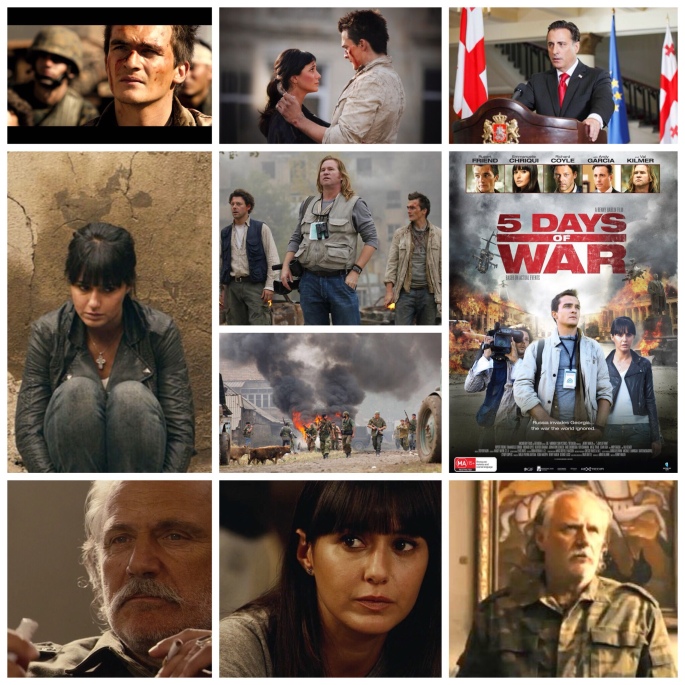
Renny Harlin’s 5 Days Of War

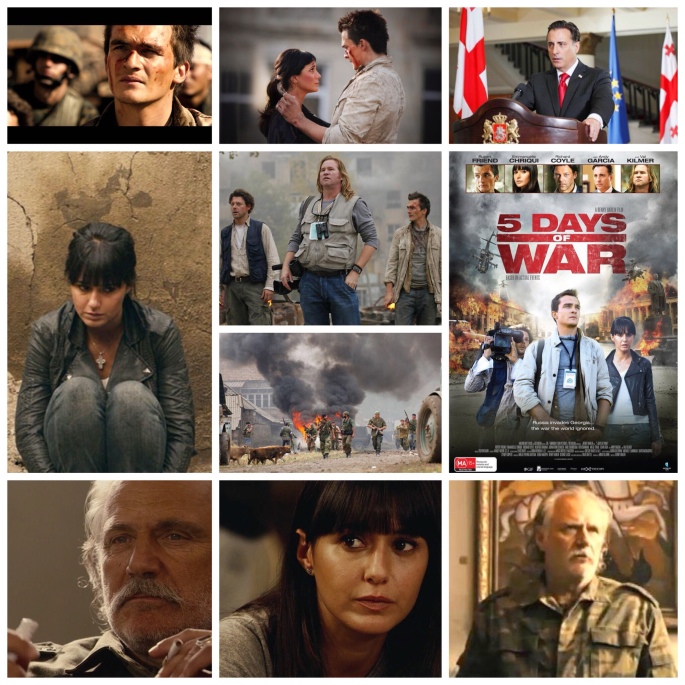
I won’t pretend to be familiar with the details of the Russian/Georgian war or anything that goes on in that region, but I’m pretty sure Renny Harlin’s 5 Days Of War is skewed in favour of special effects and kinetic commotion, as opposed to dutifully telling a story. It’s disjointed and has no idea which characters to focus on primarily and as such feels like a film out of time and space, cobbled together with loose strands and spare action sequences. Half the name actors are casted in throwaway roles too, which is disorienting. In a hectic prologue, Heather Graham plays the girlfriend of a war photographer (Rupert Friend), but she’s killed in a blast literally seconds after meeting her character, which seems arbitrary even to call her agent for a booking. The films sees Friend, a Georgian native (Emmanuelle Chriqui) and others stranded in a region on fire, torn apart by combat and cut off from communication. The details of this conflict are swept up in a near constant stream of action sequences, near misses and explosions, and much of the film is simply people running through bombed out villages in desperation. Croatian actor Rade Serbdzija (Boris The Blade from Snatch) makes good use of a Russian general role, somewhat of a villain but the film actually pauses later to give him a modicum of an ad, which he handles nicely. Val Kilmer and his Aslan mane of hair show up too in a sly, over advertised cameo as another photographer who helps them out briefly, and then disappears from the film. Elsewhere Andy Garcia laments the situation as the Russian president, grilled by the press about his actions, or lack thereof, in the struggle. In terms of story and narrative cohesion it’s all over the place. One aspect it handles well though is keeping the kinetic energy alive during the war scenes, they are extremely well shot and designed on a big scale to raise pulses. Average flick that could have done with a bit more structure and thought put into the script.

-Nate Hill
PHILLIP NOYCE: An Interview with Kent Hill

534074_2

One of the great things Phil told me – aside from passing through my hometown to play footy in his youth – was that Queensland had a big part to play in convincing the studio powers that Blind Fury (my personal favorite of Phil’s pictures) could be a hit.

After a regime change – as often is the way in Hollywood – the new brass didn’t have much faith in a film the previous caretakers saw fit to green-light. Phil knew he had a good picture and thus persuaded the powers to let him take it to the far side of the world and release it in the Sunshine State, where, with the help of a publicist, they sold the heck out of Blind Fury and brought in $500,000 buckaroos.

So Phil went back to the blokes in suits and told them if the movie can do that kind of business 7,510 miles from Hollywood, I think we have a shot. See that’s the Phil Noyce touch ladies and gentlemen, remaining Dead Calm in the face of Clear and Present Danger. If you believe that there is even a Sliver of a chance your movie can Catch a Fire, you can’t just sit there like The Quiet American and take it with a grain of Salt. You need to fix your courage to the sticking place, follow the Rabbit Proof Fence all the way home and for your hard work they’ll call you The Saint for being the The Giver of great cinematic entertainment. You can play Patriot Games till the cows come home, but if you attack them on the Newsfront then you’ll be The Bone Collector and bring home the receipts.

I’ve watched many a great interview and read many a great book about the life and career of Phillip Noyce – never thinking that one day I might catch a moment’s grace and be able to have a chat with him. I have to thank (again) a top bloke by the name of Nick Clement for putting in a good word for me – without Nick I’d still be dreamin’.

https://youtu.be/rgnlJ38ntQw

Phillip Noyce is a marvelous chap of the old school and the maker of some truly wondrous pictures. He really needs no introduction from me for his reputation speaks for itself. Without further adieu . . . the master . . . Phillip Noyce.

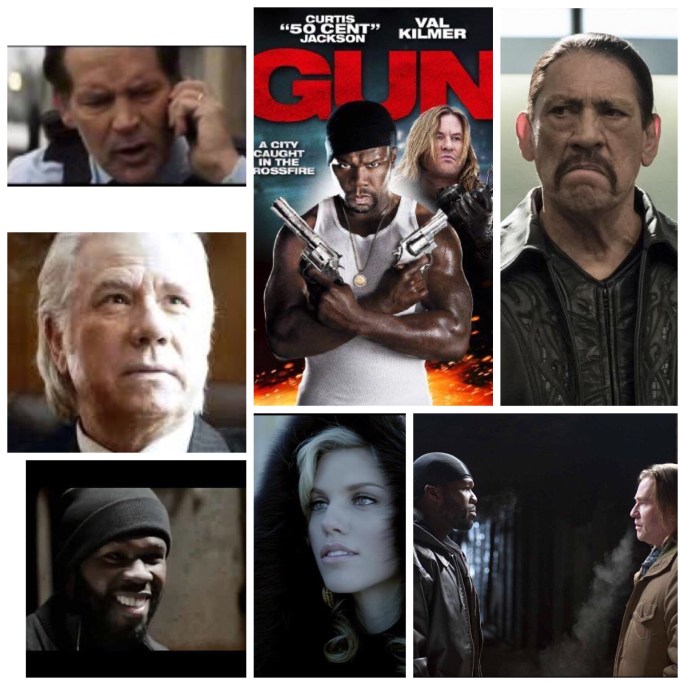
B Movie Glory: Gun

Gun is one of the countless disposable B grade flicks that 50 Cent insists on starring in, for some reason. I mean, the guy got rich, he didn’t die trying, he’s set up for a few lifetimes and he just won’t quit showing up in direct to DVD genre stuff, it’s amusingly weird and I’d love to one day ask him why. Maybe he just really enjoys acting, in which case I say go for it, but maybe with an agent who’s a bit choosier at the script roulette table. This one also stars Val Kilmer, a similarly afflicted actor who’s recently been slumming it, but the two aren’t half bad here as a powerful gun runner (fiddy) and his old prison buddy (Vally) who’s looking for a job. What the big guy doesn’t know is that Kilmer is has actually been tagged by the Feds as an informant, which turns the situation into a powder keg of betrayal and secrets that could get lit any minute. The real scene stealer here is James Remar as a dogged vice detective who has been consumed by the task of taking them both down, he puts actual grit and feeling into the role and seems to be a guest star from a way better film. Others include beauty queen Annalynne McCord as a dangerous rival arms dealer, a quick cameo from Danny Trejo playing his usual brand of aggressive thug, and strangely enough John Larroquette as well, who I swear I haven’t seen in anything since Richie Rich back in the 90’s. You could do worse for this kind of fare, but it’s nothing special.

-Nate Hill

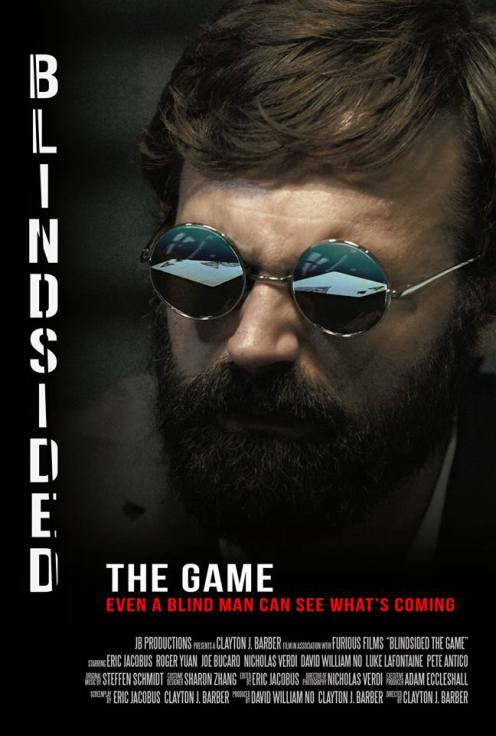
BLINDING ACTION: The Making of BLINDSIDED: THE GAME by Kent Hill

35123432_2147140425505182_6060486050529148928_n

It’s funny how the fates play their hand. Not long before I hand completed the interviews for this piece, I found I had been gifted the opportunity to interview Phillip Noyce, who happens to have directed BLIND FURY – a film that was both the inspiration behind and the film that came to mind when I first heard about Blindsided: The Game. And what a film! Walter is a seemingly unassuming guy who likes his peace and serenity – and his warm apple pie. His daily life, to the voyeur, would appear idyllic – that is until he decides to visit his local convenience store at the wrong time. A gang of stand-over men are looking for payment on a debt owed by the proprietor, and Walter’s friend. You know something is rotten in Denmark, and Walter looks as though he is the kinda guy to let sleeping dogs lie. No way! Like Josey Wales before him, Walter is the man, the hero who’ll always double back for a friend. That’s when the ACTION begins….

You might find yourself, as I did, waiting for something to happen. When Walter reveals his secret however, you’ll marvel and the grace, fluidity and devastating ability that the film’s hero has been keeping under his hat. The ensuing war which Walter wages with the movie’s antagonists is fierce – with a satisfying resolution.

I think the only thing I wasn’t happy about after watching Blindsided is that it ended – ’cause I, for one, wanted more. So it was an honor and a privilege to sit down with the filmmakers behind this veritable dynamo – this indie action gem waiting in the wings.

Blindsided: The Game pays homage to classic action films like Zatoichi and Blind Fury not only in its protagonist Walter, a blind swordsman, but also in that the film places heavy emphasis on storytelling combined with great action. This is no surprise with Clayton J. Barber in the director’s seat, who comes with over 20 years of experience as a stunt coordinator in Hollywood. Leading man Eric Jacobus plays Walter, a lovable cook who’s an expert gambler and swordsman. The character is the amalgamation of Jacobus’s 18-year career as a comedic action performer in the indie film arena. Director Clayton J. Barber is pushing the boundaries of modern action entertainment by bridging Hollywood with the indie action film world.

Barber notes that, “Eric Jacobus came from the indie action film realm. He was like a punk rocker of the action genre using raw film-making. We’re bridging these worlds together to create a totally new kind of action experience.” Jacobus echoes Barber’s sentiments: “Indie action guys have all the tools they need to showcase their skills, but the element of storytelling still has to be there. Clayton’s that storyteller who knows action. This is our Le Samurai.”

Barber and Jacobus aren’t the only stuntmen involved in Blindsided: The Game. The film features an ensemble of action stars and stunt performers both behind and in front of the camera. Roger Yuan, a veteran action star featured in action films such as Shanghai Noon and this year’s Accident Man, who plays the shopkeeper Gordon, also choreographed one of the film’s major fight scenes. Producer David William No (Altered Carbon from Netflix, and Matrix Reloaded) acts as a knife-wielding card shark and goes toe to toe with Jacobus in the climax. Veteran stunt performer Joe Bucaro (xXx, Iron Man) plays the ruthless gang leader Sal, Nicholas Verdi (Close Range, Agents of S.H.I.E.L.D.) plays Nico and acted as director of photography, and Sal’s enforcer is played by Luke LaFontaine (Savage Dog, Master and Commander) who also served as the sword fight coordinator.

Production company, JB Productions, is dedicated to delivering strong storytelling and first-rate action, created by people who truly understand action. Barber says, “This is a new approach to action film-making. Blindsided: The Game is the perfect collaboration for us, and we hired great stunt performers to play the lead roles and even work behind the camera with us because we wanted to work with folks who knew action. That’s the brand people are buying into, and we’re always looking to build that brand by collaborating with talent both in America and overseas.”   Jacobus and Barber previously collaborated on the hit short films Rope A Dope and Rope A Dope 2: Revenge of the Martial Arts Mafia. Blindsided: The Game is an expansion of the 2017 short film Blindsided, which was the first title under the Jacobus / Barber (JB) Productions banner. Blindsided was released to much acclaim, with fans craving a conclusion to the story. Blindsided: The Game replays the entirety of the original Blindsided and carries the story to completion, capping the film off at the length of a TV pilot.

Jacobus and Barber are confident that Blindsided: The Game will fulfil fans’ desires for a complete film. Blindsided: The Game will be free to stream on YouTube NOW!

ERIC JACOBUS

images

CLAYTON J. BARBER

Clayton_J._Barber

DAVID WILLIAM NO

david-no-03

LUKE LaFONTAINE

Luke-Fontaine-1864x1001

WATCH THE FILM NOW…

B Movie Glory: Streets Of Blood

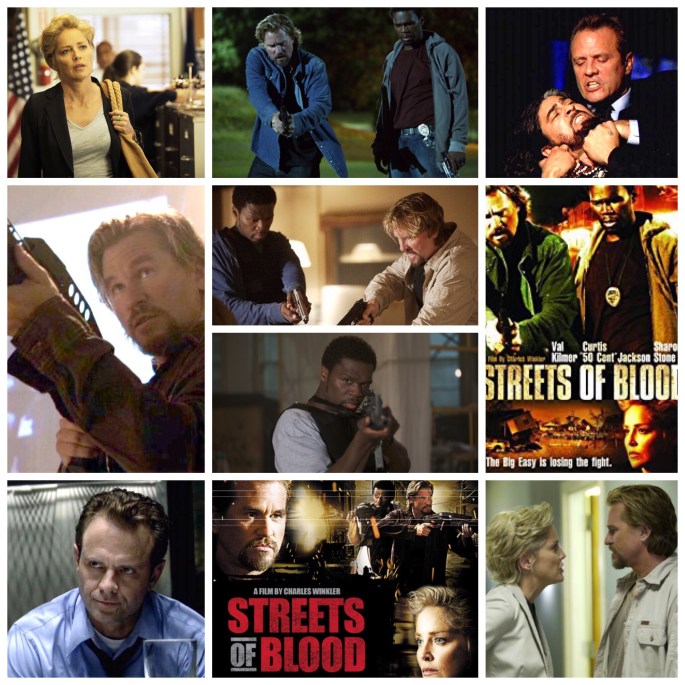
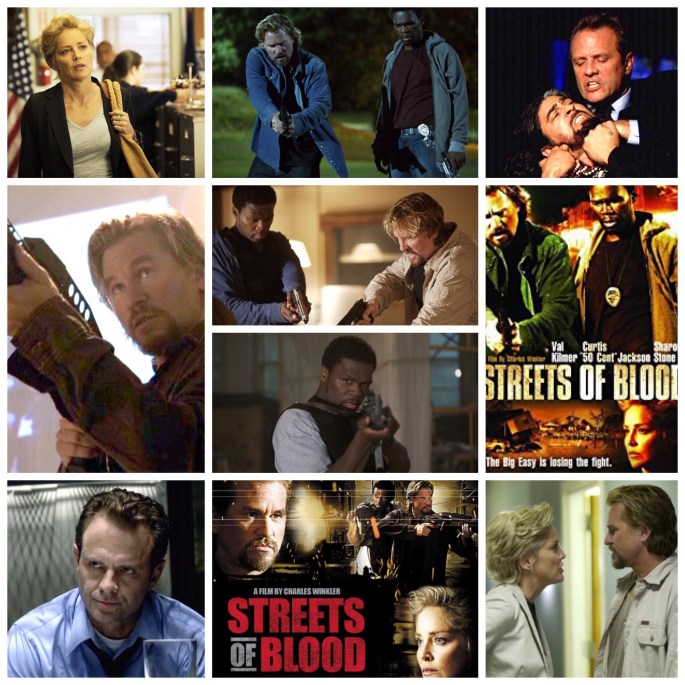
Streets Of Blood more like Streets Of Crud. Maybe I’m being a little harsh but from what I remember this thing is a huge, huge whack of disappointment when you look at the capable, wasted cast and the premise ripe with potential. Val Kilmer and Curtis 50 Cent Jackson are slick New Orleans cops investigating the corruption and death in their department following the aftermath of Hurricane Katrina. Sounds cool eh? Not so much. Most of it is noisy, incomprehensible shootouts in soggy, dilapidated warehouses and faux intense verbal standoffs in dank interrogation rooms that have no payoff because they had no discernible setup or pacing. It’s not the actors faults, they’re not even half bad. Kilmer does a flashy Orleans drawl that echoes his famous Tombstone accent. Sharon Stone even shows up as an ice queen DA,

looking like a forgotten First Lady. These fine talents just can’t rise above the muck of a half assed script that’s more hollow than the waterlogged buildings they chase suspects through. Not even the great Michael Biehn can save the day, showing up as a nasty, accusatory FBI agent that you just know will turn out to be part of the conspiracy later (I’d feel sorry spoiling that if it weren’t so blatantly obvious right off the bat). It’s a shame no one remakes B movies and gives what could have been a cool concept another shot, because they blew this one pretty bad, and produced a bigger mess than Katrina herself did.

-Nate Hill
“We’ve got some unique time constraints.” : Remembering Déjà Vu with Bill Marsilii by Kent Hill

20376139_10211941414824671_4144323378367258309_n

Initially I felt the same way about Déjà Vu as I did Gilliam’s 12 Monkeys. Both of the inaugural screenings I attended were sullied by external forces which greatly influenced my mood during the viewings and thus, my opinion of the films.

But time, it was once said, is the ultimate critic. Under different circumstances I watched both films again, and, this time around, my feelings toward both movies were drastically adjusted.

2040d

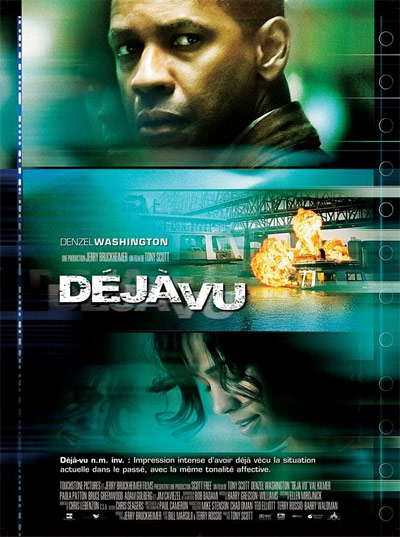
In several books on the art of screenwriting it is often put about that, if you cannot sum up the film you are writing in a single sentence, then you may want to rethink the plot. There is a great moment on the commentary track of this film in which the late, great Tony Scott admits that even he struggled to distill Déjà Vu into the logline form.

It’s a science-fiction/action/thriller/time-travel/romance in which the hero, Denzel Washington, meets the girl he will eventually fall in love with on the slab – dead as disco. Unbeknownst to him, he will eventually join a team that will, along with the help of a device that can see into the past, aid him in bringing her killer to justice. And it was from this humble yet intriguing premise that my guest, Bill Marsilii and his co-writer Terry Rossio constructed this rich, multi-layered tale which deserves more applause than some would proffer for its inventiveness and compelling real-world take on the age old time machine story.


But what I uncovered as I spoke to Bill was far more than a series of behind the scenes anecdotes and your typical boy meets idea, boy turns idea into a screenplay, screenplay sells for big dollars, boy lives happily and successfully ever after in Hollywood kind of scenario.

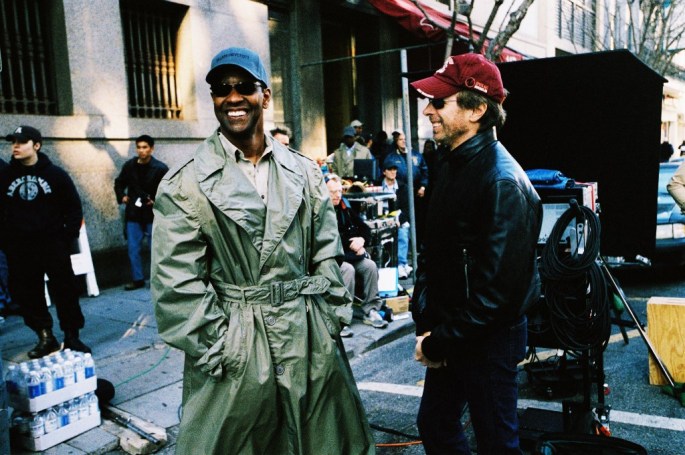
And yes, while it is true that Déjà Vu is the highest earning spec script thus far, beating out other entries like Basic Instinct, Panic Room and The Last Boy Scout, the story of how Bill came to, not only the concept, but how the writing and selling of the script changed his life is just as compelling as anything Jerry Bruckheimer and Co. managed to get onto the screen.


This interview, at least for me, proved also to be somewhat of a masterclass in, not only screenwriting, but the ever painful and soul-crushing journey the writer must endure to actually sell the script. It’s about the luck, timing, persistence and internal fortitude that you must have sufficient quantities to survive the gauntlet that exists between the page and the screen.

Bill’s heart-warming, inspirational adventure to make it in the realm where dreams are brought to life with that strange blending of art, science and commerce – that ultimately no one can tell you how, when a film is successful, it all comes together in the perfect proportions to ensure success is on the menu – is a conversation that could have gone on and on.

I hope you’ll will enjoy some extended insights into Déjà Vu, but more than that, I hope you, if you are one of those dreamers still out there trying to write your own ticket to cinematic glory, that Bill’s wisdom you’ll take onboard and continue pounding away on those keys until fortune smiles and your efforts will be coming soon, to a theater near us…

Ladies and Gentlemen . . . Bill Marsilii . . .

thvjkxqamkgoxlln7oui

B Movie Glory: Hard Cash

Hard Cash, aka Run For The Money in some regions, is a silly piece of junk, with its low budget passport grasped firmly in hand. Every actor doing the hammy shtick, every pulp B movie cliche present and accounted for. Christian Slater seems to have peppered his career with a bunch of such flicks, and he’s front and centre here as the Robin Hood-esque leader of a buncha’ thieves. He’s a bit of a legend, and goes for one job too many, a job that lands corrupt, scheming FBI Agent Val Kilmer straight in his lap when he lifts some marked bills. Kilmer wants it only to take them down, but a giant piece of the loot for himself and basically is just a greedy bastard, while Slater wants to break even and get away with his crew. It’s okay-ish stuff, decidedly low brow but that’s the arena. Kilmer is actually really fun in a candid, often improvised take, and his description of himself when he gets to little sleep is priceless. The cast is fairly strong, with work from Bokeem Woodbine, Sara Downing, Vincent Laresca, Balthazar Getty, Daryl Hannah, William Forsythe as a nastily racist fence and the late Verne ‘Mini Me’ Troyer as Slater’s most valuable lil’ asset as he can fit in tight spaces the rest of the crew can’t. It’s breezy trash, decent enough for what it is.

-Nate Hill

Michael Apted’s Thunderheart

Thunderheart is a terrific effort that coasted by to fine reviews back in the 90’s and has since not only aged well but earned just a smidge of cult status. It’s a politically charged, racially themed, hard boiled mystery thriller set in and around a troubled Sioux Native Reservation in the badlands of South Dakota. Val Kilmer is the rookie FBI agent assigned to the case, and here’s the kicker: he’s a halfbreed, part American, part Native, and as such the stakes couldn’t be higher or the moral ground more complex for an investigation that’s anything but routine. Politically charged and full of dead ends, red herrings and setups, it’s a knockout of a flick that genuinely keeps you guessing. Kilmer’s character has two mentors, which I saw as the conflict that exists within him from being both a white American lawman and and having Native blood. His senior partner Sam Shepherd is the cynical, jaded hard edge of the bureau, a persona he himself is starting to cultivate, while motorbike riding, salt of the earth Native reservation cop Graham Greene calls attention to his past, the land he’s now on and the people that came before. There’s a lot of ancestral memory tied into the story too, as we see him have visions from hundreds of years ago that guide him through the dangerous and unpredictable mystery he’s trying to solve. Fred Dalton Thompson has a bit as the senator who sends the two agents out there to see what’s up, and character actor Fred Ward is nasty business as a local mercenary who’s perpetually up to no good and almost seems to be based on a real life individual, uncanny that. It’s pulp that makes you think, and has a beating heart behind every bit of intrigue, a film that’s long been underestimated but has a lot more to say than the lurid action movie cover art might suggest. Highly recommended.

-Nate Hill

Into the OTHERWORLD : An Interview with RICHARD STANLEY by Kent Hill

The-Otherworld-still3

It’s always a fascinating experience to sit down with Richard. The man is such a natural storyteller, with a unique perspective relating not only to cinema, but also to the world around him.

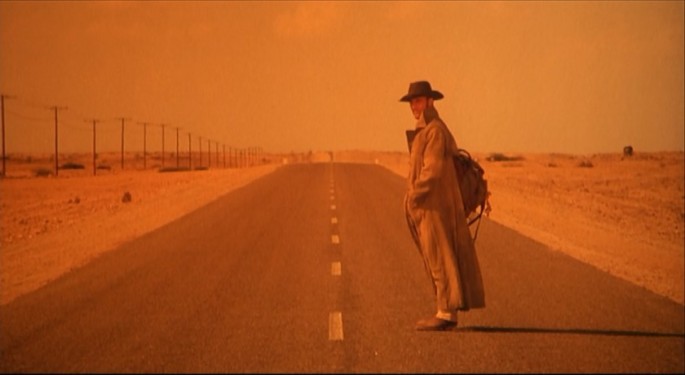
We caught up this time in the midst of bad weather, a troubled connection and, last but not least, a turbulent time in Richard’s beloved Montsegur. While our conversation touched upon this, along with the whys and wherefores of the situation, we eventually turned to movies. At this time it had been documented that Richard was again a part of an attempt to bring Moreau back to the screen – as a TV series. Having been hired by the same people that fired him during the doomed journey of his initial attempt, there seems to be, thanks to David Gregory’s documentary, a renewed interest in Richard’s take on his long-suffering passion project.

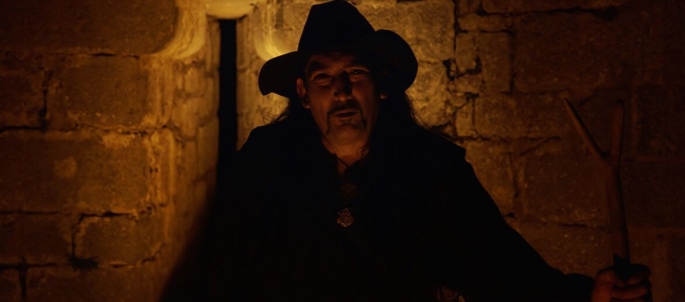
I did also bring up The Otherworld, which I had finally seen at the time. Stanley’s absorbing documentary-slash-ghost-story, and the myths and misconceptions surrounding it and ‘The Zone’ which forms the backdrop. Richard is steeped in the history of Montsegur and, flavored with his supernatural encounters, it is indeed a tale of great intrigue.

Also to we touched on, and I must say I highly anticipate, the writing of Richard’s autobiography. A project that was going smoothly until it was insisted, and initially resisted by its author, that a chapter be included on the subject of the collapse of Richard’s vision of Moreau. As thrilling a read as it will be – like I said Richard is a fascinating character – it will be equally riveting to finally have a recounting of the story from the embattled man at the center of the controversy.
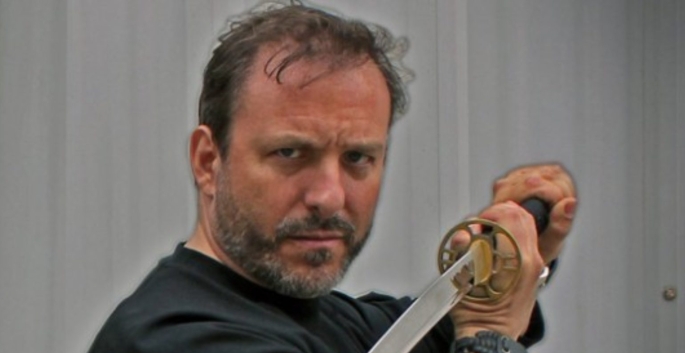
Still, the future is full of possibilities, and I for one wait with inordinate eagerness for any and all of Richard’s creative endeavors to finally emerge . . . in whatever form they shall take.
Dust_1-840x461